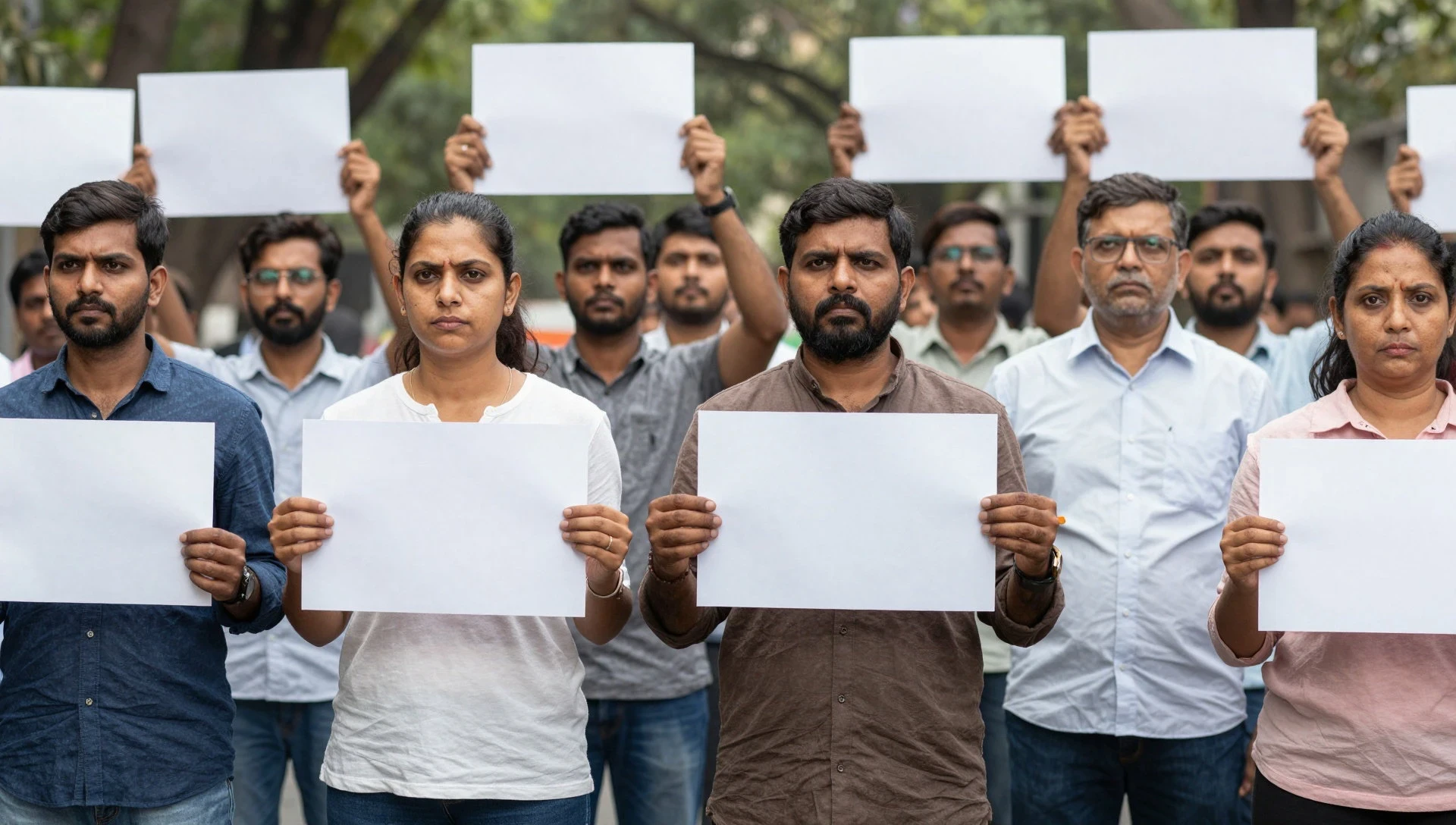
The confrontation that unfolded outside Meta's offices in Hyderabad, Mumbai and Gurugram during November 2026 represents far more than a routine political skirmish. It marks a genuine inflection point in how India's opposition Congress party has chosen to contest the power of global technology platforms over the country's digital public square. When the youth wing of the party announced fresh protests after Meta removed accounts and posts belonging to its members, it signalled a strategic shift from private grievance to public, street-level pressure. The target was not a domestic regulator or a rival political outfit, but an American corporation operating in what is, by user count, its single largest market on earth.
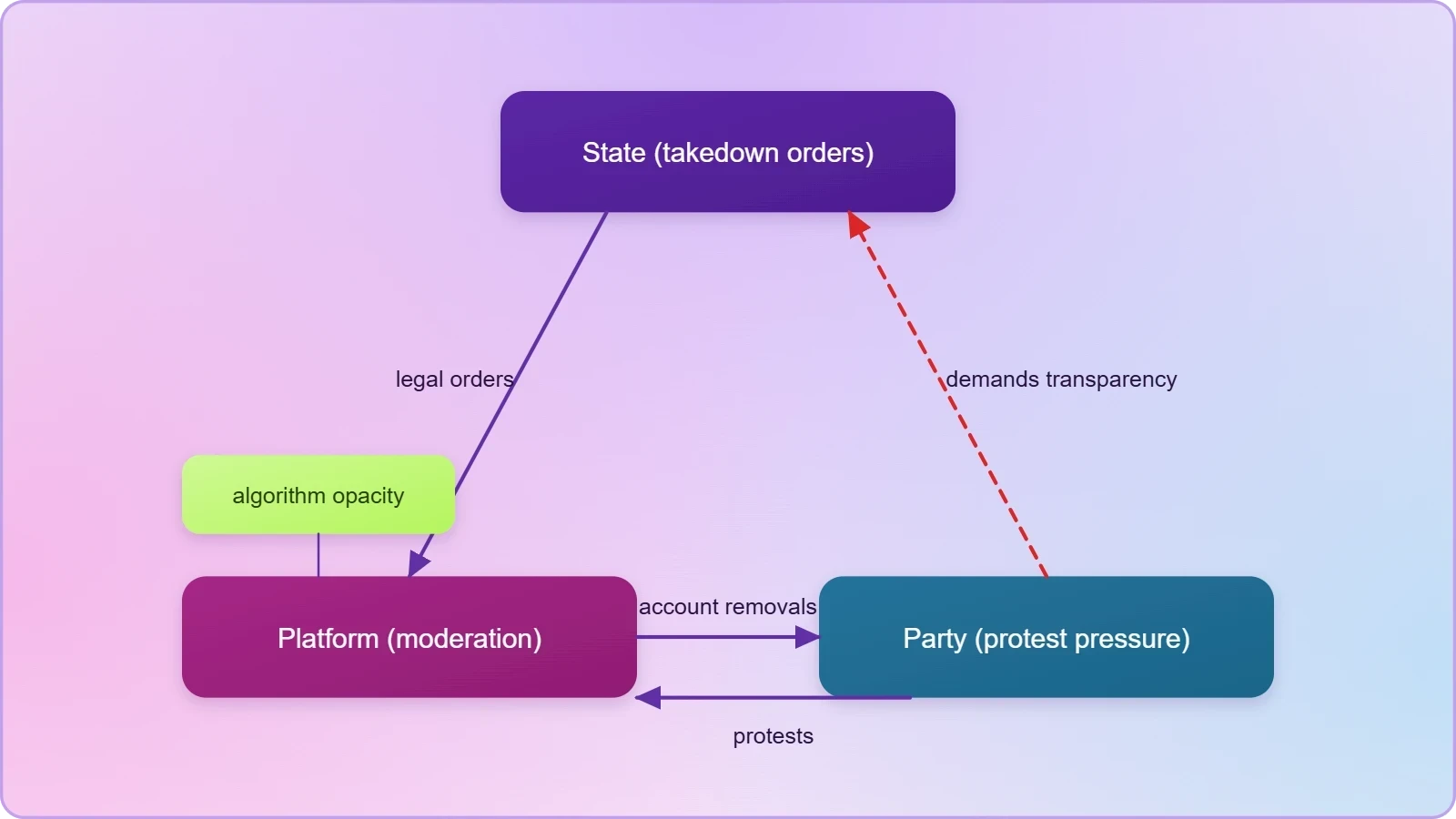
The dispute sits at the intersection of three forces that now define Indian public life: the regulatory authority of the state, the moderation machinery of private platforms, and the mobilisation capacity of political parties. Congress has long alleged that Meta and its sister platforms quietly suppress dissent by removing opposition accounts while favouring Prime Minister Narendra Modi's government. Meta, for its part, insists that it restricts content in India only to comply with local law. The government maintains that takedown orders are issued solely when content breaches statute or threatens public safety and national security. Each party tells a coherent story, and each story is contested by the others.
What makes this episode consequential is the physical escalation. Protesters carrying placards entered the building housing Meta's offices in Hyderabad, knocked plants to the ground and clashed with police. In Mumbai, Congress workers spray-painted anti-Meta slogans on exterior walls and scuffled with security guards. In Gurugram, banners demanded the restoration of youth Congress accounts. The Indian Youth Congress warned it would "storm your offices across the country" unless the Instagram accounts of its leaders were restored, and a Delhi banner recast Mark Zuckerberg as "Mark BJPberg." These are the tactics of a movement that has decided the digital grievance is now a street-level one.
On This Page
TL;DR India's Congress party escalated its confrontation with Meta in November 2026, staging protests at the company's offices in Hyderabad, Mumbai and Gurugram after the platform removed accounts belonging to party members. The youth wing threatened nationwide demonstrations unless Instagram accounts were restored, while Meta maintained it restricts content only to comply with Indian law. The episode exposes the deepening friction between political dissent, platform moderation and state takedown authority in Meta's largest market by users, and it raises unresolved questions about algorithmic transparency, journalistic content removal and the reputational cost of political vandalism for both the party and the company.
The Anatomy of a Platform-Politics Collision
The confrontation did not emerge from a vacuum. It crystallised years of accumulated frustration on the part of Congress, whose leaders have repeatedly claimed that their reach on Facebook, Instagram and WhatsApp is throttled by moderation decisions that disproportionately affect opposition voices. The party's grievance is not merely that individual posts disappear, but that the pattern of removal appears asymmetric, favouring the ruling Bharatiya Janata Party while penalising critics. Meta rejects the characterisation, pointing to its published community standards and its legal obligation to honour government takedown orders under Indian law. The result is a stalemate in which each side possesses a defensible narrative and neither accepts the other's framing.
The Grievance Framework Behind the Protests
Manu Jain, who oversees social media for the youth group, told Reuters that two accounts were restored after Friday's protests, but that thousands of accounts belonging to journalists, creators and influencers critical of the government remain restricted. That claim is the operational core of the dispute. It reframes the issue from partisan complaint to a broader question of press freedom and civic expression. If thousands of critical voices are genuinely silenced, the implications extend well beyond Congress's electoral fortunes. Reporters Without Borders has separately noted that the removal of journalistic content from social media has been rising in India this year, lending external corroboration to concerns that the takedown ecosystem is expanding rather than contracting.
The demand articulated by the youth wing is therefore twofold. First, Meta must restore accounts that were removed on government orders, which the party argues were politically motivated rather than legally necessary. Second, and more structurally significant, Meta must explain how its algorithms restrict posts. That second demand strikes at the heart of platform opacity. Algorithmic ranking and demotion are not the same as outright removal, yet they can be equally consequential for reach and visibility. Congress is effectively asking for a level of transparency that no major social platform has voluntarily provided in any jurisdiction, and that request now forms the negotiating position behind the street protests.
How the State Frames Its Takedown Authority
Prime Minister Modi's government has consistently defended its content removal regime on legal and security grounds. Officials maintain that orders are issued only when content breaks local laws or could harm public safety or national security, a formulation broad enough to encompass everything from communal incitement to misinformation during elections. Critics argue that the breadth of these categories, combined with the speed and secrecy of the process, makes meaningful challenge difficult. The IT ministry did not respond to requests for comment on the protests, a silence that itself became part of the story. When the state declines to explain, the vacuum is filled by suspicion, and suspicion is precisely the fuel that powered the demonstrations.
The legal architecture underpinning these takedowns has tightened considerably over recent years, with intermediaries facing escalating compliance obligations and the prospect of losing safe harbour protections if they fail to act on government requests. For Meta, the calculus is stark: comply and absorb political criticism, or resist and risk operating restrictions in its largest market. The company has chosen compliance, publicly framing it as adherence to local law rather than endorsement of any political position. That framing is legally sound but politically fragile, because it cedes the moral high ground to whichever party can most convincingly claim to be censored.
The Street as a Pressure Channel
Political parties in India have long understood that the street is a legitimate and often effective instrument of pressure, particularly when institutional channels appear closed. The decision to physically occupy Meta's premises represents an escalation calibrated to generate maximum visibility and international coverage. Hyderabad, Mumbai and Gurugram were not chosen at random; they are nodes of corporate presence where a protest can disrupt operations and attract media attention simultaneously. The imagery of toppled plants, spray-painted walls and scuffles with guards travels faster than any policy brief, and the party knows it. The question is whether visibility translates into leverage over a company whose moderation decisions are made thousands of miles away.
Vandalism, Reputation and the Cost of Escalation
The protests drew sharp criticism from political opponents, and that criticism deserves serious attention rather than dismissal. K.T. Rama Rao, an opposition politician in Telangana, condemned the workers for what he called vandalism at the Hyderabad office, arguing that it damaged the city's reputation as a safe place for business. Pradeep Bhandari, a national spokesperson for the ruling party, accused Congress of having "not only vandalised and destroyed Meta's office in Hyderabad" but also of "flaunting it on social media," framing the episode as a "Congress Model" of attacking private enterprise. These counterattacks reframe the party's moral claim as a law-and-order problem, and that reframing carries real political risk.
The reputational arithmetic is genuinely complicated. On one hand, the protests succeeded in forcing the restoration of two accounts and in generating sustained coverage of the underlying grievance. On the other, they handed opponents a ready-made narrative about disrespect for private property and hostility to investment, a narrative that resonates in a country courting foreign capital and positioning itself as a stable business destination. For a party seeking to project governing competence, the optics of broken plants and painted walls are not obviously advantageous. The strategic bet is that the injustice of account suppression outweighs the cost of disruptive tactics in the public imagination.
What the Youth Wing Actually Won
The concrete gains were modest but symbolically meaningful. Two accounts were restored after the protests, a result that the youth wing can present as proof that pressure works. More importantly, the episode elevated the issue of algorithmic opacity into mainstream political discourse. The demand that Meta explain how its algorithms restrict posts is now a public talking point rather than a niche concern of digital rights advocates. That shift in the terms of debate may prove more durable than any individual account restoration. Yet the thousands of still-restricted accounts belonging to journalists, creators and influencers remain the unresolved core, and no protest has yet produced a mechanism for reviewing those decisions transparently.
There is also a generational dimension worth noting. The Indian Youth Congress is precisely the constituency most dependent on social platforms for political organising, and its leaders are among those whose accounts were removed. For them, the platform is not an abstract intermediary but the infrastructure of their political careers. When that infrastructure is withdrawn, the response is existential rather than merely tactical. This helps explain the intensity of the language, the willingness to confront police and the threat to "storm your offices across the country." The youth wing is fighting for its own operational survival, and that urgency is visible in every slogan and banner.
Moderation, Law and the Transparency Deficit
Beneath the slogans and the spray paint lies a technical and legal question of considerable complexity. Content moderation in India operates through a layered system: platform community standards, automated detection, user reports, and government takedown orders issued under statutory provisions. Each layer has its own logic and its own opacity. When an account disappears, the affected user rarely knows which layer was responsible. Was it an algorithmic false positive, a human reviewer's judgment, or a government directive? The inability to distinguish between these possibilities is the transparency deficit at the heart of the dispute, and it is a deficit that affects users across the political spectrum, not merely Congress supporters.
Algorithmic Restriction Versus Outright Removal
The distinction between demotion and deletion matters enormously. A post that is removed is visibly absent, and its author can appeal. A post that is algorithmically downranked simply reaches fewer people, and its author may never know that anything was suppressed. Congress's demand that Meta explain how its algorithms restrict posts targets this subtler mechanism, which is far harder to document and contest. Researchers have long argued that reach suppression can be as consequential as removal while being almost impossible to prove from the outside. If the party's claims are accurate, the most effective censorship in India may be the kind that leaves no visible trace at all.
Meta's public position is that its systems apply consistent standards and that any restriction is subject to review. The company has published transparency reports detailing government requests and compliance rates, though the granularity of these disclosures is limited. Independent researchers have repeatedly called for more detailed data, including account-level information about enforcement actions and the specific legal basis for each removal. Without such data, claims of bias remain unverifiable in either direction. The protests have therefore achieved something analytically useful: they have made the absence of evidence a political issue rather than a technical footnote, forcing the transparency question into public debate.
The Journalistic Dimension
Reporters Without Borders has documented a rising trend in the removal of journalistic content from Indian social media this year, and that finding extends the stakes beyond partisan politics. When the accounts of journalists and creators are restricted alongside those of political activists, the issue becomes one of public information rather than electoral advantage. A democracy depends on a functioning marketplace of ideas, and that marketplace increasingly operates through platforms whose moderation decisions are neither fully transparent nor easily appealable. The Congress protests have, perhaps inadvertently, amplified this broader concern by linking the fate of party accounts to the fate of critical journalism in the same demand for restoration and explanation.
The international dimension is equally significant. India is Meta's largest market by user count, which means the company's conduct there sets precedents for its operations elsewhere. If compliance with broad takedown regimes becomes the norm in India, the template may travel to other jurisdictions with similar legal frameworks. Conversely, if Indian activists succeed in extracting meaningful transparency commitments, that outcome could strengthen demands for accountability globally. The Hyderabad protests are therefore not merely a domestic story; they are a test case in the global struggle over who governs online speech, and the outcome will be watched closely by regulators, platforms and civil society organisations far beyond South Asia.
We Also Published
- 01
- 02
- 03
- 04
Political Fallout and the Battle for Narrative
The immediate political fallout has been a contest over framing. Congress presents the protests as a legitimate response to censorship and corporate collusion with the ruling party. The BJP presents them as vandalism by a party that cannot accept electoral reality and now attacks private companies. Both framings contain elements of truth, and both are designed to mobilise their respective constituencies. The "Mark BJPberg" banner is a particularly pointed rhetorical move, collapsing the distinction between the platform and the ruling party into a single memorable insult. Whether such framing persuades undecided voters or merely energises the base is an open question, but it has certainly succeeded in dominating the news cycle.
The Ruling Party's Counter-Narrative
Pradeep Bhandari's characterisation of the events as a "Congress Model" of vandalising private offices is a deliberate attempt to nationalise the story beyond the specific grievance. By framing the protests as an attack on enterprise itself, the ruling party shifts the debate from content moderation to economic climate, an arena where it believes it holds the advantage. K.T. Rama Rao's criticism from Telangana adds a regional dimension, suggesting that even non-BJP politicians see reputational costs in the tactics employed. The counter-narrative is effective because it requires no engagement with the substance of the censorship claims; it simply reframes the protesters as the aggressors and the company as the victim.
This strategy carries its own risks. If the government appears to be defending a foreign corporation against its own citizens' free-speech claims, it may alienate voters who are sceptical of platform power regardless of party affiliation. The BJP's position is further complicated by its own history of demanding takedowns of content it finds objectionable, which makes the defence of Meta's moderation appear selective. The counter-narrative works best when it stays on the terrain of law and order and avoids the underlying question of whether the takedowns were justified. Every additional day of coverage risks drawing attention back to that question.
What Comes Next for the Standoff
The youth wing has promised further protests unless accounts are restored, and there is little reason to doubt its sincerity. Meta faces a choice between continued quiet compliance and a more proactive engagement with the transparency demands. The company could, for instance, publish more granular data on government takedown requests and their legal basis, or establish an independent review mechanism for contested removals. Such steps would not satisfy Congress entirely, but they would reduce the information asymmetry that fuels suspicion. Whether Meta is willing to accept the commercial and political costs of greater transparency in its largest market remains the central unknown.
For Congress, the strategic challenge is to sustain pressure without allowing the vandalism narrative to define the story. The party needs to convert street energy into institutional demands that can be debated on their merits, such as legislative proposals for algorithmic transparency or independent oversight of takedown orders. If the protests remain purely disruptive, they risk exhausting public sympathy and handing the ruling party a durable talking point. If they evolve into a coherent accountability campaign, they could reshape the terms of India's digital governance debate for years to come. The next few months will reveal which path the party chooses.
India's Digital Governance at a Crossroads
The Meta-Congress confrontation is best understood as a symptom of a deeper structural tension in India's digital governance. The country has built one of the world's most expansive takedown regimes while simultaneously hosting the largest user base of the very platforms it regulates. This combination creates a permanent friction: the state wants content control, the platforms want market access, and political actors want unfettered reach. No stable equilibrium has yet emerged, and each new controversy tests the boundaries of the arrangement. The protests in Hyderabad, Mumbai and Gurugram are therefore not an aberration but a predictable expression of unresolved contradictions that will recur until institutional mechanisms catch up with technological reality.
The Case for Independent Oversight
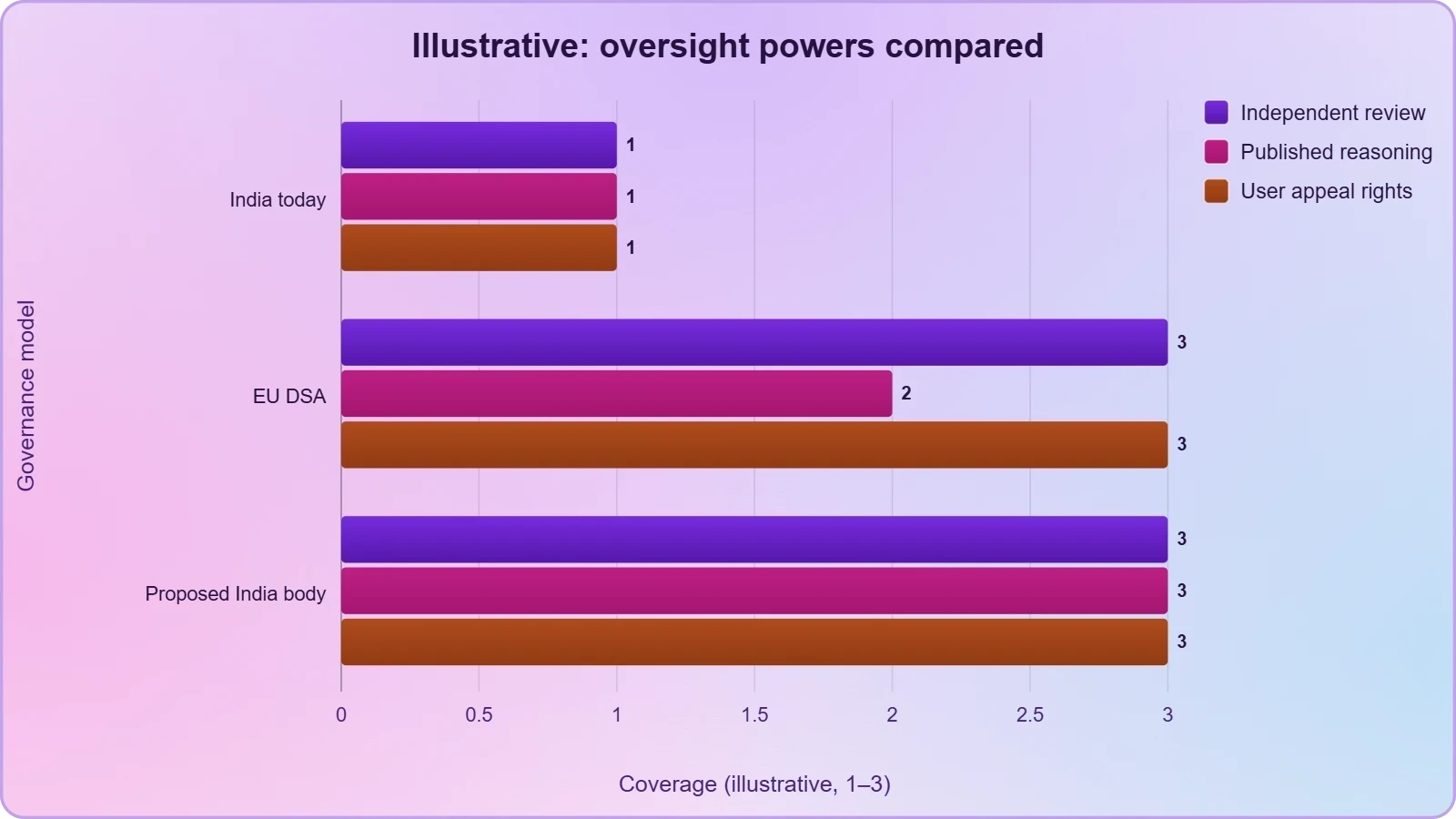
A recurring demand from digital rights advocates is the creation of an independent body to review takedown orders and platform moderation decisions. Such a body would need statutory authority, operational independence and the power to publish reasoned decisions. It would give users a meaningful appeal route and give platforms a defensible basis for resisting politically motivated requests. The Congress protests have not explicitly called for this, but the demand for algorithmic explanation points in the same direction. Without independent oversight, every takedown becomes a political accusation, and every restoration becomes a political concession. The absence of neutral adjudication is what transforms technical decisions into street confrontations.
The international comparison is instructive. The European Union's Digital Services Act has established transparency obligations and appeal mechanisms that, while imperfect, provide a template for structured accountability. India's regulatory framework has focused more heavily on compliance speed than on procedural fairness, reflecting a policy preference for control over contestability. Bridging that gap would require legislative action, and legislative action requires political will that currently does not exist across party lines. The protests may, over time, build the case for such reform by demonstrating the costs of the status quo, but the path from street demonstration to statutory change is long and uncertain.
What the Standoff Reveals About Platform Power
Perhaps the most revealing aspect of the episode is what it demonstrates about the asymmetry of power between platforms and political actors. A national political party, with all its organisational resources, found itself reduced to protesting outside an office building in the hope of restoring a handful of accounts. That is a striking illustration of how much communicative power now resides in private infrastructure. The party can mobilise thousands on the street, but it cannot restore a single Instagram profile without the company's cooperation. This asymmetry is not unique to India, but its visibility here is unusually stark, and it explains why the demand for algorithmic transparency has resonance beyond partisan boundaries.
For Meta, the episode is a reminder that market size does not insulate a company from political risk. Being the largest platform in India means being the most visible target when content moderation goes wrong. The company's silence on the protests may be a prudent legal strategy, but it leaves the public narrative to be shaped entirely by its critics. A more proactive communication posture, including clearer explanations of specific enforcement decisions, might reduce the temperature without requiring any change to the underlying legal compliance. Whether Meta chooses that path will depend on its assessment of reputational risk in a market it cannot afford to lose.
Reading the Signals Beyond the Headlines
The most durable lesson of this episode may concern the changing relationship between political parties and digital infrastructure. Congress discovered that its ability to communicate with voters depends on decisions made by a company it cannot control, regulate or replace. That dependency is shared by every political actor in the country, including the ruling party, which is why the underlying issue transcends partisan advantage. The protests were framed as a Congress-versus-Meta story, but the structural vulnerability they exposed is universal. Any party, any movement, any journalist can find their reach curtailed by an opaque process with no meaningful appeal. That universality is the strongest argument for reform.
There is also a cautionary tale about the limits of disruptive protest as a tool for technology accountability. The restoration of two accounts is a tangible but modest return on a significant escalation. The thousands of still-restricted accounts remain untouched, and Meta has not committed to explaining its algorithms. If further protests produce similarly marginal results, the tactic may lose credibility. Sustained institutional pressure, including legislative engagement, litigation and coordinated international advocacy, is likely to prove more effective over time than repeated confrontations at office buildings. The street can open a conversation, but it cannot write the rules that end it.
Finally, the episode invites reflection on what a healthy digital public sphere in India would actually look like. It would require platforms that enforce their standards consistently and transparently, a state that exercises takedown powers within clear and reviewable limits, and political actors who contest ideas rather than infrastructure. None of these conditions currently holds fully. The protests have made that gap visible to a wider audience, and visibility is a precondition for change. Whether the visibility translates into reform depends on forces far beyond Hyderabad, Mumbai and Gurugram, but the confrontation has at least ensured that the questions can no longer be quietly ignored.
From our network :
- How AI Agents Will Change the Way We Manage Personal FinancesExplore how AI agents are transforming personal finance through automated budgeting, bill payment, and investment management, while examining the critical security protocols and governance frameworks required for safe deployment.
- Committed Mediterranean Precipitation Decline: Why Emissions Cuts Alone Cannot Restore Winter RainsNew NOAA research reveals that Mediterranean winter rains may decline irreversibly even with emissions cuts. Explore the science of committed climate change and regional impacts.
- Live Online English Classes for Kids: Do They Actually Reduce Anxiety?A ten-week study reveals that synchronous online English classes can significantly reduce child language anxiety while improving listening and reading skills. Discover what makes these programs effective and how parents can select the right one.
- University Language Proficiency Exams: Why Institutional Tests Demand Different Preparation Than IELTS and TOEFLDiscover why university-specific language proficiency examinations differ fundamentally from IELTS and TOEFL, and learn strategic preparation approaches for institutional assessment success.
- The Final Descent: How ESA Retired the Legendary Cluster Constellation After 24 Years of Space Weather ScienceAfter 24 years mapping Earth’s magnetosphere, ESA’s Cluster mission concluded with a precisely controlled reentry over the South Pacific. This analysis explores the scientific legacy, engineering decisions, and debris mitigation principles behind one of space exploration’s most responsible retirements.
- CISA’s Ten-Advisory Wave: Why Generic Patching Fails in OT and How to Build Product-Specific PlaybooksCISA released ten ICS advisories in one week, exposing critical infrastructure risks. Generic patching fails in OT. Learn to build product-specific remediation playbooks.
- Forbidden Matrix Patterns and Visible Lattice Points: A Geometric DictionaryExplore how multidimensional 0–1 matrices encode geometric truths, linking forbidden patterns to visible lattice points and hypergraph theory, with applications in combinatorics and computational geometry.
- Mobile Learning and VR in English: What Global Evidence Reveals About Effective Language TechnologyA systematic review across 14 countries reveals which language-learning technologies genuinely work. Mobile learning, AI, and VR show measurable benefits when pedagogically integrated. This evidence-based guide helps educators and learners select technology that delivers real return on investment.
- The Hidden Cost of AI Convenience: Why Over-Permissioned Agents Are a Security Time BombDiscover why AI agents with excessive permissions create dangerous single points of failure, and learn how implementing least privilege principles can protect your organization from exploitation.
RESOURCES
- Resources will be updated soon.
- 01
- 02
- 03
- 04
- 05
- 06
- 07
- 08
0 Comments