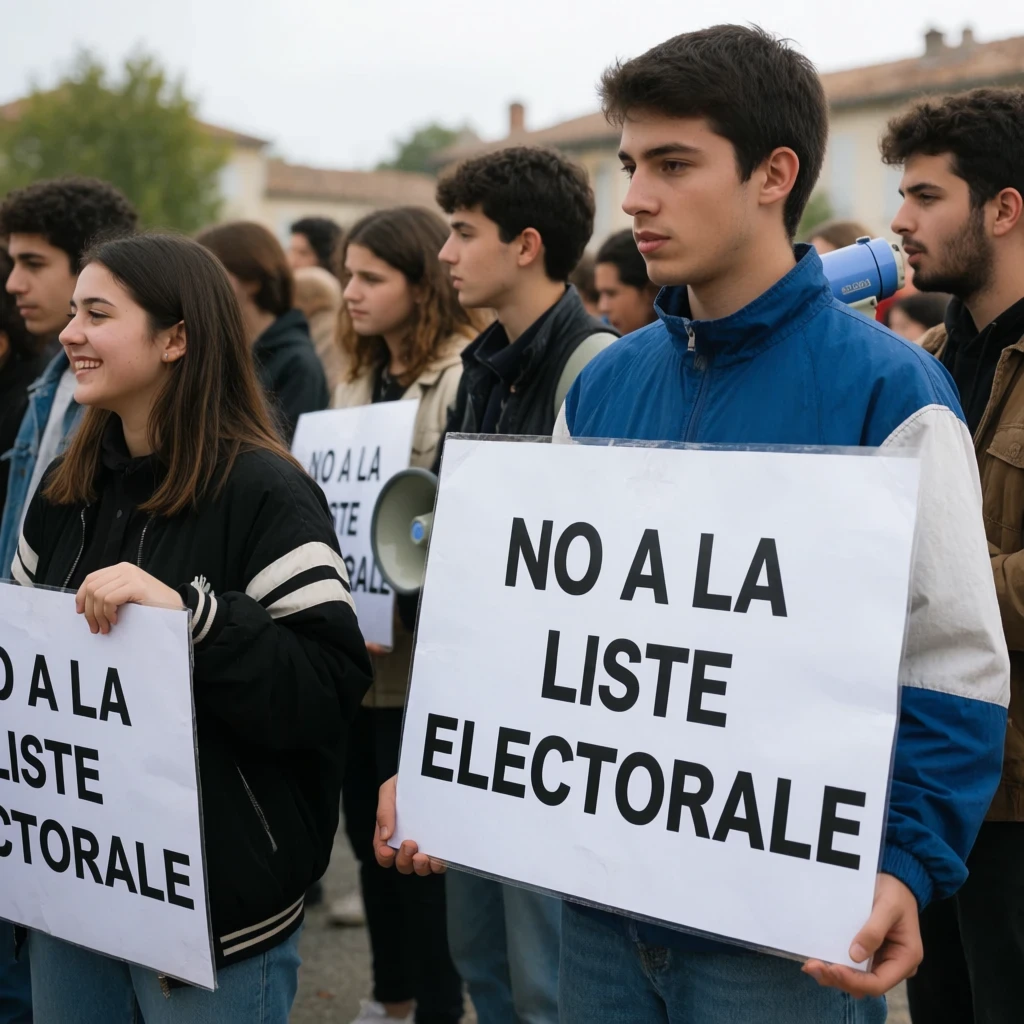
India’s protest wave has hardened into a direct challenge to the credibility of its electoral machinery, with students, youth leaders, and opposition figures accusing the state of manipulating voter rolls to the advantage of the ruling Bharatiya Janata Party. The central grievance is not merely administrative; it is existential.
When citizens believe the register itself is being engineered, every ballot becomes suspect, and every institution charged with guarding democracy is pulled into the dock.
The immediate trigger was a revised voter list process that critics say removed millions of names, including many Muslims, through technical exclusions and opaque decisions. Detentions of protesters then intensified the confrontation rather than containing it.
On This Page
The Supreme Court’s declaration that several arrests were illegal exposed a deeper fault line: a government determined to project order and a public increasingly convinced that force is being used where explanation should have been supplied.
What follows is not a routine law-and-order story. It is a study of institutional trust breaking under pressure, of young activists treating civic participation as a form of resistance, and of a capital city turned into a security zone to prevent dissent from reaching Parliament’s doorstep.
The situation now hinges on whether the Election Commission can restore confidence, or whether the crisis will deepen into a broader indictment of India’s democratic standards.
TL;DR Protests across India are escalating after detentions linked to objections over voter list revisions, with critics alleging that opaque deletions favored the BJP and undermined electoral fairness. The Supreme Court’s ruling that some detentions were illegal has strengthened the protest movement, which now frames the issue as a fight for democratic integrity, transparency, and institutional accountability.
What the protest movement is really about
The immediate dispute concerns voter list revisions, but the deeper conflict is about legitimacy. Protesters argue that the electoral roll is the foundation of democratic consent, and if that foundation is altered without transparency, then the state is no longer merely administering elections. It is deciding who gets to count.
Electoral rolls as a political battleground
In any democracy, voter registration must be scrupulously accurate, publicly explainable, and insulated from partisan suspicion. When changes to the rolls disproportionately affect entire communities, especially minorities, the process ceases to look routine. It begins to resemble quiet political engineering dressed up as paperwork.
That is why the allegations in this case have landed so heavily. Critics are not simply saying names were removed; they are saying the removals were opaque, selective, and structurally biased. The result is a crisis of trust that no press briefing or official denial can easily repair.
Youth-led dissent and the symbolism of detention
The detention of youth leaders and opposition figures has amplified the movement rather than diluted it. Arrests often carry a symbolic weight greater than their legal purpose, and here the image is unmistakable: a state trying to suppress dissent before it can gather force. That is precisely the kind of action that can convert irritation into collective defiance.
The Cockroach Janta Party and student organizations have seized that momentum. Their message is blunt: if participation is punished, protest becomes the only remaining civic instrument. In that sense, the detentions did not end the movement; they supplied it with a sharper moral argument and a more visible public face.
Why the detention order backfired
The state’s crackdown was designed to prevent a mass demonstration from reaching a sensitive location near Parliament. Instead, it created a wider controversy about civil liberties and selective policing. Heavy deployment, transport shutdowns, and internet suspensions signaled fear of protest capacity rather than confidence in public order.
Security as a signal of political insecurity
New Delhi was effectively converted into a controlled zone, with thousands of police and paramilitary personnel placed on standby. Such measures can sometimes prevent violence, but they also communicate that dissent is being treated as a threat to be contained rather than a grievance to be answered. That distinction matters enormously in democratic politics.
When roads, markets, trains, and metro lines are blocked, the state does more than restrict movement. It curtails civic visibility. Protesters are denied not just access to a site, but the public stage on which political claims are normally tested, witnessed, and contested.
The Supreme Court’s intervention changed the narrative
The court’s ruling that some detentions were illegal gave the protest camp a powerful legal and moral advantage. It suggested that the government’s response may have exceeded its lawful boundaries, transforming the issue from an administrative dispute into a constitutional one. That shift is profoundly consequential.
Once the judiciary enters the story, the argument is no longer about crowd control alone. It becomes about rights, due process, and the limits of executive power. In public discourse, that is often the moment a protest acquires institutional legitimacy and broader national resonance.
The Election Commission under scrutiny
The Election Commission stands at the center of the dispute because the institution is supposed to be the guardian of electoral neutrality. Once that credibility is questioned, every procedural decision becomes politically charged. The fact that two commissioners reportedly objected to several choices deepens the impression of internal fault lines.
Majority rule is not the same as public trust
The commission’s three-member structure means decisions are made by majority, but legal correctness does not automatically yield political legitimacy. If a process is seen as technically valid but substantively unfair, public confidence can still collapse. That distinction is at the heart of this crisis.
Critics argue that the removal of voters, especially in minority-heavy constituencies, was not explained clearly enough. Without transparent criteria and publicly auditable procedures, even ordinary revisions can appear partisan. Democratic institutions survive not only on authority, but on the appearance of scrupulous neutrality.
Transparency is the real test now
The demand for the chief election commissioner’s resignation reflects more than anger at one official. It is a demand that someone be held accountable for a process perceived as contaminated. Whether that demand is met may matter less than whether the institution itself can publish records, explain exclusions, and demonstrate correction.
In the modern political environment, secrecy is expensive. Data handling, rule changes, and voter eligibility decisions are expected to withstand public scrutiny. If the commission cannot provide that assurance, then even lawful revisions may continue to be interpreted as evidence of manipulation.
We Also Published
- 01
- 02
- 03
- 04
How public space and media coverage were constrained
Preventing access to Jantar Mantar was not only a logistical move but also a symbolic one. The site functions as a recognized arena for dissent, and keeping protesters away from it narrows their ability to frame the issue before the country. That is why the choice of location mattered so much.
Protest geography shapes political meaning
Demonstrations are never just about bodies in motion; they are about visibility, access, and legitimacy. By blocking roads and suspending transit, authorities reduced the chance that the protest would create a national spectacle. Yet suppression of visibility can also produce a harsher judgment from observers who see disproportionate force.
Journalists were detained as well, and that detail is especially telling. Once reporting itself is obstructed, the state invites suspicion that it is less interested in maintaining order than in controlling the narrative. In an age of instant transmission, suppressing witnesses often makes the story larger, not smaller.
From exam leaks to voter rolls: a recurring pattern
The same protest site had previously hosted a demonstration over exam paper leaks, also led by the same youth group. That continuity matters because it shows an emerging pattern of issue-based mobilization among younger Indians. The movement is learning to convert administrative failures into public pressure.
The resignation of the education minister after the earlier protest underlined that sustained civic agitation can force political outcomes. That memory now hovers over the current dispute. If protesters believe protest can produce consequences, they are more likely to persist even under heavy policing.
What this means for India’s democratic future
The broader lesson is stark: democratic systems are tested most severely not during routine elections, but when their procedures are questioned by the public. If the state responds with opacity and coercion, it risks confirming the very suspicions it seeks to dismiss. That is the danger now facing Indian institutions.
Trust must be rebuilt, not demanded
Trust cannot be restored by insisting that people simply accept official assurances. It must be reconstructed through disclosure, auditability, and restraint. Electoral institutions especially must treat transparency as a non-negotiable duty, because credibility once lost is far harder to recover than procedure is to design.
That means publishing records, clarifying deletion criteria, and acknowledging errors if they occurred. It also means recognizing that communities excluded from the roll will interpret silence as hostility. A stable democracy does not merely count votes; it persuades citizens that the count is fair.
The protest movement may shape the next reform agenda
If the movement continues, it may force a broader discussion about voter registration, institutional oversight, and the standards of protest policing. Even if immediate demands are not met, public memory will preserve the episode as a case study in how procedural disputes can escalate into legitimacy crises. That is the mark of a consequential political moment.
For now, the decisive issue is not whether the protests exist—they plainly do—but whether authorities choose accommodation over escalation. In politics, that choice often determines whether a controversy fades or becomes the template for future dissent.
Metric | Observation | Implication |
|---|---|---|
Detentions | Thousands | Signals broad state concern and fuels outrage |
Security deployment | 30,000+ personnel | Shows high-risk containment strategy |
Legal intervention | Detentions partly ruled illegal | Strengthens protest legitimacy |
Core dispute | Voter list revision | Raises electoral fairness concerns |
From our network :
- Mobile Learning and VR in English: What Global Evidence Reveals About Effective Language TechnologyA systematic review across 14 countries reveals which language-learning technologies genuinely work. Mobile learning, AI, and VR show measurable benefits when pedagogically integrated. This evidence-based guide helps educators and learners select technology that delivers real return on investment.
- University Language Proficiency Exams: Why Institutional Tests Demand Different Preparation Than IELTS and TOEFLDiscover why university-specific language proficiency examinations differ fundamentally from IELTS and TOEFL, and learn strategic preparation approaches for institutional assessment success.
- How AI Agents Will Change the Way We Manage Personal FinancesExplore how AI agents are transforming personal finance through automated budgeting, bill payment, and investment management, while examining the critical security protocols and governance frameworks required for safe deployment.
- Live Online English Classes for Kids: Do They Actually Reduce Anxiety?A ten-week study reveals that synchronous online English classes can significantly reduce child language anxiety while improving listening and reading skills. Discover what makes these programs effective and how parents can select the right one.
- Committed Mediterranean Precipitation Decline: Why Emissions Cuts Alone Cannot Restore Winter RainsNew NOAA research reveals that Mediterranean winter rains may decline irreversibly even with emissions cuts. Explore the science of committed climate change and regional impacts.
- Forbidden Matrix Patterns and Visible Lattice Points: A Geometric DictionaryExplore how multidimensional 0–1 matrices encode geometric truths, linking forbidden patterns to visible lattice points and hypergraph theory, with applications in combinatorics and computational geometry.
- The Hidden Cost of AI Convenience: Why Over-Permissioned Agents Are a Security Time BombDiscover why AI agents with excessive permissions create dangerous single points of failure, and learn how implementing least privilege principles can protect your organization from exploitation.
- CISA’s Ten-Advisory Wave: Why Generic Patching Fails in OT and How to Build Product-Specific PlaybooksCISA released ten ICS advisories in one week, exposing critical infrastructure risks. Generic patching fails in OT. Learn to build product-specific remediation playbooks.
- The Final Descent: How ESA Retired the Legendary Cluster Constellation After 24 Years of Space Weather ScienceAfter 24 years mapping Earth’s magnetosphere, ESA’s Cluster mission concluded with a precisely controlled reentry over the South Pacific. This analysis explores the scientific legacy, engineering decisions, and debris mitigation principles behind one of space exploration’s most responsible retirements.
RESOURCES
- What to know about nationwide protests in India over voter list ... - NPRnpr.org6 days ago ... Protesters demand the resignation of Chief Election Commissioner Gyanesh Kumar and an end to the poll body's ongoing revision of…
- "India Cut 130 Million From Voter Roll, Fueling Protests Against ...electionlawblog.org5 days ago ... “India Cut 130 Million From Voter Roll, Fueling Protests Against Modi” ... NYT: Nearly a billion people in the world's…
- India: Authorities trampling on human rights in crackdown on ...amnesty.orgOct 2, 2026 ... India: Authorities trampling on human rights in crackdown on electoral roll protests ... “The right to protest is not dependent…
- Why India's tens of millions of voter deletions have led to ... - Reutersreuters.com3 days ago ... India's verification exercise of its nearly one billion voters has sparked protests across the country, with opposition parties alleging the ...
- India Cut 130 Million From Voter Roll, Fueling Protests Against Modinytimes.com6 days ago ... The exercise is billed by an election commission appointed by Prime Minister Narendra Modi as cleaning India's voter roll of…
- India cracks down on youth protests as anger grows against Modi ...houstonpublicmedia.org2 days ago ... The protests focus on the Election Commission's voter list revision, which the opposition claims disenfranchises millions.
- 'Cockroach' protesters demand India's election chief resign over ...abcnews.comOct 1, 2026 ... India's voter list revisions began last year in the eastern state of Bihar ahead of state elections, and have since…
- Indian protesters demand electoral chief resign over alleged voter ...ft.com6 days ago ... India's Supreme Court this week demanded an explanation from the commission and government on the voter-list deletions. Modi's government ...
- India's supreme court demands answers over changes to voter rolltheguardian.com7 days ago ... Modi government, election body and its head issued notices after removal of millions from lists prompts mass protests.
- India's opposition parties protest against a controversial electoral roll ...apnews.comAug 11, 2025 ... India's opposition parties have held a protest calling for the rollback of a controversial revision of the voter list in…
- India steps up security ahead of a major protest in New Delhi over ...courthousenews.com2 days ago ... The protests center on a nationwide review of voter lists known as the Special Intensive Revision.
- India detains 'Cockroach' leaders amid voter list protests - Daily Sabahdailysabah.com2 days ago ... Indian authorities mounted a sweeping security crackdown across New Delhi on Saturday, detaining thousands of protesters as the country's ...
- India protest updates: 'Cockroach' leaders detained; New Delhi in ...aljazeera.com1 day ago ... July 20: More than 10,000 CJP protesters attempt to march to the Indian parliament, demanding Pradhan's resignation. The march led…
- Leaders from India's 'Cockroach' movement released from detention ...pbs.org9 hours ago ... The protests were triggered after authorities removed more than 130 million voters from the list since last year.
- Why India's Voter Roll Overhaul Is So Controversial - Bloomberg.combloomberg.com3 days ago ... India is in the middle of a massive exercise to revise its electoral rolls by removing dead, duplicate and ineligible…
- 01
- 02
- 03
- 04
- 05
- 06
- 07
- 08
0 Comments