
On a mild November afternoon in London, a group of newly qualified barristers gathered for one of the most consequential rituals of their professional lives: the call to the bar ceremony. For Joseph Ashong, a young Black lawyer who had spent years working toward this moment, the occasion should have been defined by relief, pride, and the quiet satisfaction of formal admission to the profession. Instead, it became the flashpoint for a national controversy when a hard-right Member of Parliament, Rupert Lowe, shared a photograph from the ceremony and framed it as evidence of discrimination against white Britons. Within hours, the image had been viewed by millions, and Ashong found himself at the centre of a hostile online storm he never sought.
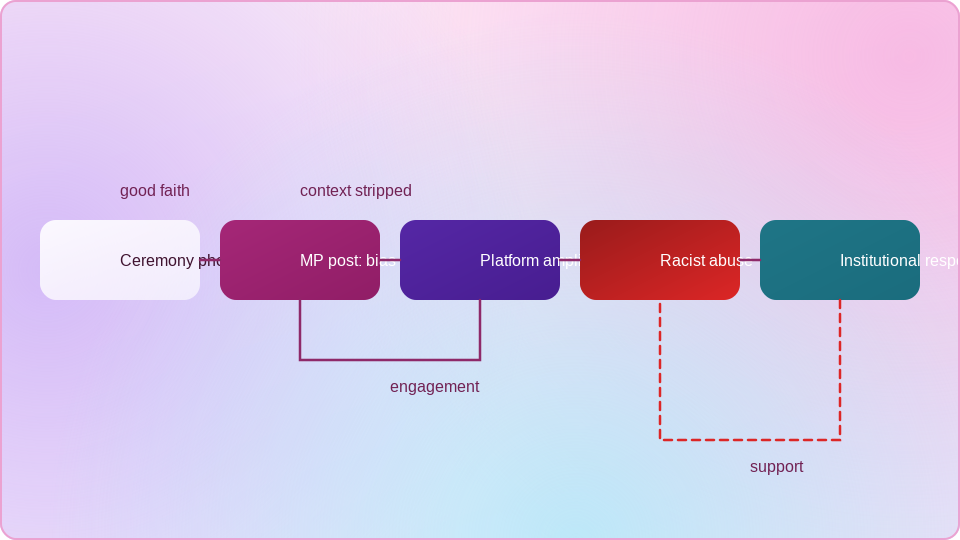
The episode is far more than a single viral post. It exposes the volatile intersection of social media virality, racial politics, and the fragile conventions that govern public discourse in the United Kingdom. A photograph taken in good faith at an institutionally significant event was repurposed as a political weapon, stripped of context, and used to fuel a narrative of grievance. Ashong has since described the abuse he received as unprecedented in its intensity, a statement that carries weight precisely because it comes from someone who has navigated the legal profession's demanding pathways. The story raises uncomfortable questions about how quickly ordinary moments can be weaponised, and about the responsibilities of public figures who command large audiences.
What follows is an examination of the incident's mechanics, its human cost, and its broader implications for law, media, and social cohesion. The analysis considers the ceremony itself, the political framing that ignited the controversy, the nature of the abuse directed at Ashong, and the institutional responses that followed. It also situates the event within wider debates about representation in the legal profession and the ways digital platforms amplify inflammatory content. Understanding this case requires attention to detail and a willingness to look past the headline to the structures beneath it.
On This Page
TL;DR A photograph from a London call to the bar ceremony was shared by hard-right MP Rupert Lowe and framed as evidence of anti-white discrimination, triggering millions of views and a wave of racist abuse against newly qualified barrister Joseph Ashong. The incident illustrates how quickly a routine professional milestone can be weaponised for political messaging, the disproportionate harm inflicted on individuals from minority backgrounds, and the urgent need for accountability from public figures and platforms alike.
The Ceremony and the Photograph at Its Centre
The call to the bar is one of the oldest and most symbolically charged rites in English legal culture. Held in London's historic legal quarter, the ceremony formally admits aspiring advocates to the Bar of England and Wales after years of study, vocational training, and examination. Attendance is typically a family affair, with parents, mentors, and friends filling the hall to witness a moment of genuine achievement. Photographs taken at such events are ordinarily celebratory artefacts, shared privately or on social media to mark a milestone. Nothing about the occasion itself suggests controversy; it is, by design, an inclusive institutional ritual meant to welcome new members into a profession that serves the public.
The photograph that became the centre of the storm captured a group of attendees at the ceremony. Its composition was unremarkable to those present, but once it entered the political bloodstream, it was read as a coded statement about racial representation. Rupert Lowe, a sitting MP known for provocative interventions, shared the image with commentary asserting that it demonstrated discrimination against white Britons. The post spread rapidly, accumulating millions of views within hours. What had been a private celebration was transformed into a public exhibit in a culture-war argument, and the people in the frame became symbols rather than individuals.
How a Private Milestone Became Public Property
The speed of the transformation is instructive. Social media platforms reward content that provokes strong emotional reactions, and racial grievance narratives reliably generate engagement. Once Lowe's post began circulating, algorithms amplified it to audiences far beyond his immediate followers. The photograph's original context, a professional ceremony, was discarded in favour of a politically convenient interpretation. Ashong and his fellow attendees had no opportunity to consent to this reframing; their images were appropriated for a message they did not endorse. The episode demonstrates how digital virality can strip individuals of agency, turning them into props in arguments they never chose to join.
Legal and ethical questions follow closely behind the human ones. While sharing a photograph taken in a semi-public setting may not breach data protection law, the use of an image to imply a false narrative raises concerns about defamation and harassment. The individuals depicted had no editorial control over how their likenesses were deployed. For Ashong, the experience was disorienting precisely because the ceremony had felt safe and formal. The contrast between the dignity of the occasion and the hostility of the online response underscores how thin the boundary between private celebration and public exposure has become in an era of instant, frictionless sharing.
The Institutional Setting of the Bar
The Bar of England and Wales has historically been one of the least diverse corners of the British establishment. Efforts to widen access have accelerated in recent years, with scholarships, outreach programmes, and mentoring schemes aimed at attracting candidates from underrepresented backgrounds. The presence of Black barristers at a call ceremony is therefore not an anomaly to be explained but a sign of gradual, hard-won progress. Framing such attendance as evidence of discrimination inverts the reality: it treats inclusion as injury. The profession's own data shows persistent gaps in retention and progression for minority lawyers, which makes the political misreading of the photograph especially jarring.
Institutions such as the Bar Council and the Inns of Court have publicly committed to diversity, yet the lived experience of new entrants often diverges from stated values. Ashong's account of unprecedented racism suggests that formal inclusion does not automatically translate into social acceptance. The ceremony, in other words, is both a symbol of belonging and a reminder of how contested that belonging remains. When a public figure weaponises an image from such an event, the harm lands not only on the individuals pictured but on the credibility of the profession's inclusion efforts. The message sent to future candidates from minority backgrounds is unmistakable and discouraging.
The Political Framing and the Grievance Narrative
Rupert Lowe's post did not emerge in a vacuum. It drew on a well-established rhetorical template in which racial equality measures are recast as anti-white bias. This framing has gained traction across parts of the British right, particularly on social platforms where grievance content performs well. By presenting a photograph of a diverse group as proof of exclusion, the post inverted the logic of discrimination: it treated the presence of Black professionals as inherently suspicious. The move is characteristic of a broader strategy that seeks to delegitimise diversity initiatives by portraying them as zero-sum contests in which white Britons are the losers.
The political utility of such messaging is considerable. It allows figures like Lowe to position themselves as defenders of an aggrieved majority while avoiding substantive policy debate. The photograph served as a visual prop, easily consumed and easily shared, requiring no context or evidence. Its emotional charge did the work that argument could not. This is the grammar of contemporary culture-war politics: find an image, attach a claim, and let the algorithm distribute it. The people in the frame become incidental to the message, their actual circumstances irrelevant to the political purpose the image is made to serve.
The Mechanics of Viral Outrage
Platform economics reward outrage. Posts that provoke anger, fear, or indignation generate more clicks, comments, and shares than measured analysis, and recommendation systems are tuned to maximise engagement. A claim of anti-white discrimination is almost perfectly designed for this environment: it is simple, emotionally charged, and invites immediate reaction. Within hours, the post had reached audiences far beyond Lowe's constituency, and the comment threads filled with hostility directed at the people pictured. The architecture of the platforms, not merely the intent of the poster, ensured that the controversy would escalate rapidly and that the targets would bear the brunt of it.
Moderation systems struggle to keep pace with this dynamic. By the time platforms review reported content, the damage is often done, and the abuse has already reached its targets. Ashong described being amazed and upset by the reaction, a response that reflects the gap between the intimacy of the ceremony and the scale of the hostility. The asymmetry is stark: a single post can reach millions, while an individual's capacity to respond, correct the record, or seek redress is limited. This imbalance is a structural feature of the attention economy, and it disproportionately affects those who are least equipped to absorb its costs.
Accountability for Public Figures
Public figures carry a heightened responsibility for the foreseeable consequences of their speech. When an MP shares an image with a claim that invites racial hostility, the resulting abuse is not an unfortunate side effect but a predictable outcome. Democratic societies protect robust political expression, but that protection coexists with duties of care and basic decency. The question is not whether Lowe had the legal right to post the image, but whether exercising that right in this manner was consistent with the obligations of public office. The distinction between legality and propriety is central to any serious discussion of the incident.
Parliamentary and party mechanisms exist to address conduct that falls below expected standards, though they are often slow and politically fraught. Calls for apology or retraction are common in such cases, but their effectiveness depends on the willingness of the figure concerned to acknowledge harm. Where that willingness is absent, the burden shifts to institutions, platforms, and the public to respond. The episode invites scrutiny of how political parties vet and discipline members whose rhetoric inflames racial tensions, and whether existing frameworks are adequate to the speed and reach of modern communication.
The Human Cost: Racist Abuse and Its Aftermath
Joseph Ashong's account of the abuse he endured is the emotional core of the story. A newly qualified barrister who had just achieved a significant professional milestone found himself subjected to hostility on a scale he had never previously encountered in the UK. His statement that this was an unprecedented level of racism is significant because it comes from someone who has navigated the legal profession's demanding and often isolating pathways. The abuse was not abstract; it was personal, targeted, and sustained by the reach of the viral post. The contrast between the dignity of the ceremony and the vitriol of the response is difficult to overstate.
The harm extends beyond the individual. When a Black professional is publicly humiliated for simply appearing in a photograph, the message ripples outward to others who share his background. It signals that visibility carries risk, that achievement can be reframed as provocation, and that the protections of professional status offer limited shelter from racial hostility. Colleagues and peers who witnessed the abuse may think twice about sharing their own milestones. The chilling effect is subtle but real, and it undermines the very diversity efforts that institutions claim to prioritise. Ashong's willingness to speak publicly is therefore an act of considerable courage.
Psychological and Professional Repercussions
The psychological toll of online abuse is well documented. Targets report anxiety, sleep disruption, hypervigilance, and a sense of isolation, particularly when the abuse is racial in nature. For a barrister at the start of a career, the professional stakes compound the personal ones. Reputation is a currency in the legal profession, and being associated with a controversy, however unjustly, can affect opportunities and relationships. Ashong's decision to describe his experience openly is a bid to reclaim the narrative, but it also exposes him to further attention. The courage required to speak is matched by the vulnerability it creates.
Support structures matter enormously in such circumstances. Professional bodies, employers, and peers can mitigate harm by offering practical assistance, public solidarity, and clear condemnation of abuse. Where such support is absent or slow, the target is left to manage alone. The legal profession's response to this incident will be watched closely, not only by its own members but by the wider public. How institutions treat those who are attacked for who they are speaks volumes about their actual commitment to the values they profess. The aftermath is therefore a test of institutional integrity as much as a personal ordeal.
Solidarity and the Wider Profession
Reactions from within the legal community have underscored a tension between solidarity and silence. Some colleagues and organisations have spoken out forcefully, condemning the abuse and affirming support for Ashong. Others have remained conspicuously quiet, wary of entering a politically charged dispute. This uneven response reflects the profession's broader discomfort with conversations about race. The Bar's leadership has publicly endorsed diversity, but translating endorsement into active defence of individual members under attack requires a different kind of commitment. The incident exposes the gap between stated values and demonstrated action, a gap that minority lawyers have long recognised.
Solidarity, where it appears, takes many forms: public statements, private messages of support, offers of mentoring, and a willingness to challenge inflammatory rhetoric in professional settings. Each gesture matters, but none substitutes for systemic change. The profession must consider how it prepares new entrants for the realities of public exposure, how it supports those targeted by abuse, and how it holds accountable those whose rhetoric enables it. Ashong's experience is not an isolated misfortune but a symptom of deeper structural dynamics. Addressing it requires more than sympathy; it requires institutional resolve.
Representation, Diversity, and the Legal Profession
The incident has renewed attention on the state of diversity within the legal profession. Despite decades of reform, the Bar remains disproportionately composed of lawyers from privileged backgrounds, and progress for Black and minority ethnic practitioners has been uneven. Retention and progression rates lag behind entry rates, suggesting that inclusion at the point of qualification does not guarantee equality of experience thereafter. Ashong's presence at the ceremony is a data point in a longer story of gradual change, but the hostility he faced illustrates how contested that change remains. The photograph, in this light, is a Rorschach test for the profession's self-image.
Diversity initiatives are frequently justified on grounds of fairness and legitimacy. A legal system that serves a diverse public is more credible when its practitioners reflect that public. Yet the political backlash against such initiatives has intensified, with critics framing them as discriminatory against majority groups. The incident shows how easily this critique can be weaponised, using a single image to imply systemic bias where none exists. Defenders of diversity must therefore make their case with clarity and evidence, distinguishing between genuine inclusion efforts and the zero-sum framing that opponents prefer. The stakes are high, and the terms of debate matter.
Data and the Reality of Progress
Available data paints a nuanced picture. Representation of Black barristers has improved at entry level, but disparities persist in earnings, case allocation, and progression to senior ranks. These gaps reflect a combination of structural barriers, implicit bias, and the cumulative effects of unequal access to networks and opportunities. The ceremony photograph, showing a diverse cohort, captures a genuine achievement, but it does not capture the challenges that lie ahead for those pictured. Celebrating entry without addressing retention and advancement risks presenting a misleading picture of equality. Honest assessment requires attention to the full career arc, not just the starting line.
Quantitative measures alone cannot capture the lived experience of minority lawyers. Surveys consistently report higher rates of discrimination, isolation, and attrition among Black practitioners. These findings align with Ashong's account of unprecedented racism, suggesting that formal inclusion has not yet produced substantive belonging. The profession's response to such evidence has been mixed, with some institutions investing in mentoring and support while others treat diversity as a box-ticking exercise. The incident offers an opportunity to move beyond rhetoric toward concrete measures that address the realities revealed by data and testimony alike.
Public Discourse and Racial Politics
The broader political climate shapes how incidents like this unfold. Debates over immigration, identity, and national belonging have become increasingly polarised, and social media amplifies the most inflammatory voices. In this environment, a photograph of Black professionals can be read as a provocation by those primed to see demographic change as threat. The MP's framing tapped into this anxiety, offering a simple explanation for complex social change. Understanding the incident therefore requires attention to the wider discourse in which it occurred, not merely the actions of individuals. The personal and the political are inseparable here.
Counter-narratives exist, but they struggle to compete for attention. Nuanced explanations of diversity, inclusion, and professional achievement are less shareable than outrage. This asymmetry is a structural challenge for anyone seeking to foster reasoned debate. The incident illustrates the difficulty of correcting a viral falsehood once it has taken hold. Ashong's testimony is one such corrective, but it reaches a fraction of the audience that saw the original post. The lesson is sobering: in the attention economy, truth often arrives late and travels slowly, while falsehood moves fast and far.
Similar Posts
- 01
- 02
- 03
- 04
Platforms, Regulation, and the Limits of Moderation
The role of social media platforms in amplifying the controversy cannot be overstated. Recommendation algorithms are designed to maximise engagement, and content that provokes strong emotions performs exceptionally well. A post alleging discrimination against a majority group is almost perfectly calibrated for this environment. By the time moderation systems intervened, if they did, the abuse had already reached its targets. The platforms' business models create incentives that favour virality over safety, and the consequences are borne disproportionately by individuals from minority backgrounds. The incident is a case study in the structural weaknesses of content governance.
Regulatory frameworks are evolving, but they lag behind the pace of technological change. The Online Safety Act and similar legislation aim to impose duties of care on platforms, yet enforcement remains complex and contested. Questions of jurisdiction, speech protection, and proportionality complicate every intervention. The incident illustrates the difficulty of designing rules that curb abuse without suppressing legitimate expression. It also highlights the importance of transparency: without data on how content spreads and how moderation decisions are made, accountability is difficult to establish. The public interest in understanding these dynamics is considerable.
What Effective Moderation Might Look Like
Effective moderation requires a combination of automated detection, human review, and clear policy. Systems must be able to identify coordinated harassment and racial abuse quickly, prioritise reports from targeted individuals, and act before harm escalates. Transparency reports should disclose how such systems perform, including error rates and response times. Platforms should also provide meaningful redress for those wrongly targeted, including the removal of abusive content and support for affected users. None of these measures is straightforward, but their absence leaves individuals exposed to harm that could be mitigated. The incident offers a concrete case for reform.
There is also a role for users and civil society. Reporting abuse, documenting incidents, and supporting targets can make a difference, though the burden should not fall solely on those affected. Media organisations have a responsibility to report on such incidents without amplifying the original falsehood. Journalists covering the story must balance the public interest in exposure against the risk of further spreading the inflammatory framing. The Guardian's coverage, which centred Ashong's testimony, illustrates one approach: foreground the human cost and treat the political claim with appropriate scepticism. Editorial judgment matters in shaping whether an incident informs or inflames.
Legal Remedies and Their Limits
Legal avenues exist for targets of abuse, including harassment and defamation claims, but they are slow, costly, and uncertain. The prospect of litigation may deter some abusers, but it offers little comfort to those facing immediate harm. Criminal law addresses the most serious cases, yet prosecution rates for online racial abuse remain low. The gap between legal rights and practical remedies is a recurring theme in discussions of online harm. For Ashong, the law may offer some recourse, but it cannot undo the experience or fully repair the damage. The limits of legal remedies underscore the need for broader cultural and institutional responses.
Professional regulation adds another layer. Barristers are subject to codes of conduct, and public figures may face parliamentary standards investigations. These mechanisms can signal disapproval and impose consequences, but they operate slowly and are often politically contested. The effectiveness of such processes depends on the willingness of institutions to act decisively, even when the figure concerned is powerful. The incident tests whether existing frameworks can deliver accountability in a timely and credible manner. The answer will shape public confidence in the institutions that govern professional and political life.
Lessons for Institutions and Public Life
The incident yields several lessons for institutions navigating similar controversies. First, speed matters: a prompt and unequivocal response can mitigate harm and signal values. Second, solidarity must be visible: quiet support is valuable, but public affirmation of targets carries additional weight. Third, accountability requires follow-through: statements of concern must be matched by action. Institutions that treat such incidents as public relations problems rather than matters of principle risk compounding the harm. The legal profession, with its stated commitment to justice, has a particular obligation to model the behaviour it expects of others.
Public figures, meanwhile, must reckon with the consequences of their rhetoric. The freedom to speak is not a licence to inflame racial hostility without regard for foreseeable outcomes. MPs and other leaders command audiences that can be mobilised rapidly, and with that reach comes responsibility. The incident invites a broader conversation about the standards expected of those in public life, and about the mechanisms available to enforce them. Whether that conversation leads to meaningful change depends on the willingness of parties, parliaments, and the public to prioritise decency over partisan advantage.
Building Resilience and Support
Resilience is not solely an individual attribute; it is shaped by the support systems around a person. Mentoring, peer networks, and accessible counselling can help targets of abuse cope with the psychological toll. Professional bodies can establish rapid-response protocols for members facing harassment, offering practical and legal guidance. Employers can create cultures in which speaking up is safe and supported. These measures are not substitutes for preventing abuse, but they can reduce its impact. The incident offers an opportunity to strengthen such systems, ensuring that future targets are not left to manage alone.
Education also has a role. Understanding the history and dynamics of racial discrimination helps counter the narratives that fuel incidents like this. Legal training, in particular, should equip practitioners to recognise and challenge inflammatory framing, whether in courtrooms, media, or public debate. The profession's commitment to equality is best demonstrated through the competence and confidence of its members in addressing these issues. Ashong's willingness to speak publicly is itself a form of education, offering a human face to abstract debates. Institutions should build on that example rather than let it fade.
The Wider Democratic Stakes
At its core, the incident raises questions about the kind of public sphere a democratic society wishes to cultivate. One in which a photograph of professional achievement can be weaponised as evidence of discrimination is one in which trust is fragile and solidarity is scarce. Rebuilding that trust requires more than condemnations of individual posts; it requires a sustained commitment to truthful discourse, accountable leadership, and inclusive institutions. The stakes extend beyond any single career or controversy. They concern the capacity of a diverse society to treat its members with dignity, even amid disagreement.
The path forward is neither simple nor guaranteed. It involves regulatory reform, institutional change, cultural shifts, and individual responsibility. Progress will be uneven, and setbacks are likely. Yet the incident also reveals resources for hope: the courage of a young barrister willing to speak, the solidarity of colleagues, and the public's capacity to recognise injustice when it is clearly described. These resources are not sufficient on their own, but they are necessary. The task is to convert them into durable structures that protect the vulnerable and uphold the values a democratic society claims to cherish.
From our network :
- The Hidden Cost of AI Convenience: Why Over-Permissioned Agents Are a Security Time BombDiscover why AI agents with excessive permissions create dangerous single points of failure, and learn how implementing least privilege principles can protect your organization from exploitation.
- CISA’s Ten-Advisory Wave: Why Generic Patching Fails in OT and How to Build Product-Specific PlaybooksCISA released ten ICS advisories in one week, exposing critical infrastructure risks. Generic patching fails in OT. Learn to build product-specific remediation playbooks.
- Committed Mediterranean Precipitation Decline: Why Emissions Cuts Alone Cannot Restore Winter RainsNew NOAA research reveals that Mediterranean winter rains may decline irreversibly even with emissions cuts. Explore the science of committed climate change and regional impacts.
- Mobile Learning and VR in English: What Global Evidence Reveals About Effective Language TechnologyA systematic review across 14 countries reveals which language-learning technologies genuinely work. Mobile learning, AI, and VR show measurable benefits when pedagogically integrated. This evidence-based guide helps educators and learners select technology that delivers real return on investment.
- University Language Proficiency Exams: Why Institutional Tests Demand Different Preparation Than IELTS and TOEFLDiscover why university-specific language proficiency examinations differ fundamentally from IELTS and TOEFL, and learn strategic preparation approaches for institutional assessment success.
- How AI Agents Will Change the Way We Manage Personal FinancesExplore how AI agents are transforming personal finance through automated budgeting, bill payment, and investment management, while examining the critical security protocols and governance frameworks required for safe deployment.
- Live Online English Classes for Kids: Do They Actually Reduce Anxiety?A ten-week study reveals that synchronous online English classes can significantly reduce child language anxiety while improving listening and reading skills. Discover what makes these programs effective and how parents can select the right one.
- The Final Descent: How ESA Retired the Legendary Cluster Constellation After 24 Years of Space Weather ScienceAfter 24 years mapping Earth’s magnetosphere, ESA’s Cluster mission concluded with a precisely controlled reentry over the South Pacific. This analysis explores the scientific legacy, engineering decisions, and debris mitigation principles behind one of space exploration’s most responsible retirements.
- Forbidden Matrix Patterns and Visible Lattice Points: A Geometric DictionaryExplore how multidimensional 0–1 matrices encode geometric truths, linking forbidden patterns to visible lattice points and hypergraph theory, with applications in combinatorics and computational geometry.
RESOURCES
- Black barrister tells of racist abuse after Rupert Lowe viral tweettheguardian.com3 hours ago ... Exclusive: Hard-right MP claimed photo featuring Joseph Ashong was sign of discrimination against white Britons.
- Black barrister tells of racist abuse after Rupert Lowe viral tweet - AOLaol.co.uk3 hours ago ... Exclusive: Hard-right MP claimed photo featuring Joseph Ashong was sign of discrimination against white Britons.
- Black barrister tells of racist abuse after viral tweet by Restore leadermagzter.com12 hours ago ... A newly qualified black barrister who took part in a group photograph that went viral after Rupert Lowe ... ceremony…
- Black barrister tells of racist abuse after Rupert Lowe viral tweet - inklinkl.com3 hours ago ... Exclusive: Hard-right MP claimed photo featuring Joseph Ashong was sign of discrimination against white Britons.
- Yahoo! UK | Mail, Weather, Search, Politics, News, Finance, Sports ...uk.yahoo.comFormer GMTV presenter Phillips smiles in rare photo amid Alzheimer's battle ... Black barrister tells of racist abuse after Rupert Lowe viral tweet. The ...
- Aston University News and Campus Life | The Aston Goosetheastongoose.comUK Guardian: 13:00 Black barrister tells of racist abuse after Rupert Lowe viral tweet ... Aston was shortlisted in three categories at the 26…
- In Memoriam - Nichols Schoolnicholsschool.orgNichols School lists names of community members who pass on this page and in the alumni magazine Toaxnoes.
- commencement 2024 - Case Western Reserve Universitycase.eduMay 17, 2024 ... ceremony. Photographs may be taken on the university grounds following the ceremonies. ... Black is the standard color for gowns…
- Comments | News - Bates Collegebates.eduGreat ceremony! Bates is a class act and I was so impressed with the President's speech and the pride and kindness shown to each…
- Obituary content by year - Wits Universitywits.ac.zaIt was during this time that he met Steve Biko, the founder of the South African Black Consciousness Movement. Biko urged him to leave…
- BlACK BRITISH SUBJECTS IN CUBA: RACE, ETHNICITY, NATION ...repository.londonmet.ac.ukThe former, a ship, became a symbol of the migration experience of black people from the Caribbean. The latter, a person, came to epitomise…
- 2015 Commencement Program - Table of Contents The Alma Matercommencement.emory.eduMayor Franklin will be presented by the dean of Emory School of Law, Robert Schapiro. Page 7. Emory University Commencement 2015 7. Award, the…
- United Kingdom Breaking News Headlines Today | Ground Newsground.newsBlack barrister tells of racist abuse after Rupert Lowe viral tweet. Rupert ... REVIEW: CEREMONY Festival : Pianka Pärna + Paul Regan. London, England ...
- Islamophobia in Europe - University of Bristol Research Portalresearch-information.bris.ac.ukOct 16, 2026 ... edl-sikh-manchester-homeless-abuse-volunteers-feeding-english- defence-league-racist-a7787241.html - accessed 16 February. 2018. 29 Dominic ...
- Exhibits to Letter to ADCRR | ACLUaclu.orgApr 8, 2021 ... even now), racist ideas about Black pov- erty and Black criminality ... escape looting, murder, sexual assault, drug abuse, arson,…
Related By Tags
- 01
- 02
- 03
- 04
- 05
- 06
- 07
- 08
0 Comments