When a government grants citizenship to one member of a family, it implicitly makes a promise about the kind of life that person can build — including the moral expectation that they will be able to care for aging parents without treating them as temporary visitors. The case of Khushhal Bhatia and his 77-year-old mother, Sita Devi, tests precisely that promise. A Christchurch resident and New Zealand citizen, Bhatia has spent more than seven years seeking residency for a woman who has lived with him since 2019 on successive visitor visas and who now suffers from stage five kidney disease. The Associate Immigration Minister, Cameron Brewer, has declined to intervene, and Devi has been told to prepare to leave the country.
The refusal has become a flashpoint because it sits at the intersection of three systems that rarely speak to one another: immigration law, public health, and the ethics of family obligation. Bhatia says his mother has no family support in India, that both her children live in New Zealand, and that he supplied medical and immigration adviser reports to the minister's office — documents he suspects were never fully reviewed. Labour MP Megan Woods called the decision "absolutely heartless," noting the family had met every immigration requirement and exhausted every other avenue. Brewer declined to comment, citing privacy, even after Bhatia furnished a privacy waiver.
What follows is a close reading of the case as a case study in discretionary ministerial power, the limits of medical evidence in immigration decisions, and the human cost of administrative delay. It examines how visitor visas function as a fragile bridge for elderly parents, why ministerial intervention exists at all, and what the Bhatia-Devi standoff reveals about the gap between policy on paper and compassion in practice. The analysis also weighs the political dimension — an opposition MP's intervention, a minister's silence, and a family's fading faith in the country their son calls home.
On This Page
- The Anatomy of a Ministerial Refusal
- Visitor Visas as a Fragile Bridge for Elderly Parents
- The Human Ledger: Emotional, Mental, and Financial Costs
- Ministerial Discretion, Politics, and the Opposition's Role
- What a Humane Immigration System Might Look Like
- Reading the Case Against Broader Migration Debates
- Conclusion: The Weight of a Single Refusal
TL;DR A New Zealand citizen's seven-year campaign to secure residency for his seriously ill 77-year-old mother has been rejected at the ministerial level, with Associate Immigration Minister Cameron Brewer declining to intervene and the family told to prepare for her departure. The case exposes the fragility of visitor-visa arrangements for elderly parents, the opacity of discretionary ministerial decisions, and the emotional and financial toll of prolonged immigration uncertainty. It also raises pointed questions about whether medical evidence and family ties are genuinely weighed when discretion is exercised — and what "humane" decision-making means when a citizen's parent has nowhere else to go.
The Anatomy of a Ministerial Refusal
Ministerial intervention is the last resort in most immigration systems, a discretionary valve designed to relieve the rigidities of rules that cannot anticipate every human circumstance. In New Zealand, the Associate Minister of Immigration holds a delegated power to grant residence or visas outside standard policy when exceptional humanitarian or compassionate factors exist. The Bhatia case arrived at exactly that door. What makes the refusal notable is not that discretion was declined — most requests are — but the manner of the refusal: a brief communication, a request that Devi prepare to leave, and a subsequent silence that the family found difficult to reconcile with the documents they had submitted.
Bhatia's account suggests a procedural gap between submission and consideration. He provided medical reports and immigration adviser assessments to the minister's office and now questions whether they were fully reviewed. That suspicion is common among applicants navigating discretionary processes, where decisions are typically issued without detailed reasoning. The absence of a substantive explanation transforms a legal outcome into a perceived injustice, and it is precisely this opacity that fuels public sympathy. When a minister declines to comment on privacy grounds even after a waiver is offered, the information vacuum is filled by the family's narrative — and by opposition politicians willing to amplify it.
How Discretionary Power Actually Works
Discretionary immigration powers are deliberately broad, and governments defend that breadth on the grounds that hard cases require flexibility. Yet breadth cuts both ways: it permits compassion, but it also permits refusal without explanation. In practice, ministerial intervention requests are assessed against internal guidance that weighs humanitarian factors, the length of time in the country, family connections, and the consequences of removal. The guidance is not law, and ministers are not obliged to follow it in any individual case. That structure gives the decision-maker enormous latitude — and leaves applicants with little recourse beyond political pressure and public advocacy.
For families like the Bhatias, the practical effect is a kind of limbo. Each visitor visa renewal buys months, not security, and each renewal requires proving ties to a home country that may no longer exist in any meaningful sense. The system assumes a returnable life elsewhere; when that assumption fails, the only remaining lever is ministerial mercy. Understanding this architecture matters because it reframes the story from a single minister's hard-heartedness to a structural design that routinely produces such outcomes — and only occasionally produces exceptions.
The Privacy Shield and Public Accountability
Privacy law exists to protect applicants from having their medical conditions and family circumstances aired without consent. That protection is legitimate and important. But when a minister invokes privacy to decline comment on a case that the applicant himself has publicised and explicitly waived privacy over, the shield begins to look like a wall. The result is asymmetric: the family speaks, the media reports, and the decision-maker stays silent, leaving the public record one-sided. Critics argue this asymmetry erodes trust in the process itself, because citizens cannot distinguish between a decision made after careful review and one made hastily.
Accountability in discretionary systems has always been awkward. Ministers are accountable to Parliament, not to individual applicants, and they are entitled to keep casework confidential. Yet the Bhatia episode illustrates how that entitlement can collide with the public interest in understanding how power is exercised. A short, reasoned statement — even one that declined intervention — would have cost the minister little and might have preserved the family's faith in the system's fairness. Silence, by contrast, reads as indifference, and indifference is politically expensive.
Visitor Visas as a Fragile Bridge for Elderly Parents
New Zealand's immigration settings are built around a simple premise: visitors come temporarily and leave. For the parents of adult migrants, that premise strains against reality. Many arrive on visitor visas to help with grandchildren, to recover from illness, or simply to be near family in later life, and the temporary status becomes a de facto long-term arrangement renewed year after year. The system tolerates this pattern without formally accommodating it, which means families live in a state of perpetual renewal — always one declined application away from crisis. Devi's decade in New Zealand, including years on visitor visas, is a textbook illustration of the gap between how migration actually unfolds and how policy imagines it.
The parent residency pathway exists, but it is narrow, expensive, and subject to capped quotas and lengthy queues. For families who cannot access it — because of health requirements, age, or the sheer weight of demand — the visitor visa becomes the only available mechanism. That mechanism offers no pathway to permanence, no access to public healthcare in most cases, and no protection against removal. When illness arrives, as it inevitably does with elderly parents, the fragility becomes acute. The family must then choose between separation and irregularity, and the state must decide whether compassion is a policy category or merely a rhetorical one.
The Health Requirement and Its Discontents
Immigration health requirements are designed to protect public health systems from foreseeable costs. Applicants with significant medical conditions, including advanced kidney disease, are typically assessed as imposing unacceptable burdens unless exemptions apply. This logic is fiscally coherent but morally blunt: it treats a person's medical needs as a liability to the host state rather than as a circumstance to be weighed against family ties and humanitarian factors. In Devi's case, stage five kidney disease is precisely the kind of condition that triggers adverse assessment — and precisely the kind of condition that makes removal to a country without family support especially harsh.
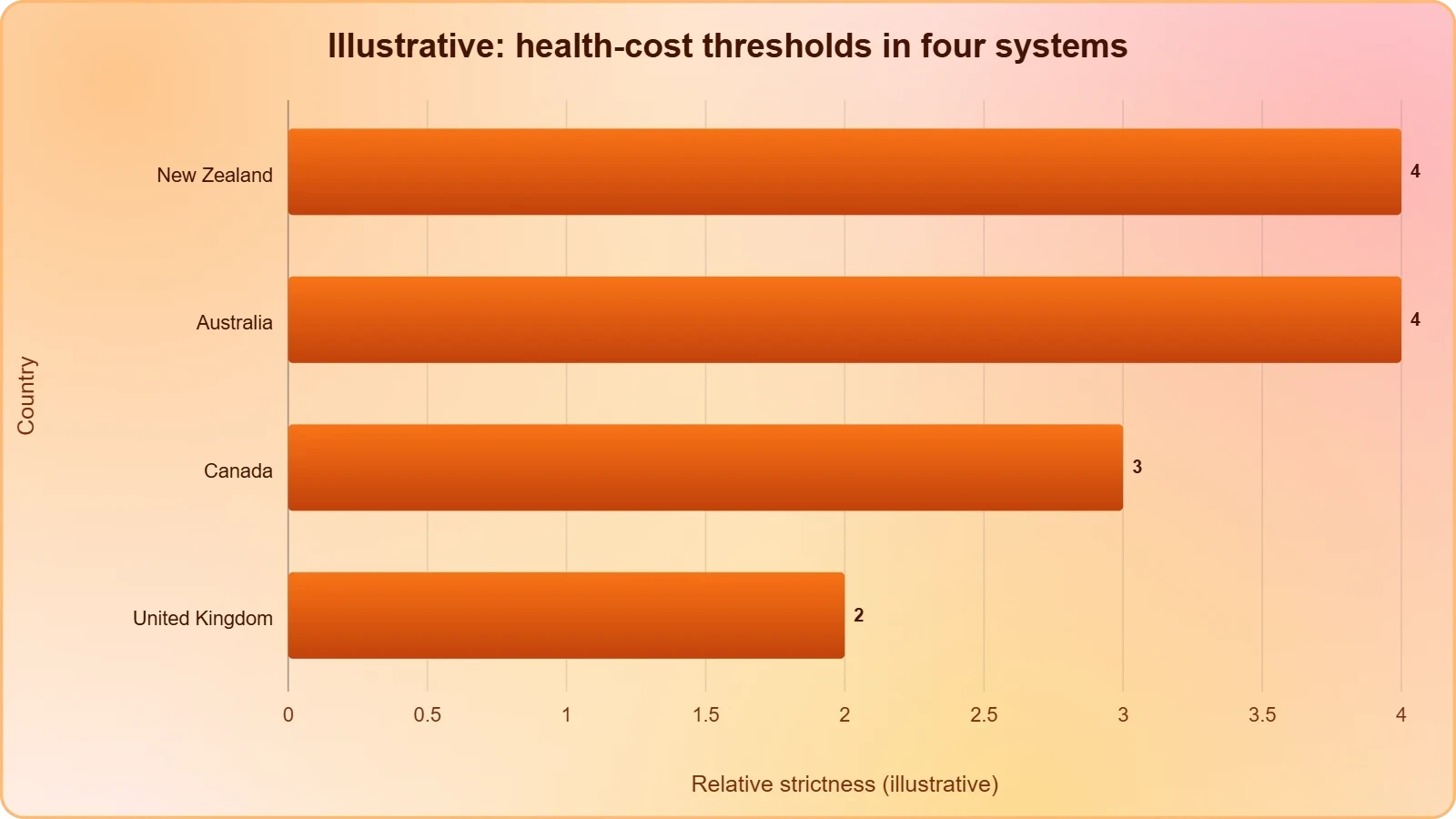
The tension is not unique to New Zealand. Australia, Canada, and the United Kingdom all operate health-based inadmissibility rules with varying thresholds and exemptions. What differs is how generously decision-makers apply humanitarian discretion when the health criterion collides with compelling family circumstances. Critics argue that the assessment is often mechanical, focused on projected costs rather than on the actual availability of family care. When a citizen son is willing and able to support his mother, the calculus shifts — yet the rules rarely accommodate that shift without ministerial intervention.
Family Ties and the Meaning of Support
Bhatia's central claim is that his mother has no family support in India and that both her children live in New Zealand. This is the kind of fact that humanitarian discretion is supposed to capture. Family ties are not sentimental extras in immigration law; they are recognised factors in virtually every compassionate assessment framework. The difficulty is evidentiary. Decision-makers must weigh claims of isolation against country information, and applicants must prove a negative — the absence of a support network — which is inherently difficult. Documents from immigration advisers attempt to bridge that gap, but their persuasive force depends on how thoroughly they are read.
The deeper question is what "support" means in practice. For an elderly woman with serious illness, support is not an abstraction; it is transport to dialysis, management of medication, a home in which to recover, and a person to call at night. These are the things a son provides and a distant relative cannot. When the state declines to recognise that reality, it is effectively asserting that the formal availability of a returnable life outweighs the substantive absence of one. That assertion may be legally defensible, but it is difficult to describe as humane.
The Human Ledger: Emotional, Mental, and Financial Costs
Bhatia's description of the past seven years — emotionally, mentally, and financially draining — is the part of the story that statistics cannot capture. Prolonged immigration uncertainty operates as a chronic stressor, affecting sleep, work performance, relationships, and mental health. Families in this position describe a cycle of hope and disappointment tied to application timelines, each renewal a small reprieve and each refusal a fresh wound. The financial dimension is equally concrete: legal fees, immigration adviser costs, medical assessments, and the expense of supporting an elderly relative without public healthcare access accumulate into a substantial burden borne entirely by the citizen sponsor.
There is also the health trajectory of the applicant herself. Devi's condition has worsened over the period of uncertainty, which is unsurprising given the well-documented relationship between stress and chronic illness progression. The family's account suggests that the immigration process has not merely coincided with her decline but contributed to it. This is the human ledger that policy debates rarely itemise: the cost of limbo is paid in health, in family stability, and in the erosion of trust in institutions. When Bhatia says he has lost faith in New Zealand, he is describing a civic loss as much as a personal one.
Stress, Illness, and the Cost of Limbo
Medical research consistently links prolonged uncertainty to adverse health outcomes, particularly among older adults managing chronic conditions. For a patient with stage five kidney disease, stability is not a luxury; it is part of treatment. Regular dialysis, consistent medication, and a predictable care environment materially affect prognosis. Immigration limbo undermines all three. The irony is that the health criterion used to assess inadmissibility is itself worsened by the process of assessment and delay. A system that worries about the cost of care inadvertently creates conditions that increase the need for it.
This dynamic is not confined to New Zealand. Studies of immigrant families in comparable jurisdictions describe similar patterns: elderly parents arriving on temporary visas, developing conditions that make return impractical, and then facing removal at precisely the moment when continuity of care matters most. The policy response has generally been to tighten eligibility rather than to design a humane pathway for ageing parents. That choice is defensible on fiscal grounds, but it should be made explicitly rather than displaced onto individual ministerial decisions that carry enormous human weight.
Faith, Belonging, and Civic Trust
Bhatia's statement that he has lost faith in New Zealand carries a significance beyond personal disappointment. Citizenship is a reciprocal relationship: the state grants status and protection, and the citizen offers loyalty, labour, and civic participation. When a citizen's most basic familial obligation — caring for an ailing parent — is frustrated by administrative rigidity, the reciprocity feels broken. This is why immigration cases of this kind resonate politically. They are not abstract policy disputes; they are tests of whether the social contract extends to the people a citizen loves.
The political response has been telling. Labour MP Megan Woods characterised the decision as "absolutely heartless," a phrase that frames the issue in moral rather than legal terms. Such framing is effective because it aligns with public intuition: a country that admits a citizen's mother for years and then expels her in ill health appears to be applying rules without judgment. Whether or not the minister's decision was legally sound, the perception of heartlessness is itself a political fact. Governments ignore such perceptions at their cost, particularly when the affected family is articulate, persistent, and visibly sympathetic.
We Also Published
- 01
- 02
- 03
- 04
Ministerial Discretion, Politics, and the Opposition's Role
Opposition politicians play a distinctive role in immigration cases: they cannot change the decision, but they can change its political meaning. Megan Woods's intervention reframed the refusal from a routine administrative outcome into a moral indictment. That is standard opposition practice, and it is also a form of accountability, since ministers are answerable in Parliament for the exercise of their delegated powers. The effectiveness of such interventions depends on the sympathy of the case and the credibility of the MP. In this instance, the combination of a seriously ill elderly woman, a long-resident citizen son, and a terse refusal proved potent.
The minister's position is equally understandable from a governance perspective. If every sympathetic case triggered intervention, the immigration system would collapse into case-by-case discretion, undermining the rules that apply to thousands of other applicants. Ministers are advised to intervene only where there are exceptional circumstances that the policy framework cannot accommodate. The question in the Bhatia case is whether those circumstances were genuinely assessed. The family's suspicion that their documents were not fully reviewed strikes at the heart of the process, because a decision made without proper consideration is not a discretionary judgment at all — it is an abdication of it.
Accountability Without Casework Disclosure
Democratic accountability normally operates through transparency, but immigration casework is inherently confidential. The result is a structural tension: ministers must answer for decisions they cannot discuss. In practice, this is managed through general statements about process, assurances that cases are considered carefully, and occasional policy announcements. For the affected family, such assurances ring hollow. The privacy waiver offered by Bhatia was an attempt to break through this wall, and the minister's continued silence — even on privacy grounds — suggests that the wall is not merely legal but institutional.
Reformers have proposed various mechanisms to improve accountability without breaching confidentiality: published decision summaries, independent review of ministerial refusals, and clearer published criteria for intervention. Each has merits and drawbacks. Published summaries could protect privacy while illuminating reasoning; independent review could reassure applicants that decisions are not arbitrary; clearer criteria could reduce the volume of hopeless applications. None of these reforms would guarantee outcomes like the one the Bhatia family sought, but they would make the system legible — and legibility is a precondition of trust.
Precedent, Deterrence, and the Signal Sent
Every ministerial decision sends a signal beyond the individual case. A grant signals that compassion can override rules in exceptional circumstances; a refusal signals that the rules will hold. Governments worry about precedent because generous decisions invite imitation. Yet refusals also set precedents, and they can signal that even severe illness and long family residence will not move the state. The balance between these signals is a political judgment, and it is one that ministers make implicitly with every case they decline. The Bhatia refusal will be cited by future applicants and by future ministers, shaping expectations on both sides.
There is also an international dimension. New Zealand competes for skilled migrants and for the loyalty of its diaspora, and its reputation for fairness matters in that competition. Cases that attract headlines describing a decision as "absolutely heartless" carry reputational costs that are difficult to quantify but real. Countries that handle such cases with visible humanity — through clear pathways, timely decisions, and reasoned explanations — build trust that pays dividends in migration and investment. Those that do not may find that individual refusals accumulate into a broader perception of coldness.
What a Humane Immigration System Might Look Like
Critics of the current framework rarely argue for open borders; they argue for coherence. A humane system would recognise that elderly parents of citizens are a foreseeable category, not an anomaly, and would design a pathway that reflects their circumstances. That could take the form of a capped but accessible parent visa with realistic health-cost sharing, a long-term visitor category with limited healthcare access, or a humanitarian stream specifically for cases where return is impractical. Each option involves trade-offs, but the current arrangement — indefinite temporary status punctuated by ministerial pleas — serves neither the state's fiscal interests nor the families' human needs.
Timeliness is equally important. Seven years of uncertainty is not a feature of a well-functioning system; it is a failure of process. Faster decisions, clearer criteria, and earlier assessments of medical and family factors would reduce the limbo that damages health and finances alike. The Bhatia case illustrates how delay compounds every other problem: the mother's condition worsened, the son's resources depleted, and the eventual refusal arrived at the point of maximum vulnerability. A system that decided sooner, even if it decided the same way, would have been less cruel.
Design Principles for Compassionate Administration
Compassionate administration does not require abandoning rules; it requires applying them with attention to context. Three principles follow from the Bhatia case. First, evidence submitted should be demonstrably considered, with decisions that reference the material provided. Second, health assessments should weigh family care capacity, not merely projected costs. Third, ministerial refusals should include brief reasons, subject to privacy safeguards, so that applicants understand the basis of the decision. These principles are modest, administratively feasible, and would substantially improve the perceived legitimacy of the system without opening the floodgates to discretionary grants.
There is also a case for independent oversight. An ombudsman-style review of ministerial refusals could examine whether relevant evidence was considered without disclosing personal details publicly. Such a mechanism would give applicants a meaningful avenue short of judicial review, which is costly and narrow. It would also protect ministers from accusations of arbitrariness by demonstrating that decisions are subject to scrutiny. The cost would be modest relative to the reputational and human benefits, and it would signal that discretion is exercised within a framework of accountability rather than in its absence.
The Family's Next Moves and the Wider Lesson
For Bhatia, the options are narrowing. He can seek judicial review of the decision on procedural grounds, approach the media and MPs for continued pressure, or prepare for his mother's departure while exploring care arrangements in India. Each path is costly, and none guarantees the outcome he seeks. His stated goal — to care for his mother without fear of immigration action — remains as reasonable as it was seven years ago, and as distant. The case may yet attract further political attention, particularly if the family's circumstances deteriorate, but ministerial refusals are rarely reversed without new evidence or a change of government.
The wider lesson is that immigration systems reveal their values at the margins. Most applicants never need ministerial intervention; the few who do are, by definition, the hardest cases. How a state treats them says more about its character than any policy document. New Zealand has long projected an image of pragmatic fairness, and the Bhatia case tests that image. Whether the minister's decision is ultimately vindicated or revisited, the episode has already done something important: it has forced a public conversation about what citizens owe their parents, and what the state owes its citizens when they try to pay that debt.
Reading the Case Against Broader Migration Debates
The Bhatia case arrives at a moment when migration policy across the developed world is being renegotiated. Ageing populations need workers; electorates demand control; health systems strain under demand. Within this environment, the parents of migrants occupy an awkward position: they are not workers, they often consume healthcare, and they arrive through family rather than economic channels. Yet they are also the reason many migrants settle and stay. Ignoring their circumstances does not make them disappear; it merely pushes their care into informal arrangements and their status into legal grey zones. The case is therefore a local instance of a global dilemma.
Comparisons with Australia are inevitable given proximity and similar policy traditions. Australia's parent visa categories are also capped and slow, and its health requirements similarly stringent, but it operates a contributory parent scheme that allows families to pay for faster processing and to offset projected costs. New Zealand has debated similar mechanisms without adopting them at scale. The comparison suggests that the problem is not compassion deficit alone but design: systems that price family reunification explicitly tend to handle hard cases more predictably than systems that rely on discretionary mercy.
Comparative Perspectives on Parent Migration
Canada's super visa offers a useful contrast: a long-duration visitor visa for parents and grandparents, requiring private medical insurance and a sponsor's income guarantee. It does not confer residency, but it provides stability and reduces the cycle of renewal. The United Kingdom's adult dependent relative route is extraordinarily restrictive, requiring proof that care is unavailable or unaffordable in the home country — a threshold few meet. Each model reflects different national priorities, but all grapple with the same underlying question: how much should a state invest in keeping families together when the family member is elderly and unwell?
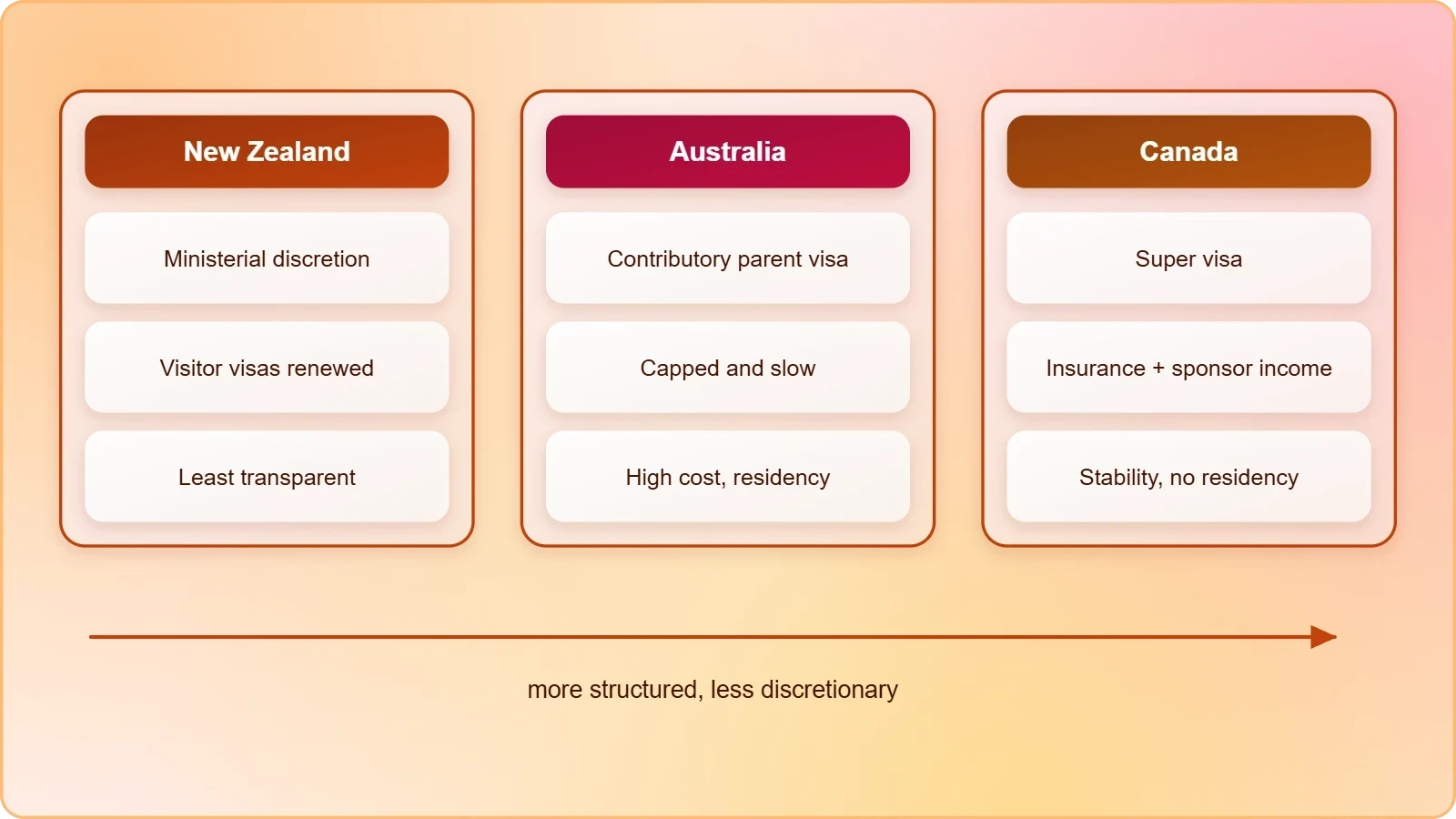
These comparisons do not yield a single best practice, but they clarify the choices. New Zealand's reliance on ministerial discretion is the least transparent of the models, and the least predictable for families. A more structured approach — whether contributory, insurance-based, or humanitarian — would at least make the rules visible and the outcomes explicable. The Bhatia case is a reminder that invisibility is not neutrality: when the rules are unclear, the burden falls hardest on those with the fewest resources to navigate them.
Public Opinion and the Politics of Sympathy
Public opinion on immigration is often assumed to be uniformly restrictive, but the evidence is more nuanced. Surveys consistently show that sympathy rises sharply for cases involving illness, family separation, and long residence — precisely the features of the Bhatia case. This creates political space for humane reform, provided it is framed as targeted rather than open-ended. Politicians who dismiss such cases as mere sentiment risk misreading an electorate that distinguishes between border control and individual compassion. The two are not contradictory; most voters support firm rules and humane exceptions.
The minister's refusal may therefore carry electoral risk disproportionate to its administrative significance. A single case, well publicised and sympathetically framed, can crystallise broader perceptions of a government's character. Whether or not that happens here depends on how the story develops and whether the family persists. But the ingredients are present: a vulnerable elderly woman, a devoted citizen son, a terse refusal, and an opposition willing to amplify. In politics, such combinations rarely fade quietly.
Conclusion: The Weight of a Single Refusal
The Bhatia-Devi case is small in administrative terms and large in human ones. It concerns one family, one minister, and one decision, yet it illuminates the entire architecture of discretionary immigration: the reliance on temporary status, the opacity of decision-making, the collision of health criteria with family obligation, and the political consequences of perceived coldness. The family's seven-year effort has not produced the security they sought, and the minister's refusal has not produced the closure that a clear decision might have offered. Instead, the case lingers, unresolved in public debate and unresolved in the lives of the people involved.
What remains is a question that no policy framework can fully answer: how should a state weigh the claims of a citizen's parent against the claims of its rules? The Bhatia case suggests that the answer cannot be purely procedural. Rules exist to make decisions predictable and fair, but they also require judgment at the edges, and judgment requires attention to the specific facts of a life. Whether or not the minister's decision is revisited, the case has already demonstrated that immigration systems are judged not only by their outcomes but by how they explain themselves — and by whether the people subject to them believe they were heard.
From our network :
- University Language Proficiency Exams: Why Institutional Tests Demand Different Preparation Than IELTS and TOEFLDiscover why university-specific language proficiency examinations differ fundamentally from IELTS and TOEFL, and learn strategic preparation approaches for institutional assessment success.
- CISA’s Ten-Advisory Wave: Why Generic Patching Fails in OT and How to Build Product-Specific PlaybooksCISA released ten ICS advisories in one week, exposing critical infrastructure risks. Generic patching fails in OT. Learn to build product-specific remediation playbooks.
- Mobile Learning and VR in English: What Global Evidence Reveals About Effective Language TechnologyA systematic review across 14 countries reveals which language-learning technologies genuinely work. Mobile learning, AI, and VR show measurable benefits when pedagogically integrated. This evidence-based guide helps educators and learners select technology that delivers real return on investment.
- Forbidden Matrix Patterns and Visible Lattice Points: A Geometric DictionaryExplore how multidimensional 0–1 matrices encode geometric truths, linking forbidden patterns to visible lattice points and hypergraph theory, with applications in combinatorics and computational geometry.
- The Hidden Cost of AI Convenience: Why Over-Permissioned Agents Are a Security Time BombDiscover why AI agents with excessive permissions create dangerous single points of failure, and learn how implementing least privilege principles can protect your organization from exploitation.
- Live Online English Classes for Kids: Do They Actually Reduce Anxiety?A ten-week study reveals that synchronous online English classes can significantly reduce child language anxiety while improving listening and reading skills. Discover what makes these programs effective and how parents can select the right one.
- Committed Mediterranean Precipitation Decline: Why Emissions Cuts Alone Cannot Restore Winter RainsNew NOAA research reveals that Mediterranean winter rains may decline irreversibly even with emissions cuts. Explore the science of committed climate change and regional impacts.
- The Final Descent: How ESA Retired the Legendary Cluster Constellation After 24 Years of Space Weather ScienceAfter 24 years mapping Earth’s magnetosphere, ESA’s Cluster mission concluded with a precisely controlled reentry over the South Pacific. This analysis explores the scientific legacy, engineering decisions, and debris mitigation principles behind one of space exploration’s most responsible retirements.
- How AI Agents Will Change the Way We Manage Personal FinancesExplore how AI agents are transforming personal finance through automated budgeting, bill payment, and investment management, while examining the critical security protocols and governance frameworks required for safe deployment.
RESOURCES
- Resources will be updated soon.
- 01
- 02
- 03
- 04
- 05
- 06
- 07
- 08
0 Comments