
The reported decision by a court in the United Kingdom to overturn a Trinidad and Tobago statute criminalising consensual same-sex relations between men raises a dense cluster of legal, constitutional and geopolitical questions that reach far beyond the headline. At its surface, the ruling appears to strike down a colonial-era prohibition that had remained on the statute books of the twin-island republic long after independence. Yet the deeper significance lies in how such a decision interacts with national sovereignty, the architecture of Commonwealth legal systems, and the ongoing global debate over the decriminalisation of private intimacy. Understanding the story requires separating what was actually decided from what observers assume was decided.
The source material is deliberately sparse. It confirms that a UK court overturned the law, that the law concerned consensual sexual relations between male same-sex couples, and that the provision is no longer in effect. It does not identify the court, the parties, the precise legal mechanism, or the route by which a British tribunal could purport to invalidate a Trinidadian statute. That absence of detail matters enormously, because the constitutional relationship between the United Kingdom and Trinidad and Tobago changed decisively in 1962, when the islands became independent, and again in 1976, when they became a republic within the Commonwealth. Any serious reading must therefore treat the report as a signal rather than a complete legal record.
What follows examines the ruling through six analytical lenses: the colonial legal inheritance that produced such statutes, the sovereignty questions raised by external judicial intervention, the human-rights framework invoked by decriminalisation advocates, the regional Caribbean context, the practical consequences for citizens and institutions, and the wider signal for other jurisdictions still carrying similar provisions. Each section weighs evidence carefully and flags where the public record remains thin, so that readers can distinguish established fact from reasonable inference and speculation.
On This Page
TL;DR A UK court has reportedly overturned a Trinidad and Tobago law that criminalised consensual same-sex relations between men, and the provision is said to be no longer in effect. The report is thin on specifics, leaving open critical questions about which court acted, on what legal basis, and how a British tribunal could bind an independent Caribbean republic. The decision nonetheless sits within a broader pattern of colonial-era morality laws being challenged across the Commonwealth, and it sharpens the tension between external human-rights enforcement and national sovereignty. The practical effect for Trinidad and Tobago, and the precedent for other states, will depend on details the original report did not supply.
The Colonial Legal Inheritance Behind the Statute
The law at the centre of the report belongs to a family of provisions exported across the British Empire during the nineteenth century. Trinidad and Tobago, like many Caribbean territories, received criminal codes modelled on English and Indian statutory templates that penalised "buggery" and "gross indecency" between men. These provisions survived independence because decolonisation transferred sovereignty without automatically rewriting the criminal law. The result is a peculiar legal archaeology in which Victorian moral assumptions remain embedded in the statute books of modern republics, often untouched for decades simply because no government wished to expend political capital on repeal.
Understanding this inheritance clarifies why the story is framed as an "overturning" rather than a parliamentary repeal. Legislatures across the region have repeatedly declined to amend these provisions, sometimes citing public opinion, sometimes citing religious constituencies, and sometimes simply avoiding the issue. Where the political route has stalled, litigants have turned to constitutional courts, arguing that such laws violate guarantees of equality, privacy and freedom of expression. That litigation strategy has produced a slow, uneven wave of decriminalisation across the Caribbean, and it is the context in which any external judicial intervention must be assessed.
The Mechanics of Imperial Legal Export
British colonial legal administration rarely drafted criminal codes from scratch. Officials adapted templates, most influentially the Indian Penal Code of 1860, and reissued them across widely separated territories. Sections penalising consensual same-sex conduct travelled through these channels into Caribbean, African and Asian statute books, often with near-identical wording. This explains why campaigners today speak of a shared colonial legacy rather than a series of unrelated national quirks. The provisions were never organic expressions of local custom; they were administrative imports, and that history is central to arguments that they lack democratic legitimacy in the states that inherited them.
The persistence of these sections after independence reflects institutional inertia as much as conviction. Repeal requires legislative time, political courage and, frequently, confrontation with organised religious opposition. Governments facing pressing economic and security challenges have tended to defer the question indefinitely. Courts, by contrast, can be compelled to address it through individual litigation, which is why the judicial route has become the principal engine of change. The Trinidad and Tobago report, whatever its precise mechanism, fits that pattern of courts displacing legislatures on a question politicians have found convenient to avoid.
Why the Statute Survived Independence
Independence constitutions typically preserved all existing law unless expressly repealed, a device known as the reception or savings clause. This continuity principle was designed to prevent legal chaos at the moment of transition, but it had the side effect of entrenching morally contested provisions. Trinidad and Tobago's 1962 independence and its 1976 republican constitution both left the inherited criminal code substantially intact. Reformers therefore had to argue not that the law was never valid, but that it had become incompatible with later constitutional guarantees of equality and private life.
That argument has force in jurisdictions whose constitutions contain explicit non-discrimination clauses. Where such clauses are absent or narrowly drafted, litigants face a harder path. The Trinidadian constitution, like several in the region, protects equality before the law but does not enumerate sexual orientation as a protected ground, which has made domestic challenges legally intricate. This constitutional texture helps explain why external judicial involvement, however unusual, might be reported as decisive: domestic avenues are slow, contested and politically fraught, and any external ruling acquires outsized symbolic weight.
Sovereignty and the Limits of External Judicial Power
The most immediate analytical puzzle is jurisdictional. Trinidad and Tobago has been a sovereign state since 1962 and a republic since 1976. Its final court of appeal is the Judicial Committee of the Privy Council in London, a body that hears appeals from several Commonwealth states that have retained that link. If the reported ruling emanated from the Privy Council, the decision would be legally binding within the Trinidadian system, and describing it as a "UK court" would be technically accurate but substantively misleading. If it came from a different British tribunal, the constitutional basis becomes far less clear and demands scrutiny.
This distinction is not pedantry. The Privy Council's continued role is a deliberate choice by sovereign states that value its jurisprudence and institutional distance from domestic politics. When it rules on a Trinidadian appeal, it acts as the republic's highest appellate court, not as an instrument of British foreign policy. Conflating the two misreads the constitutional arrangement and inflames sovereignty sensitivities. A careful reading of the report must therefore ask which court acted, because the answer determines whether the decision is binding law, persuasive authority, or something stranger still.
The Privy Council Question
The Judicial Committee of the Privy Council remains the apex court for a number of Commonwealth states, including several in the Caribbean. Its judges are largely UK Supreme Court justices sitting in a different capacity, which creates a persistent optics problem: decisions that are formally Trinidadian law are delivered by jurists in London. Defenders argue that the arrangement supplies impartiality, deep appellate experience and insulation from local political pressure. Critics counter that it perpetuates a colonial hierarchy and that the Caribbean Court of Justice, based in Port of Spain, should assume the role. The debate is live and politically charged across the region.
If the reported ruling indeed came from the Privy Council, the phrase "UK court overturns Trinidad and Tobago law" is legally defensible but rhetorically loaded. It would mean the republic's own highest court, constituted under its own constitutional arrangements, struck down an inherited provision. That framing transforms the story from external interference into domestic constitutional adjudication conducted at one remove. The distinction will shape how the decision is received in Port of Spain, where sensitivity to colonial-era authority remains acute and where any hint of metropolitan dictation invites backlash.
Reading a Thin Report Responsibly
Journalism on legal developments often compresses procedural complexity into a single verb. "Overturns" can mean a final appellate judgment, an interim injunction, a declaratory ruling, or a consent order, each carrying different consequences. The source report supplies none of these specifics, and responsible analysis must acknowledge the gap rather than fill it with assumption. Readers should treat the headline as a pointer to a developing legal event and look to the judgment text, the parties and the court's reasoning before drawing firm conclusions about precedent or enforceability.
This caution is not evasion; it is method. Legal claims carry real consequences for real people, and misdescribing a ruling's status can mislead citizens about their rights and obligations. The prudent approach is to state what is known, identify what is missing, and explain why the missing pieces matter. That discipline distinguishes analysis from advocacy and equips readers to evaluate subsequent reporting as fuller details emerge from court records, government statements and civil-society responses.
We Also Published
The Human-Rights Framework Invoked
Decriminalisation campaigns rest on a well-developed human-rights architecture. International covenants protect privacy, equality before the law and freedom from arbitrary detention, and UN treaty bodies have repeatedly held that laws criminalising consensual same-sex conduct violate these guarantees. Regional courts have reached similar conclusions, reasoning that the mere existence of such statutes chills the exercise of fundamental freedoms even when prosecutions are rare. The Trinidad and Tobago provision, like its analogues, thus sits in direct tension with obligations the state has assumed under international law.
The practical harm of such laws extends well beyond prosecution statistics. Criminalisation licenses police harassment, enables extortion, discourages victims of violence from seeking protection, and obstructs public-health outreach to communities at elevated risk. These downstream effects are documented across jurisdictions and form a central plank of the case for repeal. Advocates argue that a statute need not be actively enforced to cause injury; its existence on the books is itself a statement that a class of citizens is presumptively criminal, and that stigma radiates through policing, employment, healthcare and family life.
Privacy, Equality and Dignity
Constitutional challenges typically invoke three overlapping rights: privacy, equality and dignity. Privacy arguments hold that consensual adult intimacy falls within a protected sphere into which the state may not intrude without compelling justification. Equality arguments contend that singling out one class of citizens for criminal sanction denies them equal protection of the law. Dignity arguments tie the two together, asserting that a statute branding a person's intimate life as criminal diminishes their standing as a full member of the political community. Courts across jurisdictions have found these arguments mutually reinforcing.
The counter-arguments are equally well rehearsed. Defenders of such statutes invoke majoritarian morality, religious tradition and, occasionally, public-health claims. Courts have generally found these insufficiently weighty to justify criminal intrusion into private conduct, particularly where the asserted harms are speculative or unsupported by evidence. The trajectory of comparative jurisprudence is strongly toward decriminalisation, which lends external rulings persuasive force even where they lack direct binding authority. That persuasive dimension matters in Trinidad and Tobago, where domestic courts watch regional and Commonwealth precedents closely.
Enforcement Reality Versus Symbolic Force
Prosecutions under these provisions are rare, and convictions rarer still. Some observers therefore argue that repeal is symbolic rather than practical. That view underestimates the operational power of an unenforced statute. Police discretion is shaped by what the law permits, and a provision authorising arrest creates routine opportunities for abuse that never appear in conviction statistics. Civil-society organisations across the Caribbean report that the mere existence of such laws emboldens vigilante violence and discourages victims from approaching authorities, producing a chilling effect that is difficult to quantify but widely attested.
Symbolism and substance are therefore entangled. Repeal signals that a class of citizens is no longer presumptively criminal, which can shift institutional behaviour over time. Conversely, a court ruling that strikes down the provision without accompanying legislative reform may leave gaps in training, policy and public understanding. The most durable decriminalisation tends to combine judicial invalidation with executive guidance and legislative consolidation, ensuring that police, prosecutors and the public understand the new legal position. Whether Trinidad and Tobago follows that fuller path remains to be seen.
The Caribbean Regional Context
Trinidad and Tobago does not stand alone. Across the Caribbean, colonial-era provisions have been challenged, repealed or upheld in a patchwork of outcomes reflecting differing constitutional texts and political climates. Belize's highest court struck down its provision in 2016, a decision affirmed on appeal. Barbados repealed its law through parliamentary amendment in 2022, a route that avoided judicial confrontation. Jamaica's provision remains in force despite sustained litigation and international pressure. This uneven landscape means any Trinidadian development is read regionally as a signal about which route, judicial or legislative, is gaining momentum.
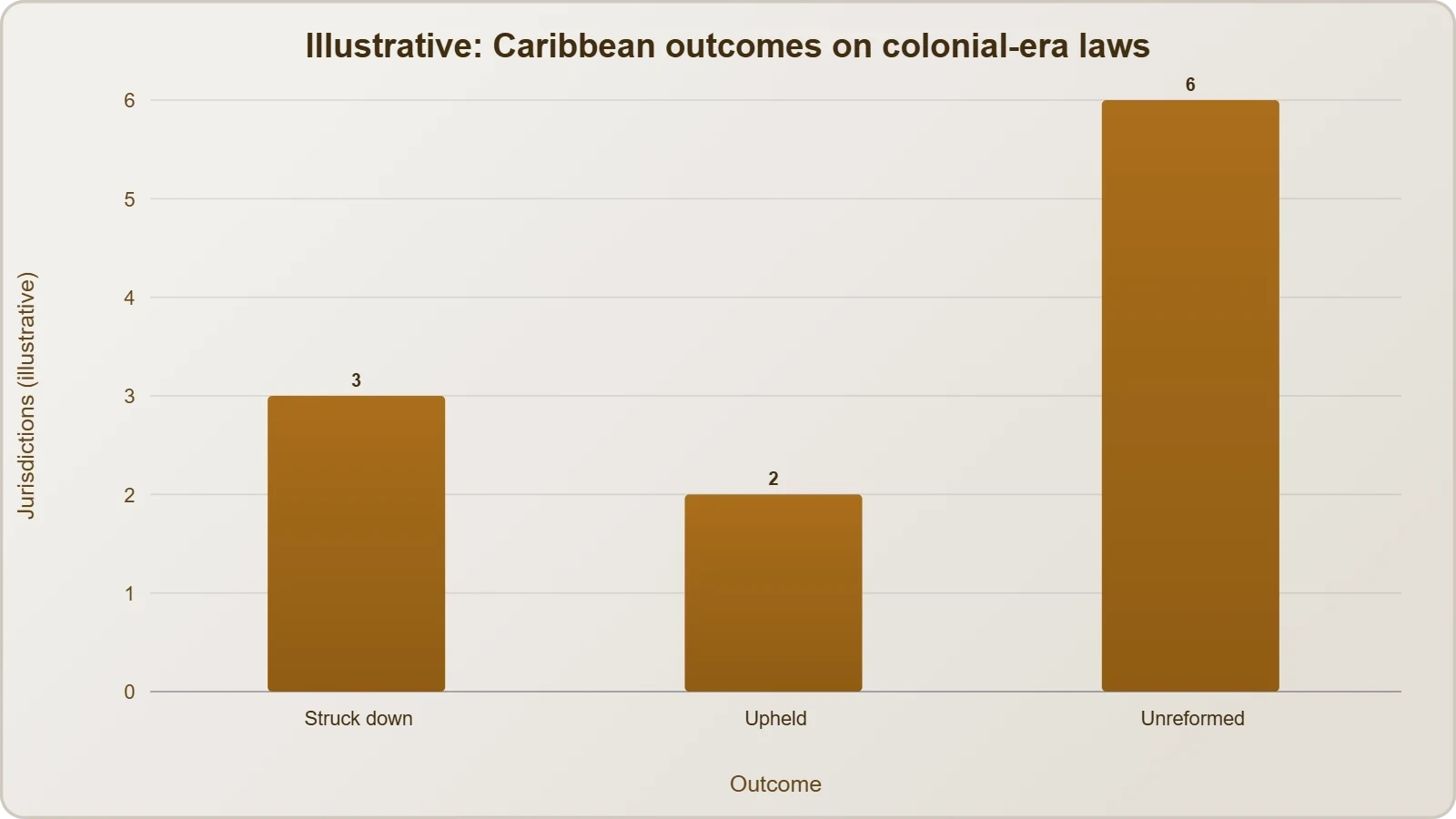
Regional politics complicate the picture. Organised religious constituencies wield substantial influence across much of the Caribbean, and governments are wary of appearing to capitulate to external pressure. Sovereignty rhetoric is readily available and politically potent, particularly when a ruling originates outside the region. Campaigners therefore emphasise domestic constitutional arguments over international obligations, framing decriminalisation as fidelity to local constitutional values rather than submission to foreign norms. That framing is strategically astute and reflects a broader postcolonial sensitivity that any external judicial intervention must navigate carefully.
- 01
- 02
- 03
- 04
Divergent Constitutional Texts
The Caribbean's patchwork outcomes are largely explained by constitutional drafting. Some states entrench broad non-discrimination clauses that courts can read to include sexual orientation; others protect enumerated grounds only, leaving litigants to argue through privacy or freedom of expression instead. Trinidad and Tobago's constitution falls into the more restrictive category, which is precisely why domestic challenges have been protracted. A ruling that bypasses these textual constraints, whether from a domestic or external court, would represent a significant constitutional moment and would likely provoke debate about judicial overreach.
Comparative experience suggests that textual ambiguity rarely produces clean resolutions. Courts that invalidate such provisions often do so on multiple independent grounds, building redundancy into the judgment so that it survives appeal on any single issue. The reasoning matters as much as the outcome, because it shapes how legislatures and executives respond. A narrow ruling invites legislative circumvention; a broad one may trigger political backlash. Observers of the Trinidadian case will therefore scrutinise not only the result but the doctrinal path taken to reach it.
Diplomatic and Soft-Power Dimensions
Decriminalisation is increasingly a component of international diplomatic engagement, particularly through development assistance, trade preferences and multilateral human-rights mechanisms. Caribbean states are not immune to these pressures, though they resist overt conditionality. The Commonwealth Secretariat has encouraged reform, and successive Commonwealth heads-of-government meetings have grappled with the legacy of colonial-era laws. This soft-power context means that a ruling described as emanating from the UK will inevitably be read through a lens of metropolitan influence, whatever the formal legal position.
Managing that perception is a diplomatic task in itself. Governments that welcome reform must frame it as consistent with national values rather than external instruction. Those that resist must weigh the reputational and economic costs of continued criminalisation against domestic political pressures. The Trinidadian government's response to the reported ruling will therefore be closely watched, both regionally and internationally, as an indicator of how the balance between sovereignty rhetoric and human-rights norms is being struck in the contemporary Caribbean.
Practical Consequences for Citizens and Institutions
If the provision is indeed no longer in effect, the immediate practical consequence is that consensual sexual relations between men cease to be a criminal offence in Trinidad and Tobago. That change affects policing practice, prosecutorial discretion and the legal position of citizens who were previously exposed to arrest. It does not, by itself, create new protections against discrimination in employment, housing or healthcare, nor does it automatically expunge historical convictions. Those are separate legislative and administrative tasks that typically follow decriminalisation and often take years to complete.
Institutions will need to adapt. Police forces require updated guidance so that officers do not continue to act on a repealed or invalidated provision. Prosecutors need clarity about pending cases. Courts must determine how to treat past convictions. Public-health agencies may adjust outreach strategies now that criminal exposure is removed. Each of these adjustments involves bureaucratic inertia and potential resistance, and the gap between a legal ruling and changed institutional behaviour is often wide. Civil-society organisations will play a crucial monitoring role in that interval.
Rights That Decriminalisation Does Not Confer
Decriminalisation removes a penal sanction; it does not establish relationship recognition, anti-discrimination protections or family-law rights. Those require separate legislative action, and in much of the Caribbean the political conditions for such action remain unfavourable. Campaigners are careful to distinguish the two agendas, since conflating them can jeopardise the narrower goal of repeal. The Trinidadian ruling, if confirmed, would settle the criminal question while leaving the broader equality agenda untouched, a distinction that will shape how advocates calibrate their next steps.
This gap matters for how the decision is characterised. Describing it as a victory for equality overstates what a criminal-law ruling can achieve. Describing it as merely symbolic understates the tangible relief it brings to citizens who were legally exposed to arrest. The honest assessment is that decriminalisation is a necessary but insufficient condition for full legal equality, and that the Trinidadian case, whatever its precise contours, advances the first objective while leaving the second conspicuously unfinished.
Backlash Risks and Political Economy
Reform rarely proceeds without resistance. Religious organisations, opposition parties and populist movements may mobilise against a ruling perceived as externally imposed, and governments may face pressure to legislate around it or to campaign for constitutional amendments. The political economy of backlash is real: reform that arrives through courts rather than parliaments can lack the public legitimacy that sustained deliberation confers. Comparative experience suggests that durable change usually requires a period of public argument in which the case for decriminalisation is made in local terms and owned by local institutions.
Managing backlash is therefore part of the reform process, not an afterthought. Civil-society organisations, sympathetic legislators and international partners can help build a public narrative that frames decriminalisation as consistent with national constitutional values and public-health priorities. The alternative, a narrow legal victory followed by political retrenchment, risks leaving citizens in a precarious position where the statute is gone but the stigma and institutional hostility persist. The Trinidadian outcome will depend heavily on how these political dynamics unfold in the months ahead.
Wider Implications for Commonwealth Jurisdictions
The Trinidadian development, if confirmed, adds to a growing body of precedent that other Commonwealth states will study closely. Roughly three dozen jurisdictions worldwide still criminalise consensual same-sex conduct, a substantial number of them former British territories carrying inherited provisions. Each new invalidation strengthens the comparative argument that such laws are incompatible with modern constitutional guarantees. It also provides litigants elsewhere with persuasive authority, doctrinal templates and strategic lessons about which arguments and forums are most effective.
The mechanism matters as much as the outcome. If the ruling came through the Privy Council, it demonstrates that the appellate route can deliver reform even where domestic legislatures will not act. If it came through another channel, it raises novel questions about the reach of British courts that other states will need to assess. Either way, the case will enter the comparative canon and be cited in future litigation, making the precise reasoning and jurisdictional basis of considerable long-term importance to campaigners and governments alike.
Precedent and Persuasive Authority
Common-law systems treat precedent as a resource rather than a command across sovereign borders. A ruling in one jurisdiction does not bind another, but it can be cited, distinguished and adapted. Litigants in states still carrying colonial-era provisions will examine the Trinidadian reasoning for arguments that travel well, particularly on privacy and equality. The more robust the reasoning, the more useful the precedent becomes. Conversely, a ruling resting on narrow or idiosyncratic grounds will have limited persuasive reach, which is why the judgment's doctrinal architecture deserves close attention.
International human-rights bodies add a parallel layer of authority. UN treaty monitoring committees have consistently recommended decriminalisation, and regional human-rights courts have issued binding judgments against states that retain such laws. These sources reinforce domestic and comparative arguments, creating a cumulative body of authority that makes continued criminalisation increasingly difficult to defend in legal terms. The Trinidadian case, whatever its precise status, joins that accumulation and strengthens the hand of reformers across the Commonwealth.
What to Watch Next
Several developments will clarify the picture. The publication of the full judgment, if it exists, will reveal the deciding court, the parties and the reasoning. Statements from the Trinidadian government and attorney general will indicate whether the ruling is accepted, contested or appealed. Civil-society organisations will report on practical effects, including any change in policing behaviour. Regional bodies may comment, and other states with similar provisions may face renewed pressure. Each of these signals will help observers move from the thin initial report toward a fuller understanding of a significant legal event.
Readers should also watch for the possibility that the initial report compressed or mischaracterised the ruling. Early reporting on legal matters frequently simplifies, and the gap between headline and judgment can be substantial. The responsible posture is to follow the story with attention to primary sources, to distinguish confirmed facts from inference, and to resist premature conclusions about precedent or enforceability. The Trinidadian case is important enough to merit that care, and the questions it raises about sovereignty, rights and colonial inheritance will remain relevant long after the immediate details are settled.
From our network :
- CISA’s Ten-Advisory Wave: Why Generic Patching Fails in OT and How to Build Product-Specific PlaybooksCISA released ten ICS advisories in one week, exposing critical infrastructure risks. Generic patching fails in OT. Learn to build product-specific remediation playbooks.
- The Hidden Cost of AI Convenience: Why Over-Permissioned Agents Are a Security Time BombDiscover why AI agents with excessive permissions create dangerous single points of failure, and learn how implementing least privilege principles can protect your organization from exploitation.
- Forbidden Matrix Patterns and Visible Lattice Points: A Geometric DictionaryExplore how multidimensional 0–1 matrices encode geometric truths, linking forbidden patterns to visible lattice points and hypergraph theory, with applications in combinatorics and computational geometry.
- Committed Mediterranean Precipitation Decline: Why Emissions Cuts Alone Cannot Restore Winter RainsNew NOAA research reveals that Mediterranean winter rains may decline irreversibly even with emissions cuts. Explore the science of committed climate change and regional impacts.
- University Language Proficiency Exams: Why Institutional Tests Demand Different Preparation Than IELTS and TOEFLDiscover why university-specific language proficiency examinations differ fundamentally from IELTS and TOEFL, and learn strategic preparation approaches for institutional assessment success.
- Live Online English Classes for Kids: Do They Actually Reduce Anxiety?A ten-week study reveals that synchronous online English classes can significantly reduce child language anxiety while improving listening and reading skills. Discover what makes these programs effective and how parents can select the right one.
- How AI Agents Will Change the Way We Manage Personal FinancesExplore how AI agents are transforming personal finance through automated budgeting, bill payment, and investment management, while examining the critical security protocols and governance frameworks required for safe deployment.
- The Final Descent: How ESA Retired the Legendary Cluster Constellation After 24 Years of Space Weather ScienceAfter 24 years mapping Earth’s magnetosphere, ESA’s Cluster mission concluded with a precisely controlled reentry over the South Pacific. This analysis explores the scientific legacy, engineering decisions, and debris mitigation principles behind one of space exploration’s most responsible retirements.
- Mobile Learning and VR in English: What Global Evidence Reveals About Effective Language TechnologyA systematic review across 14 countries reveals which language-learning technologies genuinely work. Mobile learning, AI, and VR show measurable benefits when pedagogically integrated. This evidence-based guide helps educators and learners select technology that delivers real return on investment.
RESOURCES
- UK court overturns Trinidad and Tobago law criminalising ... - Reutersreuters.com23 hours ago ... Trinidad and Tobago's law criminalising consensual sexual relations between male same-sex couples was overturned by a London court on ...
- UK court overturns Trinidad and Tobago law criminalizing gay sexdw.com8 hours ago ... A London court has overturned a Trinidad and Tobago law criminalizing consensual sexual relations between male same-sex couples.
- Anti-gay laws in Trinidad and Tobago overturned - BBCbbc.com23 hours ago ... A UK court has overturned laws criminalising same-sex intimacy in Trinidad and Tobago. London's Judicial Committee of the Privy Council ...
- Trinidad and Tobago: UK Court Overturns Same-Sex Conduct Lawshrw.org21 hours ago ... The UK Judicial Committee of the Privy Council on November 10, 2026, struck down Trinidad and Tobago's laws criminalizing consensual ...
- Anti-gay laws in Trinidad and Tobago overturned - BBC Newsbbc.co.uk23 hours ago ... A UK court has overturned laws criminalising same-sex intimacy in Trinidad and Tobago. London's Judicial Committee of the Privy Council ...
- A victory for human rights! A United Kingdom court has struck down ...facebook.com20 hours ago ... Trinidad and Tobago: UK Court Overturns Same-Sex Conduct Laws. The UK ... Trinidad and Tobago high court strikes down homophobic…
- A gay sex ban is overturned in Trinidad and Tobago. What the ruling ...cnn.com1 day ago ... ... Trinidad and lives in the UK. Jones first challenged the law in the High Court of Trinidad and Tobago,…
- UK court overturns Trinidad and Tobago law criminalising ...news.sky.com22 hours ago ... Trinidad and Tobago's law criminalising consensual sexual relations between male same-sex couples has been overturned by a UK court. It ...
- Activist wins 10-year fight against homophobic Trinidad and Tobago ...theguardian.com23 hours ago ... It also decriminalises same-sex intimacy, referred to in the ... court struck down colonial-era laws criminalising consensual gay sex.
- UK court overturns Trinidad and Tobago law criminalising ...malaysia.news.yahoo.com1 day ago ... LONDON, Nov 10 () - Trinidad and Tobago's law criminalising consensual sexual relations between male same-sex couples was overturned by…
- UK judges begin hearing appeal over Trinidad and Tobago anti-gay ...theguardian.comJul 8, 2026 ... Activist is challenging ruling last year that restored colonial-era homophobic law against same-sex intimacy.
- UK court overturns Trinidad and Tobago law criminalising ... - Redditreddit.com20 hours ago ... Trinidad and Tobago's law criminalising consensual sexual relations between male same-sex couples has been overturned by a UK court. Open.
- "A UK court has overturned laws criminalising same-sex intimacy in ...instagram.com7 hours ago ... Before this ruling, Trinidad and Tobago was one of around 34 Commonwealth countries that still criminalised same-sex intimacy under colonial-era ...
- Human Rights Watch | LinkedInlinkedin.comThese discriminatory laws, rooted in British colonial rule, have long fueled stigma, discrimination, and violence against LGBT people. Trinidad and Tobago: UK ...
- A victory for human rights! A United Kingdom court has struck down ...instagram.com2 hours ago ... A UK court has overturned laws criminalising same-sex intimacy in Trinidad and Tobago. London's Judicial Committee of the Privy Council ...
- 01
- 02
- 03
- 04
- 05
- 06
- 07
- 08
0 Comments