
The Reserve Bank of Australia's decision to lift its benchmark cash rate to 4.85 percent represents the fifth tightening of this cycle, a move that crystallises the central bank's determination to suppress lingering inflation even as household budgets strain under the weight of consecutive increases.
Governor Michele Bullock framed the decision as a calibrated response to persistent price pressures, insisting that the economy will not tip into outright recession despite unmistakable signs of deceleration across consumer-facing sectors.
For mortgage holders on variable rates, the announcement translates into immediate, tangible cost increases that will ripple through household balance sheets for months.
On This Page
What makes this episode instructive is the gap between statistical definitions and lived experience. Bullock herself conceded that many Australians will feel as though they are already in recession, because wages are not keeping pace with prices and asset values have softened.
That admission exposes the central bank's delicate communication challenge: defending a technical forecast of positive growth while acknowledging genuine hardship among borrowers, renters, and small businesses. The political temperature around the decision is rising accordingly, with critics arguing that further tightening risks engineering the very downturn policymakers claim to be avoiding.
This analysis unpacks the RBA's reasoning, the transmission channels through which the rate rise will bite, and the broader lessons for central banks navigating similar dilemmas worldwide. It examines the forecasts underpinning Bullock's confidence, the segments of the economy most exposed to higher servicing costs, and the credibility questions that arise when official optimism collides with public sentiment.
Readers will find a structured breakdown of the decision's mechanics, its distributional consequences, and the signals to watch as the slowdown unfolds.
TL;DR The Reserve Bank of Australia raised its benchmark rate to 4.85 percent, the fifth increase this year, with Governor Michele Bullock rejecting recession predictions while conceding that growth will slow sharply and households will feel poorer. The decision targets persistent inflation but intensifies pressure on variable-rate borrowers and consumer spending. This analysis explores the RBA's forecasts, the transmission of higher rates through mortgages and retail demand, the political backlash, and what the episode reveals about central bank credibility when statistical resilience diverges from public hardship.
The Policy Decision and Its Immediate Mechanics
The RBA's decision emerged from its latest policy meeting with a clear rationale: inflation remains too far above target to permit complacency, and the board judged that a fifth increase was necessary to anchor expectations.
The 4.85 percent cash rate now stands at its highest level in this tightening sequence, signalling that the central bank prioritises price stability over short-term growth support. Markets had partially anticipated the move, yet the confirmation still shifted borrowing calculations for millions of households.
How the Cash Rate Flows Through the Economy
Changes to the cash rate propagate through the financial system with remarkable speed, beginning with variable-rate mortgages that reprice almost immediately after the announcement. Lenders typically pass through the full increase to borrowers within weeks, raising monthly repayments and reducing disposable income.
Businesses with overdrafts and equipment loans face parallel cost increases, which they often absorb through margin compression or pass on as higher prices.
The transmission mechanism extends beyond direct borrowers. Deposit rates rise more slowly than lending rates, widening bank margins while savers gain modestly. Currency effects also matter: higher rates tend to support the Australian dollar, which influences import prices and therefore inflation itself.
Each channel interacts with the others, producing an aggregate demand contraction that the RBA hopes will be sufficient but not excessive.
The Fifth Increase in Context
Five increases in a single year constitute an unusually aggressive sequence by Australian standards, reflecting how stubbornly inflation has resisted earlier tightening. Each successive move carries diminishing marginal impact on demand but escalating political cost, because households have already exhausted savings buffers built during the pandemic. The cumulative burden now exceeds what any single announcement conveys.
Historical comparisons matter here. Australia avoided the severe rate spikes seen in the United States and United Kingdom, partly because its mortgage market relies heavily on variable rates that transmit policy quickly.
That structure means the RBA needs fewer basis points to achieve equivalent restraint, but it also means households absorb pain faster and more visibly than fixed-rate borrowers abroad.
Bullock's Forecast and the Recession Question
Governor Bullock's public framing rested on a distinction between technical recession and felt recession, a nuance that carries substantial political weight. Her central forecasts show growth slowing markedly but remaining positive, which technically avoids the two-consecutive-quarters contraction that defines recession.
Yet she acknowledged that weak consumer spending and stagnant real incomes will make the downturn feel real to many households regardless of the statistical verdict.
Reading the Central Forecasts
The RBA's projections hinge on assumptions about household consumption, wage growth, and global demand that could easily disappoint. If spending falls faster than modelled, the growth path narrows toward zero and the recession question becomes academic rather than theoretical. Forecasts are conditional statements, not guarantees, and Bullock's confidence rests on data that may shift.
Economists have noted that the bank's growth estimates leave little buffer for shocks. A deterioration in China's property sector, a spike in energy prices, or a sharper-than-expected employment slowdown could push the economy over the threshold the RBA insists it will avoid. The margin between slowdown and contraction is thinner than the governor's language suggests.
The Credibility Tightrope
Central bankers walk a narrow line between projecting confidence and appearing detached from ordinary experience. Bullock's explicit acknowledgment of hardship helps preserve credibility, yet her insistence that the economy is not cracking invites scrutiny if conditions deteriorate. Communication failures of this kind can damage institutional trust more than the rate decisions themselves.
Comparable episodes abroad offer cautionary lessons. When officials dismiss public anxiety as sentiment rather than substance, they risk being seen as defenders of abstract models rather than stewards of real welfare. The RBA's challenge is to maintain anti-inflation resolve while demonstrating that it understands the distributional consequences of its choices.
Household Hardship and Distributional Consequences
The burden of higher rates falls unevenly, and that unevenness shapes both the economic and political story. Households with large variable mortgages, recent first-home buyers, and those with thin savings buffers absorb the sharpest pain.
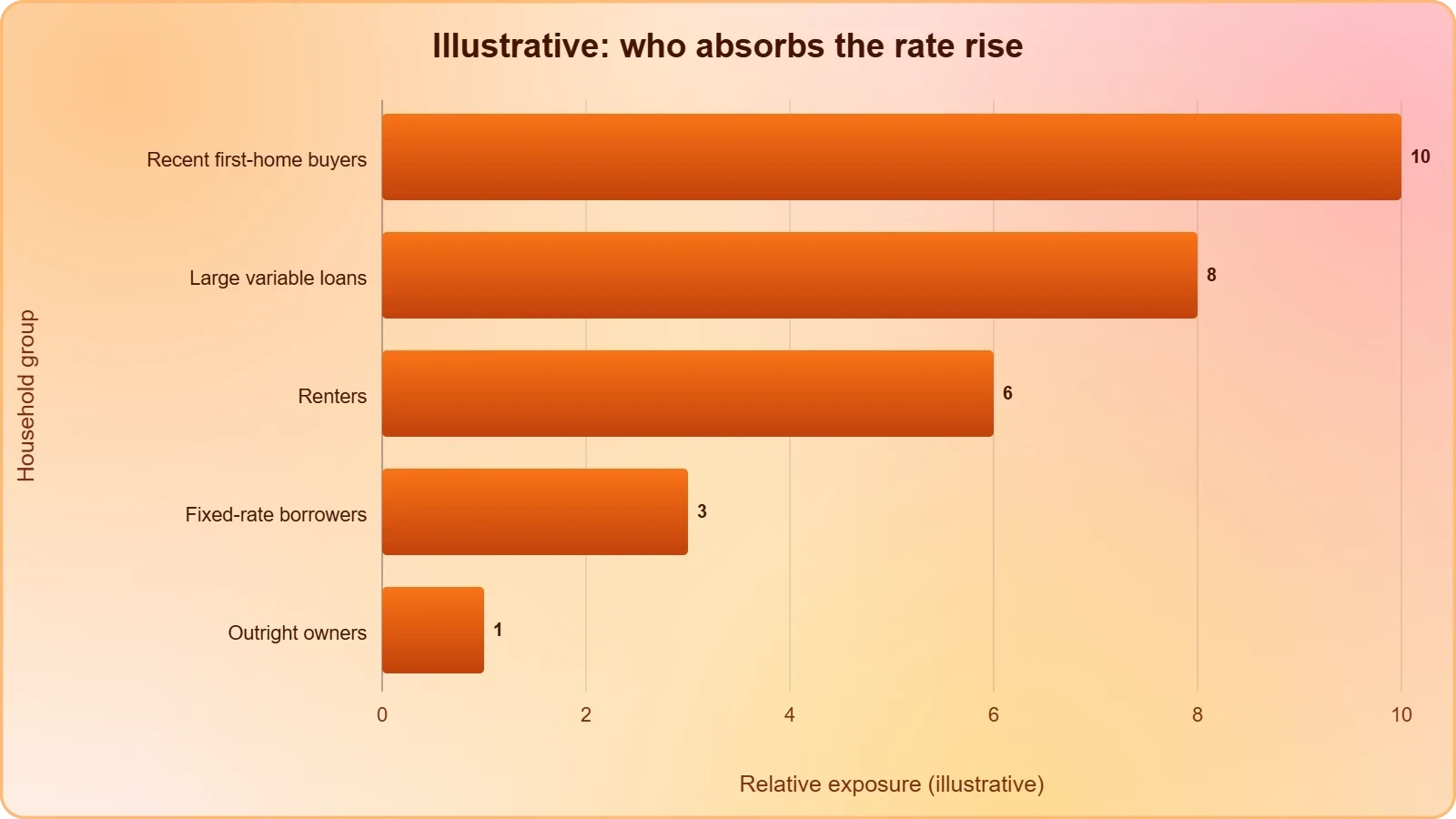
Renters face indirect pressure as landlords pass through financing costs, while retirees relying on fixed incomes experience mixed effects depending on their deposit exposure.
Who Feels the Squeeze Most
Recent borrowers who entered the market near peak prices are especially exposed, having committed to large loans at low rates that now reset sharply higher. Their spending cuts tend to be abrupt and concentrated in discretionary categories, amplifying the demand contraction the RBA seeks. Small businesses dependent on consumer footfall feel the knock-on effects quickly.
Wealthier households with fixed-rate loans or outright ownership are largely insulated, which widens the perceived unfairness of the tightening cycle. This distributional asymmetry fuels the political criticism that the central bank is imposing costs on the vulnerable to correct a problem partly generated by pandemic-era stimulus and supply disruptions.
Consumer Spending and the Wealth Effect
Weak consumer spending is both a symptom and a policy tool. As households devote larger shares of income to debt servicing, discretionary purchases contract, which reduces aggregate demand and eventually eases price pressures. The RBA relies on this mechanism, but its timing is uncertain and its severity difficult to calibrate precisely.
Falling housing prices compound the effect through the wealth channel, as homeowners perceive themselves as poorer and cut spending further. Bullock's reference to households feeling poorer captures this psychological dimension, which conventional models often underweight. Sentiment can amplify or dampen the mechanical effects of rate changes in ways that complicate forecasting.
Political Backlash and Institutional Scrutiny
Criticism that the central bank is steering Australia toward an economic downturn has intensified with each successive increase, and the fifth move will likely sharpen that narrative. Opponents argue that inflation is already decelerating and that further tightening risks unnecessary damage to employment and growth. Bullock's rejection of that view rests on forecasts that critics regard as optimistic.
The Case Against Further Tightening
Sceptics point out that monetary policy operates with long and variable lags, meaning the full effect of earlier increases has yet to materialise. Raising rates again before those effects are visible risks overshooting, producing a deeper slowdown than intended. This argument gains force as evidence of weakening demand accumulates across retail and construction sectors.
There is also a distributional critique: the costs of disinflation fall disproportionately on borrowers and workers, while the benefits accrue broadly and gradually. When inflation is driven partly by supply-side factors beyond monetary control, using demand suppression as the primary tool appears blunt and inequitable to many observers.
Independence Under Pressure
Central bank independence exists precisely to insulate rate decisions from short-term political incentives, yet that insulation becomes harder to defend when costs are visible and benefits are diffuse. Politicians facing electoral pressure may question the RBA's mandate or forecasts, testing the boundaries of institutional autonomy. Bullock's measured language reflects awareness of this dynamic.
Defending independence requires more than asserting authority; it demands clear explanation of why painful decisions serve longer-term welfare. When officials communicate only through forecasts and technical language, they cede the narrative to critics who speak in human terms. The RBA's communication strategy will matter as much as its rate settings in the months ahead.
- 01
- 02
- 03
- 04
Global Context and Comparative Lessons
Australia's predicament mirrors dilemmas facing central banks across advanced economies, though its variable-rate mortgage structure makes transmission unusually swift. The Federal Reserve, European Central Bank, and Bank of England have all wrestled with the same tension between persistent inflation and fragile growth. Comparing approaches reveals both shared constraints and distinctive national vulnerabilities.
How Other Central Banks Have Responded
Fixed-rate mortgage markets in the United States and parts of Europe slow the transmission of rate increases, giving households more time to adjust but prolonging inflation's persistence. Australia's faster pass-through produces quicker demand restraint but sharper short-term hardship, a trade-off with clear distributional implications. Neither structure is inherently superior; each embeds different political risks.
Emerging market central banks often face additional pressures from currency depreciation and capital flight, forcing them to tighten more aggressively than domestic conditions warrant. Australia's floating currency and credible institutions provide buffers that many peers lack, though its commodity dependence introduces separate vulnerabilities tied to Chinese demand.
Lessons for Policy Communication
The Australian episode underscores that technical accuracy alone cannot sustain public consent for painful policy. Officials must translate forecasts into language that acknowledges lived experience, explaining why temporary hardship serves durable price stability. Bullock's concession about felt recession is a step in that direction, though critics will demand more.
Central banks worldwide face a credibility test as inflation lingers and growth falters simultaneously. Those that communicate transparently about trade-offs, acknowledge uncertainty, and avoid triumphalism will preserve trust more effectively than those clinging to optimistic projections. The RBA's next moves will be watched as a case study in that balancing act.
Signals to Watch and Concluding Assessment
Several indicators will reveal whether the RBA's gamble pays off or whether the fifth increase proves one step too far. Employment data, retail sales, mortgage arrears, and inflation prints will collectively indicate whether demand is cooling sufficiently without tipping into contraction. Each release will reshape the political and market narrative around the decision.
Indicators That Matter Most
Mortgage arrears rates deserve particular attention, because they signal when household stress crosses from inconvenience into genuine financial distress. Rising arrears would validate critics' warnings and potentially force the RBA to pause or reverse course. Conversely, stable arrears alongside falling inflation would vindicate Bullock's calibrated approach.
Business investment and hiring intentions provide a second lens, revealing whether firms anticipate prolonged weakness or a temporary soft patch. If investment collapses alongside consumer spending, the slowdown could prove self-reinforcing. Labour market resilience remains the strongest argument against imminent recession, but it can erode quickly once demand weakens.
Final Assessment
The RBA's fifth increase reflects a defensible judgment that inflation remains the greater threat, but it carries genuine risks that Bullock's forecasts may understate. The distinction between technical and felt recession is honest yet politically fragile, because statistics rarely console households facing higher repayments. Whether the decision proves prudent or premature depends on data yet to arrive.
What endures is the broader lesson about central banking in an era of persistent price pressure: credibility rests on transparency about trade-offs, not on optimistic projections. Australia's experience will inform how other institutions navigate similar terrain, particularly regarding communication strategies that bridge the gap between models and lived reality. The coming quarters will deliver the verdict.
From our network :
- The Hidden Cost of AI Convenience: Why Over-Permissioned Agents Are a Security Time BombDiscover why AI agents with excessive permissions create dangerous single points of failure, and learn how implementing least privilege principles can protect your organization from exploitation.
- Mobile Learning and VR in English: What Global Evidence Reveals About Effective Language TechnologyA systematic review across 14 countries reveals which language-learning technologies genuinely work. Mobile learning, AI, and VR show measurable benefits when pedagogically integrated. This evidence-based guide helps educators and learners select technology that delivers real return on investment.
- The Final Descent: How ESA Retired the Legendary Cluster Constellation After 24 Years of Space Weather ScienceAfter 24 years mapping Earth’s magnetosphere, ESA’s Cluster mission concluded with a precisely controlled reentry over the South Pacific. This analysis explores the scientific legacy, engineering decisions, and debris mitigation principles behind one of space exploration’s most responsible retirements.
- Committed Mediterranean Precipitation Decline: Why Emissions Cuts Alone Cannot Restore Winter RainsNew NOAA research reveals that Mediterranean winter rains may decline irreversibly even with emissions cuts. Explore the science of committed climate change and regional impacts.
- Live Online English Classes for Kids: Do They Actually Reduce Anxiety?A ten-week study reveals that synchronous online English classes can significantly reduce child language anxiety while improving listening and reading skills. Discover what makes these programs effective and how parents can select the right one.
- How AI Agents Will Change the Way We Manage Personal FinancesExplore how AI agents are transforming personal finance through automated budgeting, bill payment, and investment management, while examining the critical security protocols and governance frameworks required for safe deployment.
- University Language Proficiency Exams: Why Institutional Tests Demand Different Preparation Than IELTS and TOEFLDiscover why university-specific language proficiency examinations differ fundamentally from IELTS and TOEFL, and learn strategic preparation approaches for institutional assessment success.
- CISA’s Ten-Advisory Wave: Why Generic Patching Fails in OT and How to Build Product-Specific PlaybooksCISA released ten ICS advisories in one week, exposing critical infrastructure risks. Generic patching fails in OT. Learn to build product-specific remediation playbooks.
- Forbidden Matrix Patterns and Visible Lattice Points: A Geometric DictionaryExplore how multidimensional 0–1 matrices encode geometric truths, linking forbidden patterns to visible lattice points and hypergraph theory, with applications in combinatorics and computational geometry.
RESOURCES
- Statement by the Monetary Policy Board - Reserve Bank of Australiarba.gov.au16 hours ago ... At its meeting today, the Board decided to increase the cash rate target by 25 basis points to 4.85 per…
- RBA lifts interest rates to highest level in 18 years to try to dampen ...abc.net.au13 hours ago ... The decision lifts the cash rate target to 4.85 per cent, up from 4.60 per cent. It is the highest…
- Reserve Bank of Australiarba.gov.au... rate target by 25 basis points to 4.85 per cent. 3 ... Analysis and outlook for the economy considered by the Board in…
- RBA hikes cash rate to 18-year high of 4.85 per cent — as it happenedabc.net.au23 hours ago ... The Reserve Bank of Australia has voted to raise interest rates by 0.25 per cent. ... The Reserve Bank will…
- Australia Interest Rate - Trading Economicstradingeconomics.comThe Reserve Bank of Australia raised its cash rate target by 25 bps to 4.85% in a 6-3 majority decision, with three members voting…
- RBA interest rate decision live: Millions brace as brutal 'ripple effect ...au.finance.yahoo.com17 hours ago ... The Reserve Bank of Australia is widely tipped to hike the cash rate to 4.85 per cent today, bringing it…
- RBA raises interest rates to 4.85pc in majority decision - Redditreddit.com16 hours ago ... 83 votes, 80 comments. The Reserve Bank of Australia raised the official cash rate by 25 basis points to an…
- RBA interest rate decision live: Michele Bullock in 'a very difficult ...au.finance.yahoo.comAug 11, 2026 ... The cash rate sits at 4.35 per cent, with Michele Bullock and the Reserve Bank board hoping three hikes earlier…
- RBA raises cash rate to 4.85pc in split board decision - AFRafr.com15 hours ago ... Six members of the RBA's nine-person monetary policy board voted to lift the cash rate by 0.25 percentage ... How…
- RBA's Cup Day call takes rates to 18-year high — as it happenedsbs.com.au14 hours ago ... Follow the Reserve Bank's November interest rates decision ... The Reserve Bank of Australia has lifted the cash rate to…
- CommBank economists forecast November RBA rate hike as ...commbank.com.au7 days ago ... CommBank economists forecast November RBA interest rate hike ... percentage points to 4.85% when its Monetary Policy Board meets next…
- How Tuesday's RBA decision could affect borrowers | SBS Newssbs.com.auSep 28, 2026 ... The Reserve Bank of Australia's next cash rate call is imminent and will impact millions of Australians' finances.
- Markets and economists expect the Reserve Bank to push up ...facebook.com18 hours ago ... ... Reserve Bank of Australia (RBA) will increase interest rates to 4.6 percent. The decision is driven by ongoing inflation…
- Ajay Bagga on X: "Reserve Bank of Australia (RBA) MAY 5, 2026 ...x.comMay 5, 2026 ... The Decision: The RBA Board decided to increase the cash rate target by 25 basis points to 4.35 per cent…
- RBA Rate Tracker - ASXasx.com.auThe tracker calculates a percentage probability of an RBA interest rate ... interest rate increase to 4.85% at the next RBA Board meeting. Market ...
- 01
- 02
- 03
- 04
- 05
- 06
- 07
- 08
0 Comments