
The intersection of religious pluralism and electoral politics in the United States has long constituted a contested terrain, and the remarks delivered by former President Bill Clinton at the Koinonia Worship Centre in Florida on 22 October 2026 offer a particularly instructive case study.
Clinton’s address, which condemned anti-Muslim rhetoric and invoked a Quranic verse introduced to him by his daughter Chelsea, represents more than a discrete news event; it functions as a rhetorical intervention in an ongoing national conversation about religious tolerance, civic identity, and the permissible boundaries of political speech.
The episode merits close analytical attention because it illuminates how senior political figures deploy religious texts as instruments of moral persuasion within pluralistic societies.
On This Page
- The Rhetorical Architecture of Interfaith Political Discourse
- Electoral Context and the Politics of Religious Outreach
- Normative Dimensions: Tolerance, Pluralism, and Civic Responsibility
- Evidentiary Constraints and Methodological Considerations
- Synthesis and Implications for Pluralistic Democracy
- Balancing Moral Witness and Political Strategy
- The Role of Elite Discourse in Shaping Norms
- Toward a More Robust Pluralistic Practice
- Rhetorical Components of the Koinonia Address
- Contextual Factors Shaping Reception
- Normative Frameworks for Religious Tolerance
- Evidentiary Constraints in Single-Event Analysis
- Interfaith Rhetoric: Historical Continuities
- Pluralistic Practice: Conditions and Indicators
The substantive content of the remarks warrants careful parsing. Clinton articulated fatigue with those who criticize Muslims merely for professing Islam, framing such criticism as a category error that conflates religious identity with political or security concerns.
By quoting the Quran, he performed a gesture of textual hospitality, positioning Islamic scripture within a shared moral vocabulary accessible to non-Muslim audiences. This rhetorical strategy, while not unprecedented in American political discourse, carries particular weight when executed by a former head of state whose public career has been intertwined with debates over religion in the public square.
The broader significance of the event resides in its timing and location. Florida, a perennial swing state with a demographically diverse electorate, provides a charged backdrop for any discussion of religious minorities.
The Koinonia Worship Centre, a Christian congregation, hosted a message of interfaith solidarity, thereby enacting a form of cross-traditional alliance that scholars of civil religion frequently identify as essential to social cohesion.
The following analysis examines the rhetorical architecture, political context, and normative implications of Clinton’s intervention, drawing on established scholarship concerning religious rhetoric in American public life.
TL;DR Former President Bill Clinton, speaking at the Koinonia Worship Centre in Florida on 22 October 2026, condemned anti-Muslim rhetoric and quoted a Quranic verse introduced to him by his daughter Chelsea. The address constitutes a significant rhetorical intervention in American debates over religious pluralism, deploying scriptural citation as a tool of moral persuasion. This analysis situates the remarks within broader scholarship on civil religion, examines the strategic dimensions of interfaith outreach in electoral politics, and assesses the evidentiary limits of interpreting a single speech as indicative of durable attitudinal change.
The Rhetorical Architecture of Interfaith Political Discourse
Political rhetoric concerning religious minorities operates within a distinctive discursive field, one shaped by constitutional commitments to disestablishment and by persistent popular attachments to particular religious traditions. Clinton’s remarks must be understood against this backdrop, wherein appeals to tolerance are simultaneously moral claims and strategic communications.
The analytical task involves disentangling these dimensions without reducing the address to mere electoral calculation or, conversely, treating it as purely principled oratory divorced from political context.
Scriptural Citation as Moral Persuasion
The practice of quoting scripture in political address possesses a long genealogy in American public life, extending from abolitionist oratory through the civil rights movement to contemporary debates over immigration and religious liberty.
When a political figure cites a sacred text, the citation performs multiple functions simultaneously: it establishes the speaker’s familiarity with the tradition, signals respect for its adherents, and appropriates the text’s moral authority for the speaker’s own argumentative purposes.
Clinton’s decision to quote the Quran, attributed to his daughter Chelsea’s influence, adds a layer of familial narrative to the rhetorical act. This attribution personalizes the gesture, rendering it an act of transmission across generations rather than a purely instrumental citation.
Scholars of rhetoric note that such personal framing can enhance persuasive efficacy by reducing perceptions of calculated pandering, though empirical evidence on this point remains qualified and context-dependent.
The specific verse quoted has not been disclosed in available reporting, which limits definitive interpretation of its argumentative function. Nevertheless, the general practice of citing Islamic scripture in a Christian worship setting constitutes what scholars term intertextual hospitality, a rhetorical maneuver that invites audiences to recognize shared moral commitments across religious boundaries.
Such maneuvers carry risks as well as rewards, since they may provoke objections from those who regard cross-traditional citation as inappropriate appropriation.
Comparative analysis of similar interventions suggests that scriptural citation by political leaders tends to be received differently depending on the speaker’s perceived religious authenticity and the audience’s prior dispositions. Clinton, whose relationship with religious constituencies has been complex and at times contentious, operates within a distinctive reception environment.
The efficacy of his citation therefore cannot be assumed but must be assessed against the specific contours of his public persona and the audiences he addressed.
The rhetorical architecture of the address thus combines moral universalism with particularistic textual reference, a combination that characterizes much successful interfaith discourse. Whether such combinations produce durable attitudinal change or merely transient approval remains an open empirical question, one that the available evidence cannot definitively resolve.
The Koinonia Setting and Civil Religion
The choice of a Christian worship center as the venue for a message of interfaith solidarity is analytically significant. The Koinonia Worship Centre, by hosting a former president who would quote Islamic scripture, enacted a form of institutional hospitality that scholars of civil religion identify as a mechanism for integrating religious diversity into a shared civic narrative. The setting thus became part of the message itself.
Civil religion, as theorized by Robert Bellah and subsequent scholars, refers to the set of beliefs, symbols, and rituals through which a polity sacralizes its collective identity and moral commitments.
American civil religion has historically drawn predominantly on Christian and biblical imagery, a fact that has generated persistent tensions regarding the full inclusion of non-Christian traditions. Clinton’s remarks can be read as an attempt to expand the civil religious repertoire to encompass Islamic sources.
Such expansion is not without precedent. American political leaders have periodically invoked Jewish scripture, and more recently have referenced Islamic traditions, in efforts to signal the pluralistic character of national identity.
These gestures, however, frequently remain symbolic rather than substantive, and critics argue that they may substitute for concrete policy commitments to religious minorities. The evidentiary record does not permit firm conclusions regarding Clinton’s intentions in this regard.
The venue’s location in Florida further complicates interpretation. Florida’s electorate includes substantial populations of Muslim, Jewish, Christian, and secular voters, and the state’s political competitiveness renders religious outreach a matter of strategic as well as moral consequence.
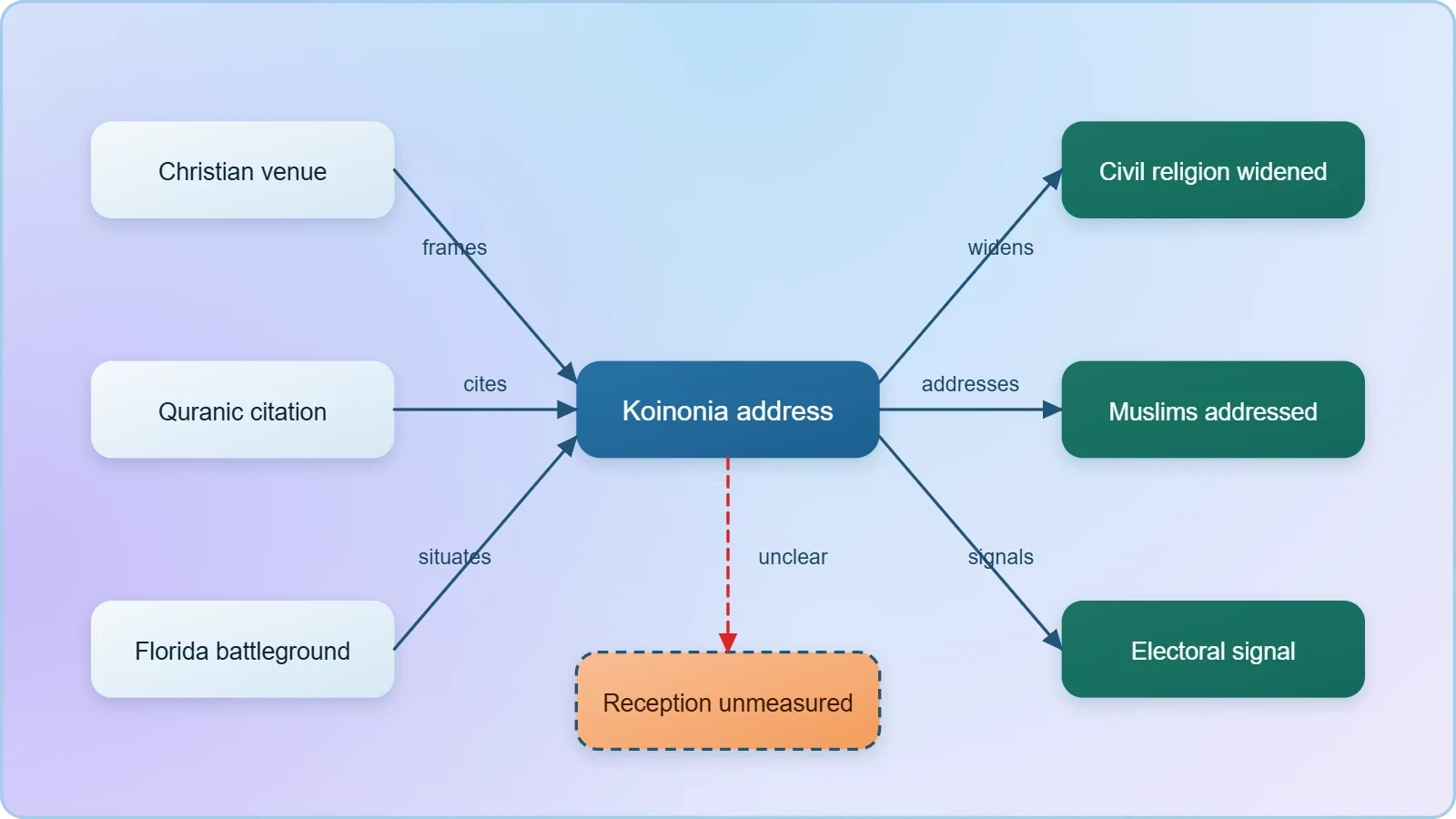
Whether the Koinonia address should be understood primarily as moral witness or electoral positioning cannot be determined from the available evidence alone.
Institutional context matters for reception as well. Congregations that host interfaith political events signal to their own members and to broader publics a willingness to engage across religious boundaries.
The Koinonia Worship Centre thereby assumed a communicative role beyond that of passive backdrop, becoming an active participant in the production of the event’s meaning.
Condemnation of Anti-Muslim Rhetoric: Scope and Limits
Clinton’s explicit condemnation of anti-Muslim rhetoric constitutes the substantive core of the address. The formulation that he was tired of people criticizing Muslims simply for being Muslim identifies a specific discursive target: criticism directed at religious identity per se rather than at conduct or belief. This distinction, while analytically clean, proves difficult to sustain in practice.
Critics of Islam frequently disclaim targeting Muslims as persons while directing criticism at Islamic doctrines or practices. The boundary between legitimate theological critique and illegitimate religious animus is contested terrain, and Clinton’s remarks implicitly intervene in that contestation by characterizing certain forms of criticism as improper. The precise criteria by which he would distinguish acceptable from unacceptable criticism remain unspecified in available reporting.
Scholarship on Islamophobia has documented the empirical prevalence of rhetoric that conflates religious identity with security threats, and Clinton’s remarks resonate with this literature. His intervention may be understood as an attempt to delegitimize a discursive frame that treats Muslims as presumptively suspect. Whether such delegitimization efforts alter public attitudes remains a question requiring systematic empirical investigation.
The scope of the condemnation also merits attention. Clinton addressed anti-Muslim rhetoric specifically, without extending his remarks to comparable rhetoric directed at other religious groups. This selective focus may reflect the salience of anti-Muslim sentiment in contemporary American politics, or it may reflect strategic calculations regarding audience composition. The available evidence does not permit adjudication between these interpretations.
Comparative perspective suggests that condemnations of religious bigotry tend to be more effective when accompanied by concrete commitments to affected communities. The address, as reported, emphasized rhetorical condemnation without detailing policy proposals.
This emphasis is consistent with the genre of commemorative or ceremonial speech but may limit the address’s practical impact on the conditions it decried.
Generational Transmission and Personal Narrative
The attribution of the Quranic verse to Chelsea Clinton introduces a familial dimension that distinguishes the address from standard political oratory. By crediting his daughter with introducing him to the verse, Clinton positioned himself as a recipient of intergenerational religious learning, a framing that softens the potentially presumptuous act of a non-Muslim quoting Islamic scripture.
This narrative device performs important rhetorical work. It suggests that religious literacy is acquired through relationships rather than through professional expertise, and it models a form of cross-generational and cross-traditional learning that audiences may find accessible.
The device also deflects potential criticism that Clinton was appropriating a tradition not his own by locating the citation within a story of familial transmission.
Scholarship on political storytelling emphasizes the role of personal narrative in establishing speaker credibility and emotional connection with audiences. The Chelsea narrative functions as what rhetoricians term an enthymeme, inviting audiences to complete the argument that openness to religious difference is a familial and generational value rather than a purely political position. The persuasive efficacy of this device depends on audience receptivity to the Clinton family narrative itself.
The personalization of the citation also carries risks. Audiences skeptical of the speaker may interpret the familial framing as a calculated attempt to inoculate against criticism. The reception of the address therefore likely varied considerably across audiences, a variability that aggregate characterizations of the event may obscure.
Generational transmission of religious knowledge is itself a topic of scholarly interest, with research indicating that familial influence remains a significant factor in religious literacy and attitudes toward religious diversity. Clinton’s narrative aligns with this research, though the anecdotal character of the account precludes strong inferences about broader patterns.
We Also Published
Electoral Context and the Politics of Religious Outreach
The timing of the address, situated within the American electoral calendar, invites consideration of its strategic dimensions. Religious outreach in electoral politics operates through complex mechanisms, and the available evidence regarding the address’s electoral intentions or effects is limited. Analytical caution is therefore warranted when assessing the political calculations that may have informed the event.
Florida as Contested Terrain
Florida’s status as a perennial battleground state renders any political event within its borders subject to strategic interpretation. The state’s demographic composition, including significant Muslim, Jewish, Hispanic, and retiree populations, creates a complex religious and ethnic landscape that political actors must navigate with care. Clinton’s remarks must be situated within this landscape.
Religious outreach in Florida has historically taken diverse forms, from appeals to evangelical Christians to engagement with Jewish communities to, more recently, efforts to address Muslim constituents. The effectiveness of such outreach depends on numerous factors, including the messenger’s credibility, the specificity of commitments, and the broader political environment. The Koinonia address represents one data point within this larger pattern.
Electoral analysis of religious outreach frequently encounters the difficulty of isolating the effects of specific appeals from the multitude of other influences on voter behavior. The Koinonia address, as a single event, cannot bear the weight of strong causal inference regarding its electoral consequences. Claims about its impact must therefore remain appropriately qualified.
The address’s location in a Christian worship center, rather than a mosque or interfaith venue, may itself carry strategic significance. Speaking to a Christian audience about the importance of respecting Muslims positions the message as intra-Christian moral exhortation rather than as outreach to Muslims themselves.
This positioning may enhance persuasive efficacy with the target audience while raising questions about the address’s relationship to Muslim communities.
Comparative analysis of religious outreach strategies suggests that messages delivered within the speaker’s own religious or cultural community can be particularly effective in shifting attitudes, as audiences may perceive such messages as less self-interested.
Clinton’s choice of venue may therefore reflect sophisticated communicative strategy, though the available evidence does not confirm this interpretation.
Anti-Muslim Rhetoric in Contemporary American Politics
Anti-Muslim rhetoric has constituted a persistent feature of contemporary American political discourse, with scholars documenting its prevalence across media, electoral campaigns, and policy debates. Clinton’s condemnation must be understood against this backdrop, as an intervention within a contested discursive field rather than as a novel departure. The address’s significance derives partly from its timing relative to broader patterns of anti-Muslim sentiment.
Empirical research on anti-Muslim attitudes in the United States has identified correlations with factors including education, media consumption, and contact with Muslim individuals. Interventions that seek to reduce such attitudes operate through various mechanisms, including exposure to counter-stereotypical information and appeals to shared values. Clinton’s remarks, by invoking shared scriptural authority, may activate the latter mechanism.
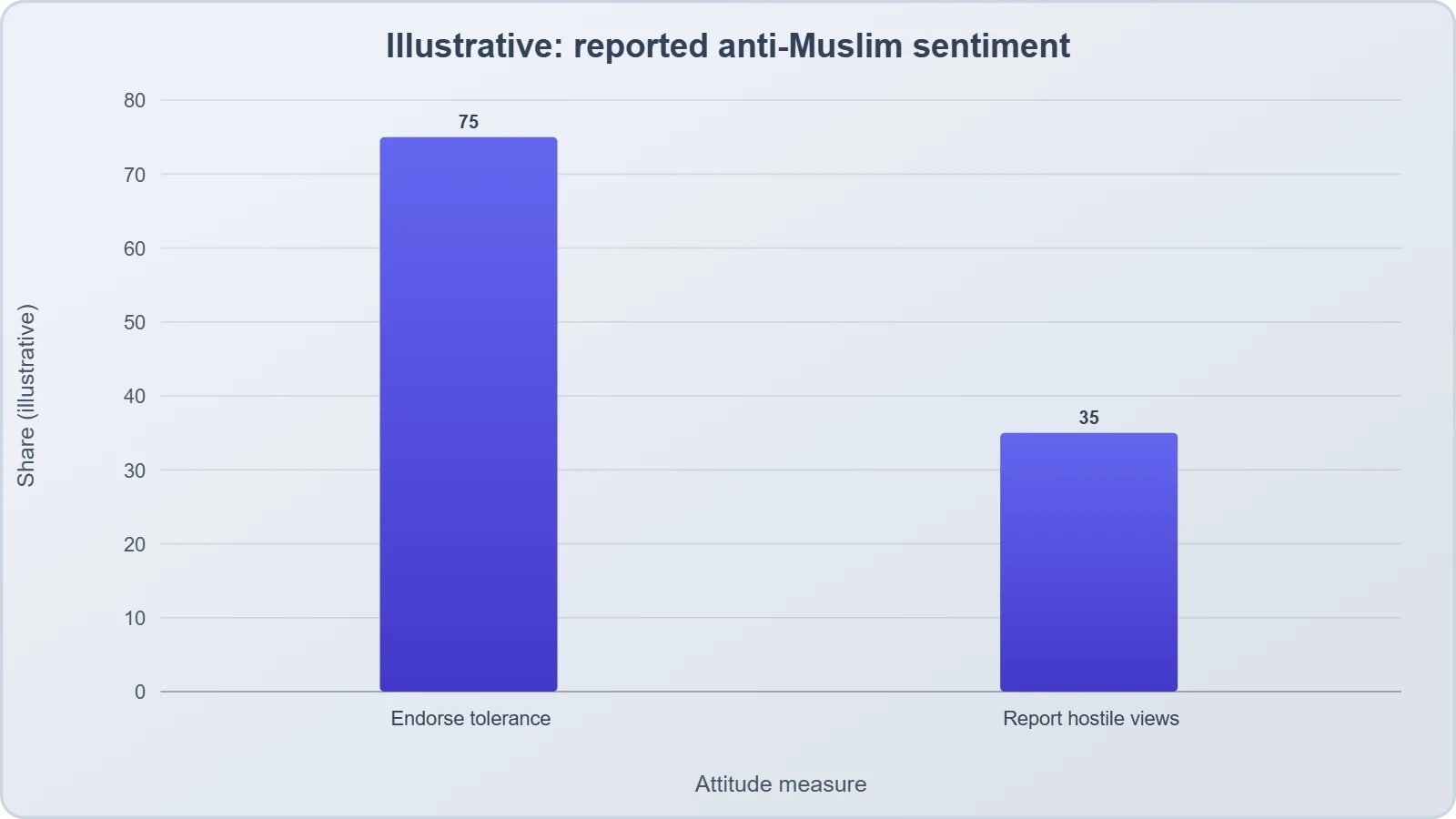
The effectiveness of elite condemnations of religious bigotry remains a subject of scholarly debate. Some research suggests that elite cues can shift public attitudes, particularly among co-partisans of the speaker, while other studies indicate that such cues may be met with resistance or may activate countervailing attitudes. The Koinonia address thus enters a contested empirical terrain.
Clinton’s status as a former president rather than a current officeholder may affect the reception of his remarks. Former presidents often enjoy elevated moral authority relative to active politicians, as they are perceived as speaking beyond immediate electoral calculations. Whether this perception obtained in the present case cannot be determined from available evidence.
The address also intervenes in intra-party debates regarding the appropriate posture toward religious minorities. By condemning anti-Muslim rhetoric explicitly, Clinton may have sought to influence the discursive boundaries of acceptable political speech within his party and beyond. The efficacy of such boundary-setting efforts depends on the speaker’s continued influence within relevant political networks.
Media Framing and Public Reception
Media coverage of the address, as represented by the Al Jazeera report, emphasized the Quranic citation and the condemnation of anti-Muslim rhetoric. This framing highlights certain aspects of the event while potentially obscuring others, a selective emphasis characteristic of news reporting. The framing choices of media outlets shape public understanding of political events.
Al Jazeera’s coverage, situated within its own editorial perspective, may emphasize aspects of the address that resonate with its audience. Comparative analysis of coverage across outlets would be necessary to assess the full range of framing strategies employed. The available source material does not permit such comparative analysis.
Public reception of the address likely varied across audiences, reflecting divergent prior dispositions toward Clinton, toward Islam, and toward the broader political context. Aggregate characterizations of reception, such as those implied by the report’s framing, may obscure this variability. Systematic public opinion data regarding the address are not available in the source material.
The report’s inclusion of keywords such as elections, government, and politics signals an interpretive frame that situates the address within electoral and governmental contexts. This framing invites audiences to understand the address as a political act rather than solely as a moral statement. The framing choices thus participate in the construction of the event’s meaning.
Media framing effects on public attitudes toward religious minorities have been documented in experimental research, with studies indicating that exposure to certain frames can shift attitudes in measurable ways. The Koinonia address, as mediated through news coverage, may therefore have effects that differ from those of the unmediated event. The magnitude and direction of such effects remain uncertain.
Normative Dimensions: Tolerance, Pluralism, and Civic Responsibility
Beyond its strategic and rhetorical dimensions, the address raises normative questions regarding the obligations of political leaders in pluralistic societies. Clinton’s call for greater tolerance invokes a contested concept, one whose meaning and implications have been the subject of extensive philosophical and political debate. The address thus participates in ongoing normative conversations about the character of civic life.
Conceptualizing Tolerance
Tolerance, as a normative ideal, admits of multiple interpretations. Minimal conceptions emphasize non-interference with religious practices, while more robust conceptions involve positive recognition and accommodation of religious difference. Clinton’s remarks, as reported, appear to invoke a conception closer to the latter, emphasizing the impropriety of criticizing individuals merely for their religious identity.
Philosophical debates regarding tolerance have interrogated its relationship to power, noting that the call to tolerate may presuppose a position of dominance from which tolerance is extended. This critique complicates the interpretation of tolerance appeals by majority-group speakers addressing majority-group audiences. Whether Clinton’s remarks navigate this complication successfully is a matter for interpretive judgment.
The distinction between tolerance and respect, while sometimes elided in ordinary discourse, carries normative significance. Tolerance may imply forbearance of something regarded as objectionable, whereas respect implies positive valuation.
Clinton’s formulation, emphasizing the impropriety of criticizing Muslims merely for being Muslim, appears to gesture toward respect rather than mere tolerance, though the precise normative content remains ambiguous.
Scholarship on religious pluralism has emphasized the importance of substantive engagement with religious difference, as opposed to mere procedural accommodation. The address, as reported, does not detail substantive engagements with Islamic thought or practice beyond the citation of a single verse. The depth of the address’s engagement with religious difference is therefore difficult to assess.
Normative assessment of the address must also consider its potential limitations. Condemnations of bigotry, while valuable, may substitute for more substantive commitments to addressing the material conditions that sustain religious discrimination. The address’s emphasis on rhetoric rather than policy may thus reflect a broader pattern in elite discourse on religious difference.
Religious Literacy and Civic Competence
The address implicitly raises questions regarding religious literacy as a component of civic competence. Clinton’s ability to quote Islamic scripture, attributed to familial transmission, models a form of religious literacy that extends beyond the speaker’s own tradition. Scholars of civic education have argued that such literacy is essential to functioning in pluralistic societies.
Religious literacy encompasses knowledge of traditions other than one’s own, as well as the capacity to engage with religious difference in informed and respectful ways. The address, by demonstrating cross-traditional textual familiarity, may serve an educational function for audiences, modeling the value of such literacy. The extent of this educational effect remains empirically uncertain.
Research on religious literacy has documented significant gaps in public knowledge regarding major religious traditions, including Islam. Interventions that increase exposure to accurate information about religious traditions may contribute to reducing prejudice and improving intergroup relations. The address’s citation of Islamic scripture may constitute one such intervention, albeit of limited scope.
The relationship between religious literacy and civic competence is not straightforward. Knowledge of religious traditions may be deployed for inclusive or exclusionary purposes, and literacy alone does not guarantee respectful engagement. The normative significance of the address’s modeling of religious literacy therefore depends on the broader context of its deployment.
Educational institutions have increasingly recognized the importance of religious literacy, with initiatives aimed at improving public understanding of diverse traditions. The address may be understood as contributing to this broader educational project, though its contribution is necessarily modest relative to institutional efforts.
Interfaith Solidarity and Social Cohesion
Interfaith solidarity, as enacted in the Koinonia address, represents one mechanism through which social cohesion across religious boundaries may be fostered. Scholars of social capital have emphasized the importance of bridging ties that connect diverse groups, and interfaith events may contribute to the formation of such ties. The address’s significance may therefore extend beyond its immediate rhetorical content.
The empirical relationship between interfaith engagement and social cohesion has been the subject of considerable research, with findings generally indicating positive associations between intergroup contact and reduced prejudice. The Koinonia address, as a form of symbolic interfaith engagement, may contribute to such effects, though the evidence regarding symbolic gestures specifically is less robust than that regarding sustained interpersonal contact.
Social cohesion in religiously diverse societies depends on multiple factors, including institutional arrangements, legal frameworks, and cultural norms. Symbolic gestures by political leaders constitute one element within this complex configuration, and their significance should not be overstated. The address’s contribution to social cohesion is therefore likely modest and contingent on broader conditions.
Interfaith solidarity also carries risks, including the potential for superficial gestures that substitute for substantive engagement or that obscure genuine theological differences. Critics of interfaith dialogue have raised such concerns, arguing that premature emphasis on commonality may impede honest engagement with difference. The address’s emphasis on shared moral vocabulary may be subject to this critique.
Balancing the benefits and risks of interfaith solidarity requires careful attention to context and implementation. The Koinonia address, as a discrete event, cannot resolve these complex questions, but it may contribute to ongoing conversations regarding the appropriate forms of interfaith engagement in pluralistic societies.
Evidentiary Constraints and Methodological Considerations
Analysis of the Koinonia address must acknowledge significant evidentiary constraints. The available source material consists of a brief news report, which necessarily omits substantial portions of the address and provides limited context regarding its reception.
Conclusions drawn from such material must therefore be appropriately qualified, and claims exceeding the available evidence should be avoided.
The Limits of Single-Event Analysis
Single political events, such as the Koinonia address, provide limited leverage for drawing broader conclusions about political attitudes, rhetorical trends, or social change. The address constitutes one data point within complex and evolving phenomena, and its significance may be either amplified or diminished by subsequent developments. Analytical humility is therefore warranted.
Scholarship on political communication has emphasized the importance of examining patterns across multiple events rather than isolated instances. The Koinonia address may be most usefully understood as an instance of broader patterns of interfaith political rhetoric, rather than as a unique or unprecedented event. Comparative analysis would be necessary to assess its distinctive features.
The address’s reception, which is central to assessing its significance, cannot be determined from the available source material. News reports typically emphasize the content of speeches rather than their reception, and the absence of reception data limits conclusions regarding the address’s effects. Future research incorporating audience response data would be necessary to address this gap.
Temporal proximity to the event also constrains analysis. The address occurred on 22 October 2026, and the long-term significance of the event may only become apparent over time. Premature assessments of historical significance risk mischaracterizing events whose importance emerges only in retrospect.
Methodological pluralism, drawing on rhetorical analysis, public opinion research, and historical contextualization, would be necessary for comprehensive assessment of the address. The present analysis, constrained by available sources, can offer only a partial contribution to such comprehensive assessment.
Source Reliability and Interpretive Caution
The source material for this analysis derives from Al Jazeera, a news organization with a particular editorial perspective. While the report’s factual claims regarding the address’s occurrence and general content appear reliable, interpretive framing may reflect the outlet’s perspective. Cross-referencing with additional sources would strengthen confidence in the analysis.
News reports of political speeches necessarily involve selection and condensation, and the resulting accounts may emphasize certain aspects while omitting others. The Al Jazeera report’s emphasis on the Quranic citation and the condemnation of anti-Muslim rhetoric may reflect editorial priorities as well as the address’s actual content. The full text of the address, if available, would permit more comprehensive analysis.
The report’s inclusion of keywords such as elections and politics signals an interpretive frame that situates the address within electoral contexts. This framing may or may not align with the address’s own emphasis, and audiences should be attentive to the interpretive work performed by such framing choices. Media literacy regarding framing effects is therefore relevant to the interpretation of the report itself.
Verification of specific claims, such as the attribution of the Quranic verse to Chelsea Clinton, would require additional sources. The report presents this attribution as Clinton’s own statement, which constitutes a form of evidence but not independent verification. The reliability of the attribution depends on the accuracy of the report’s representation of Clinton’s remarks.
Interpretive caution is particularly warranted regarding claims about intentions. The report describes Clinton’s remarks but does not provide direct evidence regarding his motivations, which must be inferred from the content and context of the address. Such inferences are necessarily speculative and should be presented as such.
Comparative and Historical Context
Situating the Koinonia address within historical context illuminates both its continuities with and departures from prior patterns of interfaith political rhetoric. American political leaders have long invoked religious texts and appealed to religious constituencies, and the address participates in this tradition.
Its distinctive features, such as the citation of Islamic scripture by a former president in a Christian venue, merit attention.
Historical analysis of interfaith rhetoric reveals shifting patterns over time, with increasing attention to religious diversity in recent decades. The address may be understood as part of this broader trajectory, reflecting evolving norms regarding the appropriate scope of religious inclusion in political discourse. The trajectory itself, however, is neither linear nor uncontested.
Comparative analysis across national contexts could illuminate the distinctive features of American interfaith political rhetoric. Other liberal democracies have developed different traditions of managing religious diversity in political discourse, and comparison could highlight the particularities of the American case. Such comparison exceeds the scope of the present analysis but represents a promising avenue for future research.
The address’s relationship to broader trends in American religion and politics also merits consideration. Declining religious affiliation, increasing religious diversity, and persistent religious polarization constitute significant features of the contemporary landscape, and the address intervenes within this landscape. Its significance may be understood partly in relation to these broader trends.
Historical perspective also cautions against overinterpreting single events. Many political speeches that appeared significant at the time have faded from collective memory, while others have acquired retrospective importance. The Koinonia address’s place in historical memory remains to be determined.
- 01
- 02
- 03
- 04
Synthesis and Implications for Pluralistic Democracy
The Koinonia address, examined through multiple analytical lenses, emerges as a multifaceted event whose significance extends beyond its immediate content. It constitutes a rhetorical intervention in debates over religious pluralism, a strategic communication within electoral contexts, and a normative statement regarding civic obligations in diverse societies. Its full significance, however, remains constrained by evidentiary limitations and the inherent difficulty of assessing single events.
Balancing Moral Witness and Political Strategy
Political leaders who speak on religious tolerance navigate a complex terrain in which moral witness and political strategy are intertwined. Clinton’s address exemplifies this intertwining, combining principled condemnation of bigotry with communicative choices that may reflect strategic considerations. Disentangling these dimensions is analytically challenging and may not be fully possible.
The normative assessment of such addresses depends partly on whether strategic considerations are understood as compromising or as enabling moral witness. Some scholars argue that effective moral leadership necessarily involves strategic communication, while others maintain that strategic considerations inevitably dilute moral clarity. The Koinonia address may be interpreted through either lens.
Audiences’ assessments of the address likely varied according to their prior dispositions toward Clinton and toward the issues he addressed. Those favorably disposed may have perceived principled leadership, while those skeptically disposed may have perceived calculated positioning. The address’s meaning is therefore partly constituted by its reception, which cannot be determined from available sources.
The balance between moral witness and political strategy is not unique to the Koinonia address but characterizes much political rhetoric on contested social issues. The address thus illuminates broader questions regarding the nature of political leadership in pluralistic democracies, questions that exceed the scope of any single event.
Normative evaluation of the address must also consider its potential effects, both intended and unintended. Condemnations of bigotry may, in some contexts, provoke backlash or reinforce perceived group boundaries. The address’s net effect on religious tolerance remains uncertain and would require empirical investigation to assess.
The Role of Elite Discourse in Shaping Norms
Elite discourse, including speeches by former presidents, contributes to the formation and transformation of social norms regarding religious difference. Clinton’s condemnation of anti-Muslim rhetoric may contribute to shifting the boundaries of acceptable public speech, though the magnitude of such effects is uncertain. The address thus participates in ongoing norm-formation processes.
Research on norm dynamics suggests that elite statements can influence public perceptions of what is acceptable, particularly when such statements are widely publicized and when the speaker possesses credibility with relevant audiences.
The Koinonia address, as reported by major media outlets, may have contributed to such norm signaling, though its effects cannot be isolated from other influences.
The relationship between elite discourse and public attitudes is complex and bidirectional. Elites may respond to perceived shifts in public opinion as well as shape them, and the causal direction of influence is often difficult to establish. The Koinonia address may reflect as well as shape evolving norms regarding religious tolerance.
Norm formation regarding religious difference occurs across multiple sites, including families, educational institutions, media, and religious communities. Elite political discourse constitutes one such site, and its relative influence should not be overstated. The address’s contribution to norm formation is therefore likely modest and contingent on broader social processes.
The durability of norm changes initiated or reinforced by elite discourse remains uncertain. Some norm shifts prove enduring, while others are reversed by subsequent developments. The long-term significance of the Koinonia address for American norms regarding religious tolerance cannot be determined at present.
Toward a More Robust Pluralistic Practice
Moving beyond the analysis of single events, the Koinonia address invites reflection on the conditions under which pluralistic democracy flourishes. Such conditions include legal protections for religious minorities, institutional arrangements that facilitate intergroup contact, and cultural norms that value religious diversity. The address touches on the last of these conditions while leaving the others unaddressed.
Robust pluralistic practice requires more than symbolic gestures, encompassing substantive commitments to equal treatment, accommodation of religious difference, and protection of minority rights. The address’s emphasis on rhetoric rather than policy may thus represent a partial rather than comprehensive contribution to pluralistic practice. This limitation is characteristic of ceremonial political discourse more broadly.
Scholarship on pluralism has emphasized the importance of institutional design in managing religious diversity, including arrangements for religious education, family law, and public accommodation. The address does not engage with such institutional questions, focusing instead on interpersonal attitudes and rhetorical norms. Its contribution to pluralistic practice is therefore necessarily limited.
Civil society organizations, including interfaith groups and religious congregations, play significant roles in fostering pluralistic practice at the community level. The Koinonia Worship Centre’s hosting of the event exemplifies such organizational contributions, though the address itself focused on individual attitudes rather than organizational practices.
The pursuit of robust pluralism is an ongoing project rather than an achieved state, requiring continuous attention to evolving challenges and contexts. The Koinonia address constitutes one moment within this ongoing project, its significance contingent on the broader trajectory of pluralistic practice in American society and beyond.
From our network :
- Mobile Learning and VR in English: What Global Evidence Reveals About Effective Language TechnologyA systematic review across 14 countries reveals which language-learning technologies genuinely work. Mobile learning, AI, and VR show measurable benefits when pedagogically integrated. This evidence-based guide helps educators and learners select technology that delivers real return on investment.
- Committed Mediterranean Precipitation Decline: Why Emissions Cuts Alone Cannot Restore Winter RainsNew NOAA research reveals that Mediterranean winter rains may decline irreversibly even with emissions cuts. Explore the science of committed climate change and regional impacts.
- Live Online English Classes for Kids: Do They Actually Reduce Anxiety?A ten-week study reveals that synchronous online English classes can significantly reduce child language anxiety while improving listening and reading skills. Discover what makes these programs effective and how parents can select the right one.
- CISA’s Ten-Advisory Wave: Why Generic Patching Fails in OT and How to Build Product-Specific PlaybooksCISA released ten ICS advisories in one week, exposing critical infrastructure risks. Generic patching fails in OT. Learn to build product-specific remediation playbooks.
- University Language Proficiency Exams: Why Institutional Tests Demand Different Preparation Than IELTS and TOEFLDiscover why university-specific language proficiency examinations differ fundamentally from IELTS and TOEFL, and learn strategic preparation approaches for institutional assessment success.
- How AI Agents Will Change the Way We Manage Personal FinancesExplore how AI agents are transforming personal finance through automated budgeting, bill payment, and investment management, while examining the critical security protocols and governance frameworks required for safe deployment.
- The Hidden Cost of AI Convenience: Why Over-Permissioned Agents Are a Security Time BombDiscover why AI agents with excessive permissions create dangerous single points of failure, and learn how implementing least privilege principles can protect your organization from exploitation.
- The Final Descent: How ESA Retired the Legendary Cluster Constellation After 24 Years of Space Weather ScienceAfter 24 years mapping Earth’s magnetosphere, ESA’s Cluster mission concluded with a precisely controlled reentry over the South Pacific. This analysis explores the scientific legacy, engineering decisions, and debris mitigation principles behind one of space exploration’s most responsible retirements.
- Forbidden Matrix Patterns and Visible Lattice Points: A Geometric DictionaryExplore how multidimensional 0–1 matrices encode geometric truths, linking forbidden patterns to visible lattice points and hypergraph theory, with applications in combinatorics and computational geometry.
RESOURCES
- Former US President Bill Clinton quoted the Quran during a speech ...facebook.com6 days ago ... ... Florida, where he firmly condemned anti-Muslim rhetoric and political discrimination. He cited a well-known verse from Surah Al-Hujurat (Quran ...
- Bill Clinton condemned anti-Muslim rhetoric during a recent speech ...instagram.com6 days ago ... The Quran message, he suggested, offers an important foundation for interfaith understanding and religious tolerance. ——— [ Bill Clinton Muslims ...
- Fact-checking Trump's demagogic rhetoric after Orlando terror attacktheguardian.comJun 14, 2016 ... ... Florida, that killed 49. Originally intended to be an attack on Bill and Hillary Clinton, Trump's speech was refocused…
- Hate and Incriminate: The US Election, Social Media, and American ...cjr.orgSep 15, 2016 ... Table of Contents. Executive Summary | Introduction | Hate Crimes Against US Muslims | When All Speech is Serious and…
- - IDENTIFYING THE ENEMY: RADICAL ISLAMIST TERRORgovinfo.gov... Clinton U.N. Resolution against Negative Speech about Islam,'' National Review, June 20, 2016, http:// www.nationalreview.com/corner/436854/doj-followed ...
- Setting the Terms for U.S.-Egypt Relationsamericanprogress.orgFeb 21, 2017 ... Meanwhile, Egyptian officials have ignored Trump's anti-Muslim rhetoric ... President Bill Clinton's administration. He also worked for ...
- Who We Are - CAIRcair.comDefamation of Islam and Muslims in the Media A number of media personalities engage in anti-Muslim rhetoric. Rev. Pat Robertson, Dr. Laura Schlessinger, Don ...
- Ambivalent nativism: Trump supporters' attitudes toward Islam and ...brookings.eduJul 24, 2019 ... Some commentators, especially anti-Trump conservatives, have suggested President Trump's political movement is distinct from other varieties of ...
- Bill Clinton Reveals How Chelsea's Experience Reading the Quran ...ground.news6 days ago ... ... Quran and condemns anti-Muslim rhetoric ... Bill Clinton quoted the Quran during a speech in Florida condemning discrimination against…
- a critical discourse analysis of anti-immigrant rhetoric in trumpscholarworks.lib.csusb.edu28-29). In this project, I examine the specific discursive strategies used by U.S.. President, Donald Trump in his speeches—both before and after his 2016.
- Beyond the Bully Pulpit | Texas Law Reviewtexaslawreview.orgIn light of the rhetorical strategies of President Donald Trump, the question of the impact of presidential statements in the courts is quickly becoming…
- Framing Islamophobia and Civil Liberties: American Political ...scholarworks.waldenu.edureview of Daniel's work, argued that anti-Islam rhetoric from Western commentators ... President Bush signs anti-terrorism bill. CNN. Retrieved from http ...
- Republican Officials Have Been Bashing Muslims. We Counted.buzzfeednews.comApr 10, 2018 ... The anti-Muslim rhetoric in virtually every state reflects the general coarsening of political speech in the anything-goes era of President ...
- The U.S. Securitization and Desecuritization of Iran: An Analysis of ...wsps.ut.ac.irCavusoglu (2020) highlighted how U.S. counterterrorism rhetoric blended Iran's threat with broader frames of Islamic fundamentalist threat. ... Bill Clinton, ...
- Humanitarian Islam - Pace Digital Commonsdigitalcommons.pace.eduAug 20, 2018 ... the heightened anti-Muslim political rhetoric during the 2016 U.S. ... 448 U.S. President Bill Clinton signed into law the Church.…
- 01
- 02
- 03
- 04
- 05
- 06
- 07
- 08
0 Comments