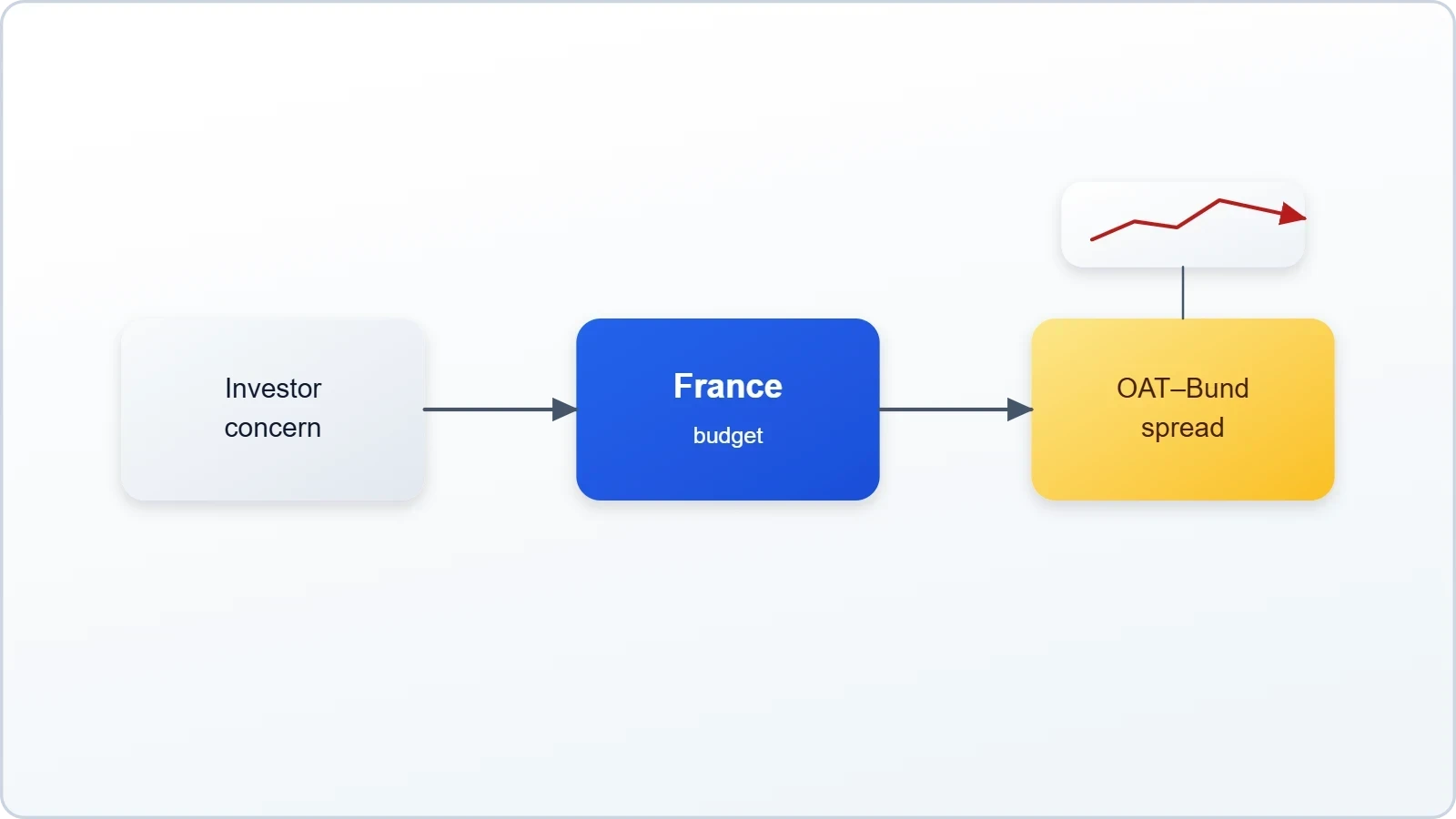
France has entered a perilous autumn of discontent, and the financial markets are watching with mounting unease. Nationwide protests over budget austerity have converged with a historic repricing of French sovereign debt, exposing the fragile intersection of street politics and fiscal credibility.
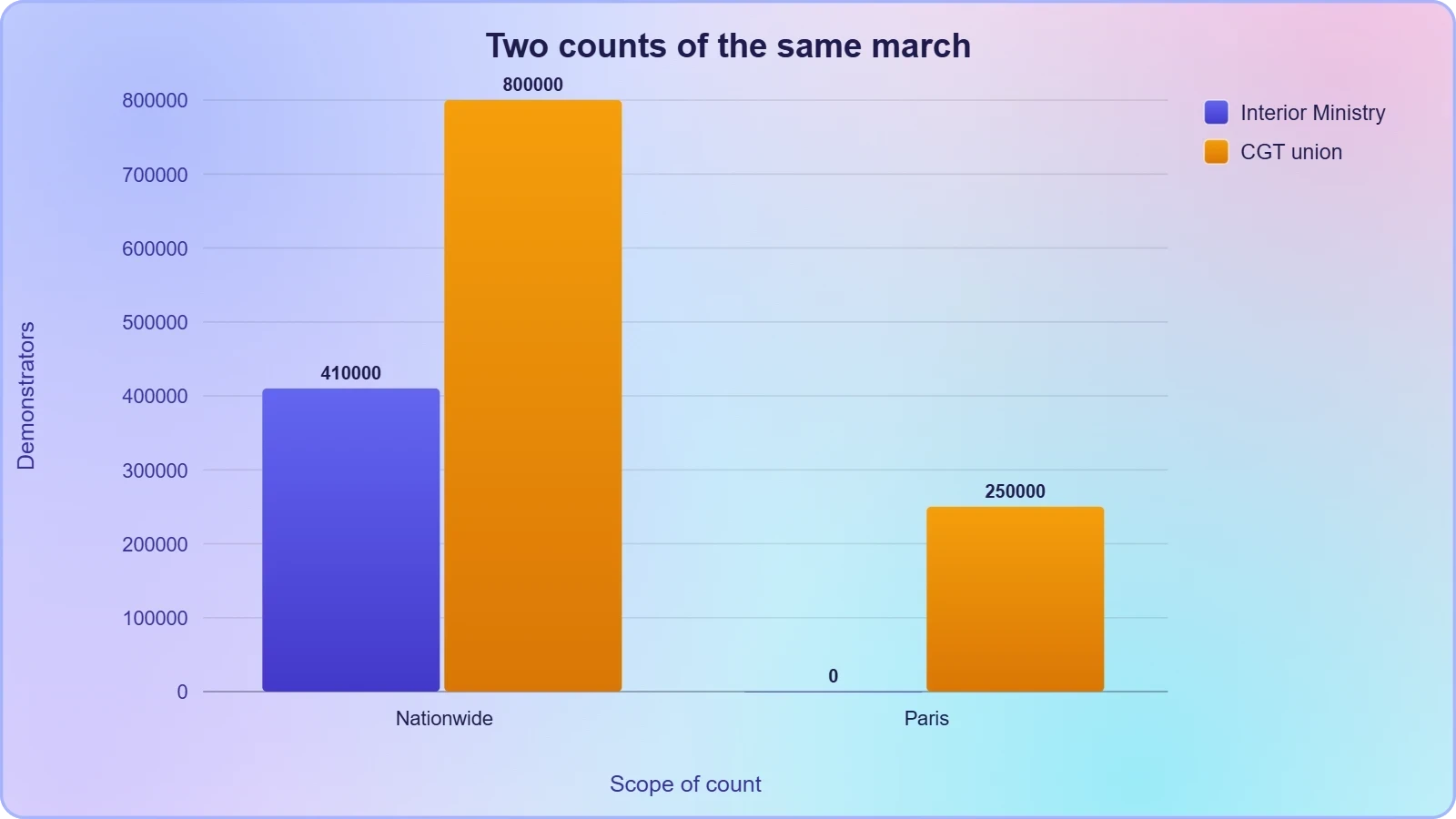
The Interior Ministry counted 410,000 demonstrators on Saturday, while the CGT union claimed roughly 800,000, including a quarter-million in Paris alone. Most marches remained peaceful, yet clashes erupted in Paris and Marseille after nightfall despite a heavy security deployment.
What elevates this episode beyond routine social unrest is its collision with the bond market. The yield on France's benchmark ten-year OAT climbed eleven basis points on Thursday to its highest level since 2002, while the spread over German Bunds widened to its largest since November 2011.
On This Page
Moody's retained France's Aa3 rating on Friday but preserved a negative outlook, citing the risk that a fragmented political landscape will keep paralyzing legislative institutions. Investors are now forced to price not merely a budget dispute but the durability of French fiscal governance itself.
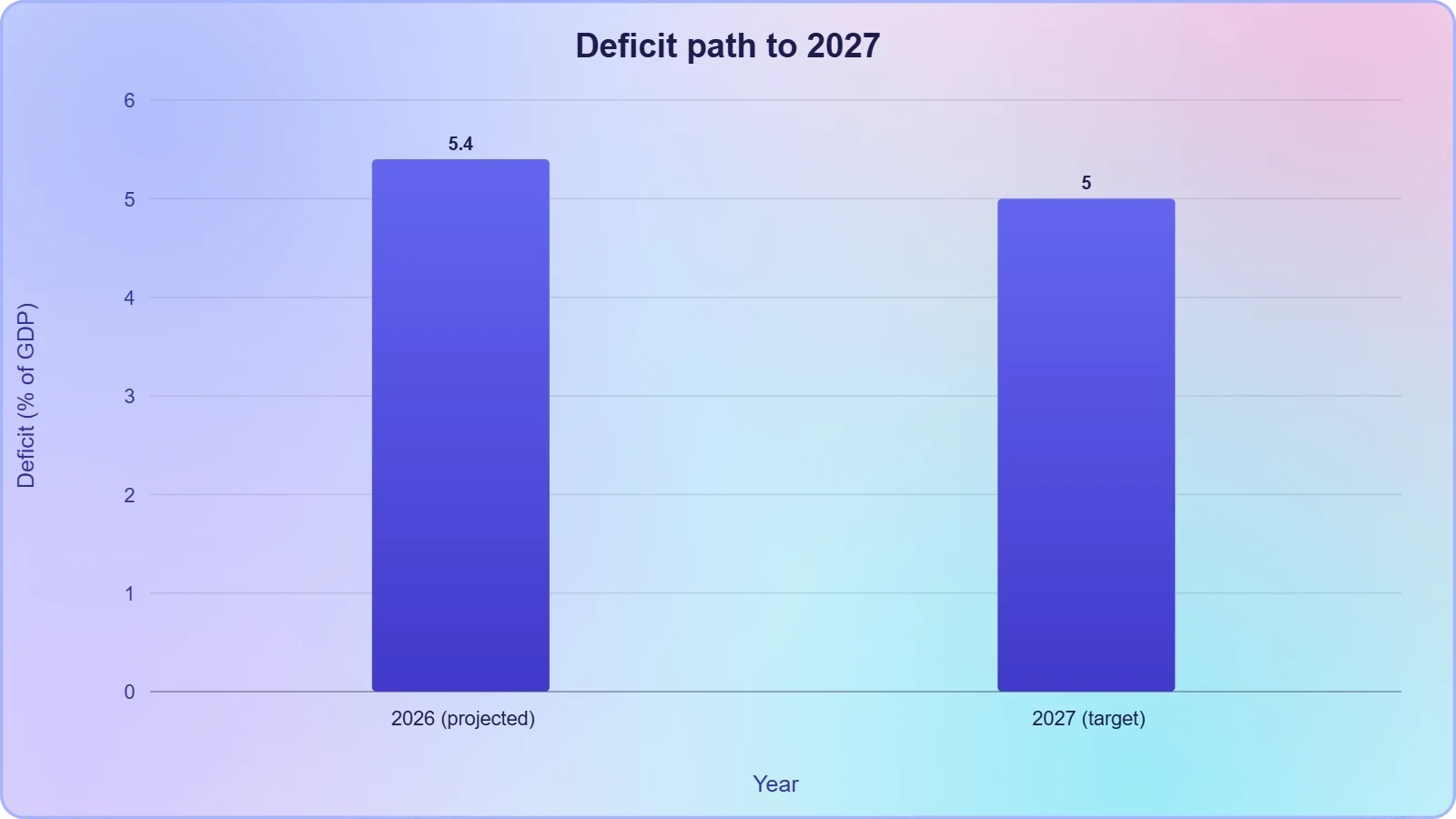
The government's stated ambition—cutting the deficit to 5% of GDP in 2027 from a projected 5.4% in 2026—rests on tax measures the National Assembly will revisit on October 27, against determined opposition resistance.
Analysts at Natixis, ING, and Ebury converge on a sobering conclusion: even legislative survival may not deliver the savings required. With unions calling a national day of strikes and protests for November, this analysis dissects the protest arithmetic, the bond-market signal, the rating agency's warning, and the sectors most exposed to prolonged turbulence.
TL;DR Mass protests across France have amplified investor anxiety over the country's public finances, pushing ten-year OAT yields to their highest since 2002 and widening the Bund spread to its widest since 2011. Moody's kept France at Aa3 but maintained a negative outlook, warning that political fragmentation obstructs deficit reduction. The government targets a 5% deficit by 2027, yet opposition resistance and possible reliance on Article 49.3 or executive ordinances underscore institutional fragility. Analysts see tactical portfolio shifts rather than wholesale exit, but long-term investors remain sidelined pending clarity on reform credibility.
The Protest Arithmetic and the Political Street
Numbers in French protest politics are never neutral, and the gap between official and union counts frames the entire dispute. The Interior Ministry's 410,000 nationwide figure and the CGT's 800,000 estimate, including 250,000 in Paris, represent competing claims about legitimacy and momentum.
Such divergence is routine in France, yet it matters enormously when markets are trying to gauge whether unrest will subside or escalate into a sustained challenge to the government's authority.
Reading the Crowd Counts
Official tallies typically undercount because they rely on police observation, while union figures aggregate organizer estimates and often inflate. Neither number is fraudulent; each serves a political function. For investors, the more instructive signal lies in geography and timing—Paris and Marseille producing post-dark clashes despite a large security operation suggests friction between peaceful mobilization and militant fringes that can destabilize the narrative.
The scheduled escalation matters more than any single Saturday. Additional demonstrations were planned for October 24, and unions have already called a national day of strikes and protests for November.
A rolling calendar of disruption raises the probability that economic activity—retail footfall, transport, tourism—suffers measurable attrition, which in turn feeds the growth concerns already embedded in French asset prices.
From Street to Balance Sheet
Protest movements influence sovereign risk through two channels: direct economic damage and indirect political constraint. The first is visible in disrupted commerce and delayed investment decisions. The second is subtler but more consequential—every concession extracted by street pressure narrows the fiscal space available for deficit reduction, precisely when Brussels and rating agencies demand credible consolidation.
This is why the unrest cannot be dismissed as background noise. It hardens the perception that any future government, regardless of composition, will struggle to deliver the reforms and savings France requires.
When ING's Charlotte de Montpellier observes that the unrest reinforces this view, she is describing a feedback loop in which social resistance raises the political cost of austerity, which raises borrowing costs, which raises the austerity required.
The Bond Market Speaks Loudest
Sovereign bond markets render verdicts faster than parliaments, and the verdict on France has been unambiguous. The ten-year OAT yield rose eleven basis points on Thursday to its highest level since 2002, a threshold that carries psychological as well as financial weight.
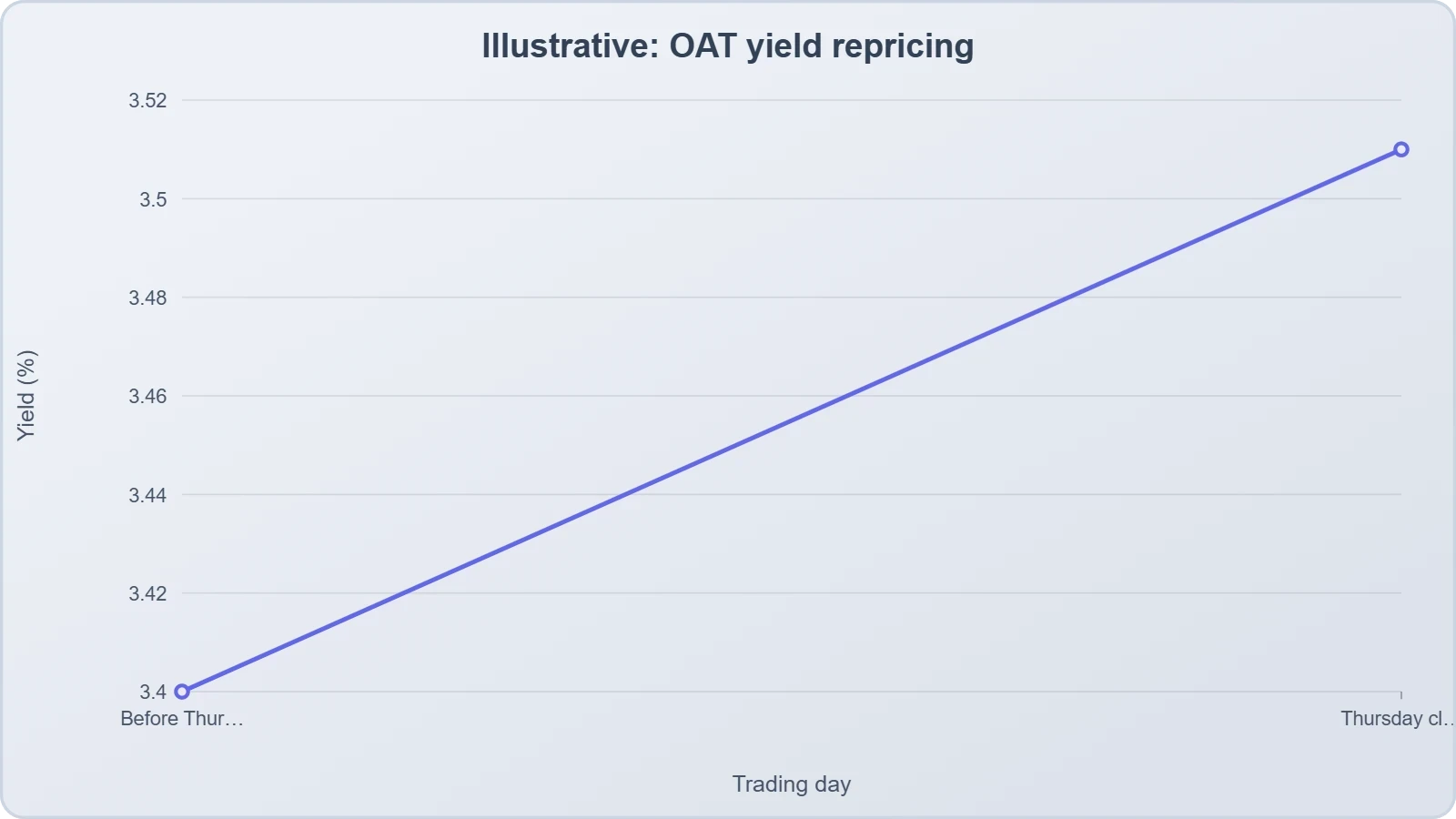
More telling still, the spread over German Bunds widened to its largest since November 2011—the era of the eurozone debt crisis, when contagion fears threatened the currency union's cohesion.
Decoding the Spread
The OAT-Bund spread functions as a risk thermometer for French creditworthiness relative to Europe's safest anchor. Widening to 2011-era levels signals that investors demand materially greater compensation to hold French debt.
This is not a default forecast; it is a repricing of political risk, fiscal trajectory, and institutional reliability bundled into a single number that every portfolio manager can read instantly.
Natixis CIB's Alain Durré offers a crucial nuance: recent pressure on French debt has mainly come from tactical portfolio shifts, with traditional long-term investors staying on the sidelines. That distinction separates a liquidity-driven wobble from a structural exodus.
Tactical money can return quickly once clarity emerges; long-term capital requires credible reform before it re-engages, and its absence leaves the market thinner and more volatile.
The Government's Defense Arsenal
Durré notes that the government is determined to prevent a sharp rise in borrowing costs and could deploy Article 49.3, which permits a bill to pass without a final vote unless a no-confidence motion succeeds, or resort to executive ordinances.
Both instruments can break legislative logjams, yet each carries a democratic cost that may itself fuel street mobilization and deepen the political fragmentation Moody's cites.
This is the central paradox of French fiscal management in this cycle. The tools available to force budget passage are precisely the tools that inflame the protests raising borrowing costs in the first place.
Every invocation of constitutional leverage buys fiscal time while spending political capital, and the market understands that arithmetic even when it cannot predict the timing of the next confrontation.
Moody's Verdict and the Deficit Trajectory
Moody's decision to keep France at Aa3 while maintaining a negative outlook is a finely calibrated warning rather than a reprieve. The agency explicitly tied the outlook to the risk that a fragmented political landscape will keep hindering the work of legislative institutions.
In plain terms, France's credit standing now depends less on economic fundamentals than on whether its parliament can function under divided political conditions.
The Path Back to Stable
Moody's also specified the route to stability: institutions must demonstrate the capacity to reduce the budget deficit. The government's target—5% of GDP in 2027, down from a projected 5.4% in 2026—defines the benchmark against which that capacity will be judged.
The trajectory is modest in ambition yet formidable in execution, requiring sustained legislative cooperation that current conditions scarcely permit.
Consider the arithmetic embedded in the plan. Trimming roughly four-tenths of a percentage point of GDP over a year demands either revenue measures that provoke the street or expenditure restraint that provokes the opposition.
Both chambers of the political spectrum have signaled resistance, and the National Assembly's October 27 debate on budget tax measures will test whether any coalition of convenience can assemble a durable majority.
Concessions and the Credibility Gap
Ebury's Matthew Ryan captures the market's deeper skepticism: it is unclear whether the 2027 budget will pass parliament, and even if it does, concessions to the left and right may leave the deficit problem insufficiently addressed.
This is the credibility gap in its purest form—legislative survival achieved through dilution produces a budget that satisfies nobody and fixes nothing.
Rating agencies are acutely sensitive to this pattern. A negative outlook maintained through a period of political fragmentation signals that downgrade risk accumulates with each missed consolidation target. France retains the buffer of a large, diversified economy and deep capital markets, but buffers erode when the political system repeatedly demonstrates an inability to convert economic capacity into fiscal discipline.
Sectors and Assets in the Crosshairs
Investors are assessing which sectors and assets could be most affected if unrest continues, and the exposure map is neither uniform nor obvious. French equities carry the CAC 40 index as their headline gauge, but the composition of that index matters enormously.
Luxury names such as LVMH Moët Hennessy Louis Vuitton and retailers like Carrefour sit at different points on the sensitivity spectrum, responding to distinct transmission channels.
Luxury, Retail, and Consumer Exposure
Luxury houses depend on global demand and tourism flows, making them vulnerable to any disruption that dents Paris's image as a safe, glamorous destination. Retailers face more direct pressure from transport strikes, reduced footfall, and supply-chain friction.
Both categories, however, share exposure to the broader confidence channel: sustained unrest depresses consumer sentiment and delays discretionary spending decisions across the economy.
The CAC 40's international orientation provides partial insulation, since many constituents earn revenue abroad. Yet index-level resilience can mask sector-level pain, and portfolio managers rotating within French equities must distinguish between companies whose cash flows are globally diversified and those anchored to domestic conditions. That differentiation becomes sharper as the protest calendar extends into November.
Banks, Sovereigns, and Contagion Channels
French banks hold substantial sovereign exposure, so widening OAT spreads compress their capital positions and raise funding costs. The transmission runs from sovereign to financial sector to credit availability, a sequence painfully familiar from the eurozone crisis. Even without a downgrade, the repricing alone tightens conditions for lending and investment across the domestic economy.
Contagion beyond France remains a live question. The Bund spread's widening reflects relative risk, but if investors begin questioning eurozone cohesion more broadly, peripheral spreads could follow. For now, the pressure appears France-specific, driven by budget politics and street unrest rather than systemic doubt about the currency union. That distinction is the market's most important stabilizing anchor.
- 01
- 02
- 03
- 04
We Also Published
Political Fragmentation as the Structural Fault Line
Beneath the protest counts and yield moves lies a structural fault line that no single budget vote can repair. Moody's language about a fragmented political landscape hindering legislative institutions describes a durable condition, not a temporary impasse.
France's political center has weakened, opposition forces on both flanks command substantial blocking power, and coalition arithmetic in the National Assembly resists stable majorities.
The Reform Paralysis Thesis
ING's observation that any future government will struggle to deliver needed reforms and savings is the analytical heart of the matter. It implies that the current difficulties are not a passing storm but a preview of recurring episodes.
Each government inherits the same structural constraints, and each confronts the same choice between constitutional shortcuts and legislative dilution.
Markets price this paralysis through term premia that rise with perceived institutional dysfunction. The OAT-Bund spread at 2011-era levels is therefore not merely a reaction to one protest weekend; it is a cumulative judgment about France's capacity to govern its finances across electoral cycles. That judgment will not reverse on a single favorable vote or a quiet month.
What Would Restore Confidence
Restoring confidence requires visible evidence that institutions can reduce the deficit without relying on Article 49.3 or executive ordinances. A budget passed through normal legislative process, with credible savings rather than cosmetic concessions, would signal functional governance. Absent that, tactical investors may return on dips, but long-term capital will keep waiting for proof.
The November strike calendar and the October 27 Assembly debate thus become twin tests. One measures social temperature; the other measures legislative capability. France's borrowing costs, its growth outlook, and its credit standing will respond to whichever signal proves stronger. Investors should watch the spread, not the headlines, for the market's running verdict on both.
The Road Through November and Beyond
The immediate calendar offers little respite. More demonstrations were planned for October 24, the National Assembly resumes budget tax debate on October 27, and unions have called a national day of strikes and protests for November.
Each event carries the potential to either clarify or compound the uncertainty that has pushed French borrowing costs to multi-decade highs and widened the Bund spread to crisis-era levels.
Scenarios for Investors
A benign scenario requires the budget to pass through normal legislative channels with credible savings, protests to remain largely peaceful, and Moody's outlook to stabilize. In that world, tactical portfolio shifts reverse, long-term investors re-engage, and the OAT-Bund spread compresses. The probability of this path depends entirely on legislative arithmetic that currently looks unfavorable.
A harsher scenario involves reliance on Article 49.3 or ordinances, sustained November disruption, and a budget diluted by concessions that leaves the deficit insufficiently addressed. Here the spread stays wide or widens further, banks face rising funding costs, and growth forecasts erode. Between these poles lies a muddle-through path of repeated near-misses that keeps volatility elevated without triggering crisis.
Positioning for Institutional Uncertainty
Prudent positioning acknowledges that French risk is now political risk, and political risk resists clean modeling. Duration exposure to OATs demands compensation for term premium that may persist. French bank equities warrant scrutiny of sovereign holdings. Consumer-facing names require sensitivity analysis around footfall and sentiment. None of this argues for wholesale avoidance, only for disciplined differentiation.
The deeper lesson transcends France. Advanced economies with fragmented politics and elevated deficits face a common market discipline: credibility is priced continuously, and institutional dysfunction carries a measurable premium. France's autumn of discontent is a case study in how street politics, legislative paralysis, and bond markets interact. Investors who read that interaction correctly will be positioned long before the headlines turn.
From our network :
- Mobile Learning and VR in English: What Global Evidence Reveals About Effective Language TechnologyA systematic review across 14 countries reveals which language-learning technologies genuinely work. Mobile learning, AI, and VR show measurable benefits when pedagogically integrated. This evidence-based guide helps educators and learners select technology that delivers real return on investment.
- CISA’s Ten-Advisory Wave: Why Generic Patching Fails in OT and How to Build Product-Specific PlaybooksCISA released ten ICS advisories in one week, exposing critical infrastructure risks. Generic patching fails in OT. Learn to build product-specific remediation playbooks.
- The Final Descent: How ESA Retired the Legendary Cluster Constellation After 24 Years of Space Weather ScienceAfter 24 years mapping Earth’s magnetosphere, ESA’s Cluster mission concluded with a precisely controlled reentry over the South Pacific. This analysis explores the scientific legacy, engineering decisions, and debris mitigation principles behind one of space exploration’s most responsible retirements.
- The Hidden Cost of AI Convenience: Why Over-Permissioned Agents Are a Security Time BombDiscover why AI agents with excessive permissions create dangerous single points of failure, and learn how implementing least privilege principles can protect your organization from exploitation.
- Live Online English Classes for Kids: Do They Actually Reduce Anxiety?A ten-week study reveals that synchronous online English classes can significantly reduce child language anxiety while improving listening and reading skills. Discover what makes these programs effective and how parents can select the right one.
- University Language Proficiency Exams: Why Institutional Tests Demand Different Preparation Than IELTS and TOEFLDiscover why university-specific language proficiency examinations differ fundamentally from IELTS and TOEFL, and learn strategic preparation approaches for institutional assessment success.
- How AI Agents Will Change the Way We Manage Personal FinancesExplore how AI agents are transforming personal finance through automated budgeting, bill payment, and investment management, while examining the critical security protocols and governance frameworks required for safe deployment.
- Committed Mediterranean Precipitation Decline: Why Emissions Cuts Alone Cannot Restore Winter RainsNew NOAA research reveals that Mediterranean winter rains may decline irreversibly even with emissions cuts. Explore the science of committed climate change and regional impacts.
- Forbidden Matrix Patterns and Visible Lattice Points: A Geometric DictionaryExplore how multidimensional 0–1 matrices encode geometric truths, linking forbidden patterns to visible lattice points and hypergraph theory, with applications in combinatorics and computational geometry.
RESOURCES
- France protests push bond yields higher, euro slips - CNBCcnbc.com6 days ago ... French government bond yields rose Monday as weekend unrest added to investor concerns over the country's fiscal and political outlook.
- When fiscal risk returns: Lessons from France - TIAAtiaa.orgOct 14, 2026 ... French OAT-German Bund 10-year Yield Spread (lhs). French OAT 10-year ... concern for investors, especially around elections and when economic ...
- Euro zone bond yields rise as French borrowing costs hit 24-year highreuters.com4 days ago ... ... French protests added to concerns over the country's fragile finances and political uncertainty ... The OAT-Bund spread has been…
- Bund Yields Ease on Safe-Haven Demand - Trading Economicstradingeconomics.com5 days ago ... Germany's 10-year Bund yield retreated toward 3.4% amid safe-haven buying, while French and other highly indebted euro-area sovereign bonds ...
- French Bond Yields Rise on Budget Protest Concerns as Treasury ...wsj.com6 days ago ... The 10-year Treasury yield rose 5 basis points, to 5.148%, according to Tradeweb. Investors are also looking ahead to next…
- Chart of the Week - Public Technologies (PUBT)docs.publicnow.comOct 5, 2026 ... France 10Y OAT Yield (LHS). 10Y OAT-Bund Spread (RHS). Current Spread (RHS). What does the chart show? The chart plots…
- News Flash - The situation in France remains a concern for investorsgroupama-am.com2 days ago ... Investors will therefore be closely monitoring the scale of the upcoming demonstrations ... An OAT-Bund spread of 170 bps and…
- À bout de souffle: What's up with France? - Algebris Investmentsalgebris.com3 days ago ... The spread between 10-year French and German government bond yields (OAT ... OAT-Bund spread into four episodes of budget negotiations…
- The situation in France remains a concern for investorsgroupama-am.com2 days ago ... This underperformance primarily reflects the increase in the risk premium demanded by investors amid ... OAT-Bund spread should, when compared ...
- Five things to know as French bond yield tops 5% - France 24france24.com4 days ago ... Faster price growth means investors demand a higher rate of return ... The spread between the 10-year yield on French…
- France is paying an ever-higher risk premium on its debt as ...facebook.comSep 26, 2026 ... The outlet attributes the strain to France's debt load, budget deficit, weak growth ... spending risks wider protests, while continued ...
- France update: Our take on equity, bond and policy implicationsam.jpmorgan.com2 days ago ... France's unrest is amplifying fiscal and political stress, widening the OAT–Bund spread and weighing on French equities as markets watch ...
- U.S. 30-Year Yield Hits New 24-Year High; French Bonds ...morningstar.comOct 7, 2026 ... France's budget talks, and accompanying nationwide protests in the ... The 10-year OAT-Bund yield spread was last at 139 basis…
- Bull market broadens as inflation, the Fed and French debt ... - UBPubp.comOct 12, 2026 ... Last week, OAT–Bund spreads widened towards recent highs of around ... The USD remains strong on higher energy prices, while…
- France Between the Barricades and the Bond Market. | PRS Groupprsgroup.com5 days ago ... For investors and country-risk analysts, the critical indicators will include the OAT–Bund spread, the eventual fiscal content of the budget, ...
- 01
- 02
- 03
- 04
- 05
- 06
- 07
- 08
0 Comments