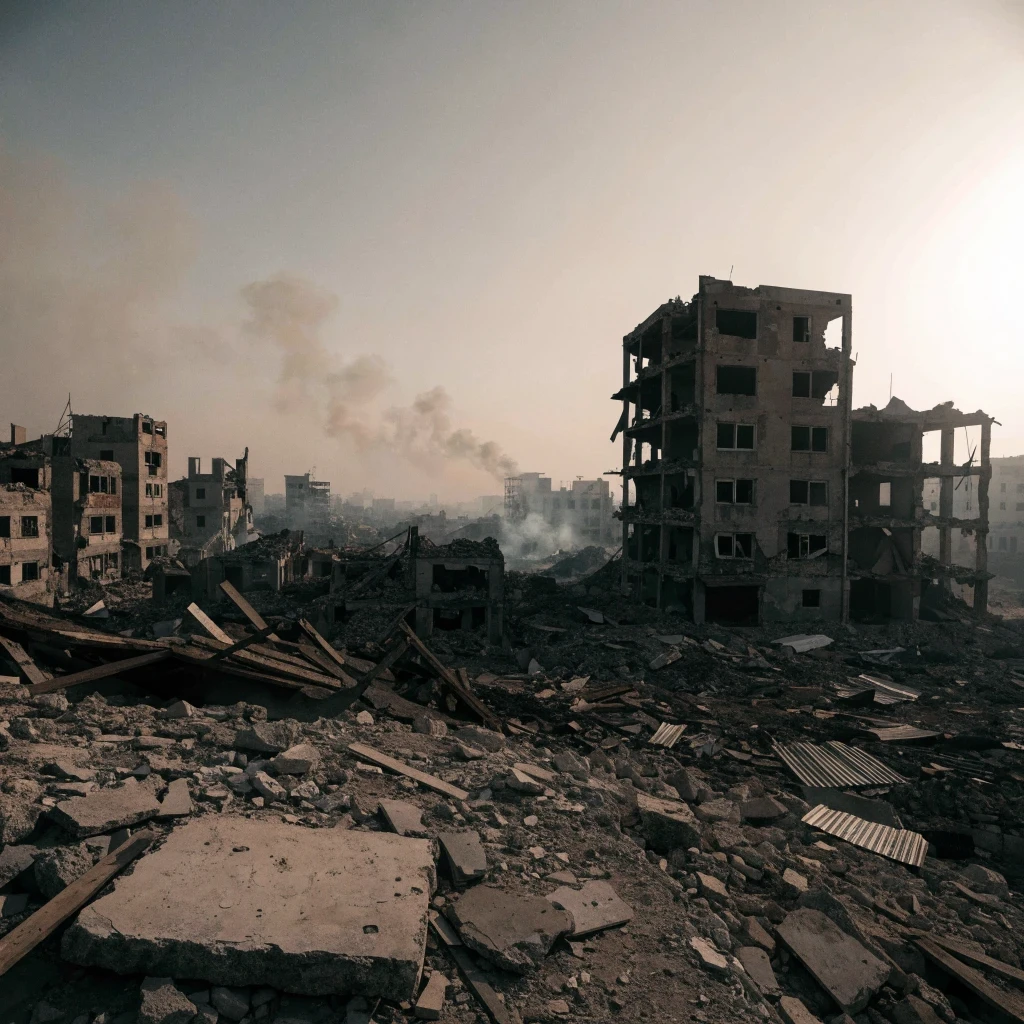
TL;DR The Israeli-Palestinian conflict remains locked in a dangerous diplomatic vacuum as Prime Minister Benjamin Netanyahu rejects a US-brokered Gaza proposal while Hamas dismisses Israeli counter-offers. This mutual rejection underscores a fundamental breakdown in trust, with both sides prioritizing domestic political survival over pragmatic compromise. The stalemate perpetuates humanitarian catastrophe, regional instability, and the erosion of American diplomatic credibility in the Middle East.
The Gaza ceasefire negotiations have collapsed into a familiar pattern of mutual rejection, with Israeli Prime Minister Benjamin Netanyahu dismissing the latest American proposal and Hamas refusing Israeli counter-demands. This diplomatic paralysis is not merely a tactical disagreement; it represents a profound structural failure in how international mediators approach one of the world's most intractable conflicts. The United States, traditionally the dominant broker in Middle East peace efforts, finds itself increasingly marginalized as both parties harden their positions.
The core problem lies in the fundamental asymmetry of interests and the absence of any credible enforcement mechanism. Netanyahu's political survival depends on maintaining a hawkish posture, while Hamas's legitimacy rests on its resistance narrative. Neither leadership can afford to appear conciliatory without risking domestic backlash. The result is a self-perpetuating cycle where every proposed framework becomes another casualty of political calculus rather than a genuine pathway toward resolution.
## The Anatomy of Diplomatic Failure in Gaza Negotiations
The rejection of the Trump-brokered proposal by Netanyahu marks yet another chapter in a long history of failed peace initiatives. Washington's approach has consistently relied on the assumption that American pressure and incentives can compel both parties toward compromise. However, this assumption ignores the fundamental reality that both Israeli and Palestinian leaderships have developed sophisticated strategies for absorbing external pressure while maintaining their core positions.
The diplomatic framework itself suffers from a critical design flaw: it treats the conflict as a negotiation problem rather than a structural power imbalance. Israel maintains overwhelming military superiority and territorial control, while Palestinians possess limited leverage beyond international sympathy and resistance operations. This asymmetry means that any agreement reflecting the actual balance of power will inevitably favor Israeli interests, making Palestinian acceptance politically untenable.
### The Netanyahu Doctrine and Domestic Political Constraints
Netanyahu's rejection of the American proposal cannot be understood without examining his domestic political position. His governing coalition depends on far-right parties that view territorial compromise as existential betrayal. The Prime Minister's political survival hinges on projecting strength against Palestinian demands, making any concession politically radioactive within his own camp.
The Israeli public's security concerns, deeply rooted in decades of conflict and terrorism, provide fertile ground for hardline positions. Polls consistently show that a majority of Israelis support a two-state solution in principle, yet simultaneously distrust Palestinian intentions. This cognitive dissonance allows Netanyahu to maintain popular support while rejecting specific proposals that would require meaningful concessions.
### Hamas's Strategic Calculus and Resistance Legitimacy
Hamas faces an equally constraining political environment, though its constraints operate differently. The organization's legitimacy within Palestinian society derives substantially from its resistance credentials. Accepting Israeli terms would undermine its foundational narrative and risk internal challenges from more radical factions. The group's leadership in Gaza also faces the practical challenge of governing a devastated territory while maintaining its military capabilities.
The October 7 attacks fundamentally altered Hamas's strategic position, transforming it from a marginalized actor into the central obstacle to Israeli security. This elevation has paradoxically strengthened its bargaining position while simultaneously making compromise more difficult. Hamas leadership calculates that time favors their position, as international pressure on Israel grows with each civilian casualty.
### The Role of Regional Actors in Shaping Negotiation Outcomes
The broader regional landscape has shifted dramatically since previous peace efforts, with Arab states increasingly prioritizing their own strategic interests over Palestinian solidarity. The Abraham Accords demonstrated that normalization with Israel could proceed without Palestinian statehood, weakening the traditional Arab leverage in negotiations. This shift has left Palestinians diplomatically isolated while Israel enjoys expanding regional acceptance.
Iran's support for Hamas and other militant groups adds another layer of complexity, transforming the conflict into a proxy confrontation within the wider regional rivalry. Tehran's interests align with perpetuating the conflict rather than resolving it, providing Hamas with an external patron that discourages compromise. The regional dimension ensures that any bilateral agreement remains vulnerable to external spoilers.
## The Humanitarian Catastrophe and Its Political Consequences
The human cost of the diplomatic failure continues to mount with devastating consequences. Gaza's infrastructure lies in ruins, with hospitals, schools, and water systems destroyed or severely damaged. The civilian population faces acute shortages of food, medicine, and shelter, creating conditions that international organizations describe as catastrophic. This humanitarian crisis generates global outrage that paradoxically hardens positions rather than facilitating compromise.
The images of suffering emerging from Gaza have reshaped international public opinion, particularly among younger generations in Western democracies. This shift creates new political pressures on governments that have traditionally supported Israel unconditionally. However, these pressures have not yet translated into meaningful diplomatic leverage, as the United States continues to shield Israel from international accountability mechanisms.
### The Economic Devastation and Reconstruction Dilemma
Gaza's economy has been effectively destroyed, with unemployment rates exceeding 80 percent and the private sector in collapse. Reconstruction costs are estimated in the tens of billions of dollars, yet no credible funding mechanism exists without a political settlement. The chicken-and-egg problem is stark: reconstruction requires stability, but stability requires addressing the underlying political grievances that perpetuate conflict.
International donors face a moral hazard in funding reconstruction without political progress, as rebuilt infrastructure could be destroyed in the next round of hostilities. This dilemma has led to donor fatigue, with previous pledges remaining largely unfulfilled. The economic desperation in Gaza fuels radicalization, creating a vicious cycle that undermines any prospects for moderate leadership to emerge.
### The Displacement Crisis and the Right of Return Question
The displacement of hundreds of thousands of Palestinians has revived the historically explosive issue of refugee return. Israel's security establishment views mass return as an existential demographic threat, while Palestinians consider it a non-negotiable right. This fundamental disagreement makes any comprehensive agreement structurally impossible under current leadership.
The refugee question extends beyond Gaza to encompass the broader Palestinian diaspora, with millions of registered refugees across the region. Any peace framework must address this issue, yet the gap between Israeli security requirements and Palestinian national aspirations appears unbridgeable. The international community's inability to develop creative solutions to this impasse reflects the deeper failure of diplomatic imagination.
### The Psychological Dimensions of an Unresolved Conflict
Decades of conflict have created deep psychological wounds on both sides that transcend rational calculation. Israeli society carries the trauma of terrorism and existential threats, while Palestinians experience the daily humiliation of occupation and displacement. These collective traumas shape political behavior in ways that resist purely rational diplomatic solutions.
The educational systems, media narratives, and religious institutions on both sides perpetuate narratives of victimhood and dehumanization. Generations have grown up knowing only conflict, with no personal experience of peaceful coexistence. Breaking these psychological barriers requires generational change that no diplomatic initiative can accelerate.
## The Geopolitical Implications of a Perpetual Stalemate
The failure to resolve the Gaza conflict has profound implications beyond the immediate parties. Regional stability continues to deteriorate, with the conflict serving as a recruiting tool for extremist groups across the Middle East. The United States finds its credibility as a mediator increasingly questioned, while other powers seek to fill the diplomatic vacuum.
China and Russia have positioned themselves as alternative diplomatic actors, offering platforms that challenge American leadership. Their involvement reflects the broader multipolar shift in international relations, where regional conflicts become arenas for great power competition. The Palestinian cause, once a unifying Arab concern, has become a tool in broader geopolitical rivalries.
### The Erosion of American Diplomatic Credibility
Washington's approach to the conflict has suffered from perceived bias and inconsistent application of principles. The Trump administration's recognition of Jerusalem as Israel's capital and its peace plan's explicit rejection by Palestinians undermined American claims of neutrality. The Biden administration's continuation of military support while criticizing specific operations has satisfied neither side.
This credibility deficit means that American proposals arrive with built-in suspicion from Palestinian leadership. The United States cannot simultaneously serve as Israel's primary military backer and honest broker for peace. This fundamental contradiction undermines every American initiative, regardless of its substantive merits.
### The Rise of Alternative Diplomatic Frameworks
The failure of American-led efforts has created space for alternative diplomatic initiatives. The Arab League and Organization of Islamic Cooperation have proposed frameworks, though their internal divisions limit their effectiveness. The United Nations remains the primary forum for international consensus, yet its resolutions lack enforcement mechanisms and face consistent Israeli and American opposition.
The International Criminal Court's investigations into alleged war crimes represent a new dimension of accountability that could reshape the conflict's trajectory. Israel's refusal to cooperate with these proceedings creates additional diplomatic friction while providing Palestinians with a new arena for pursuing their claims. The legal dimension adds complexity to an already overdetermined conflict.
### The Strategic Implications for Regional Security Architecture
The Gaza conflict has fundamentally altered the regional security environment, with implications for the broader Middle East. The normalization agreements with Arab states have not delivered the stability their architects promised, as the Palestinian issue continues to generate regional instability. Iran's network of proxies has been strengthened by the conflict, extending Tehran's influence across the region.
The conflict has also accelerated the militarization of the region, with states investing heavily in advanced weapons systems. This arms race creates new risks of escalation while providing no corresponding increase in security. The strategic landscape has become more volatile, with multiple actors possessing the capability to trigger wider conflagrations.
## The Path Forward and the Prospects for Breakthrough
The current stalemate appears intractable, yet history demonstrates that seemingly frozen conflicts can suddenly shift. The key variables that could unlock progress include leadership changes, regional realignments, and sustained international pressure. However, none of these factors currently appear sufficient to overcome the structural obstacles.
The most realistic near-term objective is not a comprehensive peace agreement but rather a sustainable ceasefire that could create conditions for broader negotiations. Such an arrangement would require international guarantees and monitoring mechanisms that have been absent from previous efforts. The humanitarian imperative alone demands creative approaches to de-escalation.
### The Case for a New Diplomatic Architecture
The failures of traditional mediation suggest the need for a fundamentally different approach. A multilateral framework that includes regional powers, international organizations, and civil society could provide the legitimacy that bilateral American mediation lacks. The involvement of actors like China, Russia, and the European Union could create a more balanced dynamic.
The international community must also address the enforcement gap that has plagued previous agreements. Any new framework requires credible mechanisms for monitoring compliance and consequences for violations. The absence of such mechanisms has allowed both parties to treat agreements as aspirational rather than binding.
### The Role of Civil Society and Track II Diplomacy
Official negotiations have repeatedly failed, yet civil society initiatives continue to build bridges across the divide. People-to-people programs, joint economic ventures, and educational exchanges offer alternative pathways toward coexistence. These efforts rarely capture headlines but create the human connections that make political compromise possible.
Track II diplomacy, involving unofficial actors with access to decision-makers, has produced creative proposals that official channels cannot consider. These informal discussions allow for exploring options without political commitment, generating ideas that can later be adopted by governments. The international community should invest more heavily in these unofficial channels.
### The Imperative of Humanitarian Action
Regardless of political progress, the humanitarian situation demands immediate action. The international community must scale up aid delivery, establish protected corridors, and fund reconstruction efforts. These actions are not merely charitable; they are essential investments in any future political settlement.
The reconstruction of Gaza cannot wait for a peace agreement, as the current conditions breed despair and extremism. A comprehensive humanitarian package, implemented with international oversight, could demonstrate tangible benefits of cooperation. Such efforts could create constituencies for peace on both sides of the conflict.
The diplomatic failure in Gaza reflects deeper structural problems in how the international community approaches protracted conflicts. The assumption that rational actors will eventually compromise ignores the powerful domestic, ideological, and regional forces that perpetuate conflict. Breaking this cycle requires not just better proposals but a fundamental rethinking of mediation strategies.
The path forward demands courage from all parties: courage to make politically costly concessions, courage to challenge domestic constituencies, and courage to envision a future beyond perpetual conflict. Without such courage, the stalemate will continue to exact its terrible human toll, destabilizing the region and undermining global security.
From our network :
- The Hidden Cost of AI Convenience: Why Over-Permissioned Agents Are a Security Time BombDiscover why AI agents with excessive permissions create dangerous single points of failure, and learn how implementing least privilege principles can protect your organization from exploitation.
- Forbidden Matrix Patterns and Visible Lattice Points: A Geometric DictionaryExplore how multidimensional 0–1 matrices encode geometric truths, linking forbidden patterns to visible lattice points and hypergraph theory, with applications in combinatorics and computational geometry.
- How AI Agents Will Change the Way We Manage Personal FinancesExplore how AI agents are transforming personal finance through automated budgeting, bill payment, and investment management, while examining the critical security protocols and governance frameworks required for safe deployment.
- CISA’s Ten-Advisory Wave: Why Generic Patching Fails in OT and How to Build Product-Specific PlaybooksCISA released ten ICS advisories in one week, exposing critical infrastructure risks. Generic patching fails in OT. Learn to build product-specific remediation playbooks.
- The Final Descent: How ESA Retired the Legendary Cluster Constellation After 24 Years of Space Weather ScienceAfter 24 years mapping Earth’s magnetosphere, ESA’s Cluster mission concluded with a precisely controlled reentry over the South Pacific. This analysis explores the scientific legacy, engineering decisions, and debris mitigation principles behind one of space exploration’s most responsible retirements.
- Norbert’s Uncertain Path: Why Hawaii’s Storm Watch Demands Patience Over PanicTropical Storm Norbert strengthens in the Eastern Pacific with winds near 50 mph, forecast to reach Category 1 hurricane status by Friday. Long-range models disagree sharply on whether Hawaii faces any threat around September 19–23, making official guidance essential.
- Former Soap Stars Embark on Ambitious Writing Projects and Theatrical StagesDiscover how former soap opera actors are transitioning into independent scriptwriting and high-profile theatrical stage productions.
- Analyzing Hoya Corporation’s Midday Volume Shifts and Financial FundamentalsExamine Hoya Corporation’s midday trading volume contraction, technical moving averages, robust solvency ratios, and stellar quarterly earnings performance.
- Committed Mediterranean Precipitation Decline: Why Emissions Cuts Alone Cannot Restore Winter RainsNew NOAA research reveals that Mediterranean winter rains may decline irreversibly even with emissions cuts. Explore the science of committed climate change and regional impacts.
RESOURCES
- Hamas will have 'hell to pay' if it fails to disarm, Trump warns after ...theguardian.comDec 29, 2025 ... ... Israeli hostage left in Gaza before the next stages of the stalled ceasefire can be implemented, Israeli officials and…
- Hamas refuses to disarm until Palestinian state established - BBCbbc.comAug 2, 2025 ... ... Israel's key demands in talks about a ceasefire in Gaza. The Palestinian armed group said it was responding to…
- With the world's attention focused on Iran, Israel's battle with Hamas ...facebook.comFeb 13, 2026 ... ... US-brokered Israel-Gaza peace deal and the accompanying fragile ceasefire. ... Israel's Netanyahu aims to sabotage ceasefire deal with Hamas.
- title Honoured to call on Israeli President Isaac Herzog. We last met ...instagram.comNov 5, 2025 ... Israel Rejects Gaza Peace Plan, Netanyahu Demands Full Hamas Disarmament ... agreement only if Israel halted strikes in Gaza and ...
- Hamas announced that it will dissolve its government in Gaza, a ...facebook.comJul 6, 2026 ... ... Israel as progress from the US-brokered ceasefire plan has stalled. ... U.S.-brokered cease-fire deal with Israel. The militant group…
- Latest News – Israeli-Palestinian Conflict | Global Conflict Trackercfr.orgIsrael to Revive Airdrops Into Gaza · Netanyahu Pursuing “Alternative” Options to End War in Gaza · Gaza Ceasefire Talks Stall as France Recognizes…
- Gaza's Ceasefire is Vital, but Only a Start | International Crisis Groupcrisisgroup.orgOct 21, 2025 ... What's new? Two years of war in Gaza halted on 9 October as a ceasefire took hold. Pushed by U.S.…
- Netanyahu gave a 'victory to Hamas' by rejecting US-backed Gaza ...france24.com4 days ago ... Israeli Prime Minister Benjamin Netanyahu's rejection of a US-backed peace plan for Gaza last week offered a diplomatic victory to…
- Netanyahu says there's no ceasefire in Lebanon as Israel ... - CNNcnn.comApr 10, 2026 ... Day 41 of Middle East conflict — Netanyahu says there's no ceasefire in Lebanon as Israel ... ceasefire agreement between…
- Israeli strikes kill dozens as both sides say the other breached Gaza ...aljazeera.comOct 19, 2025 ... ... ceasefire deal with Israel, claims Hamas rejected ... Hamas rejects US claim on Gaza ceasefire violation as 'Israeli propaganda'.
- Gaza's future remains uncertain as Palestinians and Israelis mark ...pbs.orgJul 2, 2026 ... It's the 1000th day since a Hamas-led attack on Israel sparked the war in Gaza. Other conflicts have emerged in…
- Netanyahu rejects Trump's Gaza Peace Plan - NPRnpr.org7 days ago ... The latest dispute follows an initial ceasefire ... Trump announces deal for Hamas to disarm, militants demand Israel withdraws from…
- Trump Shouldn't Follow Netanyahu's Lead - Cato Institutecato.orgMar 20, 2025 ... The January ceasefire agreement between Israel and Hamas, which brought a pause to the 15 months of death and destruction…
- Palestinian President Mahmoud Abbas to address U.N. ... - PBSpbs.orgSep 19, 2025 ... ... Hamas and made it more difficult to reach a deal for a ceasefire and hostage release in the Gaza…
- A Reckoning for the Stalled Gaza Peace Plan | The New Yorkernewyorker.comDec 29, 2025 ... Hamas says that Israel is creating pretexts to avoid honoring the agreement. U.S. officials describe the ceasefire as still holding,…
- 01
- 02
- 03
- 04
- 05
- 06
- 07
- 08
0 Comments