
When the People's Bank of China executed a 100 billion yuan swap operation on a Tuesday in early November 2026, it was not merely a routine liquidity maneuver but a carefully calibrated signal of institutional intent. Thirty-one securities and fund companies participated in the bidding, securing highly liquid collateral at a winning rate of just 10 basis points. The scale and participation breadth dwarfed both prior rounds, and the message to global markets was unmistakable: Beijing is prepared to deploy structural tools, not just rhetorical reassurance, to keep its equity markets on an even keel.
This facility, first introduced in October 2024, represents a quiet but consequential evolution in how the central bank manages capital market stability. Rather than injecting cash directly, it allows eligible institutions to pledge bonds, exchange-traded funds, and constituent shares of the CSI 300 Index as collateral in exchange for treasury bonds and central bank bills. The mechanics matter because they preserve balance sheet integrity while freeing up liquidity for equity purchases. Understanding this instrument requires looking beyond the headline figure and examining the architecture of collateral, the trajectory of bid rates, and the coordinated regulatory push behind it.
The analysis below traces the operation from its technical foundations through its market implications, drawing on the sequence of three swap rounds, the joint stance of the central bank alongside the National Financial Regulatory Administration and the China Securities Regulatory Commission, and the broader question of whether such facilities can genuinely cultivate longer-term investment rather than merely smoothing short-term volatility.
On This Page
TL;DR China's central bank conducted a 100 billion yuan swap operation with 31 participating securities and fund companies at a 10 basis point bid rate, marking the largest round since the facility launched in October 2024. The instrument lets institutions pledge bonds, ETFs, and CSI 300 shares as collateral in return for treasury bonds and central bank bills, improving funding access and supporting stock purchases. Coupled with a joint regulatory call to use the facility and a share buyback relending program more effectively, the operation signals a sustained policy commitment to capital market stability, deeper institutional participation, and lower swap fees over time.
The Architecture of China's Swap Facility
The swap facility is best understood as a collateral transformation mechanism rather than a conventional monetary injection. Eligible securities, fund, and insurance companies surrender assets such as corporate bonds, exchange-traded funds, and shares in CSI 300 constituent companies, receiving in return highly liquid instruments including treasury bonds and central bank bills. This exchange does not add base money to the system; instead, it upgrades the quality of assets on participants' balance sheets, enabling them to secure funding more cheaply and to expand equity holdings without liquidating core positions.
Collateral Mechanics and Eligibility
The design reflects a deliberate balancing act. By accepting equities and funds as collateral while disbursing sovereign-grade paper, the central bank effectively absorbs market risk onto its own books during periods of stress, shielding participating institutions from forced selling. Eligibility is restricted to a curated set of securities, fund, and insurance companies, which keeps the counterparty universe manageable and the operational risk contained. The collateral pool, anchored by CSI 300 constituents, ensures that the assets pledged carry sufficient depth and price transparency for valuation.
Observers note that this structure encourages institutions to make better use of assets already sitting idle on their books. Rather than hoarding liquid reserves defensively, firms can pledge less liquid holdings and redeploy the proceeds into equity positions. The mechanism thus addresses a persistent friction in Chinese capital markets, where institutional balance sheets often hold substantial bond exposure that could be productively mobilized to support stock market participation without compromising solvency metrics.
Operational Cadence and Bidding Dynamics
The bidding process itself reveals how the facility has matured. The inaugural October 2024 operation drew 20 institutions bidding 50 billion yuan at a 20 basis point rate. By January 2025, the amount rose to 55 billion yuan and the rate halved to 10 basis points, still with 20 bidders. The latest round expanded to 31 participants and 100 billion yuan at the same 10 basis point rate, demonstrating both growing institutional appetite and the central bank's willingness to scale supply as demand firms.
This trajectory suggests a learning curve on both sides. Institutions have grown more comfortable with the operational and accounting treatment of swaps, while the central bank has refined its pricing to a level that clears the market without appearing to subsidize excessively. The stable 10 basis point rate across the last two rounds implies a settled equilibrium, one that keeps the facility attractive relative to alternative funding channels while preserving a meaningful cost signal for participants.
Reading the Trajectory of Three Rounds
Across three operations spanning roughly two years, the facility has doubled in size, expanded its bidder base by more than half, and settled into a stable pricing band. That progression is not accidental. Each round has functioned as a test of institutional readiness and market absorption, with the central bank calibrating scale and rate to avoid overwhelming participants while steadily normalizing the tool as part of the standard liquidity toolkit. The latest round's 100 billion yuan total, roughly 14.89 billion U.S. dollars, represents a decisive step up in ambition.
From Pilot to Standing Instrument
The first operation in October 2024 carried the hallmarks of a pilot: modest size, a higher 20 basis point rate, and a narrow set of 20 bidders. Its purpose was to establish operational protocols and gauge institutional response. The January 2025 round, while similar in participation, halved the rate and nudged the amount upward, signaling that the mechanism worked and could be priced more aggressively. By November 2026, the facility had shed its experimental character entirely, emerging as a standing instrument with predictable terms.
This maturation matters for market psychology. When institutions can anticipate the availability and pricing of a liquidity backstop, they plan equity allocations with greater confidence. The facility's steady use, as industry observers note, helps institutions make better use of existing assets and supports liquidity management across both stock and bond markets. Predictability itself becomes a stabilizing force, reducing the incentive for defensive hoarding and encouraging more deliberate portfolio construction over longer horizons.
What the Numbers Reveal
The arithmetic of the three rounds tells a story of compounding confidence. A doubling of the operation size alongside a 55 percent increase in bidders, all while holding the rate at 10 basis points, suggests that demand is robust enough to absorb larger allocations without upward pressure on pricing. The central bank, for its part, has demonstrated that it can scale supply without diluting the facility's attractiveness. This balance is delicate, and its persistence across rounds indicates genuine institutional buy-in rather than reluctant participation.
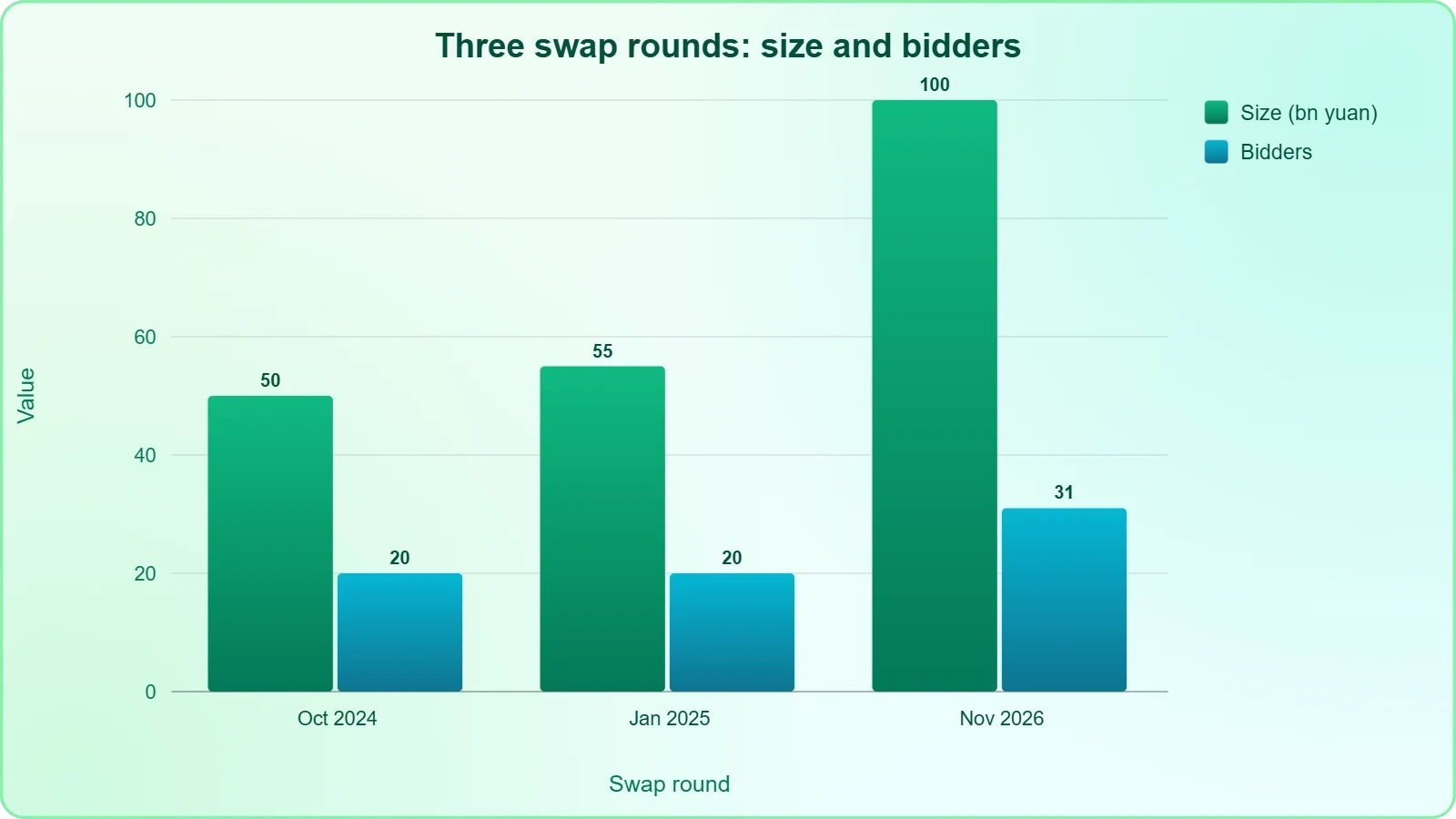
Equally telling is the composition of participants. Securities and fund companies dominate the bidder list, reflecting their central role in equity market intermediation. Their willingness to pledge CSI 300 shares and ETFs as collateral signals a strategic commitment to equity exposure, not merely a tactical funding play. When intermediaries voluntarily tie up market-linked assets to obtain liquid paper, they are effectively voting with their balance sheets on the direction and durability of the underlying market.
Coordinated Regulatory Signaling
The swap operation did not occur in isolation. On the Monday preceding it, the central bank met with the National Financial Regulatory Administration and the China Securities Regulatory Commission, and the three bodies issued a joint call for more effective use of the swap facility alongside a relending program for share buybacks and shareholding increases. This coordination elevates the operation from a technical liquidity measure to a broader policy statement about the priority assigned to capital market stability.
The Buyback Relending Complement
The relending program for buybacks and shareholding increases complements the swap facility in a meaningful way. While swaps improve the liquidity profile of institutional balance sheets, relending directly finances corporate buybacks and major shareholders' purchases. Together, they address both the supply and demand sides of equity support: swaps enable institutions to hold and accumulate shares, while relending incentivizes issuers and controlling shareholders to absorb supply. The joint endorsement signals that policymakers view these tools as mutually reinforcing rather than redundant.
This two-pronged approach reflects a sophisticated understanding of market microstructure. Buybacks reduce floating supply and signal management confidence, while institutional accumulation through swap-funded positions provides steady demand. When both channels operate simultaneously, the combined effect on price stability can exceed the sum of their individual contributions. The explicit call for more effective use suggests that utilization rates may have lagged expectations, prompting regulators to push harder for adoption among eligible institutions.
Forward Guidance on Fees and Eligibility
The central bank's stated intention to run operations in a timely manner, expand participating institutions, lower swap fees as appropriate, and improve collateral and operational arrangements amounts to forward guidance. Each element addresses a potential bottleneck. Expanding eligibility widens the pool of institutions that can access the facility, while lowering fees reduces the cost of participation and encourages more frequent use. Improvements to collateral and operational arrangements tackle the practical frictions that can deter institutions from engaging.
This guidance also functions as a commitment device. By publicly signaling a willingness to adjust terms, the central bank creates expectations that the facility will remain available and become more accessible over time. Such expectations can influence institutional behavior well before any specific change is implemented, encouraging firms to build operational capacity for swap participation in anticipation of more favorable terms. The result is a self-reinforcing cycle of adoption and refinement.
We Also Published
Liquidity Transmission Across Stock and Bond Markets
The facility's most consequential effect may be its role in bridging liquidity between bond and equity markets. Institutions that hold substantial bond portfolios can pledge those assets and receive treasury bonds and central bank bills in return, which are then used to secure funding for equity purchases. This transmission channel allows liquidity to flow from the fixed-income side of the balance sheet to the equity side without requiring outright asset sales, preserving market functioning in both segments simultaneously.
The Collateral Upgrade Effect
At its core, the swap is a collateral upgrade. Corporate bonds and equity holdings carry market and credit risk that can limit their usefulness as funding collateral, especially during periods of volatility. By exchanging these for sovereign-grade paper, the central bank effectively removes that friction. The participating institution emerges with a balance sheet that is more liquid, more stable in valuation, and better positioned to withstand margin calls or redemption pressures, all without altering its aggregate exposure to the underlying assets.
This upgrade effect has second-order benefits for market stability. When institutions are not forced to sell equities to meet funding needs, downward price spirals become less likely. The presence of a reliable collateral transformation channel acts as a circuit breaker, dampening the reflexive dynamics that can turn modest declines into disorderly routs. Over time, the knowledge that such a backstop exists can reduce the risk premium that investors demand for holding equities, lowering the cost of capital for issuers.
Encouraging Longer-Term Investment
Industry observers argue that steady use of the facility could encourage longer-term investment and strengthen market stability. The logic runs through institutional behavior: when funding is predictable and collateral is productive, portfolio managers can afford to look beyond quarterly performance and build positions based on fundamental value. The facility thus supports a shift in market culture, away from short-term trading driven by liquidity anxiety and toward more patient capital allocation aligned with longer investment horizons.
This cultural shift is difficult to measure but consequential. Markets dominated by short-term flows tend to exhibit higher volatility and wider valuation dislocations. By contrast, markets with a stable base of long-term institutional holders display greater resilience and more efficient price discovery. The swap facility, by reducing the liquidity premium embedded in equity holdings, nudges the equilibrium toward the latter. Whether this effect proves durable depends on continued refinement of the tool and sustained institutional participation.
- 01
- 02
- 03
- 04
Institutional Behavior and Market Psychology
Beyond mechanics, the swap facility operates on market psychology. The visible willingness of 31 institutions to participate in a 100 billion yuan operation signals collective confidence in the tool and in the market's near-term stability. When major securities and fund companies commit balance sheet capacity to a facility, they are implicitly endorsing the policy framework behind it. This endorsement can be as influential as the liquidity itself, shaping expectations among smaller investors and foreign participants alike.
Signaling and Credibility
Central bank signaling carries particular weight in markets where policy direction is closely watched. The decision to scale the operation to its largest size yet, while holding the rate steady, communicates that the authorities possess both the capacity and the resolve to support equities. This credibility effect can lower risk premia and attract incremental capital, creating a feedback loop in which the expectation of stability contributes to its realization. The joint statement with the NFRA and CSRC amplifies this signal by demonstrating cross-agency alignment.
Credibility, however, must be earned repeatedly. Each successful operation reinforces the perception that the facility is reliable, while any operational hiccup or perceived reluctance could undermine it. The central bank's forward guidance on timely operations, expanded eligibility, and lower fees is designed to sustain this credibility over time. By committing to continuous improvement, the authorities signal that the facility is a permanent feature of the policy landscape rather than a temporary expedient.
Risks and Limitations
No facility is without limitations. The swap mechanism addresses liquidity and collateral frictions, but it cannot resolve fundamental valuation concerns or earnings deterioration. If equity prices diverge from underlying fundamentals, liquidity support may delay rather than prevent adjustment. Moreover, reliance on a central bank backstop can create moral hazard, encouraging institutions to take on more risk than they otherwise would. These concerns argue for careful calibration and transparent communication about the facility's intended role.
There is also the question of exit. Should market conditions normalize, the central bank will need to scale back operations without disrupting the equilibrium the facility has helped create. A disorderly withdrawal could trigger the very volatility the tool was designed to prevent. The forward guidance on adjusting fees and eligibility provides some flexibility, but the eventual normalization path remains uncertain. Managing this transition will test the authorities' communication and operational skills as much as the original launch did.
Global Implications and Comparative Context
China's swap facility invites comparison with liquidity tools deployed elsewhere. The European Central Bank and the Federal Reserve have long used collateral frameworks to manage market functioning, but their instruments typically operate through banking channels rather than directly targeting equity market participants. The PBOC's approach is distinctive in its explicit focus on stock market support, reflecting the particular structure of China's capital markets and the policy priority assigned to retail investor confidence and financial stability.
Contrast With Western Facilities
Western central banks have generally been reluctant to design facilities that directly facilitate equity purchases, wary of the moral hazard and political optics involved. The Fed's various lending facilities during crises focused on credit markets and Treasury functioning, while the ECB's collateral framework, though broad, did not explicitly target stock holdings. China's willingness to accept CSI 300 shares as collateral and to frame the facility as stock market support represents a more direct approach, one shaped by different institutional constraints and policy traditions.
This divergence has implications for how global investors assess Chinese markets. A central bank that is willing to deploy targeted equity support may be perceived as providing a stronger backstop, potentially reducing the risk premium demanded by foreign investors. At the same time, such direct involvement can raise questions about market efficiency and price discovery. The balance struck by Chinese authorities will be watched closely as a test case for whether central bank equity support can be both effective and sustainable.
Implications for Foreign Investors
For foreign institutional investors, the swap facility's steady expansion offers both reassurance and a caution. On the reassuring side, it signals a policy environment committed to market stability, reducing the tail risk of disorderly declines. On the cautionary side, it suggests that market outcomes may be influenced by policy considerations in ways that complicate fundamental analysis. Investors must weigh the benefits of a stabilizing backstop against the possibility that price signals become partially decoupled from underlying economic fundamentals.
The facility also affects the calculus of capital allocation across asset classes. If equity holdings become more liquid and less risky due to the availability of swap funding, the relative attractiveness of Chinese equities may rise for institutions with the operational capacity to participate. This could draw incremental capital into the market, supporting valuations and deepening liquidity. The extent to which foreign investors can access these benefits depends on their eligibility and operational integration with Chinese market infrastructure.
What Comes Next for the Facility
The central bank's stated commitments provide a roadmap for the facility's evolution. Timely operations, expanded participation, lower fees, and improved collateral and operational arrangements form a coherent agenda aimed at deepening the tool's reach and effectiveness. Each element addresses a specific constraint, and together they suggest that the authorities view the facility as a long-term component of their market stability toolkit rather than a temporary response to current conditions.
Expanding the Participant Base
Broadening the set of eligible institutions would extend the facility's benefits beyond the current cohort of securities and fund companies. Insurance companies, already mentioned in the original design, could become more active participants, bringing longer-duration capital and different risk profiles into the mix. A wider participant base would also diversify the demand for swaps, making the facility more resilient to shifts in any single institution's funding needs and reducing concentration risk in the operation.
Expansion, however, must be managed carefully. Each new participant category brings different collateral profiles, operational requirements, and regulatory considerations. The central bank will need to ensure that its risk management frameworks can accommodate this diversity without compromising the facility's integrity. The phased approach observed so far, with gradual increases in scale and participation, suggests that the authorities are alert to these complexities and prefer incremental refinement over abrupt expansion.
Fee Reduction and Collateral Innovation
Lowering swap fees as appropriate would reduce the cost of participation and encourage more frequent use, particularly among institutions with thinner margins. The 10 basis point rate is already competitive, but further reductions could make the facility attractive even in calmer market conditions, embedding it more deeply in routine liquidity management. Collateral innovation, meanwhile, could involve broadening the range of acceptable assets or refining valuation methodologies to better reflect market conditions and reduce haircut uncertainty.
These refinements would strengthen the facility's role as a permanent market infrastructure component. When institutions can rely on predictable terms and a stable collateral framework, they can incorporate swap usage into their strategic planning rather than treating it as an emergency measure. This shift from tactical to strategic use would represent the facility's ultimate maturation, transforming it from a policy intervention into a foundational element of China's capital market architecture.
The 100 billion yuan swap operation is best read as a statement of intent as much as a liquidity event. It demonstrates that China's central bank has built, tested, and scaled a facility capable of supporting equity markets through collateral transformation rather than direct cash injection. The doubling of scale, the expansion of participants, and the stable pricing all point to a tool that has moved from pilot to permanent infrastructure. For market participants, the implication is clear: a structural backstop now exists, and its terms are likely to become more favorable over time.
Yet the facility's ultimate success will be judged not by the size of any single operation but by whether it fosters durable market stability and genuine long-term investment. Liquidity support can smooth volatility, but it cannot substitute for fundamental value creation. The central bank's forward guidance on fees, eligibility, and collateral arrangements suggests an awareness of this distinction, and a willingness to refine the tool as conditions evolve. How that refinement unfolds, and how markets respond, will determine whether the swap facility becomes a model for others or a cautionary tale about the limits of central bank equity support.
From our network :
- Forbidden Matrix Patterns and Visible Lattice Points: A Geometric DictionaryExplore how multidimensional 0–1 matrices encode geometric truths, linking forbidden patterns to visible lattice points and hypergraph theory, with applications in combinatorics and computational geometry.
- CISA’s Ten-Advisory Wave: Why Generic Patching Fails in OT and How to Build Product-Specific PlaybooksCISA released ten ICS advisories in one week, exposing critical infrastructure risks. Generic patching fails in OT. Learn to build product-specific remediation playbooks.
- University Language Proficiency Exams: Why Institutional Tests Demand Different Preparation Than IELTS and TOEFLDiscover why university-specific language proficiency examinations differ fundamentally from IELTS and TOEFL, and learn strategic preparation approaches for institutional assessment success.
- Live Online English Classes for Kids: Do They Actually Reduce Anxiety?A ten-week study reveals that synchronous online English classes can significantly reduce child language anxiety while improving listening and reading skills. Discover what makes these programs effective and how parents can select the right one.
- The Final Descent: How ESA Retired the Legendary Cluster Constellation After 24 Years of Space Weather ScienceAfter 24 years mapping Earth’s magnetosphere, ESA’s Cluster mission concluded with a precisely controlled reentry over the South Pacific. This analysis explores the scientific legacy, engineering decisions, and debris mitigation principles behind one of space exploration’s most responsible retirements.
- How AI Agents Will Change the Way We Manage Personal FinancesExplore how AI agents are transforming personal finance through automated budgeting, bill payment, and investment management, while examining the critical security protocols and governance frameworks required for safe deployment.
- Committed Mediterranean Precipitation Decline: Why Emissions Cuts Alone Cannot Restore Winter RainsNew NOAA research reveals that Mediterranean winter rains may decline irreversibly even with emissions cuts. Explore the science of committed climate change and regional impacts.
- The Hidden Cost of AI Convenience: Why Over-Permissioned Agents Are a Security Time BombDiscover why AI agents with excessive permissions create dangerous single points of failure, and learn how implementing least privilege principles can protect your organization from exploitation.
- Mobile Learning and VR in English: What Global Evidence Reveals About Effective Language TechnologyA systematic review across 14 countries reveals which language-learning technologies genuinely work. Mobile learning, AI, and VR show measurable benefits when pedagogically integrated. This evidence-based guide helps educators and learners select technology that delivers real return on investment.
RESOURCES
- China rolls out support measures to aid struggling stocks - Reutersreuters.com2 days ago ... PBOC conducts swaps, upgrades relending scheme to inject more liqudity into stock market ... China's central bank and securities watchdog…
- Argentina: Emergency Liquidity Support Through Chinese Central ...som.yale.eduAug 30, 2023 ... ... central bank swap lines and their importance in supporting foreign exchange liquidity during crises. Originally a foreign-exchange ...
- Does innovative monetary policy drive stock market performance ...sciencedirect.comTo enhance market liquidity and stabilize the capital market, Chinese authorities announced the Securities, Funds and Insurance Companies Swap Facility ...
- China c.bank conducts first operations under swap facility to bolster ...reuters.comOct 21, 2024 ... China's central bank conducted its first operations on Monday under a swap facility designed to bolster the stock market, exchanging…
- Central bank liquidity swaps - Federal Reserve Boardfederalreserve.govMar 15, 2023 ... The swap lines are designed to improve liquidity conditions in dollar funding markets in the United States and abroad by…
- Swap lines - European Central Bankecb.europa.euSwap lines between two central banks are currency swap arrangements to exchange currencies at a predetermined rate, with a commitment to reverse the ...
- China to create new monetary policy tools to support stock marketenglish.www.gov.cnSep 24, 2024 ... The central bank will establish a swap program for securities, funds and insurance companies to obtain liquidity from the central…
- China launches US$70 billion swap tool to enhance stock market ...scmp.comOct 10, 2024 ... The new swap facility would enable qualified securities, mutual funds and insurance companies to swap government bonds or central bank…
- The provision of euro liquidity through the ECB's swap and repo ...ecb.europa.euAug 19, 2020 ... Under this facility, euro liquidity is accessible to a broad range of non-euro area central banks, in exchange for euro-denominated…
- Chinese Stock Selloff Halts on Expectation of Support Measuresbloomberg.com2 days ago ... ... liquidity support as the nation's central bank introduced measures to stabilize the capital market. ... China plans to auction…
- The Fed's Central Bank Swap Lines and FIMA Repo Facilitynewyorkfed.orgInternational capital flows and global dollar liquidity respond relatively smoothly to changes in risk and returns across markets, without excessive price ...
- China's central bank taps liquidity tool to aid struggling stocksasia.nikkei.com2 days ago ... BEIJING/SHANGHAI (Reuters) -- China's central bank said on Monday it will conduct swap operations with financial institutions on Tuesday ...
- The Response by Central Banks in Advanced Economies to COVID-19rba.gov.auDec 10, 2020 ... Secondary Market Liquidity in Bonds and Asset-backed Securities · The ... The European Central Bank also established a facility that…
- Central Bank Foreign Currency Swaps and Repo Facilities Surveyelischolar.library.yale.eduJul 24, 2023 ... ... central banks, or other sources of foreign liquidity to stabilize their financial markets. ... in swaps to emerging market…
- China's central bank conducts SFISF operation to support capital ...english.scio.gov.cn2 hours ago ... Industry insiders believe the steady implementation of the swap facility will help put existing assets to better use, facilitate liquidity ...
- 01
- 02
- 03
- 04
- 05
- 06
- 07
- 08
0 Comments