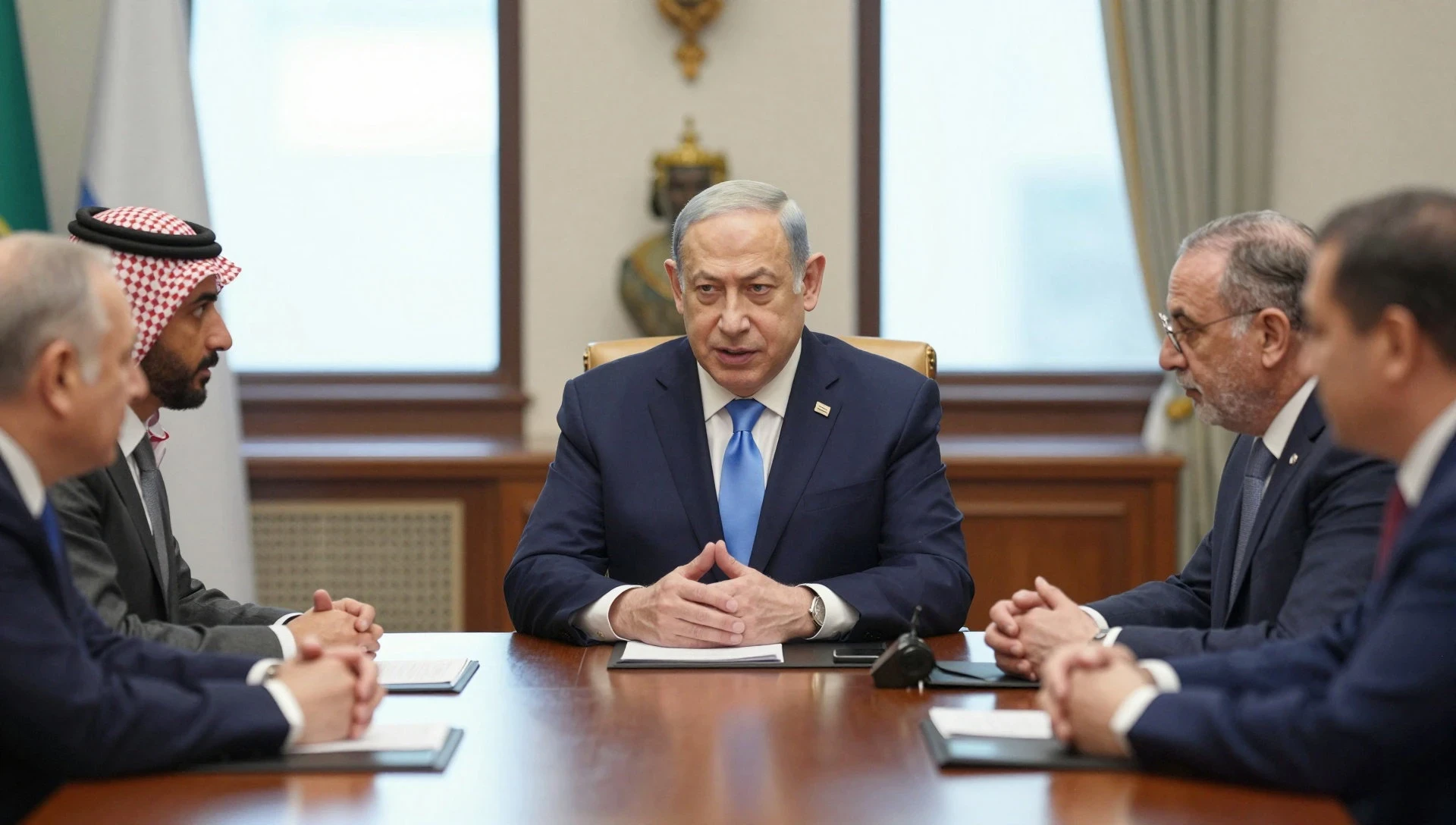
Israel's post-election arithmetic has produced a parliamentary puzzle that is easier to count than to solve. In the 120-seat Knesset, parties opposed to Prime Minister Benjamin Netanyahu control 48 seats, while the two Arab-majority lists, Raam and the Joint List, hold a combined 19.
An alliance of those blocs would command 67 seats, a working majority of nine, yet the numbers alone do not create a government. The obstacle is political will, not mathematics.
Hundreds of demonstrators gathered in Jerusalem and Tel Aviv on the Saturday following an inconclusive Tuesday election, urging opposition leader Gadi Eisenkot to build precisely that coalition. Their demand collides with Eisenkot's own stated conditions.
On This Page
- The Seat Arithmetic and the Coalition Threshold
- Eisenkot's Conditions and the Arab Party Response
- Public Pressure, Counter-Protest and the Governing Impasse
- What the Protests Can and Cannot Achieve
- The Gaza War as a Constraint
- Coalition Scenarios and Viability
- The Historical Record of Arab Party Participation
- What the Impasse Reveals About Israeli Coalition Politics
- Timeline of Post-Election Developments
- Reading the Numbers Against the Politics
- Constraints on Coalition Formation
The former military chief says he will lead only a "Zionist government" whose members recognize Israel as a Jewish, democratic and liberal state and accept that Hamas is a terrorist organization. Arab leaders have rejected those terms before, and the standoff defines the entire negotiation.
Arab citizens constitute roughly 20 percent of Israel's population, and their parties have entered a governing coalition exactly once, when Raam leader Mansour Abbas served from 2021 to 2022. That precedent matters because it proves the arrangement is legally and procedurally possible.
What follows examines the seat arithmetic, the conditions each faction has attached, and the structural reasons why a 67-seat majority may still fail to produce a 61-seat government.
TL;DR Israel's inconclusive election left anti-Netanyahu parties with 48 seats and Arab-majority parties with 19, a theoretical 67-seat majority. Opposition leader Gadi Eisenkot has not committed to relying on Arab parties, insisting on a "Zionist government" that accepts his conditions on Israel's character and Hamas. Arab leaders have refused those terms previously, while some opposition factions reject any coalition dependent on Arab support. The result is a governing impasse in which the arithmetic favors a deal that the politics of the moment may not permit.
The Seat Arithmetic and the Coalition Threshold
Israeli coalition formation is governed by a single hard number: 61 seats in a 120-member parliament. Any bloc below that threshold cannot govern, and any bloc above it still requires every member to sign the same coalition agreement.
The anti-Netanyahu camp's 48 seats fall thirteen short on their own, which is why the 19 Arab-majority seats become decisive rather than peripheral. Without them, no alternative government exists.
How the 67-Seat Bloc Is Constructed
The 67-seat figure is a sum of two distinct groups with different legal status and different political incentives. The 48 seats belong to parties that campaigned against Netanyahu directly.
The 19 belong to Raam and the Joint List, which campaigned against the rhetoric and policies of Netanyahu's right-wing government toward the Arab community. Combining them assumes a shared objective that only partially exists.
Raam and the Joint List are not a single actor. They are separate parties with separate leaderships, separate electorates and a history of running on joint and separate lists depending on the cycle. Mansour Abbas has signaled willingness to join a government again, as he did in 2021.
Yousef Jabareen of the Joint List has offered a narrower commitment: support from outside the coalition, not membership within it.
That distinction carries real weight. Outside support can deliver votes on confidence motions and budgets without binding Arab parties to cabinet collective responsibility. It is also more fragile, because it can be withdrawn.
A government resting on external support survives only as long as its external partners calculate that continued backing serves them better than early elections.
The Six-Seat Margin and Its Fragility
A surplus of six seats is thin by any parliamentary standard. It means that a handful of defections, whether from within the opposition bloc or from external supporters, can collapse a government on a single vote. Coalition managers therefore treat every faction as pivotal, and every faction prices its support accordingly. The margin shapes the negotiation as much as the total.
Compare this with the 2021 coalition, which rested on an ideologically diverse eight-party arrangement spanning right, centre, left and Raam. That government lasted roughly one year before collapsing. The lesson drawn by Israeli politicians is not that cross-bloc coalitions are impossible, but that they are unstable when the only binding agent is opposition to a single figure.
Why the Threshold Is Necessary but Not Sufficient
Formal arithmetic establishes eligibility, not viability. A bloc can hold 67 seats and still fail to produce a signed coalition agreement if its members cannot agree on a governing programme. Israeli coalition talks routinely consume weeks of negotiation over budgets, ministerial portfolios and policy commitments before any government is sworn in. The seat count opens the door; the negotiations determine whether anyone walks through it.
Eisenkot's Conditions and the Arab Party Response
Gadi Eisenkot occupies the pivotal position in this negotiation, and his public statements have narrowed rather than widened the available options. Speaking on Saturday, he said he would form only a "Zionist government" whose members commit to recognizing Israel as a Jewish, democratic and liberal state and to recognizing Hamas as a terrorist organization. Both conditions are substantive, and both have been refused by Arab leaders in previous rounds.
The Two Conditions in Detail
The first condition concerns Israel's constitutional character. Recognition of Israel as a Jewish, democratic and liberal state touches on questions of national identity that Arab parties have historically declined to endorse in those exact terms. The second concerns security classification.
Designating Hamas as a terrorist organization is a position Arab leaders have not adopted, particularly amid the war in Gaza.
Eisenkot's framing is best understood as an attempt to define the outer boundary of acceptable coalition partners before negotiations begin. By specifying conditions that Arab parties are unlikely to accept, he signals that his preferred government would rest on Jewish-majority parties with Arab support from outside. That is a narrower ambition than the demonstrators' demand, and a more achievable one.
His position contains an ambiguity that matters. Eisenkot has said he does not want a government dependent on Arab lists, but he has not explicitly rejected their outside support.
That gap between rejecting dependence and rejecting support is precisely where a workable arrangement could be constructed, if the parties choose to exploit it.
The Precedent of 2021–2022
Arab parties have formally joined an Israeli government only once, when Mansour Abbas brought Raam into a coalition that held office from 2021 to 2022. That government combined parties across the ideological spectrum and demonstrated that Arab participation was compatible with governing. It also demonstrated the arrangement's fragility, collapsing within roughly a year under cumulative pressure.
Abbas has said he is willing to repeat the experiment. His willingness is significant because it converts an abstract possibility into a concrete option with a named participant. But one party's readiness does not constitute a bloc's readiness, and the Joint List's preference for external support means the two Arab lists are not negotiating as a unit.
Opposition Within the Opposition
The anti-Netanyahu bloc is not unified on this question. Avigdor Liberman, leader of the right-wing Yisrael Beitenu party, has said he will not enter a coalition that relies on Arab parties, even for outside support.
His refusal removes a right-wing partner from any configuration that depends on Raam or the Joint List, narrowing Eisenkot's options further.
Yair Golan, leader of the left-wing Democrats, takes the opposite view and supports a government backed by Arab parties. He met Abbas on Thursday, according to the reporting. The contrast between Golan and Liberman illustrates the internal fault line: the bloc agrees on removing Netanyahu but disagrees on whether Arab parties may be part of the mechanism.
This is the structural weakness of an opposition defined by a single negative objective. Once the objective is within reach, the coalition must define what it stands for, and that definition exposes disagreements that opposition unity had suppressed. The 67-seat bloc is therefore better understood as a coalition of convenience than as a prospective government.
We Also Published
Public Pressure, Counter-Protest and the Governing Impasse
The demonstrations in Jerusalem and Tel Aviv on Saturday placed public pressure behind a specific outcome: an Eisenkot-led coalition incorporating Arab-majority parties. That pressure is real but not unanimous.
At the Tel Aviv demonstration, more than 100 Netanyahu supporters held a counter-protest, chanting a campaign slogan and asserting that the two Arab parties support Hamas. The street is contested, and the contest mirrors the parliamentary one.
What the Protests Can and Cannot Achieve
Protest movements in Israeli politics have demonstrated the capacity to shape agendas and sustain pressure over months. They have not demonstrated the capacity to dictate coalition composition, which remains a matter for party leaders negotiating in closed rooms.
The demonstrators can raise the political cost of refusing a deal; they cannot sign one on Eisenkot's behalf.
The counter-protest matters for a different reason. It shows that the accusation linking Arab parties to Hamas retains electoral force, and that any leader who relies on those parties will face that accusation directly.
Eisenkot's insistence on recognizing Hamas as a terrorist organization can be read as an attempt to neutralize this line of attack before it is deployed against him.
The Gaza War as a Constraint
Yousef Jabareen has cited concerns including the war in Gaza as a reason for offering support without joining a government. The war functions as a constraint on both sides of the negotiation.
It hardens the conditions Arab parties attach to cooperation and simultaneously raises the political cost for Jewish-majority parties of appearing to depend on those parties.
This mutual reinforcement explains why the arithmetic has not translated into action. Each side's domestic position is strengthened by maintaining distance from the other, even as the combined seat count makes cooperation the only route to an alternative government. The incentives point toward stalemate rather than toward the deal the demonstrators demand.
The Historical Record of Arab Party Participation
The single precedent of 2021 to 2022 carries outsized analytical weight because it is the only empirical test available. Raam's participation demonstrated that Arab parties could operate within a governing coalition without collapsing it immediately. It also demonstrated that such participation imposes costs on all involved, which accumulate over time.
Mansour Abbas's willingness to repeat the arrangement suggests he judges those costs acceptable relative to the alternative of remaining outside government. The Joint List's preference for external support suggests a different calculation. The divergence between the two Arab lists is itself a political fact that any coalition builder must accommodate.
- 01
- 02
- 03
- 04
What the Impasse Reveals About Israeli Coalition Politics
The impasse reveals a structural feature of Israeli politics that predates this election. Coalition formation is not a simple translation of votes into seats into government. It is a negotiation in which ideological compatibility, personal relationships and the perceived cost of alternatives all constrain the possible outcomes. Arithmetic sets the boundaries; politics determines the result.
It also reveals the limits of opposition as a governing strategy. A bloc assembled to remove a single leader must eventually answer what it would do instead, and that answer requires agreement among parties that may share little beyond their opposition. The 67-seat majority is therefore a necessary condition for replacing Netanyahu, not a sufficient one.
Reading the Numbers Against the Politics
The most instructive comparison is between what the seats permit and what the actors will accept. Sixty-seven seats permit an alternative government. Eisenkot's conditions, Liberman's refusal and the Joint List's preference for external support all constrain whether that government can be assembled. The gap between permission and acceptance is where the impasse lives.
For observers, the practical implication is that headline seat totals should be treated as the beginning of analysis rather than its conclusion. A 67-seat bloc is a statement about potential, not about outcome.
The decisive variables are the conditions each party attaches and the willingness of leaders to accept the domestic costs of meeting them.
What the demonstrations in Jerusalem and Tel Aviv ultimately test is whether public pressure can alter those calculations. The counter-protest in Tel Aviv suggests the answer is contested. Until a leader accepts the costs, the arithmetic will remain an unused majority, and the election will remain unresolved.
From our network :
- CISA’s Ten-Advisory Wave: Why Generic Patching Fails in OT and How to Build Product-Specific PlaybooksCISA released ten ICS advisories in one week, exposing critical infrastructure risks. Generic patching fails in OT. Learn to build product-specific remediation playbooks.
- Live Online English Classes for Kids: Do They Actually Reduce Anxiety?A ten-week study reveals that synchronous online English classes can significantly reduce child language anxiety while improving listening and reading skills. Discover what makes these programs effective and how parents can select the right one.
- The Hidden Cost of AI Convenience: Why Over-Permissioned Agents Are a Security Time BombDiscover why AI agents with excessive permissions create dangerous single points of failure, and learn how implementing least privilege principles can protect your organization from exploitation.
- University Language Proficiency Exams: Why Institutional Tests Demand Different Preparation Than IELTS and TOEFLDiscover why university-specific language proficiency examinations differ fundamentally from IELTS and TOEFL, and learn strategic preparation approaches for institutional assessment success.
- Mobile Learning and VR in English: What Global Evidence Reveals About Effective Language TechnologyA systematic review across 14 countries reveals which language-learning technologies genuinely work. Mobile learning, AI, and VR show measurable benefits when pedagogically integrated. This evidence-based guide helps educators and learners select technology that delivers real return on investment.
- Forbidden Matrix Patterns and Visible Lattice Points: A Geometric DictionaryExplore how multidimensional 0–1 matrices encode geometric truths, linking forbidden patterns to visible lattice points and hypergraph theory, with applications in combinatorics and computational geometry.
- Committed Mediterranean Precipitation Decline: Why Emissions Cuts Alone Cannot Restore Winter RainsNew NOAA research reveals that Mediterranean winter rains may decline irreversibly even with emissions cuts. Explore the science of committed climate change and regional impacts.
- The Final Descent: How ESA Retired the Legendary Cluster Constellation After 24 Years of Space Weather ScienceAfter 24 years mapping Earth’s magnetosphere, ESA’s Cluster mission concluded with a precisely controlled reentry over the South Pacific. This analysis explores the scientific legacy, engineering decisions, and debris mitigation principles behind one of space exploration’s most responsible retirements.
- How AI Agents Will Change the Way We Manage Personal FinancesExplore how AI agents are transforming personal finance through automated budgeting, bill payment, and investment management, while examining the critical security protocols and governance frameworks required for safe deployment.
RESOURCES
- Difficult negotiations lie ahead in Israel after Netanyahu's bloc lost its ...pbs.org3 days ago ... On Friday, Netanyahu again warned against forming a coalition with Arab parties. READ MORE: Netanyahu's party claims Israeli election ...
- Coalition talks loom in Israel as Netanyahu and Eisenkot blocs set to ...theguardian.com5 days ago ... On Wednesday night, Netanyahu reacted to the high Palestinian turnout and the success of Arab Israeli parties by claiming they…
- Israel Election 2026: Who Will Lead Israel and What Does It Mean ...ajc.org4 days ago ... No clear path to a majority. · Coalition negotiations will decide who governs. · Turnout increased. · Ultra-Orthodox parties lost…
- Thousands rally in Israel urging 'Jewish-Arab' coalition to oust ...aljazeera.com1 day ago ... ... Arab parties to remove Prime Minister Benjamin Netanyahu. Protesters at Saturday's rally told the AFP news agency this may…
- Israeli Arab Lawmaker Ayman Odeh on State of Coalition Talks - TIMEtime.comSep 27, 2019 ... His party, Blue and White, won 33 parliamentary seats, one more than Netanyahu's right wing Likud, which finished on 32.…
- Netanyahu, at risk of losing power, steps up attacks on Israel's Arab ...reuters.com4 days ago ... That individual that's nominated, what they need to do is an enter coalition negotiations with each party. And that would…
- Why 1 Arab Party Joined Israel's Coalition Government But ... - NPRnpr.orgJun 17, 2021 ... NPR's Noel King talks to Aida Touma-Sliman, a Palestinian-Israeli member of the Knesset, about the new coalition government that unseated ...
- Why Arab parties may not be the 'kingmakers' in this Israeli electionaljazeera.com5 days ago ... So far, no clear winner has emerged as partial results give Prime Minister Benjamin Netanyahu's bloc 54 seats and the…
- Israel's deadlocked election could force a new vote in 2027brookings.edu3 days ago ... If coalition talks fail, Netanyahu ... The Democrats, Israel's only remaining party of the left, strongly favor a coalition with…
- Israel faces weeks of coalition haggling as neither bloc wins majoritycnbc.com3 days ago ... Netanyahu's party has ramped up the rhetoric that the Arab-led parties have "stolen" the election. Israeli stocks, currency, and bonds…
- Netanyahu bloc falls short of majority as Israel enters coalition talksscrippsnews.com3 days ago ... Israel's election produced no clear winner, with Arab-led parties emerging as key players in negotiations to form the next government.
- #Israel's election leaves #Netanyahu short of a majority ... - Facebookfacebook.com5 days ago ... Can Arab parties unseat Netanyahu in Israeli government? ... coalition — the first time an independent Arab party did so…
- Israel's Winning Coalition: Culmination of a Long Rightward Shiftcrisisgroup.orgNov 8, 2022 ... The three parties of the Religious Zionist alliance that handed Netanyahu his win are religiously ultra-conservative, transparently Jewish ethno ...
- Israel vote tests Netanyahu's hold on power as coalition talks loomwpde.com5 days ago ... The results point to a possible return to the coalition negotiations that have followed repeated election deadlocks in Israel. Arab-led…
- Israel faces 4 possible government formation scenarios if neither ...facebook.com6 days ago ... Recent posts. Can Israel's Arab parties end Netanyahu's premiership? PolitiX Feed ▻ Benjamin Netanyahu - A Great Man. 2w ·…
- 01
- 02
- 03
- 04
- 05
- 06
- 07
- 08
0 Comments