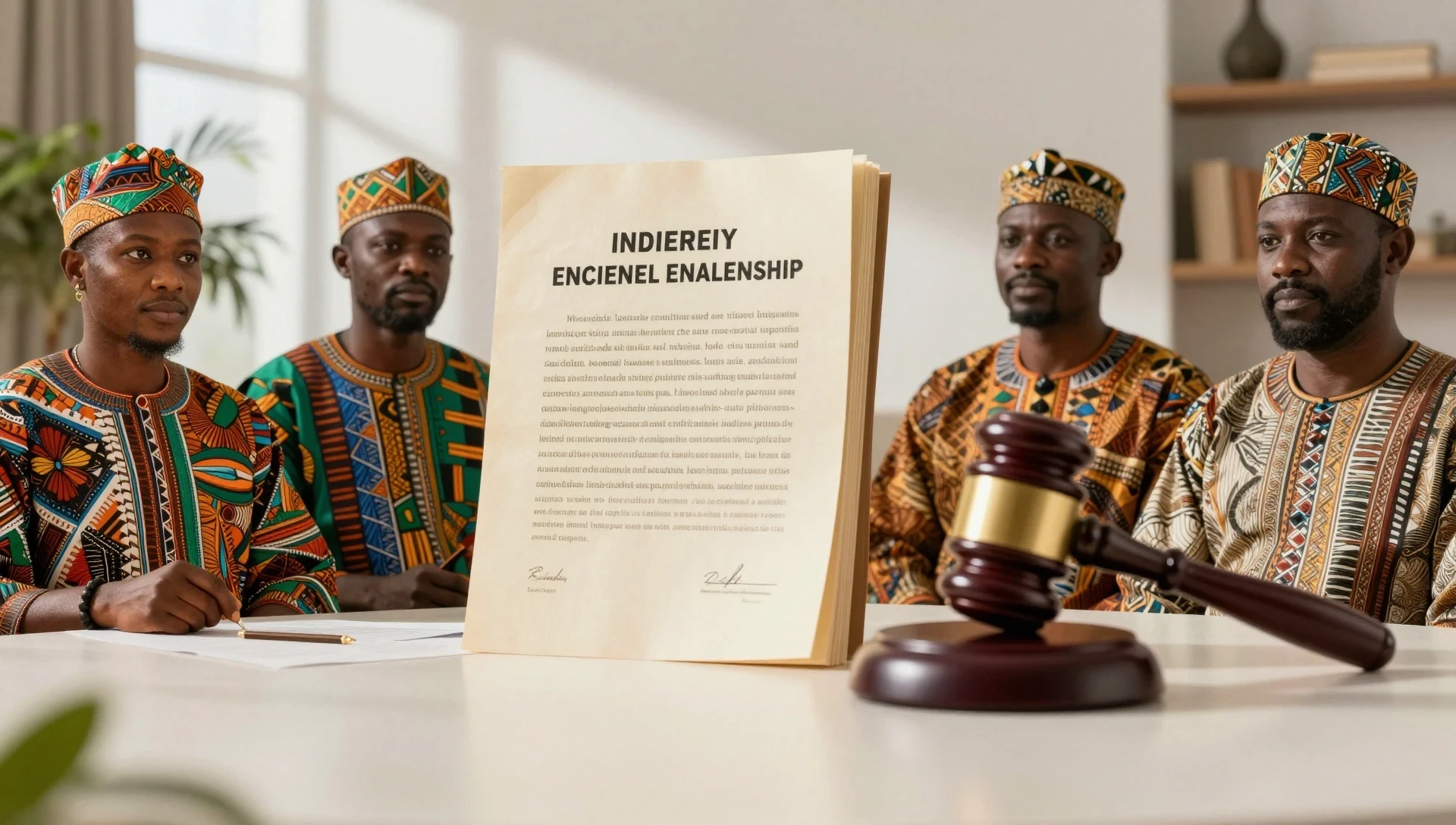
Nigeria's democratic architecture rests on a constitutional promise that citizenship is conferred by birth, descent, or naturalisation, and that no Nigerian shall be discriminated against on the grounds of ethnic group or place of origin.
Yet a parallel, unwritten system of belonging operates alongside that promise, one in which a certificate of indigene status functions as a de facto passport to schools, scholarships, civil service posts, and political office.
The tension between these two orders is not a peripheral administrative wrinkle; it is a structural fault line running through the country's federal compact.
On This Page
A widely discussed opinion piece in Punch Newspapers frames this tension through a striking image: the remains of a former governor's father, buried in three different locations over time, and the political meaning later attached to those graves. The anecdote is deliberately provocative, but its logic is precise.
In Nigerian politics, the argument runs, legitimacy is frequently traced through ancestry rather than tested against qualifications, and a grandfather's burial site can carry more weight than a birth certificate or a voter's card.
This analysis examines the constitutional, electoral, and institutional dimensions of the indigene question. It weighs the 2023 election reports of ethnic profiling in Lagos against the text of the 1999 Constitution, traces the ambiguous legal status of the indigene certificate, and considers what the ancestry test means for democratic accountability.
The evidence points to a system in which paperwork about origin competes directly with the constitutional guarantee of equal citizenship.
TL;DR Nigeria's Constitution defines citizenship by birth and prohibits discrimination based on ethnic group or place of origin, yet the widely used "indigene certificate" operates as an extra-constitutional gatekeeper for education, employment, and political legitimacy. The term itself does not appear in the Constitution, and its practical effect has been to divide the country into numerous local homelands where ancestry outranks achievement. Electoral monitoring during the 2023 elections documented ethnic profiling in Lagos, and cases such as Senator Ireti Kingibe's mixed heritage illustrate how state-of-origin paperwork generates endless questions of belonging. The core argument is that democracy should be measured by what citizens can do, not by who their ancestors were.
The Constitutional Promise and the Indigene Exception
Nigeria's foundational law is unusually explicit on the question of belonging. Section 25 of the 1999 Constitution establishes citizenship by birth for anyone born in Nigeria to parents or grandparents who belong or belonged to a community indigenous to the country, while Section 41 guarantees freedom of movement and Section 42 prohibits discriminatory treatment based on ethnic group or place of origin. On paper, the framework is inclusive and portable.
The practical reality diverges sharply. The term "indigene" is ubiquitous in administrative practice yet absent from the constitutional text, a discrepancy the Punch analysis highlights as central rather than incidental.
Because the concept has no constitutional anchor, its meaning is set by state and local government regulations, which vary considerably and are frequently applied through documentary requirements that citizens cannot satisfy without ancestral proof.
What the Constitution Actually Guarantees
The constitutional provisions are not vague aspirations; they are enforceable rights. Section 42(1) renders any law or executive action that subjects a citizen to disabilities or restrictions by reason of ethnic group or place of origin unconstitutional.
Section 41 protects the right to reside and work anywhere in the federation, which directly conflicts with residency-based indigene requirements for employment and admission.
Legal scholars have repeatedly noted that the indigene certificate has no explicit statutory foundation in the Constitution, meaning its widespread use rests on administrative convention rather than primary legislation.
When states require proof of indigene status for scholarships or civil service recruitment, they are effectively conditioning constitutional rights on a document the Constitution does not recognise, a tension that has generated litigation but little legislative correction.
The Certificate as a Parallel Citizenship Regime
The indigene certificate functions as a second, sub-national citizenship document. It determines access to state universities, bursaries, public sector jobs, and in some cases land and business permits. Its issuance is controlled by local government authorities, which apply ancestry tests that can be difficult or impossible for long-settled residents to satisfy.
The cumulative effect, as the Punch piece argues, is the fragmentation of the country into many local homelands. A Nigerian who has lived, worked, and paid taxes in a state for decades may still be classified as a non-indigene there, excluded from opportunities reserved for those whose grandparents are buried locally. Residence and contribution carry less weight than lineage.
Why the Gap Has Persisted
The persistence of the indigene system is not accidental. State governments rely on it to allocate scarce educational and employment opportunities among constituent communities, and local political elites derive authority from controlling who counts as a son of the soil. Reform therefore confronts entrenched interests that benefit from the ambiguity the Constitution leaves open.
Federal character principles, designed to ensure equitable representation across states and zones, have arguably reinforced rather than dissolved the logic of origin. By formalising quotas tied to state of origin, the system institutionalises ancestry as the primary unit of political accounting, even where the underlying constitutional text speaks in the language of individual rights.
We Also Published
Elections, Ethnic Profiling, and the 2023 Test
The 2023 general elections brought the indigene question from administrative practice into the electoral arena. The Punch analysis reports that some residents in Lagos were asked to prove their ethnic identity before voting, and that election monitors documented instances of ethnic profiling.
Such reports matter because they suggest the ancestry test has migrated from paperwork into the voting booth itself.
Lagos is an instructive case. As Nigeria's commercial capital, it attracts internal migrants from every region, producing a population in which long-settled non-indigenes may outnumber those with ancestral claims to the city.
When political competition intensifies, the distinction between indigenes and settlers becomes a mobilisation tool, and the question of who legitimately belongs acquires direct electoral consequences.
Documented Patterns of Profiling
Observer reports from the 2023 cycle described voter intimidation and identity checks that had no basis in the Electoral Act. The pattern is consistent with the broader argument that ancestry functions as a political resource: where electoral margins are narrow, questioning an opponent's origins can disqualify voters as effectively as any formal rule.
The constitutional contradiction is stark. A citizen whose birth certificate and voter registration are valid may still face demands to demonstrate ethnic authenticity. This is precisely the disability Section 42 was written to prevent, yet enforcement mechanisms remain weak and complaints rarely reach the courts in time to affect outcomes.
The Cost to Democratic Legitimacy
When belonging is contested on ancestral grounds, electoral outcomes lose legitimacy among excluded groups. Turnout suffers, trust in institutions erodes, and the winner's mandate is weakened by the perception that participation itself was unequal. The damage compounds over cycles, normalising identity checks as an accepted feature of competition.
Comparative evidence from other federal systems suggests that portable citizenship correlates with higher political trust. Nigeria's experience inverts that pattern: the more energetically origin is policed, the less citizens believe the system treats them equally, which in turn depresses the civic engagement democracy depends upon.
Enforcement Gaps in Electoral Law
The Electoral Act provides channels for challenging improper voter exclusion, but the timelines are compressed and the burden of proof falls on the excluded voter. By the time a complaint is filed, the poll may already have concluded, rendering the remedy academic. Deterrence is therefore minimal and repeat behaviour is rational for those who benefit.
Independent observers have recommended clearer prohibitions on identity-based challenges and faster adjudication. Without such reforms, the gap between constitutional text and polling-station practice will persist, and the ancestry test will continue to function as an informal but effective filter on political participation.
Ancestry, Traditional Institutions, and the Future of Belonging
The Punch analysis makes a pointed historical observation: traditional institutions have adapted to migration, intermarriage, and shifting boundaries over centuries, while modern politics clings to a static conception of ancestry.
Monarchies and chieftaincy systems evolved mechanisms for absorbing strangers and integrating newcomers, precisely because their legitimacy depended on governing everyone resident in a territory.
Modern democratic politics, by contrast, has hardened lineage into a qualification for office. The argument that bloodline tests belong to traditional monarchy rather than modern democracy is therefore not a rhetorical flourish but a structural claim: the indigene system imports pre-modern criteria of belonging into a constitutional order built on individual rights and equal citizenship.
The Kingibe Case and Mixed Heritage
Senator Ireti Kingibe's family background spans multiple ethnic groups, and the Punch piece cites her as an illustration of how state-of-origin paperwork generates endless questions. When a public figure's heritage crosses boundaries, the documentary system has no clean answer, and the resulting debate reveals the arbitrariness of the categories themselves.
Her case is not exceptional in a country where intermarriage across ethnic lines is common. Millions of Nigerians hold identities that cannot be reduced to a single local government of origin, yet the administrative system demands exactly that reduction. The mismatch between lived reality and bureaucratic categories is a design flaw, not an anomaly.
Reform Options and Their Trade-offs
Several reform paths exist. One is to replace indigene certificates with residency-based entitlements, so that access to state services follows contribution and domicile rather than ancestry. Another is to strengthen constitutional enforcement, making Section 42 claims faster and cheaper to litigate. A third is to harmonise state rules under federal legislation.
Each option carries costs. Residency tests can be gamed and may disadvantage genuinely marginalised communities that lack documentation. Litigation is slow and reactive. Federal harmonisation confronts the political reality that state governors guard control over patronage. The trade-offs are real, but the status quo also has costs, borne disproportionately by long-settled non-indigenes.
- 01
- 02
- 03
- 04
What a Stable Future Requires
The Punch analysis concludes that democracy should be about what people can do, not who their ancestors were, and warns that a stable future cannot be built on an endless ancestral contest.
The claim is analytical as well as normative: systems that allocate opportunity by lineage tend to generate perpetual disputes, because lineage claims are contestable and never finally settled.
A durable settlement would require political leadership willing to defend the constitutional text against local pressures. It would also require administrative reform so that the certificate loses its gatekeeping power. Until then, the gap between Nigeria's constitutional promise and its practice of belonging will remain the country's most consequential unresolved contradiction.
From our network :
- Forbidden Matrix Patterns and Visible Lattice Points: A Geometric DictionaryExplore how multidimensional 0–1 matrices encode geometric truths, linking forbidden patterns to visible lattice points and hypergraph theory, with applications in combinatorics and computational geometry.
- Committed Mediterranean Precipitation Decline: Why Emissions Cuts Alone Cannot Restore Winter RainsNew NOAA research reveals that Mediterranean winter rains may decline irreversibly even with emissions cuts. Explore the science of committed climate change and regional impacts.
- The Final Descent: How ESA Retired the Legendary Cluster Constellation After 24 Years of Space Weather ScienceAfter 24 years mapping Earth’s magnetosphere, ESA’s Cluster mission concluded with a precisely controlled reentry over the South Pacific. This analysis explores the scientific legacy, engineering decisions, and debris mitigation principles behind one of space exploration’s most responsible retirements.
- The Hidden Cost of AI Convenience: Why Over-Permissioned Agents Are a Security Time BombDiscover why AI agents with excessive permissions create dangerous single points of failure, and learn how implementing least privilege principles can protect your organization from exploitation.
- University Language Proficiency Exams: Why Institutional Tests Demand Different Preparation Than IELTS and TOEFLDiscover why university-specific language proficiency examinations differ fundamentally from IELTS and TOEFL, and learn strategic preparation approaches for institutional assessment success.
- Live Online English Classes for Kids: Do They Actually Reduce Anxiety?A ten-week study reveals that synchronous online English classes can significantly reduce child language anxiety while improving listening and reading skills. Discover what makes these programs effective and how parents can select the right one.
- CISA’s Ten-Advisory Wave: Why Generic Patching Fails in OT and How to Build Product-Specific PlaybooksCISA released ten ICS advisories in one week, exposing critical infrastructure risks. Generic patching fails in OT. Learn to build product-specific remediation playbooks.
- How AI Agents Will Change the Way We Manage Personal FinancesExplore how AI agents are transforming personal finance through automated budgeting, bill payment, and investment management, while examining the critical security protocols and governance frameworks required for safe deployment.
- Mobile Learning and VR in English: What Global Evidence Reveals About Effective Language TechnologyA systematic review across 14 countries reveals which language-learning technologies genuinely work. Mobile learning, AI, and VR show measurable benefits when pedagogically integrated. This evidence-based guide helps educators and learners select technology that delivers real return on investment.
RESOURCES
- Nigeria Immigration Service on Xx.comApr 19, 2024 ... ... citizen. You may also want to read up the particular part of the Nigerian Constitution that bothers on Citizenship,…
- Citizen but not Indigene: A Constitution Quagmire: The Caseideas.repec.org... questions the logic of instituting indigene-settler quaalude as seen in life of ... Nigeria is one of the most ethnically diverse nation in…
- Constitution of the Federal Republic of Nigeria 1999 Chapter I ...nigeriarights.gov.ngAny citizen of Nigeria of full age who wishes to renounce his Nigerian citizenship shall make a declaration in the prescribed manner for the…
- Migration and citizenship question in Nigeria: A study of the Berom ...academicjournals.org... indigene – settler syndrome a major issue in the citizenship ... Perhaps the most problematic of the citizenship question in Nigeria is the…
- CURBING VIOLENCE IN NIGERIA (I): THE JOS CRISISjustice.govSep 29, 2014 ... privilege broad-based citizenship over exclusive indigene status and ... ence and the Indigene/Settler Question in Nigerian Politics”,.
- Nigeria 1999 - Constitute Projectconstituteproject.orgExcept as otherwise provided by this Constitution any question proposed ... Constitution shall continue to be a citizen of Nigeria under this Constitution.
- Nigerian citizenship vs indigene status explained | Jos, Plateaufacebook.comJun 16, 2026 ... Section 25(1) of the Constitution promises a single Nigerian citizenship ... On the indigenes/settlers question, the Supreme Court of Nigeria ...
- Settlers-Indigenes Question in Nigeria: Much Rhetoric, No Answerseujournal.orgApr 30, 2017 ... Settlers-Indigenes Question in Nigeria: Much Rhetoric, No Answers ... citizenship as contained in the 1999 Constitution (as amended) side ...
- Ethnic Conflict in Plateau State: The Need to Eliminate the Indigene ...digitalcommons.wcl.american.eduThe 1999 Nigerian Constitution provides for the equal treat- ment of all Nigerians irrespective of ethnic origin. Chapter 3 addresses citizenship, but neither ...
- Examining Nigeria's Digital Identity Project as a Tool for Economic ...scielo.org.zaApr 5, 2022 ... This, in turn, queries the constitutional mandate and privileges of Nigerian citizenship ... Settlers-indigenes question in Nigeria: Much rhetoric ...
- Nigerian, But Indigenous to Where? The Constitutional Puzzle of ...lawakhigbe.com3 days ago ... Nothing in those provisions says that a Nigerian citizen must possess an indigene certificate before being Nigerian. The constitutional question ...
- Settlers-Indigenes Question in Nigeria: Much Rhetoric, No Answerseujournal.orgApr 7, 2017 ... Keywords: Nigerian federalism, settlers-indigenes, 1999 Constitution (as amended), citizenship. INTRODUCTION. As a political system, Nigeria ...
- A Street Perspective of the Citizen-Indigene Debate, By Nigeria ...opinion.premiumtimesng.comFeb 10, 2014 ... ... indigenes' and 'settlers' is part of the problem. Section 25(1) of the Constitution promises a single Nigerian citizenship, while…
- II. NIGERIA'S INDIGENE- SETTLER DIVIDE A. A N - Jstorjstor.orgDec 17, 2012 ... The 1999 constitution failed to address this problem and remains ambiguous. The indigene principle promoted in. Section 147 (3) appears…
- (PDF) Federalism and citizenship question in Nigeria: Focus on ...researchgate.netOct 16, 2022 ... constitution and contradictions in the constitution among others. Keywords: federalism, citizenship, settler- indigene, Nigeria. Introduction.
- 01
- 02
- 03
- 04
- 05
- 06
- 07
- 08
0 Comments