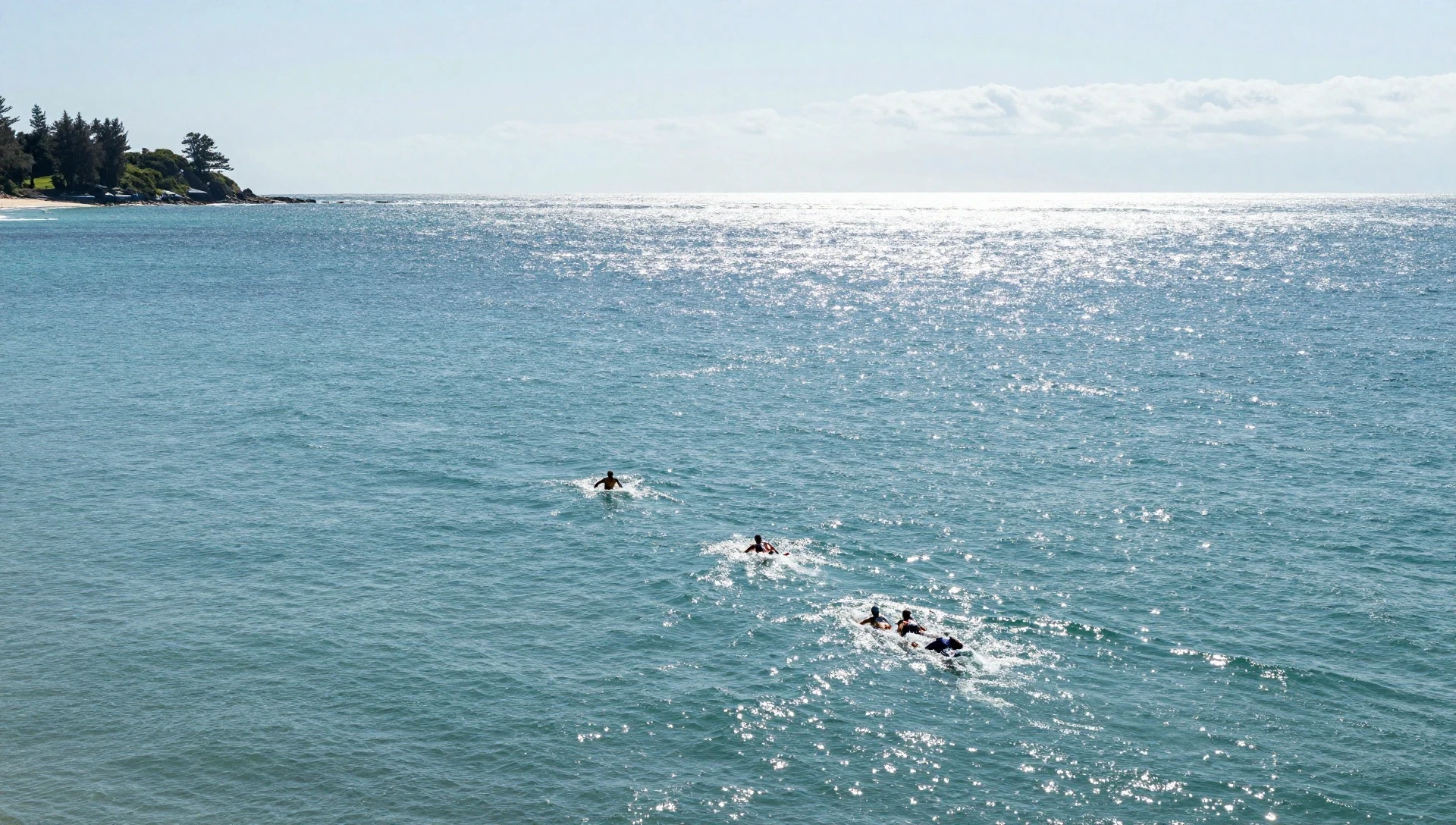
The Noosa Triathlon, the largest Olympic-distance triathlon in the world, cancelled its swim leg minutes before the scheduled 6:15am start on Sunday after a series of shark sightings off Noosa Main Beach.
Organisers converted the event into a duathlon, replacing the 1.5-kilometre ocean swim with a 5-kilometre run, and 8,500 registered athletes proceeded through a 40-kilometre cycle and 10-kilometre run instead. The decision marked the first complete cancellation of the swim in the event's 43-year history.
The sequence of events matters more than the headline. Noosa Main Beach was closed on Saturday after sharks were spotted offshore, prompting organisers to shorten the swim to roughly one kilometre to keep athletes in shallow water.
On This Page
A further sighting at first light on Sunday triggered the final call, and surf lifesavers assigned to monitor the course on jet skis and boards declined to enter the water at all. Operations chief Rebecca Van Pooss described the outcome as difficult but covered by a standing contingency plan.
What emerges is a case study in risk governance under time pressure. Surf lifesaving rules bar anyone from entering the water for 60 minutes after the last confirmed sighting; with only an hour remaining before the start, organisers could not delay further and could not guarantee a safe window.
Matt Thompson, safety manager for Surf Lifesaving Queensland, framed the decision around early threat identification rather than incident response. The elite races continued, with Matt Hauser defending his title in 1:39:34 and Natalie Van Coevorden winning the women's event in 1:58:11.
TL;DR Shark sightings off Noosa Main Beach forced organisers to cancel the swim leg of the Noosa Triathlon minutes before the 6:15am start, converting the world's largest Olympic-distance triathlon into a duathlon for the first time in 43 years. Surf lifesavers refused to enter the water, and a 60-minute post-sighting exclusion rule left no viable delay window. The episode illustrates how pre-agreed contingency protocols, delegated safety authority and hard time constraints interact when public-safety decisions must be made under live-event pressure.
The Noosa Cancellation: Anatomy of a Decision Made Under Deadline
The Noosa Triathlon occupies an unusual position in global endurance sport. It draws roughly 8,500 athletes and about 20,000 spectators annually, making it the largest event of its distance format anywhere. That scale amplifies every operational decision: a cancelled swim affects thousands of race plans, travel bookings and qualification ambitions simultaneously. The organisers' choice therefore carries weight beyond a single Sunday morning on the Sunshine Coast.
The Chronology From Saturday Closure to Sunday Call
Saturday's initial sighting closed Noosa Main Beach and prompted a precautionary course adjustment. Organisers reduced the swim to approximately one kilometre, deliberately routing athletes through shallower water where surveillance and rescue response are faster.
That intermediate step demonstrates graduated risk management: rather than cancelling outright, the team first modified exposure while retaining the event's core structure. The approach bought time without committing to an irreversible outcome.
The decisive input arrived at first light on Sunday, when another shark was reported during the pre-dawn surveillance sweep. Surveillance had begun before the 6:15am start specifically to establish water conditions. That final sighting reset the safety clock to zero.
With roughly one hour until the gun, the arithmetic of the 60-minute rule left organisers with no compliant path to a swim start, and no room to push the schedule later.
Why Surf Lifesavers Held the Effective Veto
The most consequential fact in the account is that surf lifesavers refused to enter the water. Those personnel were tasked with monitoring the course on jet skis and boards, and their absence would have stripped the swim of its primary safety layer.
Van Pooss confirmed organisers concluded that if lifesavers would not accept the risk, athletes could not reasonably be asked to either. Safety authority effectively rested with the water-safety professionals, not the race director.
This delegation is structurally sound. Lifesaving protocols are written by specialists in aquatic hazard, and event organisers inherit those standards rather than negotiating them. Thompson's framing reinforces the logic: preventing incidents is the best outcome, and identifying threats early while acting quickly is critical to keeping people safe.
The refusal was not obstruction but the protocol functioning as designed, converting professional judgment into an operational constraint.
The 60-Minute Rule as a Hard Constraint
Surf lifesaving rules require that no one enter the water for 60 minutes after the last sighting. That single parameter determined the outcome. With an hour until the start and a fresh sighting logged, the permitted window and the scheduled window overlapped almost exactly, leaving zero margin for a delayed start.
Van Pooss stated plainly that organisers could not delay further, which is the language of a binding constraint rather than a discretionary preference.
Contrast this with the Saturday adjustment, where shortening the course remained feasible because time was abundant. The same rule produced a manageable modification on one day and a full cancellation on the next, purely because of elapsed time.
This is the defining lesson: identical safety standards yield radically different operational outcomes depending on how much schedule slack remains when a hazard appears.
Safety Protocols, Delegated Authority and the Economics of Cancellation
Beneath the sporting narrative sits a governance question that recurs across mass-participation events: who holds the authority to stop play, and on what evidence. At Noosa the answer was unambiguous. Water-safety professionals applied their own rulebook, organisers accepted the resulting constraint, and the race director executed a pre-built alternative. No improvisation was required because the contingency plan already existed and had been rehearsed in principle.
Contingency Planning as Standard Operating Practice
Van Pooss noted that contingency decisions about course design and distance are not unusual at Noosa. That statement reframes the cancellation as routine risk management rather than crisis response. Organisers had already shortened the swim once, demonstrating a working escalation ladder.
The final step, converting to a duathlon, was the terminal rung of a plan that had been considered in advance and could be activated without debate.
The value of such planning is measurable in time. A live event cannot convene committees, commission analysis or negotiate standards while thousands of athletes stand on a beach. Pre-agreed triggers compress decision latency to near zero.
Noosa's organisers moved from final sighting to format change within roughly an hour, a pace only achievable when the rule, the authority and the fallback are all settled beforehand.
Reading the Risk Arithmetic
The governing constraint can be expressed simply. A swim start is permissible only when the elapsed time since the last confirmed sighting exceeds the exclusion threshold, and the remaining schedule must accommodate that gap. Formally, the condition for proceeding is ##t_{start} - t_{sighting} \geq 60\text{ min}##.
At Noosa, the sighting occurred at first light with approximately one hour until the 6:15am gun, so the inequality held only at the boundary, with no tolerance for delay.
Any margin at or near zero is operationally unusable. A single additional sighting, a delayed patrol launch or a slower-than-expected briefing would breach the rule. Organisers therefore treated a boundary condition as a failure condition, which is the conservative and defensible reading. The same inequality on Saturday, with many hours of slack, permitted a shortened course instead of cancellation.
Commercial and Competitive Consequences
Cancelling a swim is not costless. Athletes train specifically for the discipline, and a duathlon alters the physiological demands, favouring stronger runners and reducing the premium on open-water technique.
Elite results at Noosa reflect this: Hauser's 1:39:34 and Van Coevorden's 1:58:11 were earned across a 5-kilometre run, 40-kilometre cycle and 10-kilometre run, a materially different test from the standard format.
Van Coevorden's 15-second margin over Richelle Hill illustrates how narrow elite outcomes remain even under altered conditions. For age-groupers, the implications are logistical as much as athletic: wetsuit rules, swim seeding and transition layouts all shift when a leg disappears.
Organisers absorb these adjustments, but the aggregate disruption across 8,500 entrants is substantial and rarely quantified in post-race reporting.
We Also Published
What the Noosa Precedent Means for Open-Water Events
Noosa is not an isolated incident but a template. Coastal events worldwide face rising interaction rates between water users and marine wildlife, and organisers increasingly build shark-management provisions into race documentation.
The Noosa case supplies a documented example of the full escalation path: course modification, then cancellation, then format substitution, each step triggered by observable evidence rather than speculation. That record has value for other race committees drafting their own protocols.
Surveillance, Drones and the Detection Question
Shark surveillance began at first light, and the final sighting was logged during that sweep. Detection capability therefore determined the outcome directly: better surveillance produces earlier warnings, which in turn preserve more schedule slack.
Drones and aerial monitoring extend visual range beyond shoreline observation and can cover a swim course faster than patrol craft. Investment in detection is, in effect, investment in the probability that an event proceeds.
There is a countervailing consideration. More sensitive surveillance generates more sightings, and each sighting resets the exclusion clock. An event with intensive monitoring may therefore cancel more often than one with sparse coverage, even where actual risk is identical.
Organisers must decide deliberately how much detection sensitivity they want, because the rule converts every observation into a scheduling constraint with real commercial consequences.
Institutional Trust and the Cost of Getting It Wrong
Thompson's comment that preventing incidents is the best outcome states the underlying priority plainly. The reputational mathematics favour caution overwhelmingly: a single serious injury at a mass event would impose costs far exceeding any cancellation, spanning litigation, insurance, regulatory scrutiny and long-term participation decline. Against that asymmetry, the expected loss from cancelling a swim leg is modest and bounded.
Van Pooss's acknowledgment that the decision was difficult, paired with confirmation that a contingency plan was ready, describes competent crisis communication. Organisers explained the rule, identified who made the call and showed the alternative was pre-planned. That transparency protects institutional trust.
Athletes accept disappointment more readily when the reasoning is legible and the authority behind it is clearly professional rather than arbitrary.
- 01
- 02
- 03
- 04
Elite Results and the Competitive Record
Matt Hauser's victory in 1:39:34 repeated his win from the previous year, confirming form across a format he had not specifically prepared for. Natalie Van Coevorden's 1:58:11, fifteen seconds clear of Richelle Hill, shows how thin elite margins remain even when the opening discipline changes.
Both results will be recorded as Noosa wins, though the asterisk of a duathlon format will follow them in statistical archives.
For the sport's governing bodies, the deeper question is comparability. A duathlon result is not equivalent to a triathlon result, and ranking systems that treat them interchangeably introduce distortion.
Noosa's organisers were correct to prioritise safety, but the competitive record now contains an entry that resists clean comparison with the event's other 42 editions. That is a minor cost, and an unavoidable one.
Conclusion: Protocol Discipline Over Improvisation
The Noosa Triathlon's 2026 edition will be remembered for a decision nobody wanted to make. Organisers cancelled the swim because a documented rule, applied by qualified professionals, left no compliant alternative within the available time.
The event proceeded as a duathlon, Hauser and Van Coevorden won, and 8,500 athletes completed a race that was different from the one they entered but safer than the one originally planned.
The transferable lesson concerns preparation rather than hazard. Noosa's organisers had already shortened the course once, had a contingency plan ready and could execute a format change within an hour of a final sighting. That capability, not the shark itself, determined how the weekend ended.
Events that build equivalent escalation ladders and delegate water-safety authority clearly will handle similar disruptions with the same composure.
From our network :
- Forbidden Matrix Patterns and Visible Lattice Points: A Geometric DictionaryExplore how multidimensional 0–1 matrices encode geometric truths, linking forbidden patterns to visible lattice points and hypergraph theory, with applications in combinatorics and computational geometry.
- Live Online English Classes for Kids: Do They Actually Reduce Anxiety?A ten-week study reveals that synchronous online English classes can significantly reduce child language anxiety while improving listening and reading skills. Discover what makes these programs effective and how parents can select the right one.
- CISA’s Ten-Advisory Wave: Why Generic Patching Fails in OT and How to Build Product-Specific PlaybooksCISA released ten ICS advisories in one week, exposing critical infrastructure risks. Generic patching fails in OT. Learn to build product-specific remediation playbooks.
- The Hidden Cost of AI Convenience: Why Over-Permissioned Agents Are a Security Time BombDiscover why AI agents with excessive permissions create dangerous single points of failure, and learn how implementing least privilege principles can protect your organization from exploitation.
- Mobile Learning and VR in English: What Global Evidence Reveals About Effective Language TechnologyA systematic review across 14 countries reveals which language-learning technologies genuinely work. Mobile learning, AI, and VR show measurable benefits when pedagogically integrated. This evidence-based guide helps educators and learners select technology that delivers real return on investment.
- How AI Agents Will Change the Way We Manage Personal FinancesExplore how AI agents are transforming personal finance through automated budgeting, bill payment, and investment management, while examining the critical security protocols and governance frameworks required for safe deployment.
- Committed Mediterranean Precipitation Decline: Why Emissions Cuts Alone Cannot Restore Winter RainsNew NOAA research reveals that Mediterranean winter rains may decline irreversibly even with emissions cuts. Explore the science of committed climate change and regional impacts.
- The Final Descent: How ESA Retired the Legendary Cluster Constellation After 24 Years of Space Weather ScienceAfter 24 years mapping Earth’s magnetosphere, ESA’s Cluster mission concluded with a precisely controlled reentry over the South Pacific. This analysis explores the scientific legacy, engineering decisions, and debris mitigation principles behind one of space exploration’s most responsible retirements.
- University Language Proficiency Exams: Why Institutional Tests Demand Different Preparation Than IELTS and TOEFLDiscover why university-specific language proficiency examinations differ fundamentally from IELTS and TOEFL, and learn strategic preparation approaches for institutional assessment success.
RESOURCES
- Noosa triathlon swim cancelled. - Redditreddit.com1 day ago ... Noosa triathlon swim cancelled. ... So the world's largest triathlon has just cancelled the swim because someone supposedly sighted a…
- Shark sightings force Noosa Triathlon organisers to cancel swim legabc.net.au1 day ago ... The Noosa Triathlon was modified at the last minute after shark sightings an hour before the race. The swim leg…
- The Noosa Triathlon has cancelled its swim leg after multiple ...facebook.com1 day ago ... The Noosa Triathlon has cancelled its swim leg after multiple Sunshine Coast beaches were closed from confirmed shark sightings. Details:…
- Swim leg of Noosa triathlon cancelled after multiple shark sightingsbrisbanetimes.com.au1 day ago ... The organisers of Australia's biggest triathlon have been forced to cancel the swim leg of the race for the first…
- You're standing on the beach in your wetsuit, and the swim just got ...facebook.com1 day ago ... Noosa Triathlon today, cancelled swim due to marine wildlife (sharks). Multiple sightings after heavy rain brought the fish to the…
- Swim leg of Noosa triathlon cancelled after multiple shark sightingssmh.com.au1 day ago ... Noosa Triathlon spokesman Craig Heydon said the decision was made to cancel the swim altogether as there had been a…
- Noosa Triathlon event curtailed following shark sightingnews.com.au1 day ago ... The Noosa Triathlon has cancelled its swimming leg for the first time in 43 years after a shark sighting forced…
- The Noosa Triathlon was modified at the last minute after shark ...instagram.com1 day ago ... May be an image of swimming. brisbanewireqld. Shark sightings forced organisers to cancel the Noosa Triathlon's swim leg on Sunday,…
- Noosa Triathlon swim leg cancelled due to shark sightingscouriermail.com.au1 day ago ... Noosa Triathlon cancels swim leg after shark sightings close Sunshine Coast beaches ... The biggest Olympic-distance triathlon in the world…
- Another Noosa done and dusted. Made bit easier due the swim ...instagram.com1 day ago ... Made bit easier due the swim being cancelled due sightings. All ... With support from the Lions Club, they brought…
- Hot Hauser dominates shark-hit Noosa Triathlonsunshinecoastnews.com.au1 day ago ... Sharks force cancellation of swim leg for before Hauser defends Noosa Tri title ... Related story: Drone patrols reveal shark…
- Andy_Weeble_Weaver andy-weaver.bsky.social - Xx.com1 day ago ... "Shark sightings force Noosa Triathlon organisers to cancel swim leg" “The Noosa [Queensland] event is the largest Olympic distance ...
- Shark Stories - Page 49 - Swellnetswellnet.com14 hours ago ... The Noosa Triathlon was modified at the last minute after shark sightings an hour before the race. The swim leg…
- Shark scare disrupts major triathlon - Yahoo News Australiaau.news.yahoo.com1 day ago ... The Noosa Triathlon has cancelled its swimming leg for the first time in 43 years after a shark sighting forced…
- The Noosa Triathlon has cancelled its swim leg after ... - Threadsthreads.com1 day ago ... The Noosa Triathlon has cancelled its swim leg after multiple Sunshine Coast beaches were closed from confirmed shark sightings.
- 01
- 02
- 03
- 04
- 05
- 06
- 07
- 08
0 Comments