When the Council of Fashion Designers of America convenes its annual awards ceremony, the evening functions as far more than a glittering procession of celebrity stylists and red-carpet photographers. It is, in practical terms, the American fashion industry's own peer-review ritual — a moment when designers, editors, retailers, and executives collectively ratify who has shaped the cultural and commercial direction of the trade. The 2026 edition carried particular weight because Ralph Lauren, the architect of a distinctly American vocabulary of aspiration, received a historic honor from the organization he helped legitimize on the global stage. The New York Times reported the recognition, and while the original dispatch kept further particulars close to the vest, the symbolic significance of the moment requires little embellishment.
Understanding why this honor matters demands a brief look at the institutional architecture behind it. The CFDA is not a trade lobby in the conventional sense; it is a membership body of working designers whose awards carry the weight of professional consensus rather than consumer popularity. A historic honor conferred on Lauren therefore signals something about lineage and legacy — an acknowledgment that a career spanning more than half a century has become part of the industry's foundational infrastructure. The evening also featured other notable moments, according to the report, though the source did not enumerate them, leaving the broader cultural conversation to unfold in the days that followed.
This analysis examines the recognition through several lenses: the institutional logic of the CFDA, the business architecture Lauren built, the mechanics of legacy in luxury fashion, and the way awards function as economic signaling devices. It also considers what such honors reveal about the American fashion ecosystem at a moment of generational transition, and why a single evening in November can reverberate through boardrooms, retail floors, and design studios for years afterward.
On This Page
- The Institutional Logic of the CFDA Awards
- Ralph Lauren and the Architecture of American Luxury
- Legacy, Longevity, and the Mechanics of Fashion Honors
- The Wider Cast and the Texture of the Evening
- What the Honor Reveals About American Fashion's Priorities
- Reading the Moment: Caution, Context, and Conclusion
TL;DR Ralph Lauren received a historic honor at the 2026 CFDA Awards, as reported by The New York Times, an event that also included other notable moments. The recognition underscores Lauren's singular position as the designer who translated American aspiration into a global luxury enterprise, and it highlights how the CFDA's peer-driven awards function as economic and cultural signaling mechanisms. This analysis explores the institutional logic of the ceremony, the business architecture behind the Lauren empire, the mechanics of legacy in fashion, and what such honors reveal about generational transition in the American fashion industry.
The Institutional Logic of the CFDA Awards
The Council of Fashion Designers of America operates as a professional guild whose authority derives from the credibility of its membership rather than from commercial sponsorship or media polling. Founded in 1962, the organization has spent six decades building a framework in which designers evaluate designers, a structure that mirrors peer review in academia or the honors system in the sciences. When the CFDA designates an honor as historic, the language is deliberate: it signals that the recognition transcends the ordinary annual categories of womenswear, menswear, and accessories, and instead speaks to a career's cumulative contribution to the discipline itself.
How Peer Recognition Creates Industry Standards
Awards conferred by peers carry a distinct kind of authority because they cannot be purchased through marketing budgets or engineered through public relations campaigns. In fashion, where commercial success and critical esteem frequently diverge, the CFDA's verdicts serve as a corrective mechanism that rewards craft, innovation, and sustained influence. The organization's voting body comprises working designers who understand the operational realities of running a label — sourcing, production timelines, margin pressure, and the relentless cadence of seasonal collections. Their collective judgment therefore carries an operational credibility that consumer-facing awards often lack, and it shapes how retailers, investors, and emerging designers calibrate their own ambitions.
The signaling effect extends well beyond prestige. A CFDA honor influences wholesale relationships, press coverage, and even the valuation multiples that private equity firms apply to fashion brands during acquisition negotiations. When the industry's own governing body anoints a figure as historically significant, it effectively underwrites that figure's commercial durability in the eyes of financiers who may know little about hemlines but understand institutional endorsement. This is why the ceremony functions simultaneously as celebration and as market infrastructure.
The Anatomy of a Historic Designation
The word historic, when attached to an award, performs specific rhetorical work. It implies rarity, permanence, and a break from the ordinary rhythm of annual recognition. In the context of the CFDA, such a designation suggests that the honoree's influence has become so thoroughly embedded in the industry's DNA that the organization is, in effect, formalizing what everyone already knows. The New York Times report framed the moment accordingly, noting the honor without embellishment, which itself reflects the confidence that the significance requires no elaboration.
Historic designations also carry an intergenerational function. They instruct younger designers about which values the profession considers enduring — craftsmanship, consistency, commercial discipline, and cultural fluency — and they establish a canon against which future contributions will be measured. In this sense, the ceremony is pedagogical as much as celebratory, transmitting the industry's tacit standards from one cohort to the next through the simple act of public recognition.
Ralph Lauren and the Architecture of American Luxury
Few designers have built enterprises that so thoroughly fuse personal narrative with corporate strategy. Ralph Lauren began with a handful of neckties in 1967, operating out of a single drawer in a Manhattan showroom, and transformed that modest beginning into a global house whose reach spans apparel, fragrance, home furnishings, hospitality, and licensed products across dozens of categories. The company he founded, now a publicly traded entity, has long functioned as a case study in how a designer's aesthetic convictions can be systematized into a durable commercial machine without surrendering the emotional coherence that gives luxury its pricing power.
From Neckties to a Global House
The early Lauren proposition was deceptively simple: sell not garments but a world. His ties evoked English country weekends and Ivy League ease, and that narrative discipline became the organizing principle of everything that followed. By the 1970s, the Polo label had expanded into full menswear and womenswear, and by the 1980s the brand had colonized home goods, fragrances, and retail environments designed as immersive stage sets. Each category extension reinforced the same story rather than diluting it, a strategic coherence that brand theorists still cite as a model of disciplined diversification.
That coherence translated into financial resilience. The company weathered the cyclicality of apparel retail, the rise of fast fashion, and the disruption of e-commerce by maintaining a portfolio that balanced wholesale distribution with direct-to-consumer control. Licensing arrangements generated royalty streams that funded brand investment, while flagship stores in major cities functioned as marketing infrastructure as much as retail outlets. The result is a business whose valuation rests less on any single season's collection than on the accumulated equity of a story told consistently for more than five decades.
The Economics of Heritage Branding
Heritage branding operates on a straightforward economic premise: consumers pay a premium for products that carry the patina of continuity and authenticity. Lauren's designs rarely chase trends; instead, they refine a stable vocabulary of tailoring, sportswear, and Americana that allows the brand to age gracefully alongside its customers. This approach produces remarkable pricing power, because the value proposition is not novelty but belonging — the sense that purchasing a Polo shirt or a cashmere cable knit connects the buyer to a coherent and aspirational tradition.
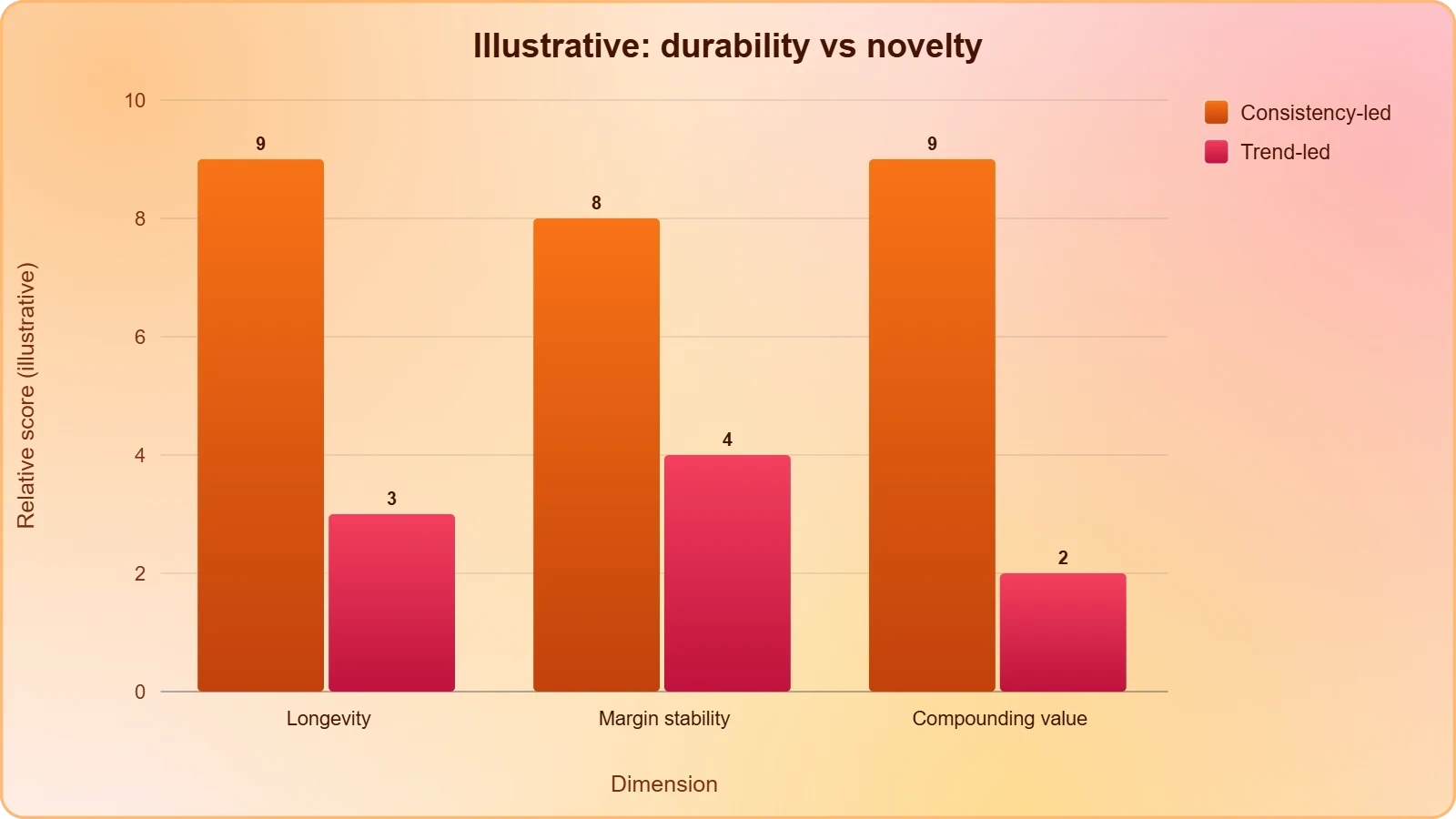
Financial analysts have long noted that heritage brands command higher gross margins and more predictable revenue streams than trend-dependent labels, precisely because their customer base is less fickle. The Lauren enterprise exemplifies this dynamic, with a diversified revenue mix that cushions seasonal volatility. When the CFDA confers a historic honor on a designer whose business model rests on heritage, the award effectively validates the economic logic of continuity over novelty — a quiet but consequential statement about what the industry values.
Legacy, Longevity, and the Mechanics of Fashion Honors
Fashion is an industry obsessed with the new, yet its most consequential institutions are devoted to the old. This paradox sits at the heart of the awards circuit, where the same community that celebrates emerging talent also consecrates established figures whose influence has become foundational. The tension is productive rather than contradictory: honoring longevity provides a stabilizing counterweight to the relentless churn of seasonal novelty, reminding the industry that durability is itself a form of innovation. A historic honor for Ralph Lauren fits neatly into this logic, positioning him as a reference point against which newer voices can be measured.
Why Durability Outlasts Novelty
Durability in fashion requires a specific set of competencies that rarely announce themselves loudly: supply chain discipline, licensing acumen, real estate strategy, and the patience to let a brand mature rather than forcing it into premature reinvention. Lauren's career demonstrates that these unglamorous capabilities matter as much as design genius. The houses that survive multiple economic cycles are those that treat their aesthetic identity as an asset to be stewarded rather than a constraint to be escaped, and the industry's honors system increasingly reflects this understanding by elevating figures whose contributions are structural rather than merely seasonal.
Novelty, by contrast, has a short half-life. Trends generate attention and revenue spikes, but they rarely compound into lasting enterprise value. The designers who endure are those who build systems — archives, licensing networks, retail footprints, and customer relationships — that outlast any single collection. When the CFDA designates an honor as historic, it is implicitly endorsing this systems view of fashion, acknowledging that the industry's true wealth resides in institutions rather than in moments.
The Ceremony as Cultural and Economic Signal
An awards ceremony is never merely an awards ceremony. It is a coordination mechanism through which an industry aligns its narratives, its hierarchies, and its investment priorities. The CFDA evening brings together designers, retailers, editors, and financiers in a single room, and the honors conferred there ripple outward through wholesale negotiations, editorial calendars, and acquisition strategies. The New York Times coverage, brief as it was, performed the essential function of transmitting the signal beyond the room to a broader public that may never attend a fashion show but understands what institutional recognition means.
The economic dimension is equally tangible. Honors influence stock sentiment for publicly traded houses, shape the perceived value of archives and licensing rights, and inform the decisions of private equity firms evaluating fashion assets. A historic honor, in particular, functions as a form of institutional underwriting that reduces perceived risk around a brand's long-term relevance. In an industry where intangible assets constitute the bulk of enterprise value, such signals are not decorative — they are part of the machinery by which capital flows.
The Wider Cast and the Texture of the Evening
The New York Times report noted that the ceremony included other notable moments beyond the Lauren honor, though the original dispatch did not enumerate them. That reticence is itself informative: in an era of saturation coverage, the decision to lead with a single historic recognition suggests that the evening's center of gravity rested there. Awards ceremonies derive their meaning from hierarchy as much as from celebration, and the editorial choice to foreground one honoree reveals how the industry's chroniclers rank the night's events. The remaining moments, whatever their specific character, functioned as supporting texture around a defining centerpiece.
Reading Between the Lines of a Brief Report
Journalism about fashion awards often operates under severe space constraints, and the resulting brevity can obscure as much as it reveals. A report that mentions other notable moments without detailing them invites readers to infer the evening's shape from context and convention. Ceremonies of this kind typically include tributes to emerging designers, acknowledgments of industry figures who have passed, and moments of political or cultural commentary that reflect the mood of the moment. The absence of specifics in the source does not diminish the significance of the central honor; it simply leaves the surrounding narrative to be reconstructed from the industry's broader patterns.
This interpretive gap is worth acknowledging honestly. Analysis that pretends to know what the report did not say would be speculative, and speculation dressed as fact undermines credibility. What can be stated with confidence is that the evening's structure followed the CFDA's established format, that the Lauren recognition anchored the proceedings, and that the event's cultural resonance will be felt in the seasons that follow. The rest belongs to the realm of reasonable inference rather than established fact.
Generational Transition in American Fashion
The American fashion industry is currently navigating a generational handover of considerable complexity. Many of its foundational figures are entering the late stages of their careers, while a new cohort of designers — often younger, more digitally native, and more globally minded — ascends into positions of influence. Awards ceremonies become focal points for this transition, simultaneously honoring the departing generation and signaling which newcomers the establishment considers worthy of eventual canonization. The Lauren honor sits at the elder end of this spectrum, representing the consolidation of a legacy even as the industry's center of gravity shifts.
This transition carries commercial implications. Brands built around a single founding designer face succession questions that are notoriously difficult to resolve, and the industry's honors system plays a subtle role in preparing markets for those transitions by reinforcing institutional continuity. When a historic honor is conferred, it effectively separates the founder's legacy from the brand's ongoing operations, making it easier for successors to inherit a story rather than merely a job title. The ceremony thus performs a quiet function in the machinery of corporate succession.
We Also Published
What the Honor Reveals About American Fashion's Priorities
Beneath the ceremony's surface glamour lies a set of priorities that reveal what the American fashion establishment values at this particular historical moment. The elevation of a designer whose career is defined by consistency, commercial discipline, and cultural storytelling suggests an industry that prizes durability over disruption — or at least that it wishes to be seen doing so. This is not merely nostalgia. It reflects a strategic recognition that in an era of rapid technological change and shifting consumer behavior, the brands with the deepest narrative roots possess the most defensible competitive positions.
Consistency as Competitive Advantage
In markets characterized by volatility, consistency functions as a form of risk management. Consumers facing economic uncertainty gravitate toward brands whose value propositions are legible and stable, and retailers prefer partners whose collections can be merchandised predictably across seasons. Lauren's career embodies this principle at the highest level, demonstrating that a designer who resists the temptation to reinvent annually can build a business whose revenue streams are more resilient than those of trend-driven competitors. The honor implicitly endorses this model as a template for the industry's future.
The endorsement carries particular weight at a moment when many fashion houses are experimenting with rapid collaboration cycles, limited-edition drops, and algorithmic merchandising. These tactics generate attention, but they also erode the narrative coherence that sustains long-term pricing power. By honoring a figure whose approach runs counter to the prevailing hype cycle, the CFDA signals that the industry's institutional memory still values the slow accumulation of brand equity over the quick capture of momentary relevance.
The Global Resonance of American Style
Ralph Lauren's influence extends far beyond the United States, and the honor therefore carries international implications. American style, as Lauren defined it, became a global export — a vocabulary of casual elegance that resonated in Tokyo, London, and Dubai as readily as in New York. This cultural reach has commercial consequences, because brands with genuine global recognition command higher licensing fees, more favorable retail placements, and greater resilience against regional economic downturns. The CFDA's recognition thus affirms not only a domestic legacy but an export success story of considerable economic significance.
The global dimension also shapes how the honor will be interpreted abroad. International markets often look to American institutions for signals about which domestic brands possess enduring legitimacy, and a historic CFDA honor provides exactly that kind of signal. For licensing partners, franchise operators, and international retailers, the award functions as a form of due diligence — an independent verification that the brand's cultural capital remains intact and transferable across borders.
Reading the Moment: Caution, Context, and Conclusion
Any responsible analysis of a brief news report must distinguish carefully between what the source states and what the surrounding context suggests. The New York Times reported that Ralph Lauren received a historic honor at the CFDA Awards and that the event included other notable moments, without providing further details. Everything beyond those facts — the business implications, the generational dynamics, the global resonance — represents informed interpretation rather than reported fact. Acknowledging this boundary is not pedantry; it is the difference between analysis and speculation, and it protects readers from drawing conclusions the evidence cannot support.
Distinguishing Fact from Interpretation
The factual core of the report is narrow but significant: a historic honor was conferred, the event occurred, and other moments transpired that the source did not enumerate. From this core, reasonable inferences can be drawn about institutional signaling, market effects, and cultural meaning, provided those inferences are labeled as such. The discipline matters because fashion coverage often blurs the line between reporting and promotion, and readers deserve clarity about which claims rest on evidence and which rest on pattern recognition. This analysis has attempted to maintain that distinction throughout.
What remains genuinely uncertain is the specific character of the other notable moments and the precise nature of the historic designation. These gaps do not undermine the central significance of the Lauren recognition, but they do counsel humility about the evening's full meaning. Future reporting may fill in the details, and subsequent ceremonies will reveal whether this honor represents an isolated tribute or part of a broader institutional reorientation toward legacy and durability.
The Enduring Value of Institutional Recognition
Institutions endure because they accumulate meaning over time, and the CFDA's awards have accumulated more than six decades of it. A historic honor conferred within that framework carries weight that no marketing campaign can manufacture, because it represents the considered judgment of a professional community evaluating one of its own. For Ralph Lauren, the recognition formalizes what five decades of consistent work had already established; for the industry, it provides a moment of collective reflection on what deserves to be preserved as fashion continues its restless evolution.
The deeper lesson concerns the relationship between recognition and substance. Honors follow achievement rather than creating it, and the most durable legacies are built through the unglamorous disciplines of consistency, craft, and commercial prudence. As the American fashion industry navigates its generational transition, the example of a designer who built a global enterprise on narrative coherence offers a template worth studying — not because it can be replicated wholesale, but because it demonstrates that patience and identity remain formidable competitive advantages in a market that often forgets them.
From our network :
- The Final Descent: How ESA Retired the Legendary Cluster Constellation After 24 Years of Space Weather ScienceAfter 24 years mapping Earth’s magnetosphere, ESA’s Cluster mission concluded with a precisely controlled reentry over the South Pacific. This analysis explores the scientific legacy, engineering decisions, and debris mitigation principles behind one of space exploration’s most responsible retirements.
- Committed Mediterranean Precipitation Decline: Why Emissions Cuts Alone Cannot Restore Winter RainsNew NOAA research reveals that Mediterranean winter rains may decline irreversibly even with emissions cuts. Explore the science of committed climate change and regional impacts.
- The Hidden Cost of AI Convenience: Why Over-Permissioned Agents Are a Security Time BombDiscover why AI agents with excessive permissions create dangerous single points of failure, and learn how implementing least privilege principles can protect your organization from exploitation.
- CISA’s Ten-Advisory Wave: Why Generic Patching Fails in OT and How to Build Product-Specific PlaybooksCISA released ten ICS advisories in one week, exposing critical infrastructure risks. Generic patching fails in OT. Learn to build product-specific remediation playbooks.
- How AI Agents Will Change the Way We Manage Personal FinancesExplore how AI agents are transforming personal finance through automated budgeting, bill payment, and investment management, while examining the critical security protocols and governance frameworks required for safe deployment.
- Live Online English Classes for Kids: Do They Actually Reduce Anxiety?A ten-week study reveals that synchronous online English classes can significantly reduce child language anxiety while improving listening and reading skills. Discover what makes these programs effective and how parents can select the right one.
- Forbidden Matrix Patterns and Visible Lattice Points: A Geometric DictionaryExplore how multidimensional 0–1 matrices encode geometric truths, linking forbidden patterns to visible lattice points and hypergraph theory, with applications in combinatorics and computational geometry.
- University Language Proficiency Exams: Why Institutional Tests Demand Different Preparation Than IELTS and TOEFLDiscover why university-specific language proficiency examinations differ fundamentally from IELTS and TOEFL, and learn strategic preparation approaches for institutional assessment success.
- Mobile Learning and VR in English: What Global Evidence Reveals About Effective Language TechnologyA systematic review across 14 countries reveals which language-learning technologies genuinely work. Mobile learning, AI, and VR show measurable benefits when pedagogically integrated. This evidence-based guide helps educators and learners select technology that delivers real return on investment.
RESOURCES
- Resources will be updated soon.
- 01
- 02
- 03
- 04
- 05
- 06
- 07
- 08
0 Comments