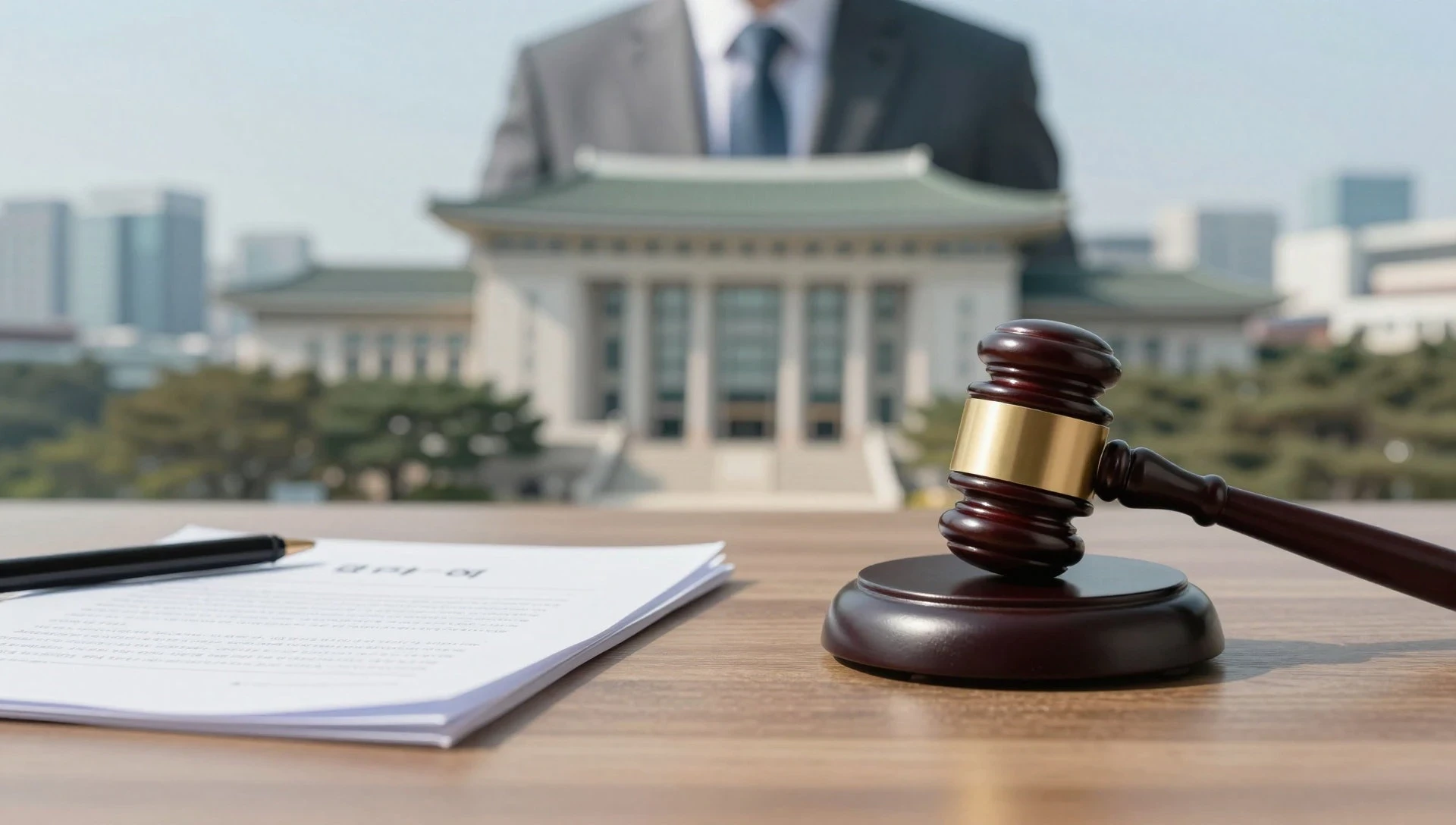
South Korea's special counsel team has formally challenged the Seoul High Court's acquittal of Seoul Mayor Oh Se-hoon, filing an appeal with the Supreme Court on Friday, one week after the appellate bench cleared him of violating the Political Funds Act.
The dispute turns on a narrow but consequential question: whether a single witness's testimony, standing alone, can sustain a conviction when the trial court found it credible and the appellate court did not.
The answer will determine not only the mayor's legal standing but also the trajectory of a politician widely discussed as a future presidential contender.
On This Page
The underlying facts are modest in scale and large in implication. Prosecutors alleged that a political supporter paid 33 million won, roughly US$24,700, to cover ten opinion polls that Oh received from Myung Tae-kyun, a self-described power broker, ahead of the 2021 mayoral by-election.
A lower court convicted the mayor in part and fined him 10 million won, a penalty that would have stripped him of office. The appellate court reversed that finding, holding that Myung's testimony could not be fully trusted as the sole direct evidence.
The special counsel's appeal argues that the appellate court's rejection of Myung's testimony was unlawful and exceeded the principle of free evaluation of evidence, and that parts of the ruling are inconsistent with common sense.
The case has become a proxy battle in Korean politics: the main opposition party welcomed the acquittal, while the ruling party pressed for an appeal. This analysis examines the legal architecture, the evidentiary standard, and the political arithmetic that converge in a single 33 million won transaction.
TL;DR South Korea's special counsel has appealed Seoul Mayor Oh Se-hoon's acquittal in a political funds case involving 33 million won in opinion polling paid by a supporter through broker Myung Tae-kyun. A lower court fined Oh 10 million won, which would have removed him from office; the appellate court overturned the conviction because Myung's testimony was the only direct evidence. The appeal tests the boundary between a trial court's credibility findings and an appellate court's power to reassess evidence, while the outcome shapes Oh's viability as a presidential candidate.
The Legal Architecture of the Political Funds Act Case
The Political Funds Act governs how money enters Korean electoral politics, and its prohibitions are deliberately broad. It restricts donations to authorized channels, caps individual contributions, and criminalizes indirect payments made on a candidate's behalf.
The charge against Oh rested on the claim that a supporter's payment for polling services amounted to a disguised political contribution routed through Myung Tae-kyun, a figure who describes himself as a power broker rather than a formal campaign operative.
The Charged Conduct and the 33 Million Won Figure
Prosecutors alleged that Oh received ten opinion polls valued at 33 million won in total, with the cost borne by a political supporter rather than by the campaign or the mayor personally.
The structure matters legally: a direct donation would trigger clear reporting obligations, whereas a third-party payment for services can be characterized as an in-kind contribution. Korean law treats both cash and in-kind support as regulated political funds, so the characterization of the polling as a contribution was central to the prosecution's theory.
The sum involved is small relative to national campaign budgets, which is precisely why the case attracted scrutiny. A 33 million won transaction, roughly US$24,700, sits well below the scale of major election spending, yet the Political Funds Act applies without a minimum threshold.
The prosecution's argument therefore depended less on the amount than on the mechanism: who paid, for whose benefit, and whether the payment was disclosed through the proper channels.
Myung Tae-kyun's role as intermediary shaped the evidentiary record. He was positioned between the supporter who paid and the candidate who received the polling, making his account the connective tissue of the prosecution's case. Without his testimony, the link between the payment and the mayor's benefit would rest on circumstantial inference. That structural weakness in the evidence became the pivot on which the appellate court turned.
The Lower Court's Partial Conviction and 10 Million Won Fine
The first-instance court found Oh partly guilty and imposed a 10 million won fine. Under Korean law, an elected official sentenced to a fine of 1 million won or more for violating the Political Funds Act faces loss of office.
The fine was therefore not a minor sanction but a functional removal mechanism, and the lower court's ruling carried immediate political consequences beyond the courtroom.
Partial conviction implies the trial court accepted some but not all of the prosecution's factual claims, a common outcome in cases built on layered testimony. The court evidently credited enough of Myung's account to establish the payment structure while stopping short of the full charge.
That calibrated finding gave both sides grounds for appeal and set up the appellate court's more categorical rejection of the testimony.
The Appellate Reversal and the Credibility Question
The Seoul High Court overturned the conviction on the ground that Myung's testimony was the only direct evidence and could not be fully trusted. Korean criminal procedure permits appellate courts to reassess factual findings, including credibility determinations, though deference to trial courts is customary.
The appellate bench concluded that the evidentiary foundation was too thin to sustain a criminal conviction beyond reasonable doubt.
This reasoning invokes the principle of free evaluation of evidence, which allows judges to weigh testimony according to their own assessment rather than fixed rules. The special counsel now argues that the appellate court misapplied that very principle, rejecting testimony in a manner that exceeded lawful discretion.
The tension is structural: the same doctrine that empowered the appellate court to acquit is the doctrine the appeal says it violated.
Evidentiary Standards and the Limits of Appellate Review
The appeal raises a question that recurs across common law and civil law systems alike: how much deference an appellate court owes to a trial court's assessment of witness credibility.
Korean procedure allows broad appellate review of facts, but the special counsel contends that the High Court's rejection of Myung's testimony crossed from permissible reassessment into unlawful disregard. The distinction is subtle and consequential.
Free Evaluation of Evidence as a Contested Doctrine
The principle of free evaluation of evidence, codified in Korean criminal procedure, directs judges to form convictions based on their own reasoned assessment rather than rigid evidentiary rules. It is a safeguard against mechanical verdicts, but it also grants substantial discretion.
When an appellate court uses that discretion to reject testimony a trial court accepted, the losing party can argue the discretion was exercised arbitrarily.
The special counsel's filing asserts precisely that: the appellate court's decision to discard Myung's testimony was unlawful and exceeded the doctrine's bounds. Proving that claim requires showing the High Court's reasoning was not merely different but defective, a demanding standard.
Korean appellate practice generally tolerates divergent credibility findings unless they rest on clear logical errors or misapprehensions of the record.
The "common sense" argument in the appeal is rhetorically forceful but legally softer. Asserting that parts of a ruling defy common sense invites the higher court to weigh plausibility rather than identify a specific legal error.
Such arguments can succeed when a ruling's internal logic is visibly strained, but they rarely prevail against a coherent credibility finding supported by reasoned analysis.
The Single-Witness Problem in Political Funds Prosecutions
Cases built on a single direct witness are structurally fragile, and political funds prosecutions frequently encounter this weakness. Financial trails can establish that money moved, but they rarely establish intent or the identity of the beneficiary without testimony connecting the dots.
When the intermediary is the only witness, the case rises or falls on his credibility, and any impeachment of his account becomes decisive.
Myung Tae-kyun's self-description as a power broker compounds the difficulty. A witness who positions himself as an insider with influence has an incentive to magnify his role, and courts scrutinize such testimony for self-serving embellishment.
The appellate court's refusal to rely solely on his account reflects a familiar judicial caution rather than an idiosyncratic judgment.
Prosecutors could have strengthened the record with documentary corroboration: polling invoices, bank records, communications between the parties, or testimony from the polling firms themselves. The appeal's prospects depend partly on whether such corroboration exists in the record and was underweighted, or whether the case genuinely rested on one voice. The special counsel's argument that the ruling is inconsistent with common sense implies the former.
What a Supreme Court Review Would Actually Decide
A higher court reviewing this appeal would not retry the facts. It would assess whether the appellate bench committed a legal error in how it handled the evidence, a narrower inquiry than the original trial.
If the court finds the credibility assessment was within lawful discretion, the acquittal stands regardless of whether another judge might have ruled differently.
This asymmetry favors the acquitted party. Appellate systems generally protect factual findings that are reasoned and internally consistent, and the High Court's ruling appears to rest on an identifiable evidentiary deficiency rather than an unexplained conclusion.
The special counsel must therefore demonstrate not that the ruling was wrong but that it was unlawful, a materially higher bar.
We Also Published
Political Consequences and the Presidential Horizon
The acquittal does more than resolve a criminal charge; it restores a mayoral mandate and reopens a national career. Oh Se-hoon governs the capital, the largest single electoral prize in Korea, and a conviction carrying a 10 million won fine would have ended his tenure automatically. The High Court's reversal therefore preserved both his office and his standing as a potential presidential candidate.
Party Reactions and the Framing Contest
The main opposition party welcomed the acquittal, framing it as vindication against what it portrays as politically motivated prosecution. The ruling party called for an appeal, casting the appellate ruling as an unwarranted leniency toward a prominent opposition figure.
These divergent reactions reflect a broader contest over whether the case was law enforcement or political pressure dressed in legal form.
Korean prosecutorial decisions carry inherent political weight because prosecutors can pursue or decline cases involving public figures with wide discretion. Special counsel appointments are themselves political instruments, created to insulate sensitive investigations from ordinary prosecutorial control.
When a special counsel appeals an acquittal, the move is read through that political lens as much as through a legal one.
Public opinion on the case is likely to split along existing partisan lines rather than converge on a shared factual reading. That polarization limits the acquittal's power to rehabilitate the mayor among opponents while strengthening his standing among supporters. The net effect on national approval is therefore uncertain and probably modest in the short term.
How the Ruling Reshapes the Presidential Field
A sustained conviction would have removed Oh from contention entirely, so the acquittal's most significant effect is negative: it eliminates a disqualifying obstacle. Whether he converts that opening into a presidential run depends on factors unrelated to the courtroom, including party dynamics, national polling, and the timing of the next election cycle.
The case nonetheless leaves a residual vulnerability. An appeal remains pending, and a reversal at a higher level would revive the loss-of-office mechanism. Any presidential campaign would have to account for that legal overhang, and opponents would likely keep the polling payment in public discussion regardless of the final disposition.
Comparable cases in Korean politics suggest that legal exoneration rarely closes the political argument. Voters tend to retain the underlying narrative even when courts reject the charge, and the 33 million won figure is small enough to be remembered as a symbol rather than assessed as a sum. The acquittal settles the law; it does not settle the politics.
- 01
- 02
- 03
- 04
Comparative Context: Political Funds Cases in Korea
Korean political funds prosecutions have historically produced mixed outcomes, with courts sometimes convicting on documentary records and sometimes acquitting where testimony was the sole foundation. The pattern suggests that evidentiary structure, not political salience, best predicts verdicts.
Cases with clear financial trails and corroborating witnesses tend to survive appeal; cases resting on a single intermediary often do not.
The Oh case fits the second category. The payment amount was documented, but the connection to the mayor's knowledge and intent depended on Myung's account. That asymmetry explains why the trial court could convict partially while the appellate court acquitted outright: the former accepted a plausible inference, the latter demanded more than plausibility before upholding a criminal sanction.
For prosecutors, the lesson is procedural rather than political. Building political funds cases around corroborated documentary evidence reduces exposure to credibility reversals on appeal. For defendants, the lesson is that a single witness's reliability can be the difference between removal from office and continued public life, a margin that Korean electoral law makes unusually narrow.
What to Watch as the Appeal Proceeds
Three variables will determine the case's trajectory. First, whether the higher court accepts the special counsel's characterization of the appellate ruling as legally defective rather than merely debatable. Second, whether any corroborating evidence in the record can be elevated to support the original conviction. Third, whether the political calendar creates pressure for resolution before the next national election cycle.
The legal question is narrow, but its political footprint is wide. A decision affirming the acquittal would close the case and consolidate Oh's position; a reversal would reopen both the criminal and the electoral questions.
Either outcome will be read as a signal about how Korean institutions handle prosecutions of prominent officials, which is why the appeal matters beyond one mayor's career.
From our network :
- Forbidden Matrix Patterns and Visible Lattice Points: A Geometric DictionaryExplore how multidimensional 0–1 matrices encode geometric truths, linking forbidden patterns to visible lattice points and hypergraph theory, with applications in combinatorics and computational geometry.
- The Final Descent: How ESA Retired the Legendary Cluster Constellation After 24 Years of Space Weather ScienceAfter 24 years mapping Earth’s magnetosphere, ESA’s Cluster mission concluded with a precisely controlled reentry over the South Pacific. This analysis explores the scientific legacy, engineering decisions, and debris mitigation principles behind one of space exploration’s most responsible retirements.
- The Hidden Cost of AI Convenience: Why Over-Permissioned Agents Are a Security Time BombDiscover why AI agents with excessive permissions create dangerous single points of failure, and learn how implementing least privilege principles can protect your organization from exploitation.
- Live Online English Classes for Kids: Do They Actually Reduce Anxiety?A ten-week study reveals that synchronous online English classes can significantly reduce child language anxiety while improving listening and reading skills. Discover what makes these programs effective and how parents can select the right one.
- CISA’s Ten-Advisory Wave: Why Generic Patching Fails in OT and How to Build Product-Specific PlaybooksCISA released ten ICS advisories in one week, exposing critical infrastructure risks. Generic patching fails in OT. Learn to build product-specific remediation playbooks.
- Mobile Learning and VR in English: What Global Evidence Reveals About Effective Language TechnologyA systematic review across 14 countries reveals which language-learning technologies genuinely work. Mobile learning, AI, and VR show measurable benefits when pedagogically integrated. This evidence-based guide helps educators and learners select technology that delivers real return on investment.
- Committed Mediterranean Precipitation Decline: Why Emissions Cuts Alone Cannot Restore Winter RainsNew NOAA research reveals that Mediterranean winter rains may decline irreversibly even with emissions cuts. Explore the science of committed climate change and regional impacts.
- How AI Agents Will Change the Way We Manage Personal FinancesExplore how AI agents are transforming personal finance through automated budgeting, bill payment, and investment management, while examining the critical security protocols and governance frameworks required for safe deployment.
- University Language Proficiency Exams: Why Institutional Tests Demand Different Preparation Than IELTS and TOEFLDiscover why university-specific language proficiency examinations differ fundamentally from IELTS and TOEFL, and learn strategic preparation approaches for institutional assessment success.
RESOURCES
- Special counsel appeals Seoul Mayor Oh Se-hoon acquittal to ...koreajoongangdaily.com3 days ago ... South Korea's special counsel has appealed Seoul Mayor Oh Se-hoon's acquittal in an alleged illegal political funds case involving private ...
- Appeals court acquits Seoul mayor of political funds law violation - UPIupi.comOct 23, 2026 ... An appeals court on Friday overturned a lower court ruling to acquit Seoul Mayor Oh Se-hoon in his high-stakes political…
- Seoul mayor acquitted on appeal in political funds casekoreaherald.comOct 23, 2026 ... Seoul Mayor Oh Se-hoon on Friday was acquitted by an appellate court of charges that he violated the Political Funds…
- South Korean prosecutors appeal Seoul mayor's acquittal - UPI.comupi.com3 days ago ... ... appeal Friday against an appellate court ruling that acquitted Seoul Mayor Oh Se-hoon of violating the country's Political Funds…
- Special counsel appeals Seoul mayor's acquittal in political funds casekoreaherald.com3 days ago ... A special counsel team said Friday it has appealed the acquittal of Seoul Mayor Oh Se-hoon in a political funds…
- Seoul Mayor Oh Se-hoon acquitted in political funds casekoreatimes.co.krOct 23, 2026 ... An appeals court on Friday acquitted Seoul Mayor Oh Se-hoon of political funding charges linked to opinion polls conducted ahead…
- Seoul Mayor Oh Se-hoon faces risk of losing office after ... - Reutersreuters.comJul 22, 2026 ... Seoul Mayor Oh Se-hoon faces risk of losing office after political funds conviction ... Oh said he could not accept…
- Seoul Mayor Oh Se-hoon Acquitted on Appeal in Political Funds Caseworld.kbs.co.krOct 23, 2026 ... Seoul Mayor Oh Se-hoon has been acquitted of violating the Political Funds Act after an appeals court overturned his earlier…
- Main opposition welcomes Seoul mayor's acquittal in political funds ...en.yna.co.krOct 23, 2026 ... 23 (Yonhap) -- The main opposition People Power Party (PPP) on Friday welcomed an appeals court's decision to acquit Seoul…
- Seoul Mayor Oh Se-hoon of the People Power Party was re-elected ...instagram.comJun 3, 2026 ... The Seoul High Court on Friday (Oct. 23) acquitted Seoul Mayor Oh Se-hoon on appeal in a political funds case,…
- Seoul Mayor Oh Se-hoon Acquitted on Appealchosun.comOct 24, 2026 ... ... acquitted Mayor Oh in the appeal trial for violating the Political Funds Act. The court also acquitted Kang Cheol-won,…
- Seoul Mayor Oh Se-hoon began a new term Wednesday ... - Instagraminstagram.comJun 30, 2026 ... 23) acquitted Seoul Mayor Oh Se-hoon on appeal in a political funds case, overturning a lower-court conviction and a 10…
- [BREAKING] An appeals court on Friday acquitted Seoul Mayor Oh ...facebook.comOct 22, 2026 ... [BREAKING] An appeals court on Friday acquitted Seoul Mayor Oh Se-hoon of political funding charges linked to opinion polls conducted…
- Appeals court acquits Seoul mayor in campaign finance casekuwaittimes.comOct 23, 2026 ... SEOUL: An appeals court acquitted Seoul Mayor Oh Se-hoon on Friday in a high-stakes campaign finance case, though a reversal…
- South Korea's top conservative 'a wounded lame duck' after guilty ...scmp.comJul 23, 2026 ... A campaign finance conviction threatens to end Seoul Mayor Oh Se-hoon's presidential ambitions, just weeks after winning a fifth term.
- 01
- 02
- 03
- 04
- 05
- 06
- 07
- 08
0 Comments