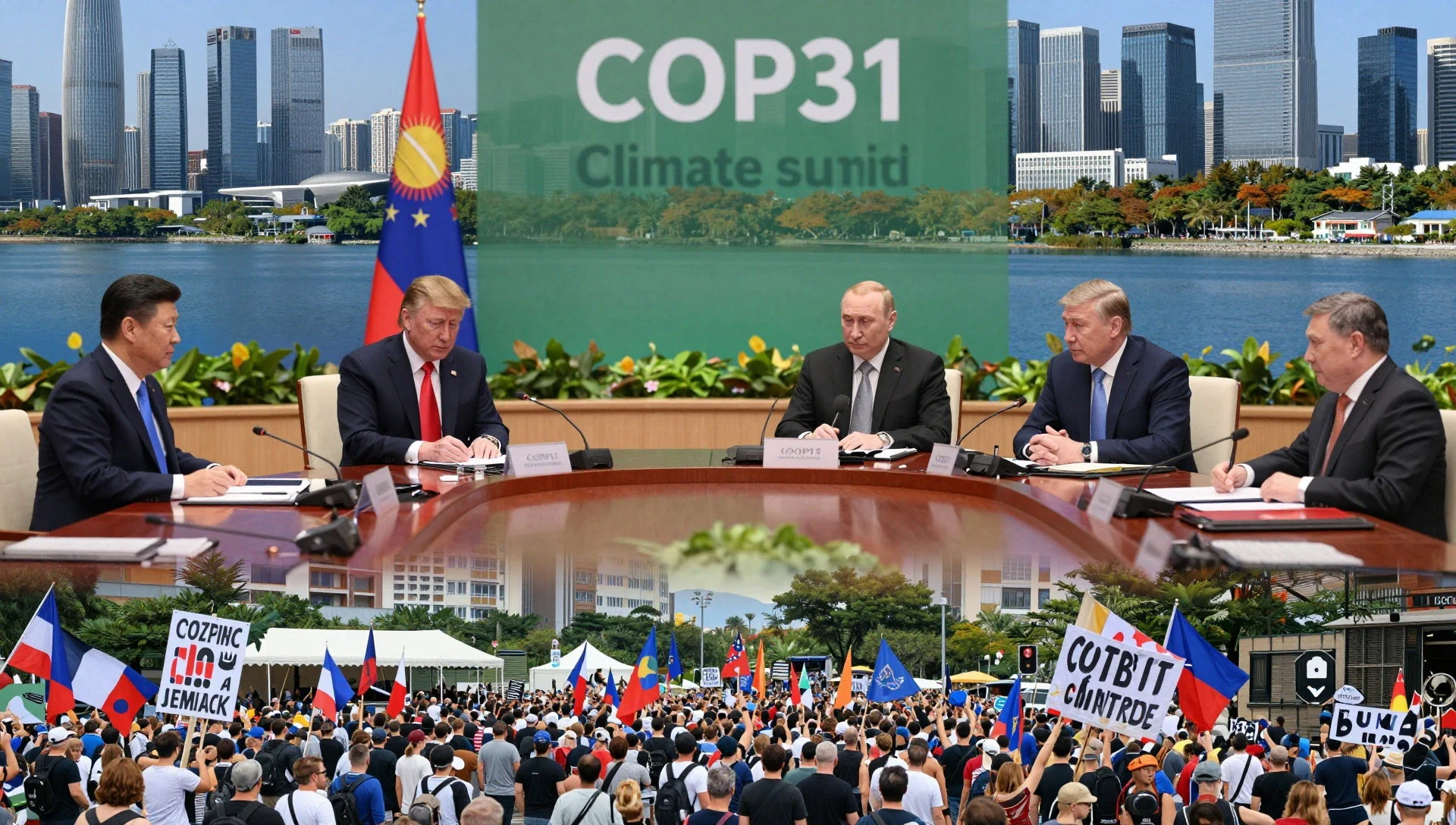
One week in late November 2026 compressed an unusual density of world-historic events into a single news cycle, and the resulting picture is less a collage of headlines than a portrait of an international order under simultaneous strain. In Shenzhen, President Xi Jinping hosted both Donald Trump and Vladimir Putin in a trilateral encounter that observers immediately described as unprecedented, a diplomatic configuration with no clear precedent in the post-war era. That same week, negotiators and activists gathered in Antalya for the COP31 climate conference, French cities filled with protesters demanding relief from living costs, and Kyiv residents sheltered in metro stations as missiles and drones struck the capital once more.
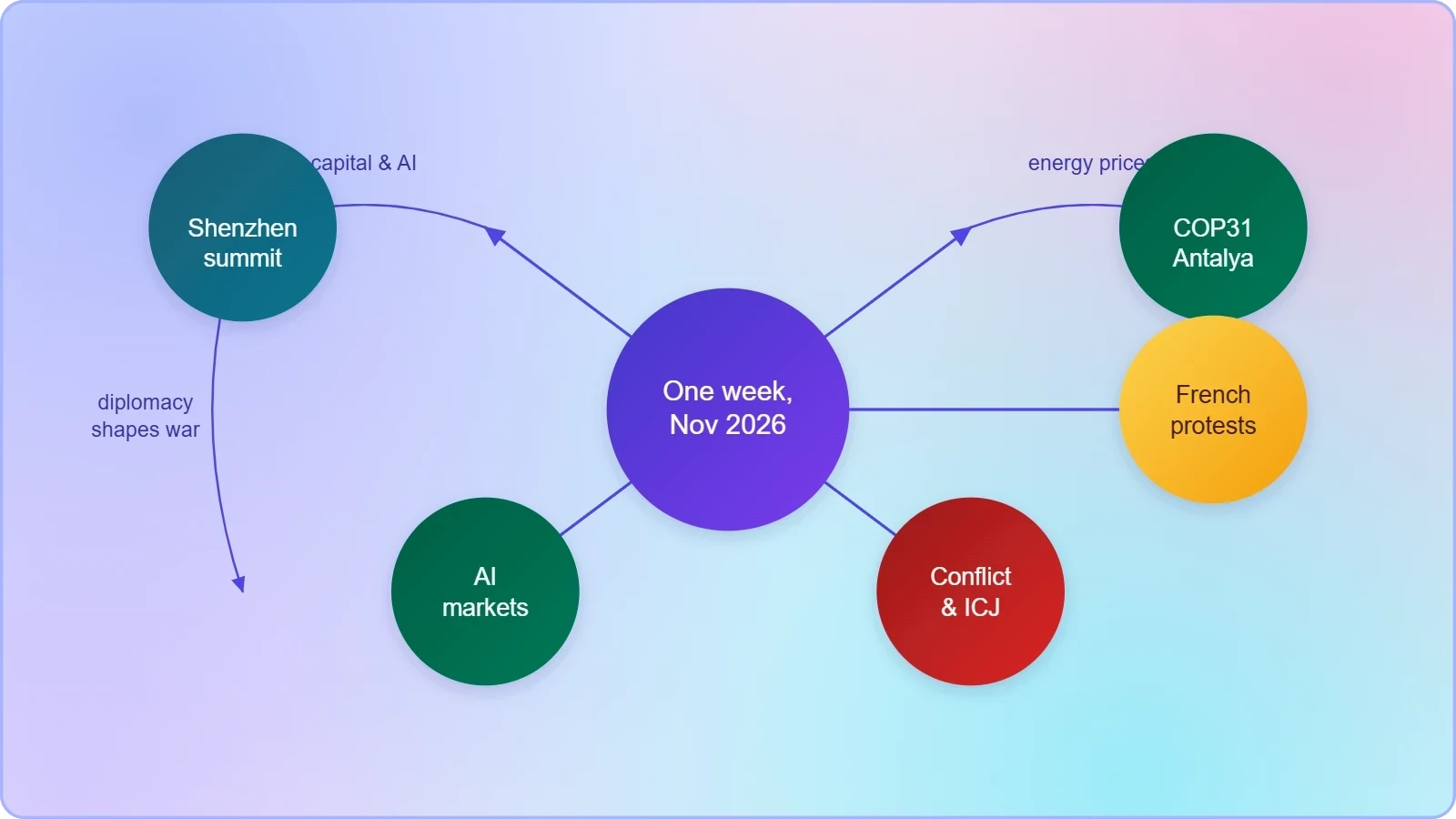
Read together, these dispatches from France 24's weekly photographic review reveal a world in which diplomacy, climate governance, domestic economic grievance, and armed conflict are no longer separable storylines. The Shenzhen summit raises questions about the architecture of great-power alignment; COP31 tests whether multilateral climate machinery can still produce binding outcomes; the French demonstrations show how inflation and public-sector pay disputes can destabilise a major European democracy. Meanwhile, the International Court of Justice delivered its verdict in the genocide case brought against Myanmar over the Rohingya, and Rohingya refugees watched from camps in Bangladesh, a reminder that legal accountability and lived suffering operate on very different clocks.
This analysis examines the week's events as interlocking signals rather than isolated bulletins. It considers what the Shenzhen meeting implies for triangular great-power relations, how COP31 fits into the wider trajectory of climate diplomacy, why French protest movements have become a recurring feature of European political life, and what the ICJ ruling means for international justice. It also looks at the quieter stories — the salvage work in Sanaa, the billboards in Times Square — that frame how technology, capital, and conflict now intersect.
On This Page
- The Shenzhen Summit and the Geometry of Great-Power Diplomacy
- COP31 in Antalya: Climate Diplomacy Under Pressure
- French Protests and the Politics of Cost-of-Living Pressure
- Ukraine, Gaza, and the Human Geography of Conflict
- Technology, Capital, and the Symbolism of Times Square
- Reading the Week as a Single System
TL;DR A single week in November 2026 brought a trilateral Xi–Trump–Putin summit in Shenzhen, the COP31 climate conference in Antalya, sustained cost-of-living protests across France, renewed Russian strikes on Kyiv, and an International Court of Justice verdict on Myanmar's treatment of the Rohingya. Each event carries distinct consequences, but together they describe a multipolar system in which great-power diplomacy, climate multilateralism, domestic economic pressure, and legal accountability are unfolding simultaneously and often in tension. The week's photographic record, from Gaza's ruined skyline to Anthropic's Times Square billboards, captures how geopolitics, technology, and human displacement now share a single frame.
The Shenzhen Summit and the Geometry of Great-Power Diplomacy
The meeting in Shenzhen between Xi Jinping, Donald Trump, and Vladimir Putin stands out precisely because it has no clean historical analogue. Trilateral summits among the leaders of China, the United States, and Russia have been rare even in bilateral form during recent decades, and the decision to convene all three in a single Chinese city signals a deliberate attempt to reframe the terms of global alignment. Shenzhen itself is a meaningful backdrop: a city built as a showcase of Chinese economic modernisation, it projects technological ambition and commercial openness rather than military posturing, offering a softer stage for hard negotiations.
Why a Three-Way Meeting Matters
The strategic significance lies in what a trilateral format does to bilateral bargaining. When Washington and Moscow negotiate alone, Beijing watches from outside; when Beijing and Washington talk, Moscow calculates its leverage. Bringing all three into one room changes the arithmetic of concessions, because each leader must weigh not only the counterpart in front of him but the third party observing the exchange. For Xi, hosting confers agenda-setting power and reinforces China's claim to convene the world's major powers on its own soil. For Trump, direct engagement offers a route to transactional deals. For Putin, presence at the table counters narratives of isolation.
Analysts will scrutinise the choreography as much as the communiqué. Seating arrangements, bilateral side meetings, and the order of statements often reveal more than joint declarations, particularly when the participants have conflicting interests in Ukraine, trade, and security architecture. The fact that the meeting was described as unprecedented suggests that conventional diplomatic templates did not apply, and that the participants themselves recognised they were improvising a new format. Whether that format produces durable mechanisms or merely a photogenic moment will depend on follow-through in the months ahead.
Risks and Readouts for Smaller Powers
For middle powers and allies, a trilateral summit among the three largest nuclear-armed states carries ambivalent signals. On one hand, direct communication among major powers can reduce miscalculation risk, a genuine public good in a period of elevated tension. On the other, arrangements struck among three capitals can bypass the interests of Europe, India, Japan, and the Global South, generating resentment and incentives to hedge. The week's other events sharpen this concern: European governments confronting domestic unrest have limited bandwidth for diplomatic counterweight, while climate negotiations in Antalya depend on the same great powers honouring commitments made elsewhere.
The readout problem is compounded by information asymmetry. Trilateral summits often produce deliberately vague statements that each participant interprets differently for domestic audiences, allowing all three to claim victory while deferring substantive disputes. That ambiguity can be useful in the short term but corrosive over time, because markets, allies, and adversaries must all guess at what was actually agreed. The coming weeks of diplomatic traffic — follow-up visits, technical talks, and military-to-military contacts — will offer the clearest indication of whether Shenzhen produced a framework or merely a photograph.
COP31 in Antalya: Climate Diplomacy Under Pressure
The COP31 conference in Antalya unfolded against a backdrop of intensifying activist pressure over fossil fuels, and the choice of Turkey as host carried its own symbolism. Situated at the crossroads of Europe, Asia, and the Middle East, Turkey embodies the energy transition's contradictions: a rapidly industrialising economy dependent on imported hydrocarbons while simultaneously expanding renewable capacity. Activists gathering in Antalya argued that the conference's procedural machinery has become too slow relative to the physical changes already underway in the climate system, and their demands for decisive action on fossil fuel phase-out reflected frustration accumulated across three decades of negotiations.
The Fossil Fuel Question
At the centre of COP31's agenda lay the perennial dispute over whether and how to commit to winding down fossil fuel production. Scientific consensus, embodied in successive IPCC assessments, holds that limiting warming to the Paris Agreement's targets requires steep and rapid reductions in coal, oil, and gas use. Yet the diplomatic text has historically lagged behind the science, reflecting the influence of producer economies and the domestic political constraints facing major emitters. Activist calls in Antalya therefore targeted not only governments but the gap between pledged ambition and implemented policy, a gap that has widened as global energy demand has continued to rise.
The conference's outcomes will be judged less by headline declarations than by the specificity of commitments and the credibility of monitoring. Previous COPs have produced language on "transitioning away" from fossil fuels that subsequently proved difficult to operationalise, and negotiators in Antalya faced the familiar challenge of translating principle into nationally determined contributions with measurable targets. For developing economies, the parallel question of climate finance remained central: without predictable flows of adaptation and mitigation funding, commitments made in conference halls cannot be delivered on the ground.
Activism, Legitimacy, and Implementation Gaps
The visible presence of activists in Antalya reflects a broader shift in how climate governance acquires legitimacy. Street pressure and civil society scrutiny have become integral to the COP process, supplying the political energy that formal negotiations often lack. Yet activism also highlights the system's structural weakness: when implementation depends on voluntary national pledges, the gap between conference rhetoric and real-world emissions becomes a recurring source of public disillusionment. The demonstrations outside the negotiating halls thus function as both a moral compass and an indictment of the pace of change.
For businesses and investors, COP31's signals matter because they shape expectations about regulation, carbon pricing, and technology subsidies. A conference that produces credible phase-out language can accelerate capital reallocation toward renewables; one that produces ambiguity can delay investment and entrench incumbents. The Antalya gathering therefore sits at the intersection of diplomacy and markets, and its readouts will be parsed as carefully in boardrooms as in negotiating chambers. The week's broader geopolitical turbulence, including the Shenzhen summit, adds a further variable, since great-power cooperation is a precondition for effective climate action.
French Protests and the Politics of Cost-of-Living Pressure
Across France, demonstrations over the cost of living, public-sector pay, and school conditions brought the country's familiar protest repertoire back into the streets of Paris and other cities. The grievances are economic at their core: households squeezed by inflation in food, energy, and housing have watched wage growth lag behind prices, while public-sector workers argue that years of constrained budgets have eroded both pay and working conditions. Schools have become a particular flashpoint, with staffing shortages and deteriorating facilities cited as evidence that public services are being asked to do more with less.
From Grievance to Political Test
French protest movements have a distinctive capacity to convert diffuse economic discontent into political tests for incumbent governments. The tradition of street mobilisation, rooted in a long history of labour organising and civic republicanism, means that demonstrations are rarely dismissed as marginal; they shape media narratives, force ministerial responses, and can determine the political fortunes of presidents and prime ministers. The current wave therefore matters not only for the specific demands raised but for what it reveals about the durability of the government's mandate and its capacity to legislate through opposition.
The composition of the protests is also significant. When public-sector workers, students, and cost-of-living campaigners converge, the resulting coalition can bridge traditional divides between organised labour and newer social movements. That breadth increases political leverage but also complicates negotiation, since the demands are heterogeneous and no single interlocutor can speak for all participants. Governments facing such coalitions typically respond with a mixture of targeted concessions and procedural delays, hoping to fragment the alliance before it consolidates into a sustained challenge.
European Echoes and Economic Context
France's unrest resonates beyond its borders because similar pressures are building across Europe. Energy price volatility, housing shortages, and stagnant real wages have fuelled discontent from Germany to the United Kingdom, and the political consequences have been visible in electoral volatility and the rise of anti-establishment movements. The French case is distinctive in its intensity and institutional expression, but the underlying economics are shared: post-pandemic inflation, fiscal constraints, and the cost of the green transition all weigh on household budgets and public finances simultaneously.
For policymakers, the challenge is to address legitimate grievances without destabilising fiscal positions that are already stretched. Public-sector pay increases and school investment require resources that must come from taxation, borrowing, or reallocation, each with political costs. The week's demonstrations thus illustrate a broader European dilemma: democratic governments are being asked to deliver improved public services and living standards precisely when the fiscal room for manoeuvre is narrowing, and the resulting tension is likely to shape electoral politics for years.
Ukraine, Gaza, and the Human Geography of Conflict
In Kyiv, residents sheltered in metro stations as Russian missile and drone strikes resumed, a scene that has become tragically routine over successive winters of the war. The use of underground stations as shelters reflects both the resilience of urban life under attack and the grim normalisation of civil defence infrastructure in a European capital. Each strike campaign carries military logic — targeting energy systems, logistics, or morale — but its human cost is borne disproportionately by civilians whose daily routines are punctuated by sirens and the calculus of whether to descend to safety.
Strike Campaigns and Civilian Resilience
The pattern of Russian strikes on Ukrainian cities has evolved into a strategy of attrition against infrastructure and public morale, timed in previous years to coincide with winter heating demand. Ukraine's air defences, bolstered by Western systems, intercept many but not all incoming munitions, and the resulting damage to power generation and distribution imposes cascading costs on hospitals, schools, and households. The metro shelter image captures this dynamic precisely: a functioning society adapting in real time to repeated disruption, its citizens developing expertise in survival that no one would choose to acquire.
For Ukraine's allies, each strike campaign renews the argument for air defence supplies and long-range capabilities, while also raising questions about escalation management. The week's diplomatic calendar, dominated by the Shenzhen summit, complicates this picture, since any trilateral understanding among Washington, Moscow, and Beijing could reshape the war's trajectory. Kyiv's European partners, preoccupied with domestic protests and fiscal constraints, face their own challenge in sustaining political and material support as the conflict grinds on.
Gaza's Ruins and the Rohingya Verdict
From the Israeli border, destroyed buildings in Gaza remained visible, a landscape of rubble that testifies to the scale of destruction wrought by conflict. Reconstruction, whenever it becomes possible, will require years and enormous resources, and the humanitarian situation continues to demand urgent attention. The juxtaposition of Gaza's ruins with the week's other stories underscores how contemporary conflicts produce displacement and destruction that outlast any ceasefire or diplomatic communiqué, leaving physical and psychological scars that shape politics for generations.
In a different theatre of accountability, the International Court of Justice delivered its verdict in the case accusing Myanmar of genocide against the Rohingya, with refugees watching from camps in Bangladesh. The ruling represents a significant moment for international law, affirming that judicial institutions can address mass atrocities even when enforcement remains uncertain. For the Rohingya, who have endured displacement and violence, the verdict offers recognition if not yet remedy, and its implications will be studied by legal scholars and human rights advocates for years to come.
- 01
- 02
- 03
- 04
We Also Published
Technology, Capital, and the Symbolism of Times Square
In New York, billboards for the AI company Anthropic appeared in Times Square on its first day of public trading, a detail that captures the intersection of artificial intelligence, capital markets, and public spectacle. Times Square billboards have long functioned as a barometer of commercial confidence, and the decision to advertise an AI company's market debut in the world's most photographed advertising space signals how thoroughly artificial intelligence has become a mainstream investment narrative. The image also invites scrutiny: public markets reward growth stories, and AI firms are now subject to quarterly expectations that may or may not align with the technology's actual development timelines.
AI Companies and the Public Markets
The listing of a major AI company raises questions that extend well beyond one firm's valuation. Public ownership imposes disclosure requirements, governance standards, and shareholder pressure that can reshape corporate strategy, particularly for companies whose research agendas depend on long time horizons. Investors must weigh extraordinary revenue growth against the capital intensity of model training, the volatility of competitive positioning, and regulatory uncertainty that varies by jurisdiction. The Times Square billboard thus marks not just a company milestone but a broader transition: AI is moving from venture-backed experimentation into the disciplined, quarterly-accountable world of public equity.
For the wider technology sector, the debut carries signalling value. Successful public listings can unlock further capital for AI startups, validate business models, and encourage incumbents to accelerate their own investments. Conversely, disappointing post-listing performance can chill sentiment and prompt reassessment of valuations across the sector. The week's juxtaposition of AI billboards with images of conflict and protest is itself instructive: technological optimism and geopolitical anxiety now coexist in the same news cycle, each shaping public perceptions of the future.
Yemen's Salvage Work and the Cost of War
In Sanaa, a man tried to salvage documents from a factory destroyed by an airstrike, an image that distils the economic devastation inflicted by Yemen's long conflict. Factories represent livelihoods, supply chains, and accumulated investment; their destruction removes not only physical capital but the institutional records and commercial relationships that allow businesses to function. Salvaging documents is an act of defiance against erasure, an attempt to preserve the paper trail of enterprises that existed before the bombs fell. Such scenes rarely dominate headlines, yet they capture the granular economic damage that wars inflict on civilian life.
Yemen's conflict has produced one of the world's most severe humanitarian crises, and the destruction of productive capacity compounds the suffering caused by displacement and disease. Reconstruction requires not only physical rebuilding but the restoration of legal, financial, and administrative systems that war has shattered. The salvage scene in Sanaa thus connects to a broader theme of the week: across Ukraine, Gaza, Myanmar, and Yemen, conflicts destroy the institutional fabric that allows societies to function, and rebuilding that fabric is far harder than clearing rubble.
Reading the Week as a Single System
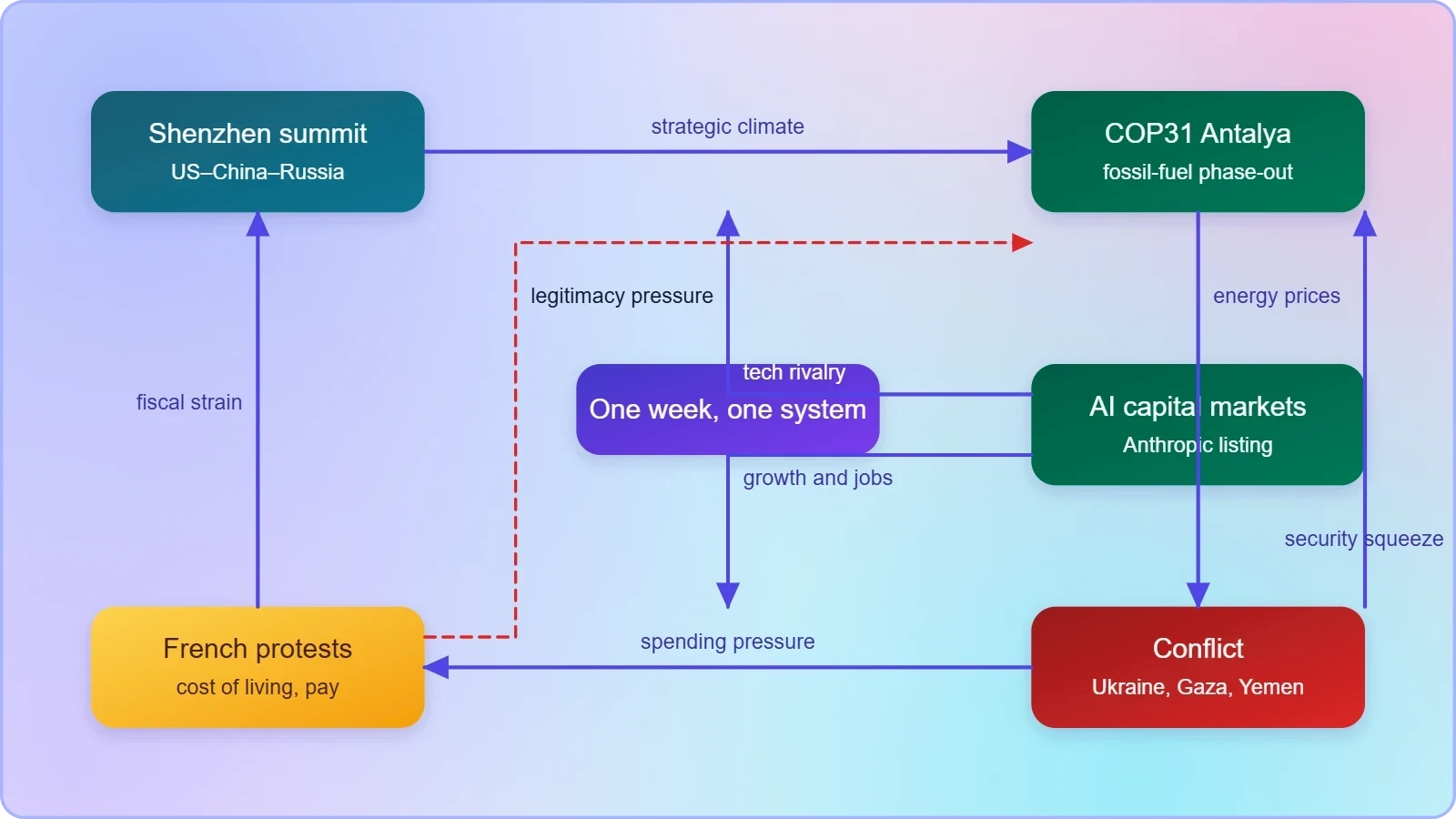
The most useful way to interpret this week's events is to treat them as components of a single system rather than separate stories competing for attention. Great-power diplomacy in Shenzhen shapes the strategic environment in which climate negotiations, European domestic politics, and conflicts in Ukraine and Gaza unfold. Climate outcomes in Antalya influence energy prices and fiscal capacity, which in turn feed the cost-of-living grievances driving French protests. Legal accountability for the Rohingya establishes precedents that resonate across other conflicts, while technology capital markets in New York determine the resources available for AI development that will shape future economic and military competition.
Interdependence and Fragility
Interdependence of this kind cuts both ways. It means that progress in one domain can create momentum elsewhere: a credible great-power understanding might unlock climate cooperation, and sustained economic growth might ease the fiscal pressures behind social unrest. But it also means that failure propagates. A breakdown in trilateral diplomacy could harden positions in Ukraine; a weak COP outcome could accelerate climate damages that strain public budgets; and prolonged protests could weaken European governments' capacity to act internationally. The week's photographic record captures this fragility in images that are individually striking but collectively diagnostic.
For analysts, the discipline required is to resist treating any single event as decisive. The Shenzhen summit may prove historic or may fade into a footnote; the ICJ verdict may catalyse enforcement or remain symbolic; the French protests may force concessions or dissipate. What matters is the pattern: a multipolar order in which multiple crises unfold simultaneously, each demanding attention and resources, and in which the capacity for coherent response is constrained by domestic politics and fiscal limits. Understanding that pattern is the first step toward navigating it.
What to Watch Next
The coming weeks will offer clearer readouts on several fronts. Follow-up diplomacy after Shenzhen will indicate whether a durable trilateral framework is emerging. COP31's final texts and national implementation plans will reveal whether Antalya produced substance or rhetoric. French labour negotiations and government responses will show whether the protest wave consolidates or fragments. On accountability, the practical consequences of the ICJ verdict for Myanmar and for the Rohingya will become clearer as legal and diplomatic processes unfold. Each of these threads will intersect with the others, and the resulting pattern will define the international agenda well into the following year.
For readers seeking to make sense of a crowded news cycle, the lesson is methodological as much as substantive. Isolated headlines reward reaction; systemic analysis rewards understanding. The week's events, taken together, describe a world in which diplomacy, climate, social cohesion, conflict, and technology are tightly coupled, and in which the quality of governance — national and international — determines whether those couplings produce resilience or cascading failure. That is the comprehensive meaning the week's dispatches convey, and it is the frame through which subsequent developments should be read.
From our network :
- How AI Agents Will Change the Way We Manage Personal FinancesExplore how AI agents are transforming personal finance through automated budgeting, bill payment, and investment management, while examining the critical security protocols and governance frameworks required for safe deployment.
- CISA’s Ten-Advisory Wave: Why Generic Patching Fails in OT and How to Build Product-Specific PlaybooksCISA released ten ICS advisories in one week, exposing critical infrastructure risks. Generic patching fails in OT. Learn to build product-specific remediation playbooks.
- University Language Proficiency Exams: Why Institutional Tests Demand Different Preparation Than IELTS and TOEFLDiscover why university-specific language proficiency examinations differ fundamentally from IELTS and TOEFL, and learn strategic preparation approaches for institutional assessment success.
- The Final Descent: How ESA Retired the Legendary Cluster Constellation After 24 Years of Space Weather ScienceAfter 24 years mapping Earth’s magnetosphere, ESA’s Cluster mission concluded with a precisely controlled reentry over the South Pacific. This analysis explores the scientific legacy, engineering decisions, and debris mitigation principles behind one of space exploration’s most responsible retirements.
- Mobile Learning and VR in English: What Global Evidence Reveals About Effective Language TechnologyA systematic review across 14 countries reveals which language-learning technologies genuinely work. Mobile learning, AI, and VR show measurable benefits when pedagogically integrated. This evidence-based guide helps educators and learners select technology that delivers real return on investment.
- Live Online English Classes for Kids: Do They Actually Reduce Anxiety?A ten-week study reveals that synchronous online English classes can significantly reduce child language anxiety while improving listening and reading skills. Discover what makes these programs effective and how parents can select the right one.
- The Hidden Cost of AI Convenience: Why Over-Permissioned Agents Are a Security Time BombDiscover why AI agents with excessive permissions create dangerous single points of failure, and learn how implementing least privilege principles can protect your organization from exploitation.
- Committed Mediterranean Precipitation Decline: Why Emissions Cuts Alone Cannot Restore Winter RainsNew NOAA research reveals that Mediterranean winter rains may decline irreversibly even with emissions cuts. Explore the science of committed climate change and regional impacts.
- Forbidden Matrix Patterns and Visible Lattice Points: A Geometric DictionaryExplore how multidimensional 0–1 matrices encode geometric truths, linking forbidden patterns to visible lattice points and hypergraph theory, with applications in combinatorics and computational geometry.
RESOURCES
- France 24 - International breaking news, top stories and headlinesfrance24.comAPEC Summit: Trump ... Was the historic Shenzhen summit a political win or humiliation for Putin?
- United States - World news, culture and opinion - LeMonde.frlemonde.frIn Shenzhen, Xi and 'friend' Putin lull Trump to sleep amid pomp. The ... Xi-Trump-Putin summit: 'The words of the absent will weigh as…
- Global News Podcastpodcasts.apple.com... Trump, Vladimir Putin and Xi Jinping. Islam is expected to surpass ... summit in Shenzhen ahead of his meeting with Xi Jinping and…
- Donald Trump - World news, culture and opinion - LeMonde.frlemonde.frFrench protests · United States · Donald Trump · War in Ukraine · Middle East ... In Shenzhen, Xi and 'friend' Putin lull Trump…
- European press roundup | eurotopics.neteurotopics.net2 days ago ... Putin, Xi and Trump meet: the upshot? The leaders of China, Russia and the US convened at an historic meeting…
- Ukraine: Berlin to host Zelenskyy, allies for talks - DW Newsdw.comDec 12, 2025 ... Zelenskyy will be in Berlin on Monday alongside French President Macron, British Prime Minister Starmer and other European leaders ·…
- Trump signs Thai trade deal as protests greet his arrival in Manilatheguardian.com6 days ago ... It's a couple of days away, but Donald Trump, Xi Jinping and Vladimir Putin will hold their first trilateral summit…
- Our weekly editorials - Cartooning for Peacecartooningforpeace.orgHere you can find the Cartooning for Peace cartoonists' weekly views on the news. Trump, Putin and Xi Jinping: the summit of false friends…
- Headlines - DW Newsdw.comA very long German compound word, with the first part magnified by a magnifying glass · The Frankenstein Monsters of the German language. Culture…
- Global News Podcast | Listen to the Podcast on Spotifyopen.spotify.com... summit in Shenzhen ahead of his meeting with Xi Jinping and Vladimir Putin. ... Trump, Putin and Xi are also expected to talk…
- Council on Foreign Relationscfr.orgRussian President Vladimir Putin, Chinese President Xi Jinping and U.S. President Donald Trump arrive for ... Trump Heads to the ASEAN and APEC Summits…
- Project Syndicate: PS - The World's Opinion Pageproject-syndicate.orgargues that the best to be hoped for from the summit of Trump, Xi, and Putin is nothing. ... Gabriela Ramos The Algorithm Driving…
- Five takeaways from Trump's summit with Xi in Washington | Reutersreuters.comSep 24, 2026 ... The US secured an extension of its trade truce this week - but only a short one.
- This Week in Explainers: Was the Trump-Xi-Putin trilateral worth the ...firstpost.com12 hours ago ... ... weekly roundup of the news. ... Summit in Shenzhen, in China's southern Guangdong Province. AFP. 2 ...
- The Diplomat – Asia-Pacific Current Affairs Magazinethediplomat.comCOP31: Why India's ... Putin-Trump-Xi trilateral in Shenzhen. Chips, Cheats, and China: The Nvidia Espionage Scandal · Will There Be a Putin-Trump-Xi Summit?
- 01
- 02
- 03
- 04
- 05
- 06
- 07
- 08
0 Comments