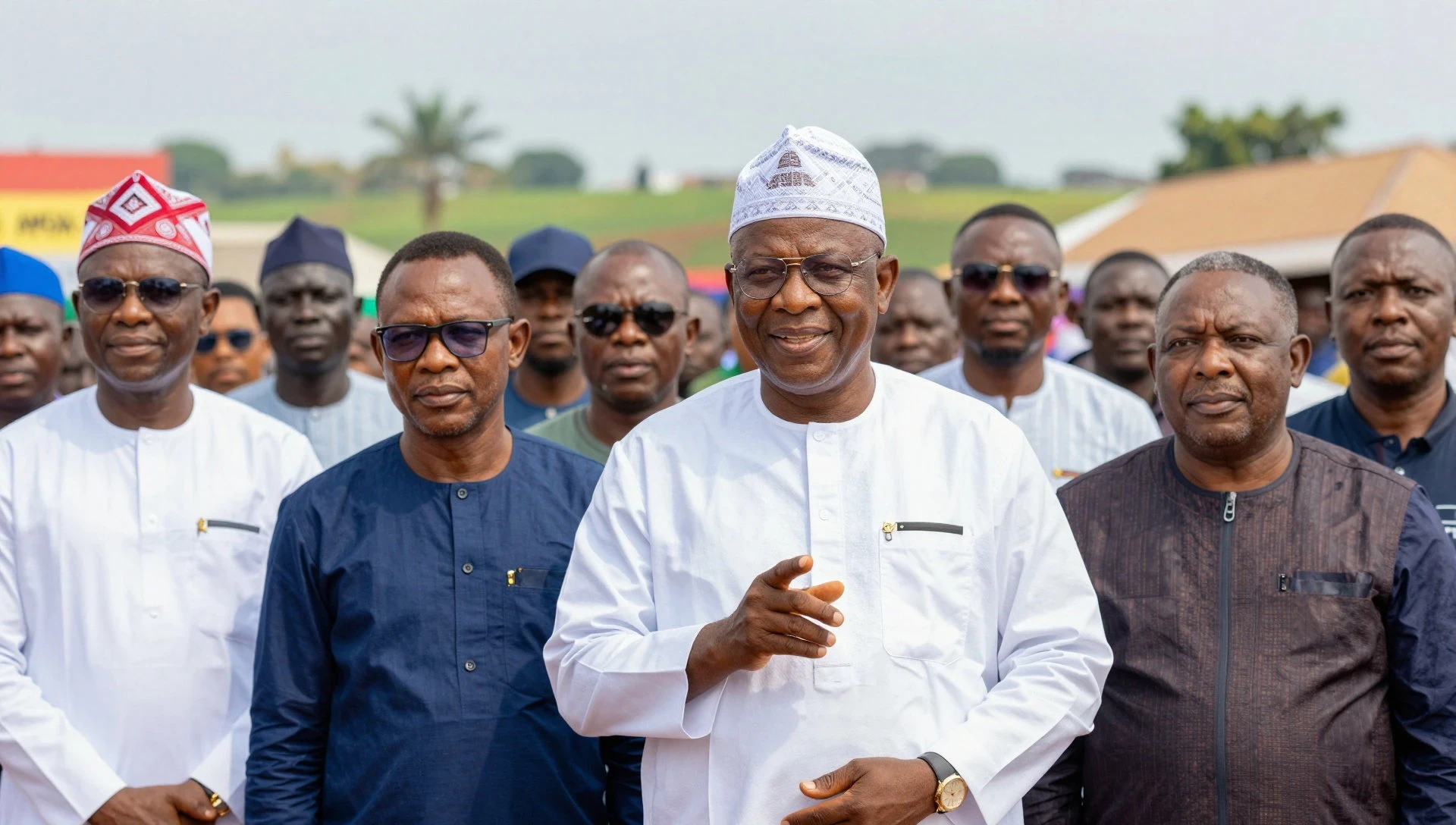
Governor Chukwuma Soludo's inauguration on October 14 as a coordinator of the All Progressives Congress Presidential Campaign Council in Anambra State has introduced a measurable fault line into the state's 2027 electoral arithmetic.
The appointment places the leader of the All Progressives Grand Alliance inside the campaign structure of a rival national party, a configuration that APGA's own National Assembly candidates now regard as an existential risk to their individual races.
Their anxiety is not abstract: it concerns the transfer of voter anger from the governorship to the ballot box, where legislative candidates have no independent machinery to absorb the backlash.
On This Page
The mechanics of that risk are specific. Nigeria's Independent National Electoral Commission has scheduled presidential and National Assembly elections for January 16, 2027, and voters will receive three separate ballot papers covering the presidential, senatorial and House of Representatives contests.
Because all three are cast on the same day, a voter's grievance against the governor can be expressed on the legislative ballots without any cost to the presidential choice. That simultaneity converts a party-level dispute into a direct threat to down-ballot APGA candidates who cannot distance themselves from the governor's decision.
Comparable friction is reported in Osun State, where President Bola Tinubu's selection of Governor Ademola Adeleke, an Accord party member, to head the APC campaign has unsettled APC National Assembly hopefuls and Accord legislative candidates alike.
The pattern is consistent across both states: presidential campaign architecture built on cross-party convenience creates confusion at the legislative tier, where party identity still determines outcomes. This analysis examines the structural incentives, the internal party dynamics and the electoral mathematics that make the Soludo arrangement consequential.
TL;DR Governor Chukwuma Soludo's appointment as an APC presidential campaign coordinator has alarmed APGA National Assembly candidates in Anambra, who fear voters will punish them for the governor's alignment with the ruling party. With presidential and legislative elections held simultaneously on January 16, 2027, and three ballot papers issued per voter, protest voting against APGA legislative candidates becomes technically frictionless. Similar confusion is reported in Osun, where Accord party governor Ademola Adeleke leads the APC campaign. The core issue is a structural mismatch between presidential coalition-building and the party discipline that legislative races still require.
The Structural Logic of Cross-Party Campaign Coordination
Presidential campaigns in Nigeria have long operated as coalitions of convenience, aggregating state-level power brokers whose party labels differ from the presidential candidate's own. The logic is arithmetic rather than ideological: a governor controls patronage, local government structures and, critically, the turnout machinery in his state.
Recruiting him into the presidential campaign council converts his network into a delivery mechanism. The arrangement with Soludo and Adeleke follows this template precisely, and both were inaugurated on the same date, October 14, suggesting a coordinated federal strategy rather than an isolated bargain.
The difficulty arises because the same governor remains the leader of a different party's state chapter. In Anambra, Soludo heads APGA, the party whose legislative candidates must compete on the same ballot.
A governor campaigning for one party's presidential candidate while his own party fields legislative candidates creates an informational problem for voters, who must now separate the man from the machine.
The source reporting indicates that APGA candidates were not informed in advance of the arrangement, which compounds the confusion with a procedural grievance inside the party itself.
The Asymmetry Between Presidential and Legislative Incentives
Presidential contests reward broad coalitions and tolerate ideological inconsistency, because the prize is a single national office and the coalition need only hold until the vote is counted. Legislative contests operate on the opposite principle: they reward narrow, identifiable party loyalty, because voters select a local representative and often use party label as the primary heuristic.
A governor optimizing for presidential influence therefore has weak incentives to protect his party's legislative slate, and strong incentives to demonstrate usefulness to the federal government.
This asymmetry explains why the APGA candidates' complaint is analytically sound rather than merely emotional. Their electoral prospects depend on voters associating them with APGA, while the governor's new role asks those same voters to associate APGA's leader with the APC. The two messages are not complementary; they are competing.
Where a governor's alignment is visible and his party's legislative candidates are not, the presidential message tends to dominate simply because it receives more broadcast time and elite attention.
The Ballot Design Problem and Protest Voting
Nigeria's three-ballot system on a single election day is the mechanism that converts elite-level grievance into down-ballot damage. A voter who wishes to register displeasure with the governor has no need to abstain or spoil a ballot; she can vote for the presidential candidate of her choice and then select an alternative party's candidate for the Senate and House of Representatives. The protest is costless, legible and precisely targeted at the candidates the governor's decision has exposed.
The APGA candidate quoted in the reporting identified the Nigeria Democratic Congress as the likely beneficiary of such sympathy or protest votes. Whether or not NDC possesses the local structures to convert grievance into votes, the perception alone is damaging, because it depresses volunteer enthusiasm and donor confidence.
Campaign activities have reportedly slowed, and candidates describe themselves as confused, which is the observable symptom of a coordination failure rather than a mere difference of opinion.
Precedent and Comparative Reading
Cross-party campaign coordination is not unique to Nigeria, but the specific hazard here is the absence of a formal separation between the governor's presidential role and his party leadership.
In systems where coalition partners negotiate seat-sharing agreements in advance, legislative candidates receive compensatory protection, such as agreed zones of contest or reciprocal withdrawals. No such arrangement appears to have been disclosed in Anambra, which is why the candidates' objection centers on the lack of prior consultation as much as on the substance of the appointment.
The Osun case reinforces the diagnosis. There, the APC's National Assembly candidates reportedly view Tinubu's choice of Adeleke, an Accord party governor, as a setback, while Accord's own legislative candidates worry that voters will not distinguish between the presidential and legislative ballots.
Two states, two different party configurations, one identical structural problem: presidential coalition-building that outruns the party discipline legislative elections still require.
Internal Party Dynamics and the Cost of Unconsulted Decisions
The most revealing element of the Anambra dispute is procedural rather than ideological. A House of Representatives candidate stated that the governor, as party leader, had not informed candidates in advance about the arrangement.
In a party system where the governor functions as the principal patron of state-level politics, prior consultation is not a courtesy; it is the mechanism through which candidates calibrate their own campaigns.
Its absence signals that the decision was made in a different arena, with different principals, and that legislative candidates were treated as residual rather than stakeholders.
A state House of Assembly candidate described the party's internal crisis as deepening, noting that many APGA leaders had protested privately while declining to speak publicly. That silence is itself informative. Public criticism of a sitting governor carries real costs in patronage and access, so dissent migrates into anonymity and leaks.
The result is a party that appears unified externally while its candidates quietly reduce their exposure to the governor's brand, a divergence that weakens the collective campaign even when no one defects.
Patronage, Discipline and the Governor's Dual Role
Nigeria's political parties are best understood as networks of patrons rather than programmatic organizations, and the governor sits at the apex of the state-level network. When he accepts a role in a rival party's presidential campaign, he does not cease to be APGA's leader, but he does change the currency of his leadership.
His usefulness to APGA candidates now depends on his ability to deliver federal benefits, while his usefulness to the APC depends on his ability to deliver Anambra's votes. Those two obligations can be satisfied simultaneously only if voters are willing to split their ballots in a disciplined way.
Disciplined ticket-splitting is precisely what the candidates fear will not occur. Voters angered by the governor's alignment have a simpler expressive option: vote against his party's legislative candidates while voting their conscience at the presidential level.
The governor's dual role therefore transfers risk downward to candidates with the least capacity to manage it, and the party's internal discipline, already strained, becomes the shock absorber.
Why Private Protest Is Weaker Than It Appears
Private protest by party leaders is a weak instrument because it imposes no cost on the decision-maker while allowing him to claim consensus. The candidates' decision to speak anonymously to a newspaper is a rational escalation: it publicizes the grievance without attaching a name to it.
But publicity without attribution rarely changes an appointment already inaugurated, and the governor's response, convening a joint APGA and APC stakeholder meeting for Sunday, suggests an attempt to convert dissent into a managed planning exercise rather than to reverse the arrangement.
The joint stakeholder meeting is itself a significant signal. Bringing APGA and APC figures into a single planning forum for the 2027 general elections formalizes the coordination that candidates had objected to, rather than addressing their concern.
From the governor's perspective, the meeting demonstrates control and delivers the organizational integration the presidential campaign requires. From the candidates' perspective, it confirms that their party's machinery is being repurposed for a campaign in which their own races are secondary.
The NDC as an Instrument of Grievance
The Nigeria Democratic Congress enters the analysis not because it possesses superior organization but because it offers a convenient receptacle for protest. Voters seeking to punish the governor need a credible alternative on the legislative ballot, and the NDC's presence provides one.
Whether the party can convert sympathy into durable support is a separate question; the immediate effect is to fragment the anti-APC vote in a way that may not benefit the NDC at all but certainly disadvantages APGA incumbents and challengers alike.
This dynamic is familiar in multi-party systems where a dominant state party fractures. The protest vote rarely consolidates behind a single alternative; it disperses, lowering the threshold required for any competitor to win.
For APGA candidates defending seats, dispersion is dangerous because it erodes pluralities without producing a clear challenger to negotiate with. The governor's alignment thus creates a competitive environment in which his own party's candidates face multiple, uncoordinated threats.
We Also Published
Electoral Consequences and the Path to January 2027
The practical question is whether the governor's alignment will actually move votes, and the honest answer is that the effect is conditional on turnout and on the visibility of the arrangement.
In low-turnout legislative contests, small shifts in sentiment can decide outcomes, and the candidates' own assessment that campaign activity has slowed suggests their ground game is already impaired. A campaign that loses volunteer energy in the months before an election rarely recovers it, regardless of the eventual national swing.
The Sunday joint stakeholder meeting between APGA and the APC will be read as a test of whether the governor can reconcile the two roles or merely formalize the subordination of one to the other.
If the meeting produces concrete protections for APGA legislative candidates, such as agreed non-interference or shared campaign resources, the internal crisis may ease. If it produces only a planning framework for the presidential contest, the candidates' fears will harden into open defection or quiet withdrawal of effort.
Reading the Risk in Probabilistic Terms
The candidates' situation can be framed as a conditional probability problem. Let ##P(G)## denote the probability that a voter holds a grievance against the governor's alignment, and ##P(L \mid G)## the probability that such a voter expresses it on the legislative ballot rather than the presidential one.
The expected loss to an APGA legislative candidate scales with the product ##P(G) \times P(L \mid G)##, and the three-ballot design pushes ##P(L \mid G)## close to one, because expression is free.
Here ##N## is the electorate size and ##s## the swing required to change the outcome. The equation is deliberately simple, but it clarifies why the candidates' anxiety is rational: the design of the ballot removes the friction that normally suppresses protest voting, leaving only the magnitude of grievance as a constraint.
Any event that raises ##P(G)##, such as a visible joint campaign appearance, increases expected loss without requiring any change in the underlying electorate.
What Would Mitigate the Risk
Three mitigations are available, and each has costs. The first is explicit separation: the governor campaigns for the presidential ticket while publicly endorsing and resourcing his own party's legislative candidates, drawing a clear line between the two roles.
The second is compensation: negotiated arrangements that give APGA candidates protected space, whether through reciprocal non-contestation or shared logistics. The third is time: allowing the controversy to fade before January 2027, which requires that no further joint appearances renew voter attention.
The governor's decision to convene a joint stakeholder meeting suggests he is pursuing the first and second simultaneously, using the forum to demonstrate that APGA's interests are being protected within the broader arrangement. Whether that demonstration is credible depends on what the meeting produces in writing.
Verbal assurances will not reassure candidates who learned of the original appointment from the newspaper rather than from their party leader, and the credibility deficit is now the binding constraint.
The Wider Signal for 2027
Beyond Anambra and Osun, the episode illustrates a general vulnerability in Nigeria's 2027 electoral architecture. Presidential campaigns that recruit governors from other parties gain turnout machinery but import the governors' local liabilities into races they do not control.
Where the governor's party fields competitive legislative candidates, as in Anambra, the imported liability is direct. Where the governor's party is weaker, as in Osun, the liability manifests as ballot confusion rather than targeted defection, but it still degrades the clarity that legislative contests depend on.
The candidates' anonymous complaints are therefore more than internal grumbling. They identify a coordination problem that will recur wherever a governor's presidential role diverges from his party's legislative interests, and they predict its symptom: depressed campaign activity, dispersed protest votes and a governing party that wins the presidency while losing the legislature. For APGA in Anambra, the next few months will determine whether that prediction holds.
From our network :
- Forbidden Matrix Patterns and Visible Lattice Points: A Geometric DictionaryExplore how multidimensional 0–1 matrices encode geometric truths, linking forbidden patterns to visible lattice points and hypergraph theory, with applications in combinatorics and computational geometry.
- Mobile Learning and VR in English: What Global Evidence Reveals About Effective Language TechnologyA systematic review across 14 countries reveals which language-learning technologies genuinely work. Mobile learning, AI, and VR show measurable benefits when pedagogically integrated. This evidence-based guide helps educators and learners select technology that delivers real return on investment.
- How AI Agents Will Change the Way We Manage Personal FinancesExplore how AI agents are transforming personal finance through automated budgeting, bill payment, and investment management, while examining the critical security protocols and governance frameworks required for safe deployment.
- University Language Proficiency Exams: Why Institutional Tests Demand Different Preparation Than IELTS and TOEFLDiscover why university-specific language proficiency examinations differ fundamentally from IELTS and TOEFL, and learn strategic preparation approaches for institutional assessment success.
- Live Online English Classes for Kids: Do They Actually Reduce Anxiety?A ten-week study reveals that synchronous online English classes can significantly reduce child language anxiety while improving listening and reading skills. Discover what makes these programs effective and how parents can select the right one.
- The Hidden Cost of AI Convenience: Why Over-Permissioned Agents Are a Security Time BombDiscover why AI agents with excessive permissions create dangerous single points of failure, and learn how implementing least privilege principles can protect your organization from exploitation.
- Committed Mediterranean Precipitation Decline: Why Emissions Cuts Alone Cannot Restore Winter RainsNew NOAA research reveals that Mediterranean winter rains may decline irreversibly even with emissions cuts. Explore the science of committed climate change and regional impacts.
- The Final Descent: How ESA Retired the Legendary Cluster Constellation After 24 Years of Space Weather ScienceAfter 24 years mapping Earth’s magnetosphere, ESA’s Cluster mission concluded with a precisely controlled reentry over the South Pacific. This analysis explores the scientific legacy, engineering decisions, and debris mitigation principles behind one of space exploration’s most responsible retirements.
- CISA’s Ten-Advisory Wave: Why Generic Patching Fails in OT and How to Build Product-Specific PlaybooksCISA released ten ICS advisories in one week, exposing critical infrastructure risks. Generic patching fails in OT. Learn to build product-specific remediation playbooks.
RESOURCES
- Why APGA adopted Tinubu for 2027 presidential election - Facebookfacebook.comOct 13, 2026 ... Anambra State Governor, Professor Chukwuma Soludo, explains the political strategy behind the All Progressives Grand Alliance (APGA) party's ...
- As residents of Anambra prepare to elect their governor, the people ...instagram.comNov 4, 2025 ... 2027: Soludo convenes APGA, APC stakeholders' meeting in Anambra ... 2027 elections, as Soludo, who coordinates the Presidential Campaign ...
- Anambra: APC, APGA, PDP, Accord endorse Tinubu's re-election bidfacebook.com13 hours ago ... We Support Only President Tinubu's Re-Election in 2027, Not Other APC Candidates in Anambra - Governor Soludo A top leader…
- title Professor Chukwuma Soludo, the governor of Anambra State ...instagram.comApr 5, 2025 ... ... (APC) campaign coordinator in Anambra State ahead of the 2027 general elections. ... 2027: Soludo convenes APGA, APC stakeholders'…
- Di candidates wey dey run for Anambra govnorship election 2025bbc.comNov 6, 2025 ... Charles Soludo (APGA) · Dr Nicholas Ukachukwu (APC) · Dr George Moghalu (Labour Party) · Jude Ezenwafor (PDP) · Names…
- 2027: APC, APGA disagree over Anambra 'alliance'punchng.comSep 22, 2026 ... ... candidates in the 2027 elections, including President Bola Tinubu. ... 2027: Soludo inaugurates Tinubu campaign council in Anambra ·…
- The Guardian Nigeria on Xx.com5 days ago ... Anambra Governor Chukwuma Soludo's role as President Bola Tinubu's re-election campaign ... APGA governor dey coordinate APC president campaign ...
- 2027: Soludo summons APGA, APC stakeholders in Anambrapunchng.comOct 24, 2026 ... ... 2027 general election candidates of APGA and APC. The list further includes current and former political appointees, members of…
- 2027: APGA Backs President Tinubu's Re-Election Bidvon.gov.ngOct 22, 2026 ... He urged the Anambra APC leadership, headed by Senator Emmanuel Anosike, to engage Governor Soludo over complaints that the party…
- 01
- 02
- 03
- 04
- 05
- 06
- 07
- 08
0 Comments