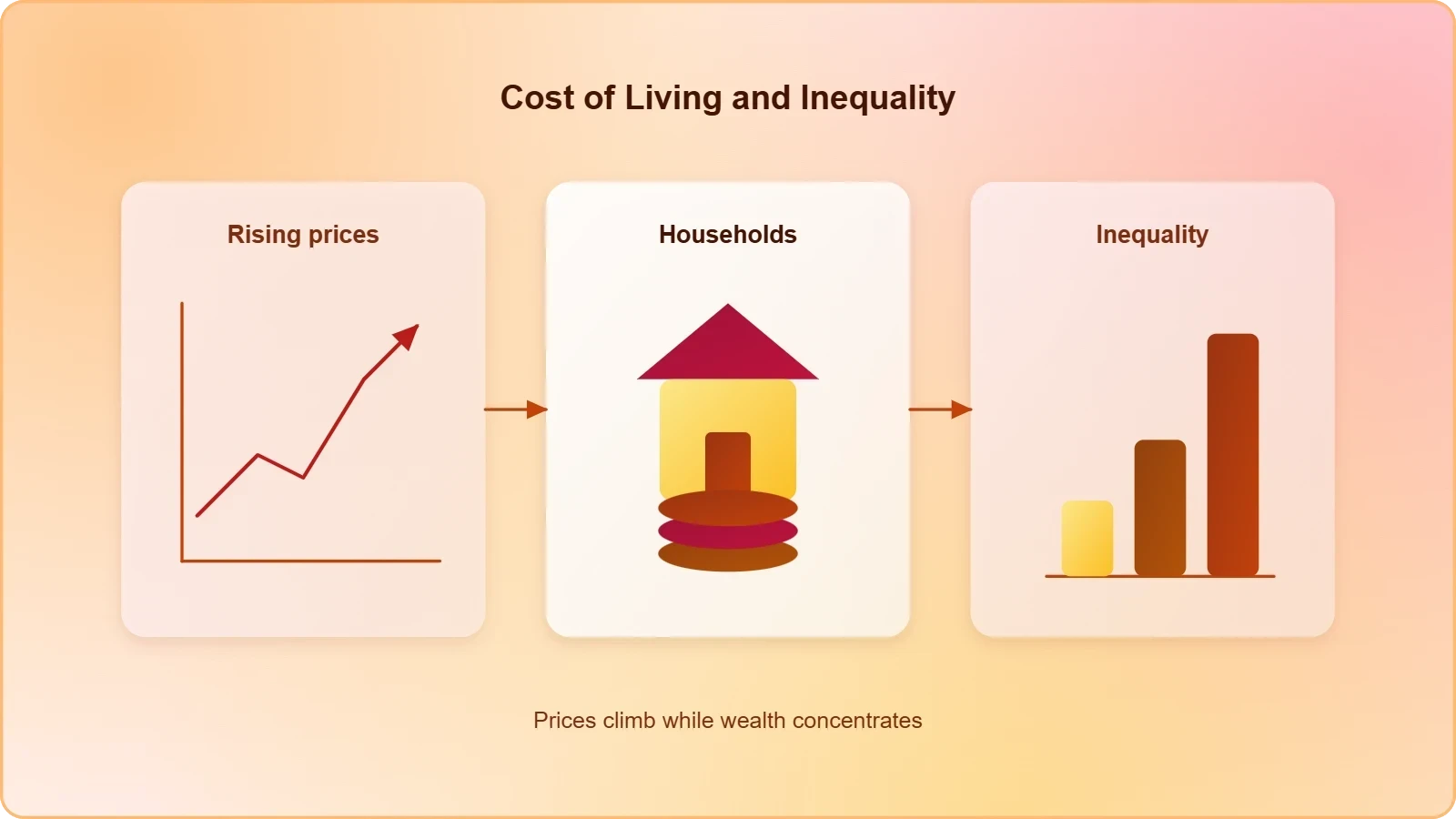
Across the European Union, a season of discontent has settled into the streets, with France, Albania, Belgium, Italy and Portugal all witnessing demonstrations that began as discrete grievances yet increasingly converge on a single, combustible theme: the rising cost of living.
What started in France as student complaints about deteriorating school facilities has metastasized into a broader revolt against stagnant wages, expensive food and fuel, and a pervasive sense that ordinary households are being squeezed while the wealthy pull further ahead.
The unrest is not a single movement but a constellation of local flashpoints, each with its own trigger, yet bound together by shared economic anxiety.
On This Page
The timing carries unmistakable political charge. France and Italy both face national elections in 2027, and opportunistic actors on all sides are eager to channel street energy into electoral advantage. Yet the deeper drivers are economic rather than purely partisan, and analysts caution against reducing the protests to campaign theatre.
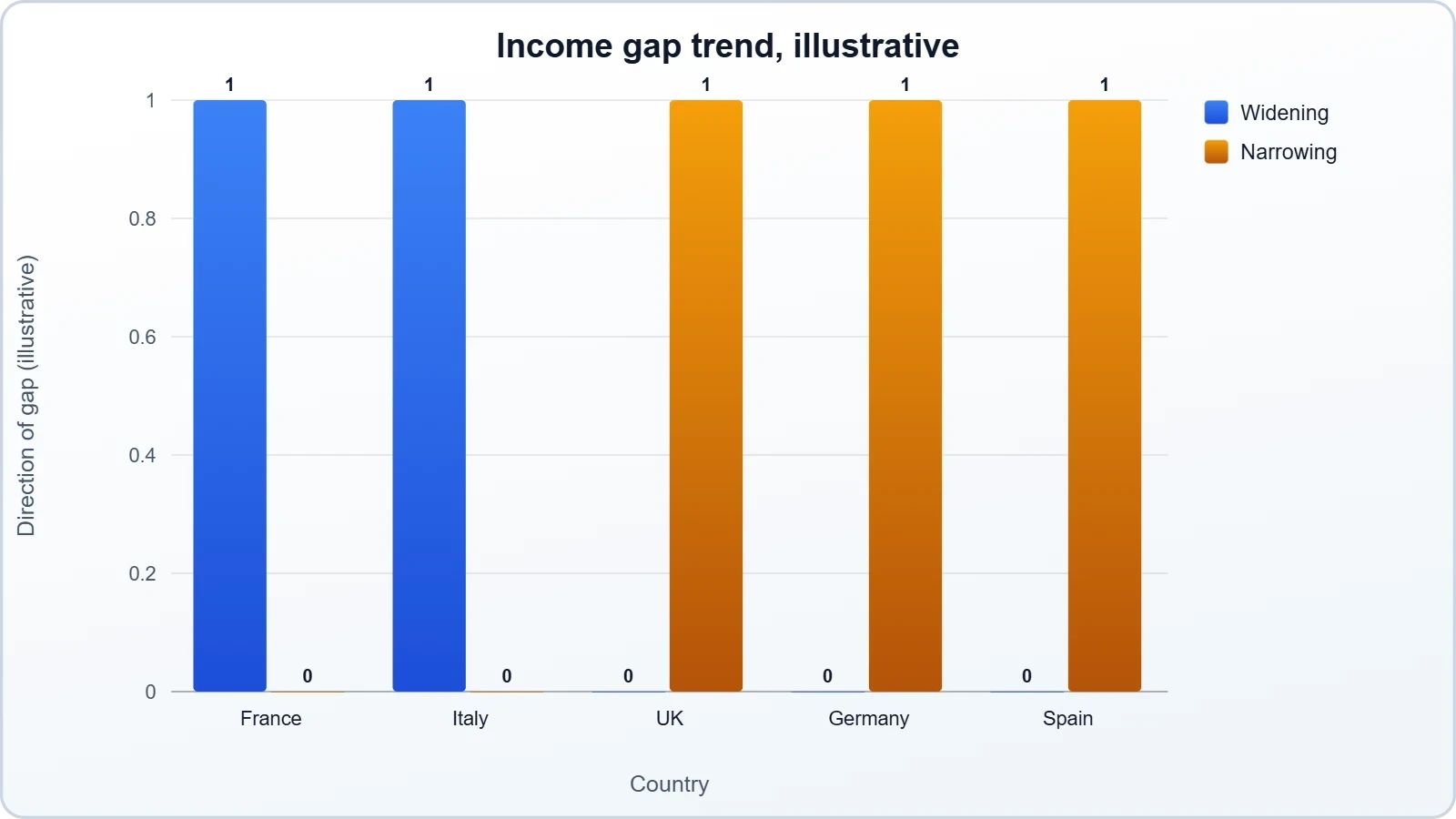
The World Inequality Report 2026, drawing on data through 2024, reveals that the income gap between the richest 10% and the poorest 50% has widened in France and Italy over the past decade, even as it narrowed in the United Kingdom, Germany and Spain.
Understanding this wave of unrest demands more than a simple inequality narrative. Economists at the International Monetary Fund have found that past unrest, whether domestic or in neighbouring countries, is the strongest predictor of future unrest, likening the dynamic to a bank run in which people act because they see others acting.
Digital access and social media accelerate that contagion, while food and fuel prices supply the spark. This analysis dissects the economics, the contagion mechanics and the uncertain consequences of Europe's protest moment.
TL;DR Street protests across France, Albania, Belgium, Italy and Portugal reflect a shared cost-of-living squeeze rather than a single political cause. The World Inequality Report 2026 shows income gaps widening in France and Italy but narrowing in the UK, Germany and Spain, proving inequality alone cannot explain unrest. IMF research identifies past unrest, domestic and regional, as the strongest predictor of future protests, a bank-run-style contagion amplified by social media. Food and fuel prices matter, but they are not necessarily the primary driver. With French and Italian elections due in 2027, the political stakes are rising even as the economic consequences remain genuinely uncertain.
The Anatomy of Europe's Cost-of-Living Unrest
The protests sweeping Europe resist easy categorisation because they emerge from multiple entry points. In France, student frustration over school facilities served as the initial fuse, but the flame quickly jumped to household budgets, grocery bills and fuel costs.
Similar economic grievances appear to be driving unrest in Albania, Belgium, Italy and Portugal, suggesting a continental pattern rather than isolated national episodes. Each country contributes its own texture, yet the underlying melody is recognisably the same.
From School Facilities to Household Budgets
The French case illustrates how narrow grievances can broaden into systemic complaint. Students protesting inadequate school conditions found common cause with families struggling against inflation, and the movement's demands expanded accordingly.
This escalation pattern is familiar to sociologists: a specific, tangible grievance provides the initial organisational energy, while a diffuse economic anxiety supplies the staying power. The result is a protest coalition that is broader, angrier and harder for governments to negotiate with.
Elsewhere the entry points differ but the destination converges. Albanian demonstrators cite wages and prices, Belgian and Portuguese protesters target energy costs, and Italian unrest blends labour concerns with cost-of-living anger. The common thread is a perception that recovery from recent economic shocks has been unevenly distributed.
Households feel the pinch of essentials while headline economic indicators suggest improvement, and that gap between lived experience and official statistics fuels resentment.
The Political Calendar and Electoral Opportunism
France and Italy both face national elections in 2027, and the timing of some protests is unmistakably political. Opposition movements and populist entrepreneurs have every incentive to amplify street discontent, framing it as evidence of governing failure.
This does not mean the grievances are manufactured, but it does mean the protests are being contested and instrumentalised. Street energy becomes electoral currency, and the line between authentic anger and strategic mobilisation blurs.
Governments face a delicate calculus. Heavy-handed policing risks inflaming sentiment and handing ammunition to rivals, while concession risks rewarding disruption and emboldening further action. The political calendar compresses the space for patient policy responses, pushing leaders toward short-term gestures rather than structural fixes.
In this environment, the protests become a recurring feature of the political landscape rather than a passing storm.
Inequality Data: A Complicated Picture
The intuitive explanation for unrest is inequality, and the World Inequality Report 2026 offers a nuanced verdict. Covering figures up to 2024, it shows the income gap between the richest 10% and the poorest 50% has widened in France and Italy over the past decade.
Yet the same report finds the gap narrowing in the United Kingdom, Germany and Spain, which complicates any simple continental narrative. Inequality is real, but its trajectory is uneven.
Widening Gaps in France and Italy
France and Italy present the clearest case of divergence between rich and poor. The widening gap in both countries coincides with the protest wave, lending superficial support to the inequality thesis.
However, France's income gap remains among the lowest compared with similar countries, which undercuts the claim that inequality levels alone explain the unrest. A relatively equal society can still produce angry streets when expectations outrun reality.
This paradox is central to understanding the protests. Relative inequality matters less than perceived fairness and the pace of change. Households comparing their situation to a recent past, or to visible wealth around them, may feel aggrieved even when aggregate measures look benign.
The data therefore illuminates the terrain without fully explaining the eruption, and economists rightly caution against monocausal stories.
Narrowing Gaps Elsewhere in Europe
The United Kingdom, Germany and Spain have seen their income gaps narrow, yet they are not immune to cost-of-living discontent. This divergence suggests that inequality trends and protest activity do not move in lockstep.
Other factors, including the level of prices, the strength of social safety nets and the credibility of political institutions, mediate how economic pressure translates into street action. The comparison across countries is instructive precisely because it refuses a tidy correlation.
Analysts should therefore treat inequality as one input among many. It shapes the background mood and supplies moral language for grievances, but it does not determine when or where protests ignite. The narrowing gaps elsewhere demonstrate that redistribution can occur without eliminating discontent, and that rising inequality can coexist with relative moderation. The lesson is humility about single-variable explanations.
The Contagion Mechanics of Social Unrest
If inequality were the whole story, the map of unrest would look different. Researchers at the International Monetary Fund have identified a more powerful predictor: past unrest, both within a country and in neighbouring countries, is the strongest signal of future unrest.
This finding reframes protests as a contagious phenomenon, spreading through observation and imitation rather than emerging independently in each location. The mechanism resembles a bank run, where depositors act because they see others acting.
The Bank-Run Analogy Explained
The bank-run analogy is analytically potent. In a financial panic, the belief that others will withdraw funds becomes self-fulfilling, and rational individuals join the queue to avoid being last.
Protests follow a similar logic: witnessing neighbours take to the streets lowers the perceived cost and raises the perceived legitimacy of doing the same. The threshold for participation falls as visible momentum builds, and what begins as a local spark can cascade across borders.
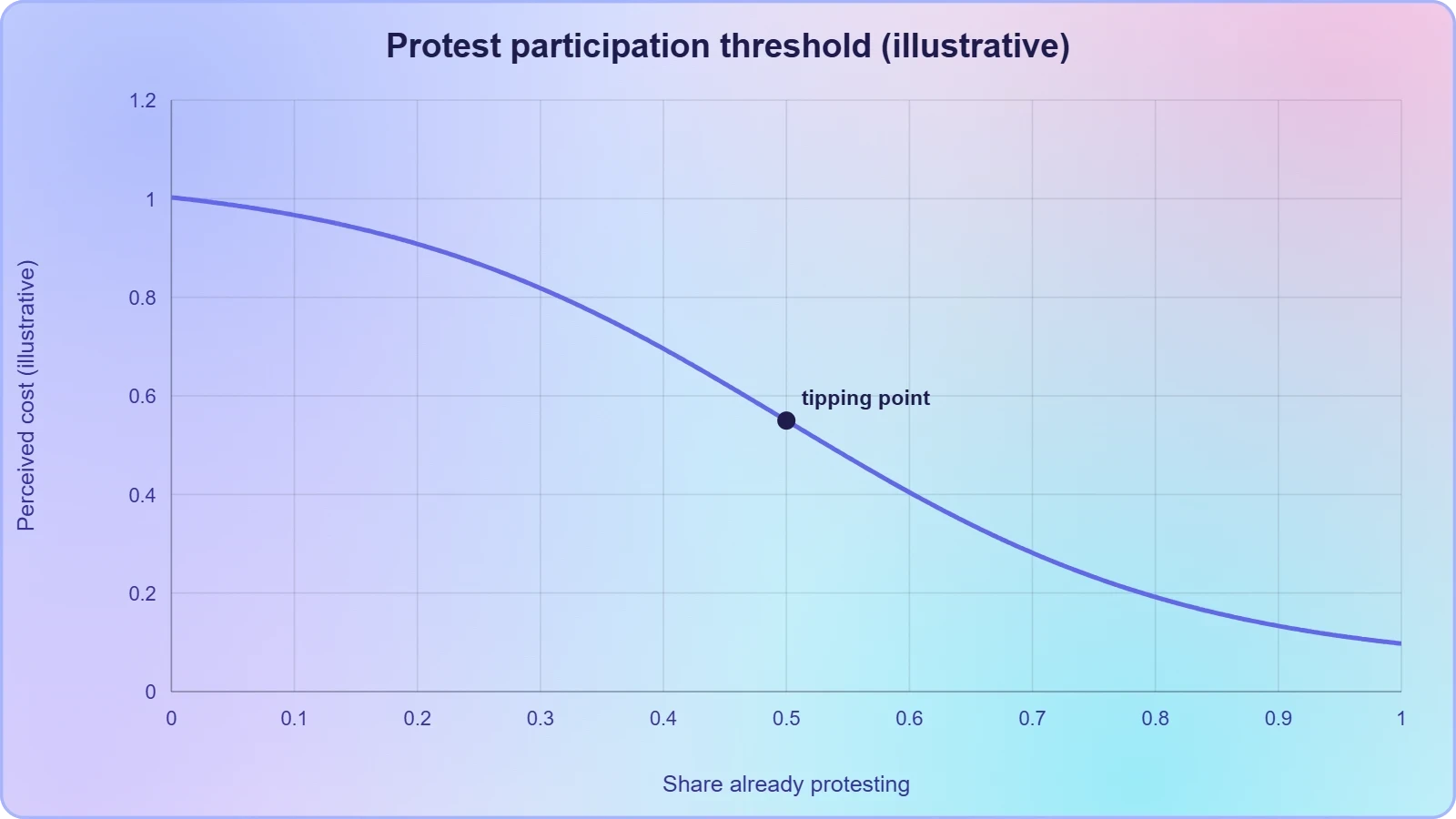
This contagion view explains why geographically and economically diverse countries erupt in near-synchrony. Albania, Belgium, Italy and Portugal do not share identical economic conditions, yet they share information environments and regional proximity. The IMF's emphasis on neighbouring-country unrest underscores how quickly a norm of protest can travel.
Governments must therefore watch not only domestic indicators but also the regional mood, which can shift faster than any spreadsheet captures.
Digital Access and Social Media Coordination
Digital access and social media use appear to help people organise and coordinate, accelerating the contagion. Platforms lower coordination costs, allow rapid dissemination of grievances and enable decentralised mobilisation without formal leadership.
This technological layer does not create the underlying discontent, but it amplifies and accelerates it, compressing the time between a triggering event and mass turnout. The result is a protest environment that is faster, flatter and harder to contain.
Yet digital tools cut both ways. They spread information and misinformation alike, and they can inflate the apparent scale of a movement. Authorities struggle to distinguish organic anger from coordinated campaigns, and the speed of online mobilisation leaves little room for negotiation.
The net effect is a structural shift in how unrest unfolds, one that rewards responsiveness and punishes complacency.
We Also Published
- 01
- 02
- 03
- 04
Prices, Food and Fuel: The Tangible Triggers
Economic factors still matter, and prices, especially for food and fuel, are important even if they are not necessarily the main driver of unrest. Essentials occupy a disproportionate place in household psychology because they are purchased frequently and visibly.
A rise in the cost of bread or petrol is felt weekly, unlike abstract wage statistics, and that frequency makes price shocks potent political symbols. They supply the concrete grievance around which broader discontent can crystallise.
Why Essentials Dominate the Narrative
Food and fuel prices dominate protest narratives because they are unavoidable and highly salient. Households can defer a purchase of clothing or electronics, but they cannot skip groceries or heating.
When these costs climb, the sense of squeeze becomes immediate and personal, and the gap between official inflation figures and lived experience widens. Politicians who cite aggregate data while shoppers face higher bills appear disconnected, and that perception is politically corrosive.
The salience of essentials also explains why protests can erupt even in countries with improving inequality metrics. A narrowing income gap does not console a family paying more for milk and electricity.
The psychology of frequent purchases amplifies the felt impact of inflation, and the visibility of prices makes them a natural rallying point. Essentials are where macroeconomic trends become kitchen-table reality.
Beyond Prices: Expectations and Fairness
Prices alone do not explain the timing or intensity of unrest. Expectations and perceptions of fairness play a mediating role, shaping whether economic pressure translates into collective action. Households compare their situation to a remembered past, to visible wealth and to promises made by leaders.
When those comparisons produce a sense of betrayal, the resulting anger can exceed what price data alone would predict. The emotional economy matters as much as the monetary one.
This is why economists caution against reducing protests to a single variable. The interplay of prices, inequality, contagion and political opportunity creates a complex system in which small changes can produce large effects. Understanding that system requires humility and a willingness to hold multiple explanations simultaneously.
The protests are overdetermined, and any analysis that claims a single root cause should be treated with suspicion.
Economic Consequences and the Road Ahead
The economic consequences of the protests remain uncertain, and that uncertainty is itself a source of risk. Sustained unrest can deter investment, disrupt transport and tourism, and weigh on consumer confidence, but the magnitude depends on duration and intensity.
Short bursts may leave little lasting damage, while prolonged disruption can compound into measurable output losses. Policymakers must weigh the cost of concession against the cost of continued instability.
Short-Term Disruption Versus Long-Term Damage
In the short term, protests disrupt daily economic life through blockades, strikes and reduced footfall in city centres. Tourism and retail suffer first, and small businesses with thin margins bear disproportionate pain. If unrest persists, investment decisions are deferred and hiring slows, transmitting the shock into labour markets. The longer the disruption, the more likely it is to leave scars on growth and employment.
Long-term damage depends on whether protests produce policy change or political paralysis. If governments respond with credible measures addressing cost-of-living pressures, the unrest may dissipate and even strengthen social cohesion. If they respond with repression or drift, grievances can harden into durable alienation.
The fork in the road is political as much as economic, and the choices made now will shape the trajectory for years.
Policy Responses and Political Risk
Policy responses range from targeted subsidies and wage support to broader redistribution and investment in public services. Each carries fiscal costs and political trade-offs, and none offers a quick fix. Governments must also contend with the 2027 electoral calendar, which incentivises short-term gestures over structural reform.
The risk is that temporary palliatives merely postpone the reckoning while failing to address the underlying squeeze on households.
Political risk is elevated because the protests can be captured by opposition movements and populist entrepreneurs. Mainstream leaders face a squeeze between angry voters and fiscal constraints, and the space for competent, patient governance narrows.
The road ahead is therefore uncertain, shaped by the interaction of economic pressure, contagion dynamics and electoral incentives. Europe's protest moment is a test of institutional resilience as much as economic management.
Reading the Signals: What Analysts Should Watch
Analysts seeking to anticipate the next phase should monitor a dashboard of indicators rather than a single metric. Regional contagion signals, digital mobilisation patterns, essential-price movements and electoral calendars all interact to shape the probability and intensity of unrest.
The IMF's finding that past unrest is the strongest predictor means that recent history deserves close attention. Each new protest raises the baseline likelihood of the next, and that momentum can be difficult to reverse.
Indicators of Escalation and De-escalation
Escalation indicators include the spread of protests to new cities, the emergence of cross-sector coalitions and the involvement of organised labour. De-escalation signals include credible policy announcements, the fragmentation of protest coalitions and a decline in online mobilisation. Watching these markers offers a more reliable guide than headline inflation alone. The interplay between street momentum and institutional response determines which path prevails.
Analysts should also track the framing battles, because how protests are described shapes how they are received. Framing as legitimate economic grievance invites negotiation, while framing as disorder invites repression. The contest over narrative is itself a leading indicator of policy direction.
Those who read the signals carefully will be better positioned to anticipate the economic and political consequences that follow.
Lessons for Policymakers and Markets
For policymakers, the lesson is that legitimacy matters as much as arithmetic. Communicating honestly about trade-offs and delivering visible relief on essentials can rebuild trust, while dismissing grievances as irrational deepens alienation. For markets, the lesson is that social stability is an underappreciated input to asset pricing. Prolonged unrest can reprice risk in affected economies, and investors should incorporate political contagion into their scenarios.
The broader lesson is that economic inequality, price shocks and digital contagion form a volatile compound. No single lever controls the outcome, and no government can fully insulate itself from regional mood. The most resilient response combines targeted relief, credible communication and institutional legitimacy.
Europe's protest wave is a stress test, and how it is navigated will inform how other regions confront similar pressures.
From our network :
- University Language Proficiency Exams: Why Institutional Tests Demand Different Preparation Than IELTS and TOEFLDiscover why university-specific language proficiency examinations differ fundamentally from IELTS and TOEFL, and learn strategic preparation approaches for institutional assessment success.
- Live Online English Classes for Kids: Do They Actually Reduce Anxiety?A ten-week study reveals that synchronous online English classes can significantly reduce child language anxiety while improving listening and reading skills. Discover what makes these programs effective and how parents can select the right one.
- Forbidden Matrix Patterns and Visible Lattice Points: A Geometric DictionaryExplore how multidimensional 0–1 matrices encode geometric truths, linking forbidden patterns to visible lattice points and hypergraph theory, with applications in combinatorics and computational geometry.
- How AI Agents Will Change the Way We Manage Personal FinancesExplore how AI agents are transforming personal finance through automated budgeting, bill payment, and investment management, while examining the critical security protocols and governance frameworks required for safe deployment.
- The Final Descent: How ESA Retired the Legendary Cluster Constellation After 24 Years of Space Weather ScienceAfter 24 years mapping Earth’s magnetosphere, ESA’s Cluster mission concluded with a precisely controlled reentry over the South Pacific. This analysis explores the scientific legacy, engineering decisions, and debris mitigation principles behind one of space exploration’s most responsible retirements.
- Mobile Learning and VR in English: What Global Evidence Reveals About Effective Language TechnologyA systematic review across 14 countries reveals which language-learning technologies genuinely work. Mobile learning, AI, and VR show measurable benefits when pedagogically integrated. This evidence-based guide helps educators and learners select technology that delivers real return on investment.
- CISA’s Ten-Advisory Wave: Why Generic Patching Fails in OT and How to Build Product-Specific PlaybooksCISA released ten ICS advisories in one week, exposing critical infrastructure risks. Generic patching fails in OT. Learn to build product-specific remediation playbooks.
- Committed Mediterranean Precipitation Decline: Why Emissions Cuts Alone Cannot Restore Winter RainsNew NOAA research reveals that Mediterranean winter rains may decline irreversibly even with emissions cuts. Explore the science of committed climate change and regional impacts.
- The Hidden Cost of AI Convenience: Why Over-Permissioned Agents Are a Security Time BombDiscover why AI agents with excessive permissions create dangerous single points of failure, and learn how implementing least privilege principles can protect your organization from exploitation.
RESOURCES
- Why have France's school protests become a wider political crisis?aljazeera.com7 days ago ... ... living costs and economic inequality. Emile Chabal, a professor of contemporary history at the University of Edinburgh, told Al…
- Rising fuel costs are piling pressure on households, businesses and ...instagram.com5 days ago ... ... Europe, fuelling cost-of-living protests. 🛢️The far right is ... prices, low wages, and growing economic inequality. French police ...
- Majority World Gen Z started the global protest wave now spreading ...fightinequality.org5 days ago ... ... Inequality Alliance who has been part of the protests in Jalisco, Mexico says: ... It is currently calling for…
- Protest and the rise of left-nationalist challengers - Taylor & Francistandfonline.comJul 16, 2025 ... The cost-of-living crisis, worsened by Russia's invasion of Ukraine, has intensified economic hardship across European societies, ...
- "Around the world, people are making their voices heard. In Europe ...facebook.com2 days ago ... Protests over inequality are spreading ... This video, posted by the Fight Inequality Alliance, addresses the rising cost of living…
- Global Protest Tracker | Carnegie Endowment for International Peacecarnegieendowment.org... on fuel. MotivationFrustration over economic inequality, rising cost of living, and persistent inequality for the country's Indigenous groups. Key ...
- The 2025 Surge in Global Protests Is Continuing in 2026europeandemocracyhub.epd.euJun 4, 2026 ... ... economic inequality and poor economic performance. In some ... living costs have gained traction in 2026 as earlier protests…
- Economic Injustice is Anchoring Itself in the Arab Worldcarnegieendowment.orgFeb 2, 2024 ... ... income, compared with 18 percent in Europe. ... Protests in Iran follow a similar pattern: Economic grievances turn into…
- What to know about May Day as workers face rising costs due to Iran ...pbs.orgMay 1, 2026 ... ... inequality and broader political issues. Demonstrations were being ... Rising energy prices and living costs. Traditional May Day labour ...
- Youth protests across Europe: the overlapping crises facing Gen Ztcd.ie3 days ago ... ... prices and the cost of living. In 2026, national surveys ... Protests concerning housing, education, climate policy and economic…
- Chile protests: Cost of living protests take deadly toll - BBCbbc.comOct 21, 2019 ... ... economic reforms. Income inequality. How Chile ranks worst among OECD nations in the gap between the richest. Presentational white…
- Inequalities unmasked: Reality of disparities across the EUeurofound.europa.euMay 1, 2024 ... What's more, non-income data for 2022, focusing on the early stages of the cost-of-living crisis, reflect the growing financial difficulties ...
- Mass protests in France spiral into worst riots in years - CNBCcnbc.com6 days ago ... ... protest against housing and other living costs. Housing prices in Portugal have doubled since 2017, fuelling one of Europe's…
- Why Protests Evolve—or Don't—in the Middle East, Europe, and ...tcf.orgMay 26, 2022 ... But more significant are protests driven by simmering grievances like chronic unemployment, high costs of living, and income inequality. In ...
- What to know about France's yellow vest movement - Stanford Reportnews.stanford.eduJan 23, 2019 ... The yellow vest protests have morphed into a broader movement about other economic ... cost of living and other government…
- 01
- 02
- 03
- 04
- 05
- 06
- 07
- 08
0 Comments