
The report dated 23 October 2026, attributed to News24, records that Melania Trump stated she had secured a ceasefire in the Ukrainian city of Oleshky. The dispatch is exceptionally sparse: it identifies a speaker, an asserted outcome, and a geographic location, yet supplies no corroborating detail regarding the timing of any agreement, the identity of the belligerent parties, or the mechanisms of verification.
Within the conventions of conflict journalism, such a report constitutes a single-source claim of the most fragile category, in which the declarative act itself becomes the principal news value rather than any independently established change in the operational environment.
The analytical significance of the item therefore lies less in the putative ceasefire than in the epistemic structure of the claim. Oleshky sits on the left bank of the Dnipro River in Kherson Oblast, territory that has been subject to sustained military contestation and repeated civilian evacuation pressures.
On This Page
- The Anatomy of a Single-Source Ceasefire Claim
- Oleshky and the Strategic Geography of the Left Bank
- Diplomatic Channels and the Role of Informal Envoys
- Information Integrity and the Verification Deficit
- Assessing Plausibility: What Would Corroboration Require
- Conclusion: Provisional Findings and Analytical Posture
A ceasefire asserted for a single settlement, advanced by a former first lady rather than by a defence ministry, a mediating state, or an international organisation, invites scrutiny of the diplomatic channels through which such an arrangement might plausibly have been brokered.
The absence of any identified counterparty renders the claim, at minimum, incomplete as a description of a bilateral or multilateral instrument.
This analysis examines the report through the lenses of source verification, diplomatic practice, the strategic geography of Oleshky, the evidentiary standards applied to ceasefire announcements, and the broader implications for information integrity in contemporary conflict reporting.
It does not adjudicate whether a ceasefire occurred; rather, it maps the conditions under which the claim could be validated or discounted, and it situates the dispatch within established frameworks for assessing unverified assertions of de-escalation.
TL;DR A News24 dispatch dated 23 October 2026 reports that Melania Trump claimed to have secured a ceasefire in Oleshky, a Ukrainian city on the Dnipro's left bank in Kherson Oblast. The report provides no information on timing, parties, or independent confirmation, and no corroboration appears in the available record. This analysis treats the item as a single-source declarative claim and examines the verification standards, diplomatic plausibility, and strategic context that would determine its credibility. The central finding is that the assertion remains unverified and should be characterised as such pending corroboration from institutional or on-the-ground sources.
The Anatomy of a Single-Source Ceasefire Claim
Ceasefire announcements are among the most consequential and most frequently misreported categories of conflict news. They typically require corroboration across at least two independent channels: the belligerent parties themselves, and a neutral monitor such as an international organisation or a third-state mediator.
The Oleshky report satisfies neither condition, resting entirely on a statement attributed to a single individual and relayed by one outlet.
What the Dispatch Actually Establishes
The report establishes that a statement was made and reported. It does not establish that a ceasefire exists, that any armed formation agreed to it, or that hostilities in or around Oleshky have altered. This distinction between the speech act and the material condition is fundamental to responsible interpretation of the item.
Journalistic convention permits the reporting of claims as claims, provided attribution is clear. The News24 dispatch does attribute the assertion to Melania Trump and does not present it as established fact.
That framing is defensible, yet readers encountering headline-level summaries may absorb the proposition as confirmed, a well-documented hazard of headline-driven news consumption.
The keywords accompanying the source material—ceasefire, Melania, Trump, secured, Ukrainian, city, Oleshky—mirror the surface content of the claim without adding evidentiary weight. Keyword extraction of this kind is descriptive rather than analytical, and it should not be mistaken for corroboration or for editorial endorsement of the underlying assertion.
No date is given for when the ceasefire was allegedly agreed, no duration is specified, and no monitoring mechanism is described. Each of these omissions is material, because ceasefires without defined temporal and spatial boundaries are frequently rhetorical rather than operational instruments in modern conflict.
The Problem of Unnamed Counterparties
A ceasefire is by definition an agreement among at least two parties. The dispatch names none. It does not identify whether the arrangement purportedly involved Ukrainian forces, Russian forces, local administrations, or some combination thereof, leaving the claimed instrument without identifiable signatories or obligations.
In the absence of named parties, verification becomes structurally impossible for external analysts. One cannot confirm compliance with an agreement whose terms and participants are unknown, and one cannot assess whether reported calm reflects a negotiated pause or merely a lull in active operations.
Diplomatic practice ordinarily requires that mediators publicise the parties to an arrangement, precisely to enable monitoring and to establish accountability for violations. The silence on counterparties in this instance is therefore anomalous relative to standard practice in mediated de-escalation.
It remains possible that details were withheld for operational or diplomatic reasons, a legitimate consideration in sensitive negotiations. However, withholding details from the public does not exempt a claim from eventual evidentiary scrutiny, and the analytical default must remain provisional.
Attribution, Proximity, and Reporting Chains
The dispatch is attributed to News24, a South African outlet, reporting on comments by a former United States first lady regarding a Ukrainian city. This configuration of source, speaker, and subject is geographically dispersed, which raises questions about the reporting chain and the proximity of the outlet to primary evidence.
Where a newsroom is distant from the events described, reliance on secondary statements, wire material, or social media amplification becomes more likely. Each relay in a reporting chain introduces potential distortion, and the absence of described primary sourcing in the dispatch leaves the chain opaque.
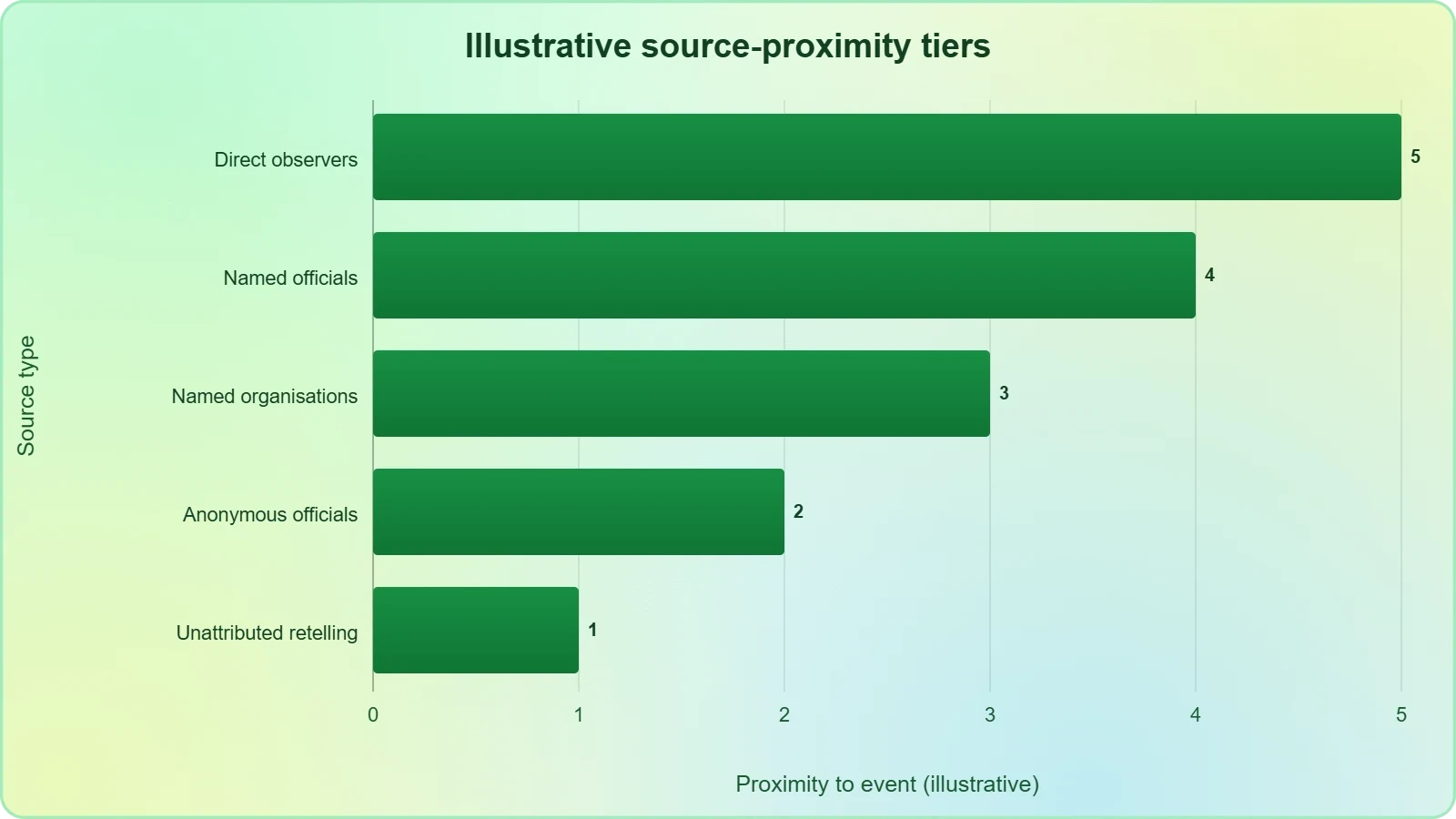
Analysts assessing such items conventionally apply a source-proximity heuristic: the closer a report is to direct observation or to named institutional confirmation, the greater its evidentiary value. By this heuristic, the Oleshky claim ranks low, pending further disclosure.
Why Sparse Reports Persist in the Record
Initial dispatches in fast-moving conflict situations are frequently thin, with details added as correspondents and institutions respond. The persistence of a sparse report therefore signals either that no further information emerged or that the claim did not attract institutional follow-up, both of which bear on credibility.
Newsroom economics also shape the lifecycle of such items. Wire-derived briefs may be published rapidly and never revisited, leaving an unverified assertion in the public record without the corrective update that rigorous practice would ordinarily supply once verification efforts conclude.
For researchers, this creates a traceability problem: the claim circulates, is cited, and acquires an appearance of established fact through repetition, even where no originating verification ever occurred. Tracking the provenance of such assertions is essential to accurate historical accounting.
We Also Published
Oleshky and the Strategic Geography of the Left Bank
Oleshky, known historically as Tsiurupynsk, lies immediately south of Kherson city on the left bank of the Dnipro River. The settlement and its surrounding dunes and wetlands have formed part of the contested littoral zone since the shifting of front lines in late 2022, and civilian conditions there have been repeatedly characterised as precarious by humanitarian observers.
Terrain, Hydrology, and Military Contention
The Dnipro constitutes a formidable natural barrier, and operations across it impose severe logistical constraints on any force attempting to sustain positions on the opposite bank. This hydrology shapes the character of any local ceasefire, which would necessarily address crossing rights, artillery ranges, and resupply corridors.
Left-bank positions have been described in open-source military analysis as exposed to sustained indirect fire and drone reconnaissance. A genuine local ceasefire would therefore be observable through measurable reductions in strike activity, a signal that analysts could in principle detect from publicly available incident data.
The absence of any reported change in strike patterns following the claim is not conclusive, since the dispatch provides no baseline. Nevertheless, the empirical testability of the assertion is important: the claim is of a kind that could be assessed against geolocated incident records.
Civilian Protection and Humanitarian Frameworks
Ceasefires in populated areas are typically sought to permit evacuation, restore utilities, or deliver aid. Humanitarian actors have documented repeated disruptions to essential services in left-bank settlements, and localised pauses have been advocated by protection clusters as a means of reducing civilian harm.
If a ceasefire were genuinely secured, the relevant humanitarian question would concern access: whether convoys could move, whether repairs to water and power infrastructure could proceed, and whether residents could register for assistance. None of these operational details appears in the dispatch.
International humanitarian law provides the normative framework within which such pauses are negotiated, including the principles of distinction and proportionality. A ceasefire claim that does not reference humanitarian purpose or monitoring is difficult to situate within that framework with any confidence.
Precedent: Localised Ceasefires in Contemporary Conflict
Localised ceasefires have been attempted in numerous contemporary conflicts, often to establish humanitarian corridors. Their durability varies widely, and many collapse within days absent robust monitoring and clear enforcement mechanisms backed by parties with command authority over frontline units.
Successful examples typically feature written terms, named signatories, and third-party observation. Where these elements are missing, local arrangements tend to function as informal tactical understandings rather than as instruments with legal or operational standing, and they rarely survive shifts in command intent.
Assessing the Oleshky claim against this precedent suggests that, even if some informal understanding existed, its characterisation as a secured ceasefire would require substantial qualification. The vocabulary of ceasefire carries expectations of formality that informal lulls do not satisfy.
Information Operations and Narrative Competition
Conflict zones are arenas of narrative competition, and claims of de-escalation can serve communicative purposes independent of material effect. An assertion of peacemaking may be directed at domestic or international audiences, shaping perceptions of influence and goodwill.
Analysts therefore treat ceasefire claims as objects of narrative analysis as well as military reporting. Questions of who benefits from the claim, and which audiences are addressed, are as pertinent as questions of whether shells have stopped falling on a particular settlement.
The involvement of a high-profile figure unconnected to formal mediation structures complicates this analysis. Such involvement may open informal channels, but it may equally generate claims whose verification pathways are unconventional and whose institutional uptake is uncertain.
Diplomatic Channels and the Role of Informal Envoys
Ceasefire mediation ordinarily proceeds through established channels: foreign ministries, multilateral organisations, or designated special envoys with mandates and reporting lines. Informal envoys can supplement these channels, but their undertakings lack the institutional standing that makes agreements enforceable and monitorable.
Formal Versus Informal Mediation
Formal mediation produces documents, named parties, and mechanisms for dispute resolution. Informal mediation may produce understandings that are deliberately unwritten, allowing parties to preserve deniability, but such understandings are correspondingly fragile and difficult to verify externally.
Where a claim of mediation emerges from an informal channel, analysts must ask whether the mediator possessed the authority to bind any party. Without such authority, the claim describes an aspiration or an impression rather than an instrument with operational effect on the ground.
The distinction matters for accountability. Formal agreements create expectations against which conduct can be measured; informal claims create ambiguity that may be exploited by parties seeking to avoid attribution for subsequent hostilities.
Celebrity Diplomacy and Its Limits
High-profile individuals have occasionally facilitated humanitarian outcomes, particularly in child welfare, prisoner release, and cultural heritage protection. Such interventions tend to succeed where they complement formal processes and where the parties perceive benefit in accommodating a prominent intermediary.
However, celebrity diplomacy operates without the verification infrastructure available to states and international organisations. Claims arising from such efforts therefore require more, not less, independent scrutiny, precisely because the conventional corroboration pathways are absent.
The analytical literature on informal diplomacy cautions against conflating access with influence. A mediator may secure meetings and sympathetic hearings without obtaining binding commitments, and public statements may overstate the durability of what was discussed.
Institutional Verification Pathways
Verification of a localised ceasefire would ordinarily involve monitoring by an international organisation, reporting from resident correspondents, and cross-referencing of incident data by open-source analysts. Each pathway provides independent evidence that can confirm or contradict the claim.
In the present case, none of these pathways appears to have produced corroboration in the available record. This absence is significant but not dispositive, since verification can lag announcement by days or weeks, particularly where access to the affected area is restricted.
Analysts should therefore specify what evidence would change the assessment: a statement from a belligerent party, a monitoring report, or a documented reduction in strikes. Absent such evidence, the claim remains a proposition awaiting substantiation rather than an established event.
Legal Status of Ceasefire Undertakings
Ceasefire agreements vary in legal character, from binding treaties to informal tactical understandings. Their status determines the obligations they create and the remedies available for breach, and it shapes how violations are characterised in international discourse.
An agreement concluded without identifiable parties and without documentation is difficult to classify within this spectrum. It may amount to a political statement rather than a legal instrument, with correspondingly limited consequences for compliance and accountability.
This legal indeterminacy reinforces the case for caution. Describing an unverified arrangement as a secured ceasefire may overstate its normative weight and create misleading expectations among affected populations and international observers.
Case Comparison: Prior Localised Pauses
Historical localised pauses in comparable conflicts have generally been announced jointly by belligerents or by a mediating organisation, with explicit time windows and designated corridors. The joint announcement serves as the primary verification signal, enabling monitors to deploy and journalists to observe.
Where announcements have come from a single actor without counterparty confirmation, subsequent reporting has often revealed either unilateral gestures or aspirational statements rather than mutually agreed arrangements. This pattern informs the cautious reading of the Oleshky claim.
Comparative analysis thus supports a provisional classification of the claim as unconfirmed, with the expectation that corroboration, if forthcoming, would arrive through institutional channels within a defined period following the announcement.
- 01
- 02
- 03
- 04
Information Integrity and the Verification Deficit
The Oleshky dispatch exemplifies a broader condition in contemporary information ecosystems: the rapid circulation of consequential claims accompanied by minimal verification infrastructure. This deficit is not unique to conflict reporting, but its consequences are most acute where claims concern life, safety, and the conduct of hostilities.
Standards of Evidence in Conflict Journalism
Professional conflict journalism ordinarily applies layered verification: multiple independent sources, documentary evidence, and where possible direct observation. These standards are resource-intensive and are unevenly applied across outlets, particularly in fast-moving and inaccessible environments.
The publication of a single-source claim is not inherently improper, provided the attribution is transparent and the claim is not presented as established. The risk arises when headline framing, aggregation, and repetition strip away the qualifying language that originally signalled uncertainty.
Readers and analysts therefore bear a share of the interpretive burden. Consuming a claim responsibly requires attention to attribution, to the presence or absence of corroboration, and to the incentives of the actors making the assertion.
Amplification, Repetition, and False Consensus
Repeated circulation of an unverified claim can generate a false impression of consensus, a phenomenon well documented in research on information cascades. Each repetition appears to add confirmation, even where all instances trace to a single origin.
Algorithmic distribution intensifies this effect by rewarding engagement over accuracy. Claims that are surprising or emotionally resonant travel further, and the corrective updates that might temper them often receive far less attention than the original assertion.
For institutional actors, the appropriate response is disciplined sourcing: citing the claim as a claim, noting the absence of corroboration, and updating assessments transparently as evidence accumulates or fails to materialise.
Implications for Public Understanding of Conflict
Public understanding of conflict is shaped by the aggregate of reported claims, not solely by verified events. Where unverified assertions enter the record without clear qualification, public perception may diverge from the evidentiary basis available to specialists.
This divergence has practical consequences, influencing public opinion, policy debate, and the credibility of institutions that later must correct the record. The cost of correction is typically higher than the cost of initial caution.
Analysts and educators therefore have a role in modelling epistemic humility: demonstrating how to hold a claim provisionally, specify what evidence would resolve it, and resist the pressure to adopt a definitive position prematurely.
Corrective Mechanisms and Their Limits
Corrections, retractions, and updates are the principal corrective mechanisms in journalism. Their effectiveness depends on reach, timeliness, and the willingness of downstream amplifiers to propagate the correction with the same energy as the original claim.
In practice, corrections rarely achieve parity of distribution. This asymmetry means that initial framing exerts disproportionate influence, reinforcing the case for caution at the point of first publication rather than reliance on later remediation.
For the Oleshky claim specifically, the appropriate corrective posture is straightforward: characterise the assertion as unverified, identify the missing elements, and monitor for institutional confirmation or contradiction as the record develops.
Assessing Plausibility: What Would Corroboration Require
Assessing the plausibility of the Oleshky claim requires specifying, in advance, the evidence that would confirm or refute it. This discipline of pre-specification guards against post hoc rationalisation and allows observers to update their assessments consistently as information arrives.
Specifying Falsifiable Indicators
A confirmed localised ceasefire would be expected to produce a measurable reduction in reported strikes, shelling, and drone activity in and around the settlement, sustained over a defined period and corroborated by multiple independent monitors.
It would also be expected to generate statements from the parties involved, whether directly or through intermediaries, acknowledging the arrangement and describing its terms. Such statements constitute the primary documentary evidence against which the claim can be assessed.
Humanitarian access provides a further indicator: if a ceasefire enabled convoys, repairs, or evacuations, implementing organisations would likely report increased access. Their operational reporting offers an independent, practically grounded signal of changed conditions.
Interpreting Silence and Ambiguity
Silence from institutions is ambiguous evidence. It may indicate that no agreement exists, that an agreement exists but is deliberately unpublicised, or that verification efforts are ongoing and inconclusive. Each interpretation carries different implications for the claim's standing.
Analysts should therefore avoid treating silence as refutation while equally avoiding the inference that silence conceals confirmation. The appropriate posture is explicit uncertainty, accompanied by continued monitoring and transparent reporting of any developments.
Ambiguity of this kind is common in conflict environments, where information control and operational security constrain disclosure. The analytical response is to maintain a clear distinction between what is known, what is claimed, and what remains unknown.
Scenarios and Their Signatures
Three broad scenarios merit consideration: a genuine localised arrangement subsequently confirmed; an informal understanding that produced temporary calm without formal status; and an unsubstantiated assertion with no operational correlate. Each would leave a distinguishable evidentiary signature.
The first scenario would generate institutional statements and observable reductions in violence. The second would produce partial, informal corroboration and uneven calm. The third would produce no corroboration and no measurable change in incident patterns.
Monitoring these signatures over the weeks following the announcement provides the most reliable basis for assessment. Premature closure, in either direction, risks error that subsequent evidence may expose.
Communicating Uncertainty Responsibly
Communicating uncertainty is itself a skill requiring precision. Statements should specify what is claimed, by whom, with what corroboration, and what remains unknown, avoiding language that implies either confirmation or dismissal beyond the evidence.
This approach serves both accuracy and public trust. Audiences are generally capable of understanding qualified claims, and transparent qualification is preferable to the false confidence that later requires correction and erodes credibility.
For the Oleshky report, responsible communication would describe an unverified claim of a ceasefire, note the absence of details and corroboration, and indicate the evidence that would resolve the question. Such framing is accurate, useful, and durable.
Quantifying Confidence
Formal confidence assessment can be expressed probabilistically, though such estimates in open-source analysis are necessarily subjective. A structured approach assigns likelihood ranges to each scenario based on available evidence and known base rates for similar claims.
Base rates matter: single-source ceasefire claims without counterparty confirmation are rarely validated in full, which should temper prior confidence. Bayesian updating provides a coherent framework for revising assessments as new evidence arrives.
The mathematical expression of such updating is straightforward. If ##P(H)## denotes the prior probability of a hypothesis and ##E## denotes new evidence, the posterior is given by Bayes' theorem:
Applying this framework to the Oleshky claim, the absence of corroboration following an announcement modestly reduces the posterior probability of a genuine, formally secured ceasefire, while leaving open the possibility of an informal arrangement.
Practical Guidance for Analysts and Readers
Analysts should record the claim, its source, and its evidentiary status at the time of encounter, creating an auditable trail. This practice supports later assessment and guards against the retrospective smoothing that obscures initial uncertainty.
Readers should attend to attribution language, distinguish between claims and confirmations, and seek institutional sources where available. Where none exist, the appropriate conclusion is that the matter remains unresolved rather than that the claim is either true or false.
Institutions should publish updates as evidence accumulates, including negative findings. Transparent reporting of unsuccessful verification is as valuable as confirmation, because it prevents unverified claims from settling into the record unchallenged.
Conclusion: Provisional Findings and Analytical Posture
The available evidence supports a single, carefully bounded conclusion: a claim of a ceasefire in Oleshky was made and reported, and that claim remains unverified. The dispatch provides no details on timing, parties, or monitoring, and no corroboration appears in the record available for assessment.
This conclusion is not a refutation. Ceasefires can be negotiated quietly, and verification can lag announcement. However, the burden of substantiation rests with those asserting the arrangement, and the analytical default must be provisional until independent evidence emerges.
The broader lesson concerns evidentiary discipline in conflict reporting. Consequential claims about violence and its cessation warrant proportionate verification, transparent attribution, and explicit acknowledgement of uncertainty, particularly where the costs of error fall on affected populations.
Continued monitoring is warranted. Institutional statements, humanitarian access reporting, and geolocated incident data would each provide independent signals capable of resolving the question, and their absence over time would itself constitute informative evidence regarding the claim's standing.
From our network :
- The Hidden Cost of AI Convenience: Why Over-Permissioned Agents Are a Security Time BombDiscover why AI agents with excessive permissions create dangerous single points of failure, and learn how implementing least privilege principles can protect your organization from exploitation.
- CISA’s Ten-Advisory Wave: Why Generic Patching Fails in OT and How to Build Product-Specific PlaybooksCISA released ten ICS advisories in one week, exposing critical infrastructure risks. Generic patching fails in OT. Learn to build product-specific remediation playbooks.
- Mobile Learning and VR in English: What Global Evidence Reveals About Effective Language TechnologyA systematic review across 14 countries reveals which language-learning technologies genuinely work. Mobile learning, AI, and VR show measurable benefits when pedagogically integrated. This evidence-based guide helps educators and learners select technology that delivers real return on investment.
- The Final Descent: How ESA Retired the Legendary Cluster Constellation After 24 Years of Space Weather ScienceAfter 24 years mapping Earth’s magnetosphere, ESA’s Cluster mission concluded with a precisely controlled reentry over the South Pacific. This analysis explores the scientific legacy, engineering decisions, and debris mitigation principles behind one of space exploration’s most responsible retirements.
- Committed Mediterranean Precipitation Decline: Why Emissions Cuts Alone Cannot Restore Winter RainsNew NOAA research reveals that Mediterranean winter rains may decline irreversibly even with emissions cuts. Explore the science of committed climate change and regional impacts.
- Forbidden Matrix Patterns and Visible Lattice Points: A Geometric DictionaryExplore how multidimensional 0–1 matrices encode geometric truths, linking forbidden patterns to visible lattice points and hypergraph theory, with applications in combinatorics and computational geometry.
- How AI Agents Will Change the Way We Manage Personal FinancesExplore how AI agents are transforming personal finance through automated budgeting, bill payment, and investment management, while examining the critical security protocols and governance frameworks required for safe deployment.
- University Language Proficiency Exams: Why Institutional Tests Demand Different Preparation Than IELTS and TOEFLDiscover why university-specific language proficiency examinations differ fundamentally from IELTS and TOEFL, and learn strategic preparation approaches for institutional assessment success.
- Live Online English Classes for Kids: Do They Actually Reduce Anxiety?A ten-week study reveals that synchronous online English classes can significantly reduce child language anxiety while improving listening and reading skills. Discover what makes these programs effective and how parents can select the right one.
RESOURCES
- White House says Melania Trump brokers truce for Ukraine ... - BBCbbc.com3 days ago ... Ukraine and Russia confirm the truce in Russian-occupied Oleshky, where residents have had to eat garden weeds to survive.
- Russia and Ukraine agree to local ceasefire in Oleshky amid ...theguardian.com4 days ago ... Despite the claim the ceasefire had been brokered by Melania Trump ... status that would rule out Nato membership. Speaking…
- Melania Trump brokers a rare humanitarian ceasefire between ...facebook.com4 days ago ... The video presents a claim that Melania Trump secured a ceasefire between Russia and Ukraine for the town of Oleshky.…
- Ukraine war latest: Kyiv 'clarifies details' with Moscow - Sky Newsnews.sky.com4 days ago ... Melania Trump has been credited with her role in a ceasefire covering Oleshky, which is expected to start next week…
- Melania Trump (@MelaniaTrump) - Facebookfacebook.comPosts. Melania Trump (Verified account). 1m · Public. THE CEASEFIRE HAS COMMENCED The ceasefire ... oleshky/ · May be an image of text ·…
- Zelenskyy tells EU leaders "associate membership" proposal is unfairpravda.com.uaMay 23, 2026 ... White House claims Melania Trump has secured ceasefire in Oleshky.
- War in Ukraine | Global Conflict Tracker - Council on Foreign Relationscfr.org... Oleshky and designates a civilian evacuation route (Reuters). U.S. First Lady Melania Trump reportedly helped to broker the ceasefire (AP). Russia Conducts ...
- Melania Trump's Adviser Claims Pope Leo Followed Her Lead on ...yahoo.com1 day ago ... Donald Trump's wife Melania Trump's adviser made a bold claim about who really brokered the Oleshky ceasefire. The first lady's…
- Trump says he spoke with Putin and then Zelenskyy "yesterday"pravda.com.uaJul 7, 2026 ... White House claims Melania Trump has secured ceasefire in Oleshky.
- https://www.whitehouse.gov/briefings-statements/2026/10/first-lady ...instagram.com4 days ago ... First Lady Melania Trump successfully secured a ceasefire between Russia and Ukraine, localized to the city of Oleshky.
- Melania Trump Ceasefire in Oleshky: When Evacuation Becomes ...diplomacyandlaw.com4 days ago ... Ukrainian civilians under Russian occupation ordinarily fall within that protection. Convention rights depend on the relevant legal status and ...
- Islamic State claims responsibility for northeastern Aleppo attack that ...reuters.comJun 20, 2026 ... Reuters could not independently verify the claim. ... Explainer: Oleshky: the occupied Ukrainian town for which Melania Trump helped broker…
- I endured the Melania film so you don't have to – my only ... - Redditreddit.comFeb 1, 2026 ... ... claims Melania Trump brokered ceasefire at ... First Lady Melania Trump Secures Ceasefire Between Russia and Ukraine, Localized to…
- Ukrainian Strikes On Yandex Data Centres Trigger Bot Claims, BBC ...newscord.orgOct 9, 2026 ... 67 outlets told this the same way. Elsewhere. Outlets did split on White House Announces Melania Trump-Backed Humanitarian Ceasefire for…
- 01
- 02
- 03
- 04
- 05
- 06
- 07
- 08
0 Comments