The election of a woman to lead the Seneca Nation represents far more than a single administrative transition; it is a profound statement about sovereignty, representation, and the evolving architecture of Indigenous governance in North America. For a nation whose political traditions stretch back centuries and whose constitutional framework was formally codified in 1848, the elevation of a female president signals a meaningful recalibration of who holds authority and how that authority is legitimized by the community. The Seneca Nation, one of the six member nations of the Haudenosaunee Confederacy, has long occupied a distinctive place in American political history, and this development adds another significant chapter to that narrative.
What makes this moment particularly instructive is the tension between tradition and institutional change that it exposes. The Haudenosaunee Confederacy is frequently cited as one of the world's oldest participatory democracies, and the role of women within its clan-based social structure has historically been substantial, with clan mothers holding the power to nominate and remove male leaders. Yet the formal presidency of the Seneca Nation, as constituted under its modern constitution, remained an exclusively male preserve until this election. Understanding why that gap existed, and what its closure signifies, requires a careful examination of how Indigenous political systems have adapted to external pressures while preserving internal cultural continuity.
This analysis examines the Seneca Nation's historic election through several lenses: the institutional mechanics of Seneca governance, the broader pattern of female leadership across Native American nations, the legal and political context of tribal sovereignty, and the symbolic weight of this transition for Indigenous communities nationwide. It also considers what the limited reporting on the election reveals about media coverage of Native American affairs and why the details of such milestones often remain frustratingly sparse in mainstream outlets.
On This Page
- The Institutional Architecture of Seneca Governance
- Women in Native American Leadership: A Broader Pattern
- Sovereignty, Law, and the Politics of Recognition
- Historical Context: The Seneca Nation and the Haudenosaunee Confederacy
- Implications for Indigenous Representation and the Road Ahead
- Conclusion: A Milestone in Context
TL;DR The Seneca Nation has elected a woman as president for the first time in its history, a milestone reported by The New York Times. The election reflects both the enduring strength of Haudenosaunee traditions of female influence and the gradual modernization of tribal constitutional structures. While specific details about the vote and the incoming president remain limited in available reporting, the development carries substantial implications for Indigenous sovereignty, gender representation in Native governance, and the visibility of tribal affairs in national media.
The Institutional Architecture of Seneca Governance
The Seneca Nation operates under a constitution adopted in 1848, a document that centralized executive authority in a presidency and a council while drawing on older clan-based traditions. This hybrid structure emerged from a period of intense external pressure, when the nation sought to present a unified political front to state and federal authorities. The presidency, as a formal office, was a departure from the more distributed authority of clan mothers and hereditary chiefs, yet it was grafted onto a society that already understood leadership as a collective and accountable enterprise.
Understanding this institutional layering is essential to appreciating why a female presidency carries such symbolic resonance. The constitution of 1848 did not explicitly bar women from the office, but custom and practice effectively did so for more than a century and a half. The election therefore represents not a constitutional rupture but a corrective alignment, bringing formal political practice into closer harmony with the substantive influence women have long exercised within Seneca society through clan structures, kinship networks, and community leadership.
The Role of Clan Mothers in Haudenosaunee Tradition
Within the Haudenosaunee Confederacy, clan mothers hold a distinctive and historically significant role. They are responsible for selecting the chiefs who represent their clans in council, and they retain the authority to remove those chiefs if they fail in their responsibilities. This system of accountability, often described as one of the earliest checks on political power in North America, placed women at the center of governance long before formal suffrage movements emerged elsewhere. The Seneca Nation's election of a female president can be read as an extension of this tradition into the executive sphere.
The persistence of clan mother authority alongside the formal constitutional presidency illustrates how Indigenous nations maintain dual systems of legitimacy. A president elected by the general citizenry must still navigate the expectations and counsel of clan-based leadership. This duality is not a contradiction but a sophisticated form of governance that distributes power across multiple institutions, reducing the risk of concentrated authority and ensuring that cultural continuity informs political decision-making at every level.
Constitutional Evolution and the 1848 Framework
The 1848 constitution was itself a product of its era, shaped by pressures from New York State and the federal government to adopt more recognizable, centralized forms of governance. It established a tripartite structure with executive, legislative, and judicial functions, mirroring American constitutional design while retaining distinctly Seneca elements. Over the decades, amendments and judicial interpretations have refined this framework, and the election of a woman to the presidency represents another step in the document's living evolution.
Constitutional change within tribal nations is rarely a purely internal affair. Federal policies, court decisions, and the need to interface with state and national governments all exert influence on how Indigenous nations structure their institutions. The Seneca Nation's ability to adapt its governance while preserving core cultural values demonstrates a resilience that has characterized Haudenosaunee political life for centuries, even as external actors have repeatedly attempted to reshape or dissolve it.
We Also Published
Women in Native American Leadership: A Broader Pattern
The Seneca Nation's milestone is part of a wider, if uneven, pattern of female leadership across Native American nations in the United States. Several tribes have elected women as chairs or presidents in recent decades, and the 2020s have seen a notable increase in female representation in tribal councils and executive offices. This trend reflects generational shifts in educational attainment, changing expectations among younger tribal citizens, and a growing recognition that governance structures benefit from the full participation of women.
Yet the pattern is far from uniform. Some nations have long traditions of female leadership rooted in matrilineal kinship systems, while others have historically concentrated authority in male-dominated councils. The Seneca case is instructive precisely because it combines a strong cultural tradition of female influence with a formal political structure that had, until now, excluded women from its highest office. The election thus represents the convergence of cultural memory and institutional reform, a dynamic that scholars of Indigenous governance have long identified as central to tribal political development.
Comparative Perspectives Across Tribal Nations
Across the United States, more than 570 federally recognized tribes operate under a remarkable diversity of governance models, from constitutional republics to traditional councils to hybrid systems. Female leadership has emerged in many of these contexts, though the pace and form vary considerably. Some nations have elected women to the chairmanship of their tribal councils, while others have seen women serve as principal chiefs or presidents. The Seneca election adds a prominent northeastern example to a landscape that is often associated with western and southern tribes in popular perception.
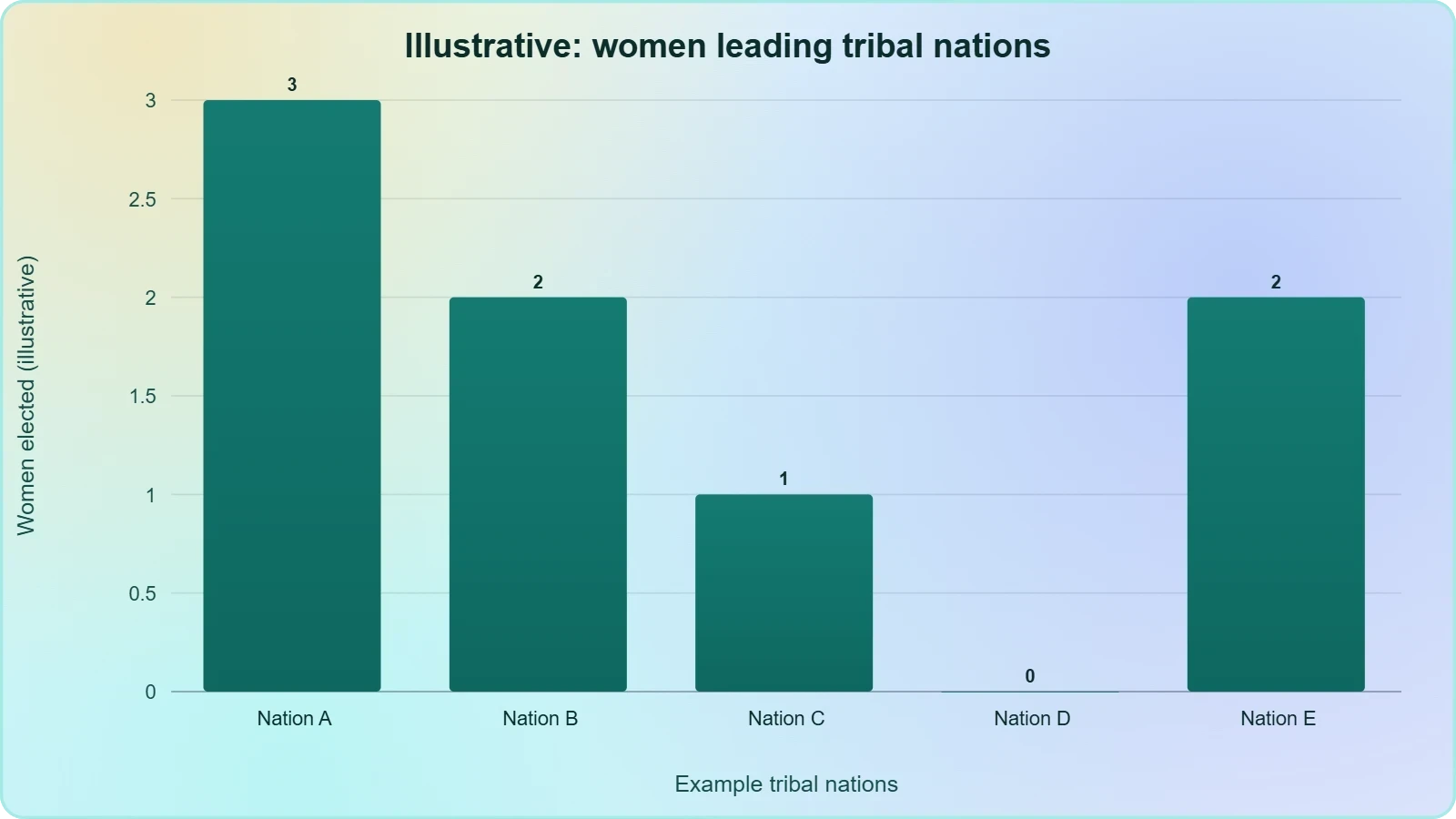
Comparative analysis of tribal governance reveals that female leadership tends to flourish where cultural traditions of female authority intersect with modern electoral systems that reward broad coalitions and community trust. The Seneca Nation, with its clan mother tradition and its formal presidency, sits precisely at this intersection. The election therefore offers a case study in how Indigenous nations can draw on cultural resources to inform contemporary political practice, rather than treating tradition and modernity as opposing forces.
Symbolic and Substantive Dimensions of Representation
The symbolic weight of a first female president should not be underestimated, particularly in a political culture where the imagery of leadership has long been male. For young Seneca women and girls, the election provides a tangible demonstration that the highest office in their nation is open to them. Representation of this kind has measurable effects on political ambition and civic engagement, as research on gender and leadership across societies has consistently shown. The symbolic and the substantive are intertwined in ways that shape the pipeline of future leaders.
Substantively, female leadership in tribal governments has been associated with particular policy priorities, including health care, education, family services, and environmental stewardship. These associations are not deterministic, and individual leaders vary widely in their agendas. Nevertheless, the presence of women in executive roles tends to broaden the range of issues that receive sustained attention, reflecting the different life experiences and community networks that female leaders often bring to office. The Seneca Nation's new president will govern within this broader context of expectation and possibility.
Sovereignty, Law, and the Politics of Recognition
Tribal sovereignty is the legal and political foundation upon which elections like the Seneca Nation's rest. Recognized through treaties, federal statutes, and Supreme Court decisions, sovereignty affirms that tribal nations possess inherent authority to govern their own affairs, including the selection of their leaders. The Seneca election is therefore not merely a community event but an exercise of sovereign self-determination, conducted under the nation's own constitution and procedures rather than those of New York State or the federal government.
This legal context matters because it frames how the election should be understood by outside observers. The Seneca Nation is not a subsidiary of any state or federal entity; it is a distinct political community with its own citizenship, territory, and governing institutions. When the nation elects a president, it is exercising a right that predates the United States itself. The historic nature of this particular election thus carries a dual significance: it is a milestone for gender representation and a reaffirmation of the nation's enduring sovereignty.
Tribal Sovereignty and Federal Indian Law
Federal Indian law has long recognized tribal nations as domestic dependent sovereigns, a status that is both protective and limiting. Treaties signed in the eighteenth and nineteenth centuries established the legal basis for tribal self-governance, and subsequent legislation and litigation have shaped the contours of that authority. The Seneca Nation, with its extensive land holdings and economic enterprises, has been an active participant in these legal developments, asserting its rights in courts and before federal agencies.
The election of a female president does not alter the legal framework of sovereignty, but it does illustrate how sovereign authority is exercised in practice. The nation's constitution, its electoral procedures, and its leadership transition all operate within the space that federal law reserves for tribal self-determination. Understanding this legal architecture helps explain why tribal elections carry a weight that extends beyond the individuals involved, touching on questions of jurisdiction, treaty rights, and the ongoing project of Indigenous nationhood.
Media Coverage and the Visibility of Native Affairs
The New York Times report on the Seneca election, brief as it is, highlights a persistent challenge in mainstream coverage of Native American affairs: the tendency to note historic firsts without providing substantive detail about the people, processes, and communities involved. The source text acknowledges that further details about the vote and the new president were not included, a gap that reflects broader patterns in how tribal news is reported. This brevity is not unique to this story but is characteristic of a media ecosystem that devotes limited resources to Indigenous affairs.
For readers seeking to understand the significance of the Seneca election, this scarcity of detail is a genuine obstacle. The milestone is clear, but the context that would make it fully intelligible—the campaign, the candidates, the issues at stake, the community's response—remains largely unreported. This gap underscores the importance of tribal media outlets and Indigenous journalists who provide the depth and continuity that national coverage often lacks. It also invites a more careful reading of what is reported and what is left unsaid.
- 01
- 02
- 03
- 04
Historical Context: The Seneca Nation and the Haudenosaunee Confederacy
The Seneca Nation is the westernmost of the Six Nations of the Haudenosaunee Confederacy, which also includes the Mohawk, Oneida, Onondaga, Cayuga, and Tuscarora. The Confederacy, often dated to the fifteenth or sixteenth century, is one of the oldest continuously functioning participatory governments in the world. Its Great Law of Peace established principles of consensus, accountability, and the separation of powers that have drawn scholarly attention and inspired political thought far beyond North America.
Within this confederacy, the Seneca hold a distinctive position as the "Keepers of the Western Door," a role that historically involved guarding the western frontier of Haudenosaunee territory. This geopolitical responsibility shaped Seneca political culture, reinforcing traditions of diplomacy, military preparedness, and strategic decision-making. The nation's modern governance, including its presidency, inherits this legacy of responsibility and adaptation, and the election of a female president can be seen as another expression of the nation's capacity to evolve while maintaining its identity.
The Great Law of Peace and Its Legacy
The Great Law of Peace, or Kaianere'kó:wa, is the constitutional foundation of the Haudenosaunee Confederacy. It established the roles of clan mothers, the selection of chiefs, and the procedures for council deliberation that continue to shape governance today. The law's emphasis on consensus and its mechanisms for accountability have been cited by scholars and political thinkers as an influence on American constitutional design, though the extent of that influence remains debated.
For the Seneca Nation, the Great Law provides a cultural and spiritual framework that exists alongside the 1848 constitution. The election of a female president resonates with the law's recognition of women's authority, even as it operates within a constitutional structure that was adopted later. This layering of legal and cultural traditions is characteristic of Haudenosaunee governance, where multiple sources of authority are held in dynamic tension rather than resolved into a single hierarchy.
Economic and Political Dimensions of Modern Seneca Life
The Seneca Nation today is a significant economic and political actor in western New York, with enterprises that include gaming, hospitality, and retail operations. These ventures have generated revenue that supports community services, infrastructure, and cultural programs, while also raising complex questions about sovereignty, taxation, and state-tribal relations. The nation's leadership must navigate these issues with skill and diplomatic acumen, balancing economic development with the protection of treaty rights and cultural heritage.
The presidency, as the chief executive office, plays a central role in these negotiations. The incoming president inherits a portfolio that includes relations with New York State, federal agencies, and neighboring communities, as well as the internal governance of a nation with diverse districts and clan affiliations. The historic nature of the election adds a layer of expectation and scrutiny, but the substantive work of governance will be measured by how effectively the administration addresses the nation's economic, social, and cultural priorities.
Implications for Indigenous Representation and the Road Ahead
The Seneca Nation's election of its first female president carries implications that extend well beyond the nation's borders. It contributes to a growing body of evidence that Indigenous governance is dynamic, adaptive, and capable of meaningful institutional change. For other tribal nations considering similar transitions, the Seneca example offers both inspiration and a reminder that such changes are most durable when they are rooted in a community's own cultural logic rather than imposed from outside.
The road ahead for the new president will involve the ordinary and extraordinary challenges of governance: managing budgets, negotiating with external authorities, addressing community needs, and representing the nation in intergovernmental forums. The historic nature of the election will shape how these tasks are perceived, but the substance of leadership will be judged by outcomes. The Seneca Nation's citizens, like citizens everywhere, will measure their president by the quality of governance and the integrity of service.
Lessons for Tribal and Non-Tribal Institutions
For non-tribal institutions, the Seneca election offers a case study in how long-standing barriers to female leadership can be dismantled through a combination of cultural continuity and institutional reform. The nation did not abandon its traditions to elect a woman; it drew on them. This suggests that progress toward gender parity in leadership is most sustainable when it is framed as an expression of institutional values rather than a departure from them, a lesson that applies to corporations, universities, and governments alike.
For tribal institutions specifically, the election reinforces the value of constitutional frameworks that are flexible enough to accommodate evolving community expectations. The 1848 constitution did not need to be rewritten to permit a female presidency; it needed to be interpreted and applied in a manner consistent with the nation's deeper traditions of female authority. This capacity for adaptive interpretation is a strength of constitutional governance, provided that the institutions charged with interpretation remain accountable to the communities they serve.
What Remains Unknown and Why It Matters
The available reporting leaves many questions unanswered: the margin of victory, the new president's background and priorities, the composition of the incoming administration, and the community's response to the milestone. These gaps are not trivial. They affect how the election is understood by outsiders and how the historical record is constructed. The absence of detail also limits the ability of scholars, journalists, and citizens to draw lessons from the event and to hold leaders accountable.
This is why the work of tribal media and Indigenous journalists is so important. Outlets that cover Native communities with depth and continuity provide the context that national reporting often lacks. Readers who want to understand the Seneca election fully would do well to seek out these sources, which are more likely to capture the voices of the candidates, the concerns of voters, and the significance of the moment as understood by the community itself. The milestone deserves nothing less than a complete account.
Conclusion: A Milestone in Context
The Seneca Nation's election of its first female president is a milestone that deserves to be understood in its full context. It is an expression of sovereignty, a reflection of cultural traditions that have long recognized women's authority, and a demonstration of institutional adaptability. It is also a reminder that historic firsts, however significant, are beginnings rather than endings. The work of governance continues, and the measure of this moment will be found in the years of service that follow.
For observers beyond the Seneca Nation, the election offers an opportunity to engage more deeply with Indigenous political life, to seek out the reporting and scholarship that illuminate it, and to recognize that tribal nations are not static relics of the past but living, evolving political communities. The Seneca Nation has added a new chapter to its long history. It is a chapter worth reading carefully, with attention to both its symbolic resonance and its substantive implications for the nation and for the broader project of Indigenous self-determination.
From our network :
- Committed Mediterranean Precipitation Decline: Why Emissions Cuts Alone Cannot Restore Winter RainsNew NOAA research reveals that Mediterranean winter rains may decline irreversibly even with emissions cuts. Explore the science of committed climate change and regional impacts.
- Forbidden Matrix Patterns and Visible Lattice Points: A Geometric DictionaryExplore how multidimensional 0–1 matrices encode geometric truths, linking forbidden patterns to visible lattice points and hypergraph theory, with applications in combinatorics and computational geometry.
- University Language Proficiency Exams: Why Institutional Tests Demand Different Preparation Than IELTS and TOEFLDiscover why university-specific language proficiency examinations differ fundamentally from IELTS and TOEFL, and learn strategic preparation approaches for institutional assessment success.
- The Hidden Cost of AI Convenience: Why Over-Permissioned Agents Are a Security Time BombDiscover why AI agents with excessive permissions create dangerous single points of failure, and learn how implementing least privilege principles can protect your organization from exploitation.
- How AI Agents Will Change the Way We Manage Personal FinancesExplore how AI agents are transforming personal finance through automated budgeting, bill payment, and investment management, while examining the critical security protocols and governance frameworks required for safe deployment.
- CISA’s Ten-Advisory Wave: Why Generic Patching Fails in OT and How to Build Product-Specific PlaybooksCISA released ten ICS advisories in one week, exposing critical infrastructure risks. Generic patching fails in OT. Learn to build product-specific remediation playbooks.
- The Final Descent: How ESA Retired the Legendary Cluster Constellation After 24 Years of Space Weather ScienceAfter 24 years mapping Earth’s magnetosphere, ESA’s Cluster mission concluded with a precisely controlled reentry over the South Pacific. This analysis explores the scientific legacy, engineering decisions, and debris mitigation principles behind one of space exploration’s most responsible retirements.
- Live Online English Classes for Kids: Do They Actually Reduce Anxiety?A ten-week study reveals that synchronous online English classes can significantly reduce child language anxiety while improving listening and reading skills. Discover what makes these programs effective and how parents can select the right one.
- Mobile Learning and VR in English: What Global Evidence Reveals About Effective Language TechnologyA systematic review across 14 countries reveals which language-learning technologies genuinely work. Mobile learning, AI, and VR show measurable benefits when pedagogically integrated. This evidence-based guide helps educators and learners select technology that delivers real return on investment.
RESOURCES
- Seneca Nation elects first female president | News 4 Buffalo - WIVBwivb.com4 hours ago ... With her election, Tina Abrams, who has been a voice of leadership for the nation for decades, makes history as…
- Tina Abrams elected first woman president of Seneca Nationfacebook.com4 hours ago ... JUST IN: The citizens of the Seneca Nation have elected the first woman President in the Nation's history. Tina Abrams,…
- Seneca Nation members protest tribal president's Blakeman fundraisercityandstateny.comOct 6, 2026 ... With no opposition possible under Seneca Party rules, Abrams is set to become the first woman to serve as president…
- For the First Time, Seneca Nation Elects a Woman as Its Presidentnytimes.com3 hours ago ... Hochul grew up in the Buffalo suburb of Hamburg — about a half-hour drive from the Senecas' Cattaraugus Territory —…
- SBU unveils Seneca Nation Land Acknowledgmentsbu.eduFeb 10, 2025 ... Seneca Nation President JC Seneca and First Lady Nicole Seneca were joined at center court by SBU President Dr. Jeff…
- Tina Abrams nominated to become first woman president of the ...oleanstar.comSep 21, 2026 ... By RICK MILLER. Olean Star. Seneca Nation Councilor Tina Abrams won the Seneca Party nomination for president on Friday over…
- Seneca Nation of Indians - Official Websitesni.orgThe Seneca Nation is a true democracy whose constitution was established in 1848. The Nation's constitution provides for a multi-branch system of government ...
- Seneca Nation elects its first woman president - Buffalo Newsbuffalonews.com4 hours ago ... We went to the polls to choose a President who can lead our Nation with strength, honesty, vision and conviction,”…
- Odie Porter announces bid to become first woman president of the ...wkbw.comJul 28, 2026 ... Odie Porter, a Seneca Nation councilor, announced her candidacy Tuesday for president of the Seneca Nation, potentially becoming the first ...
- Senator George Borrello to Honor Seneca Nation Councilor Tina ...nysenate.govApr 1, 2026 ... First elected to the Seneca Nation Council in 2001, she made history in 2012 as the first woman appointed Co-Chair…
- Tina Abrams elected Seneca Nation presidentwnypapers.com3 hours ago ... ... Seneca Nation Council for more than 20 years, as president. She is the first woman ever elected to the…
- Senator George Borrello Honors Seneca Nation Councilor Tina ...nysenate.govMay 6, 2026 ... Abrams is the first Indigenous woman to be selected as a New York State Senate Woman of Distinction, a historic…
- Darlene Miller seeks to be first female Seneca Nation presidentindianz.comAug 26, 2014 ... Miller is a tribal council member and is former CEO and controller of the Seneca Nation Health Systems. She hopes…
- Woman Suffrage Timeline (1840-1920) - Crusade for the Votecrusadeforthevote.orgSeneca Falls, New York is the location for the first Women's Rights Convention. ... Worcester, Massachusetts, is the site of the first National Women's ...
- Seneca Nation of Indians - Wikipediaen.wikipedia.org... Seneca Party was elected to serve as President of the Seneca Nation of Indians. ... ↑ "Tina Abrams nominated to become first woman…
- 01
- 02
- 03
- 04
- 05
- 06
- 07
- 08
0 Comments