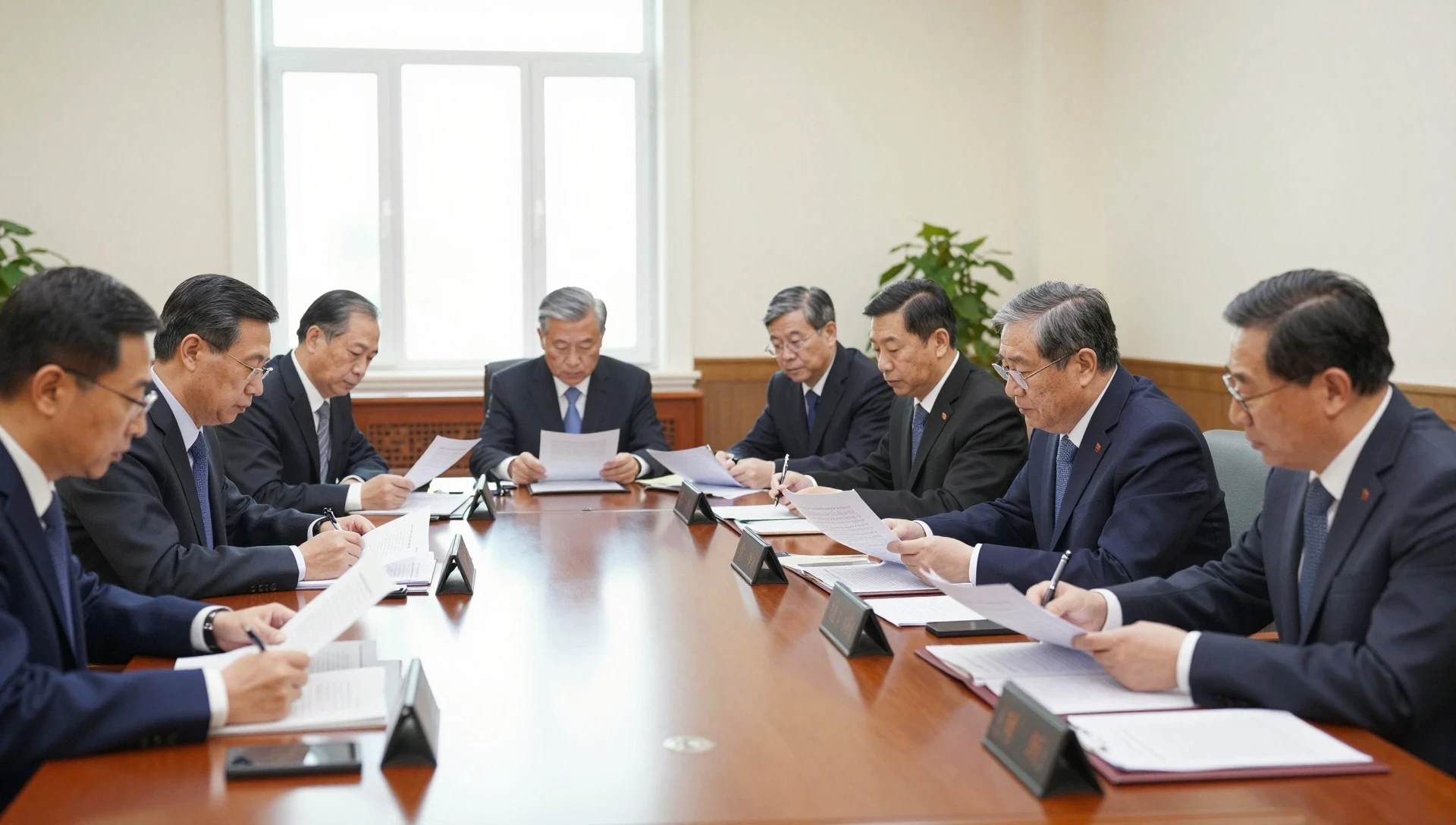
The brief Xinhua dispatch dated 30 October 2026 records a procedural event with outsized analytical weight: senior political advisors in China convened to study the guiding principles issued by a recent plenum of the Communist Party of China.
On its surface, the report is thin — no attendance figures, no session agenda, no named speakers. Yet the institutional logic behind such a gathering is well established and worth reading carefully.
China's political advisory system, anchored in the Chinese People's Political Consultative Conference (CPPCC), functions as a consultative chamber rather than a legislative one. When its senior members formally study plenum principles, the signal is not legislative but directive: the Party's central decisions are being transmitted downward through the consultative apparatus for alignment, elaboration, and eventual incorporation into policy advice. The absence of detail in the source is itself consistent with the genre.
On This Page
This analysis reconstructs what the dispatch means, situates it within the CPPCC's institutional role, and examines how plenum principles typically propagate through China's governance machinery. It also weighs the informational limits of single-source reporting and offers a structured framework for interpreting similar official announcements as they appear.
TL;DR Senior political advisors in China studied the guiding principles from a recent CPC plenum, per a brief Xinhua report. The event reflects the CPPCC's consultative role and the standard transmission of central directives through advisory bodies. The dispatch supplies no attendance or agenda details, so its significance lies in institutional pattern rather than disclosed content: plenum principles cascade into study sessions, which then shape policy consultation and implementation alignment across ministries, provinces, and advisory organs.
The Institutional Architecture Behind the Advisory Study Session
Understanding the dispatch requires familiarity with the CPPCC, China's united front organization that convenes representatives from parties, minorities, business, academia, and religious groups. Its senior members advise rather than legislate, and their formal study of Party documents is a recurring mechanism for synchronizing consultative work with central priorities.
What the CPPCC Is and How It Operates
The CPPCC was established in 1949 and has functioned since as a consultative body parallel to the National People's Congress. Its members submit proposals, conduct inspections, and offer policy suggestions, but they hold no voting power over legislation. The body's influence flows through proximity to decision-makers rather than formal authority.
Structurally, the CPPCC operates at national, provincial, municipal, and county levels, creating a dense consultative network. National committee members include senior figures from non-Communist parties and prominent professionals. Their collective output — thousands of proposals annually — feeds into government departments, though adoption rates vary by topic and political salience.
Because the CPPCC lacks legislative teeth, its study sessions serve a different function than parliamentary debate. They align advisory work with the Party's current strategic line, ensuring that proposals and inspections reflect central priorities. This alignment mechanism is the institution's core operating principle, and it explains why plenum documents receive structured study.
The advisory system's scale matters here. With hundreds of thousands of members across four administrative tiers, a national study directive can reach local consultative bodies within weeks. That reach makes the CPPCC a transmission belt as much as a deliberative forum, and study sessions are the belt's tightening mechanism.
Why Plenum Principles Carry Directive Weight
Plenums of the CPC Central Committee typically convene several times annually and address major strategic questions — economic reform, governance modernization, or long-range development planning. Their communiqués and resolutions become reference documents for the entire state apparatus, including advisory bodies that do not formally legislate.
Historically, plenum outcomes have anchored multi-year policy cycles. The 1978 third plenum launched reform and opening; the 2013 third plenum set the course for comprehensive deepening of reform. Each produced principles that cascaded through study sessions, training programs, and implementation plans across ministries, provinces, and consultative organs.
The cascade follows a recognizable sequence: communiqué release, central study circular, tiered study sessions, and finally incorporation into work plans. Advisory bodies occupy the third stage, translating abstract principles into consultative agendas. Their study sessions therefore signal that the transmission process is proceeding on schedule.
For analysts, the key inference is procedural rather than substantive. A study session confirms that plenum principles have reached the consultative tier and are being operationalized. It does not reveal which specific policies will follow, but it narrows the window in which implementation documents should be expected.
The Limits of a Single-Source Dispatch
The Xinhua report provides no attendance roster, no session duration, and no quoted remarks. This sparseness is typical of routine institutional coverage, where the fact of a meeting matters more than its content. Analysts should treat the dispatch as a procedural marker, not a policy signal.
Single-source reporting on Chinese governance carries inherent uncertainty. Without corroborating coverage from People's Daily or CPPCC official channels, details such as participant rank and session format remain unverified. The prudent approach is to log the event, note its timing relative to the plenum, and await follow-up documentation.
Timing itself is informative. A study session occurring shortly after a plenum suggests rapid transmission; a longer gap may indicate extended drafting of study materials or scheduling constraints. The 30 October 2026 date, read against the plenum's own timing, offers a rough measure of institutional responsiveness.
Finally, the dispatch's keyword set — advisors, study, principles, plenum — mirrors the standard vocabulary of Chinese institutional reporting. Familiarity with this lexicon helps analysts distinguish routine alignment events from unusual ones, where atypical phrasing or unexpected participants would warrant closer scrutiny.
How Plenum Principles Propagate Through the System
Transmission of plenum principles follows a documented sequence that analysts can track. The communiqué appears first, followed by central circulars, tiered study sessions, and finally incorporation into departmental and provincial work plans. Each stage narrows interpretive latitude and converts principle into operational guidance.
The Standard Transmission Sequence
After a plenum closes, its communiqué is published through Xinhua and major Party outlets. Within days, central departments issue study circulars directing subordinate bodies to convene sessions. The advisory tier typically acts within the first month, as the 30 October 2026 dispatch illustrates.
Study sessions are not passive readings. Participants produce summaries, discussion records, and sometimes implementation suggestions that flow upward. This two-way traffic distinguishes the process from simple dissemination: the center learns how principles are being received while local bodies learn what the center expects.
Provincial and municipal CPPCC committees then replicate the exercise, adapting language to local conditions. The replication creates a paper trail that researchers can use to measure transmission speed and fidelity. Discrepancies between national and local formulations often reveal where interpretation is contested.
Finally, principles enter work plans. Advisory bodies adjust their annual inspection topics and proposal priorities accordingly. By the time implementation documents appear, the consultative apparatus has already reoriented its agenda, which is precisely the outcome the study sequence is designed to produce.
Reading Timing and Sequencing as Signals
The interval between plenum and study session functions as a crude responsiveness indicator. Short gaps suggest urgency or well-prepared materials; longer gaps may reflect complex drafting or competing priorities. Comparing intervals across successive plenums can reveal shifts in the center's pacing.
Sequencing across institutions also matters. If advisory bodies study principles before ministries publish implementation notices, the consultative tier is being used to prepare ground. If the order reverses, advisory study may be more retrospective, consolidating rather than shaping implementation.
Public reporting frequency provides a third signal. Dense coverage of study sessions across provinces indicates broad mobilization; sparse coverage may indicate a lower-profile plenum or selective emphasis. The single dispatch examined here sits at the sparse end, consistent with routine coverage.
Analysts should combine these signals rather than rely on any one. Timing, sequence, and coverage density together form a triangulation framework that compensates for the thinness of individual reports like the Xinhua item.
Comparative Perspective on Advisory Bodies
China's consultative system differs from parliamentary upper chambers in democracies, which hold formal veto or amendment powers. The CPPCC advises without binding authority, yet its integration into the Party-state gives it informational reach that elected chambers sometimes lack. The comparison is structural, not evaluative.
Other one-party or dominant-party systems maintain analogous consultative organs, often with narrower mandates. China's version is unusually large and layered, spanning four administrative tiers. That scale amplifies its transmission function but also dilutes individual member influence over outcomes.
For comparative research, the relevant metric is not formal power but agenda alignment. Advisory bodies that consistently mirror central priorities demonstrate effective transmission; those that diverge invite corrective study campaigns. The 2026 session belongs to the alignment category by default, given the absence of reported friction.
Scholars should therefore treat study dispatches as data points in a longitudinal series. Isolated readings yield little; sequences across years reveal how the consultative apparatus responds to changing central priorities and where its interpretive autonomy contracts or expands.
We Also Published
Analytical Implications and What to Watch Next
The dispatch's value lies in what it confirms about process rather than what it discloses about content. It confirms that plenum principles reached the consultative tier by late October 2026 and that senior advisors are engaged in structured alignment. Follow-up reporting should clarify scope and emphasis.
Signals to Monitor in Subsequent Coverage
Watch for provincial CPPCC coverage in the weeks following the national session. Replication breadth indicates mobilization scale, while the language used in local summaries reveals interpretive emphasis. Divergent phrasing across provinces can flag contested implementation areas worth tracking.
Also monitor whether advisory bodies announce adjusted inspection topics or proposal priorities. Such adjustments convert study into action and provide concrete evidence of agenda alignment. Absent adjustments, the session may have been ceremonial rather than substantive.
Ministry-level implementation notices form a third signal. Their timing relative to advisory study indicates whether consultation precedes or follows administrative action. Preceding consultation suggests advisory input retains practical weight; following action suggests consolidation.
Finally, track whether Xinhua or People's Daily publish fuller accounts. Expanded coverage typically accompanies plenums of major economic or institutional significance. Continued brevity would suggest a routine plenum whose principles require standard, not exceptional, transmission.
Methodological Caveats for Researchers
Single-source dispatches invite overinterpretation. Researchers should resist inferring policy content from procedural reports and instead treat them as scheduling data. The appropriate unit of analysis is the sequence of events, not any individual announcement.
Language translation introduces additional uncertainty. Terms like "guiding principles" render Chinese formulations approximately, and nuance can shift across translations. Where possible, analysts should consult the original communiqué alongside English coverage to verify terminology.
Institutional reporting also follows genre conventions that suppress detail. The absence of attendance figures does not imply secrecy; it reflects editorial norms for routine items. Distinguishing convention from concealment requires familiarity with baseline coverage patterns.
These caveats do not diminish the dispatch's utility. They simply define its evidentiary weight: modest but real, useful within a series, and misleading if read alone as a policy signal.
Broader Significance for Governance Analysis
The event illustrates how China's system converts central decisions into coordinated action through layered study and replication. The mechanism is administrative rather than electoral, and its effectiveness depends on fidelity of transmission across tiers. Advisory bodies are one link in that chain.
For comparative governance research, the case supports treating consultative institutions as transmission infrastructure rather than independent deliberative forums. Their value to the center lies in reach and alignment, not in generating dissent or alternative policy visions.
This framing also clarifies why study sessions receive official coverage at all. Publicity demonstrates compliance and signals to lower tiers that the process is underway. The dispatch is thus both a report and an instruction, performing alignment while describing it.
Read in that light, the 30 October 2026 item is unremarkable but instructive: a routine procedural marker that, placed in series with similar reports, helps map how China's advisory apparatus tracks the Party's strategic calendar.
From our network :
- Forbidden Matrix Patterns and Visible Lattice Points: A Geometric DictionaryExplore how multidimensional 0–1 matrices encode geometric truths, linking forbidden patterns to visible lattice points and hypergraph theory, with applications in combinatorics and computational geometry.
- How AI Agents Will Change the Way We Manage Personal FinancesExplore how AI agents are transforming personal finance through automated budgeting, bill payment, and investment management, while examining the critical security protocols and governance frameworks required for safe deployment.
- Committed Mediterranean Precipitation Decline: Why Emissions Cuts Alone Cannot Restore Winter RainsNew NOAA research reveals that Mediterranean winter rains may decline irreversibly even with emissions cuts. Explore the science of committed climate change and regional impacts.
- Live Online English Classes for Kids: Do They Actually Reduce Anxiety?A ten-week study reveals that synchronous online English classes can significantly reduce child language anxiety while improving listening and reading skills. Discover what makes these programs effective and how parents can select the right one.
- CISA’s Ten-Advisory Wave: Why Generic Patching Fails in OT and How to Build Product-Specific PlaybooksCISA released ten ICS advisories in one week, exposing critical infrastructure risks. Generic patching fails in OT. Learn to build product-specific remediation playbooks.
- The Hidden Cost of AI Convenience: Why Over-Permissioned Agents Are a Security Time BombDiscover why AI agents with excessive permissions create dangerous single points of failure, and learn how implementing least privilege principles can protect your organization from exploitation.
- Mobile Learning and VR in English: What Global Evidence Reveals About Effective Language TechnologyA systematic review across 14 countries reveals which language-learning technologies genuinely work. Mobile learning, AI, and VR show measurable benefits when pedagogically integrated. This evidence-based guide helps educators and learners select technology that delivers real return on investment.
- University Language Proficiency Exams: Why Institutional Tests Demand Different Preparation Than IELTS and TOEFLDiscover why university-specific language proficiency examinations differ fundamentally from IELTS and TOEFL, and learn strategic preparation approaches for institutional assessment success.
- The Final Descent: How ESA Retired the Legendary Cluster Constellation After 24 Years of Space Weather ScienceAfter 24 years mapping Earth’s magnetosphere, ESA’s Cluster mission concluded with a precisely controlled reentry over the South Pacific. This analysis explores the scientific legacy, engineering decisions, and debris mitigation principles behind one of space exploration’s most responsible retirements.
RESOURCES
- Senior political advisors study guiding principles from CPC plenumenglish.news.cn3 days ago ... BEIJING, Oct. 30 (Xinhua) -- Leading Party members of China's top political advisory body met on Friday to study and…
- Senior political advisors study Xi's speech at CPC disciplinary ...global.chinadaily.com.cnJan 15, 2026 ... ... CPC Central Commission for Discipline Inspection, as well as the plenum's guiding principles. Wang Huning, a member of the…
- Senior political advisors study guiding principles from CPC plenumglobaltimes.cnOct 25, 2025 ... Leading Party members of China's top political advisory body met on Friday to study and discuss plans to implement the…
- The sixth plenary session of the 19th CPC Central Committeeen.people.cnA senior official of the Communist Party of China (CPC) on Thursday urged ... National political advisors study guiding principles of CPC plenum. The ...
- Chinese leaders join discussions with political advisors https://on ...facebook.comMay 23, 2020 ... Senior political advisors study guiding principles from CPC plenum. https://www.globaltimes. cn/page/202510/1346500.shtml · No photo ...
- Infographic: China's whole-process people's democracyen.people.cnNov 29, 2021 ... Top political advisor calls for thoroughly studying spirit of key Party plenum · Senior CPC official stresses deepening Party history…
- Duitse en Zwitserse president in China - Chinese Wouden 森中台wouden.substack.com11 hours ago ... ' CCP to promote Party building in emerging sectors, official says – Xinhua Senior political advisors study guiding principles from…
- CCP Decision-Making and Xi Jinping's Centralization of Authorityuscc.govNov 2, 2022 ... policy research organ under the supervision of the CCP ... making them the senior defense and military advisors to the…
- China's Fifth Plenum: Reading the Initial Tea Leaves - CSIScsis.orgOct 30, 2020 ... ... political position is singular within the senior ranks of the CCP. ... senior adviser and holds the Trustee Chair…
- Wang Huning - Wikipediaen.wikipedia.orgWang Huning is a Chinese political scientist and politician who is one of the top leaders of the Chinese Communist Party (CCP). He is…
- Chinese Politics Has No Rules, But It May Be Good if Xi Jinping ...csis.orgAug 9, 2017 ... But a careful study of the CCP's recent political history, or even ... Johnson is a senior adviser and holds…
- Policy, Politics, and U.S.–China Relations at the Fourth Plenumasiasociety.orgNov 5, 2025 ... Lobsang Tsering. Senior Research Associate on Chinese Politics, Center for China Analysis. Policy ... Military Members of CCP Central Committee ...
- 2025 Investment Climate Statements: China - State Departmentstate.gov... (CCP) political redlines. General Secretary Xi Jinping continued ... Tang Yijun, a former senior political advisor of Jiangxi Province. Resources ...
- Decoding Chinese Politics - Asia Societyasiasociety.orgThe remainder of the Politburo is constituted by directors of CCP departments such as personnel chief Shi Taifeng, United Front chief Li Ganjie, propaganda ...
- China's Views on AI Safety Are Changing—Quicklycarnegieendowment.orgAug 27, 2024 ... ... policy advisers began publicly discussing safety risks and conducting technical research into mitigations. ... principle endorsed by top CCP ...
- 01
- 02
- 03
- 04
- 05
- 06
- 07
- 08
0 Comments