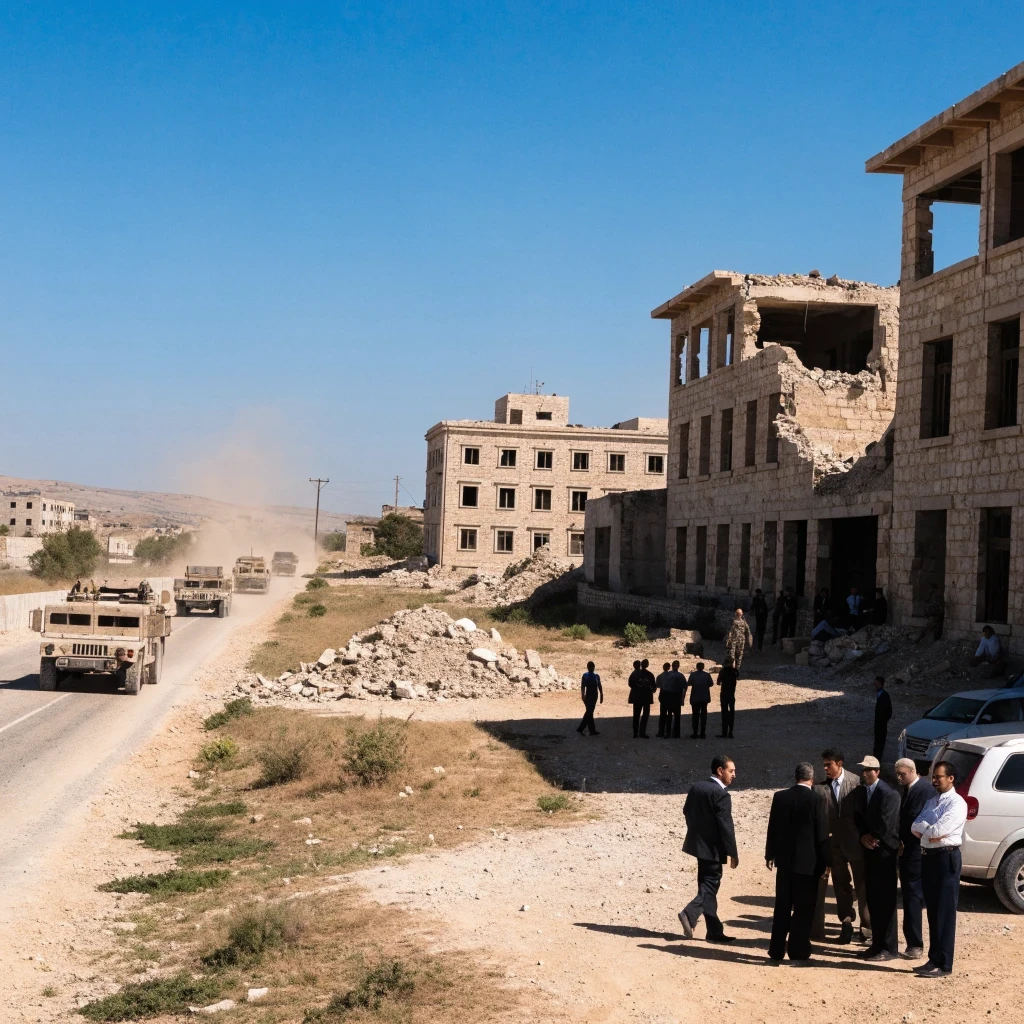
The closure of the US-led coalition's Baghdad headquarters is not a ceremonial footnote; it is the closing of a chapter written in blood, sand, and geopolitical calculation. For nearly a decade, Combined Joint Task Force – Operation Inherent Resolve has anchored the international response to ISIS, coordinating airstrikes, training Iraqi brigades, and providing the intelligence backbone that enabled the territorial defeat of the caliphate in 2017.
That era has now formally ended, and the transition to a bilateral security partnership with Baghdad signals a profound recalibration of American power projection in the Middle East.
Simultaneously, an Iraqi court has been handing down sentences to foreign nationals convicted of ISIS affiliation, a judicial reckoning that forces the international community to confront uncomfortable questions about justice, repatriation, and the fate of thousands detained in Syrian camps. These twin developments—the military drawdown and the legal prosecutions—are not isolated events. They represent the twin pillars of post-conflict stabilization: security transition and transitional justice.
On This Page
The question that now hangs over the region is whether Iraq's institutions, still scarred by corruption and sectarian tension, can bear the weight of both responsibilities without fracturing.
This analysis dissects the strategic implications of the coalition's exit, the legal complexities of ISIS trials, and the sobering reality of Iraqi military self-sufficiency. It examines the structural weaknesses that persist beneath the surface of military victory and evaluates whether the foundations for lasting stability have genuinely been laid, or whether the region is merely entering a new phase of volatility.
TL;DR The US-led coalition's closure of its Baghdad headquarters marks the formal end of the combat mission against ISIS, transitioning to a bilateral advisory role. Simultaneously, Iraqi courts are sentencing foreign ISIS affiliates, exposing the legal and humanitarian quagmire of repatriation. Iraq's security forces now face the ultimate test of self-sufficiency against a resurgent insurgent threat, while the broader Middle East security architecture shifts toward fragmented, bilateral arrangements. The path to stability remains obstructed by corruption, political fragmentation, and the unresolved fate of tens of thousands of detainees.
The Strategic Calculus Behind the Coalition Withdrawal
The formal closure of the coalition headquarters in Baghdad is the culmination of years of diplomatic negotiation and military planning. The United States and Iraq agreed in 2021 that US combat forces would conclude their mission by the end of that year, transitioning to an advisory and training role. The recent closure operationalizes that agreement, reducing the American footprint to approximately 2,500 troops focused on advising Iraqi counterterrorism forces.
This is not a withdrawal in the traditional sense; it is a reconfiguration of presence. The coalition retains significant capability through over-the-horizon assets, including air support and intelligence sharing. However, the psychological and operational symbolism of closing the Baghdad headquarters cannot be overstated. It signals to regional actors, adversaries, and the Iraqi public that the era of large-scale Western military intervention has concluded.
The decision reflects a broader American strategic pivot toward the Indo-Pacific, a recognition that the Middle East no longer commands the same military resource allocation it once did. Yet this pivot carries inherent risks. The vacuum created by reduced Western presence invites increased Iranian influence, Turkish military adventurism, and the potential resurgence of extremist networks that never fully disappeared.
The Evolution of the Coalition's Mission
The coalition's mission has undergone three distinct phases since its inception in 2014. The first phase, from 2014 to 2017, focused on territorial defeat, employing overwhelming airpower and supporting Iraqi ground forces in the brutal urban battles of Mosul, Ramadi, and Fallujah. The second phase, from 2017 to 2021, concentrated on stabilization, counterinsurgency operations, and the prevention of ISIS re-emergence in liberated areas.
The third and current phase represents a fundamental shift toward sustainability. The coalition now operates under a bilateral framework agreement with Iraq, focusing exclusively on training, intelligence sharing, and logistical support. This arrangement acknowledges that Iraqi forces must assume primary responsibility for internal security while maintaining the international partnership necessary for advanced capabilities.
Critically, the transition has been calibrated to avoid the mistakes of the 2011 withdrawal, which left Iraq vulnerable to the rapid rise of ISIS. The current advisory mission retains sufficient capability to respond to emergent threats while respecting Iraqi sovereignty. Whether this calibrated approach proves more successful than its predecessor remains an open question.
The coalition's departure also carries significant implications for regional allies. Jordan, Saudi Arabia, and the Gulf states have relied on the American security umbrella as a deterrent against Iranian expansionism. The reduced American presence in Iraq forces these nations to reassess their own security postures, potentially accelerating their pursuit of independent military capabilities and alternative security partnerships.
Iraqi Military Self-Sufficiency: Reality or Aspiration?
The Iraqi Security Forces have made undeniable progress since their near-collapse in 2014. The Counter-Terrorism Service, in particular, has emerged as a professional and effective fighting force, having borne the brunt of urban combat operations against ISIS. However, the broader military establishment remains plagued by systemic weaknesses that undermine its operational effectiveness.
Corruption remains endemic within the Iraqi military, with widespread reports of ghost soldiers, inflated payrolls, and the diversion of equipment to militias. The Popular Mobilization Forces, a collection of predominantly Shia militias with varying degrees of Iranian affiliation, operate outside the formal military chain of command, creating a parallel security structure that complicates unified command and control.
Logistical self-sufficiency remains a distant goal. The Iraqi Air Force, while improved, still relies heavily on coalition maintenance support and intelligence, surveillance, and reconnaissance assets. Ammunition production is virtually nonexistent, leaving Iraq dependent on foreign suppliers for the sustainment of its military operations. These dependencies render the notion of full self-sufficiency aspirational rather than achievable in the near term.
The psychological dimension of the transition is equally significant. Iraqi forces have operated under the coalition's protective umbrella for nearly a decade, and the removal of that safety net introduces a new calculus of risk. Junior officers and enlisted personnel must now confront the possibility of operating without the certainty of American air support, a prospect that could affect morale and operational decision-making.
The Resurgent ISIS Threat
Despite the territorial defeat of the caliphate, ISIS remains a persistent and adaptive threat. The group has reorganized into decentralized cells operating primarily in rural and desert regions, exploiting the security gaps between Iraqi and Syrian jurisdictions. Estimates suggest that between 5,000 and 10,000 active fighters remain operational across both countries.
The group's operational tempo has increased in recent years, with a notable uptick in ambushes, assassinations, and prison breaks. The attack on a military base in Kirkuk in 2023, which killed several soldiers, demonstrated the group's continued capacity for coordinated operations. More concerning is the group's exploitation of detention facilities, where radicalization continues to incubate among the thousands of suspected affiliates held in overcrowded prisons.
ISIS has also adapted its financial model, shifting from territorial taxation to kidnapping, extortion, and smuggling networks. This decentralized financial structure makes the group more resilient to counterterrorism pressure, as it no longer relies on a centralized treasury that can be targeted by airstrikes. The group's ability to regenerate its leadership cadre, despite the elimination of numerous senior figures, indicates a deep bench of experienced operatives.
The coalition's reduced presence directly impacts the counterterrorism campaign. Iraqi forces will now conduct operations with less real-time intelligence support and fewer precision strike assets. While the advisory mission retains some capability, the operational tempo of counterterrorism missions is likely to decrease, providing ISIS with additional breathing room to consolidate and expand its operations.
The Judicial Reckoning: Trials, Justice, and the Repatriation Dilemma
The sentencing of foreign nationals for ISIS affiliation by Iraqi courts represents a critical component of the post-conflict stabilization effort. These trials serve multiple purposes: they provide a measure of accountability for atrocities committed, they demonstrate the functioning of Iraqi judicial institutions, and they address the legal status of thousands of foreign fighters and their families detained in Iraq and Syria.
However, the trials are fraught with legal and ethical complications. Human rights organizations have documented systemic issues within the Iraqi justice system, including confessions obtained under torture, trials conducted without adequate legal representation, and proceedings that fail to meet international fair trial standards. The application of Iraq's counterterrorism law, which carries the death penalty for membership in terrorist organizations, raises particular concerns about due process.
The broader question of repatriation remains unresolved. Thousands of foreign nationals, primarily women and children, remain detained in camps such as Al-Hol in northeastern Syria. Their home countries have largely refused to repatriate them, citing security concerns and domestic political opposition. This diplomatic stalemate has created a humanitarian crisis and a security time bomb, as the camps have become breeding grounds for radicalization.
The Legal Framework and Its Flaws
Iraq's legal approach to ISIS affiliates is rooted in its counterterrorism legislation, which was enacted in 2005 and amended in subsequent years. The law defines terrorism broadly, encompassing membership in designated terrorist organizations, financing of terrorist activities, and incitement to terrorism. Convictions can result in life imprisonment or the death penalty, depending on the severity of the offense.
The application of this law to foreign ISIS fighters has been inconsistent and problematic. Many defendants are tried in mass proceedings, with dozens of cases processed in a single day. Legal representation is often nominal, with court-appointed lawyers having minimal time to review evidence or consult with their clients. The reliance on confessions, frequently obtained under duress, undermines the evidentiary foundation of many convictions.
International law imposes obligations on Iraq regarding the treatment of detainees and the conduct of trials. The International Covenant on Civil and Political Rights, to which Iraq is a party, requires fair trial guarantees, including the right to counsel, the presumption of innocence, and the right to appeal. The extent to which these guarantees are honored in practice remains a subject of serious concern.
The trials also raise questions about jurisdiction and the appropriate forum for accountability. Some argue that international tribunals or hybrid courts would provide more credible justice, while others contend that Iraqi courts are the appropriate venue given the crimes were committed on Iraqi soil. The tension between national sovereignty and international standards of justice remains unresolved.
The Humanitarian Crisis of Detention Camps
The detention camps in northeastern Syria, particularly Al-Hol and Roj, hold approximately 55,000 people, the vast majority of whom are women and children. These camps are governed by the Syrian Democratic Forces, a Kurdish-led militia, but their long-term status is uncertain given the complex political situation in Syria. The conditions in the camps are dire, with inadequate sanitation, healthcare, and education.
The children in these camps represent a particularly tragic dimension of the crisis. Many were born under ISIS rule and have known nothing else. They have been denied education, exposed to violence, and radicalized in an environment where ISIS ideology remains pervasive. The longer they remain in the camps, the more difficult their rehabilitation and reintegration becomes.
Repatriation efforts have been sporadic and politically fraught. A small number of countries, including Kazakhstan, Uzbekistan, and Kosovo, have conducted successful repatriation programs, demonstrating that reintegration is possible with adequate resources and political will. However, most Western nations have refused to take back their citizens, citing security concerns and domestic political opposition.
The security implications of the camps are profound. The camps have become recruitment grounds for ISIS, with the group maintaining an active presence and enforcing its own rules. The potential for a mass escape or a coordinated attack on the camps represents a significant security threat to the region and beyond. The longer the international community fails to address this crisis, the greater the risk becomes.
The Geopolitics of Repatriation
The repatriation debate is fundamentally a geopolitical issue, reflecting the tensions between national sovereignty, international responsibility, and domestic politics. Countries that refuse to repatriate their citizens argue that they cannot guarantee public safety and that the returnees should face justice in the countries where their crimes were committed. This position, while politically convenient, ignores the legal obligation of states to accept their nationals.
The United States has taken a selective approach, repatriating a small number of American citizens while leaving the majority of its nationals in the camps. European countries have been even more reluctant, with France, the United Kingdom, and Germany refusing to systematically repatriate their citizens. This inconsistency undermines the credibility of Western calls for accountability and human rights.
The Iraqi government has expressed frustration with the international community's failure to address the repatriation issue. Iraq argues that it should not bear the sole responsibility for prosecuting and detaining foreign nationals who committed crimes on its territory. The burden of these trials and detentions strains Iraq's already limited judicial and correctional resources.
The resolution of the repatriation dilemma requires a coordinated international approach that balances security concerns with humanitarian obligations. This approach must include robust rehabilitation and reintegration programs, judicial cooperation between countries, and a commitment to addressing the root causes of radicalization. Without such an approach, the camps will continue to fester as a source of instability.
We Also Published
- 01
- 02
- 03
- 04
The Future of Middle East Security Architecture
The coalition's drawdown and the ongoing judicial processes are occurring against the backdrop of a broader transformation of Middle East security architecture. The region is moving away from the era of large-scale US-led military interventions toward a more fragmented and multipolar security environment. This shift has profound implications for regional stability and the balance of power.
Iran's influence in Iraq remains significant, despite the assassination of Qassem Soleimani in 2020 and the subsequent weakening of Iranian-backed militias. The Popular Mobilization Forces continue to operate as a parallel security structure, and Iran maintains substantial economic and political leverage over Baghdad. The reduced American presence is likely to enhance Iran's ability to project power in Iraq.
Turkey has also expanded its military operations in Iraq, conducting cross-border strikes against Kurdish militant groups in the northern regions. These operations, while nominally directed at the PKK, have created tensions with the Iraqi government and complicated the security situation in the north. The absence of a strong coalition presence removes a potential mediator in these disputes.
The Regional Power Vacuum
The reduced American presence in Iraq creates a power vacuum that regional actors are eager to fill. Iran, Turkey, and the Gulf states are all competing for influence in Baghdad, each pursuing their own strategic interests. This competition has the potential to destabilize Iraq further, as external actors support different political factions and security forces.
The Gulf states, particularly Saudi Arabia and the United Arab Emirates, have sought to expand their economic and political influence in Iraq as a counterweight to Iran. These efforts have included investments in infrastructure, energy, and trade, as well as diplomatic engagement with Iraqi political leaders. However, the Gulf states lack the military capability to project power in Iraq, limiting their influence to economic and political channels.
Russia has also sought to expand its presence in Iraq, primarily through arms sales and energy investments. Moscow has positioned itself as an alternative security partner to the United States, offering advanced weapons systems and military cooperation. While Russia's influence in Iraq remains limited compared to Iran, its presence adds another layer of complexity to the regional security environment.
The fragmentation of the regional security architecture has implications beyond Iraq. The absence of a unified security framework increases the risk of miscalculation and conflict between regional powers. The competition between Iran and the Gulf states, the tensions between Turkey and the Kurds, and the broader US-Iran rivalry all intersect in Iraq, creating a volatile and unpredictable security environment.
The Role of International Institutions
International institutions, including the United Nations and NATO, have sought to fill some of the gaps left by the coalition's drawdown. The UN Assistance Mission for Iraq (UNAMI) continues to provide political and humanitarian support, while NATO has established a training mission in Iraq focused on building the capacity of Iraqi security institutions. These efforts, while valuable, are limited in scope and cannot replace the military capabilities provided by the coalition.
The UN has also been involved in the judicial process, providing technical assistance to Iraqi courts and advocating for fair trial standards. However, the UN's influence is limited by its lack of enforcement authority and the reluctance of member states to commit resources to Iraq. The organization's ability to address the repatriation crisis is similarly constrained by the unwillingness of member states to accept their nationals.
NATO's training mission in Iraq represents a modest but significant commitment. The mission, which began in 2018, focuses on advising Iraqi military institutions, including the Ministry of Defense and the Office of the National Security Adviser. While the mission does not engage in combat operations, it provides valuable expertise in areas such as military education, logistics, and institutional reform.
The effectiveness of these international efforts depends on the willingness of Iraq's political leaders to embrace reform and the commitment of external actors to support Iraqi institutions. The risk is that international engagement becomes a substitute for genuine Iraqi ownership of the stabilization process, perpetuating a cycle of dependency rather than fostering self-sufficiency.
The Long Road to Stability
The path to stability in Iraq remains long and uncertain. The country faces a complex array of challenges, including political fragmentation, economic stagnation, corruption, and the persistent threat of insurgency. The coalition's drawdown removes a stabilizing force without addressing the underlying conditions that enabled the rise of ISIS in the first place.
Political reform is essential to addressing the root causes of instability. Iraq's political system, based on a sectarian power-sharing arrangement, has proven dysfunctional and corrupt. The 2021 elections produced a prolonged government formation crisis, and the current government faces significant challenges in delivering basic services and addressing public grievances. Without meaningful political reform, the conditions for extremism will persist.
Economic development is equally critical. Iraq's economy remains heavily dependent on oil revenues, leaving it vulnerable to fluctuations in global energy prices. High unemployment, particularly among youth, provides a recruitment pool for extremist groups. Diversifying the economy and creating jobs are essential to undermining the appeal of ISIS and other militant organizations.
The long road to stability also requires addressing the legacy of conflict, including the displacement of millions of Iraqis and the destruction of infrastructure in liberated areas. Reconstruction efforts have been slow and inadequate, leaving many communities without basic services and fueling resentment against the government. The failure to address these grievances creates conditions for renewed conflict.
From our network :
- Committed Mediterranean Precipitation Decline: Why Emissions Cuts Alone Cannot Restore Winter RainsNew NOAA research reveals that Mediterranean winter rains may decline irreversibly even with emissions cuts. Explore the science of committed climate change and regional impacts.
- The Hidden Cost of AI Convenience: Why Over-Permissioned Agents Are a Security Time BombDiscover why AI agents with excessive permissions create dangerous single points of failure, and learn how implementing least privilege principles can protect your organization from exploitation.
- The Final Descent: How ESA Retired the Legendary Cluster Constellation After 24 Years of Space Weather ScienceAfter 24 years mapping Earth’s magnetosphere, ESA’s Cluster mission concluded with a precisely controlled reentry over the South Pacific. This analysis explores the scientific legacy, engineering decisions, and debris mitigation principles behind one of space exploration’s most responsible retirements.
- Former Soap Stars Embark on Ambitious Writing Projects and Theatrical StagesDiscover how former soap opera actors are transitioning into independent scriptwriting and high-profile theatrical stage productions.
- How AI Agents Will Change the Way We Manage Personal FinancesExplore how AI agents are transforming personal finance through automated budgeting, bill payment, and investment management, while examining the critical security protocols and governance frameworks required for safe deployment.
- Forbidden Matrix Patterns and Visible Lattice Points: A Geometric DictionaryExplore how multidimensional 0–1 matrices encode geometric truths, linking forbidden patterns to visible lattice points and hypergraph theory, with applications in combinatorics and computational geometry.
- CISA’s Ten-Advisory Wave: Why Generic Patching Fails in OT and How to Build Product-Specific PlaybooksCISA released ten ICS advisories in one week, exposing critical infrastructure risks. Generic patching fails in OT. Learn to build product-specific remediation playbooks.
- Analyzing Hoya Corporation’s Midday Volume Shifts and Financial FundamentalsExamine Hoya Corporation’s midday trading volume contraction, technical moving averages, robust solvency ratios, and stellar quarterly earnings performance.
- Norbert’s Uncertain Path: Why Hawaii’s Storm Watch Demands Patience Over PanicTropical Storm Norbert strengthens in the Eastern Pacific with winds near 50 mph, forecast to reach Category 1 hurricane status by Friday. Long-range models disagree sharply on whether Hawaii faces any threat around September 19–23, making official guidance essential.
RESOURCES
- America's Failed Strategy in the Middle East: Losing Iraq and the Gulfcsis.orgJan 2, 2020 ... ... U.S. advisors and U.S. and Coalition air support/ground support played in defeating ISIS. The IISS report also does not…
- Join us this afternoon from 3PM for a #FacebookLive with Dr. Denise ...facebook.comNov 6, 2019 ... After ISIS: Creating Strategic Stability in Iraq The United States ... U.S. Global Coalition to Defeat ISIS from 2014 to…
- Iraq after US Withdrawal | Ethnic and Cultural Studies - EBSCOebsco.comCoalition, Kurdish, and Iraqi efforts led to the recapture of territorial areas controlled by ISIS. In 2017, the last remaining ISIS strongholds in Iraq…
- Syria: Transition and U.S. Policy - Congress.govcongress.govFeb 26, 2026 ... ... Coalition to Defeat ISIS, a multilateral civil and military coalition of dozens of countries. In 2015, the United States…
- Ten questions (and expert answers) on Operation Inherent ...atlanticcouncil.orgSep 10, 2025 ... The US-Iraq partnership is entering a new era. This September, the Global Coalition to Defeat the Islamic State of Iraq…
- Case Studies - Department of Warmedia.defense.govApr 7, 2025 ... The existing Iraqi army was disbanded by the American-led coalition. ... Although after the US drawdown in 2011 the Iraqi…
- operation inherent resolve - Department of State OIGstateoig.govSep 4, 2022 ... Through OIR, U.S. and Coalition forces seek the defeat of ISIS in ... U.S. CONGRESS I 17. IRAQ. COALITION ADVISING…
- Is ISIS Reviving in Iraq? - Stimson Centerstimson.orgJun 6, 2024 ... A partial U.S. drawdown of troops from Iraq and rising tensions over ... U.S.-led international anti-terrorist coalition in 2017. Other ...
- You Can Go Home Again: A Proposal for Phased Military ...quincyinst.orgMar 16, 2023 ... ... ISIS conquest of much of the country still looms large for Iraqis. U.S. interests in Iraq are derived from…
- [H.A.S.C. No. 113-124] RISKS TO STABILITY IN AFGHANISTANgovinfo.gov[House Hearing, 113 Congress] [From the U.S. Government Publishing Office] . [H.A.S.C. No. 113-124] RISKS TO STABILITY IN AFGHANISTAN: POLITICS, SECURITY, ...
- Statement for the Record: Worldwide Threat Assessment - 2021dia.milApr 29, 2021 ... ... Iraq from Iran-backed Iraqi Shia militias seeking to secure a U.S. drawdown. ... ISIS operations absent coalition support for…
- No timeline as US to move remaining combat troops out of Iraqaljazeera.comApr 7, 2021 ... ... ISIS can never again threaten Iraq's stability,” the statement added. ... US, coalition forces are based, according to coalition…
- Full article: The intelligence crisis in Iraq: political fragmentation and ...tandfonline.comU.S. and coalition advisors worked through the Joint Operations Command ... These dual developments, UNAMI's drawdown and ISIS's residual but ...
- Averting Crisis: American strategy, military spending and collective ...ussc.edu.auAug 19, 2019 ... ... stability of America's alliance and partner network. In a direct ... coalition efforts against ISIS under Operation Okra. Although ...
- Full article: Was the Rise of ISIS Inevitable? - Taylor & Francistandfonline.comMay 15, 2017 ... ... stability to allow for the continued drawdown of US troops. US ... See also Martin Chulov and Spencer Ackerman,…
- 01
- 02
- 03
- 04
- 05
- 06
- 07
- 08
0 Comments