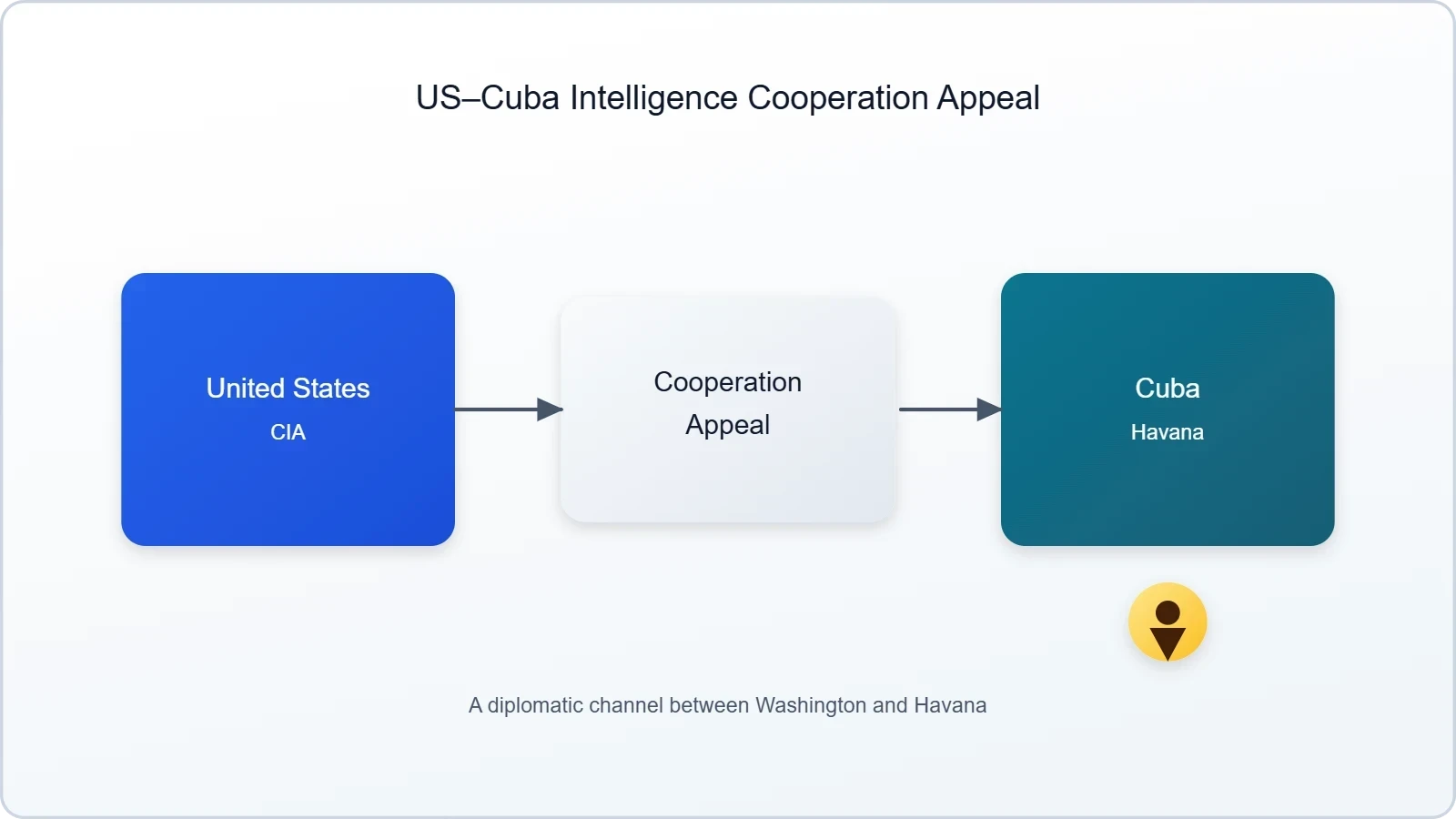
Washington’s diplomatic posture toward Havana has entered a conspicuously aggressive phase, and the latest signal arrives through an unusually direct channel. According to reporting attributed to France 24, US Secretary of State Marco Rubio has openly urged Cubans to cooperate with the Central Intelligence Agency, a move that reframes decades of covert pressure as something closer to public recruitment.
The Cuban government’s reply was swift and theatrical, dismissing the appeal as a symptom of desperation rather than strength, and framing Washington’s overture as evidence of a strategy running out of credible options.
What makes this episode analytically significant is not the headline itself but the architecture beneath it. A secretary of state publicly inviting a foreign population to work with an intelligence service collapses the traditional firewall between diplomacy and espionage, converting a covert instrument into a messaging device.
On This Page
- The Strategic Logic Behind a Public Intelligence Appeal
- Havana’s Rhetorical Counterstrike: Ridicule as Defense
- Historical Precedents of Covert Pressure Made Public
- The Geopolitics of an Overt Intelligence Overture
- Information Warfare and the Battle for Narrative Control
- Implications for US-Cuba Relations and the Road Ahead
Havana’s mockery, in turn, is a calculated rhetorical counterstrike designed to portray the Trump administration as flailing rather than formidable, and to reassure domestic audiences that external pressure remains manageable.
The following analysis dissects the strategic logic, historical precedents, propaganda mechanics, and regional consequences of this exchange. It examines how public intelligence appeals function as instruments of coercion, why Havana defaults to ridicule as a defensive posture, and what the episode reveals about the broader contest over Cuba’s political future.
TL;DR Secretary of State Marco Rubio publicly called on Cubans to cooperate with the CIA, and Havana answered with derision, labeling the appeal a mark of desperation. The exchange converts a covert intelligence instrument into open diplomatic messaging, signaling a harder US line while handing Cuba a ready-made narrative of American weakness. Beneath the rhetoric lies a familiar contest over legitimacy, sovereignty, and the loyalty of an island population that has weathered six decades of pressure.
The Strategic Logic Behind a Public Intelligence Appeal
Publicly inviting a foreign population to collaborate with an intelligence agency is an extraordinary act, and it is never accidental. Such statements are calibrated to serve multiple audiences simultaneously: domestic hawks demanding toughness, Cuban dissidents seeking validation, and Havana’s leadership confronting an explicit challenge to its internal control.
The appeal functions less as an operational recruitment drive than as a psychological operation conducted in broad daylight.
Signaling Toughness to Domestic and Diaspora Audiences
For the Trump administration, the Cuba file carries outsized symbolic weight with Florida’s Cuban-American electorate, a constituency with deep historical grievances against the Castro-era system. A public call for cooperation with the CIA projects resolve without committing troops or triggering immediate diplomatic rupture, offering maximum rhetorical yield at minimal material cost. It also flatters exile communities who have long demanded a harder line.
The choice of Rubio as messenger amplifies the signal considerably. As the son of Cuban immigrants and a longtime critic of the Havana government, his personal biography lends the appeal an authenticity that a generic State Department statement could never achieve. The message is thus doubly encoded: policy pressure from Washington, and familial urgency from a Cuban-American statesman.
Testing Havana’s Internal Cohesion
Beyond messaging, the appeal probes Cuba’s internal fault lines. By openly soliciting cooperation, Washington invites individuals inside the state apparatus to consider whether their loyalties remain fixed, sowing ambient suspicion without requiring any actual defection.
Intelligence services have long understood that the mere suggestion of infiltration can generate paralysis, purges, and self-defeating paranoia within a target government.
Havana’s security apparatus must now weigh whether to intensify internal surveillance, a costly move that consumes resources and breeds resentment, or to ignore the provocation and risk appearing complacent. Either path carries costs, which is precisely the point.
The appeal’s value lies not in recruits obtained but in the defensive expenditures and institutional anxiety it provokes.
Havana’s Rhetorical Counterstrike: Ridicule as Defense
Havana’s response was not a measured diplomatic protest but an exercise in mockery, and that choice deserves scrutiny. Ridicule is the weapon of the structurally weaker party, allowing it to reframe an adversary’s aggression as incompetence without risking direct confrontation.
By calling the appeal desperate, Cuban officials inverted the power dynamic, casting Washington as the anxious suitor rather than the commanding superpower.
Why Mockery Beats Outrage
Outrage would have conceded that the appeal carried weight, implicitly acknowledging that Cubans might actually be tempted to cooperate. Mockery denies that premise entirely, treating the offer as so absurd that it requires no serious rebuttal.
This rhetorical jujitsu protects domestic morale while signaling to international observers that Havana remains unshaken and confident in its internal legitimacy.
The framing also exploits a durable narrative in Cuban political culture: that the United States, despite its material superiority, has repeatedly failed to dislodge the revolution. Every American pressure campaign that fails to produce capitulation becomes fresh evidence for this story. Havana’s dismissal slots the Rubio appeal into a long lineage of thwarted imperial gestures, reinforcing regime resilience.
The Desperation Frame and Its Limits
Yet the desperation frame carries risks of its own. Overuse dulls its edge, and Havana has deployed variants of this accusation against every American administration for decades. When every US move is labeled desperate, the label loses diagnostic value and begins to sound reflexive. Sophisticated observers may read the mockery as compensatory rather than confident.
Moreover, dismissing a public intelligence appeal too casually could breed complacency within Cuba’s own security apparatus. If officials genuinely believe Washington has nothing to offer, they may underestimate the appeal’s subtle corrosive effects on institutional trust. The most effective counterpropaganda acknowledges the provocation while neutralizing its psychological payload.
We Also Published
Historical Precedents of Covert Pressure Made Public
American intelligence operations against Cuba constitute one of the longest continuous campaigns in the agency’s history, stretching from the Bay of Pigs invasion through decades of assassination plots and sabotage. What distinguishes the present moment is not the existence of covert pressure but its public advertisement. Historically, Washington denied involvement; now a senior official openly solicits collaboration, a striking inversion of standard tradecraft.
From Operation Mongoose to Open Solicitation
Operation Mongoose, authorized in 1961, pursued Castro’s removal through sabotage, propaganda, and paramilitary action, all conducted under strict secrecy. Exposure of these programs proved deeply embarrassing, reinforcing Cuban narratives of victimhood and generating international sympathy. The current approach inverts that calculus, accepting transparency in exchange for psychological impact and domestic political gain.
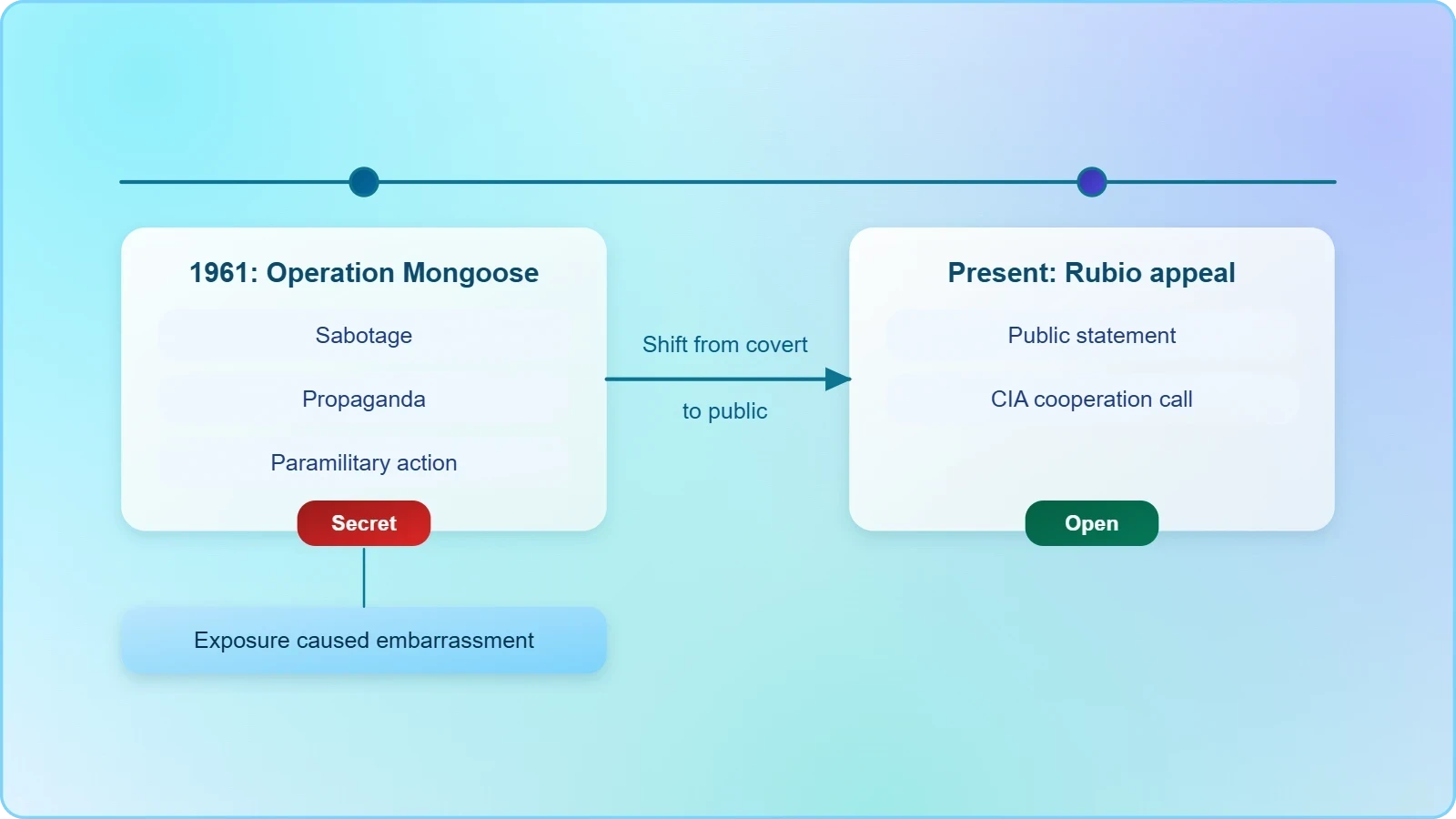
This shift reflects broader changes in how intelligence is weaponized in the information age. Secrecy remains operationally essential, but public disclosure of intent can itself be a coercive tool.
By announcing the appeal, Washington forces Havana to respond publicly, generating a cycle of claim and counterclaim that keeps Cuba’s vulnerabilities in the global spotlight.
Lessons From Six Decades of Failed Coercion
The historical record offers a sobering verdict on coercive strategies toward Cuba. Six decades of embargo, sabotage, and isolation have not dislodged the ruling party, and each escalation has been absorbed and repurposed as evidence of external hostility.
This resilience suggests that public appeals to cooperate with the CIA are unlikely to produce meaningful operational gains.
What they can produce, however, is continued political utility at home. The Cuba file functions as a reliable instrument for mobilizing diaspora support and signaling ideological clarity. Judged by that metric, the Rubio appeal succeeds regardless of its effect in Havana, which explains why such gestures recur despite their meager strategic returns.
The Geopolitics of an Overt Intelligence Overture
Cuba’s strategic significance far exceeds its economic weight, and that asymmetry explains why Washington keeps returning to the island. Positioned at the entrance to the Gulf of Mexico, Havana hosts intelligence facilities and maintains partnerships with Russia and China that American strategists view with persistent unease. Any overture to Cuban citizens is therefore also a message to those rival capitals.
Cuba as a Stage for Great-Power Signaling
By publicly courting Cuban cooperation, Washington signals to Moscow and Beijing that it retains the capacity and will to contest their presence in the Western Hemisphere. The appeal functions as a sphere-of-influence assertion, reminding rivals that the Caribbean remains within America’s declared strategic perimeter. Whether Havana’s partners take the provocation seriously is another matter entirely.
For Russia and China, the episode offers convenient propaganda material. They can portray Washington as meddling and desperate, reinforcing their own narrative of a declining hegemon resorting to crude tactics. The appeal thus generates diplomatic dividends for Havana’s allies at minimal cost, an unintended consequence that Washington’s planners likely anticipated but discounted.
Regional Reactions Across Latin America
Latin American governments will read the appeal through their own political lenses, and reactions will split along ideological lines. Left-leaning administrations will condemn it as interference, while conservative governments may quietly welcome the pressure.
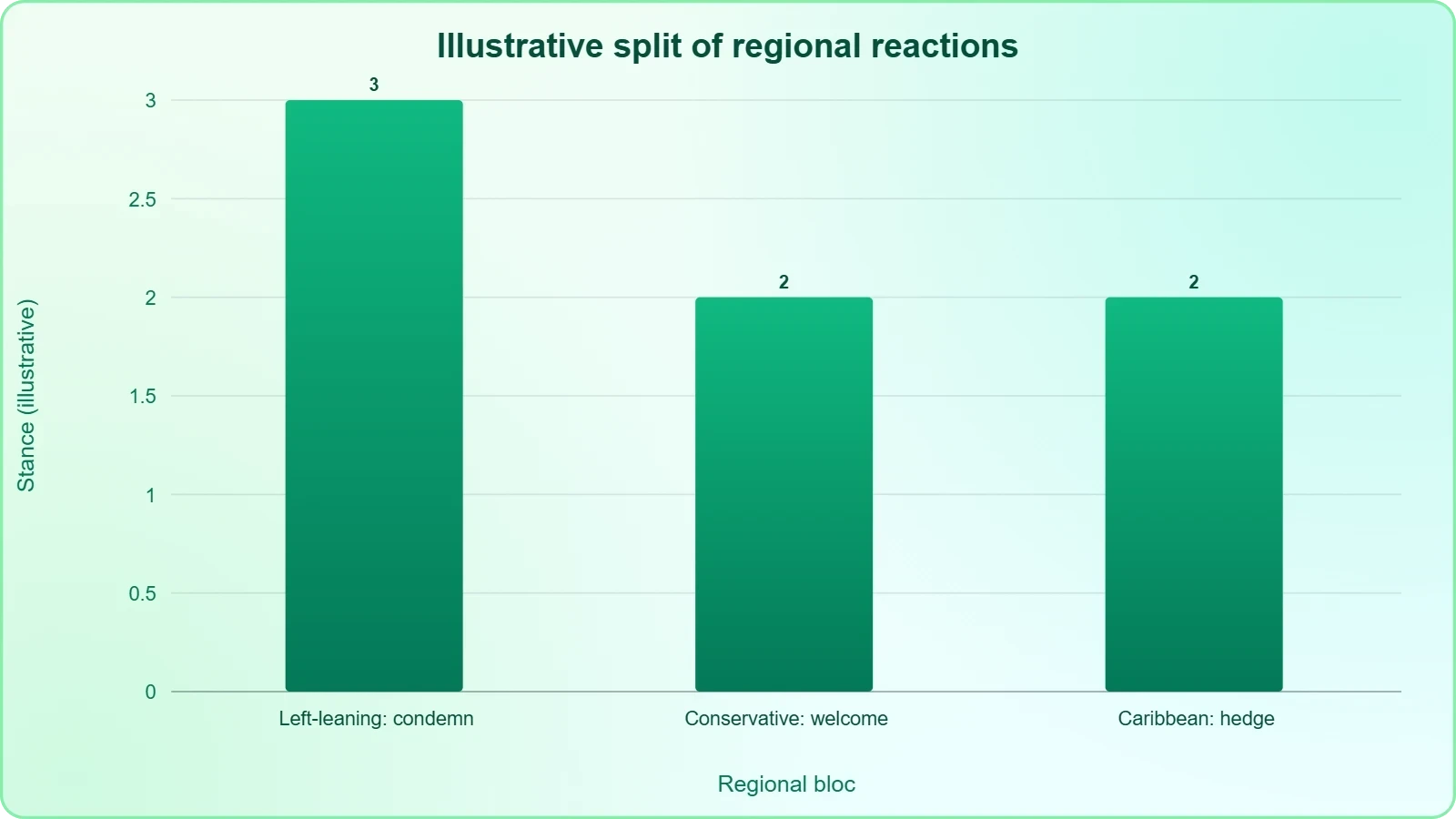
The episode thus becomes another data point in the region’s ongoing polarization over how to engage with Cuba’s political system.
For Caribbean states dependent on Cuban medical cooperation, the appeal creates uncomfortable positioning. They must balance American goodwill against tangible benefits received from Havana, a calculus that discourages loud endorsement of Washington’s approach. The result is likely to be studied silence rather than enthusiastic support, limiting the appeal’s regional resonance.
- 01
- 02
- 03
- 04
Information Warfare and the Battle for Narrative Control
The Rubio appeal is best understood as a salvo in an information war rather than a discrete diplomatic event. Both capitals are competing to define what the episode means, and the winner will be the one whose interpretation achieves broader international uptake. In this contest, speed, repetition, and emotional resonance matter more than factual precision.
Framing Contests and Media Amplification
France 24’s reporting, which noted the absence of detailed elaboration from either side, illustrates how thin the factual substrate can be. A single sentence from a secretary of state generates global coverage, and the interpretive frames attached by each capital travel further than the underlying substance. Media amplification thus becomes the primary battlefield.
Havana’s rapid dismissal was designed to seize the interpretive initiative before Washington could elaborate. By responding within hours, Cuban officials ensured that early coverage paired the appeal with mockery, embedding skepticism into the story’s initial framing. This speed advantage is a recurring feature of Havana’s media strategy against American pressure campaigns.
Verification Gaps and Strategic Ambiguity
The report’s acknowledged lack of detail creates strategic ambiguity that both sides can exploit. Washington can later clarify or soften the appeal without formal retraction, while Havana can characterize it however suits its narrative. Ambiguity thus functions as a shared resource, allowing each capital to claim victory without committing to verifiable positions.
For analysts, this opacity demands caution. Conclusions about the appeal’s operational significance must remain provisional until corroborating details emerge. What can be assessed with confidence is the rhetorical function of the exchange, which operates independently of whatever covert activities may or may not be underway beneath the surface.
Implications for US-Cuba Relations and the Road Ahead
The immediate practical consequences of the appeal are likely to be modest, but its symbolic consequences may prove more durable. It hardens the rhetorical baseline for future engagement, making softer diplomatic gestures harder to justify politically.
Once a secretary of state has publicly invited cooperation with the CIA, retreating to quiet diplomacy becomes awkward and costly.
Escalation Risks and Diplomatic Costs
Escalation carries genuine risks that extend beyond rhetoric. Havana may respond by tightening internal controls, restricting foreign access, or expelling diplomats, each of which complicates American operations on the island. The appeal could thus produce the opposite of its intended effect, reducing rather than expanding Washington’s influence within Cuban society.
Diplomatic costs also accumulate with allies who prefer predictable engagement over public confrontation. European and Latin American partners may quietly distance themselves from an approach they consider counterproductive, narrowing the coalition Washington can assemble around Cuba policy. Isolation, in other words, may be the appeal’s most tangible yield.
What Observers Should Watch Next
Several indicators will reveal whether the appeal was a one-off rhetorical flourish or the opening of a sustained campaign. Watch for follow-up statements from the State Department, changes in embassy staffing, and any uptick in publicized defections or intelligence disclosures. Each would signal that the initial appeal was embedded in a broader operational design.
Equally telling will be Havana’s subsequent messaging. If mockery gives way to sustained countermobilization or internal purges, the appeal will have struck a nerve. If the story fades within weeks, it will confirm that the episode was primarily a domestic political gesture aimed at American audiences rather than a genuine intelligence initiative.
From our network :
- Committed Mediterranean Precipitation Decline: Why Emissions Cuts Alone Cannot Restore Winter RainsNew NOAA research reveals that Mediterranean winter rains may decline irreversibly even with emissions cuts. Explore the science of committed climate change and regional impacts.
- The Final Descent: How ESA Retired the Legendary Cluster Constellation After 24 Years of Space Weather ScienceAfter 24 years mapping Earth’s magnetosphere, ESA’s Cluster mission concluded with a precisely controlled reentry over the South Pacific. This analysis explores the scientific legacy, engineering decisions, and debris mitigation principles behind one of space exploration’s most responsible retirements.
- University Language Proficiency Exams: Why Institutional Tests Demand Different Preparation Than IELTS and TOEFLDiscover why university-specific language proficiency examinations differ fundamentally from IELTS and TOEFL, and learn strategic preparation approaches for institutional assessment success.
- The Hidden Cost of AI Convenience: Why Over-Permissioned Agents Are a Security Time BombDiscover why AI agents with excessive permissions create dangerous single points of failure, and learn how implementing least privilege principles can protect your organization from exploitation.
- CISA’s Ten-Advisory Wave: Why Generic Patching Fails in OT and How to Build Product-Specific PlaybooksCISA released ten ICS advisories in one week, exposing critical infrastructure risks. Generic patching fails in OT. Learn to build product-specific remediation playbooks.
- Mobile Learning and VR in English: What Global Evidence Reveals About Effective Language TechnologyA systematic review across 14 countries reveals which language-learning technologies genuinely work. Mobile learning, AI, and VR show measurable benefits when pedagogically integrated. This evidence-based guide helps educators and learners select technology that delivers real return on investment.
- How AI Agents Will Change the Way We Manage Personal FinancesExplore how AI agents are transforming personal finance through automated budgeting, bill payment, and investment management, while examining the critical security protocols and governance frameworks required for safe deployment.
- Forbidden Matrix Patterns and Visible Lattice Points: A Geometric DictionaryExplore how multidimensional 0–1 matrices encode geometric truths, linking forbidden patterns to visible lattice points and hypergraph theory, with applications in combinatorics and computational geometry.
- Live Online English Classes for Kids: Do They Actually Reduce Anxiety?A ten-week study reveals that synchronous online English classes can significantly reduce child language anxiety while improving listening and reading skills. Discover what makes these programs effective and how parents can select the right one.
RESOURCES
- Cuba has ridiculed a public CIA recruitment appeal by US Secretary ...facebook.com1 day ago ... Cuba has ridiculed a public CIA recruitment appeal by US Secretary of State Marco Rubio as “desperation,” while warning against…
- China's Intelligence Footprint in Cuba: New Evidence and ... - CSIScsis.orgDec 6, 2024 ... It even featured in the 2016 U.S. presidential primary debates when Florida senator Marco Rubio ... partnership with Havana. Russia…
- Marco Rubio calls on those seeking change in Cuba to partner with ...facebook.com1 day ago ... what's the true story behind the 2017 movie 'American Made'? the Barry Seal in the late 1970s versus that of…
- Cuba mocks US 'desperation' after Rubio urges Cubans to work with ...arabnews.com1 day ago ... HAVANA: Cuba on Friday mocked what it called US “desperation” after Secretary of State Marco Rubio urged Cubans seeking political…
- Rubio's CIA Pitch to Cuba Raises the Stakes in Washington's ...latintimes.com15 hours ago ... ... Havana, intensifying U.S. pressure on Cuba ... TOPSHOT - US Secretary of State Marco Rubio speaks with members of ...
- The U.S. Is Actively Seeking Regime Change in Cuba by the End of ...wsj.comJan 22, 2026 ... Cuba's Parliament in Havana. Cuba's National Capitol in Havana ... Marco Rubio, the son of Cuban immigrants who came to…
- The Informant on X: " ⚔️ Rubio publicly urged Cubans seeking ...x.com21 hours ago ... Rubio publicly urged Cubans seeking change to form a "discrete partnership with the CIA ... U.S. "desperation." The post came…
- Cuba Country Report 2026 - Bti-project.orgbti-project.orgWith the return of Trump to the U.S. presidency and Cuban exile hard-liner Marco Rubio as his secretary of state, U.S.-Cuba policy will likely…
- How Marco Rubio Went from “Little Marco” to Trump's Foreign-Policy ...newyorker.comJan 12, 2026 ... Before joining the Trump Administration, he spent his career advocating for America as the leader of the world's democracies; the…
- Rubio targets Cuban military procurement with new sanctionsthehill.comAug 6, 2026 ... Sec. of State Marco Rubio sanctioned 13 Cuban entities and individuals tied to military procurement to pressure the "communist regime."…
- NOMINATIONS - Senate Foreign Relations Committeeforeign.senate.govNov 29, 2022 ... SUBMITTED TO KATHLEEN ANN KAVALEC BY SENATOR MARCO RUBIO ... at the U.S. Embassy in Havana as a guest of…
- A/HRC/63/29/Add.2 Unofficial translation - ohchrohchr.orgSep 8, 2026 ... In January 2026, U.S. Secretary of State Marco Rubio asserted before the Senate that ... cooperation agreements with Cuba. 121.…
- Department Press Briefing – August 12, 2025 - State Departmentstate.govAug 12, 2025 ... Under the leadership of President Trump and Secretary Marco Rubio, the United States continues to pursue a clear-eyed foreign policy…
- US hands off Cuba! - The Militantthemilitant.comMay 22, 2026 ... CIA Director John Ratcliffe went to the island “to deliver a message” to the Cuban government; U.S. spy planes have…
- Cuba's Role in U.S. Presidential Elections - Quincy Institutequincyinst.orgMay 22, 2024 ... ... American candidates, Republican Senators Marco Rubio of Florida and Ted Cruz of Texas. ... us/politics/havana-syndrome-cia-report.html. ↩. Annual ...
- 01
- 02
- 03
- 04
- 05
- 06
- 07
- 08
0 Comments