When crude oil futures drift lower by a few cents on a single Tuesday, the movement itself is rarely the story. The story lives in the reason traders stepped back from their desks: a national election in the world's largest oil-consuming economy, with control of Congress hanging in the balance. On 4 November 2026, benchmark crude slipped modestly as investors awaited United States midterm election results, and the restraint in the market told us more about political risk than about barrels, pipelines, or refinery margins. Prices moved, but conviction did not.
This analysis examines what that cautious dip actually signified. It unpacks how midterm elections reshape energy policy, why traders prefer to wait rather than guess, and how the machinery of oil pricing absorbs political uncertainty. We will look at the regulatory levers Congress controls, the difference between headline volatility and structural repricing, and the way professional investors treat electoral outcomes as inputs rather than verdicts. The small decline was not a forecast of weaker demand; it was a market-wide pause, a collective decision to hold positions until the political picture sharpened.
Understanding this dynamic matters well beyond a single trading session. Energy markets sit at the intersection of geopolitics, regulation, and macroeconomics, and election nights concentrate all three into a few hours of uncertainty. The mechanics of that concentration, and the signals investors read in the aftermath, form the substance of what follows.
On This Page
TL;DR Oil prices edged lower on 4 November 2026 as investors paused ahead of United States midterm election results, a decline driven by uncertainty rather than any shift in supply or demand. The move illustrates how electoral politics feeds directly into energy pricing: control of Congress shapes regulation, permitting, and fiscal policy, and traders respond by reducing exposure until outcomes are clear. The episode is a compact case study in political risk management, showing that in commodity markets the absence of information can move prices as meaningfully as information itself.
The Anatomy of a Cautious Market Dip
A decline of a few cents per barrel is, in absolute terms, almost noise. Daily crude price swings routinely exceed one or two percent on inventory data, weather forecasts, or a single production comment from a major exporter. What distinguishes the 4 November move is its cause: it was not triggered by a supply disruption or a demand revision but by anticipation. Markets fell slightly because participants chose not to trade aggressively, and thin liquidity in a waiting market can nudge prices in either direction. The dip was a symptom of hesitation, not a diagnosis of weakness.
Why Traders Wait Instead of Guessing
Professional energy traders operate under risk limits that reward precision and punish speculation on binary events. An election is precisely such an event: the outcome arrives in a single night, and the policy consequences unfold over months. Rather than position heavily on a guess about congressional control, desks reduce exposure, tighten stops, and wait for the result. This behavior is rational, not timid. When the cost of being wrong exceeds the expected gain from being early, the optimal strategy is patience, and patience in aggregate produces exactly the kind of shallow, directionless drift observed on election day.
The mechanics reinforce the caution. Liquidity thins as participants stand aside, which means smaller order flows move prices more than usual. A modest sell order that would be absorbed in a busy market can push the front-month contract down several cents when the book is light. Investors watching the tape therefore see a decline that reflects market structure as much as market sentiment. Reading political meaning into such a move would be a category error; the correct interpretation is that the market temporarily stopped expressing views.
Uncertainty as a Priced Commodity
Financial theory treats uncertainty as a cost, and commodity markets price it explicitly through volatility premiums and options skew. When the direction of policy is unknown, the range of plausible future prices widens, and participants demand compensation for holding risk through that wider range. The slight dip in crude on election day can be understood as a small risk-off adjustment: some holders trimmed positions rather than carry them through an information event. The price change was modest because the uncertainty itself was bounded, a scheduled event with a known resolution date rather than an open-ended crisis.
This distinction matters for interpretation. Scheduled uncertainty, such as an election, tends to compress into a narrow window and resolve quickly. Unscheduled uncertainty, such as a sudden conflict or an unexpected supply outage, can persist for weeks and command far larger risk premiums. The midterm episode belongs firmly in the first category, which is why the market's response was a gentle dip rather than a sharp selloff. Investors were not fleeing; they were waiting, and the price reflected the cost of that wait.
How Midterm Elections Reach the Oil Market
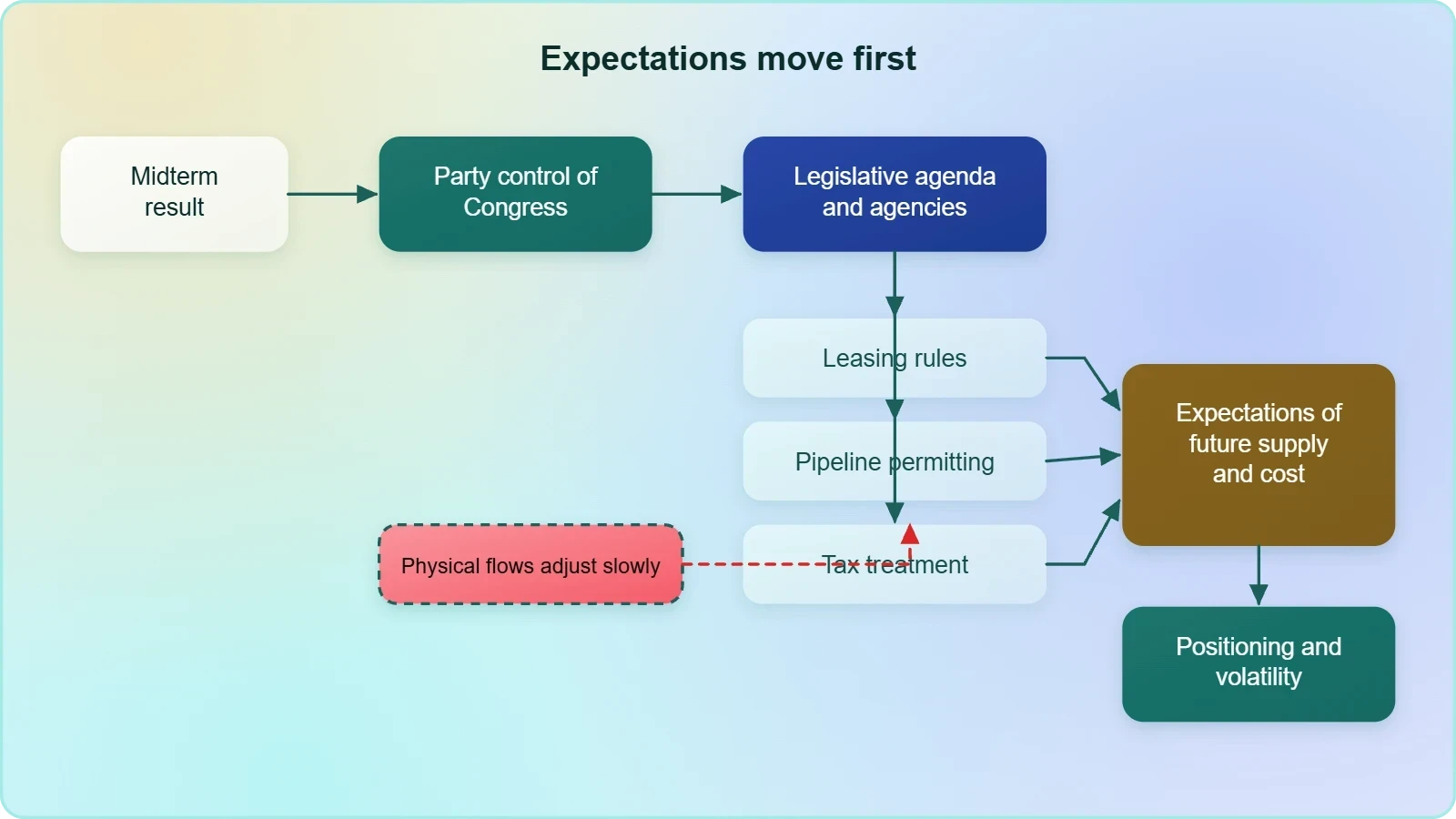
Congress does not set the price of a barrel, but it shapes the conditions under which that barrel is produced, transported, taxed, and sold. Midterm elections determine which party controls the House and Senate, and that control governs the legislative agenda on energy leasing, pipeline permitting, emissions rules, and subsidies for renewables and fossil fuels. Investors therefore treat election results as a leading indicator of the regulatory environment that will prevail for the following two years. The oil market's attention to a midterm vote is not political curiosity; it is a rational assessment of policy risk that eventually shows up in capital expenditure decisions and, ultimately, in supply.
The Regulatory Levers That Matter
Several concrete levers connect elections to crude prices. Federal land and offshore leasing rules determine how quickly new production can be brought online. Pipeline permitting affects the cost of moving crude from wellhead to refinery. Tax treatment, including credits and deductions, influences project economics. Environmental regulation sets compliance costs that vary by jurisdiction. When control of Congress shifts, the expected direction of each lever shifts with it, and traders adjust their medium-term supply assumptions accordingly. Even the anticipation of gridlock, where divided government blocks major changes, is itself a market-relevant outcome because it preserves the status quo.
The transmission mechanism is rarely immediate. Legislation moves slowly, and much energy policy is executed through agencies rather than statutes. What changes quickly is expectation. A market that expects tighter environmental rules may price in higher future compliance costs and slower supply growth; a market that expects looser leasing may price in the opposite. These expectations are embedded in forward curves long before any bill reaches a floor vote. The election-day dip was therefore a small adjustment in a much larger process of expectation-setting that will continue for months.
Reading Policy Signals in Price Action
Sophisticated investors do not simply react to who wins; they react to what the result implies about the balance of power and the likelihood of legislative action. A decisive outcome that removes ambiguity can actually reduce volatility, because the range of plausible policies narrows. A contested or delayed result extends uncertainty and keeps risk premiums elevated. This is why markets sometimes rally after elections regardless of the winner: the resolution of uncertainty is itself valuable. The 4 November dip, occurring before results were known, fits this pattern precisely, as a market paying a small premium for the wait.
Analysts also watch for signals beyond the headline outcome. Committee leadership changes, the fate of specific energy bills, and the composition of state-level results all feed into the assessment. Each signal refines the probability distribution of future policy, and prices adjust incrementally as those probabilities update. The process is continuous and cumulative, which is why a single election night produces a modest move rather than a dramatic one. The market is not waiting for a verdict on oil; it is waiting for a stream of information that will gradually reshape its assumptions.
We Also Published
Supply, Demand, and the Limits of Political Noise
It is tempting to overstate the political dimension of oil pricing. In reality, crude prices are anchored by physical fundamentals: production levels among major exporters, inventory draws and builds, refinery utilization, and the trajectory of global demand. Political events matter at the margin, shaping expectations around those fundamentals rather than replacing them. The 4 November dip was small precisely because the underlying supply and demand picture had not changed. Investors were not repricing barrels; they were repricing the probability distribution of policies that might eventually affect barrels. That distinction keeps the political signal in proportion.
Fundamentals as the Anchor
When fundamentals are tight, political uncertainty tends to be absorbed quickly, because the physical market's needs dominate sentiment. When fundamentals are loose, political noise can have a more visible effect, since there is less underlying pressure to anchor prices. The modest decline observed on election day suggests a market in reasonable balance, where participants felt no urgency to reposition aggressively. Had inventories been critically low or a major supply disruption been underway, the same political uncertainty might have produced a very different reaction, possibly even a rally as traders hedged against policy-driven supply risk.
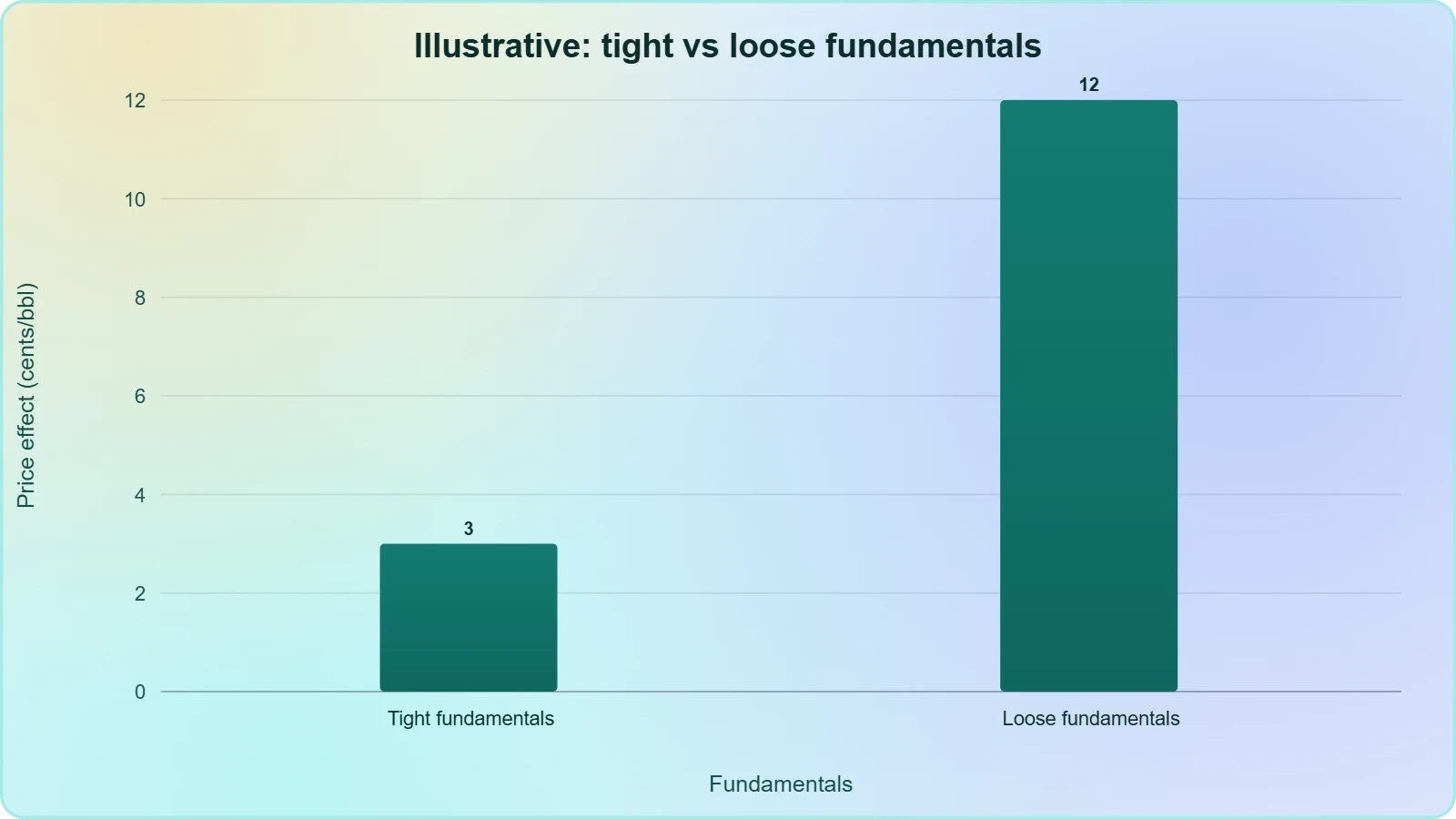
This anchoring effect explains why experienced analysts resist reading too much into single-session moves. A few cents of drift tells you about positioning and liquidity, not about the balance of global supply and demand. The proper analytical response is to separate the political signal from the physical one, assess each on its own terms, and then consider how they interact. On this occasion, the physical signal was neutral and the political signal was one of caution, producing a small net decline that carried little forecasting value.
When Politics Overwhelms Fundamentals
There are moments when politics does dominate. Sanctions regimes, export bans, strategic reserve releases, and major tax changes can move physical flows directly and force rapid repricing. Those are policy actions, not policy uncertainty, and they carry far greater market weight than an election whose consequences will unfold gradually. Investors distinguish sharply between the two. The midterm vote created uncertainty about future policy; it did not itself change any flow of oil. That is why the market's response was a pause rather than a pivot, and why the episode is best understood as a study in anticipation rather than a turning point.
Recognizing this hierarchy is essential for anyone interpreting energy headlines. Not every political event deserves a price reaction, and not every price reaction signals a fundamental shift. The discipline lies in asking what actually changed in the physical world and what merely changed in the realm of expectation. On 4 November, the answer was clear: nothing physical changed, expectations shifted slightly, and prices reflected that modest shift with corresponding modesty.
- 01
- 02
- 03
- 04
The Psychology of Waiting in Commodity Markets
Markets are often described as discounting mechanisms, pricing in the future before it arrives. But discounting requires a view, and when the future is genuinely unknown, the rational response is to stop discounting and start waiting. The psychology of that waiting is a subject in its own right. Traders who hold positions through an information event accept risk they cannot quantify; those who step aside avoid the risk but forgo any advantage from being early. The aggregate of these individual decisions produces the subdued, directionless trading that characterized the session before the midterm results were known.
Risk Aversion and Position Sizing
Professional risk management is fundamentally about position sizing, not prediction. A trader may have a strong view on the likely election outcome and still reduce exposure, because the cost of being wrong on a binary event is asymmetric. Institutional mandates, drawdown limits, and quarterly performance reviews all push desks toward caution around scheduled uncertainty. The result is a market that temporarily empties of conviction. Prices do not collapse; they simply stop being pushed by anyone with size. The slight dip on 4 November is a textbook illustration of this dynamic at work across an entire market simultaneously.
This behavior also explains why post-event moves are often larger than pre-event moves. Once the uncertainty resolves, positions can be rebuilt with confidence, and the release of pent-up conviction can produce a sharper repricing than the cautious drift that preceded it. Investors who understand this pattern prepare for the aftermath rather than the event itself, positioning to respond to the information rather than to guess at it. The waiting period is not wasted time; it is the necessary prelude to a more decisive phase of trading.
Information Events and Market Efficiency
Elections are information events, and their relationship to market efficiency is subtle. In efficient markets, prices should already reflect all available information, which means the election's outcome should move prices only to the extent it differs from expectations. The pre-election dip reflects the market's attempt to price the probability distribution of outcomes rather than any single result. When the actual result arrives, prices adjust by the difference between expectation and reality, which is often smaller than observers anticipate. This is why dramatic election nights frequently produce modest market moves, and why the cautious pre-event drift is a sign of efficiency rather than dysfunction.
The practical implication for investors is that election-driven volatility is usually better managed through preparation than prediction. Understanding which policy levers matter, how quickly they can change, and which assets are most exposed allows for calibrated positioning without requiring a forecast of the result. The market's collective hesitation on 4 November was, in this light, a sophisticated response: a recognition that the value of waiting exceeded the value of guessing, and that the information about to arrive would be more useful than any position taken in advance.
What the Episode Reveals About Global Energy Governance
Zooming out from the trading session, the midterm episode illuminates a broader truth about global energy governance: the world's largest consumer economy exercises enormous influence over energy markets not only through its consumption but through the predictability of its policy framework. When that framework is subject to electoral revision, the effects ripple outward to exporters, shipping companies, refiners, and importers across every continent. The slight dip in crude was a local expression of a global phenomenon, a reminder that the political stability of one nation is a variable in the pricing equations of many others.
The Exporters' Perspective
Producers outside the United States watch American elections with particular attention because US policy affects both the demand for their barrels and the competitive position of American producers. Changes to leasing rules or export policy can alter the global supply balance, while shifts in environmental regulation can affect the relative cost of different crude grades. Exporters therefore incorporate US political risk into their long-term planning, adjusting investment timelines and market strategies in response to expected policy trajectories. The election-day caution in crude markets was, from their vantage point, a familiar and rational response to a recurring source of uncertainty.
For national oil companies and sovereign wealth funds, the calculus extends beyond price to strategy. A policy environment that favors domestic US production may compress the market share available to exporters, while one that constrains it may open opportunities. These considerations are weighed over years, not days, but they begin with the same electoral signals that traders read in a single session. The midterm vote was one input among many, but it was an input that every serious participant in the global oil market had reason to monitor.
Lessons for Investors and Policymakers
For investors, the lesson is that political risk is manageable when it is understood as a structured variable rather than an unpredictable shock. Elections are scheduled, their possible outcomes are enumerable, and their policy consequences can be mapped to specific market exposures. This makes them amenable to preparation rather than prediction. For policymakers, the lesson is that market confidence depends on the predictability of the policy process itself. A framework that investors can anticipate, even when they dislike its direction, supports more efficient pricing than one that lurches unpredictably between regimes.
The 4 November episode, modest as it was, encapsulates both lessons. The market did not panic; it waited. It did not abandon fundamentals; it held them in view while adjusting for political uncertainty. And it did not treat the election as a verdict on oil's future; it treated it as one more piece of information in an ongoing process of price discovery. That disciplined response is the real story behind the headline, and it is the behavior that makes energy markets resilient in the face of political change.
Reading the Signal Without Overreading It
The final discipline in interpreting an episode like this is restraint. A small price decline on election day is a genuine signal, but it is a signal about market conditions rather than about the future of oil. It tells us that participants were cautious, that liquidity was thin, and that uncertainty was priced modestly. It does not tell us where crude will trade next month, whether supply will rise or fall, or which policies will ultimately be enacted. The value of the episode lies in what it teaches about how markets process political information, not in any forecast it provides about prices.
Separating Signal from Noise
Experienced analysts develop a hierarchy of market signals, ranking them by persistence and physical relevance. Inventory data, production decisions, and demand trends sit near the top because they reflect real flows that persist over time. Political events sit lower, not because they are unimportant but because their effects are mediated through policy processes that unfold slowly and uncertainly. The election-day dip belongs in this lower tier, a genuine but transient signal whose main value is diagnostic: it reveals how the market was positioned and how it responds to scheduled uncertainty.
This hierarchy also guards against the temptation to narrativize every move. Markets move constantly, and the human mind readily constructs stories to explain each fluctuation. The professional approach is to ask whether a move is consistent with known fundamentals, whether it reflects positioning or information, and whether it is likely to persist. On 4 November, the answers pointed to a positioning-driven, information-poor move that carried little persistence. Recognizing that is itself a form of analytical skill, and it is the skill that separates disciplined interpretation from reactive commentary.
The Enduring Relevance of Political Risk
None of this diminishes the importance of political risk in energy markets. Elections genuinely matter, and the policies they produce can reshape supply and demand for years. The point is that their influence is exercised through identifiable channels and over identifiable timeframes, which makes it analyzable rather than mysterious. Investors who map those channels, monitor the relevant signals, and calibrate their exposure accordingly are better positioned than those who react to every headline. The midterm episode was a small demonstration of this principle, and its lessons scale to far larger political events.
As the results came in and the uncertainty resolved, the market's attention shifted from the vote itself to its implications, and the process of gradual repricing began. That transition, from waiting to interpreting, is where the real analytical work happens. The slight dip of 4 November was merely the opening note in a longer conversation between politics and prices, a conversation that will continue to shape energy markets long after the ballots are counted.
From our network :
- The Final Descent: How ESA Retired the Legendary Cluster Constellation After 24 Years of Space Weather ScienceAfter 24 years mapping Earth’s magnetosphere, ESA’s Cluster mission concluded with a precisely controlled reentry over the South Pacific. This analysis explores the scientific legacy, engineering decisions, and debris mitigation principles behind one of space exploration’s most responsible retirements.
- How AI Agents Will Change the Way We Manage Personal FinancesExplore how AI agents are transforming personal finance through automated budgeting, bill payment, and investment management, while examining the critical security protocols and governance frameworks required for safe deployment.
- Committed Mediterranean Precipitation Decline: Why Emissions Cuts Alone Cannot Restore Winter RainsNew NOAA research reveals that Mediterranean winter rains may decline irreversibly even with emissions cuts. Explore the science of committed climate change and regional impacts.
- Mobile Learning and VR in English: What Global Evidence Reveals About Effective Language TechnologyA systematic review across 14 countries reveals which language-learning technologies genuinely work. Mobile learning, AI, and VR show measurable benefits when pedagogically integrated. This evidence-based guide helps educators and learners select technology that delivers real return on investment.
- The Hidden Cost of AI Convenience: Why Over-Permissioned Agents Are a Security Time BombDiscover why AI agents with excessive permissions create dangerous single points of failure, and learn how implementing least privilege principles can protect your organization from exploitation.
- University Language Proficiency Exams: Why Institutional Tests Demand Different Preparation Than IELTS and TOEFLDiscover why university-specific language proficiency examinations differ fundamentally from IELTS and TOEFL, and learn strategic preparation approaches for institutional assessment success.
- CISA’s Ten-Advisory Wave: Why Generic Patching Fails in OT and How to Build Product-Specific PlaybooksCISA released ten ICS advisories in one week, exposing critical infrastructure risks. Generic patching fails in OT. Learn to build product-specific remediation playbooks.
- Forbidden Matrix Patterns and Visible Lattice Points: A Geometric DictionaryExplore how multidimensional 0–1 matrices encode geometric truths, linking forbidden patterns to visible lattice points and hypergraph theory, with applications in combinatorics and computational geometry.
- Live Online English Classes for Kids: Do They Actually Reduce Anxiety?A ten-week study reveals that synchronous online English classes can significantly reduce child language anxiety while improving listening and reading skills. Discover what makes these programs effective and how parents can select the right one.
RESOURCES
- Four ways the midterms can reshape US energy policyatlanticcouncil.orgOct 19, 2026 ... How will the upcoming midterm elections affect US energy policy? ... prices for fuels such as natural gas. But the…
- Trump strikes deal with Putin for Russian diesel in sharp ... - PBSpbs.orgOct 9, 2026 ... ... prices ahead of the U.S. midterm elections ... Trump strikes deal with Putin for Russian diesel in sharp reversal…
- Trump strikes deal with Putin to get diesel in sharp reversal of US ...opb.orgOct 9, 2026 ... ... prices ahead of the U.S. midterm elections. The price of a ...
- Why experts say the Iran war underscores risks of Trump's all ... - PBSpbs.orgMar 19, 2026 ... "The biggest short-term losers of the war will be U.S. consumers of oil and gas, as energy prices rise," said…
- FACTBOX: Energy affordability dominates US midterm contests as ...spglobal.comAug 4, 2026 ... Democrats: Link higher energy prices to Trump foreign policy and Republicans' clean energy rollbacks ... Oil price politics. US-Iran ...
- How War, Tariffs, and Other Foreign Policy Issues Could Affect the ...cfr.org5 days ago ... On November 3, voters in the United States head to the polls to cast their ballots in the midterm elections.…
- US midterm elections to have little impact on oil output, analysts sayspglobal.comSep 9, 2026 ... ... policies that could pass Congress with a narrow Democratic majority, energy market analysts said. Even if Democrats were to…
- Trump says oil and gas prices won't fall until after midterm electioncnbc.comSep 9, 2026 ... President Donald Trump said energy prices that have been elevated due to the Iran war will not come down until…
- The Energy Election: 2026 Midterms Likely To Determine ... - Forbesforbes.comOct 19, 2026 ... ... US House of Representatives up for grabs, state-level energy policy could be the deciding factor in setting energy prices…
- Trump sees Iran war ending 'very soon', oil prices then falling - CNBCcnbc.comSep 12, 2026 ... Politics & Policy. Trump sees Iran war ending soon after midterm elections, predicts oil prices will then fall sharply. Published…
- Another oil crisis is here. How will American drivers respond?brookings.eduApr 27, 2026 ... Elevated gasoline prices will likely impact the midterm elections: The average ... Absent a drop in global crude prices, no…
- Trump's pledge not to hit Iran before midterms can't soothe oilnbcnews.comOct 8, 2026 ... U.S. crude oil also ended the trading session up 3.6%, at $91.49, after having jumped to nearly $93. Other critical…
- Pain at the pump: What spiking gas prices mean for consumers, the ...siepr.stanford.eduMar 25, 2026 ... Stanford Environmental and Energy Policy Analysis Center (SEEPAC) ... midterm elections. At the start of the year, the administration ...
- Energy News | Top Energy Headlines | Reutersreuters.comAmericans head to the polls today in midterm elections that could shape the final two years of President Trump's agenda. Oil prices swing after…
- 'Nightmare scenarios': Iran hits oil targets, testing Trump's Tefloneenews.netMay 14, 2026 ... The regime's attacks on tankers and refineries could reverberate through the U.S. economy ahead of midterms. President Donald Trump speaks ...
- 01
- 02
- 03
- 04
- 05
- 06
- 07
- 08
0 Comments