France convulsed on Saturday, October 24, 2026, as tens of thousands of citizens poured into the streets to denounce the relentless erosion of purchasing power and the widening chasm between the nation's wealthiest and its working majority.
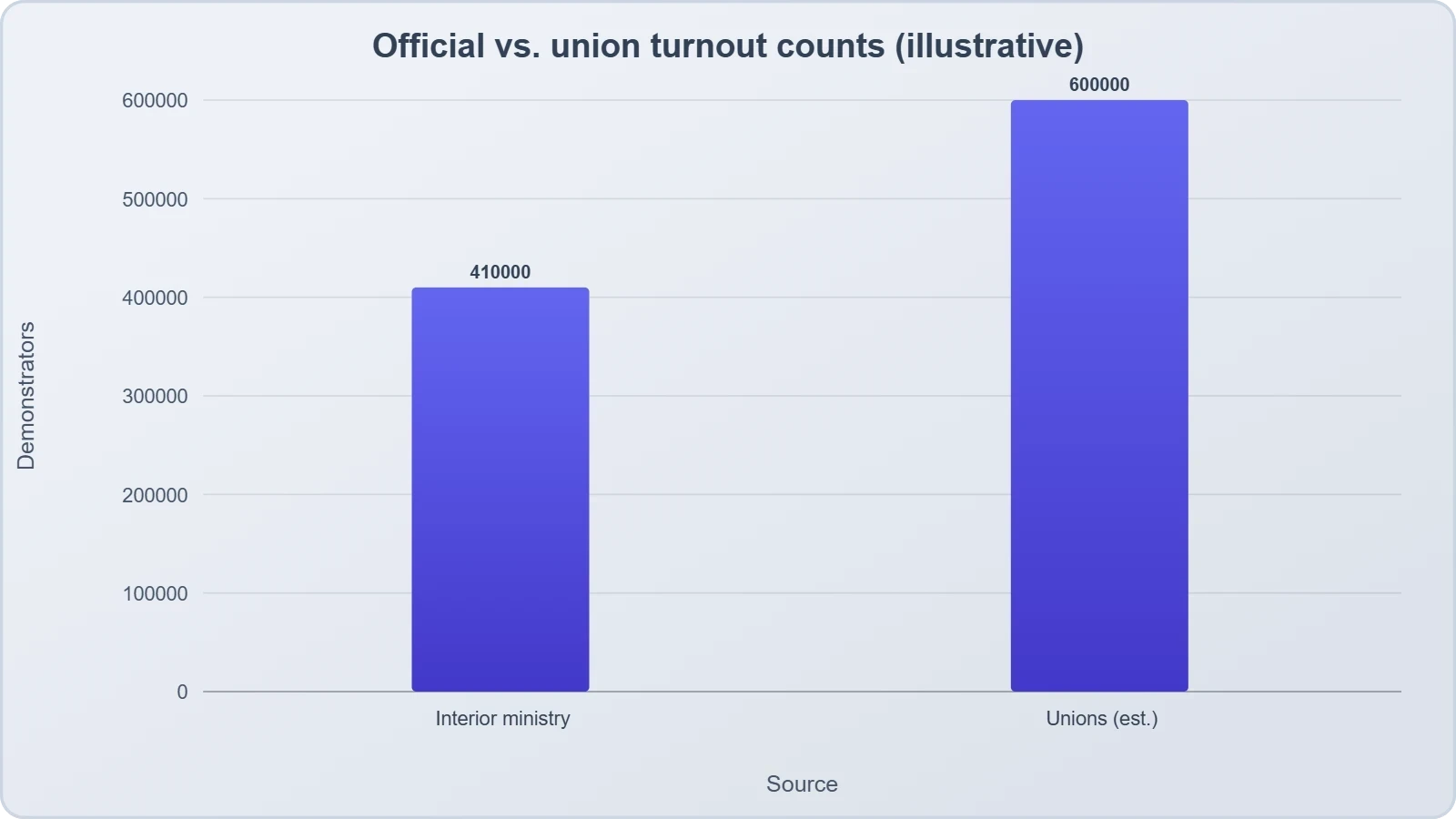
The interior ministry placed the national turnout at 410,000, while trade unions insisted the true figure was substantially higher, a familiar statistical duel that has become a ritual of French protest politics.
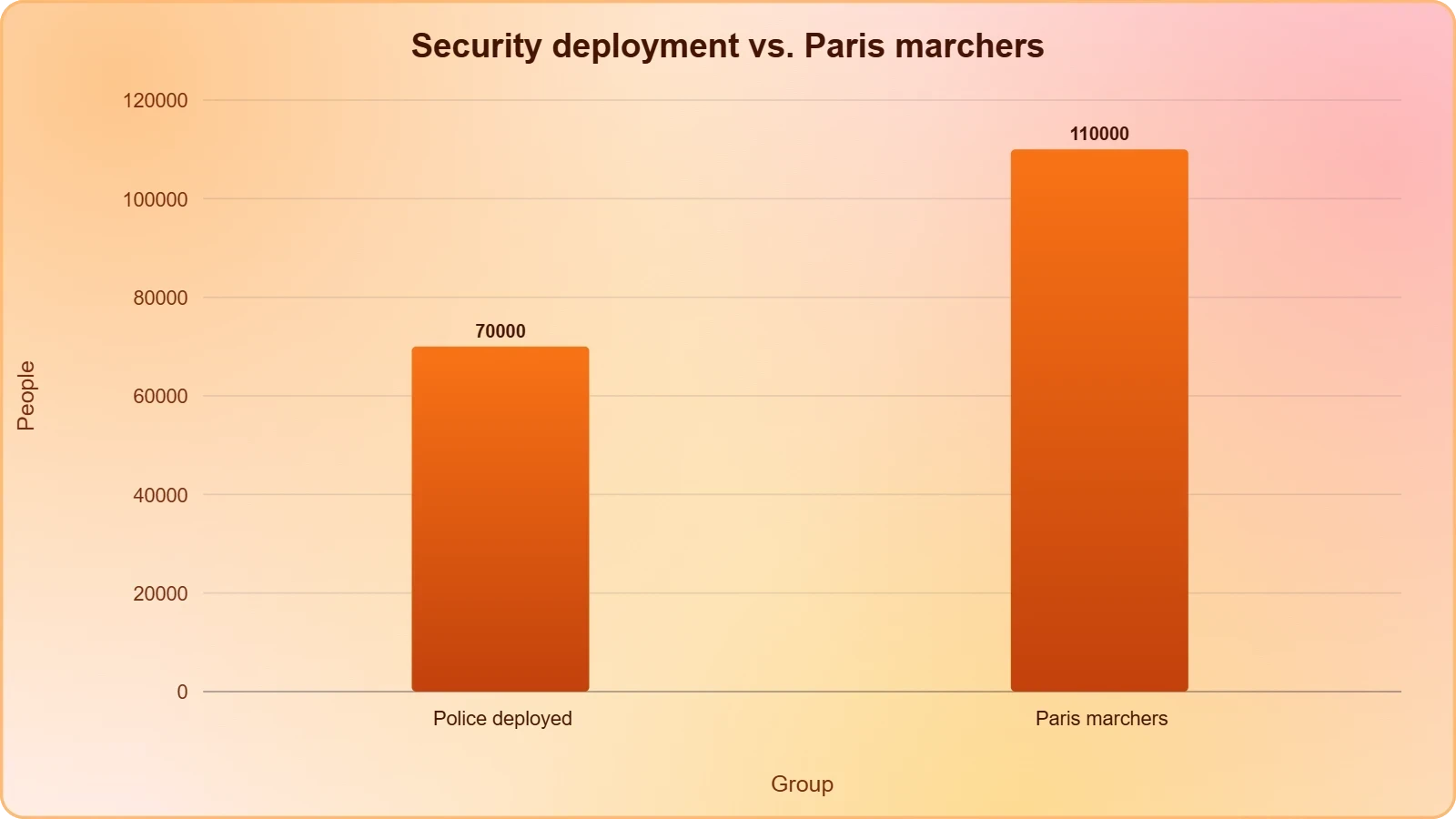
In Paris alone, at least 110,000 demonstrators marched against rising living costs, transforming the capital's boulevards into a theatre of grievance and defiance.
On This Page
The state answered with overwhelming force. More than 70,000 police officers and elite security units were deployed across the country, an extraordinary mobilisation that underscores how seriously the government of President Emmanuel Macron's successor viewed the threat of contagion.
Clashes erupted in Paris, Marseille, Lyon, Bordeaux, Grenoble, Clermont-Ferrand, Lille, Rennes, Nantes and Toulouse, with hooded youths setting trash cans ablaze, hurling rocks and bottles, and forcing police to respond with tear gas and water cannons.
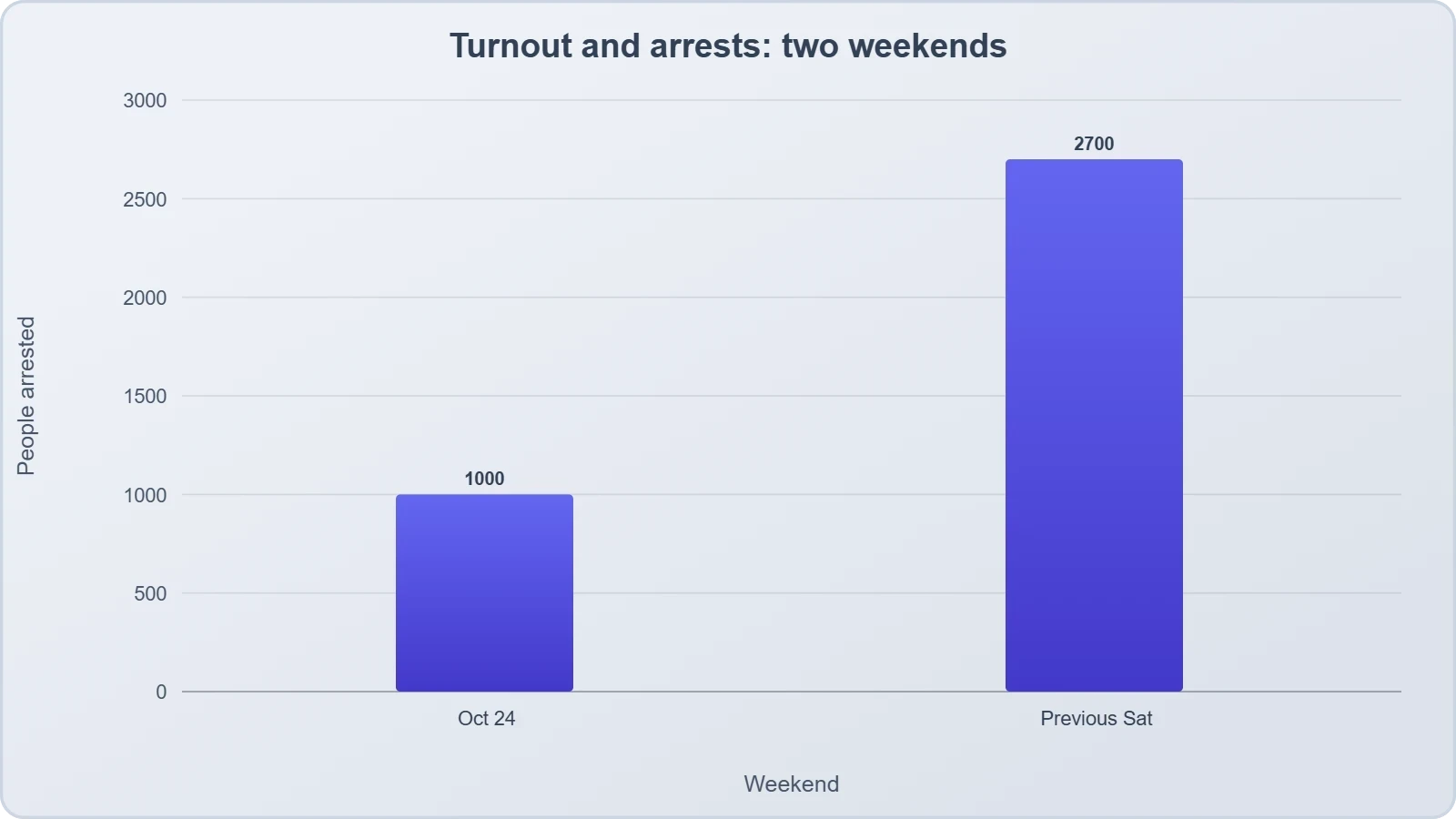
Interior Minister Laurent Nunez confirmed that nearly 1,000 people had been arrested, a tally expected to climb as officials finalised their count.
Yet the unrest was measurably smaller than the previous Saturday's convulsion, when buildings were defaced and torched and roughly 1,500 shops were looted, prompting 2,700 arrests. A Deutsche Welle correspondent in Paris observed that altercations between police and demonstrators are largely embedded in France's protest culture, and that Saturday's denouement could be read as a relatively calm close to the demonstrations.
In Milan, Italy, security guards were deployed during separate cost-of-living protests that proved less unruly than the prior weekend, suggesting the discontent is not confined to French borders.
TL;DR France witnessed nationwide protests on October 24, 2026, drawing 410,000 demonstrators according to the government and higher estimates from unions, with at least 110,000 in Paris alone. Over 70,000 security personnel were deployed, clashes erupted in more than ten cities, and nearly 1,000 arrests were made — a marked de-escalation from the previous weekend's 2,700 arrests and 1,500 looted shops. The episode crystallises France's enduring struggle with inflation, inequality, and the combustible chemistry between street politics and state authority.
The Anatomy of a National Mobilisation
Saturday's protests were not a spontaneous eruption but the culmination of weeks of mounting frustration over stagnant wages, soaring energy bills, and a perception that fiscal policy favours the affluent.
The interior ministry's figure of 410,000 participants nationwide represents a substantial show of force, yet the gap between official and union counts reveals a deeper contest over narrative control.
In Paris, at least 110,000 people demonstrated, a concentration that placed the capital at the epicentre of the movement and demanded the heaviest security deployment.
The Geography of Discontent
Clashes were reported in Lyon, Bordeaux, Grenoble, Clermont-Ferrand, Lille, Rennes, Nantes and Toulouse, a geographic spread that signals the movement's reach beyond the Parisian periphery. In Marseille, young people blocked roads with burning trash cans and pelted security forces with rocks and bottles, a tactic that has become emblematic of urban protest in France's second city. The simultaneous eruption across so many municipalities suggests coordinated mobilisation rather than isolated outbursts.
The deployment of more than 70,000 police and elite security forces represents one of the largest internal security operations in recent French history. Interior Minister Laurent Nunez framed the operation as a success, noting that multiple lootings had been prevented and that arrests approached 1,000.
Yet the sheer scale of the deployment raises questions about the fiscal and social cost of policing dissent at this magnitude.
Paris as the Crucible
In Paris, police used tear gas and water cannons to disperse a group of about 500 hooded youths at the close of an approved rally, a sequence that has become almost choreographed in the French protest repertoire.
The violence occurred at the margins of an otherwise sanctioned demonstration, suggesting that a militant fringe exploits legitimate gatherings to confront the state. A DW reporter characterised the altercations as largely part of France's protest culture, framing the day's end as relatively calm.
This cultural reading is not merely journalistic colour; it reflects a deep-seated French tradition in which street protest functions as a legitimate instrument of political expression, enshrined in the national imagination since 1789. The state's tolerance for demonstration, paired with its readiness to deploy overwhelming force, produces a distinctive equilibrium. Saturday's events fit that pattern with unsettling precision.
Arrests, Looting, and the Calculus of Control
The arrest figures tell a story of comparative restraint. Nearly 1,000 people were detained on Saturday, against 2,700 the previous weekend, when buildings were defaced and burned and approximately 1,500 shops were looted.
Interior Minister Laurent Nunez emphasised that multiple lootings had been prevented, a claim that positions the security operation as a success in protecting commercial property. Yet the numbers also reveal a state calibrating its response to avoid the optics of overreach.
The Previous Weekend as Benchmark
The prior Saturday's disorder, with its burning buildings and mass looting, established a baseline of chaos against which Saturday's events appear comparatively contained. That comparison matters politically: a government eager to demonstrate control will highlight the decline in arrests and destruction as evidence of effective policing.
Critics, however, will note that nearly a thousand arrests in a single day remains an extraordinary figure for a liberal democracy.
Nunez's public accounting of prevented lootings serves a dual purpose, reassuring shopkeepers and investors while projecting competence. The interior ministry's communications strategy reflects a broader pattern in French crisis management, where quantitative transparency is deployed to shape perception. Whether the public accepts that framing depends largely on the images that circulate from the streets.
Policing Dissent in a Liberal Democracy
The deployment of 70,000 security personnel raises profound questions about the balance between public order and civil liberty. France's protest culture is protected by constitutional tradition, yet the state's capacity to mobilise overwhelming force creates an asymmetry that critics argue chills legitimate dissent.
The use of tear gas and water cannons against hooded youths at an approved rally's conclusion illustrates the fine line between containment and confrontation.
Legal scholars have long debated whether France's policing model, with its doctrine of maintaining order through visible force, is compatible with evolving European human rights standards. Saturday's events will likely fuel that debate, particularly if footage of water cannons against young demonstrators circulates widely. The government's defence will rest on the prevention of looting and the protection of property.
The Economic Grievance Beneath the Flames
At the heart of the unrest lies a straightforward economic complaint: the cost of living has outpaced wages, and inequality has widened to levels that many French citizens consider intolerable.
Rising energy prices, food inflation, and housing costs have squeezed household budgets, particularly in peri-urban and rural areas where public services have thinned. The protests are not merely about abstract inequality but about the tangible experience of making less go further.
Inflation and Purchasing Power
France's inflation trajectory, like much of Europe's, has been shaped by energy market volatility and supply chain disruptions. While headline figures may have moderated from their peaks, the cumulative effect on purchasing power is what animates the streets.
Workers who negotiated wage increases find them eroded by price levels, and pensioners on fixed incomes feel the squeeze most acutely.
The government's fiscal response has been criticised as insufficiently targeted, with critics arguing that support measures have disproportionately benefited corporations and higher earners. This perception of unfairness is politically combustible in a country where the social contract is understood to guarantee a certain quality of life. The protests translate that abstract sense of injustice into concrete demands.
Inequality as a Political Flashpoint
Growing inequality in France has become a defining political issue, cutting across traditional left-right divides and fuelling populist movements on both flanks. The concentration of wealth in Paris and a handful of metropolitan centres contrasts sharply with the stagnation of provincial towns, a geographic dimension that Saturday's nationwide clashes made visible.
The burning trash cans of Marseille and the blocked roads of Toulouse are symptoms of that spatial inequality.
Economists note that France's tax and transfer system remains among the most redistributive in the OECD, yet public perception often diverges from statistical reality. That gap between measured redistribution and felt fairness is precisely where political discontent incubates.
Saturday's protests are less a rejection of the welfare state than a demand that it deliver on its promises.
France's Protest Culture and the Security State
France's protest tradition is not an aberration but a constitutive element of its political identity, dating to the Revolution and reinforced by the strikes and barricades of the nineteenth and twentieth centuries. The right to demonstrate is constitutionally protected, and the state's response has historically oscillated between accommodation and repression.
Saturday's events fit squarely within that lineage, with the DW correspondent's observation that altercations are "largely part of France's protest culture" capturing the ritualised quality of the confrontation.
The Ritual of Confrontation
The choreography of French protest, from the approved rally to the tear gas at its conclusion, follows a recognisable script. Hooded youths, often described as casseurs, exploit the cover of legitimate demonstrations to confront police, while the state deploys overwhelming force to reclaim control.
This dynamic produces a predictable cycle of violence at the margins, which both sides use to advance their narratives.
Understanding this ritual is essential to interpreting Saturday's events accurately. The relatively calm end noted by the DW reporter suggests that the security operation achieved its objective of containment without triggering the kind of systemic breakdown seen the previous weekend. The state can claim success, while demonstrators can claim their message was heard.
Comparative Perspective: Milan and Beyond
In Milan, Italy, security guards were deployed during separate demonstrations against the rising cost of living, which proved less unruly than the previous weekend. The Italian comparison is instructive: cost-of-living discontent is a European-wide phenomenon, but the institutional channels for expressing it differ markedly. Italy's protest culture is less confrontational than France's, and its policing model less militarised.
The transnational dimension of the grievances, from energy prices to housing costs, suggests that Saturday's French protests are a local expression of a continental malaise. Whether that malaise produces sustained political realignment or episodic unrest depends on how governments respond.
France's experience offers a cautionary tale about the costs of ignoring the economic anxieties of the working majority.
- 01
- 02
- 03
- 04
We Also Published
Political Fallout and the Road Ahead
The political consequences of Saturday's protests will unfold over the coming weeks, shaping the government's legislative agenda and the opposition's rhetorical strategy. Interior Minister Laurent Nunez's public accounting of arrests and prevented lootings signals a government eager to project control while acknowledging the depth of public anger.
The opposition, from both the left and the populist right, will seize on the unrest to argue that the administration has lost touch with ordinary citizens.
Government Strategy Under Pressure
The administration faces a delicate balancing act: it must reassure investors and moderate voters that order prevails, while addressing the economic grievances that fuel the protests. Fiscal measures targeting purchasing power, such as energy subsidies or targeted tax relief, are likely to be debated.
Yet the fiscal space is constrained by European budget rules and the need to maintain credibility with bond markets.
Nunez's emphasis on prevented lootings suggests a communications strategy centred on competence rather than empathy. Whether that resonates with a public sympathetic to the protesters' economic complaints is uncertain. The government's challenge is to demonstrate that it hears the grievances without appearing to capitulate to the streets.
What Comes Next
The trajectory of French protest movements is notoriously difficult to predict. Some fizzle after a weekend of catharsis; others, like the Yellow Vests, snowball into sustained movements that reshape national politics.
The key variables are the organisational capacity of unions, the cohesion of the protest coalition, and the government's willingness to make concessions. Saturday's turnout suggests a substantial reservoir of discontent.
The Milan comparison offers a modest caution against overstating the French exception: cost-of-living anger is widespread across Europe, but its political expression varies by institutional context. France's distinctive combination of a strong protest culture and a centralised state produces a particularly volatile chemistry. The coming weeks will reveal whether Saturday's unrest was a peak or a prelude.
Reading the Numbers: Turnout, Arrests, and Credibility
The statistical contest between the interior ministry's 410,000 and the unions' higher estimates is more than a numbers game; it is a struggle over legitimacy. Turnout figures determine the perceived strength of the movement and, by extension, its political leverage.
Governments historically undercount while organisers overcount, and the gap between the two is itself a political datum. Saturday's discrepancy follows a well-worn pattern.
The Politics of Counting
Independent crowd scientists have long noted that both police and union estimates are methodologically flawed, with police counting at entry points and unions extrapolating from dense sections. The true figure likely lies between the two, but the political utility of the numbers lies in their rhetorical force rather than their precision. Each side selects the figure that serves its narrative.
For the government, a lower turnout supports the claim that the protests are a fringe phenomenon rather than a national uprising. For unions, a higher figure demonstrates the breadth of discontent and strengthens their bargaining position. The public, exposed to both figures, must adjudicate between competing authorities.
Arrests as a Metric of Control
The arrest count, nearly 1,000 on Saturday against 2,700 the previous weekend, functions as a proxy for the intensity of disorder and the effectiveness of policing. A lower arrest count can be read as evidence of successful deterrence or as a sign that the protests were smaller and less confrontational. Nunez's framing emphasises prevention, positioning the state as proactive rather than reactive.
Yet arrests also carry human and political costs, particularly when they involve young people from marginalised communities. The images of hooded youths dispersed by water cannons resonate beyond France, shaping international perceptions of the country's stability. The government must weigh the benefits of visible control against the reputational risks of heavy-handedness.
From our network :
- CISA’s Ten-Advisory Wave: Why Generic Patching Fails in OT and How to Build Product-Specific PlaybooksCISA released ten ICS advisories in one week, exposing critical infrastructure risks. Generic patching fails in OT. Learn to build product-specific remediation playbooks.
- Forbidden Matrix Patterns and Visible Lattice Points: A Geometric DictionaryExplore how multidimensional 0–1 matrices encode geometric truths, linking forbidden patterns to visible lattice points and hypergraph theory, with applications in combinatorics and computational geometry.
- The Hidden Cost of AI Convenience: Why Over-Permissioned Agents Are a Security Time BombDiscover why AI agents with excessive permissions create dangerous single points of failure, and learn how implementing least privilege principles can protect your organization from exploitation.
- Committed Mediterranean Precipitation Decline: Why Emissions Cuts Alone Cannot Restore Winter RainsNew NOAA research reveals that Mediterranean winter rains may decline irreversibly even with emissions cuts. Explore the science of committed climate change and regional impacts.
- Mobile Learning and VR in English: What Global Evidence Reveals About Effective Language TechnologyA systematic review across 14 countries reveals which language-learning technologies genuinely work. Mobile learning, AI, and VR show measurable benefits when pedagogically integrated. This evidence-based guide helps educators and learners select technology that delivers real return on investment.
- How AI Agents Will Change the Way We Manage Personal FinancesExplore how AI agents are transforming personal finance through automated budgeting, bill payment, and investment management, while examining the critical security protocols and governance frameworks required for safe deployment.
- University Language Proficiency Exams: Why Institutional Tests Demand Different Preparation Than IELTS and TOEFLDiscover why university-specific language proficiency examinations differ fundamentally from IELTS and TOEFL, and learn strategic preparation approaches for institutional assessment success.
- Live Online English Classes for Kids: Do They Actually Reduce Anxiety?A ten-week study reveals that synchronous online English classes can significantly reduce child language anxiety while improving listening and reading skills. Discover what makes these programs effective and how parents can select the right one.
- The Final Descent: How ESA Retired the Legendary Cluster Constellation After 24 Years of Space Weather ScienceAfter 24 years mapping Earth’s magnetosphere, ESA’s Cluster mission concluded with a precisely controlled reentry over the South Pacific. This analysis explores the scientific legacy, engineering decisions, and debris mitigation principles behind one of space exploration’s most responsible retirements.
RESOURCES
- Macron urges calm as France counts cost of worst unrest in yearsreuters.com5 days ago ... One protester died on Saturday after suffering a cardiac arrest during demonstrations in Paris. Police made 2,400 arrests across France,…
- France protests: Violent clashes, looting and buildings ablaze ... - BBCbbc.com7 days ago ... ... demonstrations against hardship in schools and the cost of living. At least 1,200 people were arrested during what the…
- Mass protests in France spiral into worst riots in years - Reutersreuters.comOct 17, 2026 ... PARIS, Oct 17 (Reuters) - Rioting erupted in cities across France on Saturday as demonstrations against rising living costs and…
- Buildings set ablaze and more than 1,800 arrested as police clash ...theguardian.comOct 17, 2026 ... “We are fighting because the cost of living ... More than 1,800 arrested in France as protests spread across Europe.…
- Macron condemns those who 'sought to bring down the Republic ...pbs.org7 days ago ... New tensions erupted in Paris on Sunday. Macron addresses nation after clashes at cost-of-living protests in France. French President Emmanuel ...
- Cost of living protests hit Belgium, Italy, Portugal and Francealjazeera.comOct 17, 2026 ... Italian demonstrators clash with police at Piazza Duomo in Milan on October 17 2026. ... French Prime Minister Sebastien Lecornu…
- France protests: Some 2,400 arrested after looting and arsondw.com10/18/2026 October 18, 2026. Rioters ... Almost 2,400 people were arrested across France following riots, looting and arson during cost-of-living protests, ...
- France protests updates: Curfews imposed in parts of Paris, other ...aljazeera.com5 days ago ... ... demonstrations against the cost of living and rising fuel prices, in Lyon, France, October 19, 2026. The graffiti on…
- France PM says around 1,200 arrested, 150 police officers injured ...cbc.caOct 17, 2026 ... October 17. October 17 · 5:46 PM EDT. Violence in cities across France as hundreds of thousands take to streets…
- French police arrest more than 1,800 people after violent protests ...cbsnews.com7 days ago ... ... protest against the high cost of living, in Lille, northern France, on Oct. 17, 2026. Sameer AL-DOUMY /AFP via…
- Macron denounces 'unbridled' violence as France hit by new clashesafp.com7 days ago ... French President Emmanuel Macron on Sunday slammed the "unbridled" violence that erupted in cost-of-living demonstrations across the country ...
- French police arrest 1800 after violent clashes mar protests - NPRnpr.orgOct 17, 2026 ... Updated October 18, 20262:47 PM ET Originally published October 17 ... protests against rising living costs and poor conditions in…
- Dispatch From Paris: Student-Led Protests Spread, Despite Brutal ...truthout.org4 days ago ... ... A demonstrator kicks a tear gas canister away during student and cost-of-living protests in Paris, France, on October 17,…
- France reels after cost-of-living protests see widespread violenceeuronews.com7 days ago ... The French government has said around 1200 arrests were made across France in relation to Saturday's events and that 150…
- 'Like we had a war': France left reeling after nationwide violent protestsfrance24.com7 days ago ... ... demonstrations against the cost of living and rising fuel prices, in Paris, France, October 18, 2026. © Stephanie Lecocq,…
- 01
- 02
- 03
- 04
- 05
- 06
- 07
- 08
0 Comments