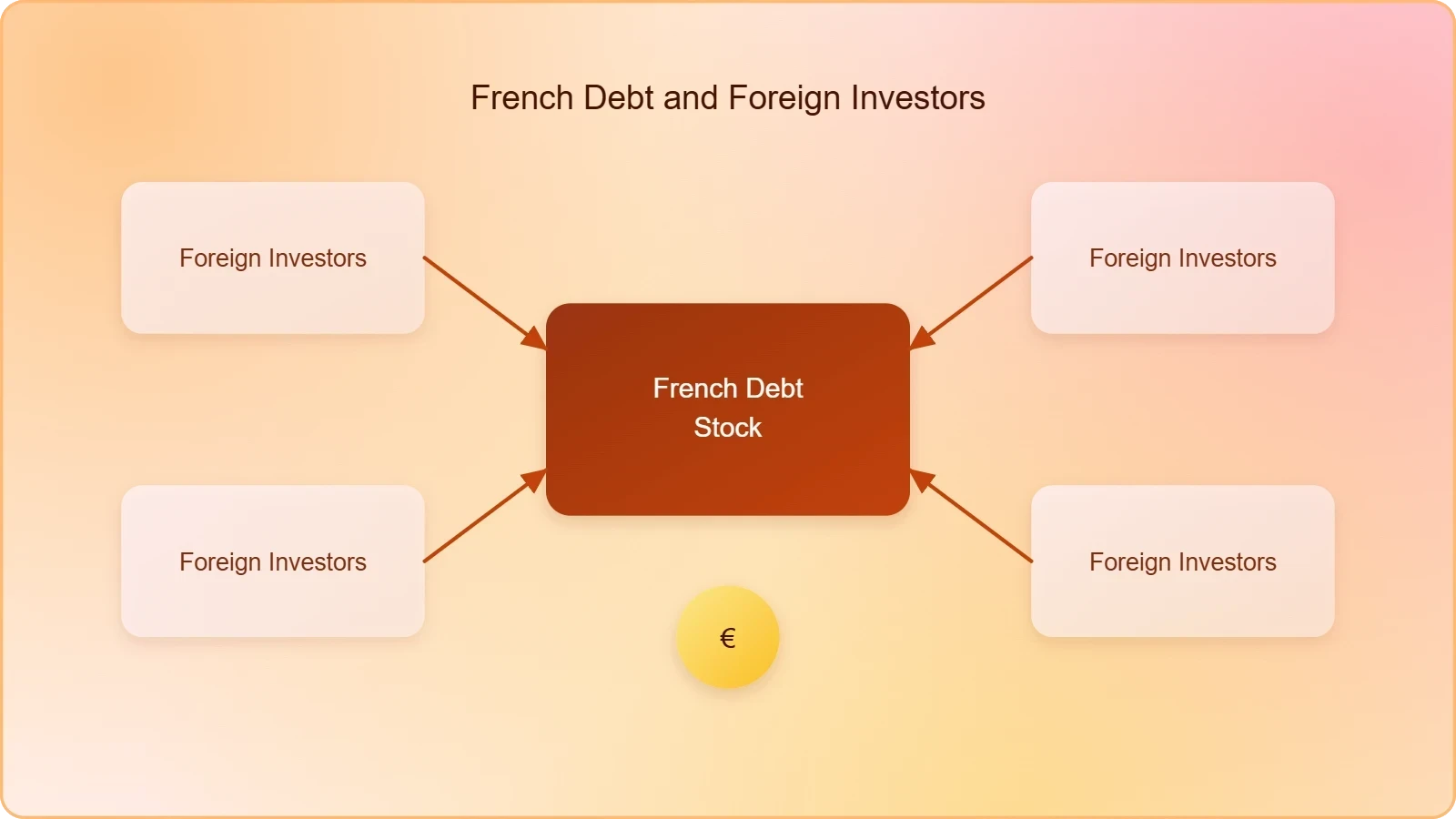
Foreign investors are quietly retreating from French government debt, and that retreat carries consequences far beyond the borders of the Fifth Republic. A Wall Street Journal report has flagged a marked reduction in overseas holdings of French sovereign bonds, a signal that international capital is reassessing the risk profile of one of the eurozone's foundational economies.
France has long functioned as a pillar of European financial stability, second only to Germany in the scale and depth of its bond market, so any erosion of foreign appetite for its paper deserves serious scrutiny.
The mechanics of sovereign debt demand are unforgiving. When foreign buyers step back, domestic institutions must absorb the slack, and the government's borrowing costs tend to drift upward as auctions clear at higher yields.
On This Page
- The Anatomy of a Sovereign Debt Retreat
- France's Fiscal Position in Comparative Perspective
- The Mechanics of Rising Borrowing Costs
- Political Economy and the Credibility Gap
- Implications for the Eurozone and Global Markets
- Historical Parallels and Lessons From Sovereign Debt Cycles
- Strategic Outlook and Policy Pathways
France already carries one of the heaviest public debt burdens in the eurozone, which means every basis point of added yield compounds into a larger fiscal obligation over time.
The trend therefore matters not merely as a market curiosity but as a potential inflection point in the cost of financing the French state.
What makes this development especially consequential is its timing and its ambiguity. The report does not quantify the scale of the sell-off, nor does it isolate a single cause, leaving analysts to infer whether the pullback reflects fiscal anxiety, political uncertainty, or a broader rotation away from eurozone exposure.
Each interpretation carries different implications for policy, and each demands a distinct response from Paris and from Brussels. The following analysis dissects the drivers, the market mechanics, and the strategic implications of this capital flight.
TL;DR Foreign investors are reducing their exposure to French government debt amid mounting concerns over the country's fiscal trajectory. France carries one of the largest sovereign debt burdens in the eurozone, and reduced foreign demand threatens to raise borrowing costs, strain the national budget, and unsettle regional financial stability. The pullback, reported by The Wall Street Journal, lacks precise figures but signals a meaningful shift in international confidence. This analysis examines the structural vulnerabilities behind the trend, the mechanics of sovereign bond demand, the political and fiscal pressures at play, and what the retreat means for France, the eurozone, and global investors navigating an increasingly fragmented capital landscape.
The Anatomy of a Sovereign Debt Retreat
Sovereign bond markets are the circulatory system of modern states, and foreign participation is the oxygen that keeps the system running efficiently. When overseas investors reduce their holdings, the state does not collapse, but it does pay more to borrow, and that premium ripples through every layer of public finance.
Understanding why foreign capital is exiting French debt requires a clear-eyed look at the structural conditions that made France attractive in the first place and the forces now eroding that appeal.
Why Foreign Capital Flowed Into France
For more than a decade, French government bonds functioned as a reliable store of value for global institutions seeking euro-denominated safety. The European Central Bank's accommodative posture, negative or near-zero policy rates, and France's status as a core eurozone economy combined to make French paper a default allocation for pension funds, insurers, and sovereign wealth vehicles worldwide.
That structural demand kept yields compressed and financing costs manageable, even as the debt stock climbed steadily upward.
The arrangement depended on a fragile equilibrium: investors accepted modest returns because the perceived risk was minimal and liquidity was abundant. France's deep, liquid bond market offered easy entry and exit, a quality prized by large institutional holders who need to move size without distorting prices.
As long as that equilibrium held, the French treasury could refinance maturing obligations at favorable rates and defer difficult fiscal consolidation. The equilibrium, however, was never permanent, and the conditions sustaining it have visibly shifted.
The Triggers Behind the Pullback
Several forces converge to explain the retreat. Rising global interest rates have raised the opportunity cost of holding low-yielding European debt, prompting investors to reallocate toward higher-return assets in the United States and elsewhere.
Simultaneously, France's fiscal trajectory has drawn scrutiny, with budget deficits exceeding eurozone norms and debt-to-GDP ratios among the highest in the bloc. Political fragmentation and difficulty passing credible consolidation measures have amplified these concerns.
Rating agencies and institutional analysts have increasingly questioned whether France can deliver the fiscal adjustment its peers expect, and markets price doubt before it becomes fact. The Wall Street Journal report does not specify causes, but the pattern aligns with a broader reassessment of eurozone credit risk.
When multiple pressures coincide, foreign investors tend to act first and ask questions later, and their collective exit can become self-reinforcing.
We Also Published
France's Fiscal Position in Comparative Perspective
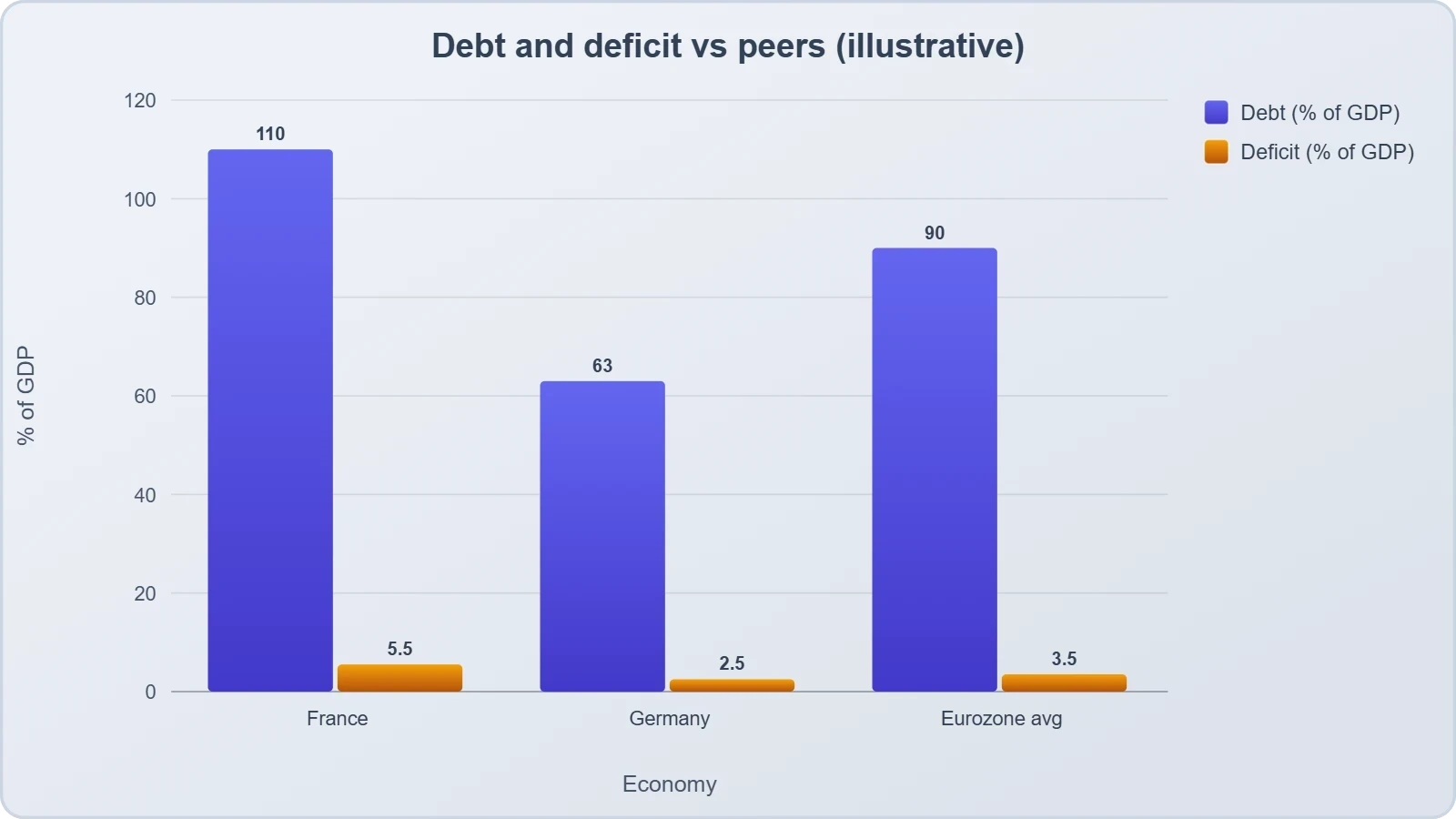
France's fiscal profile is not merely weak in absolute terms; it is weak relative to the peers against which investors benchmark it. Germany, the eurozone's anchor, maintains far lower debt ratios and has demonstrated consistent fiscal discipline. Italy, long the bloc's fiscal laggard, has at times shown sharper consolidation resolve than Paris.
This comparative dimension matters because foreign investors allocate capital across the eurozone as a spectrum of risk, and France's position on that spectrum has deteriorated.
The Debt Burden in Numbers
French public debt has climbed past the threshold that many economists consider sustainable without sustained primary surpluses, and the deficit has repeatedly breached eurozone fiscal rules. Each year of elevated borrowing adds to the interest bill, which crowds out spending on infrastructure, defense, and social programs.
The arithmetic is unforgiving: when ##r > g##, meaning the interest rate exceeds nominal growth, debt ratios rise even without new borrowing, and France currently faces precisely that configuration.
The compounding effect is what transforms a manageable debt stock into a structural vulnerability. A government that must devote an expanding share of revenue to debt service has less fiscal room to respond to recessions, security crises, or social unrest.
Foreign investors recognize this dynamic and price it into their allocation decisions, which is why the retreat documented by the Journal is less a sudden panic than a rational recalibration of risk.
How France Compares to Eurozone Peers
Benchmarking France against its neighbors clarifies why international capital is growing cautious. Germany's debt ratio sits materially lower, and its borrowing costs reflect that advantage through tighter spreads. Spain and Portugal, once peripheral risks, have improved their fiscal positions and now compete for the same pool of foreign demand that France has historically commanded. The competitive landscape for sovereign capital has intensified.
The Mechanics of Rising Borrowing Costs
When foreign demand for sovereign bonds declines, the adjustment mechanism operates through price, and price in bond markets means yield. Higher yields translate directly into higher borrowing costs for the government, and because France must refinance a substantial volume of maturing debt each year, even modest yield increases compound into significant fiscal outlays. The transmission from investor sentiment to budget reality is swift and measurable.
From Yield Spreads to Budget Arithmetic
The spread between French and German bond yields, known as the OAT-Bund spread, serves as the market's real-time verdict on French creditworthiness. Widening spreads signal that investors demand compensation for perceived risk, and that compensation flows directly into the interest expense line of the national budget. A sustained widening of even a few dozen basis points can add billions to annual debt service.
The fiscal math is straightforward and brutal. If the average yield on French debt rises by one percentage point on a debt stock measured in trillions of euros, the annual interest bill increases by tens of billions.
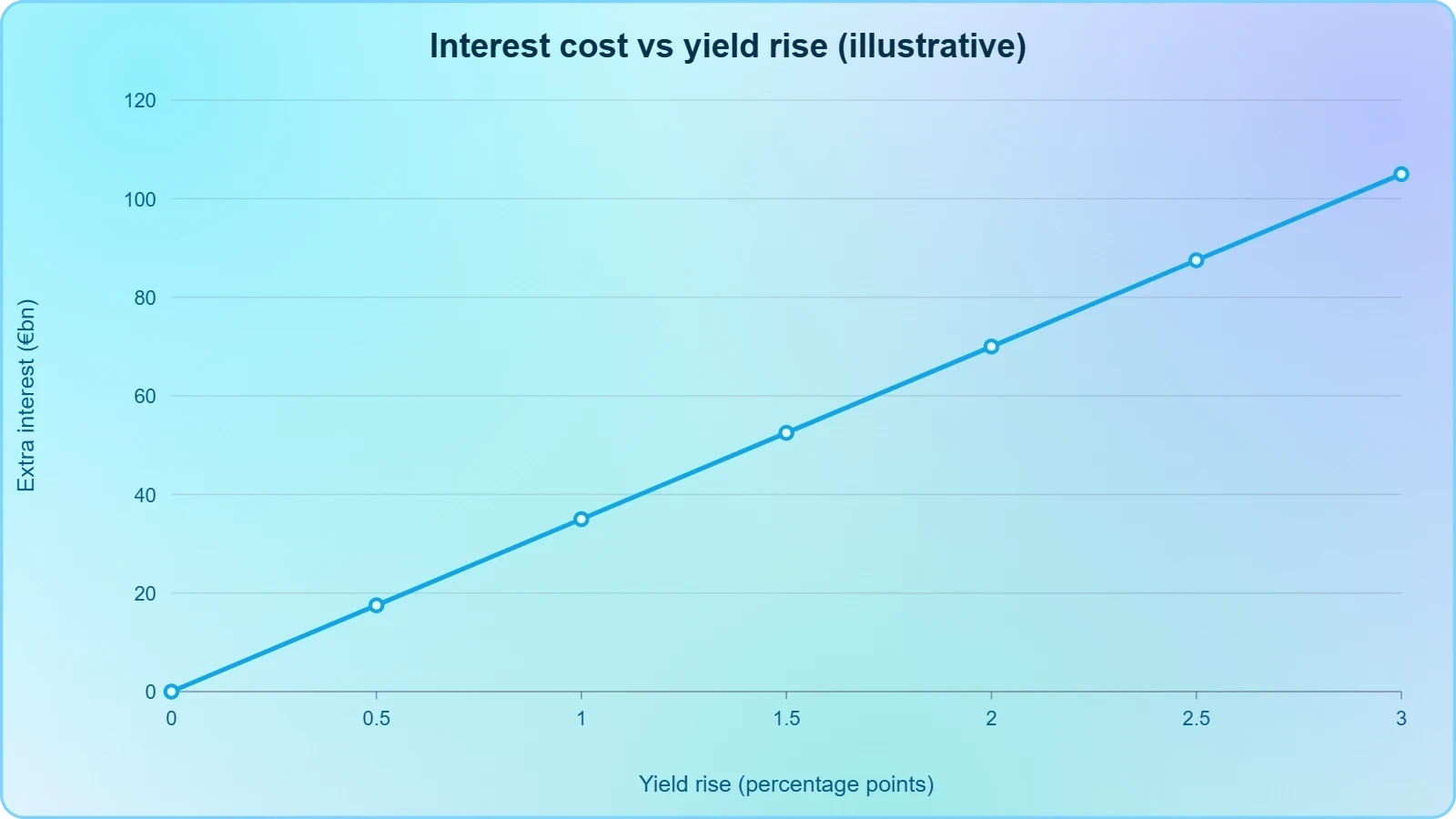
That sum must be financed through either higher taxes, spending cuts, or additional borrowing, each of which carries political and economic costs that further complicate the consolidation challenge.
Refinancing Risk and Market Confidence
France's debt management office must continuously roll over maturing obligations, and each auction is a test of market appetite. When foreign investors withdraw, domestic banks and money market funds absorb more of the issuance, but their capacity is finite and their demand is price-sensitive.
A weakening auction, marked by higher yields or lower bid-to-cover ratios, can trigger further selling and accelerate the cycle.
Refinancing risk is the quiet danger in sovereign debt dynamics. It does not announce itself with a crisis headline; it accumulates through successive auctions that clear at progressively less favorable terms.
By the time the deterioration becomes obvious, the fiscal position has already worsened, and the policy response required to restore confidence has grown correspondingly more painful.
Political Economy and the Credibility Gap
Sovereign debt is ultimately a political instrument, and investor confidence rests as much on governance as on arithmetic. France's political landscape has grown fragmented, with coalition dynamics complicating the passage of budgets and structural reforms.
When a government struggles to legislate fiscal discipline, markets interpret the difficulty as evidence that consolidation promises may not be honored, and they price that doubt into every bond they buy or sell.
Fiscal Governance Under Strain
The credibility gap is not a matter of intentions but of demonstrated capacity. Investors watch legislative outcomes, not communiqués, and they discount pledges that lack political backing. France's recent budget processes have exposed the difficulty of building durable majorities around spending restraint, and each episode of gridlock reinforces the perception that fiscal adjustment is politically constrained.
This dynamic creates a feedback loop familiar from other sovereign debt episodes. Political difficulty raises borrowing costs, higher costs intensify budgetary pressure, and the resulting austerity demands further erode political consensus.
Breaking the loop requires either a credible external anchor, such as European Union fiscal frameworks, or a domestic political realignment capable of sustaining unpopular decisions over multiple electoral cycles.
European Rules and Domestic Constraints
The eurozone's fiscal rules provide a framework, but enforcement has historically been flexible and politically negotiated. France's ability to comply with deficit and debt thresholds has been questioned repeatedly, and the credibility of the rules themselves depends on whether large member states respect them.
When the bloc's second-largest economy strains against the framework, the entire architecture of fiscal discipline comes under scrutiny.
Domestic constraints compound the European dimension. French voters have repeatedly demonstrated resistance to pension reform, spending cuts, and tax increases, and politicians respond to those preferences. The result is a structural mismatch between what fiscal sustainability requires and what democratic politics can deliver, a gap that foreign investors observe with increasing wariness.
- 01
- 02
- 03
- 04
Implications for the Eurozone and Global Markets
France is not an isolated case, and its difficulties carry systemic weight. As a core eurozone economy and a major contributor to European financial stability mechanisms, France's fiscal trajectory influences the bloc's overall risk perception.
A sustained loss of foreign confidence in French debt could spill over into other sovereign markets, raising borrowing costs across the periphery and complicating the European Central Bank's policy calculus.
Contagion Channels and Regional Stability
Contagion in sovereign debt markets operates through correlation and confidence. When investors reassess one core economy, they typically revisit their assumptions about others, and spreads can widen across multiple countries simultaneously.
The ECB's transmission protection instrument exists precisely to counter such dynamics, but its use carries political stigma and market signaling effects that policymakers prefer to avoid.
Regional stability also depends on the perception that core economies are anchors, not risks. If France comes to be viewed as a source of instability rather than a stabilizing force, the eurozone's institutional balance shifts, and the political capital required to maintain cohesion increases. That is a burden the bloc can ill afford amid existing geopolitical and economic pressures.
What Global Investors Should Watch
For international investors, the French debt retreat is a signal to monitor rather than a trigger for wholesale repositioning. Key indicators include the OAT-Bund spread, auction bid-to-cover ratios, foreign ownership shares of French debt, and the trajectory of fiscal legislation.
Each provides a window into whether the pullback is a temporary reallocation or the beginning of a structural shift.
Portfolio strategy should account for the possibility that European sovereign risk is being repriced more broadly. Diversification across geographies and asset classes remains prudent, and duration management becomes more important when term premia are rising.
The lesson of sovereign debt cycles is that confidence can erode gradually and then suddenly, and positioning should reflect that asymmetry.
Historical Parallels and Lessons From Sovereign Debt Cycles
Sovereign debt crises follow recognizable patterns, and France's current predicament echoes earlier episodes without yet reaching crisis proportions. The eurozone debt crisis of 2010 to 2012 demonstrated how quickly investor confidence can evaporate once doubts about fiscal sustainability take hold.
Greece, Ireland, Portugal, and Spain each experienced sudden stops in foreign demand that forced painful adjustments and institutional interventions.
What Earlier Episodes Reveal
The critical lesson from those episodes is that the transition from manageable concern to acute crisis can be abrupt. Markets tolerate deterioration for extended periods, then reprice violently when a threshold is crossed.
The threshold is rarely a specific debt ratio; it is more often a shift in the perceived credibility of the government's adjustment path, which can change suddenly with a political event or a failed auction.
Another lesson concerns the role of external anchors. Countries that entered adjustment programs with credible external oversight regained market access faster than those that relied on domestic commitments alone.
France's anchor is the European framework, but the framework's credibility depends on enforcement, and enforcement has historically been uneven when large member states are involved.
Divergences From Past Crises
France differs from the crisis countries in important respects. It possesses a large, diversified economy, a deep domestic investor base, and the institutional capacity to manage debt issuance professionally. These advantages provide buffer and time, but they do not eliminate the underlying dynamic.
A wealthy economy can sustain higher debt than a poorer one, yet no economy is immune to the arithmetic of compounding interest when growth lags.
The divergence that matters most is the absence of an acute trigger. France is not facing an immediate refinancing cliff, and its domestic institutions continue to absorb supply. That relative calm is precisely why the foreign investor retreat deserves attention: it is a slow-moving signal that could presage a faster-moving problem if left unaddressed.
Strategic Outlook and Policy Pathways
The trajectory of French sovereign debt will be determined by the interaction of three variables: the pace of fiscal consolidation, the strength of economic growth, and the durability of investor confidence. Each is partially controllable by policy, and each influences the others.
A credible consolidation program that stabilizes debt ratios can restore confidence, lower borrowing costs, and create fiscal space, but only if it survives political scrutiny.
Paths to Restoring Investor Confidence
Restoring foreign demand requires more than rhetoric; it requires demonstrable progress on the fiscal trajectory. A multi-year consolidation plan with binding targets, transparent reporting, and political commitment across coalition lines would signal seriousness to markets.
Structural reforms that raise potential growth would improve the debt dynamics from the denominator side, making adjustment less painful and more sustainable.
European coordination also matters. If the eurozone strengthens its fiscal framework and demonstrates consistent enforcement, the credibility of national commitments increases. France, as a core member, has both the responsibility and the leverage to shape that framework, and its willingness to do so would itself be a confidence signal.
Risks of Inaction
The cost of inaction is cumulative and ultimately self-defeating. If foreign investors continue to withdraw and domestic institutions reach capacity limits, borrowing costs will rise faster than fiscal adjustment can offset.
At that point, the government faces a choice between abrupt austerity, external intervention, or a loss of market access, each of which imposes severe economic and political costs.
Inaction also carries systemic risk. France's debt is embedded in the balance sheets of European banks, insurers, and pension funds, and a disorderly repricing would transmit stress throughout the financial system.
The interconnectedness that makes French debt a stable asset in normal times makes it a potential amplifier in stressed times, which is why the current retreat warrants careful attention from policymakers and investors alike.
From our network :
- The Final Descent: How ESA Retired the Legendary Cluster Constellation After 24 Years of Space Weather ScienceAfter 24 years mapping Earth’s magnetosphere, ESA’s Cluster mission concluded with a precisely controlled reentry over the South Pacific. This analysis explores the scientific legacy, engineering decisions, and debris mitigation principles behind one of space exploration’s most responsible retirements.
- CISA’s Ten-Advisory Wave: Why Generic Patching Fails in OT and How to Build Product-Specific PlaybooksCISA released ten ICS advisories in one week, exposing critical infrastructure risks. Generic patching fails in OT. Learn to build product-specific remediation playbooks.
- Mobile Learning and VR in English: What Global Evidence Reveals About Effective Language TechnologyA systematic review across 14 countries reveals which language-learning technologies genuinely work. Mobile learning, AI, and VR show measurable benefits when pedagogically integrated. This evidence-based guide helps educators and learners select technology that delivers real return on investment.
- Committed Mediterranean Precipitation Decline: Why Emissions Cuts Alone Cannot Restore Winter RainsNew NOAA research reveals that Mediterranean winter rains may decline irreversibly even with emissions cuts. Explore the science of committed climate change and regional impacts.
- How AI Agents Will Change the Way We Manage Personal FinancesExplore how AI agents are transforming personal finance through automated budgeting, bill payment, and investment management, while examining the critical security protocols and governance frameworks required for safe deployment.
- Live Online English Classes for Kids: Do They Actually Reduce Anxiety?A ten-week study reveals that synchronous online English classes can significantly reduce child language anxiety while improving listening and reading skills. Discover what makes these programs effective and how parents can select the right one.
- University Language Proficiency Exams: Why Institutional Tests Demand Different Preparation Than IELTS and TOEFLDiscover why university-specific language proficiency examinations differ fundamentally from IELTS and TOEFL, and learn strategic preparation approaches for institutional assessment success.
- Forbidden Matrix Patterns and Visible Lattice Points: A Geometric DictionaryExplore how multidimensional 0–1 matrices encode geometric truths, linking forbidden patterns to visible lattice points and hypergraph theory, with applications in combinatorics and computational geometry.
- The Hidden Cost of AI Convenience: Why Over-Permissioned Agents Are a Security Time BombDiscover why AI agents with excessive permissions create dangerous single points of failure, and learn how implementing least privilege principles can protect your organization from exploitation.
RESOURCES
- France's Debt Crisis Deepens as Foreign Investors Look for the Exitwsj.com3 days ago ... France faces a financial challenge as foreign investors, who owned almost 55% of French debt last year, have less reason…
- French debt crisis: causes, repercussions, and risksefginternational.comOct 5, 2026 ... Le Pen has recently sought to reassure investors by proposing a "golden rule" to progressively reduce the deficit, yet uncertainty…
- France protests push bond yields higher, euro slips - CNBCcnbc.com6 days ago ... French unrest compounds debt crisis fears. Paris-listed stocks ... Overseas investors hold a growing share of French debt, rising from ...
- The debt crisis leaves the French government with no room to ...english.elpais.com4 days ago ... Fifty-five percent of French debt is held by foreign investors and what happened this weekend does not inspire much confidence.…
- France Is Veering Toward a Potential Debt Crisis Amid Protests and ...nytimes.comOct 8, 2026 ... ... International Monetary Fund. In a nightmare scenario, the ... More worrying, another measure of investors' feelings toward French debt ...
- Massive debt puts France in a bind as investor doubts deepenfrance24.comOct 9, 2026 ... ... debt crisis -- with consequences that ripple across the eurozone. "What's happening in France is raising questions for foreign…
- France debt crisis: Investors render a 'guilty' verdict and are pricing ...fortune.comOct 2, 2026 ... France debt crisis: Bond investors have rendered a 'guilty ... Ales Koutny, head of international rates at Vanguard, told the…
- Who owns France's debt and why it matters - Reutersreuters.comJun 25, 2024 ... ... debt crisis. Get a look at the day ahead in U.S. and global ... Foreign investors own around 50%…
- What Might the Scenarios Be for a French Debt Crisis? - GoldBrokergoldbroker.comSep 24, 2026 ... — while likely limiting bank withdrawals in the face of the inevitable panic that would grip part of the population.…
- The foreign capital that finances France may be going into reverse ...facebook.com3 days ago ... France's Debt Crisis Deepens as Foreign Investors Look for the Exit ... French finance minister that the economy risks stumbling…
- Dow Jones Top Markets Headlines at 7 AM ET: France's Debt Crisis ...morningstar.com3 days ago ... France's Debt Crisis Deepens as Foreign Investors Look for the Exit. The foreign capital that finances France may be going…
- The French Political Crisis Th… - Odd Lots - Apple Podcastspodcasts.apple.comOct 16, 2026 ... The French Political Crisis That's Turning Into a Debt Crisis. Odd ... Foreign Relations and he advises institutional investors —…
- France's debt crisis-in-waiting - Financial Timesft.comSep 1, 2026 ... But it does suggest investors are reassessing French political risk (a ... foreign investors, compared with about a third of…
- The stages in France's European financial integrationbanque-france.frJan 12, 2023 ... Through these measures, France succeeded in attracting more capital and supporting substantial foreign direct investment (FDI) by French firms ...
- France debt crisis: Bond investors have rendered a 'guilty' verdict ...finance.yahoo.comOct 2, 2026 ... France debt crisis: Bond investors have rendered a 'guilty' verdict and are pricing in growing odds of a sovereign default,…
- 01
- 02
- 03
- 04
- 05
- 06
- 07
- 08
0 Comments