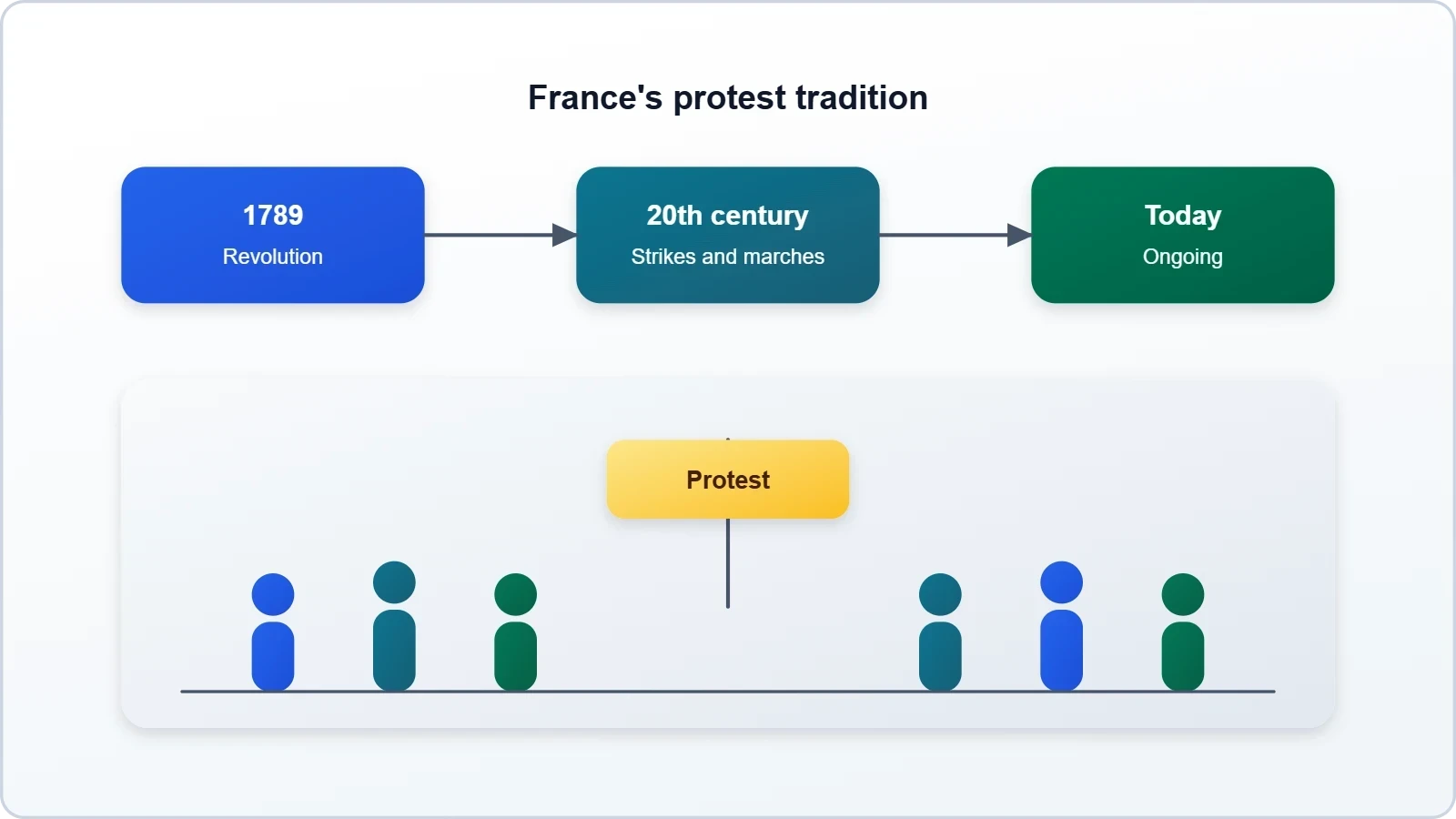
France does not merely tolerate protest; it has institutionalized dissent as a constitutive element of national identity, a civic grammar through which citizens articulate grievances and renegotiate the terms of legitimate authority.
The demonstrations that erupted across Paris and Marseille in late 2026 — beginning with student demands for improved school conditions before metastasizing into a broader indictment of inflation, austerity, and the rising cost of living — are neither aberrations nor sudden ruptures.
They are the latest iteration of a political tradition whose foundational text was written in blood and philosophy during the summer of 1789, when the storming of the Bastille transformed localized complaints about bread prices into a universal claim upon political rights.
On This Page
- The Bastille as Founding Text: How 1789 Redefined Resistance
- When Authority Pushes Back: Repression and the Limits of Resistance
- The Street as Contested Arena: Protest Beyond the Left
- Inflation, Austerity, and the 2026 Conflagration
- The Macron Era and the Question of Governability
- Why the French Street Still Matters: Lessons for Democratic Legitimacy
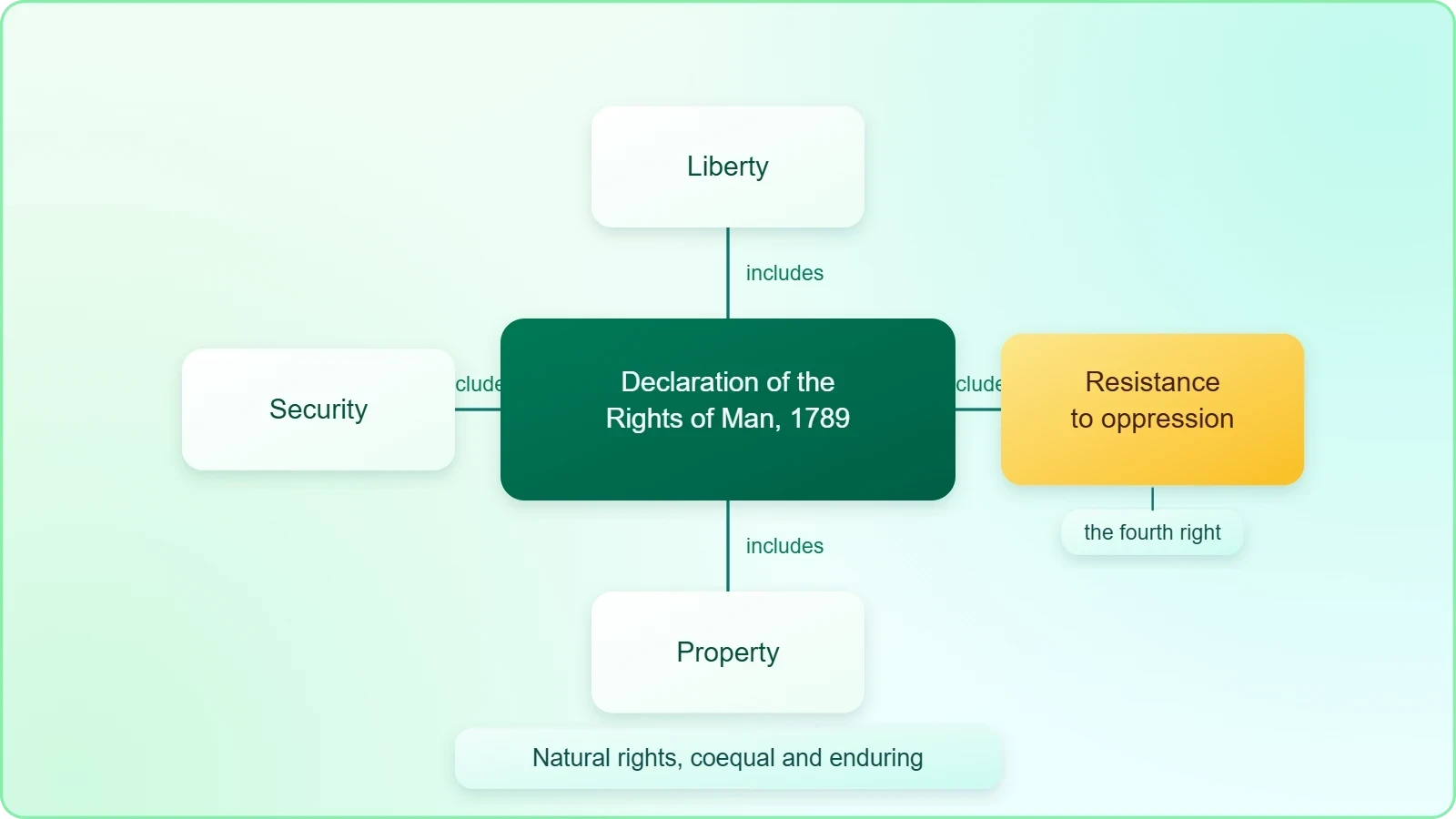
Understanding this tradition requires more than cataloguing successive upheavals; it demands an appreciation of how the French Revolution permanently altered the semantic field of protest itself. The Declaration of the Rights of Man and of the Citizen enshrined "liberty, property, security, and resistance to oppression" as natural rights, and that fourth guarantee established a principle with remarkable longevity: authority may be questioned, and the people possess a legitimate, even sacred, role in resisting its abuse.
Every subsequent French government — Napoleonic, Bourbon, Orléanist, republican — has governed in the shadow of that proposition, alternately suppressing, channeling, or capitulating to it.
The contemporary unrest, captured in images of detainees at the Place de la Bastille and protesters storming Marseille's city hall beneath defiant placards, illustrates how seamlessly the vocabulary of 1789 is repurposed for twenty-first-century anxieties.
Students protesting school conditions become the vanguard of a wider coalition aggrieved by purchasing power erosion and fiscal austerity imposed by the central government. This pattern — a specific grievance igniting a general mobilization — recurs with almost structural regularity across French history, from the July Revolution of 1830 through the banquets campaign of 1848 to the student-worker alliance of May 1968.
TL;DR France's protest culture is not a symptom of instability but a durable political inheritance from 1789, when resistance to oppression was codified as a natural right. The 2026 demonstrations in Paris and Marseille — rooted in student grievances over school conditions before broadening into cost-of-living and austerity protests — replay a familiar dynamic in which specific complaints escalate into challenges to state authority. Crucially, this tradition belongs to neither left nor right: the same streets that carried revolutionary and worker movements also hosted massive 2013 demonstrations against same-sex marriage. Protest functions as France's contested civic arena, where competing visions of society assert legitimacy through collective presence.
The Bastille as Founding Text: How 1789 Redefined Resistance
The storming of the Bastille on July 14, 1789, is conventionally remembered as the opening act of the French Revolution, but its deeper significance lies in the conceptual transformation it effected.
Before 1789, protest in France was largely a mechanism for expressing local grievances — most notably food prices and subsistence crises — within a framework that accepted royal authority as given.
The Revolution changed the meaning of protest itself, converting it from a petitionary practice into a claim upon political rights that no sovereign could legitimately withhold.
From Bread Riots to Natural Rights
The Declaration of the Rights of Man and of the Citizen accomplished something extraordinary: it named resistance to oppression as a natural right, coequal with liberty, property, and security. This was not rhetorical decoration but a juridical foundation.
By elevating resistance from a desperate act to a principled entitlement, the Revolution gave subsequent generations a language in which authority could be questioned without the questioner being cast as a criminal.
The fourth right established a principle that has endured for more than two centuries, surviving empires, restorations, and republics alike. Authority can be challenged; the people have a legitimate role in resisting its abuse.
This proposition embedded itself so deeply in French political life that even governments hostile to popular mobilization have had to negotiate with its cultural authority rather than simply extinguish it.
The Contested Inheritance of Revolutionary Language
Each generation reinterprets 1789's principles for its own grievances, and the legacy of the Revolution supplies a ready-made vocabulary of resistance to movements that might otherwise lack one. Émile Zola's open letter during the Dreyfus Affair drew explicitly on this inheritance, casting the defense of an unjustly condemned officer as a revolutionary act of conscience against state malfeasance.
The upheavals of May 1968 demonstrated the tradition's adaptability when students and workers joined forces, merging cultural rebellion with labor militancy in a synthesis that briefly paralyzed the state.
Neither Zola nor the 1968 demonstrators were simply repeating 1789; they were translating its grammar into new contexts, proving that revolutionary language remains generative rather than merely commemorative.
When Authority Pushes Back: Repression and the Limits of Resistance
Governments have not always welcomed challenges to their power, and the post-revolutionary record reveals a persistent tension between the revolutionary inheritance and the imperatives of governance. After 1789, the Napoleonic Empire and the Bourbon Restoration attempted to reverse or limit some of the Revolution's gains, seeking to restore monarchical authority while managing the unruly legacy of popular sovereignty.
These efforts never fully succeeded, precisely because the principle of resistance had acquired a cultural authority that outlasted any single regime.
The July Revolution and the Betrayal of Its Participants
The July Revolution of 1830 demonstrated both the potency and the limits of popular mobilization. Charles X, having restricted the press and dissolved the elected Chamber, was overthrown by insurrectionary crowds — yet the workers who fought in those events gained little from the July Monarchy that followed.
The episode established a recurring pattern in French political life: revolutionary energy is harnessed by elites who then consolidate power on terms that exclude the very people who made change possible.
This dynamic of appropriation and disappointment would recur repeatedly, informing working-class suspicion of bourgeois republicanism and fueling subsequent radical movements. The July Monarchy's failure to extend political rights or address economic hardship set the stage for the next rupture, proving that revolutionary victories are rarely stable settlements.
1848 and the Fragility of Authoritarian Control
Economic hardship and limited political rights led to another revolution in 1848, when the government banned public meetings known as "banquets." Within days, King Louis-Philippe had abdicated — a striking demonstration of how quickly a regime can collapse when it mistakes the suppression of assembly for the consolidation of power.
The banquets campaign revealed that in France, the right to gather is not a peripheral civil liberty but a core expression of political agency.
The speed of the 1848 collapse underscores a structural vulnerability of French governments that attempt to close the civic space. When public meetings are prohibited, the prohibition itself becomes the grievance, transforming scattered discontent into unified opposition. The regime that bans the banquet invites the revolution it fears.
The Street as Contested Arena: Protest Beyond the Left
Protest is not limited to the political left, and any account that treats French mobilization as an exclusively progressive phenomenon misreads the historical record. The French right has also repeatedly mobilized large crowds for its causes, claiming the same civic space and the same language of legitimate resistance.
In May 2013, for example, hundreds of thousands took to the streets in demonstrations against the legalisation of same-sex marriage, demonstrating that the revolutionary inheritance is available to all who can plausibly cast themselves as resisting an overreaching authority.
Competing Visions of French Society
The street is therefore also a place where competing visions of French society seek to assert themselves, and no faction holds a permanent monopoly on its symbolic power. Conservative movements invoke tradition, family, and national identity with the same fervor that progressive movements invoke equality and social justice. Both sides draw on the deep reservoir of 1789, each interpreting its principles in mutually incompatible ways.
This contestation is not a corruption of the protest tradition but its logical extension. If resistance to oppression is a natural right, then the definition of oppression becomes the central political question — and different constituencies will answer it differently. The street becomes the forum where these competing definitions are tested through numbers, visibility, and disruption.
Why the Right Also Marches
The 2013 marriage demonstrations revealed that mass mobilization is a technique, not an ideology. The French right learned to use the street as effectively as the left, organizing disciplined, large-scale protests that commanded media attention and political response. This development complicates any simple narrative that equates protest with progressivism and authority with conservatism.
Instead, France's protest culture functions as a shared civic grammar that any sufficiently mobilized constituency can employ. The question is never whether protest is legitimate in principle — that was settled in 1789 — but which grievances will command sufficient collective presence to force political acknowledgment.
We Also Published
- 01
- 02
- 03
- 04
Inflation, Austerity, and the 2026 Conflagration
The current unrest began with students demanding better conditions in schools, but it has grown into a broader expression of public dissatisfaction over the rising cost of living, inflation, and austerity measures by the central government. This escalation from specific institutional grievance to generalized economic protest follows a well-worn French trajectory.
Students, historically positioned as moral vanguards, lend legitimacy to broader coalitions, while economic precarity supplies the combustible material that transforms campus discontent into urban conflagration.
From School Conditions to Systemic Critique
Student demands for improved school conditions may appear modest, but in the French context they function as entry points to systemic critique. Underfunded schools signal state withdrawal from public goods; deteriorating conditions become evidence of a government prioritizing fiscal discipline over social provision.
The grievance thus connects local experience to national policy, allowing students to speak for a broader public abandoned by austerity.
Images from the protests show people detained at the Place de la Bastille and protesters storming Marseille's city hall, with placards carrying defiant messages. The symbolic geography is unmistakable: the Bastille, birthplace of revolutionary resistance, and Marseille's city hall, seat of municipal authority, become stages for the reenactment of a foundational national drama.
The Economics of Legitimate Rage
Inflation and austerity provide the material conditions for mobilization, but the French tradition supplies the interpretive framework that transforms hardship into political claim. Rising prices are not merely inconveniences; they are violations of the social contract, evidence that authority has failed in its duty to secure the security named in the 1789 Declaration. Austerity becomes oppression, and resistance becomes a right.
This framing explains why economic protests in France so readily escalate into challenges to state legitimacy. The government's fiscal choices are interpreted not as technical necessities but as political decisions that privilege some constituencies over others.
When the central government imposes austerity, it activates the revolutionary principle that authority may be questioned — and the street becomes the venue for that questioning.
The Macron Era and the Question of Governability
Emmanuel Macron's presidency has repeatedly confronted the structural challenge of governing a nation whose political culture treats resistance as a natural right. Pension reform, fuel taxes, and fiscal consolidation have each triggered mass mobilization, and the 2026 unrest extends this pattern into a period of acute economic pressure.
The question facing the Macron government — and any French government — is not whether protest will occur but how to govern alongside it without either capitulating to every demand or provoking the kind of escalation that delegitimizes authority.
Reform Against Resistance
Macron's reform agenda has consistently collided with the protest tradition, revealing a fundamental tension between technocratic governance and participatory legitimacy. Reforms designed by experts and justified by fiscal necessity encounter a public that interprets them through the lens of 1789, asking whether authority is acting within its legitimate bounds or abusing its power. The answer, for many protesters, is the latter.
This tension is not unique to Macron, but his governing style — centralized, fast-paced, and often perceived as dismissive of street-level dissent — has intensified it. When reform is imposed rather than negotiated, it activates the revolutionary principle that authority may be questioned, and the street becomes the site where that questioning is performed.
Governing a Nation That Resists
The deeper challenge is structural: France's political culture makes resistance a permanent feature of governance rather than an episodic disruption. Governments must therefore develop strategies for managing dissent that neither suppress it illegitimately nor surrender to it entirely.
This requires a delicate balance between responsiveness and resolve, between acknowledging legitimate grievances and maintaining the coherence of policy.
Whether the 2026 unrest will produce significant policy change or merely another cycle of mobilization and containment remains uncertain. What is clear is that the tradition of 1789 continues to shape the terms of French political contestation, ensuring that the street remains a central arena of democratic life.
Why the French Street Still Matters: Lessons for Democratic Legitimacy
The French case offers a broader lesson about democratic legitimacy: a polity that institutionalizes the right of resistance may be more stable, not less, than one that suppresses dissent until it erupts violently.
France's repeated revolutions and constant protests have not destroyed the republic; they have repeatedly reconstituted it on more legitimate foundations. The capacity to challenge authority is, paradoxically, a source of governmental accountability.
Resistance as Democratic Infrastructure
When resistance to oppression is recognized as a natural right, protest becomes a form of democratic infrastructure rather than a threat to order. It provides a channel through which grievances reach decision-makers before they fester into crisis, and it forces governments to justify their choices in public terms. The street functions as an informal but powerful institution of accountability.
This does not mean that all protests are wise or all demands justified. But the structural presence of a protest tradition creates incentives for governments to anticipate dissent, consult constituencies, and calibrate reforms to public tolerance.
The alternative — a quiescent population that never challenges authority — offers no such feedback and often conceals deep illegitimacy.
The Unfinished Legacy of 1789
The legacy of 1789 remains unfinished because each generation must reinterpret its principles for new circumstances. The 2026 protests over inflation, austerity, and school conditions are not repetitions of the Revolution but translations of its grammar into contemporary terms.
The fourth right — resistance to oppression — continues to authorize challenges to authority, even as the meaning of oppression is contested.
France's long tradition of protest is therefore neither a quaint historical curiosity nor a symptom of ungovernability. It is a living political inheritance that shapes how citizens understand their relationship to the state and how governments understand the limits of their power. The street remains where French democracy negotiates its terms.
From our network :
- Live Online English Classes for Kids: Do They Actually Reduce Anxiety?A ten-week study reveals that synchronous online English classes can significantly reduce child language anxiety while improving listening and reading skills. Discover what makes these programs effective and how parents can select the right one.
- Mobile Learning and VR in English: What Global Evidence Reveals About Effective Language TechnologyA systematic review across 14 countries reveals which language-learning technologies genuinely work. Mobile learning, AI, and VR show measurable benefits when pedagogically integrated. This evidence-based guide helps educators and learners select technology that delivers real return on investment.
- CISA’s Ten-Advisory Wave: Why Generic Patching Fails in OT and How to Build Product-Specific PlaybooksCISA released ten ICS advisories in one week, exposing critical infrastructure risks. Generic patching fails in OT. Learn to build product-specific remediation playbooks.
- How AI Agents Will Change the Way We Manage Personal FinancesExplore how AI agents are transforming personal finance through automated budgeting, bill payment, and investment management, while examining the critical security protocols and governance frameworks required for safe deployment.
- The Hidden Cost of AI Convenience: Why Over-Permissioned Agents Are a Security Time BombDiscover why AI agents with excessive permissions create dangerous single points of failure, and learn how implementing least privilege principles can protect your organization from exploitation.
- The Final Descent: How ESA Retired the Legendary Cluster Constellation After 24 Years of Space Weather ScienceAfter 24 years mapping Earth’s magnetosphere, ESA’s Cluster mission concluded with a precisely controlled reentry over the South Pacific. This analysis explores the scientific legacy, engineering decisions, and debris mitigation principles behind one of space exploration’s most responsible retirements.
- Forbidden Matrix Patterns and Visible Lattice Points: A Geometric DictionaryExplore how multidimensional 0–1 matrices encode geometric truths, linking forbidden patterns to visible lattice points and hypergraph theory, with applications in combinatorics and computational geometry.
- Committed Mediterranean Precipitation Decline: Why Emissions Cuts Alone Cannot Restore Winter RainsNew NOAA research reveals that Mediterranean winter rains may decline irreversibly even with emissions cuts. Explore the science of committed climate change and regional impacts.
- University Language Proficiency Exams: Why Institutional Tests Demand Different Preparation Than IELTS and TOEFLDiscover why university-specific language proficiency examinations differ fundamentally from IELTS and TOEFL, and learn strategic preparation approaches for institutional assessment success.
RESOURCES
- France's riots: revolution without utopia - Engelsberg Ideasengelsbergideas.comOct 8, 2026 ... France's riots may carry echoes of 1789 and 1968, and of a long tradition ... The current protests are no…
- France's Long, Fervent History of Protest - The New York Timesnytimes.comOct 9, 2026 ... Modern France sprang out of a bloody revolt in 1789 ... Here are some protests in modern French history that…
- The long and short reasons for why Revolution broke out in France ...swansea.ac.ukIn 1789 the bourgeoisie made common cause with the peasantry and the urban labouring classes to begin the Revolution. The Marxist interpretation of the…
- Aux barricades! France's long history of revoltfrance24.comDec 7, 2018 ... During the 1789 Revolution that began with the storming of the Bastille, French workers rioted over taxes, economic inequality and…
- The United States and the French Revolution, 1789–1799history.state.govMilestones: 1784–1800. NOTE TO READERS “Milestones in the History of U.S. Foreign Relations” has been retired and is no longer maintained ...
- it's a revolution.” The Duke of Rochefoucauld-Liancourt responded ...instagram.com5 days ago ... ... the present borders of France ... France has a long history of major protests and political unrest, dating back…
- Revolutions in France: 1789, 1830, 1848guides.loc.govAug 24, 2026 ... France--History--Revolution, 1789-1799--Causes · France--History ... Old Regime, the Revolution, and the post-1830 politics of protest.
- Versailles at the Heart of the French Revolution 1789en.chateauversailles.fr... today, the museum's collections bear traces of this key episode in France's history. the context. Louis XVI acceded to the French throne on…
- A Natural History of Revolution by Mary Ashburn Miller | Hardcovercornellpress.cornell.eduJun 15, 2011 ... ... Old Regime protest tactics. A Natural History of Revolution suggests ... Mary Ashburn Miller argues that the French revolutionaries…
- French high school protests: 'The social contract since ... - Le Mondelemonde.fr2 days ago ... The memory of 1789, however, shapes today's distrust and social ... If France has a radical tradition, it is rooted…
- The French Revolution and the Catholic Church | History Todayhistorytoday.comIn 1789, Catholicism was the official religion of France – five years later worship was suppressed. The French Revolution posed problems for religion, ...
- Why are the French so good at protesting? : r/AskHistorians - Redditreddit.comJun 4, 2020 ... To put it simply, the French - and particularly the people of Paris - have a long history of political…
- French Revolution: Timeline, Causes, Key Figures & Eventshistory.comNov 9, 2009 ... The French Revolution was a watershed event in world history that began in 1789 and ended in the late 1790s…
- A Social History of France 1780-1914: Second Edition - Amazon.comamazon.com... France and is now thoroughly updated to cover the 'long nineteenth century' from 1789-1914. Peter McPhee offers both a readable narrative and a…
- French Revolution - Wikipediaen.wikipedia.orgIn 1789, the most populous French colonies were Saint-Domingue (today Haiti) ... A short history of the French Revolution: 1789–1799. Geoffrey Symcox ...
- 01
- 02
- 03
- 04
- 05
- 06
- 07
- 08
0 Comments