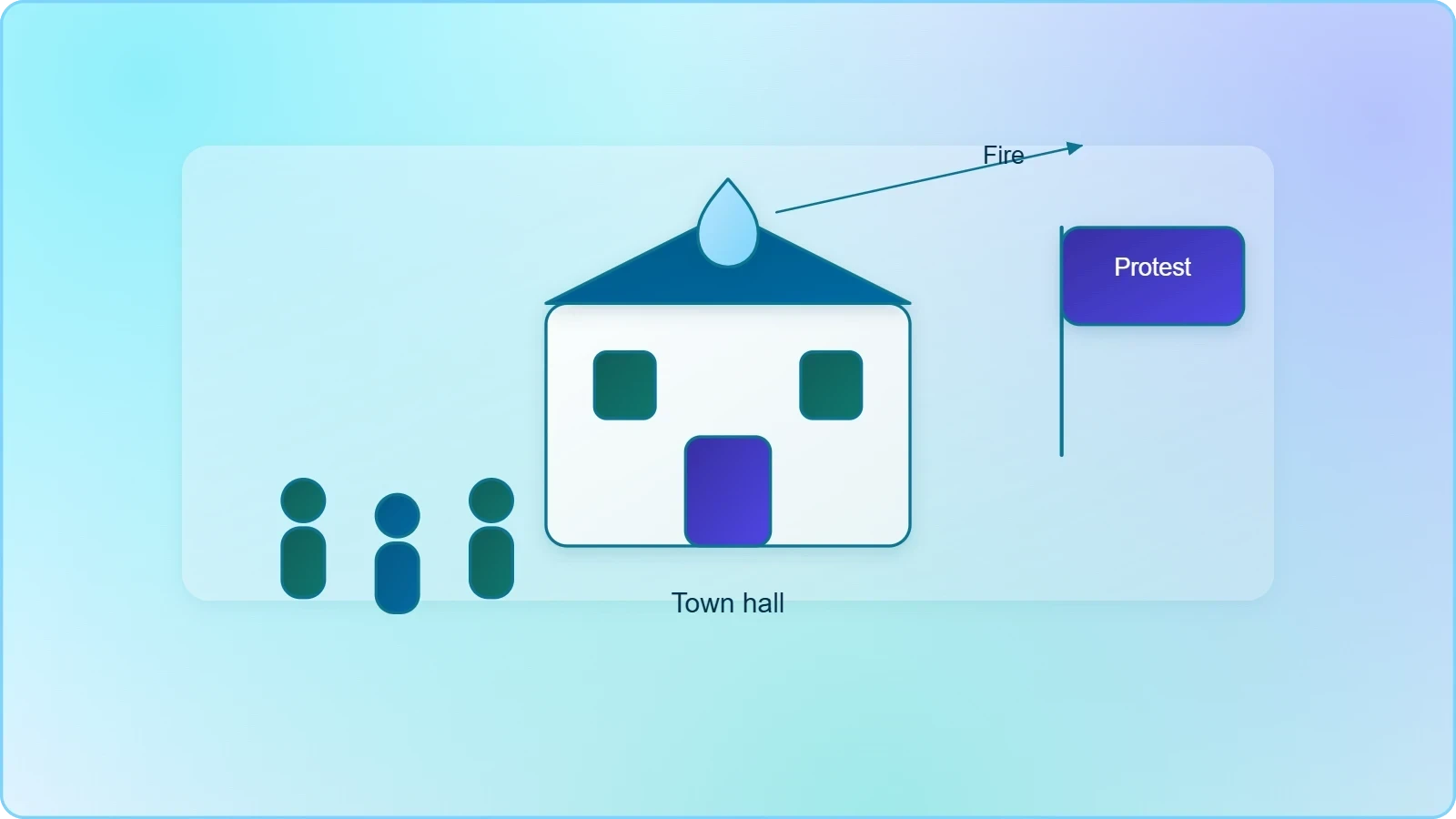
The burning of Limoges town hall on a late October night in 2026 transformed a regional administrative building into a national emblem of French discontent. Flames consumed the nineteenth-century structure and toppled its wooden clock tower, producing an image that circulated across the world within hours.
What began as student-led demonstrations over squalid high-school conditions has metastasized into a far broader revolt against the cost of living, stagnant wages, and a political class that appears bereft of answers.
The fire is no longer merely a crime scene; it is a Rorschach test through which every faction in France reads its own grievances.
On This Page
- The Anatomy of a Symbol: How a Town Hall Became a Flashpoint
- Political Blame and the Battle for Legitimacy
- The Generational Ledger: Monuments Versus Monthly Survival
- Fiscal Reality and the Limits of Electoral Promise
- Security, Solidarity, and the Reconstruction of Trust
- The Wider Reckoning: France's Crisis in Global Context
Mayor Guillaume Guérin, barely six months in office, wept at the ruins and pointed squarely at the hard left and organized rioters. Prosecutors arrested two men, aged 66 and 34, reportedly tied to radical-left networks, lending the mayor's accusation evidentiary weight. Yet the symbolic force of the blaze exceeds any single arrest.
Limoges residents gathered quietly with flowers at the entrance, mourning a building that anchored civic identity for generations. The destruction has forced an uncomfortable question onto the national stage: when institutions fail to deliver dignity, what remains sacred?
This analysis dissects the Limoges fire as a case study in institutional legitimacy, fiscal constraint, and generational rupture. It examines the sequence from school protests to urban unrest, the contested meaning of the town hall's ruin, and the electoral calculus confronting a centrist government without a majority, a budget, or time.
The stakes extend well beyond one city in southwest-central France. With a presidential election six months away and one of Europe's largest fiscal deficits looming, Limoges may prove the spark that reorders French politics.
TL;DR The Limoges town hall fire of October 2026 crystallized weeks of French protests that began over high-school conditions and widened into a revolt against living costs and political paralysis. Mayor Guillaume Guérin blames radical-left networks; two suspects are in custody. The blaze damaged a beloved nineteenth-century landmark, prompted curfews and protest bans, and now shadows a presidential election set against one of Europe's largest fiscal deficits. Beneath the symbolism lies a raw generational argument about whether monuments matter more than people surviving on €300 a month.
The Anatomy of a Symbol: How a Town Hall Became a Flashpoint
The Limoges fire did not emerge from nowhere; it capped weeks of escalating confrontation between a youthful protest movement and a state increasingly reliant on bans and curfews. Hundreds of thousands marched, mostly young, initially demanding decent conditions in high schools.
That narrow grievance proved combustible because it sat atop a deeper reservoir of frustration about rent, food prices, and the sheer difficulty of ordinary life. When the town hall burned, the movement acquired an image it could neither control nor fully disown.
From Classroom Grievance to National Conflagration
Student protests over school conditions followed a familiar French pattern: localized complaints igniting into generalized defiance when met with indifference. The demonstrators' ranks swelled as economic anxiety recruited workers, the unemployed, and pensioners into a coalition of the fed-up.
Each concession from authorities arrived too late or too thin, confirming the suspicion that the centrist government simply lacked solutions. The transition from marches to riots was neither planned nor accidental; it was the predictable chemistry of unmet demands and heavy-handed policing.
Officials responded by banning demonstrations in several cities and promising reinforced police deployments over the weekend. Limoges itself imposed overnight curfews and capped central gatherings at ten people, measures that treat symptoms while leaving causes untouched.
Such restrictions risk inflaming the very populations they aim to contain, particularly when young people perceive the state as protecting property more vigorously than futures. The security-first posture may purchase calm for a weekend but cannot purchase consent for a government.
The Contested Meaning of the Ruins
Not every resident of Limoges reads the fire as simple vandalism. Alexander, a 24-year-old student, conceded the loss was sad before asking whether a town hall matters more than people living in poverty.
Jade, a 19-year-old medical student, called the burning sad but insisted it was not the saddest part of the protests, noting she survives on €300 per month. These voices reveal a generational calculus in which heritage and hardship are weighed against each other without sentimentality.
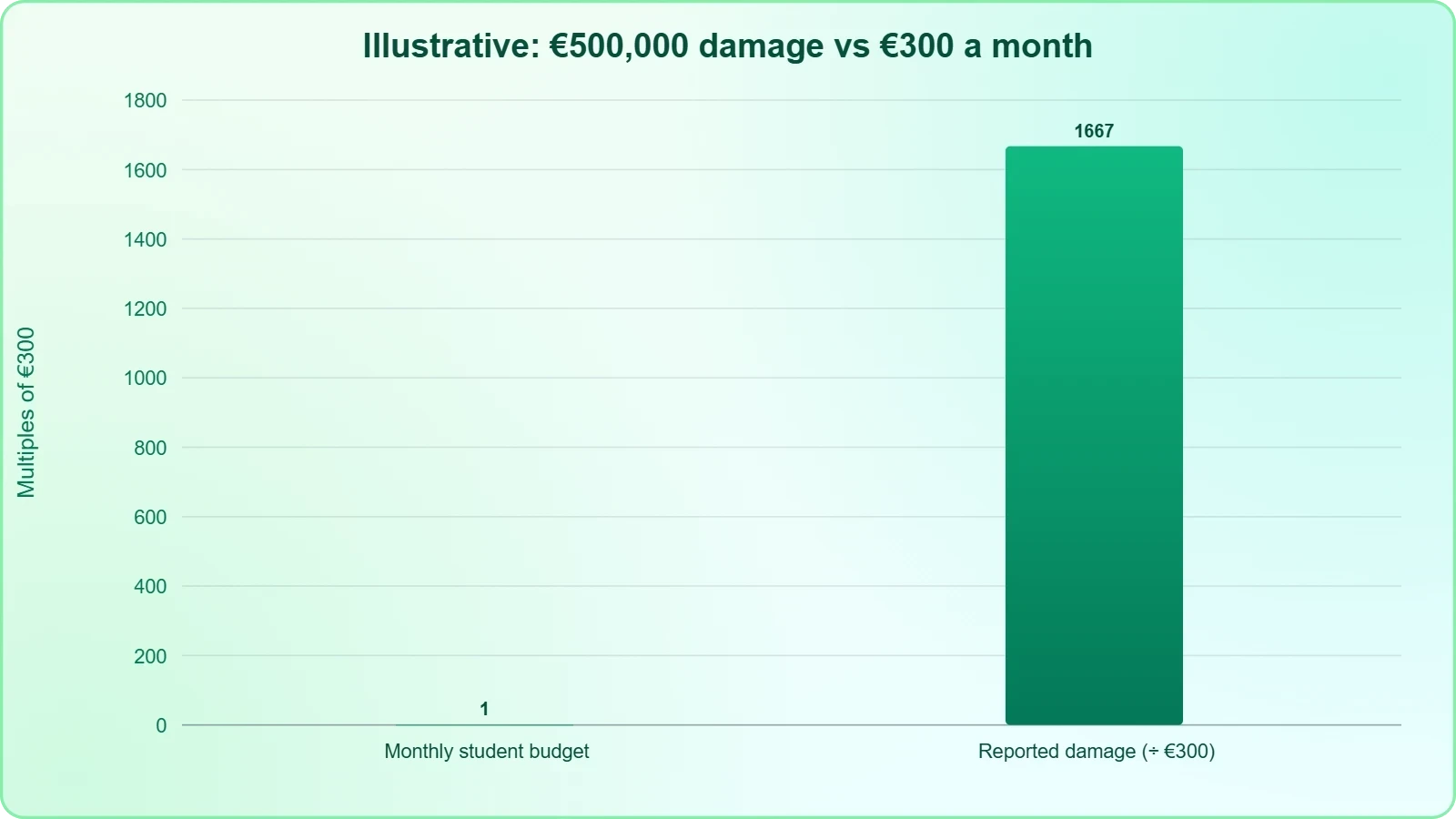
Mayor Guérin's grief is genuine and politically consequential, yet it competes with a colder arithmetic of monthly budgets and unaffordable rents. The €500,000 in reported damage from last weekend's looting and fires in Limoges is a rounding error against the national deficit, but it is emotionally legible in a way fiscal abstractions never are.
The town hall's clock tower, collapsed in flames, has become a memento mori for a political order that many citizens believe has already expired.
Political Blame and the Battle for Legitimacy
Guérin's accusation against the French hard left is more than a mayoral outburst; it is a strategic framing that seeks to convert arson into electoral ammunition. By linking the suspects to radical-left networks, he invites voters to see the unrest as ideological sabotage rather than spontaneous despair.
The claim that the fire will shape the presidential election in six months is an admission that Limoges has already been absorbed into national campaign logic. Blame, in this reading, is a resource to be mined.
Guérin's Grief and the Politics of Victimhood
The mayor's disclosure that he received support from US Vice President JD Vance but not from outgoing President Emmanuel Macron is a pointed diplomatic snub rendered personal. It signals a rupture between local authority and the Élysée, and it positions Guérin as a figure abandoned by his own national leadership.
Such details matter in French politics, where gestures carry the weight of policy. A mayor crying over ruins while the president stays silent writes a narrative no spin doctor could improve upon.
Guérin's blunt assessment that the country is not doing well functions as both lament and indictment. It aligns him with a public mood that transcends party lines, even as his attribution of blame to the hard left narrows his appeal.
The tension between mourning a building and prosecuting a movement defines his dilemma. He must appear above politics while waging a political fight, a balancing act few mayors sustain under international scrutiny.
A Government Without Majority, Budget, or Time
The centrist government's predicament is structural rather than incidental. It lacks solutions credible to protesters, a majority in the National Assembly to legislate them, and the time before elections to prove anything. France's fiscal deficit, among the largest in Europe, constrains every promise candidates might make.
Austerity alienates the street; generosity alarms the bond market. This trap is the true subject of the Limoges fire, which merely rendered it visible in ash and smoke.
Prime Minister Sébastien Lecornu's Friday evening visit to Limoges was a ritual of concern rather than a delivery of remedy. Officials banned demonstrations and pledged more police, defaulting to order maintenance because transformation exceeds their mandate.
Meanwhile, political candidates across the spectrum are offering solutions ahead of the presidential election, each promising to resolve what the incumbent government cannot. The electorate will judge not the plans but the plausibility of their authors.
The Generational Ledger: Monuments Versus Monthly Survival
The most revealing testimony from Limoges came not from officials but from students weighing heritage against hardship. Jade's €300 monthly budget is a figure that reframes the entire debate, converting a debate about arson into an audit of social provision.
When a medical student cannot afford to live, the state's claim to legitimacy weakens at its foundation. The town hall's clock tower measured time for a city; her budget measures how little time the government has left.
Reading the Protesters' Arithmetic
Alexander's question, whether a town hall matters more than people living in poverty, is rhetorical but not frivolous. It articulates a hierarchy of values in which shelter, food, and dignity outrank architectural heritage.
This is not philistinism; it is the logic of people who have been asked to sacrifice repeatedly while institutions remain insulated. The protesters are conducting a cost-benefit analysis of citizenship itself, and the results are damning for the incumbent order.
The demonstrations began over poor conditions in high schools, a demand so modest it should have been satisfied within weeks. Instead, neglect compounded into grievance, grievance into mobilization, and mobilization into riot. Each stage reflects a failure of responsiveness rather than a failure of restraint.
The young people filling French streets are not enemies of the republic; they are its creditors, presenting a bill long overdue and now compounded with interest.
When Order Maintenance Replaces Reform
Curfews, gathering caps, and protest bans constitute a grammar of control that governments deploy when persuasion fails. They may suppress disorder temporarily, but they cannot manufacture legitimacy. Limoges now lives under overnight restrictions and a ten-person limit on central gatherings, measures that treat citizens as potential threats rather than aggrieved parties.
Such policies often deepen alienation, ensuring that the next eruption arrives sooner and burns hotter than the last.
The €500,000 damage estimate from the prior weekend's looting and fires will be cited as justification for tougher policing. Yet the fiscal deficit dwarfing that sum receives far less emotional attention, revealing how publics respond to visible destruction more readily than to slow institutional decay.
France's crisis is not that buildings burn; it is that the arrangements meant to prevent burning have lost credibility. Reconstruction of stone is straightforward; reconstruction of trust is not.
Fiscal Reality and the Limits of Electoral Promise
France's fiscal position is the silent participant in every debate about Limoges. A deficit among the largest in Europe means candidates cannot simply promise to restore services, raise wages, and rebuild landmarks without confronting bond markets and Brussels. The centrist government's inability to offer solutions is therefore partly arithmetic and partly imaginative.
It has neither the money nor the narrative to reconcile demands with constraints, leaving a vacuum that populists on all sides rush to fill.
The Arithmetic Behind the Anger
Consider the monthly budget of a student surviving on €300 in a French city. Housing, food, transport, and heating consume that sum before any allowance for dignity, leisure, or contingency. When such conditions persist amid visible national wealth, the social contract appears fraudulent to those bound by it.
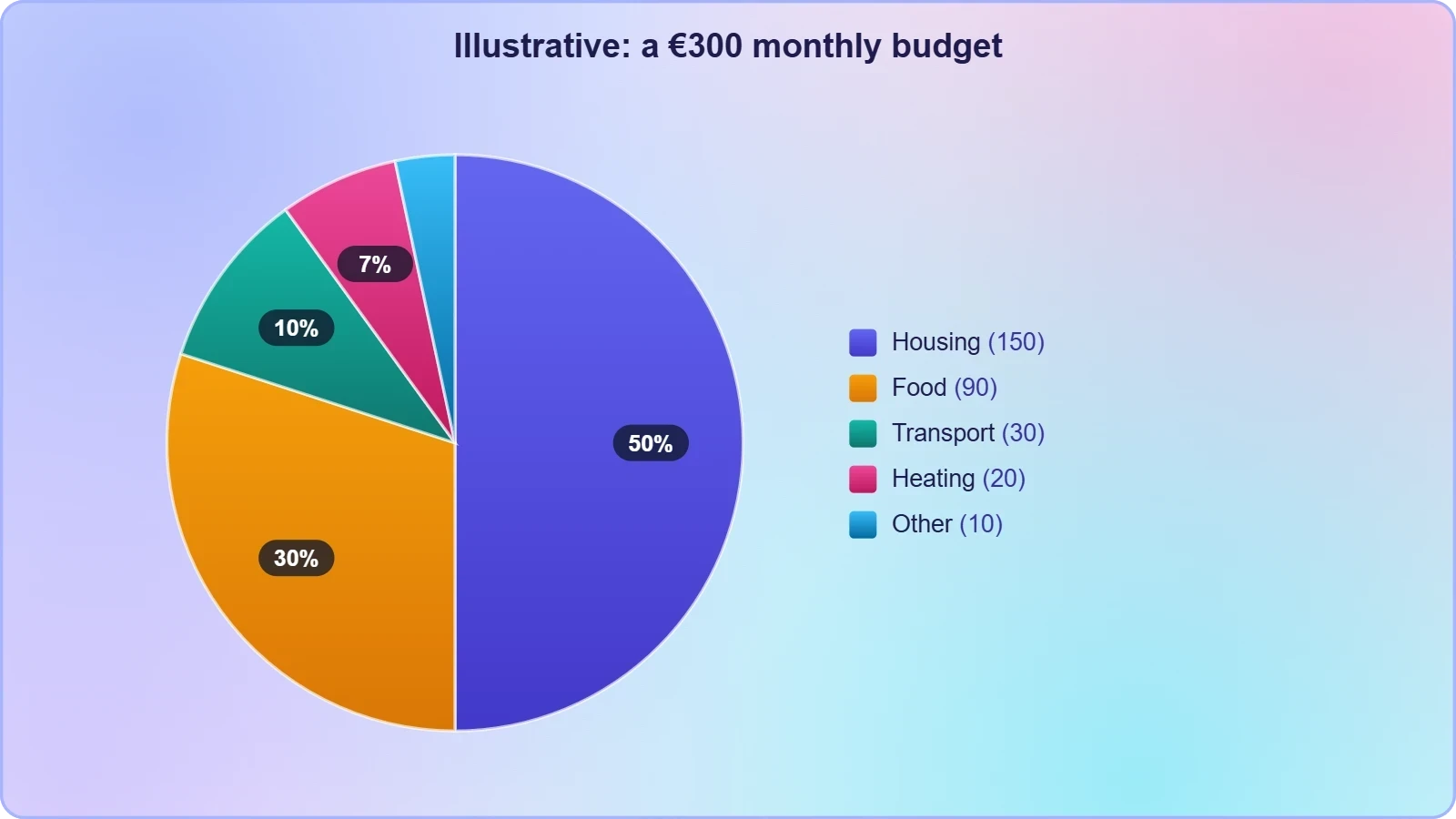
The protesters are not demanding luxury; they are demanding that the numbers add up to a life. Their arithmetic is more rigorous than most campaign platforms.
Fiscal consolidation typically arrives through spending restraint, tax increases, or growth, each politically costly in different ways. A government without a parliamentary majority can scarcely choose any of them, let alone implement the choice. This is why the deficit functions as a trap rather than a parameter.
It forecloses the generosity that might calm the streets while the streets reject the restraint that might calm the markets.
Election Six Months Out: The Limoges Variable
Guérin's assertion that the fire will affect the presidential election is plausible precisely because images outlast arguments. A collapsed clock tower will appear in campaign advertisements, debaters' talking points, and voters' memories long after the damage assessment is filed.
Candidates will compete to explain what Limoges reveals about France, and each explanation will flatter one coalition while alienating another. The fire has become a text that every politician must interpret.
The risk for incumbents is that Limoges confirms a narrative of disorder they cannot rebut. The risk for challengers is that blame attributed to radical networks taints the broader protest movement they wish to champion. Between these risks lies the electorate, weary of curfews and rhetoric alike.
Six months is simultaneously ample time for a campaign to reshape opinion and scant time for a government to rebuild a burned town hall, let alone a broken consensus.
- 01
- 02
- 03
- 04
We Also Published
Security, Solidarity, and the Reconstruction of Trust
The immediate response to Limoges has been securitized: bans, curfews, reinforcements, and arrests. This is the reflex of a state that can still project force even when it cannot project vision. Yet security without solidarity is merely the management of resentment, and resentment compounds.
The flowers at the town hall entrance suggest a civic mourning that could be channeled into renewal, but only if leadership treats grief as a bridge rather than a weapon.
What the Flowers at the Entrance Signify
Quiet onlookers laying flowers at a ruined building express something the rioters and the mayor both struggle to articulate. They mourn not merely architecture but a shared life that the building represented, a commons now damaged by conflict. This mourning is politically available to anyone who can speak to it honestly.
A leader who acknowledges both the loss of heritage and the legitimacy of hardship might convert sorrow into consent, but such leadership is conspicuously absent.
The division among Limoges residents, some condemning the destruction outright and others insisting poverty is sadder, mirrors the national split. Neither camp is irrational; each weighs incommensurable goods. The task of politics is to hold both truths without dismissing either, a task the current government has abandoned in favor of enforcement. Until that changes, the flowers will remain a gesture of grief without a corresponding gesture of governance.
Lessons Beyond France's Borders
Limoges is not an isolated curiosity; it is a preview of a pattern visible across Europe, where fiscal constraint meets generational expectation and produces combustion. The specific trigger, high-school conditions, could be housing, healthcare, or wages elsewhere.
The underlying equation remains constant: when institutions demand sacrifice without delivering dignity, legitimacy erodes until a single spark suffices. France's deficit is large, but its credibility deficit is larger and far more dangerous.
Observers abroad should resist the temptation to read Limoges as mere French melodrama. The fire illuminates a general condition in which centrist governance, squeezed between markets and streets, loses the capacity to persuade. Whether the response is curfew or concession, the decisive variable is whether citizens believe their grievances are heard.
In Limoges, the clock tower fell; elsewhere, the clock is simply ticking. The lesson is that time, like trust, is a finite resource.
The Wider Reckoning: France's Crisis in Global Context
Limoges arrives at a moment when European democracies confront a common squeeze between fiscal discipline and social expectation. The fire is local, but its grammar is continental: austerity without growth, governance without majorities, and citizens without patience.
France's particular intensity derives from its tradition of street politics and its centralization, which makes a provincial town hall a national stage. What burns in Limoges is not only wood and stone but the assumption that the center can hold.
From Provincial Fire to Continental Precedent
Across Europe, governments facing deficits have discovered that legitimacy is not a budget line but a precondition for fiscal adjustment. When citizens distrust the process, even necessary reforms become flashpoints. France's deficit is among the continent's largest, but its credibility deficit may be the more consequential figure.
Limoges demonstrates that a single dramatic image can do more political damage than years of fiscal reports, because images recruit emotions that spreadsheets cannot.
The international dimension surfaced oddly when Guérin noted support from US Vice President JD Vance but silence from Macron. This detail hints at how local crises now resonate in global media ecosystems, attracting foreign attention while domestic leadership withholds it.
In an age of instant circulation, a burning clock tower becomes an international symbol before the embers cool. France's internal argument is being conducted before a global audience that draws its own conclusions.
What Comes Next for Limoges and for France
Reconstruction of the town hall will proceed, funded by insurance, state allocations, and municipal resolve. But the deeper reconstruction, of the relationship between citizens and institutions, requires decisions no masonry can supply.
The government must choose between managing unrest and addressing its causes, and it must do so with limited money, limited majority, and limited time. Every option carries electoral risk, which is precisely why leadership is scarce.
The presidential election six months away will now be fought on terrain the fire helped define: order versus justice, heritage versus survival, competence versus empathy. Candidates who can articulate a synthesis may prosper; those who choose one horn of the dilemma will mobilize one camp and repel another.
Limoges has given France an image and a question. The answer will be written not in ash but in ballots, budgets, and whether the flowers at the entrance are joined by remedies.
From our network :
- Forbidden Matrix Patterns and Visible Lattice Points: A Geometric DictionaryExplore how multidimensional 0–1 matrices encode geometric truths, linking forbidden patterns to visible lattice points and hypergraph theory, with applications in combinatorics and computational geometry.
- The Final Descent: How ESA Retired the Legendary Cluster Constellation After 24 Years of Space Weather ScienceAfter 24 years mapping Earth’s magnetosphere, ESA’s Cluster mission concluded with a precisely controlled reentry over the South Pacific. This analysis explores the scientific legacy, engineering decisions, and debris mitigation principles behind one of space exploration’s most responsible retirements.
- Mobile Learning and VR in English: What Global Evidence Reveals About Effective Language TechnologyA systematic review across 14 countries reveals which language-learning technologies genuinely work. Mobile learning, AI, and VR show measurable benefits when pedagogically integrated. This evidence-based guide helps educators and learners select technology that delivers real return on investment.
- The Hidden Cost of AI Convenience: Why Over-Permissioned Agents Are a Security Time BombDiscover why AI agents with excessive permissions create dangerous single points of failure, and learn how implementing least privilege principles can protect your organization from exploitation.
- Live Online English Classes for Kids: Do They Actually Reduce Anxiety?A ten-week study reveals that synchronous online English classes can significantly reduce child language anxiety while improving listening and reading skills. Discover what makes these programs effective and how parents can select the right one.
- CISA’s Ten-Advisory Wave: Why Generic Patching Fails in OT and How to Build Product-Specific PlaybooksCISA released ten ICS advisories in one week, exposing critical infrastructure risks. Generic patching fails in OT. Learn to build product-specific remediation playbooks.
- University Language Proficiency Exams: Why Institutional Tests Demand Different Preparation Than IELTS and TOEFLDiscover why university-specific language proficiency examinations differ fundamentally from IELTS and TOEFL, and learn strategic preparation approaches for institutional assessment success.
- Committed Mediterranean Precipitation Decline: Why Emissions Cuts Alone Cannot Restore Winter RainsNew NOAA research reveals that Mediterranean winter rains may decline irreversibly even with emissions cuts. Explore the science of committed climate change and regional impacts.
- How AI Agents Will Change the Way We Manage Personal FinancesExplore how AI agents are transforming personal finance through automated budgeting, bill payment, and investment management, while examining the critical security protocols and governance frameworks required for safe deployment.
RESOURCES
- Ruins of city hall a symbol of France divided by protests - BBCbbc.com1 day ago ... Younger Limoges residents see the destruction of their town hall as unfortunate collateral damage in a wider movement. For others,…
- In France's Limoges, the fire-ravaged town hall rekindles memories ...reuters.com6 days ago ... In France's Limoges, the fire-ravaged town hall rekindles memories of Notre Dame · Blaze started by masked protesters on Saturday…
- Suspect arrested after historic town hall set alight - French mediabbc.com5 days ago ... ... city hall in AFP via Getty Images. The city hall's roof and clock tower in Limoges was severely damaged…
- This French City Was Rarely Linked With Unrest. Then Arsonists ...nytimes.com7 days ago ... ... city of Limoges, where rioters set fire to the city hall ... Limoges Residents Grieve City Hall Damage After…
- France arrests man believed to be connected to town hall fire in ...euronews.com5 days ago ... ... demonstration in Limoges on Saturday. Some 7,000 people then took part in a protest to denounce the violence on…
- Town hall in Limoges 'largely lost' to blaze set during French protestsfrance24.comOct 17, 2026 ... Limoges (France) (AFP) – The town hall in the French city of Limoges was "largely lost" to a fire set…
- The Burning of This French City Hall Was a 'Catastrophe for ...smithsonianmag.com6 days ago ... ... Fire. French authorities say that the Limoges city hall, built in the late 19th century and celebrated as an…
- French police arrest man over Limoges city hall fire during protestslemonde.fr5 days ago ... French security forces arrested a man on Tuesday, October 20, over a fire that burnt down a historic city hall…
- Buildings set ablaze and more than 1,800 arrested as police clash ...theguardian.comOct 17, 2026 ... Police fire teargas in Paris and Limoges town hall 'largely lost' to ... More than 1,800 arrested in France as…
- 'Anger' and 'heartbreak' in French city after fire devastates town hall ...lemonde.fr6 days ago ... On Sunday evening, nearly 7000 people gathered in Limoges to condemn the violent aftermath of the protests. The mayor blamed…
- Historic town hall in Limoges set on fire during French protestsdezeen.com6 days ago ... Significant parts of the 143-year-old Limoges Town Hall have been destroyed in an arson attack, as protests broke out in…
- France protests: Some 2,000 arrested after looting and arsondw.com7 days ago ... In central France, rioters set fire to Limoges' historic town hall, leaving much of it gutted. Mayor Guillaume Guerin condemned…
- France's 143-year-old Limoges City Hall survived Nazi occupationfinance.yahoo.com6 days ago ... A historic French town hall that served as a hub for resistance during World War II was devastated by fire…
- Ruins of city hall a symbol of France divided by protests - BBC Newsbbc.co.uk1 day ago ... Younger Limoges residents see the destruction of their town hall as unfortunate collateral damage in a wider movement. For others,…
- In France's Limoges, the fire-ravaged town hall rekindles memories ...thestate.com7 days ago ... Fire in Limoges city hall amid protests, in Limoges, France, October 17, 2026, in this screengrab from a video obtained…
- 01
- 02
- 03
- 04
- 05
- 06
- 07
- 08
0 Comments