
A decade has now passed since the Indianapolis Star first published the allegations that would topple Larry Nassar, the disgraced physician who served USA Gymnastics and Michigan State University.
That reporting opened a floodgate: hundreds of women came forward, describing abuse that had been hidden behind the authority of a trusted doctor. Nassar's conviction and imprisonment became a landmark moment, yet the deeper reckoning it demanded remains unfinished.
Survivors and advocates gathered near the World Gymnastics Championships in Rotterdam to deliver a sobering verdict on the intervening years. Speaking from a houseboat close to the venue, they argued that the structural reforms promised in the aftermath of the scandal have arrived too slowly.
On This Page
The sport, they insist, still shelters the same cultures of obedience, fear, and silence that once enabled a predator to operate with impunity.
This analysis examines what the Nassar case exposed, why institutional change has lagged, and what genuine athlete protection now requires. It weighs the courage of the survivors against the inertia of governing bodies, and it asks a difficult question: how much has gymnastics truly learned?
TL;DR Ten years after the Indianapolis Star exposed Larry Nassar's abuse, survivors say gymnastics reform remains dangerously slow. Nassar, a former USA Gymnastics and Michigan State doctor, was sentenced to up to 175 years in state prison, with additional federal and state convictions pushing his total exposure to 300 years to life. Judge Rosemarie Aquilina allowed 169 victims to deliver statements over seven days, a spectacle of testimony that encouraged others to come forward. Yet advocates meeting near the Rotterdam World Championships argue that promised safeguards have not materialized fast enough. The case exposed a coaching culture of obedience, fear, and silence, documented in the film Athlete A. Real reform demands independent oversight, athlete-centered reporting systems, and accountability that outlasts headlines.
The Anatomy of a Scandal and Its Unfinished Reckoning
The Nassar case was never merely the story of one predatory physician. It was a systemic failure involving federations, universities, coaches, and medical institutions that collectively ignored warning signs for years.
Understanding that architecture of complicity is essential to judging whether anything meaningful has changed in the decade since.
How the Allegations Finally Surfaced
The Indianapolis Star's 2016 investigation gave voice to gymnasts whose complaints had long been dismissed or buried. What began as a local newspaper inquiry rapidly expanded into a global reckoning for a sport built on deference to authority. The reporting demonstrated that silence was not accidental but cultivated.
Hundreds of women eventually accused Nassar of abuse under the guise of medical treatment. His position as a trusted team doctor gave him extraordinary access to young athletes, and institutions repeatedly deferred to his credentials. That deference became the mechanism of harm.
The scale of the accusations transformed the case from a criminal matter into a referendum on institutional culture. Federations worldwide were forced to confront how their own safeguards had failed young athletes. The questions raised in Indianapolis echoed across every gymnastics program on earth.
Survivors describe the moment of publication as both terrifying and liberating. For many, it was the first time their experiences were treated as credible rather than inconvenient. That validation, however, arrived only after years of institutional denial.
The Courtroom That Changed the Conversation
Judge Rosemarie Aquilina's decision to allow 169 victims to deliver statements over seven days became a defining moment. Her courtroom turned individual testimony into a collective indictment of the systems that had failed them. The proceedings were extraordinary in both length and emotional force.
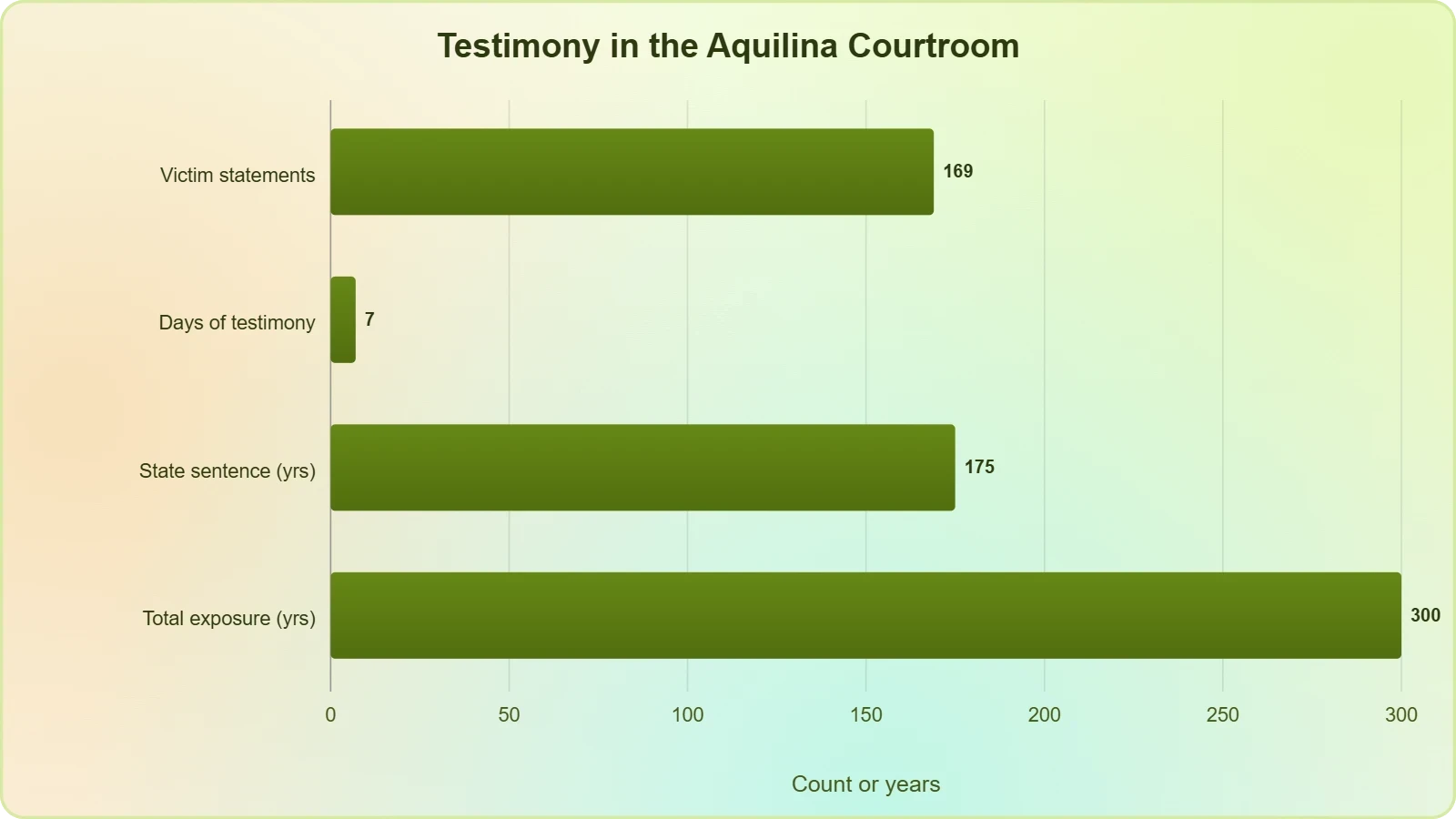
Aquilina sentenced Nassar to up to 175 years in state prison, and additional federal and state convictions brought his total exposure to 300 years to life. She later emphasized that public testimony helped many victims feel heard and believed. Crucially, one person's courage encouraged others to come forward.
Olympic gold medalists Aly Raisman and Jordyn Wieber, bronze medalist Jamie Dantzscher, and former national champion Mattie Larson were among those who spoke. Their willingness to testify publicly shattered the stigma that had long surrounded abuse in elite sport. Each statement strengthened the case for systemic reform.
Simone Biles, the most decorated gymnast of her generation, later revealed she was a victim and testified before the US Senate Judiciary Committee. Her intervention carried enormous weight precisely because she was the sport's most celebrated figure. When the most powerful voice speaks, institutions can no longer claim ignorance.
The Culture That Enabled Abuse
The 2020 documentary Athlete A examined the coaching culture of obedience, fear, and silence that allowed Nassar to operate. It showed how young athletes were conditioned to comply without question. That conditioning made reporting abuse feel impossible.
Elite gymnastics rewards discipline and punishes dissent from an early age. Coaches wield near-total control over training, competition, and sometimes living arrangements. Such concentrated authority creates fertile ground for exploitation.
Survivors have repeatedly described a code of silence enforced through fear of losing Olympic dreams. When a career depends on a single coach's favor, speaking up carries existential risk. Institutions exploited that vulnerability rather than protecting against it.
The documentary also revealed how complaints were routed through channels controlled by the very organizations implicated. Internal reporting mechanisms became tools of containment rather than accountability. Reform must therefore address power itself, not merely procedures.
Why Survivors Say Change Is Too Slow
A decade after the scandal broke, survivors argue that the sport still has not done enough to ensure athlete safety. Their frustration centers on the gap between public apologies and durable structural change. Promises, they note, are not protections.
Advocates meeting near the Rotterdam World Championships highlighted persistent weaknesses in oversight and reporting. They contend that athlete voices remain marginal in the bodies that govern the sport. Without genuine representation, accountability remains performative.
Critics also point to the revolving door between federations and the institutions they are meant to police. Independence, they argue, is the missing ingredient in every reform package. Oversight conducted by insiders rarely challenges insider culture.
The survivors' message is not that nothing has changed, but that change has been too cautious and too slow. A decade is a long time to wait for safeguards that should have existed from the start. Their patience is a form of courage, not consent.
We Also Published
Reform, Resistance, and the Global Dimension
The Nassar case was American in origin but global in implication. Every federation that sends young athletes into elite competition faced the same uncomfortable questions. The response has varied widely, and the variance itself is revealing.
The Reform Measures Promised
In the wake of the scandal, federations pledged independent investigations, athlete safeguarding offices, and mandatory reporting protocols. Many introduced background checks and codes of conduct for coaches and medical staff. On paper, the architecture of protection expanded considerably.
USA Gymnastics underwent leadership turnover and structural reorganization under pressure from Congress and survivors. Michigan State faced investigations, settlements, and reputational reckoning. Federal legislation strengthened reporting obligations across Olympic sports.
Training programs now emphasize athlete education about boundaries and reporting channels. Safeguarding officers have been appointed in numerous national federations. These are genuine steps, and survivors acknowledge them.
Yet implementation has been uneven, and enforcement remains the weakest link. Policies without independent auditing become ornaments rather than safeguards. The distance between a code of conduct and a protected athlete is measured in accountability.
The Voices That Carried the Weight
The survivors who testified transformed a private trauma into a public reckoning. Raisman, Wieber, Dantzscher, Larson, and Biles each lent their credibility to a cause larger than themselves. Their testimony created a record that institutions cannot erase.
Aquilina's courtroom became a stage for collective truth-telling, and its impact extended far beyond Michigan. Victims in other sports and other countries recognized their own experiences in those statements. Solidarity spread through testimony.
Biles's Senate testimony was particularly consequential because it challenged the sport's most powerful institutions directly. Her stature made dismissal impossible and forced legislative attention. When the greatest athlete speaks, the machinery of denial stalls.
Survivors now function as advocates, pressing federations for independent oversight and athlete-centered governance. Their persistence is the engine of whatever reform has occurred. The movement they built refuses to be quietly retired.
The Global Safeguarding Gap
While Nassar's crimes were the most extensively documented, other countries also faced questions about their safeguards. The scandal exposed vulnerabilities that transcended national borders and legal systems. Gymnastics is a global enterprise, and so is its risk.
National federations vary enormously in resources, legal frameworks, and cultural attitudes toward authority. Some have robust safeguarding offices; others rely on volunteers with minimal training. That disparity leaves athletes in some countries far more exposed.
International governing bodies have issued guidelines and safeguarding standards, but enforcement remains fragmented. Without binding consequences, standards become suggestions. Athletes pay the price for that ambiguity.
The Rotterdam gathering underscored that the reform conversation must be global, not merely American. Survivors from different nations are comparing notes and demanding consistency. Their coordination is a warning to federations everywhere.
What Genuine Accountability Requires
Real reform begins with independent oversight insulated from the institutions being monitored. Athletes must hold meaningful voting power in governance, not symbolic seats. Reporting systems must be external, confidential, and trusted.
Coaching culture requires deliberate transformation, not merely new codes of conduct. Training environments must reward athlete welfare over medal counts. Fear-based discipline must be recognized as a safeguarding risk, not a coaching virtue.
Accountability also demands transparency about investigations and outcomes. Federations must publish safeguarding data and submit to external audits. Secrecy is the habitat of institutional failure.
Finally, survivors must be treated as partners in reform rather than inconvenient reminders. Their experience contains the blueprint for prevention. Listening is not a courtesy; it is a safeguard.
- 01
- 02
- 03
- 04
Lessons for Sport, Institutions, and Society
The Nassar case offers lessons that extend well beyond gymnastics. Any institution entrusted with young people faces the same structural temptations: deference to authority, fear of reputational damage, and the quiet burial of complaints. The scandal is a mirror, not an anomaly.
The Psychology of Silence
Silence in abusive systems is rarely a single decision; it is a cumulative culture. Young athletes learn early that questioning authority threatens their dreams. That lesson is taught through selection, discipline, and the celebration of compliance.
Institutions reinforce silence by making reporting costly and visibility dangerous. When complainants face retaliation or dismissal, others learn to stay quiet. The chilling effect is the predator's most reliable ally.
Breaking silence requires more than hotlines; it requires credible assurance that speaking will change outcomes. Survivors must see consequences for institutions, not just individuals. Trust is rebuilt through visible accountability.
Psychologically, the courtroom testimony demonstrated the healing power of being believed. Aquilina's observation that one testimony encouraged others captures a fundamental truth. Voice is contagious, and so is courage.
Governance and the Athlete Voice
Governing bodies have historically treated athletes as performers rather than stakeholders. Reform requires inverting that hierarchy and placing athlete welfare at the center of every decision. Representation is the mechanism of that inversion.
Athlete councils with genuine authority can surface problems before they become scandals. Independent safeguarding commissions can investigate without institutional interference. Transparent reporting can make concealment impossible.
Financial incentives must also align with safety, not merely medals. Funding tied to safeguarding compliance would change behavior faster than any pledge. Where money flows, priorities follow.
The survivors' demand is ultimately modest: a sport that protects rather than exploits its young people. Achieving it requires governance that answers to athletes, not administrators. That is the unfinished work of the last decade.
Media, Memory, and the Long Watch
Investigative journalism played a decisive role in exposing Nassar, and continued scrutiny remains essential. Scandals fade from headlines, but institutional memory must not fade with them. The press functions as an external conscience.
Documentaries like Athlete A preserve testimony and educate new generations about the cost of silence. They also hold institutions to their promises by keeping the record public. Memory is a form of accountability.
Survivors understand that attention is a resource that must be renewed. Their Rotterdam gathering was itself an act of media stewardship. They are ensuring the story does not end with a sentence.
The decade mark is therefore not a conclusion but a checkpoint. Progress exists, but it is fragile and incomplete. The watch must continue until protection is structural rather than personal.
The Road Ahead
Genuine reform will be measured not by statements but by the experience of the next generation of gymnasts. If young athletes feel safe to speak and confident they will be heard, change is real. If not, the promises remain hollow.
Federations must submit to independent audits and publish their findings without selective editing. Coaches must be trained and evaluated on safeguarding, not only performance. Athletes must hold power in the rooms where decisions are made.
Survivors have shown what courage looks like when institutions fail. Their testimony created a moral standard against which every reform must now be judged. The sport's future depends on meeting it.
A decade after the first headline, the question is no longer whether abuse happened but whether the systems that enabled it have truly changed. The answer remains contested, and the survivors are still waiting. Their patience should not be mistaken for satisfaction.
From our network :
- Live Online English Classes for Kids: Do They Actually Reduce Anxiety?A ten-week study reveals that synchronous online English classes can significantly reduce child language anxiety while improving listening and reading skills. Discover what makes these programs effective and how parents can select the right one.
- The Final Descent: How ESA Retired the Legendary Cluster Constellation After 24 Years of Space Weather ScienceAfter 24 years mapping Earth’s magnetosphere, ESA’s Cluster mission concluded with a precisely controlled reentry over the South Pacific. This analysis explores the scientific legacy, engineering decisions, and debris mitigation principles behind one of space exploration’s most responsible retirements.
- How AI Agents Will Change the Way We Manage Personal FinancesExplore how AI agents are transforming personal finance through automated budgeting, bill payment, and investment management, while examining the critical security protocols and governance frameworks required for safe deployment.
- Mobile Learning and VR in English: What Global Evidence Reveals About Effective Language TechnologyA systematic review across 14 countries reveals which language-learning technologies genuinely work. Mobile learning, AI, and VR show measurable benefits when pedagogically integrated. This evidence-based guide helps educators and learners select technology that delivers real return on investment.
- Forbidden Matrix Patterns and Visible Lattice Points: A Geometric DictionaryExplore how multidimensional 0–1 matrices encode geometric truths, linking forbidden patterns to visible lattice points and hypergraph theory, with applications in combinatorics and computational geometry.
- CISA’s Ten-Advisory Wave: Why Generic Patching Fails in OT and How to Build Product-Specific PlaybooksCISA released ten ICS advisories in one week, exposing critical infrastructure risks. Generic patching fails in OT. Learn to build product-specific remediation playbooks.
- University Language Proficiency Exams: Why Institutional Tests Demand Different Preparation Than IELTS and TOEFLDiscover why university-specific language proficiency examinations differ fundamentally from IELTS and TOEFL, and learn strategic preparation approaches for institutional assessment success.
- Committed Mediterranean Precipitation Decline: Why Emissions Cuts Alone Cannot Restore Winter RainsNew NOAA research reveals that Mediterranean winter rains may decline irreversibly even with emissions cuts. Explore the science of committed climate change and regional impacts.
- The Hidden Cost of AI Convenience: Why Over-Permissioned Agents Are a Security Time BombDiscover why AI agents with excessive permissions create dangerous single points of failure, and learn how implementing least privilege principles can protect your organization from exploitation.
RESOURCES
- Addressing Abuse in US Gymnastics—and The Reform Movementlilith.orgJul 29, 2024 ... ... Larry Nassar to jail for what is effectively a life sentence. New ... What would a deeper approach mean…
- 'Money and medals over safety': Nassar judge warns gymnasts are ...theguardian.com7 days ago ... The judge who sentenced the former USA Gymnastics team doctor Larry Nassar ... reform 10 years on from Nasser case.…
- USA Gymnastics, Olympic committee reach $380 million deal ... - NPRnpr.orgDec 13, 2021 ... Nassar abuse survivors reach $380 million deal with USA Gymnastics, Olympic committee · Law · The FBI mishandled Larry Nassar's…
- How USA Gymnastics has changed since the Larry Nassar scandalabcnews.comSo, what has changed since then? Reforms in the gymnastics world. Since the ... However, a lawsuit is still pending in the case against…
- Judge in Larry Nassar abuse case says gymnastics still failing ...sports.yahoo.com6 days ago ... Judge Rosemarie Aquilina said little progress had been made despite reforms in the decade since USA Gymnastics doctor Larry Nassar…
- Spurred by USA Gymnastics scandal, senators roll out bill to reform ...nbcnews.comSep 22, 2022 ... ... Larry Nassar investigation. The former USA Gymnastics doctor is ... The bill would also include new case review provisions…
- Larry Nassar: The USA Gymnastics Scandal That Exposed ...employmentdiscrimination.com3. Legal and Cultural Impact. Catalyst for Reform in Sports and Beyond. The Nassar case sparked a national reckoning in sports, education, and youth-serving ...
- USA Gymnastics, hundreds of sex abuse survivors reach $380M ...nbcnews.comDec 13, 2021 ... USA Gymnastics, hundreds of sex abuse survivors reach $380M deal in Nassar case ... The settlement forces reforms on USA…
- Texas considers bill that allows sexual abuse survivors to sue entitiestexastribune.orgMay 13, 2019 ... Gymnasts who survived abuse by Larry Nassar urge Texas lawmakers not to water down reform ... cases of sexual abuse.…
- š? SafeSport Reform is Needed to Protect Athletes From Abusedigitalcommons.law.villanova.eduApr 7, 2025 ... com/2018/01/25/sports/larry-nassar-gymnastics-abuse.html [https://archive.ph/. aU7BR] (describing abuse that Nassar's victims endured and how ...
- A Case Study of the Minor Athlete Abuse Pre" by Daniel Ray Raneydigitalcommons.calpoly.eduIn response to the unprecedented scrutiny following the Larry Nassar case, USA Gymnastics initiated comprehensive policy reforms aimed at strengthening the ...
- Examining the Inspector General's Report on the FBI's Handling of ...oig.justice.govBefore I turn to our report, I want to recognize and acknowledge the many gymnasts who had the courage to come forward to report…
- U.S. Olympic Sexual Abuse Investigation - Senator Jerry Moranmoran.senate.gov... Larry Nassar abuse case. Introducing the Empowering Olympic and Amateur ... Gymnastics and Michigan State University to protect Olympic and amateur athletes from ...
- Olympic gymnast shares story of childhood sexual abuse, urges ...kansasreflector.comFeb 10, 2023 ... ... reforms to current law on childhood sexual abuse cases. ... In 2020, she disclosed she was abused by former…
- It's Not Just the Larry Nassar Case. We Are Failing Sexual Assault ...nytimes.comSep 27, 2021 ... ... gymnastics team doctor convicted on multiple counts of sexually ... In Chicago, survivors and advocates have demanded reform of…
- 01
- 02
- 03
- 04
- 05
- 06
- 07
- 08
0 Comments