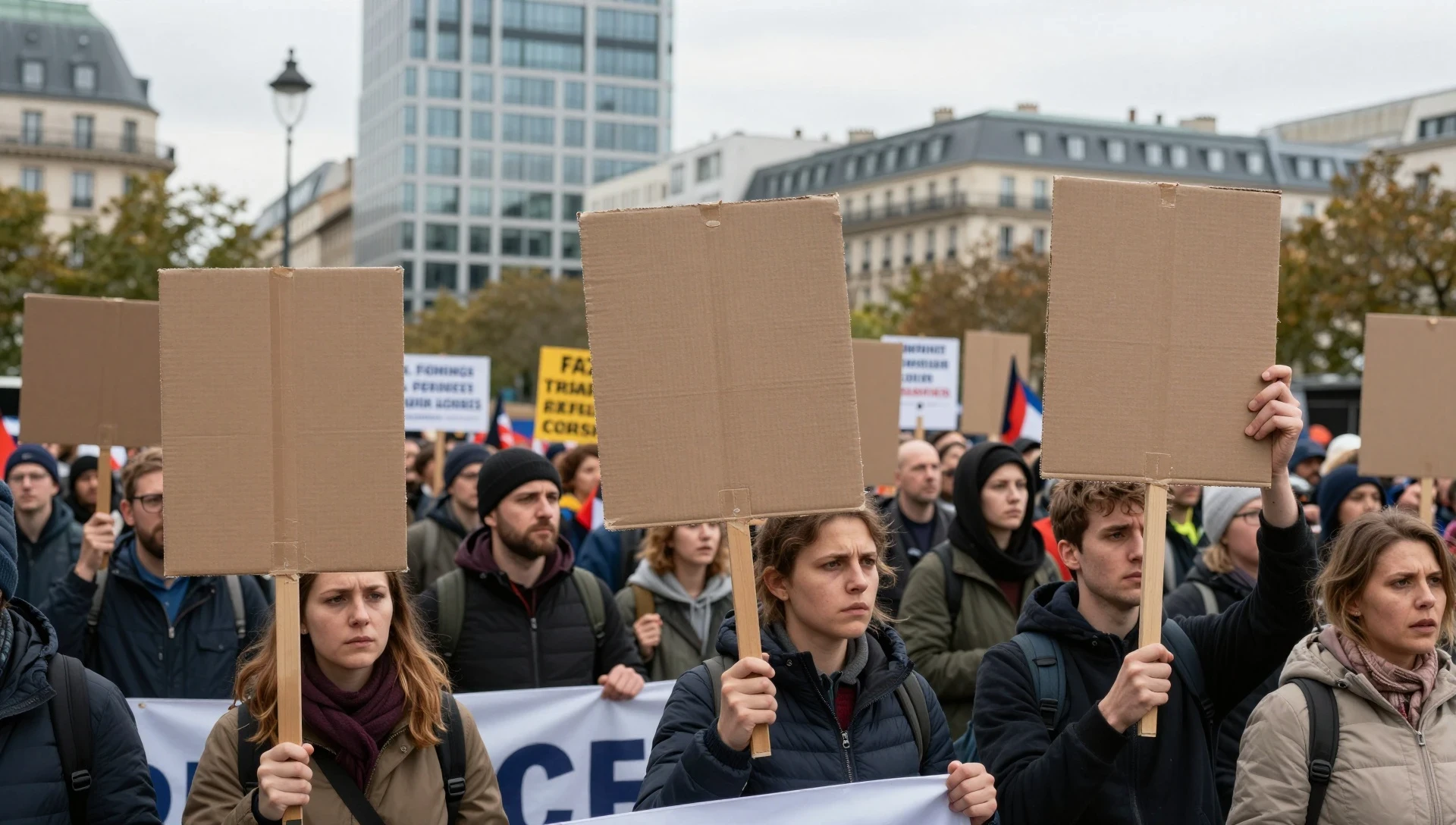
On 1 November 2026, more than 320,000 demonstrators took to the streets of France in a coordinated national mobilization against the rising cost of living and deteriorating public services, while German cities including Berlin, Hamburg and Frankfurt staged parallel protests on the same day.
What began as daytime marches in Paris ended after nightfall in confrontations between protesters and riot police, who deployed tear gas and flashbang devices to disperse crowds. Authorities confirmed more than 1,300 arrests as clashes extended into a second day of mass action, and looting was reported in several German locations where demonstrations turned violent.
The convergence of French and German unrest is analytically significant because it marks a shift from episodic, single-country grievance to a synchronized European pattern. Both economies face the same structural pressures: energy costs that remain elevated relative to pre-crisis baselines, wage growth lagging consumer prices, and public services strained by fiscal consolidation.
On This Page
When two of the eurozone's largest economies experience simultaneous street-level volatility, the signal is less about any single policy failure and more about the durability of the cost-of-living shock across the currency bloc.
This analysis examines the protest wave through three lenses: the scale and composition of the demonstrations, the security and legal response from both states, and the wider political and economic implications for European governance.
It also situates the unrest alongside unrelated French developments reported the same week, including a terrorism charge in a Paris suburb, the detention of a sports journalist in Algeria, and a consumer dispute over a camper-van, to show how security, foreign policy and everyday economic frustration now compete for the same public attention.
TL;DR More than 320,000 people protested across France on 1 November 2026 against the cost of living and poor public services, with Paris clashes after nightfall, tear gas and flashbangs deployed, and over 1,300 arrests. Germany saw simultaneous demonstrations in Berlin, Hamburg and Frankfurt, with looting in some locations. The synchronized Franco-German unrest reflects shared structural pressures—elevated energy costs, lagging wages and strained public services—rather than isolated national grievances, and it arrives alongside separate French security and consular cases that complicate the political narrative.
The Scale and Anatomy of the Franco-German Protest Wave
The headline figure of 320,000 demonstrators across France places this mobilization among the larger recent French protest cycles, though well below the peak turnout recorded during the pension reform confrontations of 2023.
The geographic spread matters as much as the raw number: demonstrations occurred nationwide rather than concentrating in the capital, indicating that the grievance is not a Parisian phenomenon but a broad-based reaction to household budget pressure.
German participation, while less precisely quantified in the source reporting, followed the same calendar and the same thematic framing.
Turnout, Geography and the Calendar of Unrest
French turnout of 320,000 is best read against the historical baseline of French street politics, where national days of action routinely produce six-figure totals. The critical variable is not the absolute count but the ratio of peaceful daytime participation to post-dark confrontation.
In Paris, the demonstration remained largely orderly during daylight hours before clashes erupted after nightfall, a pattern that suggests organized daytime mobilization followed by a more fluid, less controlled evening phase involving different participant profiles.
German demonstrations in Berlin, Hamburg and Frankfurt occurred on the same day, creating a coordinated cross-border visual and media effect. The choice of Frankfurt is notable given its role as the eurozone's financial center, while Hamburg and Berlin represent port and political capitals respectively.
This geographic selection gave the German protests a symbolic reach beyond any single local grievance, linking cost-of-living frustration to the broader question of who bears the adjustment burden in Europe's largest economy.
The timing—1 November, a public holiday in parts of Europe—lowered the opportunity cost of participation and likely inflated turnout relative to a working weekday. Analysts should therefore treat the 320,000 figure as a high-water mark within this cycle rather than a stable run-rate. Subsequent mobilization numbers will reveal whether the movement sustains momentum or dissipates after the symbolic holiday date.
Looting in some German locations marks a qualitative escalation from the French pattern, where the reported disorder centered on confrontations with riot police rather than property crime. This distinction matters for how each state frames the unrest: France confronts a public-order and policing question, while Germany faces a hybrid of political protest and criminal opportunism that complicates the legitimacy narrative of the demonstrations.
Composition of Grievances: Cost of Living and Public Services
The stated grievances—rising cost of living and poor public services—are economically linked rather than separate complaints. Households facing elevated food, energy and housing costs simultaneously encounter degraded public provision in healthcare, transport and education, producing a compound sense of declining real living standards.
This compound effect explains why the protests attracted participants beyond the traditional union and activist base, including middle-income households unaccustomed to street politics.
Public services deterioration is a fiscal story. Years of constrained budgets, pandemic-era debt accumulation and defense spending commitments have squeezed discretionary spending across both countries. When citizens perceive that they pay more for daily life while receiving visibly less from the state, the political contract itself comes under scrutiny. The protests are therefore best understood as a legitimacy signal, not merely a price complaint.
Cross-border synchronization amplifies this legitimacy signal. A French grievance alone can be dismissed as national politics; a Franco-German grievance on the same day suggests a structural European condition. That framing is politically potent because it shifts blame from national governments toward the broader economic architecture of the eurozone and the policy choices embedded within it.
The absence of a single, negotiable demand complicates resolution. Cost-of-living protests lack the clear bargaining counterparty that wage disputes possess, making them harder to settle through conventional industrial relations. This diffuseness is precisely what makes such movements durable and unpredictable, since they can re-ignite around any new price shock or service failure.
Security Response and the Policing Question
French police deployed tear gas and flashbang devices after nightfall in Paris, and the arrest of more than 1,300 people represents a substantial custodial load. Flashbangs are less-lethal diversionary devices that generate intense light and sound; their use in urban crowds carries documented injury risk and invites scrutiny from human rights monitors.
The scale of arrests also raises due-process questions about detention capacity and the evidentiary basis for individual charges.
Germany's response focused on looting, a property-crime framing that positions the state as protector of commercial order rather than manager of political dissent. This distinction shapes public perception: French coverage emphasizes confrontation between citizens and police, while German coverage emphasizes criminal opportunism.
Both framings are politically convenient for the respective governments, and both obscure the underlying economic grievance that triggered the mobilization.
Policing costs are themselves a fiscal variable. Sustained mass mobilization diverts officers from routine duties, strains judicial throughput and generates compensation claims. Over repeated cycles, the security response becomes a recurring budget line that competes with the very public services whose deterioration fueled the protests—a feedback loop worth monitoring in subsequent fiscal reporting.
Comparative European experience suggests that heavy-handed responses can extend rather than shorten protest cycles. The analytical question is whether either government calibrates its response toward de-escalation or toward deterrence. Early indicators—the volume of arrests in France and the looting narrative in Germany—point toward deterrence, which historically correlates with prolonged contention.
Adjacent French Developments: Security, Consular and Consumer Cases
The same reporting cycle carried three French developments unrelated to the protests but politically entangled with them. A suspect in a deadly shooting in a Paris suburb was charged with murder and attempted murder in connection with a terrorist enterprise, with prosecutors stating the suspect targeted people who appeared Muslim or of African appearance.
The suspect was sent for psychiatric observation to assess whether questioning could continue, a procedural step that will determine the pace of the judicial process.
Terrorism Charge and Psychiatric Assessment
The charging decision—murder and attempted murder linked to a terrorist enterprise—signals that prosecutors view the shooting as ideologically motivated rather than an isolated criminal act. The stated targeting criterion, appearance-based selection of Muslim or African victims, inverts the usual framing of extremist violence and complicates the political conversation about communal tension in France. The case will be watched for how authorities characterize motive without inflaming further polarization.
Psychiatric observation is a standard but consequential procedural mechanism. Its outcome determines whether the suspect is fit for continued interrogation, which in turn affects the evidentiary timeline and the eventual trial schedule. For the public, the psychiatric phase can appear as delay; for the defense, it is a safeguard. Managing that perception is part of the broader challenge of maintaining confidence in counterterrorism prosecutions.
Timing matters politically. A terrorism charge landing in the same news cycle as mass cost-of-living protests forces the French state to manage two distinct legitimacy challenges simultaneously: public order in the streets and communal security in the suburbs.
Resource allocation across policing, intelligence and judicial capacity becomes a visible trade-off rather than an abstract budget question.
The case also intersects with the protest narrative through the shared theme of state capacity. Citizens protesting degraded public services and citizens demanding robust security both measure the state against a standard of effective provision.
When both groups express dissatisfaction in the same week, the aggregate signal about institutional performance is stronger than either complaint alone.
Detention of a Sports Journalist in Algeria
A French sports journalist is being held in Algeria, accused of supporting terrorism after traveling to the Kabylie region, and the Ballon d'Or ceremony drew attention to his situation. The case sits at the intersection of press freedom, Franco-Algerian relations and counterterrorism law.
Kabylie, a predominantly Amazigh region, has a complex history of state-society tension, and reporting from the area carries legal risk under Algerian statutes that critics describe as overly broad.
Using a high-profile cultural event as a platform for consular advocacy is a recognizable diplomatic tactic. It generates visibility that formal channels may lack, particularly when bilateral relations are strained.
The effectiveness of such pressure depends on whether the Algerian authorities treat the case as a legal matter or a political bargaining chip, and early signals are rarely conclusive.
For media organizations, the detention reinforces the operational risk calculus of reporting from North Africa. Insurance, editorial safety protocols and local fixer networks all become cost centers that shape which stories get covered.
The analytical consequence is a systematic underreporting of regions where legal risk is highest, which in turn distorts the information environment available to policymakers.
The case also tests the limits of terrorism legislation as applied to journalism. Accusations of supporting terrorism can encompass material support, association or expression depending on statutory drafting. How Algeria applies its law here will inform how press freedom organizations rank the country and how French diplomats calibrate future engagement.
The Camper-Van Dispute as a Consumer Signal
A man's camper-van, which he had described as a dream vehicle, became what he called his "worst nightmare," and the RAC said he had been badly let down by an independent garage.
On its surface this is a minor consumer story, but it carries a recognizable pattern: high-value discretionary purchases turning into disputes over workmanship and accountability, with an industry body siding with the consumer.
Consumer disputes of this kind are economically informative because they reveal where enforcement gaps sit. Independent garages operate with variable oversight, and redress mechanisms depend on the buyer's willingness to pursue formal complaints. The RAC's public intervention suggests that reputational pressure functions as a substitute for regulatory action in this segment.
The story also connects to the broader cost-of-living theme through the psychology of major purchases. When households commit significant sums to vehicles they intend to keep, defects impose both financial loss and emotional cost.
That combination is precisely what fuels the diffuse anger visible in the street protests, even though the mechanisms of redress differ entirely.
For policymakers, the lesson is that consumer confidence depends on visible, accessible enforcement. A single well-publicized dispute resolved in the consumer's favor can reinforce trust; a pattern of unresolved complaints erodes it. The camper-van case is small, but it belongs to the same legitimacy ledger as the protests.
We Also Published
- 01
- 02
- 03
- 04
Economic Drivers and the European Political Outlook
The cost-of-living shock that triggered these protests is not a single event but a cumulative process. Energy prices rose sharply, then partially retreated, but remained above pre-crisis levels; food inflation proved stickier than headline indices suggested; and housing costs continued climbing in major cities.
Wage settlements, while improving, lagged the cumulative price level, meaning real disposable income for many households has not recovered to earlier peaks.
Inflation, Wages and the Real Income Gap
The analytical core of the grievance is the real income gap: the difference between cumulative price increases and cumulative wage growth since the onset of the energy shock. Even where nominal wages have risen, households experience the gap as a persistent shortfall.
This is why official inflation declining does not translate into perceived relief, and why protests can intensify as headline numbers improve.
Public services deterioration compounds the gap. When healthcare waiting times lengthen, transport reliability falls or school provision tightens, households must substitute private spending for formerly public provision. That substitution effectively raises the true cost of living beyond what consumer price indices capture, widening the perceived gap between official statistics and lived experience.
Fiscal constraints limit the available policy responses. Both France and Germany operate under debt and deficit rules that restrict discretionary stimulus, and defense commitments now compete with social spending. Governments can offer targeted transfers, but targeted measures are administratively complex and often perceived as insufficient. Broad-based support is fiscally expensive and may itself fuel inflation.
The result is a policy trap: the measures most likely to calm the streets are the least affordable, while the affordable measures are the least visible. This trap explains why governments in both countries have struggled to convert economic stabilization into political calm, and why protest cycles have recurred rather than subsided.
Political Consequences and Coalition Pressure
Synchronized unrest across France and Germany creates coalition pressure in both countries, though the institutional mechanics differ. France's centralized executive structure concentrates blame on the presidency, making protests inherently referenda on leadership.
Germany's coalition model diffuses responsibility across parties, which can absorb pressure but also produces paralysis when coalition partners disagree on the response.
Electoral consequences are likely to favor parties that articulate the cost-of-living grievance without bearing responsibility for the policy response. This dynamic historically benefits both radical-left and radical-right formations, compressing the center.
The analytical risk is that policy responses designed to recapture centrist voters may be too slow to affect the next electoral cycle.
European-level politics adds another layer. If the grievance is framed as a eurozone structural condition, pressure builds on EU institutions to address energy market design, fiscal rules and social investment.
The European Commission's room for maneuver is limited, but its framing power is substantial, and how it characterizes the protests will shape national debates.
The medium-term outlook depends on whether real incomes recover before the next electoral test. If wage growth catches up and services stabilize, the protest wave may recede. If the real income gap persists, the synchronized Franco-German pattern is likely to repeat, with each cycle raising the political cost of inaction.
What the Synchronized Unrest Signals for Europe
The defining feature of this episode is synchronization. France and Germany, the two largest eurozone economies, experienced mass cost-of-living mobilization on the same day, with disorder in both. That coincidence transforms a pair of national stories into a single European signal about the durability of the cost-of-living shock and the limits of current policy responses.
The 320,000 French demonstrators and the 1,300 arrests are the visible metrics; the underlying real income gap is the causal variable.
Reading the Evidence Without Overreach
Analytical discipline requires distinguishing what the evidence shows from what it suggests. The evidence shows large, geographically dispersed protests, post-dark clashes in Paris, tear gas and flashbang deployment, over 1,300 arrests, and looting in some German cities. It suggests, but does not prove, a shared structural driver across the two countries.
Correlation in timing is not proof of coordination, and the source reporting does not establish organizational links between French and German movements.
Similarly, the adjacent French cases—the terrorism charge, the journalist's detention, the camper-van dispute—should not be forced into a single narrative. They are separate events that happen to share a news cycle.
Their analytical value lies in what they reveal about state capacity and public attention, not in any causal connection to the protests. Overreading them would weaken rather than strengthen the analysis.
The most defensible conclusion is that European governments face a compound legitimacy challenge: economic grievance, security concerns and consular obligations competing for finite institutional bandwidth. Each is manageable in isolation; together they strain the same fiscal and political resources.
That compound pressure, rather than any single event, is the story worth tracking into the next reporting cycle.
For observers, the practical takeaway is to monitor three indicators: subsequent turnout figures, the trajectory of real wages relative to prices, and whether either government shifts from deterrence toward de-escalation. These variables will determine whether the synchronized unrest of 1 November 2026 proves to be a peak or a prelude.
From our network :
- The Final Descent: How ESA Retired the Legendary Cluster Constellation After 24 Years of Space Weather ScienceAfter 24 years mapping Earth’s magnetosphere, ESA’s Cluster mission concluded with a precisely controlled reentry over the South Pacific. This analysis explores the scientific legacy, engineering decisions, and debris mitigation principles behind one of space exploration’s most responsible retirements.
- Forbidden Matrix Patterns and Visible Lattice Points: A Geometric DictionaryExplore how multidimensional 0–1 matrices encode geometric truths, linking forbidden patterns to visible lattice points and hypergraph theory, with applications in combinatorics and computational geometry.
- Mobile Learning and VR in English: What Global Evidence Reveals About Effective Language TechnologyA systematic review across 14 countries reveals which language-learning technologies genuinely work. Mobile learning, AI, and VR show measurable benefits when pedagogically integrated. This evidence-based guide helps educators and learners select technology that delivers real return on investment.
- The Hidden Cost of AI Convenience: Why Over-Permissioned Agents Are a Security Time BombDiscover why AI agents with excessive permissions create dangerous single points of failure, and learn how implementing least privilege principles can protect your organization from exploitation.
- Committed Mediterranean Precipitation Decline: Why Emissions Cuts Alone Cannot Restore Winter RainsNew NOAA research reveals that Mediterranean winter rains may decline irreversibly even with emissions cuts. Explore the science of committed climate change and regional impacts.
- CISA’s Ten-Advisory Wave: Why Generic Patching Fails in OT and How to Build Product-Specific PlaybooksCISA released ten ICS advisories in one week, exposing critical infrastructure risks. Generic patching fails in OT. Learn to build product-specific remediation playbooks.
- University Language Proficiency Exams: Why Institutional Tests Demand Different Preparation Than IELTS and TOEFLDiscover why university-specific language proficiency examinations differ fundamentally from IELTS and TOEFL, and learn strategic preparation approaches for institutional assessment success.
- Live Online English Classes for Kids: Do They Actually Reduce Anxiety?A ten-week study reveals that synchronous online English classes can significantly reduce child language anxiety while improving listening and reading skills. Discover what makes these programs effective and how parents can select the right one.
- How AI Agents Will Change the Way We Manage Personal FinancesExplore how AI agents are transforming personal finance through automated budgeting, bill payment, and investment management, while examining the critical security protocols and governance frameworks required for safe deployment.
RESOURCES
- Cost of living protests to spread to Germany and reignite in France ...theguardian.com3 days ago ... ... 2026. 'An orchestra being gassed should be an alarm signal': the musical activists targeted in Paris. 23 Oct 2026.…
- Cost of living protests hit Belgium, Italy, Portugal and Francealjazeera.comOct 17, 2026 ... Hundreds of thousands take to the streets for separate demonstrations, putting pressure on governments across the EU.
- Shops looted as German cost-of-living protests turn violent - BBCbbc.com20 hours ago ... The unrest in Germany follows similar youth-led mass protests in France, where more than 320,000 people also demonstrated on Saturday.…
- Protests spread to Germany as hundreds of thousands march again ...cnn.com2 days ago ... Cost-of-living protests that began in France have spread to Germany where demonstrations to coincide with Halloween took place on Saturday, ...
- Massive protests sweep Europe over cost of living and strained ...nbcnews.com1 day ago ... 31, 2026, 4:39 AM PDT / Updated Oct. 31, 2026, 2:35 PM PDT ... Germany, France, Spain and Italy are…
- Protests spread across Europe: Cost-of-living pressures behind the ...euronews.comOct 19, 2026 ... The spread between French and German yields have also widened reflecting the uncertainty in France. "It comes at an already…
- A third weekend of protests in France as youth-led rallies sweep ...pbs.org1 day ago ... Protest against the cost of living and rising fuel prices, in Paris. A person releases colored smoke as protesters take…
- 'Nobody heard us' – why Gen Z are leading protests across Europereuters.com5 days ago ... ... France, October 22, 2026. REUTERS/Noemie Olive. Second nationwide day of protests against the cost of living in France. A…
- Europe Braces for More Protests as Cost-of-Living Anger Growsbloomberg.com2 days ago ... Cities in France, Germany and Italy were bracing for mass demonstrations ... Help©2026 Bloomberg L.P. All Rights Reserved.
- Cost-of-living protests that began in France have spread to Germany ...facebook.com1 day ago ... When that many people are protesting, two things are true. One, whatever they are protesting about is very relevant and…
- Italy, Spain, Belgium, Portugal: Social unrest spreads across Europe ...lemonde.frOct 20, 2026 ... France is not the only country where the cost of living is driving people into the streets. Images of protests,…
- Protests spread to Germany as hundreds of thousands march ... - CNNedition.cnn.com2 days ago ... Cost-of-living protests that began in France have spread to Germany where demonstrations to coincide with Halloween took place on Saturday, ...
- Germany's Gen Z joins France's cost-of-living protest waveisraelhayom.com23 hours ago ... Cost-of-living demonstrations that erupted in France have spread to Germany, where a youth-led movement drew tens of thousands onto the ...
- German youth plan France-style mass protests - DW.comdw.comOct 22, 2026 ... Thousands are expected to participate in demonstrations protesting "broken schools and austerity," as well as the cost of living, social ...
- Cost-of-living protests set to spread to Germany on Halloween as ...krdo.com2 days ago ... The German youth movement follows a broader wave of protests that have swept Europe, including significant unrest in France, which…
- 01
- 02
- 03
- 04
- 05
- 06
- 07
- 08
0 Comments