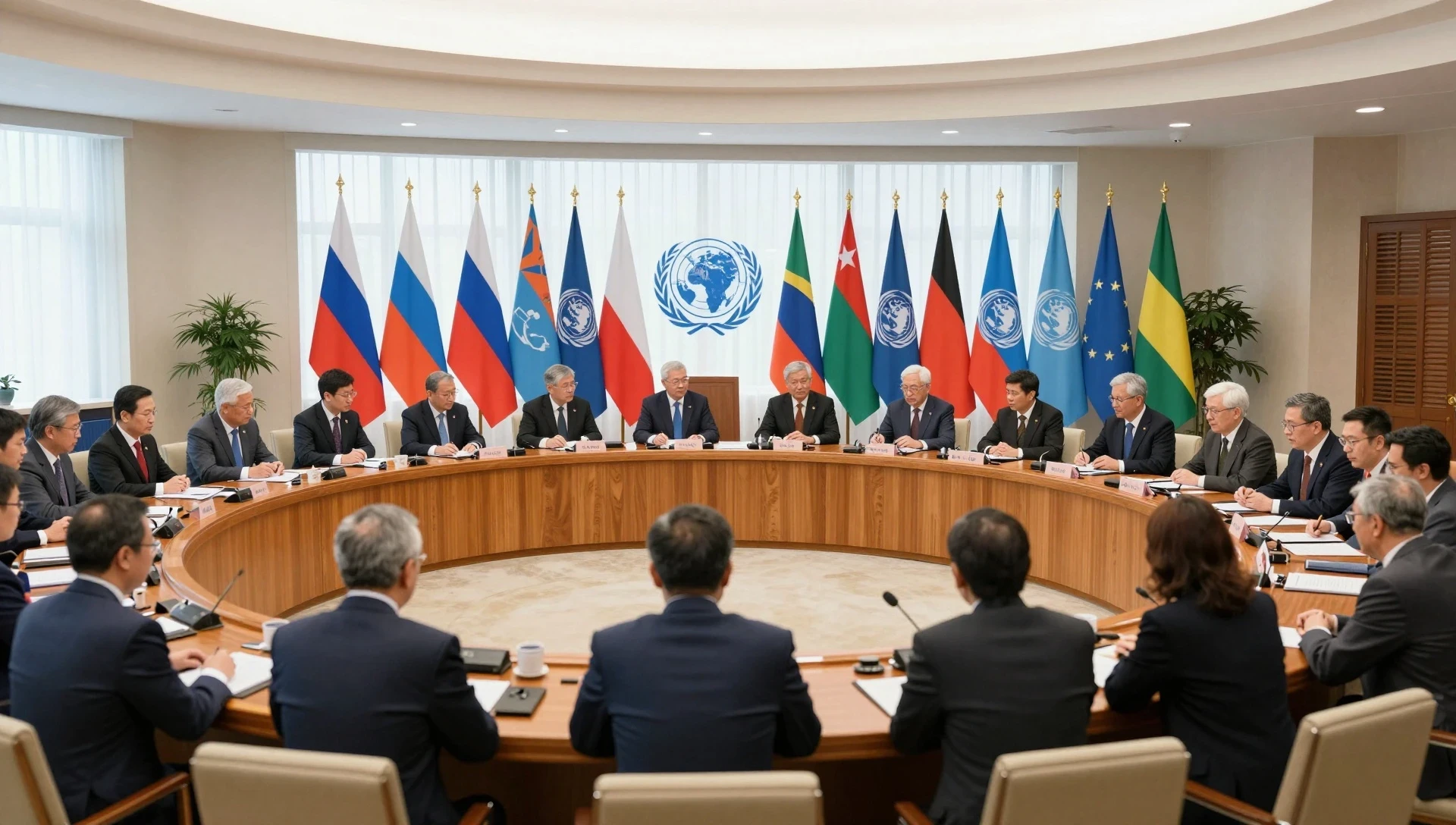
The Third Russia-Africa Summit produced a declaration that reads less like a diplomatic communiqué and more like a structural audit of the post-1945 economic order. Russia and the assembled African states jointly called for reform of the International Monetary Fund, the World Bank, and the World Trade Organization, framing the demand around three principles: depoliticised governance, equal treatment of members, and expanded African representation in leadership and decision-making.
The timing matters. The declaration lands at a moment when quotas, voting weights, and lending conditionality are already under scrutiny from multiple blocs, and when African finance ministries are carrying debt burdens that constrain policy space.
The substance of the demand splits cleanly along institutional lines. For the Bretton Woods lenders, the signatories want leadership selection and quota formulas detached from political leverage, with African states holding a larger share of votes and senior posts.
On This Page
For the WTO, they defend the consensus rule, non-discrimination, and special and differential treatment for developing and least-developed members. That combination is analytically interesting: the same declaration asks for more influence inside the IMF and World Bank while defending the WTO's most protective features for weaker economies.
What follows examines the declaration's institutional logic, the arithmetic of representation that underpins it, and the obstacles that stand between stated intent and enacted reform. The analysis draws on quota data, voting thresholds, and the historical record of IMF and World Bank governance changes to test how far the Russia-Africa position can travel through existing amendment procedures.
TL;DR At the Third Russia-Africa Summit, Russia and African nations endorsed a declaration demanding reform of the IMF, the World Bank, and the WTO. The core asks are depoliticised governance, equal treatment of members, greater African representation in leadership and decision-making, and preservation of WTO principles including consensus, non-discrimination, and special treatment for developing countries. The declaration is politically significant but procedurally constrained: IMF and World Bank governance changes require supermajorities that Africa and Russia together cannot muster, while WTO reform requires consensus among members that have divergent interests. The document is best read as a bargaining position rather than a legislative programme.
The Institutional Architecture Behind the Reform Demand
The declaration's three targets operate under different governance logics, and conflating them obscures where reform is feasible. The IMF and World Bank are shareholder institutions where voting power tracks financial contributions through quota subscriptions.
The WTO is a member-driven organisation where each state holds one vote and decisions are normally taken by consensus. Understanding this divergence is essential to judging what the Russia-Africa declaration can realistically achieve.
Quota Formulas and the Arithmetic of IMF Voting Power
IMF voting power derives from quotas, which are calculated using a formula blending GDP, openness, economic variability, and international reserves. The 16th General Review of Quotas, concluded in December 2023, raised quotas by 50 percent without changing the relative shares of members. That outcome preserved the existing distribution, which is precisely the arrangement the declaration seeks to alter.
The arithmetic is unforgiving. Major governance decisions at the IMF require an 85 percent majority of voting power, which gives the United States an effective veto at roughly 16.5 percent.
Shifting quota shares toward African members would require the largest shareholders to accept dilution, and the 2023 review demonstrated their reluctance to do so even in a modest rebalancing exercise.
African members collectively hold a small fraction of IMF quotas, well below the continent's share of global population and its weight in several commodity markets. The declaration's call for greater African representation in leadership follows from this gap, though the IMF's managing director has by convention been European and the World Bank president American.
Leadership Selection and the Convention of Appointed Chiefs
The declaration's demand for greater African representation in IMF and World Bank leadership confronts an informal arrangement rather than a written rule. By convention, the IMF managing director has been European and the World Bank president American since the institutions' founding. No charter provision mandates this, yet the pattern has held for eight decades.
African candidacies have surfaced periodically, most visibly in 2019 when the World Bank presidency was contested. The selection processes remain opaque, conducted through executive board consultations rather than open competition. The declaration's emphasis on leadership representation therefore targets a genuine gap between formal meritocracy and informal allocation.
Reform here is procedurally easier than quota change because it requires only a shift in political practice, not an amendment. But practice changes only when the largest shareholders permit it, and the historical record shows they have not. The declaration's value lies in raising the political cost of maintaining the convention.
WTO Principles and the Defence of Special Treatment
The WTO section of the declaration is defensive rather than transformative. Russia and African states committed to an open, transparent, inclusive, non-discriminatory, rules-based trading system and to keeping the WTO at the centre of global trade.
They explicitly endorsed consensus decision-making, equal treatment of members, and special and more favourable treatment for developing and least-developed countries.
This is a notable position because consensus and special treatment are the two features most frequently criticised by reform advocates in advanced economies. Proposals to move toward plurilateral agreements and to graduate developing members from preferential treatment run directly against the declaration's stated preferences. The signatories are defending the WTO's protective architecture, not dismantling it.
The analytical tension is clear. The same document demands more influence within weighted-voting institutions while defending equal voting within the WTO. That is a coherent bargaining strategy for states that are minorities in one forum and majorities in another, but it complicates any unified reform narrative.
We Also Published
Representation Gaps, Voting Thresholds, and the Politics of Amendment
Translating the declaration into institutional change requires navigating amendment procedures designed to be slow. IMF quota changes need approval by a supermajority of voting power plus consent from members holding a specified share of quotas. World Bank charter amendments carry comparable thresholds.
These rules were built to protect the institutions from abrupt shifts, and they now protect the status quo the declaration opposes.
Measuring the African Representation Deficit
Africa's share of IMF quotas and voting power sits well below its demographic and economic weight in several dimensions. The continent accounts for a large share of the IMF's concessional lending recipients and a substantial portion of its programme engagements, yet its voice in quota-based decisions remains limited. This asymmetry between exposure and influence is the empirical core of the declaration's grievance.
The World Bank exhibits a similar pattern. African members hold limited shares of International Bank for Reconstruction and Development voting power, and the institution's capital increases have not substantially rebalanced shares toward the continent. The declaration's call for a larger decision-making role follows directly from these numbers.
Reform proposals have circulated for years, including formula revisions that would weight population and openness more heavily. Each proposal produces winners and losers among existing shareholders, which is why consensus has proven elusive. The declaration adds political pressure without altering the underlying arithmetic.
The Veto Arithmetic That Constrains Quota Reform
The 85 percent threshold is the decisive constraint. Any single member holding more than 15 percent of voting power can block a quota change, and the United States sits above that line. This means African representation gains cannot be enacted over American objection, regardless of how many members support the declaration.
Reformers have explored alternatives, including shifting some decisions to simple or special majorities. Each alternative requires the same supermajority to approve it, creating a circularity that has frustrated governance reform for decades. The declaration does not address this procedural trap, which limits its operational value.
The practical implication is that the Russia-Africa demand functions as agenda-setting rather than law-making. It raises the salience of representation deficits and creates political pressure, but it cannot compel the shareholders who must consent. Analysts should read it as a signal of coalition intent, not a forecast of imminent institutional change.
Why the WTO Consensus Defence Cuts Both Ways
Consensus protects weaker members from being outvoted, which explains why the declaration defends it. But consensus also allows any single member to block reform, including reform that would strengthen the trading system's dispute settlement or update its rulebook. The same mechanism that shields developing countries also freezes the institution.
This duality explains the WTO's current paralysis. Dispute settlement has been impaired since the Appellate Body lost its quorum, and efforts to restore it have stalled. The declaration's call to keep the WTO at the centre of global trade is therefore aspirational in a context where the institution's core adjudicative function is degraded.
Special and differential treatment adds another layer. Advanced economies argue that major developing traders should assume fuller obligations, while the declaration insists on preserving preferential treatment for developing and least-developed members. Bridging these positions requires negotiated differentiation, not blanket principles.
Strategic Reading: What the Declaration Signals and What It Cannot Deliver
The declaration is best understood as a coalition statement with three audiences. It speaks to African domestic constituencies demanding a louder voice in global economic governance. It speaks to Western shareholders whose consent is required for any change. And it speaks to other emerging economies that share grievances about institutional legitimacy. Its effectiveness depends on how those audiences respond.
Coalition Building and the Limits of Joint Declarations
Russia and African states have convergent interests in criticising Western influence over multilateral lenders, but their underlying objectives differ. African governments generally seek greater access to financing and more voice within the existing system. Russia's interest lies partly in challenging the architecture itself. This divergence limits how far joint positions translate into joint action.
Summit declarations are cheap to sign and expensive to implement. The Third Russia-Africa Summit produced a document, not a voting bloc. African members of the IMF and World Bank act through their own executive directors and finance ministries, and their votes are not bound by summit communiqués. Coalition cohesion should therefore be assessed sceptically.
That said, repeated declarations can shift the terms of debate. The representation question has moved from technical appendix to political headline over the past decade. Each summit adds momentum, and momentum matters in institutions where change requires sustained pressure over multiple review cycles.
Depoliticisation as a Contested Standard
The demand that the IMF and World Bank operate without political influence raises an immediate definitional problem. Conditionality is inherently political in effect, since it prescribes policy choices to sovereign borrowers. Whether it is political in intent depends on design and implementation, which are contested in every programme negotiation.
Critics of the institutions point to the historical pattern of lending decisions tracking geopolitical alignments. Defenders argue that conditionality reflects economic necessity and that governance safeguards constrain arbitrary action. The declaration sides with the critics without specifying what depoliticisation would look like in practice, leaving the standard undefined.
A workable standard would require transparent, published criteria for programme design and independent evaluation of outcomes. Some of this exists already through evaluation offices and published country reports. The gap is enforcement, not documentation, and the declaration does not propose enforcement mechanisms.
- 01
- 02
- 03
- 04
What Would Count as Progress
Measurable progress would include a quota review that shifts shares toward under-represented regions, an open and contested leadership selection, and a functioning WTO dispute settlement. None of these is imminent. The next quota review cycle and future leadership transitions provide the natural checkpoints for assessing whether the declaration's pressure produces results.
Intermediate indicators matter too. Executive board composition, the share of African nationals in senior management, and the frequency of African candidacies for top posts all provide observable evidence. Tracking these over the coming years will show whether the declaration changed behaviour or merely restated grievances.
The broader lesson concerns institutional legitimacy. Institutions that concentrate decision-making among a small group of shareholders face persistent challenges from those outside that group. The Russia-Africa declaration is one expression of that tension, and it will recur until representation and influence align more closely with exposure and stake.
Frequently Asked Questions
Readers encountering the declaration often ask how binding it is, what Russia gains from it, and whether African states speak with one voice. The answers clarify the document's status and its likely trajectory through the institutions it targets.
Is the Declaration Legally Binding?
No. A summit declaration is a political statement, not a treaty or an institutional decision. It creates no legal obligations for the IMF, World Bank, or WTO, and it does not alter any member's voting rights or commitments. Its force is persuasive and political rather than legal.
What Does Russia Gain From the Alignment?
Russia gains diplomatic support for a critique of Western influence over multilateral institutions, which serves its broader geopolitical messaging. It also deepens relationships with African governments at a time of sanctions pressure. The economic substance of the alignment, however, remains limited relative to the rhetorical output.
Do African States Negotiate as a Bloc?
Not consistently. African members of the IMF and World Bank act through individual executive directors and finance ministries, and their interests diverge on borrowing needs, commodity exposure, and debt restructuring. The African Union provides coordination, but bloc voting is rare and summit declarations do not bind members.
Could the WTO Reform Demand Succeed?
Selectively. Preserving consensus and special treatment requires no change, so that part of the declaration is defensive and achievable by inaction. Restoring dispute settlement and updating rules requires consensus among members with conflicting interests, which makes substantive WTO reform slow and uncertain.
From our network :
- Forbidden Matrix Patterns and Visible Lattice Points: A Geometric DictionaryExplore how multidimensional 0–1 matrices encode geometric truths, linking forbidden patterns to visible lattice points and hypergraph theory, with applications in combinatorics and computational geometry.
- CISA’s Ten-Advisory Wave: Why Generic Patching Fails in OT and How to Build Product-Specific PlaybooksCISA released ten ICS advisories in one week, exposing critical infrastructure risks. Generic patching fails in OT. Learn to build product-specific remediation playbooks.
- The Final Descent: How ESA Retired the Legendary Cluster Constellation After 24 Years of Space Weather ScienceAfter 24 years mapping Earth’s magnetosphere, ESA’s Cluster mission concluded with a precisely controlled reentry over the South Pacific. This analysis explores the scientific legacy, engineering decisions, and debris mitigation principles behind one of space exploration’s most responsible retirements.
- The Hidden Cost of AI Convenience: Why Over-Permissioned Agents Are a Security Time BombDiscover why AI agents with excessive permissions create dangerous single points of failure, and learn how implementing least privilege principles can protect your organization from exploitation.
- University Language Proficiency Exams: Why Institutional Tests Demand Different Preparation Than IELTS and TOEFLDiscover why university-specific language proficiency examinations differ fundamentally from IELTS and TOEFL, and learn strategic preparation approaches for institutional assessment success.
- Live Online English Classes for Kids: Do They Actually Reduce Anxiety?A ten-week study reveals that synchronous online English classes can significantly reduce child language anxiety while improving listening and reading skills. Discover what makes these programs effective and how parents can select the right one.
- Mobile Learning and VR in English: What Global Evidence Reveals About Effective Language TechnologyA systematic review across 14 countries reveals which language-learning technologies genuinely work. Mobile learning, AI, and VR show measurable benefits when pedagogically integrated. This evidence-based guide helps educators and learners select technology that delivers real return on investment.
- Committed Mediterranean Precipitation Decline: Why Emissions Cuts Alone Cannot Restore Winter RainsNew NOAA research reveals that Mediterranean winter rains may decline irreversibly even with emissions cuts. Explore the science of committed climate change and regional impacts.
- How AI Agents Will Change the Way We Manage Personal FinancesExplore how AI agents are transforming personal finance through automated budgeting, bill payment, and investment management, while examining the critical security protocols and governance frameworks required for safe deployment.
RESOURCES
- BRICS Joint Statement on Strengthening and Reforming the ...mea.gov.inJun 1, 2021 ... Brazil China Russia South Africa BRICS G20 IMF UN WHO World Bank WTO Disarmament Human Rights International Law Non-Proliferation Security ...
- Joint Statement by the Heads of the Food and Agriculture ...worldbank.orgJul 15, 2022 ... IMF World Bank Group Thailand 2026 Logo. 16d/19h/17m/00s. Annual ... World Bank Board Endorses Reforms to the Bank-Fund Debt Sustainability ...
- Chair's Statement: Fifty-First Meeting of the IMFC - Mr. Mohammed ...imf.orgApr 25, 2025 ... We encourage the IMF and the World Bank to help advance the ... Lesetja Kganyago, Governor, South African Reserve Bank,…
- Joint Statement by the Heads of the International Energy Agency ...worldbank.orgHome · News · Statements; Joint Statement by the Heads of the International Energy Agency, International Monetary Fund, and World Bank ... World Bank…
- BRICS and the Price of Consensus - Egmont Instituteegmontinstitute.beSep 25, 2026 ... ... Russia, India, China and South Africa. ... It sets out positions on IMF quota realignment, World Bank shareholding reform…
- Chair's Statement Fifty-Second Meeting of the IMFCimf.orgOct 17, 2025 ... We support the work by the IMF and the World Bank under their three ... Lesetja Kganyago, Governor, South African…
- G20 Leaders Declaration (19/06/2012) - G7/G20 Documents Databaseg7g20-documents.orgJun 19, 2012 ... ... Reform by the agreed date of the 2012 IMF/World Bank ... We thank international organizations, including the UN, IMF,…
- Joint Statement by the Heads of the Food and Agriculture ... - WFPwfp.orgFeb 8, 2023 ... Policies and reforms supported by financing from IMF and the World Bank have focused on the transition from broad-based measures…
- Moscow summit calls for IMF, World Bank, WTO reform - Facebookfacebook.com19 hours ago ... What reform should come first? https://brics24.news/russia-africa-declaration-imf- world-bank-wto-reform-african-representation/ ...
- 2021 BRICS Joint Statement on Strengthening and Reforming the ...brics.utoronto.caJun 1, 2021 ... The Ministers called for governance reform in the recruitment processes of the World Bank and the IMF by ensuring selection…
- Russia and Africa Approve Summit Declaration: Key Provisionsen.sputniknews.africa3 days ago ... Urgently reform global institutions, including the IMF, WTO, and World Bank. Advance UN Security Council reform to reflect current ...
- News - Speeches: Director-General Ngozi Okonjo-Iweala - WTOwto.org... Statement by the Heads of the IEA, IMF, World Bank, and WTO. 7 July 2026. The Heads of the International Energy Agency (IEA),…
- XIV BRICS Summit Beijing Declaration - President of Russiaen.kremlin.ruJun 23, 2022 ... ... World Trade Organization(WTO). We will engage constructively to pursue the necessary WTO reform to build an open world economy…
- Emerging powers, the G20, and reform of multilateral institutionsnupi.noThey also voice increasingly vocal calls for reform of the UN, the World. Bank and the IMF. This report analyzes how Brazil, India, Indonesia,…
- Pledges And Operational Snags Of The BRICS New Delhi Declarationthereporterethiopia.comSep 19, 2026 ... ... World Bank to mirror shifting centers of global economic gravity. It advocates for comprehensive WTO reform ... Russia–Africa Summit.
- 01
- 02
- 03
- 04
- 05
- 06
- 07
- 08
0 Comments