
On the first weekend of November 2026, an unusual alignment quietly took hold across the North American continent. Residents of Pensacola, Florida, and Cranbrook, British Columbia, glanced at their clocks and discovered they were reading the exact same hour, despite sitting on opposite edges of the continent.
This synchronization is not the product of coordinated policy or diplomatic negotiation; it is an accidental byproduct of two jurisdictions making independent decisions about daylight saving time. The overlap will persist for roughly five months before dissolving in March.
The story matters because time zones are rarely examined as policy instruments. They are treated as fixed infrastructure, invisible scaffolding beneath daily life, yet they carry real consequences for health, commerce, family routines, and regional identity.
On This Page
British Columbia's decision to abandon the seasonal clock change reflects a growing North American skepticism toward biannual time shifts, while Florida's adherence to tradition illustrates how deeply entrenched the practice remains. When these two philosophies collide, the result is a temporary geographic curiosity with genuine analytical value.
What follows examines the mechanics of this alignment, the divergent policy choices behind it, and the broader questions it raises about how societies govern something as fundamental as the hour on the wall.
The analysis draws on reporting from the National Post and situates the event within the wider continental debate over permanent daylight time, regional consistency, and the surprisingly complicated politics of clock management.
TL;DR British Columbia adopted permanent Pacific Time in November 2026, skipping the usual fall clock rollback, while Florida's panhandle counties reverted to Central Standard Time as normal. The result is a five-month window in which Pensacola and Cranbrook share the same clock reading despite radically different climates and geographies. The alignment exposes deeper tensions between permanent daylight time advocates and jurisdictions that retain seasonal shifts, and it will end in March when Florida springs forward and British Columbia stays put.
The Mechanics of an Accidental Synchronization
Time zone alignment between distant places is ordinarily unremarkable, since the globe is stitched together by longitudinal bands that place many cities on shared clocks. What makes the Florida–British Columbia overlap notable is that it emerged from policy divergence rather than geographic logic.
Two jurisdictions on opposite coasts arrived at the same hour through entirely separate decisions, one by abandoning a tradition and the other by keeping it.
How the Clocks Converged
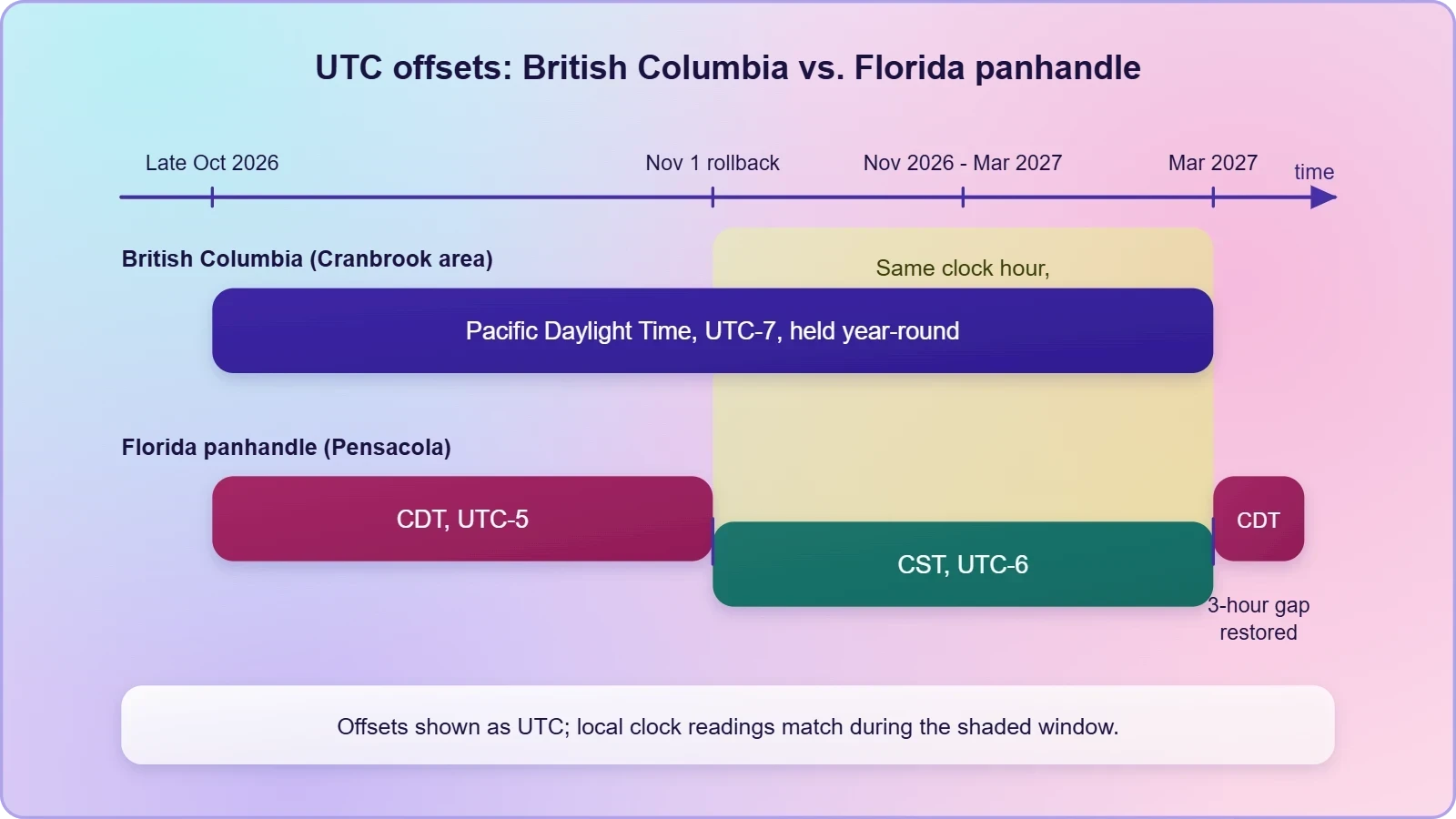
British Columbia's government elected to remain on daylight time year-round, meaning most of the province did not observe the customary November 1 rollback that swept across Canada. The province effectively locked itself into Pacific Time permanently, a choice framed as a health and scheduling measure.
Meanwhile, Florida's nine Central Time counties, including Pensacola, performed their usual autumn ritual and fell back one hour to Central Standard Time.
The arithmetic is straightforward once the offsets are laid out. Pacific Time normally sits three hours behind Central Time, but the seasonal divergence compresses that gap. With British Columbia holding daylight time and Florida's panhandle on standard time, the two regions briefly occupy the same effective offset, producing identical clock readings from November through March.
The Geographic Exceptions Within British Columbia
Not every British Columbia community followed the provincial lead. Southeastern municipalities including Cranbrook, Fernie, and Elkford chose to remain on Mountain Time throughout the year, preserving alignment with neighboring Alberta.
This carve-out acknowledges that economic and social ties often flow along regional corridors rather than provincial borders, and that clock consistency with trading partners can outweigh uniformity within a province.
These exceptions add a layer of complexity to the broader picture. A province can declare a single time policy, yet local realities demand flexibility, and the resulting patchwork means that travelers crossing British Columbia may encounter multiple clock regimes within a single day's drive. The Cranbrook decision, in particular, is what places that city in direct synchronization with Pensacola.
British Columbia's Permanent Daylight Time Decision
British Columbia's move toward year-round daylight time did not emerge overnight. It followed years of legislative groundwork, public consultation, and alignment discussions with neighboring Pacific states that had expressed similar intentions.
The province positioned the change as a public health intervention, citing research on circadian disruption and the documented spike in traffic incidents and cardiac events following spring clock shifts.
Health, Family, and Scheduling Rationale
Government statements emphasized that eliminating the biannual clock change would reduce disruptions for families, simplify scheduling across sectors, and deliver an additional hour of evening light during winter months.
These arguments resonate with a substantial body of sleep science suggesting that abrupt one-hour shifts disturb circadian rhythms and impose measurable costs on productivity and safety.
The evening-light benefit is particularly salient in northern latitudes, where winter daylight is scarce and an extra hour of afternoon brightness carries tangible quality-of-life value. By locking the clock forward, British Columbia effectively trades darker winter mornings for brighter evenings, a tradeoff that polls suggest many residents prefer despite the grogginess of late sunrises.
Alignment With the Pacific Northwest
British Columbia's decision was designed in conversation with Washington, Oregon, and California, all of which have debated permanent daylight time at various points. The province's stated preference was to move in concert with West Coast partners, ensuring that cross-border commerce and commuting would not be disrupted by mismatched clocks along the shared corridor.
That coordination remains incomplete, since federal approval in the United States is required before those states can adopt permanent daylight time. British Columbia proceeded unilaterally, betting that the health and lifestyle benefits outweighed the risk of temporary misalignment with American neighbors.
The gamble has produced the current situation, where the province sits one hour ahead of what its southern partners observe in winter.
Florida's Split Time Zone Reality
Florida presents one of the more intricate time zone arrangements in the United States. The state straddles the boundary between Eastern and Central Time, with nine of its sixty-seven counties entirely within the Central band.
These panhandle counties, including Escambia County where Pensacola sits, have long maintained their own temporal identity, distinct from the peninsula's Eastern Time majority.
The Panhandle's Central Time Tradition
Pensacola and its neighbors observe Central Time because of historical and economic ties to Alabama and the broader Gulf Coast region. Their clocks align with Mobile and Montgomery rather than Miami or Orlando, reflecting a cultural and commercial orientation that predates modern state boundaries. This orientation persists through every seasonal shift, anchoring the panhandle to its western neighbors.
When the panhandle fell back to Central Standard Time over the weekend, it was performing a ritual repeated across much of the continent. Nothing about the change was novel or contested; it simply followed the familiar rhythm of autumn.
Yet that ordinary act, combined with British Columbia's extraordinary one, produced the temporary synchronization now visible on clocks from the Gulf Coast to the Rocky Mountain foothills.
Why Florida Has Not Abandoned the Clock Change
Florida has considered permanent daylight time legislation in the past, and the state senate has at times approved measures calling for year-round daylight saving. Those efforts stalled at the federal level, where approval from Congress remains a prerequisite for states to adopt permanent daylight time under the Uniform Time Act. Without that approval, Florida continues its seasonal shifts.
The state's two-zone structure further complicates any permanent change. A single statewide policy would have to reconcile Eastern and Central constituencies with divergent preferences and economic ties. For now, the panhandle's adherence to tradition keeps Florida in the seasonal system, ensuring that the alignment with British Columbia will dissolve when March arrives.
- 01
- 02
- 03
- 04
Contrasting Climates Under a Shared Clock
The synchronization is most striking when set against the environmental gulf between the two locations. On the Monday following the change, Pensacola recorded a balmy 23 degrees Celsius while Cranbrook sat at a freezing 0 degrees Celsius.
The same clock reading governed two places experiencing radically different seasons, a reminder that time zones are human constructs layered atop a planet indifferent to their logic.
Gulf Coast Warmth Versus Interior Chill
Pensacola's subtropical climate delivers mild winters, with November temperatures often lingering in the low twenties Celsius. Cranbrook, nestled in the Rocky Mountain Trench of southeastern British Columbia, endures continental cold, with early November frequently bringing frost and the first snows.
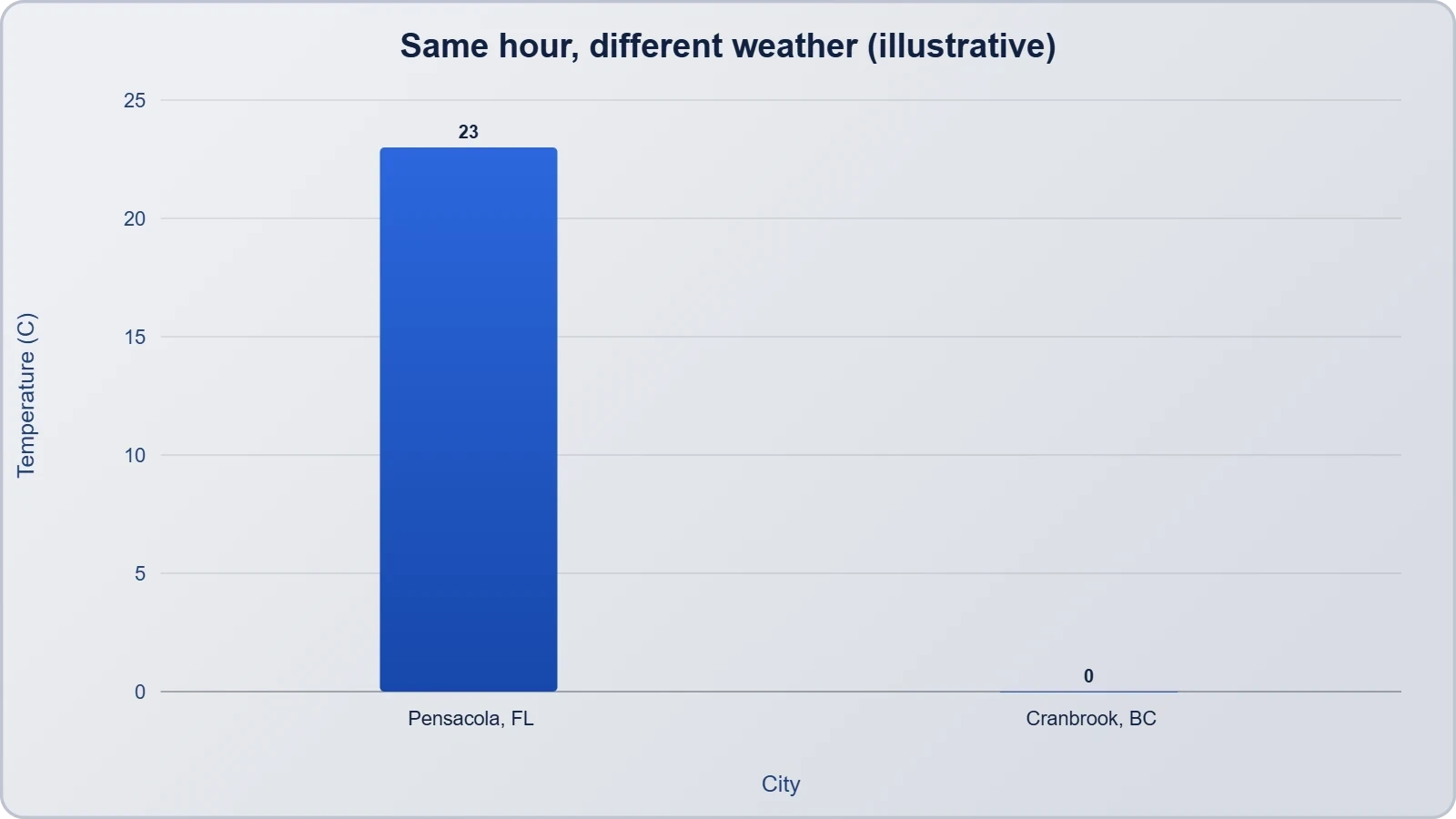
The twenty-three-degree gap on that Monday captures the climatic distance between the Gulf Coast and the interior Northwest.
This contrast underscores how time zone policy operates independently of natural rhythms. The sun rises and sets according to latitude and season, not legislative decree, and a shared clock reading does not imply shared daylight.
Residents of the two cities experience the same hour differently, one in shirtsleeves and the other in winter coats, each navigating their own relationship with the sun.
What the Temperature Gap Reveals
The temperature disparity is more than a meteorological curiosity. It illustrates that time zone alignment is a bureaucratic artifact, not a natural phenomenon, and that its consequences vary enormously across geographies. A policy designed for one climate may produce different effects in another, particularly regarding daylight availability and energy consumption.
For Cranbrook, permanent Mountain Time means winter mornings begin in darkness, a tradeoff accepted in exchange for evening light and Alberta alignment. For Pensacola, the seasonal shift preserves familiar rhythms. The shared clock reading masks these divergent experiences, offering a superficial unity that dissolves under scrutiny of sunrise tables and thermometers alike.
The Continental Debate Over Daylight Saving Time
The Florida–British Columbia alignment is a small episode in a much larger continental conversation. Across North America, jurisdictions are reconsidering the twice-yearly clock change, driven by health research, energy concerns, and simple public frustration.
The debate has produced a patchwork of proposals, some advancing and others stalled, with no continental consensus in sight.
Momentum Toward Permanent Time
Numerous US states have passed legislation or resolutions favoring permanent daylight time, contingent on federal authorization or neighboring state coordination. In Canada, provinces including Ontario and Quebec have signaled similar intentions, though implementation has lagged.
British Columbia's move places it at the forefront of this movement, albeit with the complications of cross-border alignment.
The momentum reflects a broad shift in public sentiment. Surveys consistently show majorities favoring an end to clock changes, though respondents divide on whether permanent standard or permanent daylight time is preferable. That internal disagreement complicates legislative action, since the two options produce very different winter experiences depending on latitude.
The Case for Seasonal Consistency
Opponents of permanent daylight time argue that darker winter mornings pose safety risks for children commuting to school and workers traveling before dawn. They contend that standard time better aligns with solar noon and human circadian biology, and that the health benefits claimed by permanent daylight advocates are overstated or context-dependent.
These arguments carry particular weight in northern regions, where winter sunrises already arrive late. A permanent daylight regime would push sunrise past nine in some communities, a prospect many find unappealing.
The debate thus turns on tradeoffs between evening light and morning darkness, with no universally correct answer across such a vast continent.
What the Five-Month Window Means for Residents
For ordinary residents of Pensacola and Cranbrook, the alignment is mostly a curiosity, a trivia item to mention at dinner. Yet it carries practical implications for anyone scheduling cross-continental calls, coordinating business between the two regions, or traveling between them. For five months, the arithmetic of time zone conversion simplifies to nothing at all.
Practical Effects on Scheduling and Travel
Businesses with operations in both regions will find their meeting logistics temporarily streamlined, since a 9 a.m. call in Pensacola corresponds to 9 a.m. in Cranbrook. Airlines, however, must still account for the geographic distance and the different daylight conditions at each endpoint. The shared clock does not shorten the journey, only the mental math.
Travelers should note that the alignment is fragile and localized. Only the southeastern communities of British Columbia share the clock with Florida's Central Time counties; Vancouver and most of the province sit an hour ahead.
A traveler driving from Cranbrook to Vancouver would need to adjust their watch, even though both cities are in the same province.
The March Reversal and Its Aftermath
When March arrives, Pensacola and its fellow Central Time counties will spring forward to daylight time, restoring the conventional three-hour gap between Pacific and Central zones. British Columbia will remain on permanent daylight time, unmoved by the seasonal ritual. The alignment will vanish, and the two cities will return to their ordinary temporal distance.
The reversal will leave British Columbia increasingly isolated in its permanent daylight stance, at least until American states secure federal approval to join. Whether that approval arrives remains uncertain, and the province's experiment will continue to produce curiosities like the Pensacola alignment in the meantime. Time, as ever, remains a matter of politics as much as astronomy.
From our network :
- How AI Agents Will Change the Way We Manage Personal FinancesExplore how AI agents are transforming personal finance through automated budgeting, bill payment, and investment management, while examining the critical security protocols and governance frameworks required for safe deployment.
- The Final Descent: How ESA Retired the Legendary Cluster Constellation After 24 Years of Space Weather ScienceAfter 24 years mapping Earth’s magnetosphere, ESA’s Cluster mission concluded with a precisely controlled reentry over the South Pacific. This analysis explores the scientific legacy, engineering decisions, and debris mitigation principles behind one of space exploration’s most responsible retirements.
- University Language Proficiency Exams: Why Institutional Tests Demand Different Preparation Than IELTS and TOEFLDiscover why university-specific language proficiency examinations differ fundamentally from IELTS and TOEFL, and learn strategic preparation approaches for institutional assessment success.
- Forbidden Matrix Patterns and Visible Lattice Points: A Geometric DictionaryExplore how multidimensional 0–1 matrices encode geometric truths, linking forbidden patterns to visible lattice points and hypergraph theory, with applications in combinatorics and computational geometry.
- CISA’s Ten-Advisory Wave: Why Generic Patching Fails in OT and How to Build Product-Specific PlaybooksCISA released ten ICS advisories in one week, exposing critical infrastructure risks. Generic patching fails in OT. Learn to build product-specific remediation playbooks.
- Committed Mediterranean Precipitation Decline: Why Emissions Cuts Alone Cannot Restore Winter RainsNew NOAA research reveals that Mediterranean winter rains may decline irreversibly even with emissions cuts. Explore the science of committed climate change and regional impacts.
- Live Online English Classes for Kids: Do They Actually Reduce Anxiety?A ten-week study reveals that synchronous online English classes can significantly reduce child language anxiety while improving listening and reading skills. Discover what makes these programs effective and how parents can select the right one.
- The Hidden Cost of AI Convenience: Why Over-Permissioned Agents Are a Security Time BombDiscover why AI agents with excessive permissions create dangerous single points of failure, and learn how implementing least privilege principles can protect your organization from exploitation.
- Mobile Learning and VR in English: What Global Evidence Reveals About Effective Language TechnologyA systematic review across 14 countries reveals which language-learning technologies genuinely work. Mobile learning, AI, and VR show measurable benefits when pedagogically integrated. This evidence-based guide helps educators and learners select technology that delivers real return on investment.
RESOURCES
- Resources will be updated soon.
- 01
- 02
- 03
- 04
- 05
- 06
- 07
- 08
0 Comments