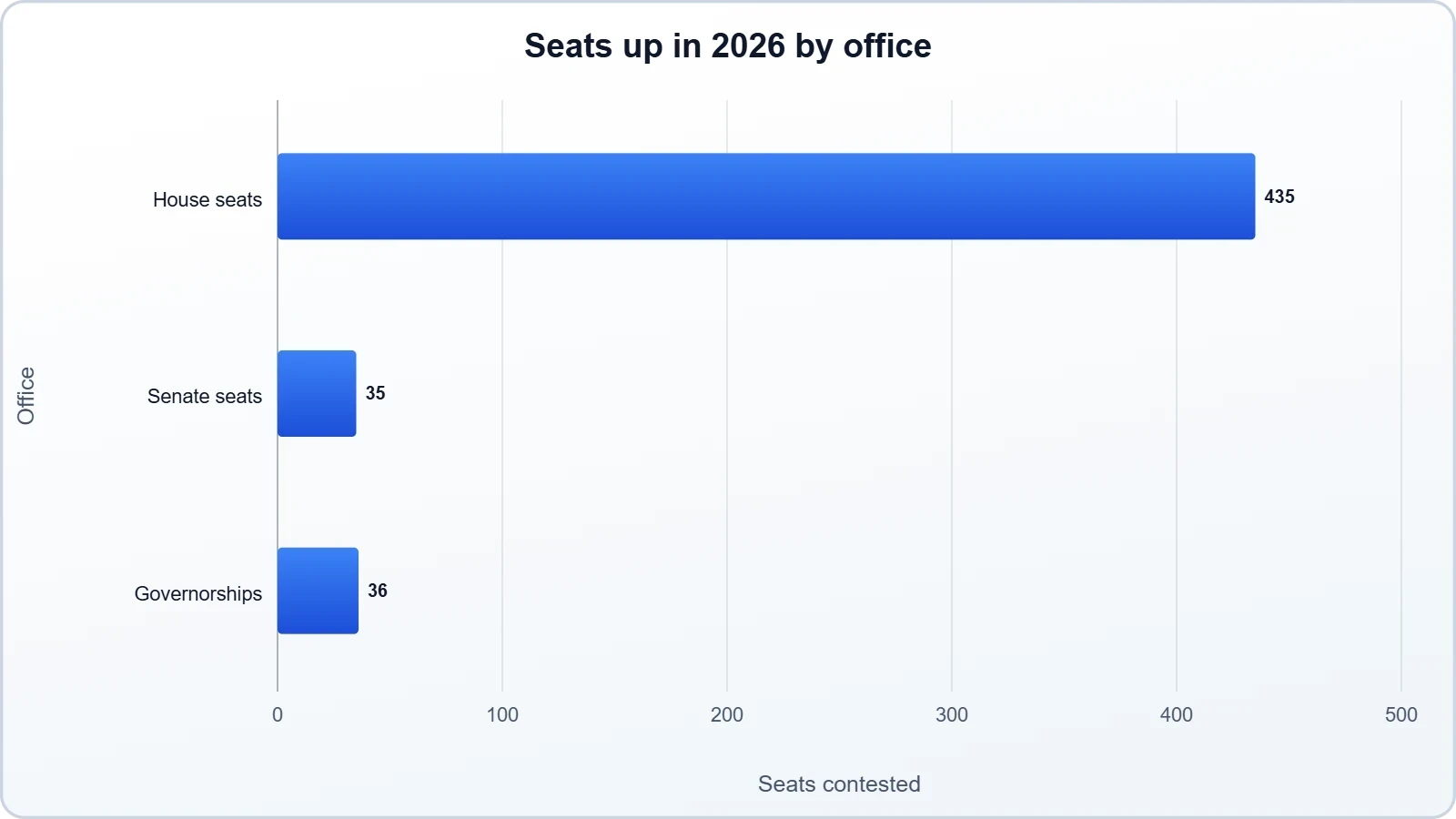
The 2026 United States midterm elections represent far more than a routine constitutional exercise; they constitute a decisive referendum on the balance of power in Washington during the second half of Donald Trump's presidency. When voters across the nation cast ballots on Tuesday, November 3, 2026, they were not merely selecting individual representatives but effectively rendering judgment on the direction of American governance, the scope of executive authority, and the durability of the Republican Party's legislative dominance. Every seat in the House of Representatives—all 435 of them—was contested, alongside 35 of the 100 Senate seats and governorships in 36 states, creating a sprawling electoral map that stretched from the Atlantic seaboard to the Pacific coast.
The structural arithmetic of these midterms is what lends them their extraordinary significance. Republicans entered the cycle controlling both chambers of Congress, which granted the president considerable latitude to advance his agenda without meaningful legislative resistance. For Democrats to constrain presidential power during the remaining two years of Trump's term, they needed to secure a majority in at least one chamber—a threshold that transforms individual district races into pieces of a much larger strategic puzzle. More than 210 million Americans were registered to vote, underscoring the scale of civic participation and the intensity of political engagement that defined this election cycle.
As polling stations closed in stages across the country's time zones—beginning with Indiana and Kentucky at 6:00 p.m. Eastern Time—early results began to crystallize in several high-profile races. Reports identified winners in Virginia's 10th Congressional District, New Jersey's 3rd and 7th Congressional Districts, Rhode Island's 2nd Congressional District, and Florida's 1st, 15th, and 22nd Congressional Districts, among others. These early declarations offered the first concrete signals of how the national mood was translating into legislative outcomes, and they set the stage for a night of accumulating evidence about the future configuration of American power.
On This Page
TL;DR The 2026 US midterm elections, held on November 3, determined control of all 435 House seats, 35 Senate seats, and 36 governorships, with more than 210 million registered voters participating. Republicans entered holding both chambers of Congress, and Democrats needed to flip at least one chamber to constrain President Donald Trump's authority in the latter half of his term. Early results declared winners across Virginia, New Jersey, Rhode Island, and Florida, offering the first indications of how the national electorate chose to redistribute power in Washington.
The Electoral Architecture of the 2026 Midterms
The midterm elections of 2026 were engineered around a constitutional design that deliberately staggers political accountability, ensuring that the entire House faces voters every two years while the Senate rotates in overlapping six-year terms. This architecture means that midterms function as a mid-course correction mechanism, allowing the electorate to register dissatisfaction or affirmation without waiting for a full presidential cycle. Understanding this structure is essential to interpreting why control of even a single chamber carries such outsized consequences for the president's remaining legislative window.
The House of Representatives: All 435 Seats in Play
Every two years, the entire House of Representatives is subject to the judgment of the electorate, and 2026 was no exception. All 435 seats were contested, meaning that the chamber's partisan composition could shift dramatically depending on how voters in competitive districts responded to the national political climate. Because House districts are drawn to reflect population changes and often favor one party or another, the real battle unfolded in a relatively small number of swing districts where neither party held a structural advantage, making those races the true fulcrum of congressional power.
The granularity of House elections means that national trends are filtered through local concerns, candidate quality, and district-level demographics. A party can win the national popular vote for Congress yet still lose control of the chamber if its support is inefficiently distributed across districts. This dynamic forces both parties to allocate resources with surgical precision, targeting the specific districts where marginal shifts in turnout or persuasion can flip a seat. In 2026, the early declarations in Virginia, New Jersey, Rhode Island, and Florida provided the first data points in this complex calculus of district-by-district arithmetic.
The Senate and Gubernatorial Contests
While the House commanded the most attention for its wholesale turnover, the Senate contests—35 of 100 seats—carried equally profound implications for the confirmation of judicial nominees, the ratification of treaties, and the passage of legislation. The Senate's staggered structure means that only a third of its members face voters in any given cycle, creating a slower-moving but no less consequential battlefield. Control of the Senate determines whether a president can reshape the federal judiciary and staff his administration, making these races pivotal to the long-term institutional legacy of any presidency.
Simultaneously, gubernatorial elections in 36 states shaped the executive leadership of state governments and, crucially, the administration of future elections themselves. Governors appoint election officials, influence redistricting processes, and set the tone for state-level policy on issues ranging from healthcare to education. The convergence of federal and state contests on a single ballot meant that voters in 2026 were making decisions with cascading effects across multiple layers of governance, reinforcing the midterms' status as a comprehensive assessment of the American political landscape.
The Balance of Power and Presidential Authority
The central question animating the 2026 midterms was not merely which party would win individual races, but how the resulting distribution of seats would recalibrate the relationship between the executive and legislative branches. A president whose party controls both chambers enjoys a legislative runway that enables the passage of ambitious agendas with minimal compromise. Conversely, losing even one chamber transforms the president from an agenda-setter into a negotiator, forced to bargain with an opposition that possesses the power to block, investigate, and subpoena.
Why One Chamber Changes Everything
Control of a single chamber grants the opposition party a formidable toolkit. In the House, a majority controls committee chairmanships, the power to initiate investigations, and the ability to bring legislation to the floor—or refuse to. In the Senate, a majority controls judicial confirmations and can block executive appointments. For Democrats in 2026, capturing either chamber would mean the capacity to check presidential initiatives, demand accountability through oversight hearings, and force negotiations on spending and policy, fundamentally altering the political dynamics of Trump's final two years.
The historical pattern of midterm elections consistently penalizes the incumbent president's party, a phenomenon rooted in the electorate's tendency to use these contests as a corrective mechanism. Voters who may have supported a president in a general election often express reservations two years later, particularly when unified government has produced policies they find objectionable. This structural headwind means that the president's party typically defends more vulnerable seats, making the 2026 cycle a test of whether Trump's coalition could defy this historical gravity or whether the pendulum would swing back toward divided government.
The Stakes for the Second Half of the Term
The phrase "second half of his term" carries particular weight in the context of a presidency that has already exercised considerable executive authority. A president entering the final two years with unified congressional support can pursue legacy-defining legislation, reshape federal agencies, and cement judicial appointments. But a president facing an opposition-controlled chamber must navigate a landscape of investigations, budget confrontations, and legislative gridlock. The 2026 results therefore determine not just the composition of Congress but the operational freedom of the executive branch for the remainder of Trump's tenure.
Beyond the immediate legislative implications, the midterms shape the political narrative heading into the next presidential cycle. A strong Democratic performance would signal vulnerability for the Republican coalition and embolden challengers, while a Republican hold would reinforce the president's political capital and discourage internal dissent. The election thus functions as both a verdict on the past two years and a preview of the political terrain on which the next national contest will be fought, making the results consequential far beyond the immediate legislative session.
Early Results and Declared Winners
As the evening progressed and polling stations closed across successive time zones, the first wave of declared winners began to emerge, offering an initial sketch of the electoral landscape. These early declarations, while incomplete, provided crucial signals about which districts were breaking toward which party and whether the national environment favored one side decisively. The staggered closing times—beginning with Indiana and Kentucky at 6:00 p.m. Eastern Time and continuing through the night—meant that the picture assembled gradually, with each new batch of results adding a layer to the emerging narrative.
Key Congressional District Outcomes
Among the earliest races to be called were Virginia's 10th Congressional District, New Jersey's 3rd and 7th Congressional Districts, Rhode Island's 2nd Congressional District, and Florida's 1st, 15th, and 22nd Congressional Districts. Each of these districts carries its own demographic and political character, and their outcomes collectively indicated how suburban, urban, and coastal constituencies were responding to the national mood. Virginia's 10th, a district that has oscillated between parties in recent cycles, served as an early bellwether for suburban sentiment, while the New Jersey contests offered insight into how voters in the densely populated Northeast were aligning.
Florida's multiple declared districts—the 1st, 15th, and 22nd—provided a cross-section of the Sunshine State's diverse political geography, from the conservative Panhandle to competitive central and coastal regions. Rhode Island's 2nd District, representing a smaller and historically Democratic-leaning state, offered a different kind of data point about whether traditional party strongholds were holding firm or showing signs of erosion. Together, these early declarations functioned as a preliminary map of the national political terrain, hinting at the broader patterns that would become clearer as more results arrived.
Notable Candidates and Races
The early reporting also identified Keisha Lance Bottoms as a winner in an unspecified race, a declaration that underscored how individual candidacies can become focal points in midterm cycles. High-profile candidates often attract national attention and resources, transforming local contests into referenda on broader political themes. The presence of such figures in the results reflects the increasingly nationalized character of American elections, where local races are frequently interpreted through the lens of national partisan identity and where candidate profiles can sway outcomes in ways that transcend district-level concerns.
The specificity of the early declarations—naming particular districts and candidates—highlights the granular nature of modern election reporting, where results are called race by race rather than as a single national verdict. This approach allows observers to track the ebb and flow of partisan fortunes in real time, identifying which regions are shifting and which are holding steady. For analysts and citizens alike, these early calls serve as the building blocks of a larger understanding, each declared winner adding a piece to the mosaic of congressional control that would ultimately determine the balance of power in Washington.
We Also Published
- 01
- 02
- 03
- 04
The Mechanics of Voting and Polling Logistics
The administration of a national election involving more than 210 million registered voters is a logistical undertaking of immense complexity, requiring coordination across thousands of jurisdictions, each with its own procedures, equipment, and timelines. In 2026, polling stations closed in stages through the night, beginning with Indiana and Kentucky at 6:00 p.m. Eastern Time—which corresponded to 4:30 a.m. Indian Standard Time on Wednesday—and continuing westward as each time zone reached its statutory closing hour. This staggered system reflects the constitutional deference to states in election administration.
Staggered Poll Closings Across Time Zones
The sequential closing of polls across America's time zones creates a distinctive rhythm to election night, with results from the East Coast arriving hours before the West Coast has finished voting. This temporal asymmetry means that early returns can shape perceptions and even influence late voting in ways that have long been debated by election analysts. The 6:00 p.m. Eastern closings in Indiana and Kentucky marked the first official data points, followed by a cascade of closures that gradually illuminated the national picture as the night wore on.
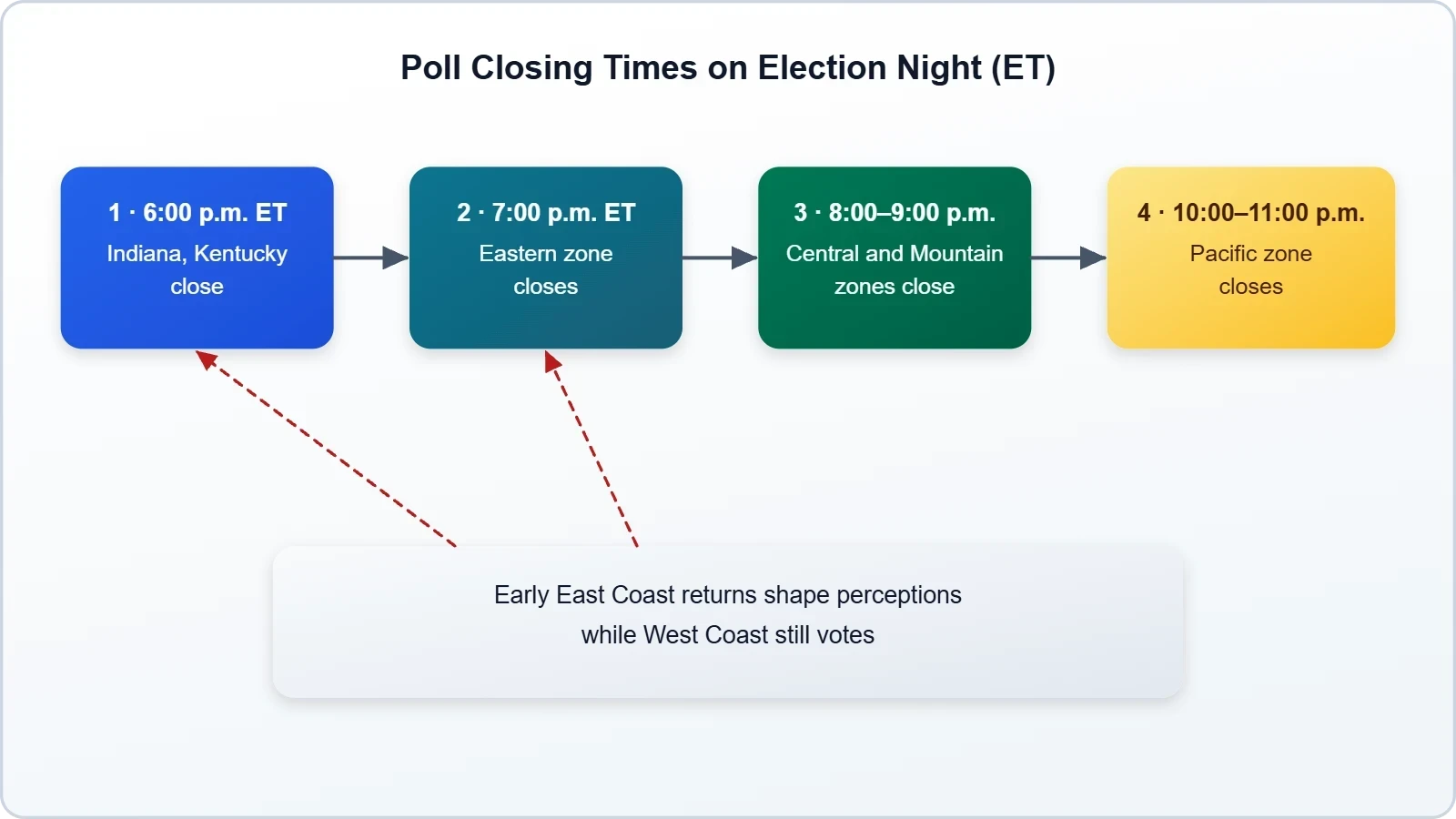
This staggered structure also complicates the task of projecting overall outcomes, as analysts must weigh partial returns against historical patterns and demographic models. A strong showing in early-closing states may or may not presage similar results in later-closing regions, depending on the partisan lean and turnout dynamics of each area. The result is an election night experience characterized by anticipation and incremental revelation, where each new batch of results refines the emerging narrative without fully resolving it until the final polls close.
Voter Registration and Turnout Dynamics
With more than 210 million people registered to vote, the 2026 midterms represented one of the largest potential electorates in American history, though registration does not guarantee turnout. Midterm elections historically attract lower participation than presidential years, a pattern that both parties seek to disrupt through mobilization efforts targeting their most reliable supporters. The gap between registered and actual voters is where campaigns invest enormous resources, recognizing that converting registrants into ballots cast is often the decisive factor in close races.
Turnout dynamics are further shaped by the competitiveness of individual races, the salience of national issues, and the effectiveness of get-out-the-vote operations. In districts where control of Congress hangs in the balance, voters may be more motivated to participate, while in safely partisan areas, participation may lag. The 2026 cycle's high registration figures suggested intense public engagement, but the ultimate composition of the electorate—and therefore the outcome—depended on which segments of the registered population actually showed up at the polls.
Interpreting the Results and Their National Significance
Beyond the individual races and the mechanics of voting, the 2026 midterms carry a significance that extends to the fundamental character of American democracy. Midterm elections serve as a pressure valve for public sentiment, allowing voters to express approval or discontent with the sitting president and the governing party without waiting for the next presidential contest. The results therefore function as a national referendum, offering a snapshot of the electorate's mood and a forecast of the political battles to come.
What the Results Signal About the Electorate
The pattern of winners and losers across districts and states reveals much about the priorities and anxieties of the American electorate. Shifts in suburban districts, for instance, often signal changing attitudes among college-educated voters, while results in rural areas reflect the durability of populist coalitions. By examining which districts flipped and which held, analysts can infer which issues resonated most powerfully and which segments of the electorate were most motivated to participate, providing a roadmap for future campaigns.
The 2026 results also speak to the broader question of political polarization and the durability of partisan alignments. If Democrats made significant gains, it would suggest that the electorate was receptive to checks on executive power and dissatisfied with unified Republican governance. If Republicans held their ground, it would indicate that the president's coalition remained resilient and that Democratic messaging failed to translate into sufficient seat gains. Either outcome carries implications for how both parties will position themselves in the years ahead.
Implications for the Road Ahead
The consequences of the 2026 midterms will reverberate well beyond the immediate legislative session, shaping the political landscape for the 2028 presidential election and beyond. A Congress controlled by one party or divided between two creates different incentives for compromise, confrontation, and coalition-building. The results will determine whether the remainder of Trump's term is characterized by legislative productivity or gridlock, by executive assertiveness or congressional pushback, and by national unity or deepening partisan division.
For citizens and observers, the midterms offer a reminder that democratic governance is a continuous process rather than a periodic event. The choices made on November 3, 2026, will shape policy outcomes, institutional dynamics, and the tenor of public debate for years to come. Understanding the results requires attention not only to who won and lost but to what those outcomes reveal about the health of American democracy, the responsiveness of its institutions, and the enduring contest over the distribution of power between the branches of government.
Context and Caveats: Reading the Early Reports
The source material for these results carries important limitations that any careful reader should recognize. The original report included subscription prompts, login requests, and links to other newsletters and sections—elements that are not part of the election reporting itself and should be disregarded when assessing the substantive content. Separating journalistic substance from commercial and navigational clutter is essential to understanding what the early results actually tell us and what remains unknown.
Distinguishing Reporting from Platform Elements
Modern news consumption increasingly blurs the line between editorial content and the digital infrastructure that surrounds it. Paywalls, newsletter sign-ups, and cross-promotional links are standard features of online journalism, but they can obscure the core reporting if not carefully filtered. In the case of the 2026 midterm coverage, the essential facts—the offices contested, the number of registered voters, the timing of poll closures, and the early declared winners—must be extracted from a presentation that also includes these ancillary elements.
Recognizing this distinction matters because the credibility of election reporting depends on the clarity of its factual claims. The declared winners in Virginia, New Jersey, Rhode Island, and Florida, along with the identification of Keisha Lance Bottoms, represent the substantive core of the early results. Everything else—the subscription prompts and navigation links—is packaging rather than content, and treating it as otherwise would distort the reader's understanding of what the election actually produced.
What Remains Uncertain
Early results are, by their nature, incomplete, and the 2026 midterms were no exception. The declarations that emerged as polls closed represented only a fraction of the 435 House races, 35 Senate contests, and 36 gubernatorial elections, leaving the overall balance of power unresolved at the time of initial reporting. Readers should therefore treat the early winners as provisional data points rather than a final verdict, recognizing that the full picture would only emerge as additional results were counted and certified.
The uncertainty inherent in early reporting is compounded by the complexity of American election administration, where different states and localities count ballots at different speeds and under different rules. Mail-in ballots, provisional ballots, and military and overseas ballots can take days or even weeks to be fully tabulated, meaning that narrow races may remain undecided long after election night. This reality underscores the importance of patience and precision in interpreting midterm results, resisting the temptation to draw premature conclusions from partial returns.
From our network :
- Committed Mediterranean Precipitation Decline: Why Emissions Cuts Alone Cannot Restore Winter RainsNew NOAA research reveals that Mediterranean winter rains may decline irreversibly even with emissions cuts. Explore the science of committed climate change and regional impacts.
- Mobile Learning and VR in English: What Global Evidence Reveals About Effective Language TechnologyA systematic review across 14 countries reveals which language-learning technologies genuinely work. Mobile learning, AI, and VR show measurable benefits when pedagogically integrated. This evidence-based guide helps educators and learners select technology that delivers real return on investment.
- Forbidden Matrix Patterns and Visible Lattice Points: A Geometric DictionaryExplore how multidimensional 0–1 matrices encode geometric truths, linking forbidden patterns to visible lattice points and hypergraph theory, with applications in combinatorics and computational geometry.
- The Hidden Cost of AI Convenience: Why Over-Permissioned Agents Are a Security Time BombDiscover why AI agents with excessive permissions create dangerous single points of failure, and learn how implementing least privilege principles can protect your organization from exploitation.
- CISA’s Ten-Advisory Wave: Why Generic Patching Fails in OT and How to Build Product-Specific PlaybooksCISA released ten ICS advisories in one week, exposing critical infrastructure risks. Generic patching fails in OT. Learn to build product-specific remediation playbooks.
- University Language Proficiency Exams: Why Institutional Tests Demand Different Preparation Than IELTS and TOEFLDiscover why university-specific language proficiency examinations differ fundamentally from IELTS and TOEFL, and learn strategic preparation approaches for institutional assessment success.
- The Final Descent: How ESA Retired the Legendary Cluster Constellation After 24 Years of Space Weather ScienceAfter 24 years mapping Earth’s magnetosphere, ESA’s Cluster mission concluded with a precisely controlled reentry over the South Pacific. This analysis explores the scientific legacy, engineering decisions, and debris mitigation principles behind one of space exploration’s most responsible retirements.
- Live Online English Classes for Kids: Do They Actually Reduce Anxiety?A ten-week study reveals that synchronous online English classes can significantly reduce child language anxiety while improving listening and reading skills. Discover what makes these programs effective and how parents can select the right one.
- How AI Agents Will Change the Way We Manage Personal FinancesExplore how AI agents are transforming personal finance through automated budgeting, bill payment, and investment management, while examining the critical security protocols and governance frameworks required for safe deployment.
RESOURCES
- Resources will be updated soon.
- 01
- 02
- 03
- 04
- 05
- 06
- 07
- 08
0 Comments