Poland's constitutional order reached a breaking point on the night of October 30, 2026, when the Constitutional Tribunal announced the suspension of its own president and vice-president, and the country's head of state responded by boarding a plane, turning it around mid-flight, and walking into the sealed courthouse to declare its judges illegitimate. The confrontation between Prime Minister Donald Tusk's governing coalition and President Karol Nawrocki is not a sudden rupture but the visible fracture of a legal war that has run for roughly a decade. What unfolded in Warsaw that evening condensed years of disputed appointments, refused oaths, and competing claims to legitimacy into a single, televised standoff.
At the centre of the dispute sits a fifteen-member body empowered to strike down legislation and to review bills before the president signs or vetoes them. That authority makes the Tribunal the ultimate arbiter of Polish law, and control of it therefore determines whether a government's legislative programme survives judicial scrutiny. When the Tribunal's leadership suspended its own presiding officers, and when a president physically entered a police-sealed building to reject the legitimacy of the judges inside, the question stopped being procedural and became existential: who, precisely, speaks for the Polish constitution? The answer remains contested, and the consequences extend well beyond Warsaw.
This analysis examines the mechanics of the crisis, the sequence of events that produced it, the institutional interests driving each faction, and the comparative and financial dimensions that make the Polish case instructive for observers of constitutional governance everywhere. It traces how a dispute over five judicial oaths escalated into a confrontation involving police cordons, mass protest, and a presidential U-turn over Senegalese airspace, and it considers what a "constitutional reset" would actually require.
On This Page
- The Anatomy of a Constitutional Standoff
- The Institutional Architecture Under Strain
- The Political Forces Behind the Impasse
- Streets, Police, and the Symbolism of Sealed Courthouses
- Toward a Constitutional Reset
- Comparative and Financial Dimensions
- What the Polish Crisis Reveals About Constitutional Order
TL;DR Poland's Constitutional Tribunal suspended its president, Bogdan Święczkowski, and vice-president, Bartłomiej Sochański, for one month on October 30, 2026, in an order signed by judge Anna Korwin-Piotrowska, one of five Sejm-elected judges whose oaths President Karol Nawrocki has refused to accept. Police sealed the Tribunal building as protesters massed outside; Nawrocki turned his flight to Senegal back to Warsaw and told those present they were "not Constitutional Tribunal judges." The standoff pits Prime Minister Donald Tusk's governing coalition against a president backed by the opposition, and it caps a decade-long legal conflict now pushing both sides toward calls for a constitutional reset through amendment.
The Anatomy of a Constitutional Standoff
The Polish crisis is best understood as a collision between two competing theories of institutional legitimacy, each with a plausible legal footing and each unwilling to concede the other's premise. On one side stands a governing coalition that commands a parliamentary majority and argues that the Sejm's power to elect judges is decisive; on the other stands a president who insists that without a valid presidential oath, a judge cannot lawfully sit. Neither position is frivolous, and that is precisely what makes the dispute so intractable. When both sides can point to a legal argument, the resolution shifts from courts to politics, and from politics to the street.
The Suspension Order and Its Immediate Aftermath
The Tribunal's announcement on the evening of October 30 suspended its president and vice-president for one month, an extraordinary act of internal discipline within a body already under siege. The order carried the signature of judge Anna Korwin-Piotrowska, whose own standing is contested because she is among five judges elected by the Sejm whose oaths President Nawrocki has declined to accept. That detail matters enormously: the official who suspended the Tribunal's leadership is herself, in the president's view, not a lawful judge. The order therefore rests on a chain of authority that one branch of the state rejects outright, which is why the suspension deepened rather than resolved the crisis.
Police sealed off the Tribunal building as a large crowd of protesters attempted to push through the cordon, transforming a juridical dispute into a physical confrontation over access to a public institution. The imagery was unmistakable: a courthouse ringed by officers, citizens pressing against barricades, and a president racing back from an overseas trip to assert control over the scene. Within hours, the confrontation had acquired the symbolic weight of a constitutional moment, the kind of episode that later histories treat as a turning point rather than an incident.
The Presidential Intervention at the Tribunal
Shortly before one in the morning, President Nawrocki entered the Tribunal and delivered a statement whose brevity belied its force: "You are not Constitutional Tribunal judges." The declaration repudiated the legal personality of the assembled judges in a single sentence, and it did so inside the institution's own walls, before witnesses, at an hour chosen for maximum symbolic effect. By turning his aircraft back from a scheduled journey to Senegal, the president signalled that the confrontation outranked ordinary diplomacy, and that he intended to contest the Tribunal's authority in person rather than through lawyers or press releases.
The gesture also carried a risk that its author presumably calculated. A head of state who enters a sealed courthouse to deny the legitimacy of judges invites the charge that he is substituting personal will for legal process, and critics wasted no time making that argument. Yet for Nawrocki's supporters, the intervention was an act of constitutional guardianship, a refusal to let an unlawfully constituted body discipline its own officers. The same act thus reads as either defence of the constitution or assault upon it, depending entirely on which premise one accepts about the five disputed oaths.
We Also Published
The Institutional Architecture Under Strain
To grasp why a suspension order could paralyse a state, one must appreciate the Tribunal's place in Poland's constitutional design. The body comprises fifteen judges, each elected by the Sejm for a nine-year term, a structure intended to insulate judicial tenure from short-term political swings while anchoring appointment in democratic mandate. The Tribunal can strike down laws passed by parliament and can review bills the president refers to it before deciding whether to sign or veto. Those two powers make it simultaneously a check on the legislature and an advisory chamber for the executive, which is why every faction in Polish politics has a vital stake in who sits on it.
Fifteen Judges and the Arithmetic of Legitimacy
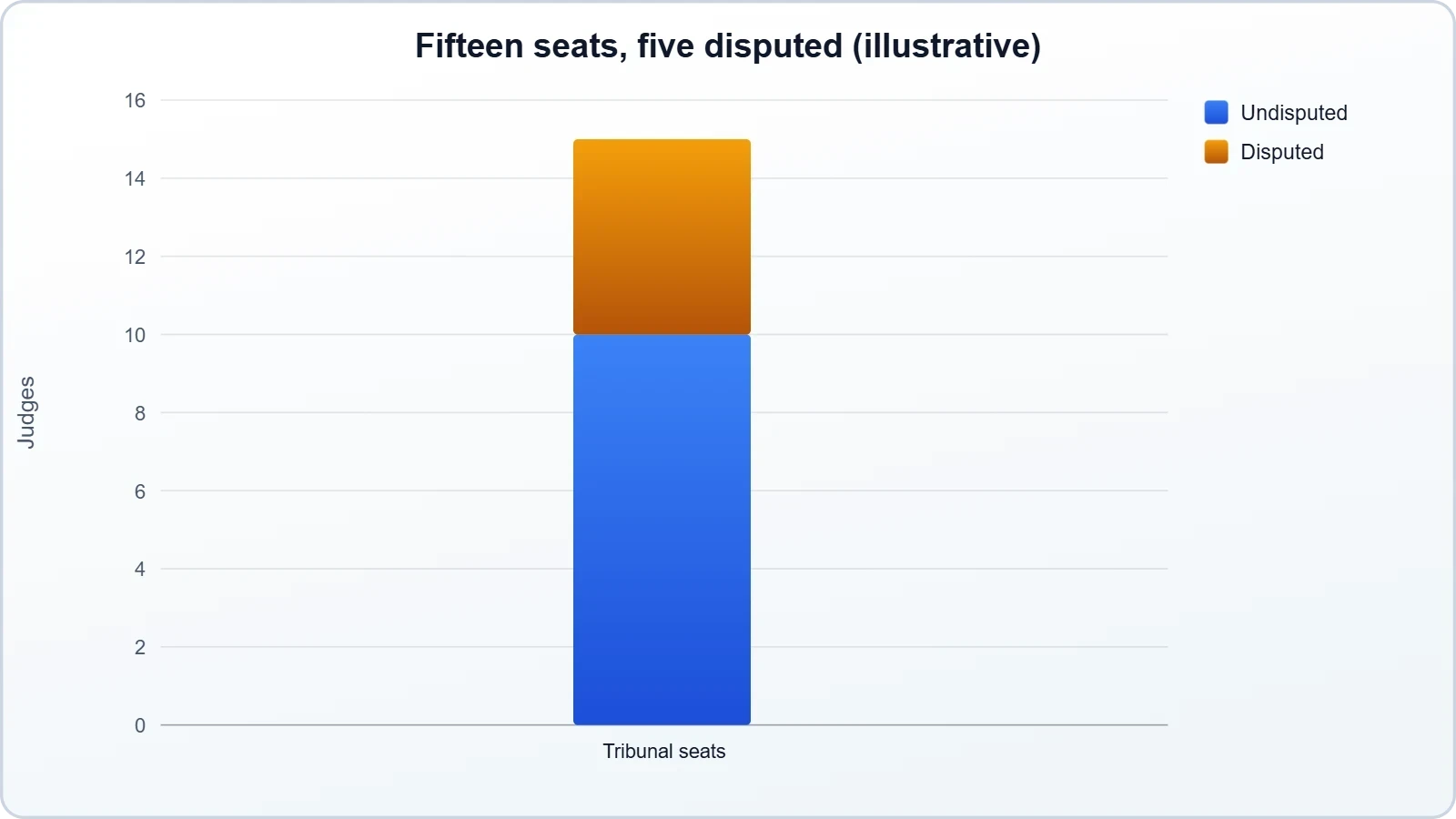
The arithmetic of a fifteen-member court is unforgiving. A single disputed seat can flip outcomes, and five contested appointments represent a third of the bench, enough to cast doubt on virtually any ruling the Tribunal issues. Because the Sejm elects judges and the president administers their oaths, the appointment chain requires cooperation between two branches that currently refuse to recognise each other's actions. When the president withholds an oath, the Sejm's election is complete but the judge's tenure is contested; when the Tribunal acts through such a judge, every decision inherits the dispute. The result is a court whose output is permanently vulnerable to jurisdictional challenge.
Nine-year terms were designed to outlast political cycles, but they also mean that a contested appointment poisons the bench for nearly a decade. The five disputed judges will remain a live controversy until their terms expire or the underlying disagreement is resolved by amendment, resignation, or some negotiated settlement. That structural feature explains why the current crisis has been described as a decade-long dispute rather than a single episode: the terms themselves guarantee that the conflict has a long half-life, and each new government inherits the unresolved appointments of its predecessors.
Why the Oath Became the Battleground
The presidential oath has become the fulcrum of the entire dispute because it is the one step in the appointment process that the head of state controls personally. By refusing to administer it to five Sejm-elected judges, President Nawrocki has effectively created a category of judicially elected but constitutionally incomplete officers, and the Tribunal's own composition now depends on whether that category is recognised. The governing coalition treats the refusal as an obstruction of the Sejm's constitutional prerogative; the president's camp treats the oath as a substantive safeguard rather than a formality. Neither reading can be disproved by the other, which is why the argument keeps returning to the same five names.
This concentration of leverage in a single ceremonial act is unusual and revealing. Most constitutional systems distribute appointment authority across multiple institutions precisely to prevent any one actor from freezing the process. Poland's design gives the president a genuine gatekeeping role, and the current occupant has used it to its fullest extent. Whether that constitutes principled guardianship or partisan capture depends on one's view of the underlying judges, but the structural lesson is clear: procedural choke points become crisis points when political trust collapses.
The Political Forces Behind the Impasse
The confrontation is often framed as a clash between Prime Minister Donald Tusk's governing coalition and a president backed by the opposition, and that framing captures the partisan geometry accurately enough. Tusk commands the Sejm majority that elected the disputed judges and now demands that their mandates be honoured; Nawrocki draws support from parties that lost the parliamentary contest and has converted the presidency into a redoubt from which to contest the government's judicial programme. Each side therefore fights with the instrument it controls: the coalition with legislative arithmetic, the president with the oath and the veto.
The Governing Coalition's Position
For the governing coalition, the Tribunal's suspension order is a legitimate exercise of internal governance by a court whose judges were lawfully elected by the Sejm. To accept the president's refusal to swear in five judges would be to concede that a single office-holder can nullify parliamentary appointments indefinitely, a proposition the coalition regards as incompatible with the constitutional order. The government's supporters argue that the president is not defending the constitution but paralysing it, using ceremony as a weapon to prevent a duly elected majority from governing within legal bounds. On this reading, the suspension of the Tribunal's leadership is a defensive measure against an internal faction aligned with the president.
The coalition's difficulty is that its legal case, however coherent, must be enforced through institutions the president can obstruct. A parliamentary majority can pass statutes, but it cannot compel a presidential signature or an oath, and it cannot easily force the Tribunal's disputed judges into undisputed legitimacy. That asymmetry explains the government's growing interest in a constitutional reset achieved through amendment, a route that would require supermajorities the coalition does not currently command. The appeal of amendment lies precisely in its permanence: it would resolve the five seats by rewriting the rules rather than litigating them.
The Presidency and the Opposition Bloc
President Nawrocki's position rests on the claim that an unsworn judge is no judge at all, and that a Tribunal composed partly of such judges cannot lawfully discipline its own officers. His midnight declaration inside the sealed building was the purest expression of that doctrine: not an argument about procedure but a denial of status. For the opposition bloc that backs him, the president is the last constitutional firewall against a government determined to capture the judiciary, and his willingness to confront the Tribunal physically demonstrated a resolve that legal filings alone could not convey. The political dividend is obvious, since the confrontation casts him as the defender of institutional integrity.
Yet the presidency's position carries its own vulnerabilities. A head of state who denies the legitimacy of a constitutional organ invites reciprocal denial, and the coalition has begun to question the president's own adherence to constitutional norms. Moreover, the opposition's strategy depends on the dispute remaining unresolved, since a settlement would remove the president's most potent political asset. That incentive structure makes compromise harder than it might otherwise be, because each side benefits politically from prolonging the confrontation even as the state suffers institutionally from its continuation.
Streets, Police, and the Symbolism of Sealed Courthouses
The physical confrontation outside the Tribunal building matters as much as the legal arguments inside it. When police sealed the courthouse and a large crowd attempted to push through the cordon, the dispute acquired a dimension that legal analysis alone cannot capture: the question of who has the right to occupy public space in defence of constitutional claims. Protests of this kind perform a dual function, signalling popular support for one side while raising the political cost of enforcement for the other. A government that deploys police against demonstrators at a courthouse invites a narrative of repression; a president who enters that courthouse by night invites a narrative of defiance.
Policing a Constitutional Dispute
The decision to seal the Tribunal building placed law enforcement in an impossible position, tasked with protecting an institution whose own leadership was under suspension by judges whose legitimacy was contested. Polish police are not constituted to adjudicate constitutional questions, yet the operational choices of that evening inevitably carried constitutional meaning. Every barricade communicated which authority the state was prepared to defend, and every hour the cordon held communicated the government's determination to keep the Tribunal functioning under its preferred leadership. The neutrality that policing ideally embodies became impossible to sustain once the building itself was the prize.
Protesters pressing against the cordon were likewise making a claim that transcended the immediate dispute. For many participants, the confrontation was about whether judicial independence could survive a government determined to reshape the bench, and their presence outside the building was intended to demonstrate that the public, not merely the parliament, had a stake in the outcome. Whether one sympathises with that position or not, the sight of citizens contesting access to a constitutional court is a marker of how far the dispute had travelled from the courtroom to the civic sphere.
The Midnight Declaration as Political Theatre
President Nawrocki's arrival shortly before one in the morning was choreographed for maximum symbolic effect, and it succeeded on those terms. A president who abandons a diplomatic mission, returns to the capital, and enters a sealed courthouse to pronounce the judges illegitimate has staged an event that will be remembered long after the legal arguments are forgotten. The sentence he delivered was short enough to be quoted endlessly and absolute enough to foreclose ambiguity: "You are not Constitutional Tribunal judges." Political theatre of this kind does not resolve disputes, but it fixes their terms and raises the stakes for any subsequent compromise.
The theatrical dimension also carries risk, because spectacle invites counter-spectacle. The governing coalition can stage its own performances of constitutional defence, and the Tribunal's suspended leadership can present itself as the victim of an unlawful presidential intrusion. Once both sides are performing for public opinion, the technical legal questions become subordinate to the contest over narrative, and the eventual settlement, whenever it comes, will be judged less on its legal coherence than on which side appeared to prevail in the public imagination.
- 01
- 02
- 03
- 04
Toward a Constitutional Reset
Calls for a "constitutional reset" have emerged from across the political spectrum, including from within the ruling camp, and their breadth is itself a signal of exhaustion. A reset through amendment would address the underlying defects rather than the symptoms: the five disputed appointments, the ambiguity of the presidential oath, and the absence of a mechanism for resolving deadlocks between the Sejm and the presidency over judicial appointments. Amendment is attractive precisely because it promises a durable settlement, one that would not depend on which faction happens to control which institution at any given moment.
The Mechanics and Obstacles of Amendment
Amending the Polish constitution requires supermajorities that no single faction currently commands, which means any reset must be negotiated across the governing coalition, the presidency, and the opposition. That requirement is both the promise and the peril of the amendment route: it guarantees that any settlement will be broadly acceptable, but it also gives each party a veto, and each party has incentives to withhold agreement while the status quo serves its political interests. The arithmetic of amendment therefore reproduces the arithmetic of the crisis, with the same actors holding the same leverage in a different forum.
Even a successful amendment would face implementation challenges. Transitional provisions would need to specify what happens to the five disputed judges, whether they are confirmed, replaced, or grandfathered, and how pending cases decided with their participation are to be treated. Each of those questions reopens the original dispute in miniature, and each requires a level of mutual trust that the decade-long conflict has systematically eroded. A reset is therefore less a single act than a process, and its success will depend on whether the political class can sustain cooperation long enough to see it through.
Comparative and Financial Dimensions
Poland's predicament is not unique, and the comparative record offers both warning and instruction. Several European democracies have experienced prolonged conflicts over judicial appointments, and the outcomes have varied from negotiated settlements to entrenched stalemate. What distinguishes the Polish case is the combination of a contested bench, a presidential veto point, and a governing coalition willing to legislate aggressively, a triad that produces chronic instability rather than episodic friction. Comparative analysis suggests that systems with multiple appointment veto points are more vulnerable to this pattern, because each veto holder can extract concessions by threatening paralysis.
Lessons from Other Constitutional Crises
Other jurisdictions have resolved similar disputes through mechanisms that Poland currently lacks: time-limited negotiation frameworks, independent mediation, or sunset provisions that force resolution by a fixed date. The common thread is that successful settlements impose costs on delay, making continued obstruction more expensive than compromise. Poland's current structure does the opposite, rewarding each side for holding out. Any serious reform proposal would therefore need to build in deadlines and consequences, converting the incentive structure from one that perpetuates conflict into one that penalises it.
The comparative record also cautions against expecting courts to resolve their own legitimacy crises. A tribunal whose composition is contested cannot credibly adjudicate the question of its own composition, and attempts to do so tend to deepen rather than heal the underlying dispute. That is why the Polish impasse has migrated from the courtroom to the parliament and the street, and why the eventual resolution, if it comes, is likely to be political rather than judicial. Courts can interpret rules, but they cannot manufacture the mutual recognition on which their authority ultimately depends.
Market and Institutional Confidence
Constitutional instability carries measurable economic consequences, even when it does not immediately disrupt markets. Prolonged uncertainty over the rule of law affects sovereign risk premia, foreign direct investment decisions, and the cost of capital for domestic firms, because investors price the probability that legal commitments will be honoured. Poland's decade-long judicial conflict has coincided with periodic scrutiny from European institutions and rating agencies, and each escalation renews questions about the durability of legal protections for contracts and property. The financial dimension is therefore not incidental to the constitutional dispute but one of its most consequential downstream effects.
Institutional confidence operates on a longer timescale than market sentiment, and it is correspondingly harder to rebuild. Firms can hedge currency risk and diversify supply chains, but they cannot easily hedge against the possibility that a court ruling will later be declared void because the judges who issued it were not lawfully appointed. That kind of uncertainty raises the required return on any long-term investment, and it accumulates quietly in the background of every commercial decision. A constitutional reset, if achieved, would therefore deliver economic as well as political dividends, restoring predictability to a legal environment that has been contested for a decade.
What the Polish Crisis Reveals About Constitutional Order
The Polish confrontation ultimately illustrates a truth that constitutional theory often obscures: legal order depends less on the elegance of its rules than on the willingness of rival actors to recognise each other's authority. Poland's constitution contains a coherent design, with a fifteen-member Tribunal, nine-year terms, and a presidential oath, yet that design has proved incapable of resolving a dispute in which the participants reject each other's premises. Rules can allocate power, but they cannot compel the mutual recognition that makes power legitimate, and when recognition collapses, the rules become instruments of conflict rather than frameworks for resolution.
The crisis also demonstrates how procedural details acquire outsized significance under conditions of distrust. A ceremonial oath, a one-month suspension, a signature on an order, each of these would be unremarkable in a functioning constitutional culture, yet each has become a decisive battleground in Poland. This is characteristic of institutional breakdown: the mechanisms that ordinarily operate invisibly become visible and contested, and the state's capacity to act depends on resolving questions that were previously settled by convention. The Polish experience suggests that constitutional stability rests on unwritten understandings as much as written text, and that those understandings are the first casualty of political polarisation.
For observers beyond Poland, the case offers a cautionary template. Any system that concentrates appointment leverage in a single office, or that lacks a mechanism for resolving deadlocks between branches, is vulnerable to the pattern now unfolding in Warsaw. The remedy is not necessarily a wholesale redesign but a deliberate cultivation of the norms that make design work: restraint in the exercise of procedural powers, willingness to accept adverse outcomes, and a shared commitment to the legitimacy of institutions even when they produce unwelcome decisions. Poland's leaders now face the task of rebuilding those norms, and the outcome will determine whether the crisis of October 2026 is remembered as a rupture or a turning point.
From our network :
- Mobile Learning and VR in English: What Global Evidence Reveals About Effective Language TechnologyA systematic review across 14 countries reveals which language-learning technologies genuinely work. Mobile learning, AI, and VR show measurable benefits when pedagogically integrated. This evidence-based guide helps educators and learners select technology that delivers real return on investment.
- The Hidden Cost of AI Convenience: Why Over-Permissioned Agents Are a Security Time BombDiscover why AI agents with excessive permissions create dangerous single points of failure, and learn how implementing least privilege principles can protect your organization from exploitation.
- Committed Mediterranean Precipitation Decline: Why Emissions Cuts Alone Cannot Restore Winter RainsNew NOAA research reveals that Mediterranean winter rains may decline irreversibly even with emissions cuts. Explore the science of committed climate change and regional impacts.
- How AI Agents Will Change the Way We Manage Personal FinancesExplore how AI agents are transforming personal finance through automated budgeting, bill payment, and investment management, while examining the critical security protocols and governance frameworks required for safe deployment.
- Live Online English Classes for Kids: Do They Actually Reduce Anxiety?A ten-week study reveals that synchronous online English classes can significantly reduce child language anxiety while improving listening and reading skills. Discover what makes these programs effective and how parents can select the right one.
- Forbidden Matrix Patterns and Visible Lattice Points: A Geometric DictionaryExplore how multidimensional 0–1 matrices encode geometric truths, linking forbidden patterns to visible lattice points and hypergraph theory, with applications in combinatorics and computational geometry.
- The Final Descent: How ESA Retired the Legendary Cluster Constellation After 24 Years of Space Weather ScienceAfter 24 years mapping Earth’s magnetosphere, ESA’s Cluster mission concluded with a precisely controlled reentry over the South Pacific. This analysis explores the scientific legacy, engineering decisions, and debris mitigation principles behind one of space exploration’s most responsible retirements.
- University Language Proficiency Exams: Why Institutional Tests Demand Different Preparation Than IELTS and TOEFLDiscover why university-specific language proficiency examinations differ fundamentally from IELTS and TOEFL, and learn strategic preparation approaches for institutional assessment success.
- CISA’s Ten-Advisory Wave: Why Generic Patching Fails in OT and How to Build Product-Specific PlaybooksCISA released ten ICS advisories in one week, exposing critical infrastructure risks. Generic patching fails in OT. Learn to build product-specific remediation playbooks.
RESOURCES
- Polish constitutional crisis - Wikipediaen.wikipedia.orgThe Polish constitutional crisis, also known as the Polish rule-of-law crisis, is a political conflict ongoing since 2015 in which the Polish government has ...
- Poland's ongoing rule-of-law crisis explainednotesfrompoland.comMar 17, 2025 ... What is Poland's Constitutional Tribunal crisis? ... Beyond reviewing the compatibility of laws, the TK tackles several other essential tasks, ...
- Polish Constitutional Tribunal crisis - Wikipediaen.wikipedia.orgThe Polish Constitutional Tribunal crisis has been an ongoing political conflict in Poland starting in the second half of 2015 over the appointment of…
- The Polish Constitutional Tribunal Crisis from the Perspective of the ...cambridge.orgMar 30, 2022 ... The facts of the Xero Flor case are related to the crisis over the Polish Constitutional Tribunal. This crisis began…
- A New Step in the Polish Constitutional Crisis: Should Fire be ...iconnectblog.comDec 11, 2025 ... On September 23, 2025[1], the Polish Constitutional Tribunal issued a ruling declaring unconstitutional the provisions of the law of July…
- The Collapse of Judicial Independence in Poland: A Cautionary Talejudicature.duke.eduOnce the Constitutional Tribunal had been packed with enough PiS-friendly judges, the PiS Minister of Justice threatened disciplinary sanction against any judge ...
- Constitutional Crisis in Poland 2015–2016 in the Light of the Rule of ...link.springer.comJan 6, 2021 ... The constitutional crisis in Poland began in October 2015. It was triggered by appointing, by the outgoing Parliament (elected for…
- Judicial Change to the Law-in-Action of Constitutional Review of ...utrechtlawreview.orgMay 5, 2022 ... The constitutional crisis centred around the Constitutional Tribunal proved to be a catalyst for a new phase in the diffuse…
- Poland: Constitutional Tribunal is illegitimate, unfit to interpret ...europarl.europa.euOct 21, 2021 ... In a resolution adopted on Thursday with 502 votes for, 153 against, and 16 abstentions, MEPs emphasised that the Polish…
- Polish(ing) a Broken Tribunal. How to Restore Constitutional Justice ...tandfonline.comMar 31, 2026 ... In his view, the Tribunal lost its legitimacy on 8 February 2017, when the first ruling involving a double judge…
- Polish PM Tusk vows support for tribunal amid court crisis - Reutersreuters.com1 day ago ... A long-running political dispute over the Constitutional Tribunal has effectively paralysed the institution, with the pro-European government ...
- Poland crisis explained: a dispute over legitimacy and the courtseuronews.com2 days ago ... The dispute over Poland's Constitutional Tribunal began in 2015, when the two main political camps, PO and PiS, clashed over…
- Hostile Takeover: How Law and Justice Captured Poland's Courtsfreedomhouse.orgLaw and Justice's campaign to capture Poland's Constitutional Tribunal was the central component of its wider push to seize control of the judicial institutions ...
- Protests outside Poland's constitutional court: What's the crisis about?aljazeera.com2 days ago ... Riot police have been deployed outside Poland's Constitutional Tribunal as a dispute over who should serve on the court escalates…
- From Parallel Constitutions to Schrödinger's Tribunals: Poland's ...populismstudies.orgAug 27, 2026 ... Kamil Jonski examines Poland's protracted constitutional crisis through the prospect of what he calls “Schrödinger's Tribunals”: parallel ...
- 01
- 02
- 03
- 04
- 05
- 06
- 07
- 08
0 Comments