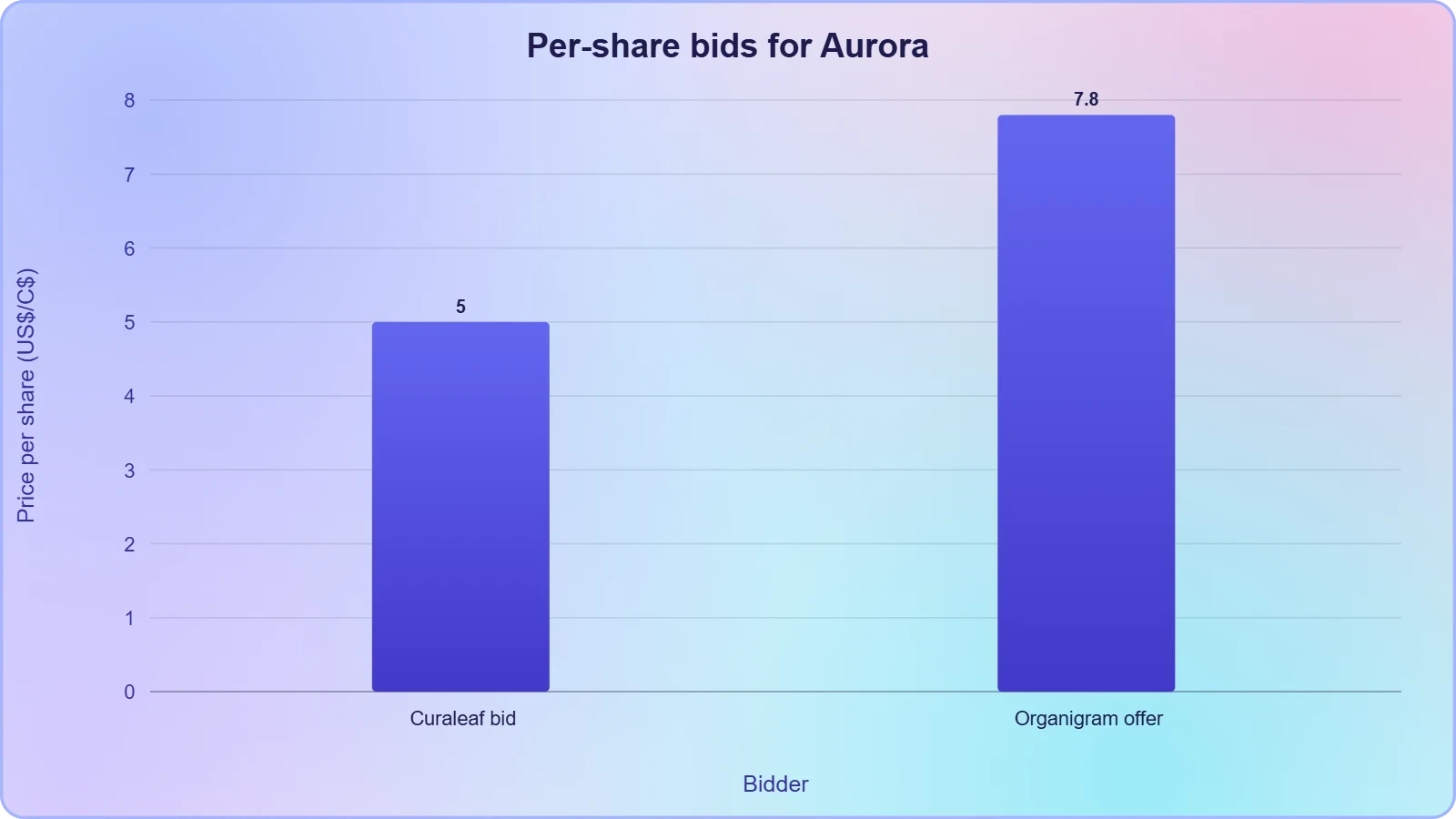
Organigram Global Inc.'s roughly $561-million agreement to acquire Aurora Cannabis Inc. marks one of the most consequential moments in the short, turbulent history of Canada's legal cannabis industry. The transaction, announced on a Tuesday and confirmed by Aurora, does more than consolidate two licensed producers; it effectively ends Aurora's resistance to a hostile takeover bid from Curaleaf Holdings Inc. and redraws the competitive map for a sector that has spent years recovering from the excesses of its early boom. The offer of $7.80 per Aurora share represents a meaningful premium over Curaleaf's latest bid of US$5 per share, signaling that Organigram is prepared to pay for scale, international reach, and hard-won regulatory credentials rather than simply for domestic market share.
What makes the deal particularly instructive is the arc it traces. Aurora, based in Edmonton, was once among the most prominent names in Canadian cannabis, carrying a stock market value of nearly $14-billion in 2019. By the end of 2020, the market had shifted, Aurora had overpaid for several acquisitions, and the company recorded close to $2-billion in impairment charges while cutting more than 1,000 jobs in a restructuring. Earlier this year, Aurora exited the recreational market entirely to concentrate on medical products, which generally carry higher margins, and it has been positioning itself as a global supplier to countries that have legalized cannabis for medical use. Organigram, meanwhile, has pursued its own international expansion, recently acquiring Germany's Sanity Group for about $174-million.
The combined entity, if approved, would operate five production and distribution facilities certified under EU good manufacturing practices, a credential few producers outside Canada hold and one that is required to sell cannabis in European Union markets. The deal requires at least two-thirds of votes cast by Aurora shareholders at a special meeting expected in December, and Organigram is funding it partly through a $188-million private placement with British American Tobacco and $210-million in loan facilities from ATB Financial. British American Tobacco is Organigram's largest shareholder, and Organigram CEO James Yamanaka is a former executive of the company, adding a layer of strategic continuity to the financing structure.
On This Page
- The Strategic Logic Behind the Organigram–Aurora Transaction
- Aurora's Rise, Impairment, and Medical-Only Pivot
- EU-GMP Certification as the Deal's Hidden Asset
- Financing Architecture and Shareholder Approval Mechanics
- Consolidation Dynamics and the Future of Canadian Cannabis
- Reading the Deal Through a Financial Lens
TL;DR Organigram Global Inc. has agreed to acquire Aurora Cannabis Inc. for approximately $561-million, offering $7.80 per share and ending Aurora's resistance to a hostile bid from Curaleaf Holdings. The transaction consolidates two Canadian licensed producers around medical cannabis and international exports, with the combined company operating five EU-GMP-certified facilities. Organigram is funding the deal through a $188-million private placement with British American Tobacco and $210-million in ATB Financial loan facilities. Approval requires two-thirds of votes cast by Aurora shareholders at a December meeting, and the deal reflects a broader industry pivot from recreational volume toward regulated global medical supply.
The Strategic Logic Behind the Organigram–Aurora Transaction
The Organigram bid is best understood as a bet on regulatory geography rather than on Canadian retail shelves. Canada's domestic cannabis market has matured into a crowded, price-sensitive arena where licensed producers compete on brand, distribution, and cost discipline, and where the early promise of explosive growth has given way to consolidation. By contrast, medical cannabis exports and EU-compliant production represent a narrower but more defensible opportunity, one where certification acts as a barrier to entry and where Canadian producers hold a genuine head start. Organigram's willingness to pay a premium over Curaleaf's offer reflects the value it places on Aurora's medical portfolio and its international supply relationships.
The premium itself is revealing. At $7.80 per Aurora share, Organigram is offering roughly 21 percent more than Curaleaf's latest bid of US$5 per share, a gap wide enough to make the hostile approach difficult to sustain. Aurora shareholders can elect cash, 5.86 Organigram shares, or a combination of $3.75 in cash and 3.04 Organigram shares, giving them flexibility to weigh immediate liquidity against participation in the combined company's upside. That structure is designed to appeal to a shareholder base that has endured years of volatility and impairment charges and may now prioritize certainty over speculative recovery.
Why Aurora Became a Target Rather Than an Acquirer
Aurora's trajectory explains much of the deal's logic. In 2019, the company's stock market value approached $14-billion, a valuation built on expectations of rapid global legalization and aggressive capacity expansion. When those expectations outran reality, Aurora found itself carrying assets it had acquired at inflated prices, and by the end of 2020 it recorded nearly $2-billion in impairment charges while cutting more than 1,000 jobs. The restructuring that followed was painful but clarifying: Aurora retreated from the recreational market earlier this year to focus exclusively on medical products, which generally offer higher profit margins and more predictable demand.
That pivot made Aurora a more attractive acquisition target even as it narrowed the company's standalone ambitions. A medical-only producer with international supply agreements and EU-GMP certification is a complementary asset for a buyer seeking scale in regulated markets, and Organigram fits that profile. The hostile bid from Curaleaf had already signaled that Aurora's assets were undervalued relative to their strategic potential, and Organigram's friendly offer effectively converted a contested situation into a negotiated consolidation with a clearer path to shareholder approval.
The Role of British American Tobacco and ATB Financial
Financing arrangements often reveal the true architecture of a deal, and this transaction is no exception. Organigram is funding the acquisition in part through a $188-million private placement with British American Tobacco, its largest shareholder, alongside $210-million in loan facilities from ATB Financial. The involvement of BAT is significant because it ties the cannabis producer to a global tobacco company with deep experience in regulated nicotine markets, brand management, and international distribution. Organigram CEO James Yamanaka is a former BAT executive, which lends the partnership a degree of strategic alignment that goes beyond a simple capital injection.
The ATB Financial facilities provide the debt component that allows Organigram to structure a cash-and-stock offer without overextending its balance sheet. Together, the private placement and the loan facilities give the acquirer the liquidity to present Aurora shareholders with a credible menu of consideration options. For BAT, the investment extends its exposure to cannabis-derived products and regulated adult-use markets without requiring direct operational control, a posture consistent with the cautious approach major tobacco companies have taken toward the sector.
Aurora's Rise, Impairment, and Medical-Only Pivot
Aurora's story is a case study in the gap between expectation and execution that defined the first wave of Canadian cannabis investing. When the company reached a stock market value of nearly $14-billion in 2019, investors were pricing in a future of rapid global legalization, export dominance, and consumer demand that would reward aggressive capacity building. That future arrived unevenly. By the end of 2020, the market had changed, Aurora had overpaid for several acquisitions, and the company recorded nearly $2-billion in impairment charges while cutting more than 1,000 jobs as part of a restructuring that reshaped its cost base and its ambitions.
The decision earlier this year to leave the recreational cannabis market and focus only on medical products was the logical endpoint of that restructuring. Recreational cannabis in Canada became a low-margin, highly competitive business in which provincial distributors wielded considerable pricing power and illicit market competition persisted. Medical products, by contrast, generally have higher profit margins, more stable demand, and clearer pathways into international markets where patients rely on prescribed cannabis. Aurora's pivot was therefore both a retreat and a repositioning, narrowing its scope in order to compete where its regulatory and clinical expertise could command a premium.
From Domestic Prominence to Global Medical Supplier
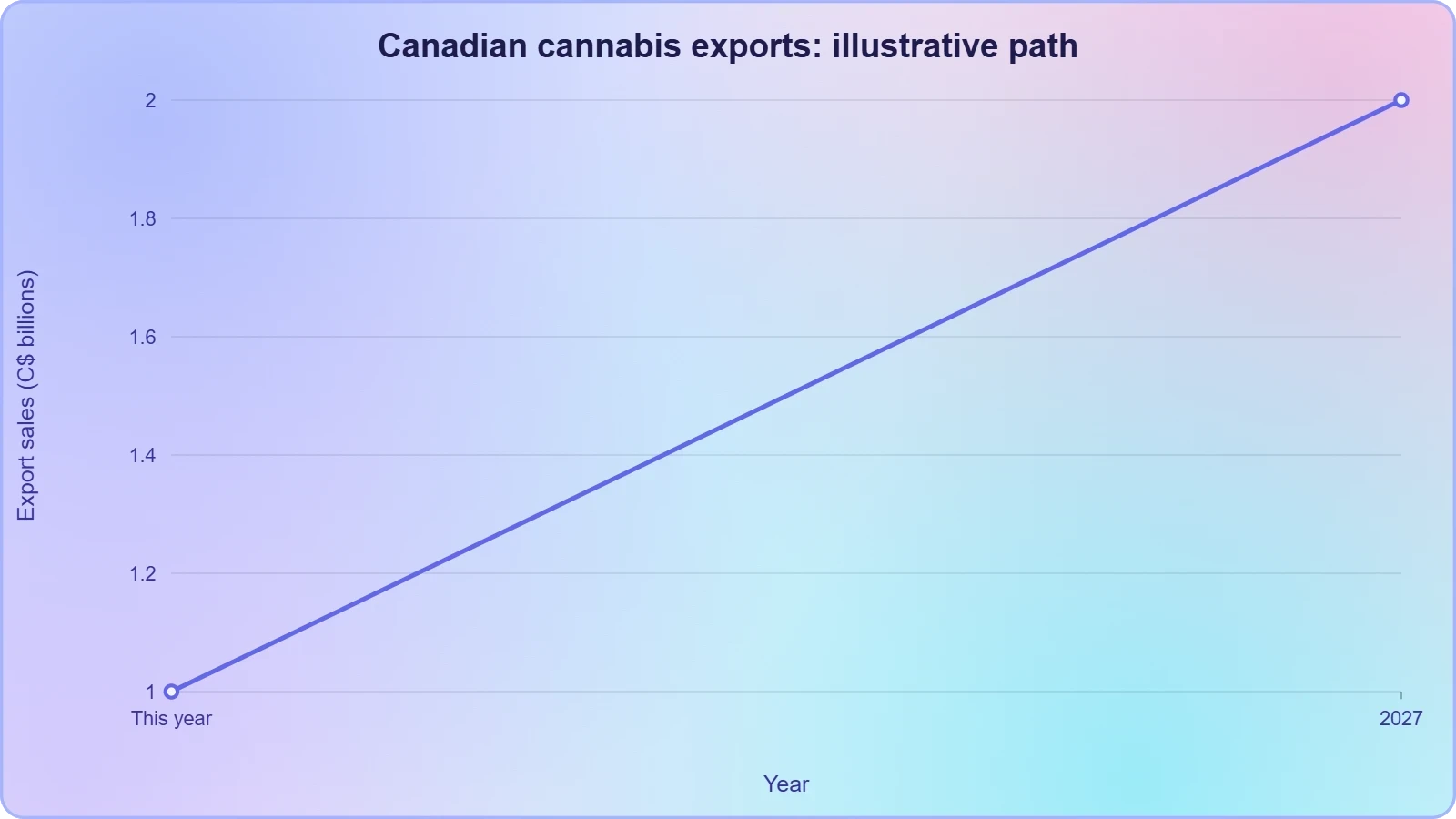
Aurora has been trying to become a global supplier to countries that have legalized cannabis for medical use, a strategy that depends on certification, consistency, and diplomatic patience. According to Statistics Canada, cannabis sales to foreign markets are expected to exceed $1-billion this year, and the industry expects that figure to double in 2027. Those projections explain why producers are willing to absorb the cost of EU-GMP certification and why international supply agreements have become strategic assets rather than optional extras. For Aurora, the medical-only focus aligns its operations with the segment of the market where Canadian producers retain a genuine competitive advantage.
The company's history also illustrates the risks of scaling ahead of demand. Impairment charges of nearly $2-billion reflected the write-down of goodwill and assets acquired during the boom, and the job cuts that accompanied them signaled a shift from growth-at-all-costs to capital discipline. That discipline is now embedded in the company's profile as an acquisition target: a leaner, medical-focused producer with international certifications is easier to value and integrate than a sprawling recreational operator with excess capacity and uncertain brand equity.
Organigram's Parallel International Ambitions
Organigram has not been a passive observer of these trends. Its recent acquisition of Germany's Sanity Group for about $174-million demonstrates a deliberate push into European markets, where medical cannabis frameworks are developing and where domestic supply remains limited. Germany's medical cannabis market, in particular, has attracted attention from Canadian producers because of its size, its regulatory structure, and its reliance on imported product. By acquiring a German operator, Organigram gains local market knowledge, distribution relationships, and a foothold in a jurisdiction that could serve as a gateway to broader European expansion.
The Aurora acquisition extends that logic. Combining Organigram's German presence with Aurora's medical portfolio and international supply relationships would create a producer with meaningful reach across multiple regulated markets. Both companies have criticized bureaucratic restrictions that they say are preventing Canada from maintaining its global leadership position as other countries develop their own cannabis export rules. That shared frustration helps explain why a friendly combination appeals to both management teams: scale and regulatory depth are more useful than standalone agility when the competitive threat comes from emerging national champions in Europe and Latin America.
EU-GMP Certification as the Deal's Hidden Asset
Beneath the headline numbers, the most strategically valuable element of this transaction may be the certification footprint. If the takeover is approved, the combined company would operate five production and distribution facilities certified under EU good manufacturing practices. That certification is required to sell cannabis in European Union markets, and few producers outside Canada meet the standard. In an industry where product quality, consistency, and traceability determine market access, EU-GMP status functions as a license to compete in jurisdictions that would otherwise be closed to Canadian exporters.
The scarcity of EU-GMP certification explains why scale matters in this sector. Achieving and maintaining compliance requires investment in quality systems, facility design, documentation, and auditing, costs that are difficult to justify for a single small producer but more manageable across a larger, diversified operation. By combining their certified facilities, Organigram and Aurora would create a platform capable of supplying multiple European markets from a consolidated quality infrastructure. That platform is more valuable than the sum of its parts because it reduces duplication and strengthens negotiating leverage with distributors and regulators.
Why European Market Access Commands a Premium
Europe represents one of the most attractive long-term opportunities in medical cannabis, with a large population, established pharmaceutical distribution channels, and a growing number of countries permitting prescribed cannabis products. However, access is gated by regulatory requirements that favor producers with certified facilities and documented supply chains. Canadian producers that invested early in EU-GMP compliance now hold an advantage that is difficult to replicate quickly, and that advantage is reflected in the valuations buyers are willing to pay for certified assets.
The industry's export projections reinforce this dynamic. Statistics Canada expects cannabis sales to foreign markets to exceed $1-billion this year, with the industry anticipating that figure will double in 2027. Those numbers are modest relative to the hype of 2019, but they represent real, recurring revenue from regulated medical channels rather than speculative recreational demand. For acquirers, certified capacity is the means of capturing that revenue, and for sellers, it is the asset that justifies a premium in a consolidating market.
The Competitive Threat From Emerging Export Regimes
Both Organigram and Aurora have warned that bureaucratic restrictions are eroding Canada's global leadership position as other countries develop their own cannabis export rules. That warning carries weight because the advantage conferred by early certification is not permanent. Countries such as Colombia, Portugal, and various European Union member states are building domestic production capacity, and as their regulatory frameworks mature, they will rely less on Canadian imports. Canadian producers therefore face a narrowing window in which to establish durable positions in foreign markets.
Consolidation is one response to that pressure. A combined Organigram and Aurora would have greater resources to navigate export regulations, maintain certifications, and pursue partnerships in jurisdictions where local requirements are evolving. The deal also creates a larger voice for industry advocacy on the bureaucratic constraints both companies have criticized. Whether that voice proves effective in shaping Canadian export policy is uncertain, but the strategic logic of combining forces ahead of a more competitive global landscape is difficult to dispute.
- 01
- 02
- 03
- 04
Financing Architecture and Shareholder Approval Mechanics
The transaction's financing structure deserves close attention because it determines both the acquirer's leverage and the seller's confidence in the offer. Organigram is funding the deal in part through a $188-million private placement with British American Tobacco and $210-million in loan facilities from ATB Financial. The private placement anchors the equity component with a strategic investor that already holds the largest stake in Organigram, while the loan facilities provide debt capacity without requiring a broader public offering. That combination allows Organigram to present a credible cash-and-stock offer while preserving balance sheet flexibility.
Approval mechanics add a further layer of complexity. The deal needs at least two-thirds of votes cast by Aurora shareholders at a special meeting expected in December, a threshold that requires substantial support from a shareholder base that has experienced significant losses since 2019. The friendly nature of the offer, combined with the premium over Curaleaf's bid, is designed to secure that support. However, the election options mean shareholders must weigh cash certainty against stock upside, and the outcome may depend on how institutional investors assess the combined company's prospects.
British American Tobacco's Strategic Position
British American Tobacco's role extends beyond financing. As Organigram's largest shareholder, BAT has a direct interest in the company's expansion and a track record of investing in regulated nicotine and cannabis-adjacent markets. The $188-million private placement strengthens that relationship and gives BAT greater exposure to a producer with international ambitions. Organigram CEO James Yamanaka's background as a former BAT executive reinforces the alignment, suggesting that the partnership is built on shared strategic assumptions rather than purely financial considerations.
For BAT, the investment offers a measured way to participate in cannabis market growth without assuming direct operational responsibility. Tobacco companies have approached the sector cautiously, mindful of regulatory scrutiny and reputational considerations, and a minority stake in a licensed producer provides exposure while limiting risk. If the Organigram–Aurora combination succeeds, BAT's position in a larger, internationally certified producer could become more valuable, reinforcing the logic of its continued support.
What the December Vote Means for the Industry
The December shareholder meeting will be watched closely across the cannabis sector because it tests whether consolidation can proceed smoothly after years of failed or contested deals. A successful vote would demonstrate that friendly, strategically motivated combinations can overcome the resistance of hostile bidders and the skepticism of a battered shareholder base. A failed vote, by contrast, would leave Aurora exposed to Curaleaf's hostile approach and raise questions about the feasibility of further consolidation among Canadian producers.
Beyond the immediate outcome, the vote carries implications for how the industry structures future transactions. The cash-and-stock election mechanism, the involvement of a strategic investor, and the reliance on certified facilities as a valuation anchor all represent templates that other producers may study. If the deal closes and the combined company performs well, it could encourage similar combinations among mid-sized Canadian producers seeking scale in international medical markets. If it stumbles, the sector may remain fragmented longer than analysts expect.
We Also Published
Consolidation Dynamics and the Future of Canadian Cannabis
The Organigram–Aurora transaction is the latest signal that Canadian cannabis is entering a consolidation phase in which scale, certification, and international reach matter more than domestic brand proliferation. The industry's early years were defined by dozens of licensed producers competing for shelf space in a market that proved smaller and more price-sensitive than expected. That competition eroded margins and left many producers with excess capacity. Consolidation offers a way to rationalize assets, reduce duplication, and direct capital toward the regulated medical and export segments where returns are more predictable.
Yet consolidation is not a cure-all. Integrating two producers with different histories, cost structures, and corporate cultures requires disciplined execution, and the combined company will still face the same regulatory constraints and competitive pressures that shaped its predecessors. The deal's success will depend on whether Organigram can realize synergies without eroding the certification and quality standards that make the combined facilities valuable. Investors will watch closely for signs of integration friction, particularly in the first year after closing.
Lessons From the 2019 Valuation Peak
The contrast between Aurora's nearly $14-billion valuation in 2019 and the roughly $561-million price now on the table is a sobering reminder of how far the sector has traveled. The 2019 peak reflected optimism about global legalization, export dominance, and consumer demand that did not materialize on the expected timeline. The impairment charges that followed were not merely accounting events; they represented real capital that had been deployed on assumptions that proved incorrect. The current transaction prices Aurora on the basis of its medical portfolio, certifications, and international relationships rather than on speculative growth.
That repricing has implications for how investors evaluate cannabis companies today. Metrics such as EU-GMP certification, export agreements, and margin discipline now carry more weight than capacity announcements or brand portfolios. The Organigram deal reflects this shift: the buyer is paying for assets that generate regulated revenue and market access, not for the promise of a future recreational boom. For an industry still recovering from its early excesses, that discipline is a welcome development, even if it comes at the cost of the valuations that once defined the sector.
What to Watch After the December Vote
If Aurora shareholders approve the deal in December, attention will shift to integration and to the combined company's ability to compete in European medical markets. Key indicators will include the pace of certification maintenance across the five EU-GMP facilities, the trajectory of export sales against the $1-billion industry projection, and the combined company's success in securing supply agreements in Germany and other regulated jurisdictions. Organigram's existing German acquisition, Sanity Group, will be central to that effort, and its performance will offer an early read on whether the international strategy is working.
If the vote fails, Aurora will remain exposed to Curaleaf's hostile approach, and the sector will confront renewed uncertainty about whether friendly consolidation can succeed. Either outcome will shape the next phase of Canadian cannabis, but the strategic logic driving the deal—certification scarcity, export growth, and the need for scale in regulated markets—is unlikely to disappear. The industry's future will be determined less by the drama of individual bids than by the quiet, persistent economics of compliance, quality, and access to patients in jurisdictions that have chosen to legalize medical cannabis.
Reading the Deal Through a Financial Lens
From a valuation standpoint, the transaction invites comparison between Aurora's current price and the capital it has consumed since 2019. A $561-million acquisition price for a company that once carried a market value near $14-billion reflects the destruction of value wrought by impairment charges, restructuring costs, and the pivot away from recreational cannabis. Yet the price also reflects what remains valuable: medical product portfolios, international supply relationships, and EU-GMP certified facilities that are difficult and expensive to replicate. The buyer is effectively purchasing a regulatory platform rather than a growth story.
The financing mix adds a layer of financial engineering worth examining. A $188-million private placement with British American Tobacco and $210-million in ATB Financial loan facilities together exceed the cash component of the offer, giving Organigram flexibility in how it allocates consideration between cash and stock. The structure reduces reliance on public markets at a time when cannabis equities remain volatile, and it aligns a strategic investor with the combined company's long-term prospects. For Aurora shareholders, the election options translate into a choice between immediate liquidity and continued exposure to a larger, more diversified producer.
Valuation Metrics and What They Reveal
Analysts will likely assess the deal using metrics such as enterprise value relative to medical cannabis revenue, the implied value per certified facility, and the premium relative to Curaleaf's bid. The 21 percent premium over US$5 per share provides a straightforward benchmark, but the more revealing comparison may be the price paid per unit of EU-GMP certified capacity. Because certification is scarce, that metric could indicate whether Organigram is paying a reasonable price for strategic access or overpaying for assets that Aurora struggled to monetize independently.
The impairment history also matters for how the combined company will report its balance sheet. Aurora's nearly $2-billion in impairment charges reset the carrying value of its assets, which means Organigram may be acquiring them at a more realistic basis than the original acquisition costs would suggest. That accounting context does not guarantee a good deal, but it does mean the buyer is less likely to inherit the inflated valuations that plagued Aurora's earlier expansion. The financial lens ultimately points to a transaction priced for regulatory assets and medical revenue rather than for speculative growth.
Risk Factors That Could Reshape the Outcome
Several risks could alter the deal's trajectory. Shareholder approval requires two-thirds of votes cast, a high threshold that gives dissident investors leverage, and the December meeting timeline leaves room for competing bids or revised offers. Regulatory approvals, while not detailed in the announcement, could introduce delays or conditions. Integration risk is also significant, particularly around maintaining EU-GMP certification across five facilities while combining workforces and rationalizing operations. Any of these factors could affect the deal's completion or the combined company's performance.
Market conditions represent a further variable. Cannabis equities remain sensitive to regulatory news, export policy changes, and broader risk appetite, and a deterioration in sentiment could complicate financing or reduce the appeal of the stock component of the offer. Currency movements between Canadian and U.S. dollars also matter given Curaleaf's U.S.-denominated bid. The deal's architects have structured the consideration to manage some of these risks, but no structure can eliminate them entirely, and investors should weigh the uncertainties alongside the strategic rationale.
From our network :
- The Final Descent: How ESA Retired the Legendary Cluster Constellation After 24 Years of Space Weather ScienceAfter 24 years mapping Earth’s magnetosphere, ESA’s Cluster mission concluded with a precisely controlled reentry over the South Pacific. This analysis explores the scientific legacy, engineering decisions, and debris mitigation principles behind one of space exploration’s most responsible retirements.
- The Hidden Cost of AI Convenience: Why Over-Permissioned Agents Are a Security Time BombDiscover why AI agents with excessive permissions create dangerous single points of failure, and learn how implementing least privilege principles can protect your organization from exploitation.
- Committed Mediterranean Precipitation Decline: Why Emissions Cuts Alone Cannot Restore Winter RainsNew NOAA research reveals that Mediterranean winter rains may decline irreversibly even with emissions cuts. Explore the science of committed climate change and regional impacts.
- CISA’s Ten-Advisory Wave: Why Generic Patching Fails in OT and How to Build Product-Specific PlaybooksCISA released ten ICS advisories in one week, exposing critical infrastructure risks. Generic patching fails in OT. Learn to build product-specific remediation playbooks.
- Mobile Learning and VR in English: What Global Evidence Reveals About Effective Language TechnologyA systematic review across 14 countries reveals which language-learning technologies genuinely work. Mobile learning, AI, and VR show measurable benefits when pedagogically integrated. This evidence-based guide helps educators and learners select technology that delivers real return on investment.
- University Language Proficiency Exams: Why Institutional Tests Demand Different Preparation Than IELTS and TOEFLDiscover why university-specific language proficiency examinations differ fundamentally from IELTS and TOEFL, and learn strategic preparation approaches for institutional assessment success.
- Forbidden Matrix Patterns and Visible Lattice Points: A Geometric DictionaryExplore how multidimensional 0–1 matrices encode geometric truths, linking forbidden patterns to visible lattice points and hypergraph theory, with applications in combinatorics and computational geometry.
- Live Online English Classes for Kids: Do They Actually Reduce Anxiety?A ten-week study reveals that synchronous online English classes can significantly reduce child language anxiety while improving listening and reading skills. Discover what makes these programs effective and how parents can select the right one.
- How AI Agents Will Change the Way We Manage Personal FinancesExplore how AI agents are transforming personal finance through automated budgeting, bill payment, and investment management, while examining the critical security protocols and governance frameworks required for safe deployment.
RESOURCES
- Resources will be updated soon.
- 01
- 02
- 03
- 04
- 05
- 06
- 07
- 08
0 Comments