Equity markets rarely move for a single reason, and the turbulence recorded in early November 2026 illustrates that principle with unusual clarity. Investors found themselves caught between two powerful and overlapping anxieties: the rapid, sometimes unsettling advance of artificial intelligence through the corporate landscape, and the policy uncertainty generated by the United States midterm elections. Neither force operates in isolation. AI reshapes earnings expectations, labor costs, and competitive moats across entire sectors, while a midterm cycle can redraw the legislative map on taxation, regulation, and industrial policy. When both pressures converge in the same trading window, price discovery becomes noisy and volatility rises.
The immediate market reaction was one of wobble rather than collapse. Benchmarks swung between gains and losses as traders parsed headlines, repositioned around earnings guidance, and hedged exposure ahead of the vote. What matters for readers is not the daily tick but the underlying transmission mechanism: how technological disruption and political risk travel through valuations, discount rates, and sector rotation. Understanding that mechanism helps investors distinguish temporary noise from durable shifts in the investment landscape. The episode is a useful case study in how macro-political events and structural technology trends interact inside modern portfolios.
This analysis examines the forces behind the fluctuation, the sectors most exposed, and the practical frameworks investors can apply when uncertainty arrives from two directions at once. It draws on the broader record of how markets have historically processed election risk and technological disruption, and it separates what is knowable from what remains speculative. The goal is clarity rather than prediction, because the most reliable edge in volatile conditions is a disciplined process, not a confident forecast.
On This Page
TL;DR Stock markets wobbled as investors weighed two simultaneous sources of uncertainty: the disruptive economic impact of artificial intelligence and the policy implications of the US midterm elections. AI concerns center on job displacement, regulatory response, and competitive disruption, while midterms raise questions about fiscal policy, taxation, and sector-specific rules. Neither risk is resolved, and volatility reflects genuine ambiguity rather than panic. Investors benefit from separating structural technology trends from cyclical political noise, stress-testing sector exposure, and maintaining liquidity and diversification. The episode underscores that modern market risk is increasingly multi-source, and that disciplined process outperforms reactive trading when headlines arrive from several directions at once.
The Anatomy of a Two-Front Market Shock
Market shocks are usually described as if they arrive from a single direction, but the November episode was distinctly two-fronted. On one side sat artificial intelligence, a general-purpose technology whose diffusion is reshaping cost structures, hiring plans, and capital expenditure across software, media, financial services, and professional services. On the other side sat the US midterm elections, a scheduled political event with an unscheduled range of outcomes. When a structural technology shift and a political inflection point coincide, investors face what risk managers call correlated uncertainty, where two independent narratives begin to reinforce each other in the same trading sessions.
The result is a market that oscillates rather than trends. Prices react to AI-related earnings commentary in the morning and to polling or policy speculation by the afternoon, producing intraday reversals that frustrate momentum strategies. This pattern is not irrational. It reflects genuine disagreement about how quickly AI productivity gains translate into margins, and about which legislative configuration will emerge after the vote. Volatility, in this reading, is the market's honest admission that the probability distribution around future cash flows has widened.
Why AI Anxiety Is Now a Macro Variable
Artificial intelligence has graduated from a sector story to a macroeconomic variable. Capital expenditure on compute infrastructure, data centers, and model development now influences national investment figures, while AI-driven automation affects wage bargaining and hiring in white-collar occupations. When investors worry about AI, they are often worrying about second-order effects: whether incumbent business models will be cannibalized, whether regulators will impose compliance costs, and whether the productivity dividend will accrue to shareholders or be competed away. Each of these questions carries a different time horizon, which is precisely why markets struggle to price them consistently.
The anxiety also has a competitive dimension. Firms that lag in AI adoption risk margin compression, while leaders face scrutiny over concentration and pricing power. Regulatory attention tends to follow scale, so the largest beneficiaries of the AI cycle are also the most exposed to antitrust and disclosure rules. Investors must therefore hold two ideas simultaneously: that AI is a genuine productivity engine, and that its distributional and regulatory consequences create real, if uneven, risk. The market's fluctuation reflects the difficulty of holding both truths at once.
Midterm Elections as a Policy Risk Event
Midterm elections matter to markets less for who wins than for what becomes legislatively possible. A divided government constrains sweeping change but also entrenches gridlock, which markets sometimes welcome and sometimes lament depending on the sector. Tax policy, spending priorities, energy rules, and technology regulation all hinge on the balance of power. When the outcome is uncertain, investors reduce risk exposure, defer capital commitments, and price in a wider band of policy scenarios. That behavior is rational preparation, not panic, and it explains why volatility often peaks before results are known and subsides afterward.
Historical patterns offer a useful anchor. Markets have generally absorbed midterm outcomes without lasting dislocation, because policy change is slow and partially anticipated. The complication in this cycle is that the election arrives while a technological revolution is already redistributing profits. Political risk and technology risk are not additive; they interact. A legislative shift on AI oversight, for instance, would land on a sector already repricing itself. That interaction, more than either factor alone, explains the choppy trading environment investors encountered.
We Also Published
Sector Exposure: Where the Wobble Was Felt Most
Not every sector experienced the turbulence equally. The fluctuation was concentrated where AI exposure and policy sensitivity overlap. Technology and communication services bore the brunt of AI-related repricing, as investors debated whether current valuations adequately reflected both the upside of automation and the downside of regulatory scrutiny. Financials and industrials showed more moderate moves, caught between optimism about efficiency gains and caution about compliance costs. Defensive sectors such as utilities and consumer staples provided partial shelter, though even these were not immune to broad risk-off sentiment during the sharpest intraday swings.
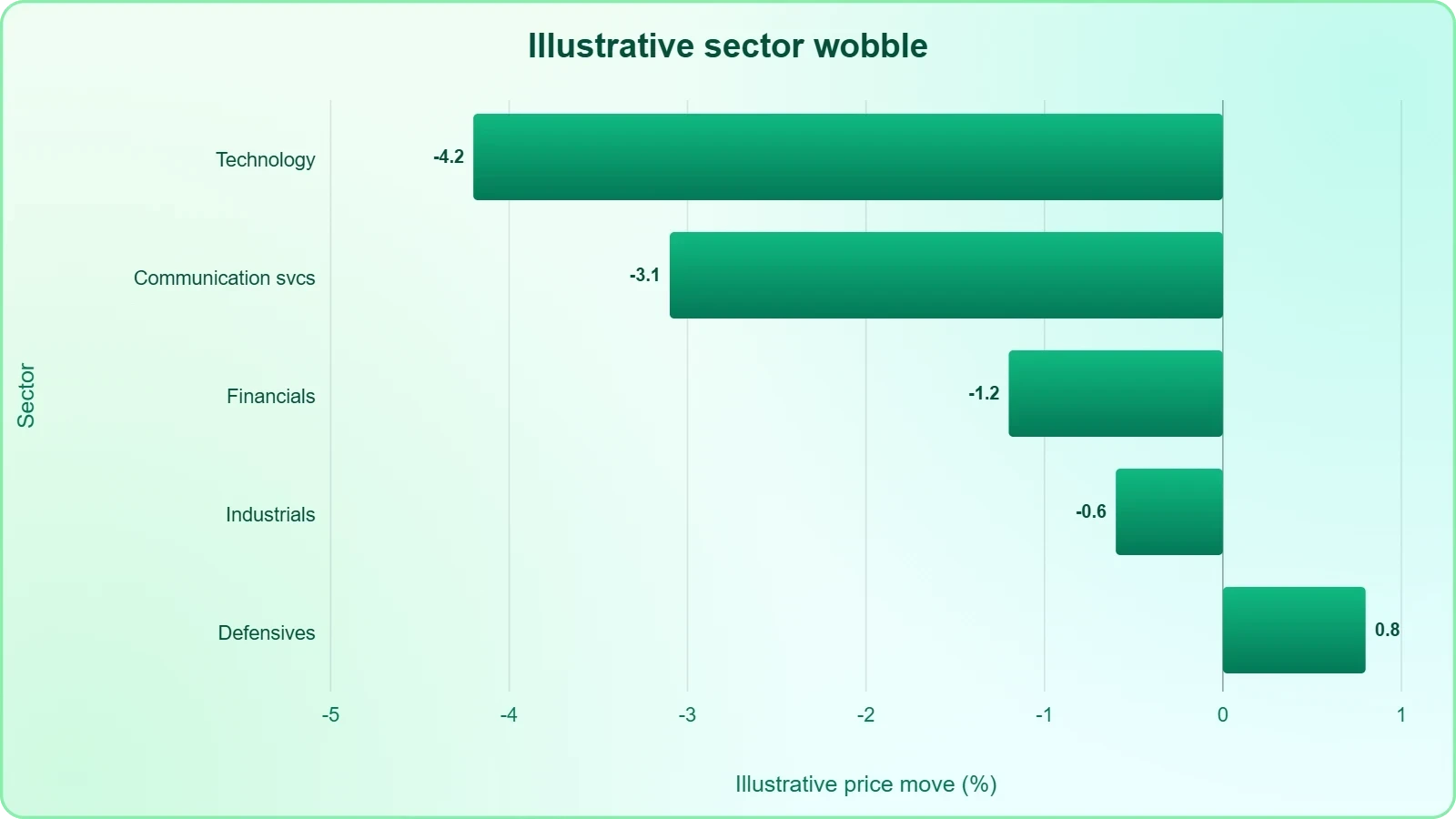
The dispersion matters because it reveals what the market was actually pricing. A uniform decline would suggest generalized fear; a rotation suggests discrimination. Investors were not abandoning equities wholesale but reallocating within them, trimming positions where dual exposure to AI disruption and political risk was highest. That behavior is consistent with a market engaged in genuine reassessment rather than reflexive selling. For portfolio managers, the lesson is that headline volatility often masks meaningful relative-value opportunities for those willing to look beneath the index level.
Technology and Communication Services
Technology stocks sat at the epicenter because they carry the most direct AI exposure. Semiconductor firms, cloud providers, and software platforms have seen valuations expand on expectations of sustained AI-driven demand, which makes them vulnerable to any signal that growth may moderate or that regulation may bite. When investors grow anxious about AI, they are often questioning the durability of these expectations rather than the technology itself. The distinction is subtle but important: skepticism about near-term monetization is different from doubt about long-term adoption, and markets frequently confuse the two during volatile periods.
Communication services faced a parallel dynamic. Media and advertising businesses are exposed to AI-generated content, changing consumer attention patterns, and potential disclosure rules. Platforms that both develop and deploy AI carry compounded risk, since they face competitive pressure and regulatory scrutiny simultaneously. The sector's swings during the episode reflected this dual identity. Investors were effectively pricing two scenarios at once: one in which AI expands margins through automation, and another in which compliance costs and competitive intensity erode them. The market's inability to settle on one narrative produced the choppy price action observed.
Financials, Industrials, and Defensives
Financials occupy an interesting middle ground. Banks and insurers stand to gain from AI-driven efficiency in underwriting, fraud detection, and customer service, but they also face heightened expectations around model governance and consumer protection. Midterm outcomes could shift the regulatory posture toward financial institutions, adding a political layer to an already complex technology story. The result was moderate volatility rather than dramatic swings, as investors weighed efficiency gains against compliance burdens and concluded that the net effect remained genuinely uncertain.
Industrials and defensives told a different story. Industrial firms are AI adopters rather than AI originators, so their exposure runs through productivity and supply-chain optimization rather than direct disruption. Defensive sectors, meanwhile, attracted flows as investors sought shelter from dual uncertainty. Utilities benefited from the electricity demand associated with data centers, a rare case where AI exposure was unambiguously positive during the episode. This dispersion illustrates a broader principle: in a two-front shock, the winners are often found in unexpected corners of the market.
How Investors Process Political Uncertainty
Political uncertainty is one of the most studied phenomena in finance, and the research consensus is reassuring: markets adapt. Elections are scheduled events, and investors typically price a range of outcomes in advance, reducing the shock when results arrive. The midterm cycle is particularly well understood because it recurs every two years, giving markets ample historical data on how policy gridlock, divided government, and legislative turnover affect different sectors. The volatility observed during the episode is therefore best read as a temporary widening of the probability distribution rather than a structural break in market functioning.
What complicates this cycle is the interaction with AI. Political risk usually resolves within days or weeks of an election, while technology risk persists for years. Investors must therefore manage two clocks simultaneously: a fast-moving political clock and a slow-moving technological one. Misjudging either leads to error. Treating AI anxiety as a passing election story underestimates structural change; treating election noise as a permanent regime shift overstates political durability. The disciplined approach is to assign each risk its appropriate horizon and to avoid letting short-term headlines distort long-term allocation decisions.
The Historical Record on Election Volatility
Historical data consistently shows that equity markets tend to rise over the twelve months following midterm elections, regardless of the outcome. The pattern is not a guarantee, but it reflects a simple mechanism: uncertainty resolves, policy becomes clearer, and investors redeploy capital that had been held back. The pre-election period, by contrast, is often characterized by reduced risk appetite and elevated volatility, precisely the conditions observed during the episode. Understanding this rhythm helps investors contextualize short-term swings and avoid overreacting to what is, in historical terms, a recurring seasonal pattern.
The caveat is that historical patterns describe averages, not certainties. When an election coincides with a genuine technological inflection, the post-election relief rally may be muted or delayed by ongoing sector-level repricing. Investors who rely solely on the election calendar without accounting for AI-driven fundamentals risk misreading the market. The better approach is to treat the historical record as a baseline and then adjust for the specific structural forces at play. In this cycle, those forces are unusually strong, which argues for caution about assuming a smooth post-election recovery.
Reading Volatility as Information
Volatility is often described as noise, but it also carries information. Widening option-implied volatility signals that investors disagree about future outcomes, and the term structure of that volatility reveals which risks the market considers most pressing. During the episode, elevated short-dated volatility suggested that investors expected near-term resolution of election uncertainty, while persistent longer-dated volatility pointed to ongoing concern about AI's trajectory. Reading these signals requires technical sophistication, but the underlying principle is accessible: markets communicate their fears through the shape of volatility, not just its level.
For long-term investors, the practical implication is that volatility creates opportunity as well as risk. When prices swing on dual uncertainty, some assets become mispriced relative to their fundamentals. The challenge is distinguishing genuine mispricing from justified repricing. That requires fundamental analysis rather than headline reaction, and it rewards patience over speed. Investors who understand why the market is fluctuating are better positioned to act selectively when others are reacting broadly, turning a period of instability into a disciplined opportunity to improve portfolio quality.
- 01
- 02
- 03
- 04
Portfolio Construction Under Dual Uncertainty
When two independent risks arrive together, portfolio construction must adapt. The first principle is diversification across risk sources, not merely across asset classes. A portfolio that holds many technology stocks is diversified by name but concentrated by risk factor, since all of them respond to the same AI narrative. True diversification requires exposure to sectors and geographies whose returns are driven by different forces. During the episode, investors who held utilities, healthcare, and international equities experienced less turbulence than those concentrated in domestic technology, illustrating the practical value of factor-level diversification.
The second principle is liquidity management. Volatility creates margin calls and redemption pressure, and investors forced to sell during dislocations often realize losses they could have avoided. Maintaining a cash buffer and avoiding excessive leverage are unglamorous disciplines that prove their worth precisely in periods like this one. The third principle is rebalancing discipline. When prices swing on sentiment rather than fundamentals, systematic rebalancing forces investors to sell what has become expensive and buy what has become cheap, converting volatility from a threat into a modest source of return.
Stress-Testing for Correlated Shocks
Traditional stress tests often examine one risk at a time, which is inadequate when shocks arrive in pairs. A more useful approach is to model scenarios in which AI disappointment and political surprise occur simultaneously. What happens to a portfolio if AI capital expenditure slows while a legislative shift raises compliance costs for technology firms? Running such combined scenarios reveals hidden concentrations that single-factor tests miss. The exercise is not about predicting the exact outcome but about understanding where losses would concentrate if two adverse developments coincided, which is precisely the situation investors faced.
Scenario analysis also clarifies which positions serve as genuine hedges. Some assets that appear defensive in isolation may fail when correlation rises across markets. Gold, long-duration bonds, and certain currencies behave differently depending on whether the shock is inflationary or deflationary, political or technological. Mapping these responses in advance allows investors to construct hedges that actually work when needed. The discipline is demanding, but it is far cheaper than discovering hedge failures during a live dislocation, when adjustment options are limited and prices are least favorable.
Separating Signal from Noise in Practice
Practically, separating signal from noise requires a written investment thesis with explicit assumptions. If a position depends on AI adoption accelerating, the investor should specify what evidence would confirm or refute that thesis, and at what price the position becomes unattractive. Similarly, if a position depends on a particular policy outcome, the investor should define the range of acceptable outcomes and the response if the range is breached. This discipline prevents reactive trading, because decisions are anchored to pre-specified criteria rather than to the emotional pull of the latest headline.
The approach also improves accountability. When outcomes diverge from expectations, a documented thesis reveals whether the error lay in the analysis or in unforeseeable events. That distinction is essential for learning. Investors who trade on intuition alone cannot distinguish bad luck from bad process, and they repeat mistakes. Those who document their reasoning build a feedback loop that compounds over time. In a market defined by dual uncertainty, the edge belongs not to those who predict best but to those who process information most systematically and adapt without abandoning discipline.
The Broader Economic Context
The market fluctuation did not occur in an economic vacuum. It unfolded against a backdrop of evolving monetary policy, shifting inflation expectations, and a labor market adjusting to automation. AI investment has become a meaningful component of capital expenditure, particularly in data centers and energy infrastructure, which means technology sentiment now influences macroeconomic data. When investors grow cautious about AI, the effects ripple into construction, utilities, and semiconductor supply chains. The technology story and the macro story have become entangled, and disentangling them is one of the central analytical challenges of the current cycle.
Political uncertainty adds another layer. Midterm elections determine the fiscal trajectory, the regulatory posture toward emerging technologies, and the composition of committees that oversee financial markets. Even when legislative change is modest, the direction of travel matters for long-term planning. Companies delay investment decisions when the policy environment is unclear, and that delay itself becomes an economic drag. The interaction between technology-driven investment and politically driven caution produces the kind of mixed signals that generate market volatility without a clear directional trend.
AI Investment and the Real Economy
The scale of AI-related capital expenditure has become large enough to influence aggregate demand. Data center construction, power generation, and semiconductor fabrication require substantial physical investment, creating jobs and orders across industrial supply chains. This spending supports earnings in sectors far removed from software, which is why AI sentiment now moves markets beyond technology. When investors question the durability of AI spending, they are implicitly questioning a component of economic growth, and that connection explains why the anxiety spread beyond the technology sector during the episode.
There is also a productivity dimension that markets struggle to price. If AI delivers meaningful efficiency gains, corporate margins could expand even as employment patterns shift. If gains prove slower or more uneven, the investment may weigh on returns before it pays off. Investors are effectively asked to underwrite a multi-year productivity bet with limited visibility. That uncertainty is normal for general-purpose technologies, but it becomes acute when combined with political risk, because the two together widen the range of plausible economic outcomes and complicate capital allocation.
Policy Transmission Channels
Policy affects markets through several channels, and midterms touch most of them. Fiscal policy influences aggregate demand and bond yields. Regulatory policy shapes compliance costs and competitive dynamics. Trade policy affects supply chains and input prices. For technology firms, the most relevant channel is regulation, particularly around data, competition, and liability. For financial firms, it is supervision and capital rules. For energy and utilities, it is permitting and environmental standards. A single election can shift all of these simultaneously, which is why markets reduce risk exposure ahead of the vote rather than waiting for clarity.
The transmission is rarely immediate. Legislation moves slowly, agencies interpret mandates over months, and courts adjudicate disputes over years. Markets, however, price expectations rather than outcomes, so the anticipation of policy change moves prices long before any rule takes effect. That timing mismatch explains why election-related volatility often peaks before the vote and fades afterward, even when the underlying policy questions remain unresolved. Investors who understand the lag between expectation and implementation can avoid overreacting to headlines that will take years to become reality.
What the Episode Reveals About Modern Markets
The most instructive aspect of the episode is what it says about the structure of contemporary market risk. Two decades ago, a midterm election would have dominated the narrative, with technology concerns treated as a sector story. Today the two are intertwined, because AI has become large enough to move macroeconomic aggregates and important enough to attract political attention. This entanglement is likely to persist. Investors should expect future volatility to arise from multiple, interacting sources rather than from single identifiable events, and they should build processes that accommodate that complexity.
The episode also demonstrates the value of perspective. Daily fluctuations dominate headlines, but they rarely alter long-term outcomes for diversified investors. The market wobbled, absorbed information, and continued functioning. No systemic break occurred, no institution failed, and no permanent repricing of risk took place. What happened was a normal, if uncomfortable, process of price discovery under uncertainty. Recognizing this helps investors maintain discipline when headlines suggest crisis, and it prevents the kind of reactive behavior that converts temporary volatility into permanent loss.
Lessons for Long-Term Investors
The first lesson is that uncertainty is not the same as danger. Markets frequently fluctuate without lasting consequence, and the ability to distinguish transient noise from structural change is a core investment skill. The second lesson is that diversification must be evaluated at the level of risk factors, not just asset names. A portfolio full of different companies exposed to the same AI narrative is not diversified in any meaningful sense. The third lesson is that process beats prediction. No one knows how AI will evolve or which coalition will govern, but disciplined allocation, rebalancing, and documentation improve outcomes regardless of which scenario unfolds.
The fourth lesson concerns temperament. Volatility tests patience, and investors who sell during dislocations often lock in losses that would have reversed. Conversely, those who buy indiscriminately during drawdowns may catch falling knives. The balanced response is selective action guided by analysis: trimming positions whose theses have weakened, adding to those whose fundamentals remain intact but whose prices have fallen on sentiment. This approach requires both courage and restraint, and it is far easier to describe than to execute consistently under pressure.
Looking Ahead
Looking forward, the key variables to monitor are the pace of AI monetization, the regulatory response that follows the midterms, and the interaction between the two. If AI adoption accelerates while regulation remains light, the anxiety that drove the fluctuation may fade quickly. If adoption slows while regulatory pressure increases, the dual headwind could persist. Most likely, the outcome will be mixed, with some sectors benefiting and others facing headwinds. Investors should prepare for a range of outcomes rather than committing to a single narrative, and they should revisit their assumptions as new information arrives.
The broader message is one of resilience. Markets have absorbed technological revolutions and political transitions many times before, and they have adapted. The current episode is uncomfortable but not unprecedented. What distinguishes successful investors is not the ability to avoid uncertainty but the ability to function within it, maintaining discipline when headlines are loudest and conviction when prices are most volatile. That capacity, more than any forecast, determines long-term outcomes in markets defined by dual and interacting sources of risk.
From our network :
- Mobile Learning and VR in English: What Global Evidence Reveals About Effective Language TechnologyA systematic review across 14 countries reveals which language-learning technologies genuinely work. Mobile learning, AI, and VR show measurable benefits when pedagogically integrated. This evidence-based guide helps educators and learners select technology that delivers real return on investment.
- Forbidden Matrix Patterns and Visible Lattice Points: A Geometric DictionaryExplore how multidimensional 0–1 matrices encode geometric truths, linking forbidden patterns to visible lattice points and hypergraph theory, with applications in combinatorics and computational geometry.
- Live Online English Classes for Kids: Do They Actually Reduce Anxiety?A ten-week study reveals that synchronous online English classes can significantly reduce child language anxiety while improving listening and reading skills. Discover what makes these programs effective and how parents can select the right one.
- How AI Agents Will Change the Way We Manage Personal FinancesExplore how AI agents are transforming personal finance through automated budgeting, bill payment, and investment management, while examining the critical security protocols and governance frameworks required for safe deployment.
- CISA’s Ten-Advisory Wave: Why Generic Patching Fails in OT and How to Build Product-Specific PlaybooksCISA released ten ICS advisories in one week, exposing critical infrastructure risks. Generic patching fails in OT. Learn to build product-specific remediation playbooks.
- Committed Mediterranean Precipitation Decline: Why Emissions Cuts Alone Cannot Restore Winter RainsNew NOAA research reveals that Mediterranean winter rains may decline irreversibly even with emissions cuts. Explore the science of committed climate change and regional impacts.
- The Final Descent: How ESA Retired the Legendary Cluster Constellation After 24 Years of Space Weather ScienceAfter 24 years mapping Earth’s magnetosphere, ESA’s Cluster mission concluded with a precisely controlled reentry over the South Pacific. This analysis explores the scientific legacy, engineering decisions, and debris mitigation principles behind one of space exploration’s most responsible retirements.
- The Hidden Cost of AI Convenience: Why Over-Permissioned Agents Are a Security Time BombDiscover why AI agents with excessive permissions create dangerous single points of failure, and learn how implementing least privilege principles can protect your organization from exploitation.
- University Language Proficiency Exams: Why Institutional Tests Demand Different Preparation Than IELTS and TOEFLDiscover why university-specific language proficiency examinations differ fundamentally from IELTS and TOEFL, and learn strategic preparation approaches for institutional assessment success.
RESOURCES
- Resources will be updated soon.
- 01
- 02
- 03
- 04
- 05
- 06
- 07
- 08
0 Comments