When a sitting American president announces the termination of a decade-long security assistance agreement with Israel, the decision reverberates far beyond a single budget line. The reported move to end the ten-year Memorandum of Understanding that has channeled roughly $3.8 billion annually to Israel since 2019 represents one of the most consequential recalibrations of the US-Israel strategic relationship in a generation. The announcement, framed by President Donald Trump as a mutual understanding reached with Prime Minister Benjamin Netanyahu, arrives at a moment of intense political crosscurrents in Washington, where midterm elections, domestic discontent, and shifting ideological coalitions are reshaping how American leaders justify foreign commitments to their own voters.
What makes this development analytically rich is the collision of several distinct forces: a decades-old aid architecture built on bipartisan consensus, a prime minister who has publicly aspired to wean his country off American largesse, an opposition that sees the decision as proof of failed leadership, and a president who explicitly tied the cut to domestic political grievances. Understanding the full meaning of this event requires moving past the headline number and examining the historical scaffolding of US assistance to Israel, the mechanics of the agreement itself, the strategic doctrine of military autonomy that Netanyahu has championed, and the electoral calculus that appears to have shaped the timing. Each layer reveals something different about how alliances are negotiated, maintained, and sometimes unwound.
This analysis unpacks the announcement from multiple angles, drawing on the historical record of American aid to Israel, the structure of the 2016 memorandum signed under President Barack Obama, and the political reactions that followed. It considers what the decision signals about burden-sharing debates in Washington, how Israel's defense establishment might adapt, and why the intersection of foreign policy and midterm politics matters for allies watching from Europe, Asia, and the Middle East. The goal is not to predict outcomes but to map the terrain clearly, so readers can evaluate the claims, the numbers, and the strategic logic with precision.
On This Page
- The Architecture of American Assistance to Israel
- The Announcement and Its Immediate Political Context
- Domestic Politics and the Midterm Connection
- Strategic Consequences for Israel's Defense Posture
- Alliance Management in an Era of Transactional Politics
- Reading the Decision Through Numbers and Doctrine
TL;DR President Donald Trump announced the termination of a ten-year security assistance agreement that provided Israel approximately $3.8 billion annually through 2028, claiming Israel agreed to the move and that Washington would still assist if needed. The decision drew sharp criticism from Israeli opposition figures who argued the defense establishment learned of the change through the media, and Trump himself linked the cut to domestic political frustrations with anti-Israel sentiment in US midterm races. The episode captures a broader shift in burden-sharing debates, Israel's stated ambition for military autonomy, and the growing entanglement of alliance management with electoral politics.
The Architecture of American Assistance to Israel
American financial and military support for Israel rests on a foundation laid over more than seven decades, accumulating to a figure the Council on Foreign Relations places above $300 billion in inflation-adjusted terms since 1948. That total makes Israel the largest cumulative recipient of US foreign assistance since 1946, a distinction that reflects both strategic alignment during the Cold War and a domestic political consensus that long treated support for Israel as sacrosanct. The assistance has never been a single stream but rather a portfolio of military financing, economic grants, missile defense co-funding, and loan guarantees, each with its own legislative history and conditions.
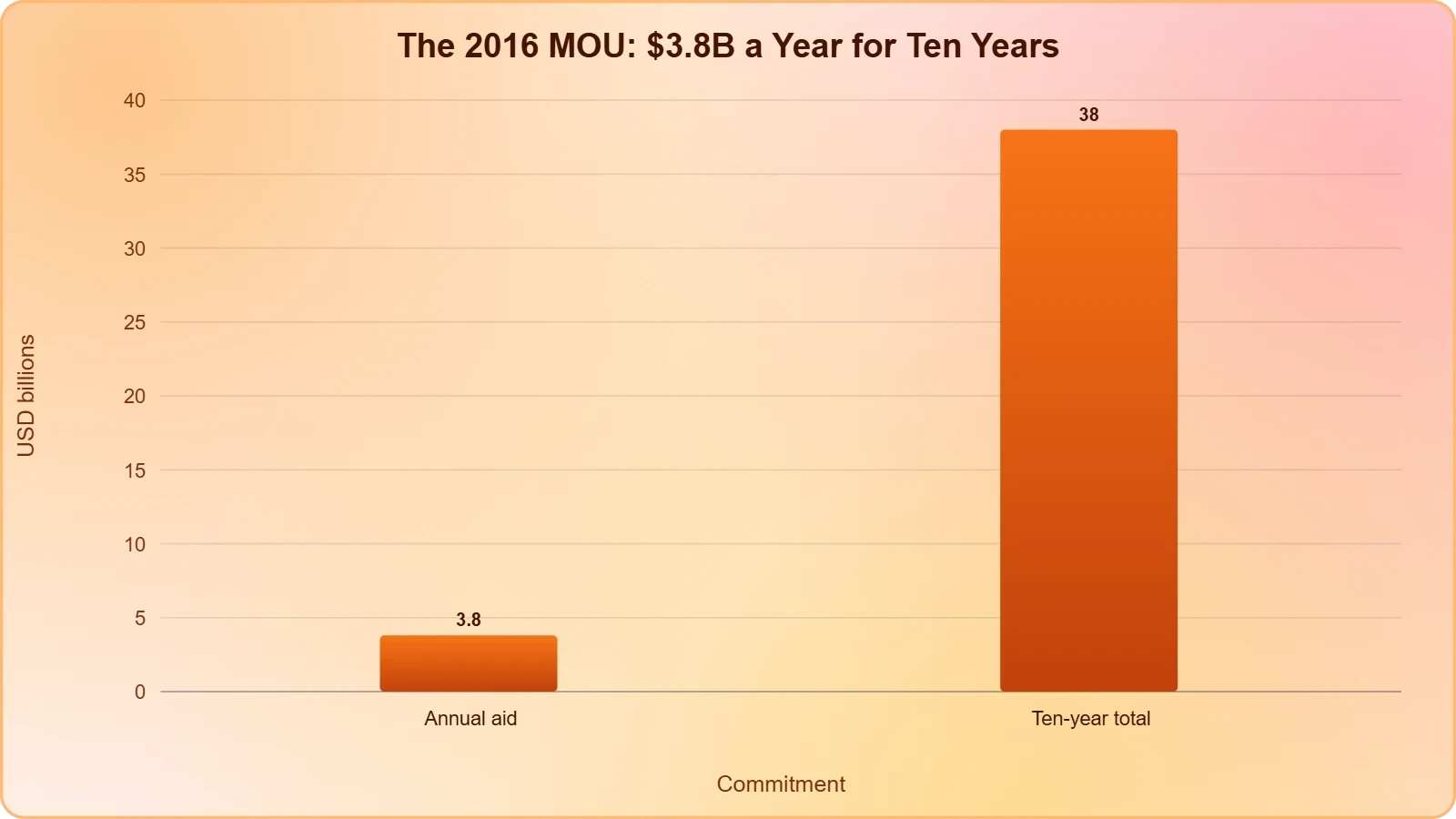
The modern structure of that support crystallized in the 2016 Memorandum of Understanding, signed under President Obama, which committed the United States to roughly $3.8 billion annually over ten years beginning in 2019. The agreement represented a deliberate shift toward military financing over economic aid, reflecting Israel's status as a high-income economy and the priority placed on qualitative military edge. Under its terms, Israel received funds to procure American weapons systems, a arrangement that simultaneously bolstered Israeli defense capacity and American defense industrial interests. The memorandum was designed to provide predictability, insulating the relationship from annual congressional appropriations battles.
The 2016 Memorandum and Its Terms
The ten-year framework signed in September 2016 was notable for what it changed as much as for what it preserved. It phased out the practice of allowing Israel to convert a portion of military aid into shekels for domestic defense procurement, a concession that had effectively subsidized Israeli industry. In exchange, the total package increased modestly over the prior arrangement. The memorandum also included dedicated funding for missile defense programs that had previously been appropriated separately, folding them into the baseline figure. This consolidation gave Israel greater certainty but also made the entire package vulnerable to a single political decision at the presidential level.
Critically, the agreement was never a treaty obligation. It was an executive-branch commitment, renewable by successor administrations but not legally binding in the way a ratified treaty would be. That structural feature explains how a president could announce its termination unilaterally, subject only to congressional pushback and the practical mechanics of existing contracts. The memorandum's non-binding character has long been a point of quiet anxiety among Israeli planners, who understood that American commitments endure only as long as the political coalition sustaining them. The current announcement validates that anxiety in the most direct way possible.
Cumulative Aid and Strategic Rationale
The historical rationale for assistance has combined moral commitment following the Holocaust, Cold War containment strategy, and a shared-values narrative that anchored bipartisan support for decades. Successive administrations argued that a strong Israel served American interests by deterring adversaries, stabilizing a volatile region, and providing intelligence and technological cooperation. That rationale produced extraordinary legislative durability: aid packages passed with overwhelming margins, and criticism of the relationship remained confined to the political margins for most of the post-1948 era. The consensus was so robust that even presidents who privately chafed at the arrangement publicly reaffirmed it.
Yet the cumulative figure of more than $300 billion invites scrutiny of returns and burden-sharing, a frame that gained traction as American fiscal constraints tightened and as domestic constituencies questioned foreign commitments. Analysts have long noted that military financing functions partly as a subsidy for American defense contractors, since recipient nations must spend the funds on US-produced equipment. That circularity complicates simple narratives of generosity. The debate over whether assistance buys influence, enables autonomy, or merely sustains an entrenched arrangement has become increasingly pointed, and the current decision draws directly on that contested terrain.
The Announcement and Its Immediate Political Context
The decision surfaced through a televised interview rather than a formal diplomatic communique, a delivery method that itself carried meaning. Speaking on Fox and Friends, Trump characterized the termination as mutually agreed with Netanyahu and asserted that Israel was "fine" with the arrangement, while promising American help if circumstances demanded it. The informal channel and the president's framing emphasized personal diplomacy over institutional process, suggesting that the decision emerged from leader-to-leader conversation rather than interagency review. For a relationship managed for decades through structured memoranda and congressional notification, the shift in method was as notable as the substance.
Timing amplified the political charge. The announcement landed on the day of midterm elections, and Trump explicitly referenced domestic political dynamics in explaining his reasoning. He pointed to criticism from Abdul El-Sayed, a leftist Democratic candidate for the US Senate who had harnessed anti-Israel sentiment in his campaign, and asked why the United States should absorb criticism from such quarters when Israel purportedly no longer required the support. That rhetorical move fused foreign assistance with domestic culture-war politics, framing the aid not as strategic investment but as a political liability to be shed. The logic signals a transactional doctrine in which alliances are continuously re-priced against electoral costs.
Netanyahu's Stated Goal of Military Autonomy
The Israeli prime minister's public statements provide essential context for interpreting the announcement. In June, Netanyahu called for greater military autonomy and expressed hope of achieving it within a decade. In May, he told CBS that he wanted American support to reach "zero." These declarations were not new heterodoxies but the culmination of a long-running Israeli aspiration to reduce dependence on a patron whose politics could shift unpredictably. Netanyahu has argued that a prosperous, technologically advanced Israel should shoulder more of its own defense burden, a position that resonates with sovereignty-focused constituencies at home and with burden-sharing advocates abroad.
Yet the gap between aspiration and capability remains substantial. Israel's qualitative military edge depends heavily on American platforms, munitions, and co-development programs, and the transition to full autonomy would require sustained increases in domestic defense spending that carry fiscal and social costs. Netanyahu's ten-year horizon implicitly acknowledged that the shift cannot be immediate. The announcement therefore places Israel in an awkward intermediate zone: publicly committed to eventual self-reliance, but operationally still reliant on the very assistance now being withdrawn. Managing that transition without degrading deterrence is the central strategic challenge the decision creates.
Opposition Criticism and Institutional Trust
Israeli opposition figure Gadi Eisenkot, a former military chief, offered the sharpest domestic rebuttal, arguing that the decision demonstrated Netanyahu must go. His criticism focused less on the merits of autonomy than on process and trust: he described it as dangerous that Israel's defense establishment reportedly learned of a change in the strategic relationship through the media at the same time as the general public. That complaint strikes at a core principle of alliance management, namely that defense planners require advance notice and structured consultation to adjust procurement, deployment, and contingency planning. Learning of a foundational change from television undermines the very institutional coordination that security relationships exist to provide.
Eisenkot's framing also converted the episode into a domestic political weapon, casting the prime minister as either unable or unwilling to protect Israeli interests within the relationship. Whether or not that characterization is fair, it illustrates how foreign policy decisions become entangled with coalition politics and leadership credibility. For observers of Israeli politics, the reaction signals that the aid question will remain contested terrain, with opponents arguing that autonomy achieved through abrupt rupture is recklessness rather than sovereignty. The debate over means, not ends, will likely define the next phase of Israeli discussion.
We Also Published
Domestic Politics and the Midterm Connection
The explicit linkage between the aid decision and American electoral politics deserves careful examination, because it reveals a doctrine in which foreign commitments are evaluated against their domestic political price. Trump's reference to El-Sayed was not incidental; it identified a specific political current, namely left-leaning Democratic candidates who have channeled discontent with Israel into electoral energy. By naming that current, the president positioned the aid cut as a response to domestic critics, arguing that the United States should not sustain criticism from adversaries while continuing to underwrite a partner's defense. The framing converts a strategic question into a question of political reciprocity.
This transactional lens has precedents in burden-sharing debates over NATO, where successive administrations pressed allies to increase defense spending by invoking the costs borne by American taxpayers. The Israel decision extends that logic to a relationship long treated as exceptional and insulated from cost-benefit scrutiny. Whether the framing persuades voters is an empirical question, but its doctrinal significance is clear: alliance maintenance now requires continuous justification in domestic political terms, and leaders may find it advantageous to demonstrate willingness to cut commitments rather than defend them. That shift has implications for every partner that relies on American security guarantees.
Burden-Sharing Doctrine in Practice
Burden-sharing arguments rest on the premise that alliances should distribute costs proportionally to capacity and benefit. Applied to Israel, the argument notes that the country is now a high-income economy with a sophisticated defense industry, capable in principle of assuming more of its own security costs. Advocates of reduction point to Israel's technological prowess and export success as evidence that continued subsidy is anachronistic. Critics counter that qualitative military edge is not merely a function of wealth but of interoperability, shared intelligence, and the deterrent signal that American commitment sends to adversaries. Both positions contain truth, which is why the debate resists easy resolution.
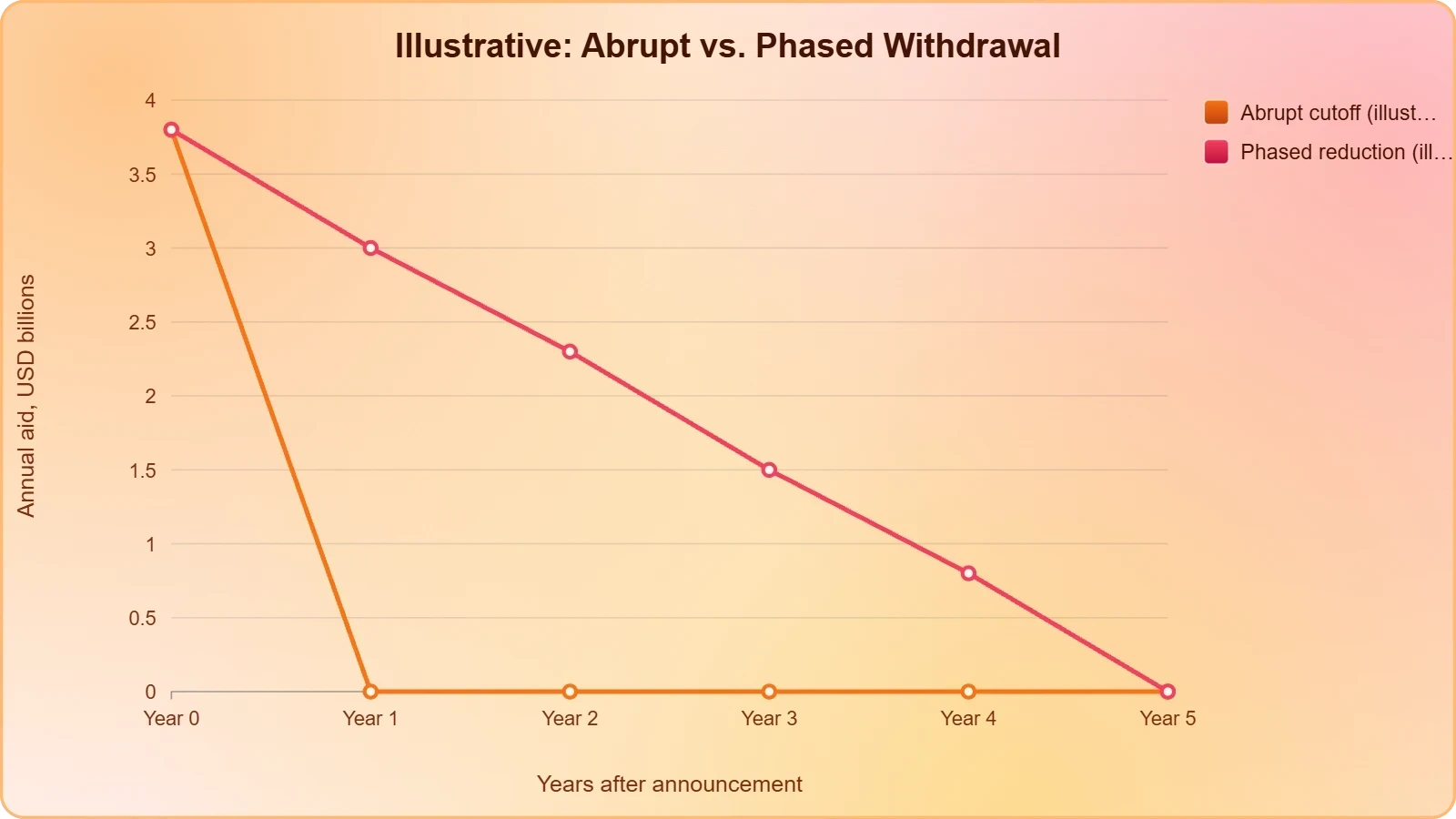
The practical mechanics of withdrawal matter enormously. Military financing operates through multi-year procurement contracts, so an immediate cessation would strand orders and disrupt supply chains. A phased reduction, by contrast, would allow both governments to adjust planning horizons. The announcement's reference to continued help "if needed" suggests an implicit safety net, preserving a residual commitment while ending the formal framework. That ambiguity may be deliberate, providing political cover for a decision whose operational consequences will unfold over years rather than months. Analysts will watch appropriations legislation closely for signals about the actual pace of change.
Electoral Incentives and Alliance Credibility
Alliances function on credibility, and credibility depends on the expectation that commitments survive changes in domestic politics. When a leader explicitly ties a commitment's termination to electoral grievances, allies everywhere recalibrate their assumptions about durability. The signal extends beyond Israel: partners in Europe, Asia, and the Middle East will ask whether their own arrangements are similarly contingent on the political mood of a single election cycle. That uncertainty carries strategic costs, encouraging hedging, accelerating indigenous capability development, and potentially reducing the influence that assistance was designed to purchase. The long-term effect may be a more fragmented security landscape in which partners diversify suppliers and patrons.
Domestic electoral incentives, meanwhile, are not uniform. Support for Israel has historically been bipartisan, and any perception of abandoning a partner can mobilize countervailing constituencies. The decision therefore carries risk for the president's coalition as well as potential reward among voters skeptical of foreign aid. The net political effect will depend on how the announcement is received by donors, religious constituencies, defense industry stakeholders, and swing voters. Because the decision was announced during midterm voting, its electoral consequences will be measured almost immediately, making it a live experiment in the politics of alliance retrenchment.
- 01
- 02
- 03
- 04
Strategic Consequences for Israel's Defense Posture
Israel's defense planning rests on assumptions about resupply, munitions availability, and intelligence cooperation that the assistance framework helped guarantee. Removing the formal commitment does not instantly eliminate those benefits, but it introduces uncertainty into calculations that military planners prefer to keep stable. The most immediate concern involves precision-guided munitions and interceptor stocks, categories where American co-production and financing have been central. Over the medium term, Israel would need to expand domestic production lines, accelerate indigenous programs, and diversify suppliers, each of which requires capital and time that the ten-year horizon may not comfortably accommodate.
The strategic environment compounds the challenge. Israel faces threats from multiple directions, including Iranian nuclear ambitions, proxy networks, and rocket arsenals that demand layered missile defense. Deterrence depends not only on capability but on the perception of resolute backing, and adversaries may read an aid cut as a signal of reduced American commitment. That perception risk is precisely what critics of the decision emphasize. Supporters counter that Israel's demonstrated military effectiveness and technological sophistication provide sufficient deterrence independent of American financing, and that autonomy removes a vulnerability to political pressure from Washington.
Military Autonomy and Industrial Capacity
Autonomy is easier declared than achieved. Israel's defense industrial base is formidable, exporting systems worldwide and pioneering technologies in drones, missile defense, and cyber. Yet even robust industries depend on American components, engines, and munitions that are difficult to substitute quickly. Full autonomy would require sustained investment in domestic production capacity, potentially at the expense of other budget priorities, and would take years to mature. Netanyahu's ten-year timeline implicitly acknowledged this constraint. The announcement accelerates the timeline without necessarily providing the resources, creating a gap that Israeli planners must bridge through improvisation, prioritization, and possibly increased domestic taxation or borrowing.
There is also a qualitative dimension. American assistance has historically included not only hardware but access to technology, joint development, and intelligence sharing that no amount of domestic spending can fully replicate. Autonomy in the strict sense may be unattainable for a country of Israel's size, and the realistic goal is diversification rather than independence. European suppliers, domestic innovation, and expanded co-production arrangements could partially fill the gap, but each alternative carries political conditions and interoperability costs. The strategic question is whether reduced dependence on Washington increases or decreases Israeli freedom of action, and the answer likely varies by scenario.
Regional Deterrence and Signaling
Deterrence is fundamentally psychological, and the announcement sends multiple signals simultaneously. To adversaries, it may suggest reduced American backing; to partners, it may suggest that Israel is assuming greater responsibility; to domestic audiences in both countries, it may signal a new era of transactional alliance management. The net effect on regional stability is genuinely uncertain. A more self-reliant Israel could act with greater freedom, potentially increasing risk-taking, or it could become more cautious as it conserves diminished resources. Much depends on how the transition is managed and whether the residual American commitment remains credible.
Neighboring states and non-state actors will interpret the decision through their own strategic lenses. Iran may see opportunity; Gulf partners may see a reason to deepen their own American ties or to hedge; European allies may see confirmation that Washington's commitments are unreliable. The announcement thus functions as a stress test for the broader American alliance system, revealing how quickly perceptions can shift when a single decision is framed as political rather than strategic. Managing those perceptions will require careful diplomacy, and the promise of help "if needed" will be scrutinized for credibility.
Alliance Management in an Era of Transactional Politics
The deeper significance of this episode lies in what it reveals about the changing grammar of American alliance management. For decades, security commitments were justified through a vocabulary of shared values, strategic necessity, and institutional continuity. The current announcement substitutes a vocabulary of cost, reciprocity, and domestic political grievance. That substitution is not merely rhetorical; it changes the incentives facing allies and adversaries alike. Allies learn that commitments must be continuously defended in domestic political terms, while adversaries learn that American resolve may fluctuate with electoral cycles. The result is a more volatile strategic environment in which predictability itself becomes scarce.
This shift is not unique to one relationship or one administration. Debates over NATO spending, trade arrangements, and troop deployments have all moved toward transactional framing, reflecting deeper changes in domestic politics across Western democracies. Voters increasingly ask what alliances deliver in concrete terms, and leaders respond by emphasizing burden-sharing and reciprocity. The Israel decision is a particularly vivid instance of this broader trend, because the relationship had long been treated as exceptional and insulated from such calculations. Its exposure to transactional logic signals that no commitment is now exempt from re-pricing.
Implications for Other Security Partners
Partners watching from Europe, Asia, and the Middle East will draw lessons that may not align with American intentions. Some may conclude that they should accelerate defense spending and reduce dependence, which is precisely what burden-sharing advocates desire. Others may conclude that they should hedge by diversifying suppliers and diplomatic relationships, which could erode American influence. Still others may seek to strengthen their domestic political connections in Washington to insulate their arrangements from future shocks. The aggregate effect is likely a more complex, multi-polar security landscape in which American leadership is one variable among several rather than the organizing principle.
For Israel specifically, the lesson may be that autonomy, however desirable in principle, requires careful sequencing. Abrupt changes in foundational arrangements create uncertainty that can undermine the very capabilities autonomy is meant to protect. A phased approach, with clear benchmarks and consultation, would better serve both partners' interests. Whether such an approach emerges from the current announcement depends on follow-on diplomacy that has not yet been described. The gap between announcement and implementation is where the real policy will be made, and that gap is currently wide.
Credibility, Trust, and the Future of Commitments
Credibility is the currency of international politics, and it is spent whenever commitments are revised without consultation. The reported failure to give Israel's defense establishment advance notice, if accurate, represents a withdrawal from the account of trust that cannot be easily replenished. Even allies sympathetic to burden-sharing will note the method and adjust their expectations accordingly. Rebuilding confidence would require structured consultation, transparent timelines, and consistent follow-through, all of which are difficult in a political environment that rewards dramatic gestures over quiet reliability. The episode thus illustrates a tension between domestic political incentives and international credibility that will define alliance management for years.
Ultimately, the meaning of this decision extends beyond the $3.8 billion figure or the specific terms of a memorandum. It concerns how a superpower defines its commitments, how a partner navigates dependence and autonomy, and how domestic politics intrudes on strategic relationships. The answers will shape not only US-Israel relations but the broader architecture of American alliances. Observers should watch for congressional responses, Israeli budget adjustments, and signals from other partners, because those reactions will determine whether this announcement marks a temporary adjustment or a durable reorientation. The stakes are structural, and the outcome remains genuinely open.
Reading the Decision Through Numbers and Doctrine
Quantitative context sharpens the analysis. The $3.8 billion annual figure represents a small fraction of total American federal spending but a significant share of Israel's defense budget, and its multiplier effects on procurement and industrial cooperation are larger than the raw number suggests. Cumulative assistance exceeding $300 billion over seven decades illustrates the depth of the relationship, while the ten-year memorandum's structure shows how predictability was institutionalized. These figures frame the debate, but they do not resolve it, because the value of assistance depends on strategic effects that resist simple accounting. Numbers illuminate the scale of the change without settling its wisdom.
Doctrine matters equally. The decision reflects a transactional doctrine that evaluates commitments against domestic political costs and reciprocal benefits. That doctrine has coherence, but it also carries risks, particularly when applied to relationships built on deterrence and credibility. A purely transactional approach may secure short-term savings while eroding long-term influence, and it may encourage partners to hedge in ways that complicate American strategy. The tension between transactional efficiency and strategic durability is the central doctrinal question this episode raises, and it will not be resolved by a single decision. It will be tested across multiple relationships over many years.
What to Watch Next
Several indicators will reveal how the announcement translates into policy. Congressional appropriations legislation will show whether lawmakers preserve any assistance streams. Israeli budget documents will reveal the pace of domestic defense investment. Statements from Gulf and European partners will indicate whether they interpret the decision as a signal about their own arrangements. And follow-on diplomacy between Washington and Jerusalem will clarify whether the termination is absolute or conditional. Each indicator provides a data point for assessing whether this is a tactical gesture or a structural reorientation, and together they will define the trajectory of the relationship.
The broader lesson concerns the fragility of arrangements that depend on political consensus rather than legal obligation. The 2016 memorandum was never a treaty, and its durability depended on sustained bipartisan support that has now visibly frayed. Partners who wish to insulate their relationships from political volatility may seek more formal instruments, but formalization carries its own costs and constraints. The dilemma is structural: informal commitments are flexible but fragile, while formal ones are durable but rigid. Navigating that trade-off is the enduring challenge of alliance management, and this episode illustrates it with unusual clarity.
From our network :
- Mobile Learning and VR in English: What Global Evidence Reveals About Effective Language TechnologyA systematic review across 14 countries reveals which language-learning technologies genuinely work. Mobile learning, AI, and VR show measurable benefits when pedagogically integrated. This evidence-based guide helps educators and learners select technology that delivers real return on investment.
- CISA’s Ten-Advisory Wave: Why Generic Patching Fails in OT and How to Build Product-Specific PlaybooksCISA released ten ICS advisories in one week, exposing critical infrastructure risks. Generic patching fails in OT. Learn to build product-specific remediation playbooks.
- Forbidden Matrix Patterns and Visible Lattice Points: A Geometric DictionaryExplore how multidimensional 0–1 matrices encode geometric truths, linking forbidden patterns to visible lattice points and hypergraph theory, with applications in combinatorics and computational geometry.
- University Language Proficiency Exams: Why Institutional Tests Demand Different Preparation Than IELTS and TOEFLDiscover why university-specific language proficiency examinations differ fundamentally from IELTS and TOEFL, and learn strategic preparation approaches for institutional assessment success.
- Live Online English Classes for Kids: Do They Actually Reduce Anxiety?A ten-week study reveals that synchronous online English classes can significantly reduce child language anxiety while improving listening and reading skills. Discover what makes these programs effective and how parents can select the right one.
- The Final Descent: How ESA Retired the Legendary Cluster Constellation After 24 Years of Space Weather ScienceAfter 24 years mapping Earth’s magnetosphere, ESA’s Cluster mission concluded with a precisely controlled reentry over the South Pacific. This analysis explores the scientific legacy, engineering decisions, and debris mitigation principles behind one of space exploration’s most responsible retirements.
- The Hidden Cost of AI Convenience: Why Over-Permissioned Agents Are a Security Time BombDiscover why AI agents with excessive permissions create dangerous single points of failure, and learn how implementing least privilege principles can protect your organization from exploitation.
- How AI Agents Will Change the Way We Manage Personal FinancesExplore how AI agents are transforming personal finance through automated budgeting, bill payment, and investment management, while examining the critical security protocols and governance frameworks required for safe deployment.
- Committed Mediterranean Precipitation Decline: Why Emissions Cuts Alone Cannot Restore Winter RainsNew NOAA research reveals that Mediterranean winter rains may decline irreversibly even with emissions cuts. Explore the science of committed climate change and regional impacts.
RESOURCES
- Resources will be updated soon.
- 01
- 02
- 03
- 04
- 05
- 06
- 07
- 08
0 Comments