When a Union Minister announces that welfare money will henceforth be routed through voter identity cards rather than Aadhaar, the statement travels far beyond a routine administrative tweak. It touches the two most consequential databases in Indian public life: the electoral roll, which determines who holds political power, and the Aadhaar ecosystem, which determines who receives state benefits. Rajiv Ranjan Singh, the Union Panchayati Raj Minister, chose Sikkim's capital Gangtok as the venue for this declaration, having first floated the idea at a ministry workshop in Delhi. The timing and the framing suggest a deliberate policy signal rather than an offhand remark.
The proposal envisions beneficiaries presenting their Elector Photo Identity Card (EPIC) number alongside biometric authentication before receiving funds under ministry schemes. Singh's stated rationale is that Aadhaar is comparatively easy to obtain, which in his assessment opens space for ineligible claimants to slip into welfare rolls. A voter ID paired with biometrics, he argues, would tighten verification, purge fraudulent entries, and improve transparency in how schemes reach the intended population. The Sixteenth Finance Commission's recommendation of ₹4,35,236 crore in grants for 2.55 lakh panchayats and traditional local bodies over 2026-31 provides the financial backdrop against which this identification debate is unfolding.
What makes the announcement politically charged is its collision with an ongoing opposition campaign alleging wrongful deletions from electoral rolls. By proposing the voter ID as the gateway to welfare, the government simultaneously elevates the electoral roll's importance and invites scrutiny of its accuracy. This analysis examines the minister's reasoning, the institutional mechanics of EPIC-based verification, the fiscal scale involved, the legal and federal tensions it raises, and what the shift could mean for beneficiaries, panchayats, and the credibility of India's welfare architecture.
On This Page
- The Minister's Announcement and Its Immediate Context
- The Logic Behind Preferring Voter IDs Over Aadhaar
- Fiscal Scale and the Panchayati Raj Delivery Machinery
- Legal Authority, Data Linkage, and Federal Questions
- Risks for Beneficiaries and the Integrity of Welfare Delivery
- Comparative Perspective and the Road Ahead
- Reading the Signal: Politics, Policy, and Public Trust
TL;DR Union Panchayati Raj Minister Rajiv Ranjan Singh has indicated that welfare payments under his ministry will be linked to voter identity cards (EPIC) with biometric authentication instead of Aadhaar, arguing that Aadhaar's accessibility makes it vulnerable to fraudulent claims. The shift would make the electoral roll a welfare gatekeeping instrument, arriving alongside opposition allegations of wrongful voter deletions and a Finance Commission grant package of ₹4,35,236 crore for local bodies across 2026-31. The proposal raises questions about legal authority, data linkage, federal consultation, and the risk that citizens omitted from electoral rolls could lose access to benefits they currently receive.
The Minister's Announcement and Its Immediate Context
The announcement emerged in two stages, which itself is instructive. Singh first raised the idea at a ministry workshop in Delhi on a Friday, then repeated and elaborated on it before media in Gangtok the following Tuesday. This pattern of internal ventilation followed by public articulation suggests a policy direction being tested rather than a finalized reform with notified rules. No gazette notification, operational guideline, or inter-ministerial consultation has been cited, which means the statement currently functions as declared intent, not enforceable policy.
What Exactly Was Said, and What Was Not
According to the minister, Aadhaar presently serves as the identification instrument for beneficiaries under his ministry's schemes, and this will change. Beneficiaries would instead furnish their EPIC number and undergo biometric verification to claim government benefits. Singh's justification rests on a comparative judgment about document integrity: Aadhaar, in his characterization, is easy to obtain, whereas a voter ID tied to biometrics offers a firmer check. Notably absent from the public remarks were details on which specific schemes are covered, how existing Aadhaar-linked bank accounts and Direct Benefit Transfer rails would be reconciled, and what transition period beneficiaries would receive.
The Political Backdrop of Electoral Roll Controversy
The remarks landed amid an opposition campaign alleging wrongful deletions from electoral rolls, a dispute that has periodically convulsed Indian politics. Elevating the voter ID to welfare gateway status intensifies the stakes of that dispute considerably. If electoral roll inclusion becomes a precondition for benefits, then administrative errors in roll maintenance cease to be mere electoral inconveniences and become livelihood threats. Critics will inevitably ask whether a document whose accuracy is actively contested should be entrusted with determining welfare eligibility, particularly when the government proposing the change is also the custodian of the roll.
The Logic Behind Preferring Voter IDs Over Aadhaar
The minister's core argument deserves careful parsing because it inverts a decade of policy orthodoxy. Successive governments have treated Aadhaar as the gold standard for beneficiary identification precisely because of its near-universal reach and biometric de-duplication. Singh's contention is different: he frames Aadhaar's accessibility as a liability rather than an asset. If obtaining an Aadhaar number is straightforward, the reasoning goes, then the barrier to entry for a fraudulent claimant is correspondingly low, and the document loses its filtering power. Whether this premise holds empirically is a question the announcement leaves unanswered.
Fraud Prevention as the Stated Objective
Singh explicitly linked the shift to three goals: ensuring welfare schemes reach only eligible people, removing fraudulent entries from beneficiary lists, and improving verification and transparency. These are legitimate administrative ambitions, and any government is entitled to pursue them. The analytical difficulty is that the same objectives have historically been cited to justify Aadhaar-based de-duplication, which suggests the debate is less about ends than about which database is trusted to deliver them. Fraud prevention is a universal aspiration; the choice of instrument is where the controversy resides.
Assessing the "Easy to Obtain" Premise
The claim that Aadhaar is easy to obtain carries an implicit comparison that the minister did not fully spell out. Voter registration, too, is a routine administrative process, and enrolment drives are a familiar feature of Indian electoral life. If accessibility is the criterion for suspicion, the distinction between the two documents becomes less obvious than the announcement implies. A more rigorous framing would examine specific fraud typologies, the evidentiary record of each database, and the actual incidence of ineligible claims, none of which featured in the public remarks.
Fiscal Scale and the Panchayati Raj Delivery Machinery
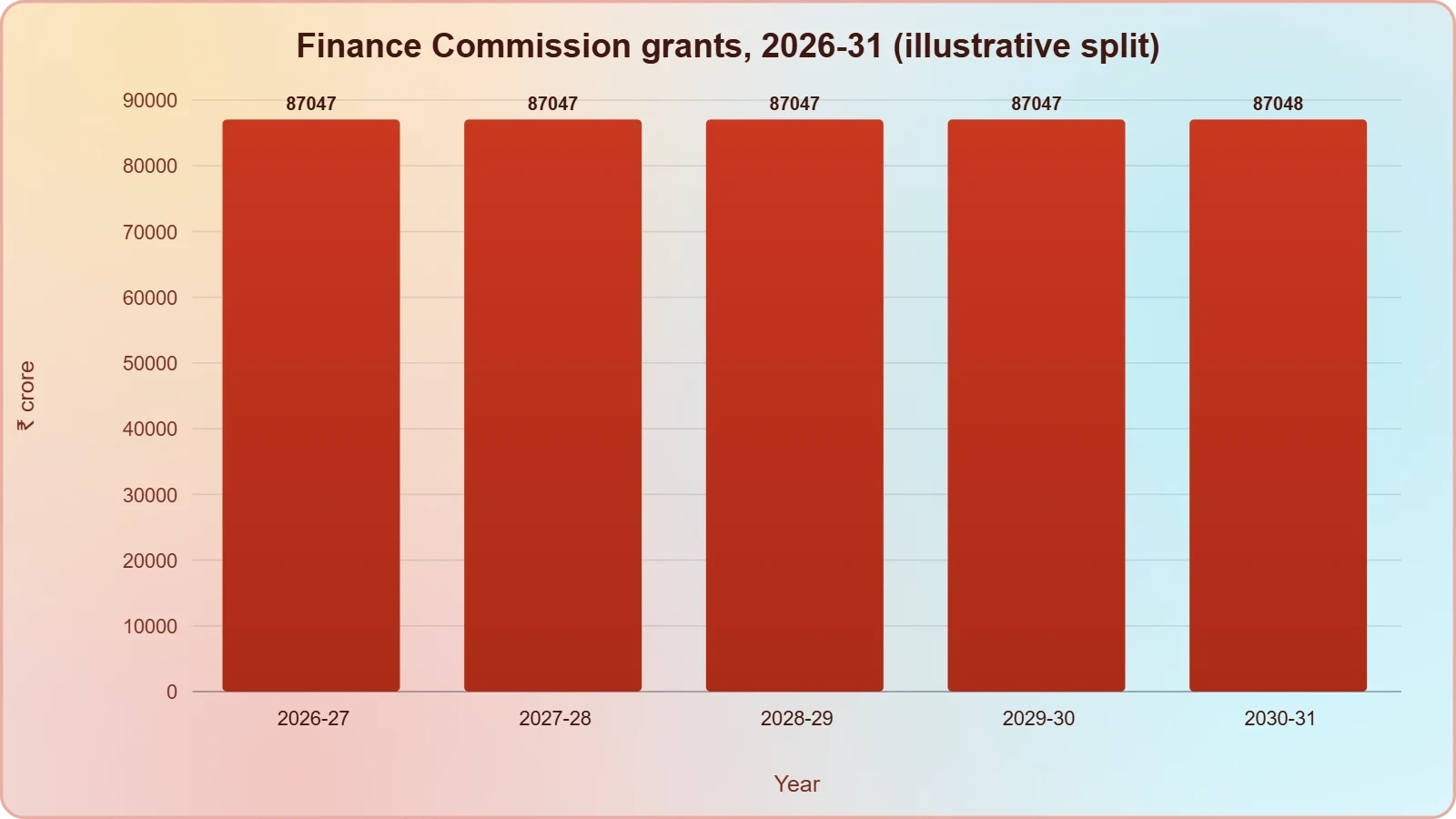
The identification debate acquires concrete weight when set against the money involved. The Sixteenth Finance Commission has recommended grants totaling ₹4,35,236 crore for 2.55 lakh panchayats and traditional local bodies across the 2026-31 period. That is a substantial transfer of public resources to the grassroots tier of governance, and every rupee of it must be matched to a verified beneficiary. The choice of identification instrument therefore determines not merely administrative convenience but the integrity of one of India's largest decentralized fiscal flows.
How Panchayats Actually Disburse Benefits
Panchayati Raj institutions operate at the intersection of scheme design and last-mile delivery. Funds flow from the Finance Commission grants into gram panchayat accounts, and from there into wages, infrastructure payments, and individual entitlements. Verification at the point of disbursement depends on documents that local officials can check and authenticate. Introducing EPIC-based biometric verification would require panchayat functionaries to access electoral roll data and biometric infrastructure, a capacity question that the announcement did not address but which will determine whether the reform is workable in practice.
The Finance Commission Grant Architecture
The recommended grants are earmarked for local bodies over a five-year horizon, which means the identification rules adopted now will govern an entire fiscal cycle. Any transition from Aadhaar to EPIC must therefore be sequenced carefully to avoid disrupting payments mid-stream. A poorly managed switch could leave beneficiaries without funds while databases are reconciled, a risk that grows with the size of the transfer. The fiscal magnitude argues for phased implementation, statutory clarity, and consultation with states before any operational change is notified.
Legal Authority, Data Linkage, and Federal Questions
Beneath the administrative argument lies a constitutional question that the announcement did not confront. Aadhaar-based welfare delivery rests on a statutory framework, the Aadhaar Act of 2016, which defines permissible uses and authentication procedures. The electoral roll, by contrast, is governed by the Representation of the People Act, 1950, and administered by the Election Commission. Repurposing EPIC as a welfare verification instrument would require legal grounding that currently does not exist, and would raise fresh questions about the separation between electoral administration and benefit delivery.
Statutory Gaps and the Aadhaar Act Framework
The Aadhaar architecture was built through legislation, litigation, and years of operational refinement. Its use for subsidy delivery has been tested in court and codified in rules. No comparable framework authorizes the use of voter IDs for welfare authentication. A minister's public statement cannot substitute for statutory authority, and any operational shift would need either new legislation or amendments to existing welfare scheme guidelines. Until such instruments appear, the proposal remains a policy direction awaiting legal form, and beneficiaries cannot be asked to comply with rules that lack a notified basis.
Federal Consultation and State Sensitivities
Panchayati Raj is a subject where the Union and states share responsibility, and welfare delivery involves state machinery at every stage. Unilateral changes to identification requirements would ripple through state budgets, local official workloads, and beneficiary expectations. States already managing contested electoral roll revisions would face compounded administrative pressure. Meaningful reform in this space requires consultation through inter-governmental channels, clear transition timelines, and sensitivity to the fact that different states maintain electoral data with varying degrees of accuracy and digitization.
- 01
- 02
- 03
- 04
Risks for Beneficiaries and the Integrity of Welfare Delivery
The most consequential question is what happens to a citizen who is eligible for welfare but absent from the electoral roll. India's electoral roll, while extensive, is not perfectly coextensive with the adult population. Migrant workers, the elderly, persons with disabilities, and residents of remote areas may lack current registration. Under an Aadhaar-based system, such individuals could still establish identity; under an EPIC-based system, their exclusion from the roll would translate directly into exclusion from benefits, a compounding of administrative disadvantage that the announcement did not address.
Exclusion Risk and the Deletion Controversy
The opposition's allegations of wrongful electoral deletions sharpen this concern considerably. If roll maintenance has been imperfect, and if deletions have occurred erroneously, then tying welfare to roll inclusion converts those errors into denial of livelihood support. The minister's stated goal of removing fraudulent entries is legitimate, but the mechanism must distinguish fraud from error. A verification system that cannot reliably tell the difference risks penalizing the very citizens that welfare schemes exist to protect, and the political controversy surrounding deletions makes public confidence harder to secure.
Data Privacy and Cross-Database Linkage
Linking electoral data with biometric authentication for welfare purposes creates a new data relationship between two sensitive repositories. India's developing privacy jurisprudence, shaped by the Puttaswamy judgment, counsels purpose limitation and data minimization. Combining voter records with benefit disbursement systems expands the state's informational footprint and creates incentives for further linkage. Any such architecture would need a clear privacy impact assessment, defined access controls, and safeguards against function creep, none of which have been articulated in the public discussion so far.
We Also Published
Comparative Perspective and the Road Ahead
India's welfare identification history offers a useful comparative lens. The shift from ration cards to Aadhaar-linked public distribution was justified on fraud-prevention grounds and produced measurable savings alongside documented exclusion errors. Each transition in identification technology has redistributed risk between the state and the citizen, and each has required years of adjustment. The EPIC proposal belongs to this lineage, and the lessons of prior transitions suggest that the design of grievance mechanisms matters as much as the choice of document.
Lessons From Previous Identification Transitions
Earlier reforms demonstrate that verification systems fail at the margins, where documentation is thinnest and citizens are least equipped to navigate appeals. Successful transitions paired new requirements with enrollment drives, grace periods, and accessible redress. A shift to EPIC-based welfare would need comparable safeguards, including provisions for citizens whose electoral registration is pending or disputed. Without such measures, the reform's fraud-prevention gains could be offset by exclusion costs that fall hardest on the poorest and least documented beneficiaries.
What a Credible Implementation Pathway Looks Like
A workable pathway would begin with statutory clarification, followed by pilot implementation in selected panchayats, independent evaluation of exclusion and fraud outcomes, and phased national rollout. Inter-ministerial and state consultation would need to precede notification, and data protection safeguards would require articulation before any cross-database linkage. The minister's announcement has opened a necessary debate about identification integrity; converting it into sound policy requires the institutional rigor that public statements alone cannot supply.
Reading the Signal: Politics, Policy, and Public Trust
Announcements of this kind perform two functions simultaneously. As policy, they sketch a direction that may or may not mature into notified rules. As politics, they communicate priorities to constituencies and opponents alike. The Panchayati Raj Minister's remarks signal a willingness to reconsider Aadhaar's centrality in welfare delivery, and they do so at a moment when electoral roll integrity is a live political battleground. Understanding the announcement requires holding both readings together rather than treating it as purely technical.
Signaling, Trial Balloons, and Policy Formation
Indian policy formation frequently begins with ministerial statements that test public reaction before formal instruments follow. The two-stage articulation, workshop first and press conference second, fits this pattern. Whether the EPIC proposal advances depends on how stakeholders respond, how legal obstacles are addressed, and whether the political costs of exclusion risk outweigh the fraud-prevention benefits claimed. The absence of operational detail is characteristic of trial balloons, and observers should watch for follow-up notifications rather than treat the statement as settled policy.
Trust as the Ultimate Currency of Welfare Reform
Every identification reform ultimately rests on public trust. Beneficiaries comply with verification requirements when they believe the system is fair, and they resist when they suspect exclusion is the point. The minister's emphasis on transparency is therefore well placed, but transparency must extend to the rules themselves, the appeal mechanisms, and the data practices involved. A welfare system that verifies rigorously and redresses promptly earns legitimacy; one that verifies aggressively and redresses poorly invites the very distrust that the electoral roll controversy has already generated.
From our network :
- The Final Descent: How ESA Retired the Legendary Cluster Constellation After 24 Years of Space Weather ScienceAfter 24 years mapping Earth’s magnetosphere, ESA’s Cluster mission concluded with a precisely controlled reentry over the South Pacific. This analysis explores the scientific legacy, engineering decisions, and debris mitigation principles behind one of space exploration’s most responsible retirements.
- Forbidden Matrix Patterns and Visible Lattice Points: A Geometric DictionaryExplore how multidimensional 0–1 matrices encode geometric truths, linking forbidden patterns to visible lattice points and hypergraph theory, with applications in combinatorics and computational geometry.
- How AI Agents Will Change the Way We Manage Personal FinancesExplore how AI agents are transforming personal finance through automated budgeting, bill payment, and investment management, while examining the critical security protocols and governance frameworks required for safe deployment.
- CISA’s Ten-Advisory Wave: Why Generic Patching Fails in OT and How to Build Product-Specific PlaybooksCISA released ten ICS advisories in one week, exposing critical infrastructure risks. Generic patching fails in OT. Learn to build product-specific remediation playbooks.
- The Hidden Cost of AI Convenience: Why Over-Permissioned Agents Are a Security Time BombDiscover why AI agents with excessive permissions create dangerous single points of failure, and learn how implementing least privilege principles can protect your organization from exploitation.
- Committed Mediterranean Precipitation Decline: Why Emissions Cuts Alone Cannot Restore Winter RainsNew NOAA research reveals that Mediterranean winter rains may decline irreversibly even with emissions cuts. Explore the science of committed climate change and regional impacts.
- University Language Proficiency Exams: Why Institutional Tests Demand Different Preparation Than IELTS and TOEFLDiscover why university-specific language proficiency examinations differ fundamentally from IELTS and TOEFL, and learn strategic preparation approaches for institutional assessment success.
- Mobile Learning and VR in English: What Global Evidence Reveals About Effective Language TechnologyA systematic review across 14 countries reveals which language-learning technologies genuinely work. Mobile learning, AI, and VR show measurable benefits when pedagogically integrated. This evidence-based guide helps educators and learners select technology that delivers real return on investment.
- Live Online English Classes for Kids: Do They Actually Reduce Anxiety?A ten-week study reveals that synchronous online English classes can significantly reduce child language anxiety while improving listening and reading skills. Discover what makes these programs effective and how parents can select the right one.
RESOURCES
- Resources will be updated soon.
- 01
- 02
- 03
- 04
- 05
- 06
- 07
- 08
0 Comments