Prediction markets have quietly evolved from niche gambling venues into quasi-institutional forecasting instruments, and the 2026 US midterms will be the moment that transformation is either validated or severely questioned. Platforms such as Polymarket and Kalshi allow participants to buy and sell contracts tied to discrete real-world outcomes, with contract prices functioning as continuously updating probability estimates. The intellectual appeal is straightforward: instead of asking a sample of voters how they feel, these markets aggregate the collective conviction of people willing to stake real capital on a specific result. That mechanism, advocates argue, distills dispersed information into a single, tradeable number that can outperform traditional polling in speed and responsiveness.
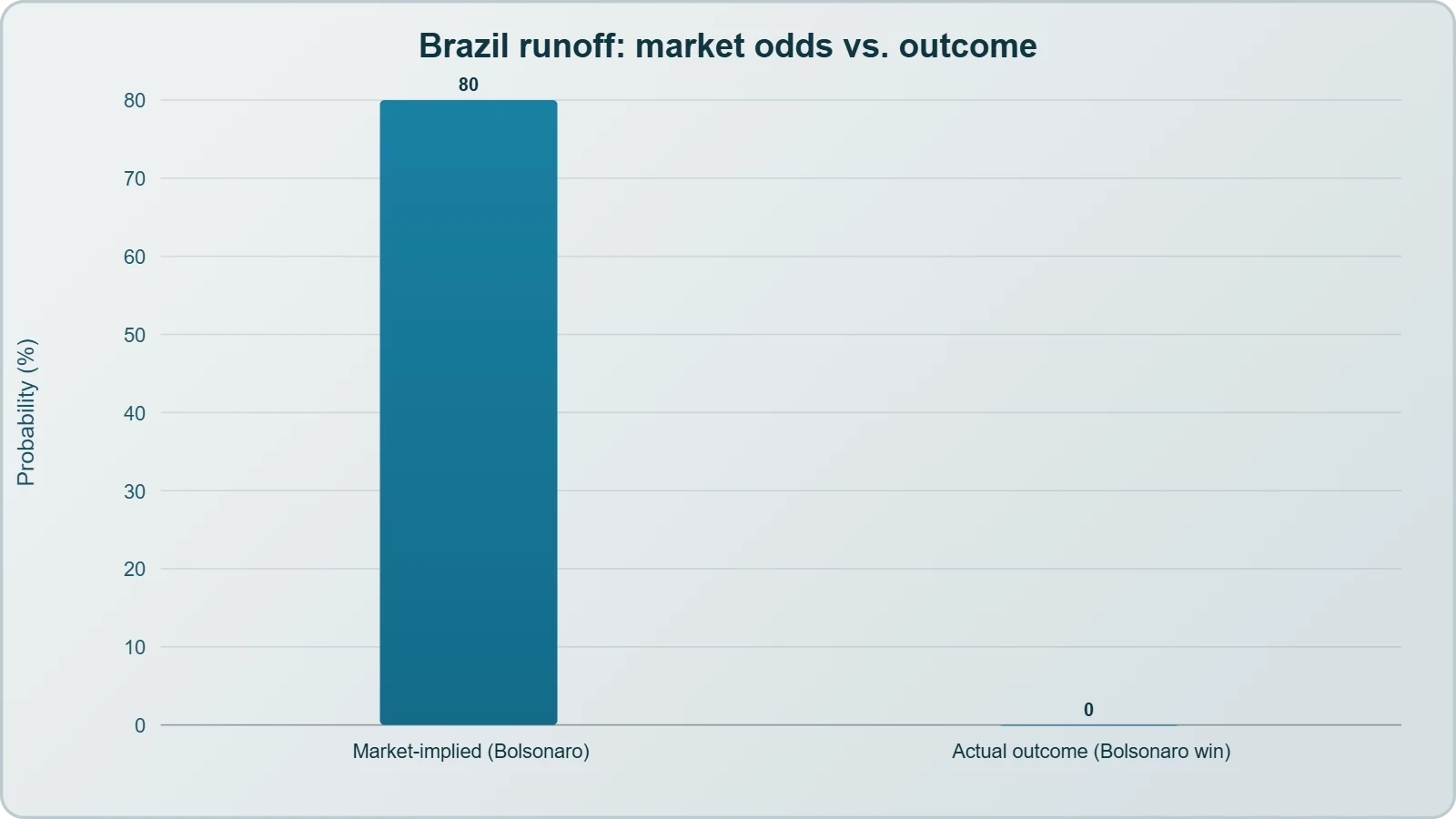
Yet the credibility of that proposition now rests on a fragile foundation. Brazil's 2022 presidential runoff delivered a stark illustration of the gap between market consensus and electoral reality, when Polymarket priced Flavio Bolsonaro near an 80 percent probability of victory on election day, only for Luiz Inacio Lula da Silva to prevail with 51.8 percent of the vote. Similar divergences have surfaced across other high-profile contests, prompting regulators, journalists, and quantitative analysts to ask whether these platforms are genuinely predictive or merely reflective of well-funded sentiment. The distinction matters enormously, because major newsrooms now embed live election odds directly into their coverage, lending market prices an authority that may exceed their demonstrated reliability.
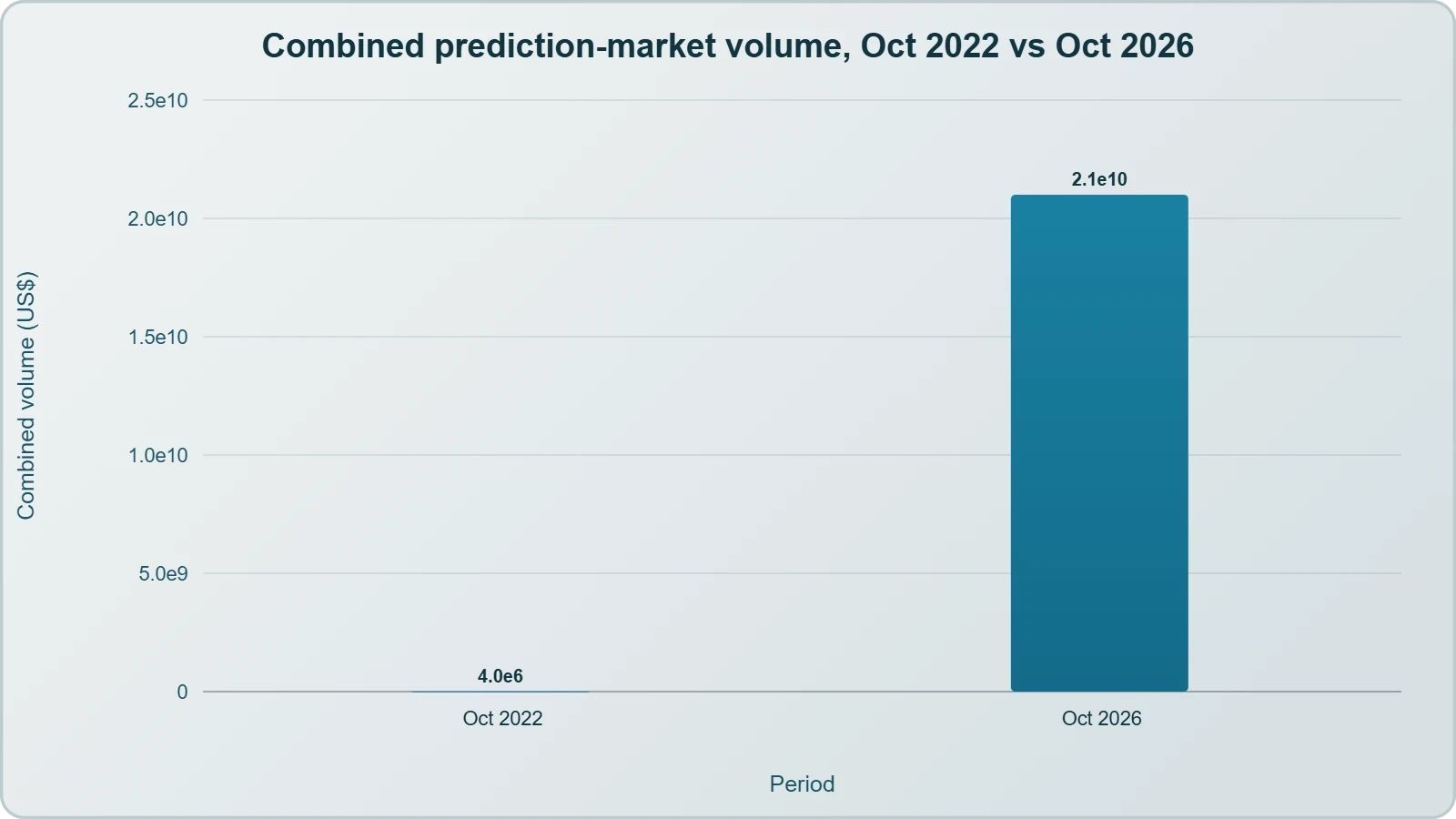
The scale of the shift is difficult to overstate. Combined volume on Polymarket and Kalshi stood at roughly $4 million in October 2022, ahead of the previous midterms; by October 2026, that figure had climbed to approximately $21 billion. That is not incremental growth but a structural reallocation of attention and capital toward event-based contracts. With the Commodity Futures Trading Commission under current leadership actively working to keep these markets operating domestically, and with the Associated Press, CNN, The Wall Street Journal, and CNBC all holding agreements to display live odds, prediction markets have acquired both regulatory shelter and mainstream distribution. The midterms will test whether that institutional embrace was prudent.
On This Page
- How Prediction Markets Actually Generate Their Probabilities
- The Brazil Precedent and the Anatomy of a Market Miss
- Regulatory Posture and the CFTC's Calculated Support
- What the 2026 Midterms Will Actually Measure
- Reading Market Prices With Appropriate Skepticism
- The Broader Stakes for Information Markets
TL;DR Prediction markets like Polymarket and Kalshi have grown from roughly $4 million in combined volume before the 2022 US midterms to about $21 billion in October 2026, and major outlets now publish their live election odds. Yet high-profile misses, most notably Brazil's 2022 runoff where Polymarket gave Flavio Bolsonaro an 80 percent chance of winning while Lula won with 51.8 percent, have raised doubts about their accuracy. Regulators at the CFTC have broadly supported event contracts, while critics warn that rising money flows create incentives for manipulation and privileged-information trading. The 2026 midterms represent the largest real-world test yet of whether these markets deserve the authority they have accumulated.
How Prediction Markets Actually Generate Their Probabilities
Understanding the midterm test requires clarity about what a prediction market price actually represents. When a contract trading at 63 cents resolves to $1 if an event occurs and $0 if it does not, the price implies a 63 percent market-implied probability. That number is not a forecast in the conventional sense; it is the clearing point where buyers and sellers with opposing views agree to transact. The elegance of the design lies in its incentive structure, because participants who hold inaccurate beliefs lose capital, while those with superior information or analysis are rewarded. Over enough volume and liquidity, the theory holds, prices should converge toward genuine likelihoods.
That theoretical purity, however, depends on conditions that real markets rarely satisfy completely. Thin liquidity in obscure contracts, asymmetric access to information, and the presence of participants trading for entertainment rather than accuracy all distort the signal. Political contracts are especially vulnerable because the underlying events are singular, non-repeatable, and resolved on a fixed calendar, leaving little opportunity for the market to self-correct through repeated trials. A stock price can be wrong for a day and corrected the next; an election contract resolves once, and the error becomes permanent history. This asymmetry between continuous pricing and binary resolution is central to the current debate.
The Mechanics of Event Contracts and Their Appeal
Event contracts are structurally simple instruments, but their simplicity masks considerable complexity in how information flows into prices. A trader who believes a Senate seat will flip can express that view by purchasing the relevant contract, and the act of purchase itself moves the price, transmitting private conviction into public signal. When thousands of such transactions aggregate, the resulting price reflects a weighted blend of informed analysis, partisan wishful thinking, and speculative positioning. Proponents contend that the informed component dominates over time, particularly in high-volume markets where professional traders have strong financial incentives to correct mispricing quickly and ruthlessly.
The appeal to media organizations is equally pragmatic. Live odds provide a continuously updating data point that fills airtime and engages audiences far more effectively than static poll numbers released weekly. For readers accustomed to financial market coverage, the framing is intuitive: a probability that moves in response to debate performances, scandal revelations, or economic data releases feels more alive than a survey conducted days earlier. This editorial convenience, however, creates a subtle dependency, because once a newsroom builds infrastructure around market data, it acquires an institutional stake in those markets being perceived as credible and authoritative.
Why Aggregated Judgment Can Outperform Traditional Polling
The strongest case for prediction markets rests on the well-documented weaknesses of conventional polling. Surveys suffer from declining response rates, sampling frame limitations, and the persistent challenge of translating stated intent into likely behavior. Market prices, by contrast, incorporate not only polling data but also fundraising figures, historical patterns, insider knowledge, and the accumulated judgment of participants who bear financial consequences for error. When a pollster is wrong, reputational damage is diffuse and slow; when a trader is wrong, the loss appears in the account immediately. That immediacy of consequence is the mechanism that advocates believe produces superior calibration over repeated forecasting exercises.
Academic research on forecasting tournaments and information aggregation lends partial support to this view. Studies of prediction markets in corporate and policy settings have found that market prices often rival or exceed expert panel forecasts, particularly when participants have diverse information sources and genuine skin in the game. The critical qualifier is diversity: markets dominated by a single ideological or demographic cluster can produce confident but systematically biased prices. Political prediction markets, given their user bases skewing toward technologically engaged and often younger demographics, may carry exactly this vulnerability, producing consensus that reflects the participants rather than the electorate.
The Brazil Precedent and the Anatomy of a Market Miss
The Brazilian runoff deserves close examination because it encapsulates nearly every criticism leveled at political prediction markets. On election day, Polymarket assigned Flavio Bolsonaro roughly an 80 percent probability of victory, a level of confidence that would have appeared decisive to any reader encountering it in a news broadcast. Lula's eventual 51.8 percent share did not merely contradict the market; it inverted the market's implied certainty. For a platform whose core value proposition is superior information aggregation, an error of this magnitude demands explanation, and the explanations offered so far have not fully satisfied skeptics who see structural rather than incidental causes.
Several factors plausibly contributed. Liquidity in the contract may have been concentrated among participants with strong partisan preferences, producing prices that reflected enthusiasm rather than analysis. International traders, who dominate crypto-native platforms like Polymarket, may have applied frameworks poorly suited to Brazilian electoral dynamics. And the market may simply have been wrong in the way any forecast can be wrong, a possibility that defenders emphasize but that critics find insufficient given the authority these prices now carry in mainstream coverage. The distinction between a market being occasionally wrong and a market being systematically unreliable is precisely what the midterms will help resolve.
Comparing Market Implied Probabilities Against Final Results
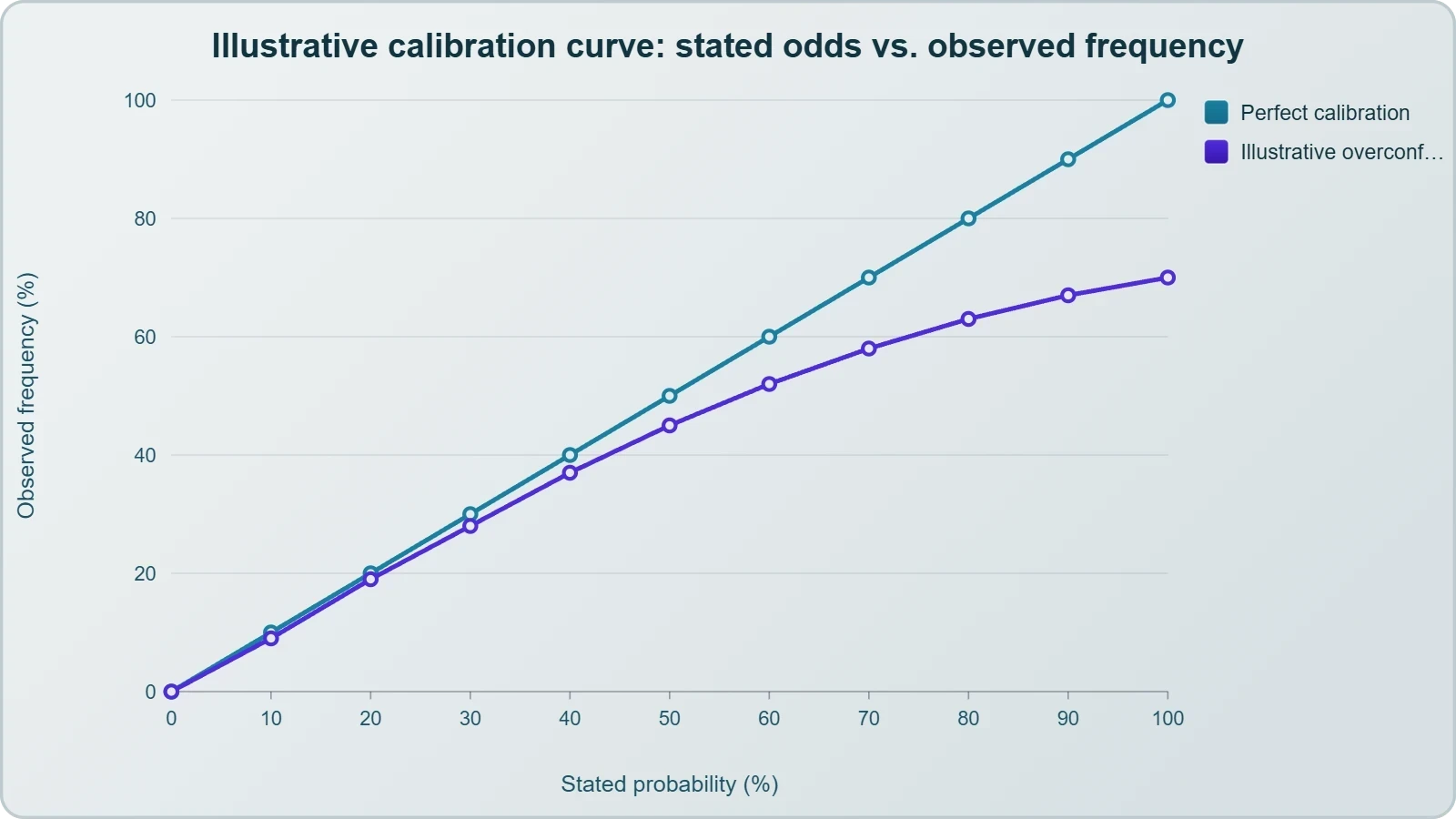
Systematic evaluation requires more than anecdotal recall of dramatic misses. Analysts tracking prediction market calibration examine the full distribution of forecasts, asking whether events priced at 70 percent occur roughly seven times in ten across a large sample. Early research on political contracts suggests reasonable calibration in high-liquidity races but notable overconfidence in contests where information is scarce or partisan sentiment runs high. The problem is that the dramatic misses receive far more media attention than the quiet successes, creating a distorted public perception that may overstate unreliability even as it understates the risks of overreliance.
For newsrooms integrating live odds, the practical challenge is presenting market prices with appropriate epistemic humility. A number displayed as a probability carries an implicit claim to precision that the underlying market may not support, particularly when liquidity is thin or the participant base is unrepresentative. Responsible coverage would contextualize odds with volume data, historical calibration records, and explicit acknowledgment of uncertainty ranges. Whether media partners will adopt such rigor, or simply present the numbers as authoritative forecasts, will significantly influence public trust when the midterm results arrive and are compared against the pre-election pricing.
Liquidity, Partisanship, and the Limits of Crowd Wisdom
The crowd wisdom literature is frequently invoked in defense of prediction markets, but it comes with conditions that political contracts often violate. Surowiecki's formulation requires diversity of opinion, independence of participants, decentralization of information, and a mechanism for aggregating judgments. Political markets can satisfy the aggregation mechanism while failing on diversity and independence, because participants read the same news sources, follow the same social media accounts, and may coordinate implicitly through shared ideological communities. When those conditions break down, the crowd can be confidently and collectively wrong, and the market price will faithfully record that error rather than correcting it.
Liquidity compounds the issue. A market with deep liquidity attracts professional traders who profit by correcting mispricing, but a thin market may be moved substantially by modest trades, making prices vulnerable to manipulation or mere noise. The $21 billion in combined volume sounds formidable, yet it is distributed unevenly across thousands of contracts, and individual races may trade with far less depth than the headline figure suggests. Critics who warn about manipulation incentives are therefore pointing at a genuine structural vulnerability, not merely speculating about bad actors, and the growth in volume simultaneously increases both the market's usefulness and its exposure.
Regulatory Posture and the CFTC's Calculated Support
The Commodity Futures Trading Commission has emerged as an unlikely institutional ally of the prediction market industry. Under its current leadership, the agency has worked to keep event contracts operating within the United States, arguing that such instruments can help the public forecast and plan for future outcomes and may sometimes outperform polling. This position represents a meaningful shift from earlier regulatory caution, when event contracts faced skepticism about their resemblance to gambling and their potential for public harm. The agency's stance has effectively legitimized a sector that operates at the boundary between financial derivatives and speculative entertainment.
That regulatory shelter is not unconditional, and the midterms will test its durability. If manipulation allegations surface during the election cycle, or if a major market failure coincides with a contested result, political pressure on the CFTC could intensify rapidly. The agency's argument that event contracts serve a public forecasting function depends on those markets demonstrating reasonable reliability under scrutiny. A repeat of the Brazil divergence in a closely watched American race would undermine the evidentiary basis for that argument and hand critics a powerful case for restricting or reclassifying political contracts.
Media Partnerships and the Authority Borrowed From Newsrooms
The agreements with the Associated Press, CNN, The Wall Street Journal, and CNBC represent a different kind of validation, one grounded in editorial judgment rather than regulatory permission. By embedding live election odds in coverage, these organizations confer journalistic legitimacy on market prices, implicitly treating them as information worthy of the same presentation as polling averages or expert analysis. That borrowing of authority cuts both ways: it elevates the platforms, but it also exposes the newsrooms to reputational risk if the odds prove badly miscalibrated in high-profile races.
Editorial standards for presenting probabilistic information are notoriously inconsistent. A poll result typically arrives with a margin of error, sample size, and methodology disclosure, allowing audiences to weigh its reliability. Market odds, by contrast, are often displayed as bare percentages without accompanying volume figures, liquidity indicators, or historical calibration data. This asymmetry in disclosure may lead audiences to overestimate the precision of market forecasts relative to polls, an ironic outcome given that markets are frequently promoted as the more rigorous alternative. Whether media partners will develop comparable transparency standards for odds remains an open question.
Manipulation Risk as Capital Concentrates in Election Contracts
Critics raise a concern that grows more acute with every dollar of volume: as more money enters election contracts, the incentive to manipulate prices or trade on privileged information increases proportionally. A market participant with advance knowledge of a campaign's internal polling, a planned withdrawal, or an unreported scandal could profit substantially by positioning before the information becomes public. Unlike securities markets, where insider trading is aggressively policed and prosecuted, prediction markets operate with thinner surveillance infrastructure and less established legal precedent for enforcement against political information advantages.
Price manipulation presents a related but distinct threat. A well-capitalized actor could theoretically move a thinly traded contract to create a misleading impression of momentum, then profit from the resulting distortion in related markets or public perception. The defense that arbitrageurs would correct such manipulation assumes sufficient liquidity and sophisticated participants, conditions that may not hold in every midterm race. The CFTC's willingness to tolerate these risks reflects a judgment that the forecasting benefits outweigh the manipulation exposure, a calculus that the midterm experience will either reinforce or call into question.
We Also Published
- 01
- 02
- 03
- 04
What the 2026 Midterms Will Actually Measure
The midterms function as a natural experiment with unusually high stakes for the industry's future. Unlike a single presidential race, the midterm cycle encompasses hundreds of contests across varying levels of salience, liquidity, and media attention, providing a rich dataset for evaluating calibration across different market conditions. If prediction markets perform well in high-profile Senate and gubernatorial races while struggling in obscure House districts, that pattern would support a nuanced conclusion: markets are informative where liquidity and attention are sufficient, and unreliable elsewhere. Such a finding would argue for selective rather than blanket reliance.
The timing of the test is significant because the industry's growth has been so rapid that historical calibration data may not predict current performance. A market with $4 million in volume operates very differently from one with $21 billion, and the participant base has likely broadened considerably. Greater participation could improve accuracy by diversifying information sources, or it could degrade accuracy by introducing more noise and partisan sentiment. The midterms will reveal which effect dominates, and the answer will shape how regulators, media organizations, and the public treat these platforms for years to come.
Scenarios That Would Validate or Undermine Market Credibility
A validating scenario would see market-implied probabilities closely track final results across a broad range of races, with the most liquid contracts performing best and few dramatic divergences. Such an outcome would strengthen the CFTC's position, encourage further media integration, and likely accelerate institutional adoption. An undermining scenario would involve multiple high-profile misses, particularly if they cluster in the same direction, suggesting systematic bias rather than random error. The most damaging possibility would be a miss accompanied by credible manipulation allegations, combining accuracy failure with integrity concerns in a single narrative that critics could cite for years.
Between these extremes lies a more probable outcome: mixed results that resist simple interpretation. Markets may outperform polls in some races and underperform in others, leaving both advocates and skeptics with supporting evidence. In that scenario, the debate would shift from whether prediction markets are accurate to under what conditions they are accurate, a more sophisticated question that demands better data on liquidity, participant composition, and information flows. The industry's long-term legitimacy may depend less on the midterm results themselves than on whether platforms and their media partners respond to those results with genuine analytical transparency.
Implications for Election Coverage and Public Trust
The deeper question concerns the relationship between quantified forecasts and democratic discourse. Presenting election outcomes as probabilities to be traded and displayed risks framing citizenship as spectatorship, where voters watch odds move rather than engage with substantive stakes. This concern is not new, having accompanied every wave of election forecasting innovation from statistical models to polling aggregators, but prediction markets intensify it by attaching financial stakes to political outcomes. The line between forecasting and wagering becomes blurred when the same instrument serves both functions, and public comfort with that blurring may prove limited once the novelty fades.
Trust, once damaged, is difficult to restore. If the midterms produce a widely publicized market failure, the newsrooms that embedded odds in their coverage will face questions about why they elevated unproven instruments to positions of apparent authority. The platforms will face regulatory scrutiny that could constrain their growth. And the public may conclude that quantified probability, however elegantly presented, offers no shortcut around the fundamental uncertainty of electoral politics. The industry's best defense is not rhetorical but empirical: demonstrating, through the midterm results, that its prices carry genuine informational value.
Reading Market Prices With Appropriate Skepticism
For anyone encountering prediction market odds in election coverage, a disciplined interpretive framework is essential. The first question should always concern liquidity: a contract trading millions of dollars carries more informational weight than one trading thousands, regardless of the percentage displayed. The second concerns participant composition, since a market dominated by a narrow demographic may reflect that group's preferences rather than the broader electorate. The third concerns historical calibration, asking whether this platform or contract type has a track record of accuracy or a pattern of overconfidence. Without these contextual layers, a bare probability number is less informative than it appears.
It is also worth distinguishing between markets as forecasting tools and markets as media products. The two functions impose different requirements: forecasting demands rigor, transparency, and honest acknowledgment of uncertainty, while media products demand engagement, clarity, and narrative appeal. When the same number serves both purposes, the media imperative can crowd out the analytical one, encouraging presentation of odds as definitive when they are provisional. Audiences attuned to this tension can consume market-based coverage more critically, treating odds as one input among many rather than as authoritative verdicts on electoral outcomes.
Practical Indicators of Market Reliability
Several observable indicators can help assess whether a given market price deserves attention. Volume and open interest reveal depth, indicating whether prices reflect broad participation or a handful of trades. Bid-ask spreads signal confidence, with narrow spreads suggesting consensus and wide spreads indicating disagreement or uncertainty. Price volatility in the final days before an event can reveal late information flows or manipulation attempts. And divergence between platforms covering the same event can expose idiosyncrasies in participant bases or contract design. None of these indicators is decisive alone, but together they provide a richer picture than any single probability figure.
Historical calibration records, where available, offer the most direct evidence. A platform that publishes its past forecasts alongside outcomes allows observers to assess whether its prices have been well calibrated or systematically overconfident. Unfortunately, such transparency is uneven across the industry, and the rapid growth in volume means historical records may not reflect current conditions. The most responsible posture for both journalists and citizens is therefore provisional: treat market odds as informative signals worth monitoring, but resist the temptation to treat them as settled predictions that relieve anyone of the obligation to think independently about electoral possibilities.
The Broader Stakes for Information Markets
Beyond the immediate midterm question lies a larger issue about how societies aggregate and trust information. Prediction markets are one expression of a broader movement toward quantified, market-based approaches to forecasting everything from geopolitical events to economic indicators. If these instruments prove reliable in elections, the case for extending them to other domains strengthens considerably. If they prove unreliable, the retreat may be equally broad, with implications for how institutions evaluate any market-derived signal. The midterms are therefore not merely an election story but a test case for a particular philosophy of knowledge production.
That philosophy holds that prices encode information more efficiently than deliberation, that incentives discipline belief, and that aggregation outperforms expertise. These are contestable claims, and the evidence remains mixed. What the midterms can provide is not a final verdict but a substantial increment of evidence, one that will inform regulatory decisions, editorial practices, and public expectations. The most valuable outcome would be a clearer understanding of when market prices deserve trust and when they do not, replacing both uncritical enthusiasm and reflexive dismissal with calibrated, conditional confidence.
Balancing Innovation Against Democratic Accountability
Regulators face a genuine dilemma. Restricting prediction markets would foreclose a potentially valuable forecasting tool and push activity toward less supervised venues, while permitting them to operate freely exposes the public to manipulation risks and the political process to financial influence. The CFTC's current approach, favoring operation with oversight, represents a bet that the benefits outweigh the risks and that problems can be addressed through monitoring rather than prohibition. The midterms will provide the first substantial evidence on whether that bet was well placed, and the agency's response to whatever emerges will set precedents for years.
Democratic accountability adds another dimension. Elections are not merely events to be forecast; they are processes through which citizens exercise sovereignty, and treating them as tradeable contracts may subtly alter how participants and observers relate to the political process. The concern is not that prediction markets corrupt democracy directly, but that they contribute to a broader framing of politics as spectacle, where outcomes are consumed as entertainment and engagement is mediated through financial or informational positions rather than civic commitment. Whether that concern is warranted, and how it should be weighed against the informational benefits, is a question the midterms will illuminate but not settle.
What Comes After the Midterm Verdict
Whatever the results, the prediction market industry will not return to its earlier obscurity. The volume growth, media partnerships, and regulatory engagement have embedded these platforms in the information ecosystem, and the midterms will determine the terms of that embedding. A strong performance would likely accelerate integration, encouraging more newsrooms to adopt live odds and more institutions to cite market prices in analysis. A weak performance would prompt retrenchment, with media partners reassessing their commitments and regulators reconsidering their permissive stance. In either case, the trajectory established over the past four years will be confirmed or redirected.
The most durable outcome may be a more mature conversation about probabilistic information in public life. Polls, models, and markets all offer imperfect windows onto uncertain futures, and the public would benefit from clearer understanding of each one's strengths and limitations. Prediction markets have forced that conversation by presenting probability as a live, tradeable quantity, and the midterms will supply the empirical material for evaluating that presentation. The industry's future authority depends less on winning the argument in principle than on demonstrating, in practice, that its prices carry genuine informational value under real-world conditions.
From our network :
- University Language Proficiency Exams: Why Institutional Tests Demand Different Preparation Than IELTS and TOEFLDiscover why university-specific language proficiency examinations differ fundamentally from IELTS and TOEFL, and learn strategic preparation approaches for institutional assessment success.
- The Hidden Cost of AI Convenience: Why Over-Permissioned Agents Are a Security Time BombDiscover why AI agents with excessive permissions create dangerous single points of failure, and learn how implementing least privilege principles can protect your organization from exploitation.
- How AI Agents Will Change the Way We Manage Personal FinancesExplore how AI agents are transforming personal finance through automated budgeting, bill payment, and investment management, while examining the critical security protocols and governance frameworks required for safe deployment.
- Forbidden Matrix Patterns and Visible Lattice Points: A Geometric DictionaryExplore how multidimensional 0–1 matrices encode geometric truths, linking forbidden patterns to visible lattice points and hypergraph theory, with applications in combinatorics and computational geometry.
- CISA’s Ten-Advisory Wave: Why Generic Patching Fails in OT and How to Build Product-Specific PlaybooksCISA released ten ICS advisories in one week, exposing critical infrastructure risks. Generic patching fails in OT. Learn to build product-specific remediation playbooks.
- Live Online English Classes for Kids: Do They Actually Reduce Anxiety?A ten-week study reveals that synchronous online English classes can significantly reduce child language anxiety while improving listening and reading skills. Discover what makes these programs effective and how parents can select the right one.
- The Final Descent: How ESA Retired the Legendary Cluster Constellation After 24 Years of Space Weather ScienceAfter 24 years mapping Earth’s magnetosphere, ESA’s Cluster mission concluded with a precisely controlled reentry over the South Pacific. This analysis explores the scientific legacy, engineering decisions, and debris mitigation principles behind one of space exploration’s most responsible retirements.
- Committed Mediterranean Precipitation Decline: Why Emissions Cuts Alone Cannot Restore Winter RainsNew NOAA research reveals that Mediterranean winter rains may decline irreversibly even with emissions cuts. Explore the science of committed climate change and regional impacts.
- Mobile Learning and VR in English: What Global Evidence Reveals About Effective Language TechnologyA systematic review across 14 countries reveals which language-learning technologies genuinely work. Mobile learning, AI, and VR show measurable benefits when pedagogically integrated. This evidence-based guide helps educators and learners select technology that delivers real return on investment.
RESOURCES
- Are prediction markets accurate on elections? The US midterms are ...theguardian.com21 hours ago ... Accuracy fell to 67% and 78% on Polymarket and Kalshi respectively, while prices “diverged sharply across markets, exchanges, and contract…
- Prediction markets price Democratic sweep as US midterm ... - Reutersreuters.com21 hours ago ... The markets tout high accuracy rates in providing betting odds, but some high-profile misses during the US primaries and in…
- Are Betting Markets Better than Polling in Predicting Political ...facultyprofiles.vanderbilt.eduprecision in predicting election outcomes, which has not only caused uncertainty for American voters, but has also impacted campaign strategies, spending ...
- Betting on Democracy | Council on Foreign Relationscfr.orgOct 27, 2026 ... Recent analysis has found that election markets are a uniquely accurate mechanism for forecasting political results and public opinion. Those ...
- Polymarket and Kalshi Face a Major Accuracy Test: The Midtermsnytimes.com5 days ago ... ... U.S. midterm elections is an important proving ground ... Prediction Markets Face Their Biggest Accuracy Test Yet: The Midterms.
- Prediction Markets? The Accuracy and Efficiency of $2.4 Billion in ...ideas.repec.orgWhile 93% of PredictIt markets correctly predicted outcomes better than chance, accuracy fell to 78% on Kalshi and 67% on Polymarket. Even the most…
- New Study Finds Prediction Markets Are Influencing Votersbrennancenter.orgOct 20, 2026 ... In this study, voters disagreed with such a characterization. Only 19 percent of voters believed that election prediction markets were…
- Prediction markets have gone 'mainstream' but what effect will ... - CBCcbc.ca1 day ago ... Kalshi and Polymarket election prediction markets are seeing record trades ahead of the 2026 U.S. midterms. ... accurate prediction markets ...
- Prediction market accuracy in the long run - ScienceDirect.comsciencedirect.comThe results show that prediction markets are more accurate long-run forecasting tools than polls across elections and across long periods of time preceding ...
- Prediction markets' credibility 'on the line' in midterms - POLITICOpolitico.comOct 26, 2026 ... ... U.S. elections. The polls had the 2024 presidential contest as a ... A repeat of 2024 — with early…
- US midterms: why gambling markets often predict elections more ...theconversation.comUS midterms: why gambling markets often predict elections more accurately than polls. Published: November 8, 2022 1:08pm EST. https://theconversation.com/us ...
- Election Odds & Predictions (2026–2027) - Polymarketpolymarket.comThe prediction markets on this page cover elections across the globe. Depending on the election cycle, that can include the U.S. presidential elections and ...
- Are Betting Markets Better than Polling in Predicting Political ... - arXivarxiv.orgJul 11, 2025 ... The 95% predictive interval bands from the Polymarket model predictions fan out through time while those from the polling data…
- What to know about election forecasting and prediction markets this ...cip.uw.eduOct 26, 2026 ... A new study from the Brennan Center for Justice found that if a candidate was favored by prediction markets, voters…
- Election Betting Is Banned in Most States. Will Prediction Markets ...ncsl.orgAug 19, 2026 ... ... U.S. presidential election ... Prediction markets have gained a reputation in recent years for accurately predicting presidential election ...
- 01
- 02
- 03
- 04
- 05
- 06
- 07
- 08
0 Comments