
OpenAI has crossed a threshold that many enterprise software companies spend a decade trying to reach: the majority of its revenue now flows from businesses rather than individual consumers. Co-founder Greg Brockman confirmed the shift in remarks reported by Reuters, pairing that disclosure with a statement that the company is prepared for an initial public offering in 2027. For a firm that became a household name through a free consumer chatbot, the revelation reframes its identity. ChatGPT may still be the public face, but the balance sheet increasingly belongs to corporate buyers who embed models into products, workflows, and internal tooling.
The significance extends well beyond a single revenue statistic. When business customers become the dominant source of income, a company's priorities, pricing architecture, contract structures, and risk posture all migrate toward the needs of procurement departments and enterprise IT leaders. Consumer products reward virality and engagement; enterprise products reward reliability, compliance, data governance, and predictable billing. OpenAI's trajectory suggests it is deliberately trading some of the former for much more of the latter, a trade that investors typically reward with higher revenue multiples because enterprise contracts are stickier and more forecastable than consumer subscriptions.
The IPO signal adds a second layer of meaning. An initial public offering in 2027 would require audited financials, transparent disclosure of customer concentration, and a narrative that public market investors can underwrite. Brockman's framing — that the company is "prepared" rather than merely "considering" — implies internal readiness work already underway. This analysis examines what the enterprise revenue shift actually means, why 2027 matters as a timeline, how the competitive landscape shapes the decision, and what risks could derail the plan before shares ever trade.
On This Page
- The Revenue Shift From Consumers to Enterprises
- Why 2027 Is the Target for an Initial Public Offering
- Competitive Pressure Across the Enterprise AI Market
- Financial Architecture of an Enterprise-Heavy Business
- Risks That Could Reshape the 2027 Timeline
- What the Shift Signals About the AI Industry's Direction
TL;DR OpenAI now derives most of its revenue from business customers, according to co-founder Greg Brockman, and the company is positioning itself for an initial public offering in 2027. The shift from consumer subscriptions to enterprise contracts changes how the company prices, sells, and reports its business, and it aligns OpenAI with the predictable, contract-based revenue models that public market investors favor. The 2027 timeline implies substantial governance, audit, and disclosure preparation. Key risks include customer concentration, compute costs, regulatory scrutiny, and the possibility that enterprise demand growth slows before the offering window opens.
The Revenue Shift From Consumers to Enterprises
The consumer-to-enterprise pivot is not a sudden reversal but the visible result of a multi-year strategy. ChatGPT's explosive consumer adoption gave OpenAI distribution and brand recognition at a scale few software products achieve. That consumer base served as a proving ground: it generated training data signals, stress-tested infrastructure, and created the cultural familiarity that makes corporate buyers comfortable adopting the same underlying models. The business revenue now overtaking consumer revenue reflects the natural maturation of that funnel, where individual familiarity inside organizations converts into departmental budgets and eventually enterprise-wide contracts.
Why Enterprise Contracts Command Higher Value
Enterprise agreements differ structurally from consumer subscriptions in ways that materially affect revenue quality. A corporate contract typically bundles API access, higher rate limits, dedicated support, security reviews, and compliance documentation into an annual or multi-year commitment. The average contract value can run from tens of thousands to millions of dollars, and renewal rates tend to be high once a model is embedded in production systems. Switching costs rise sharply after integration, because replacing a model means re-engineering prompts, retraining evaluation pipelines, and re-certifying outputs against internal quality standards.
This stickiness explains why investors assign premium multiples to enterprise software relative to consumer subscription businesses. Consumer churn is frictionless — a user cancels with two clicks. Enterprise churn requires procurement review, migration planning, and executive sign-off, which means revenue persists even through periods of budget tightening. For OpenAI, the implication is that each enterprise dollar is worth more in valuation terms than each consumer dollar, not merely because of size but because of durability and predictability across fiscal cycles.
The Mechanics of Enterprise Adoption
Corporate adoption of generative models follows a recognizable pattern. It usually begins with individual employees experimenting on personal accounts, then moves to a departmental pilot funded from discretionary budget, and finally escalates to a formal procurement process involving security review, legal negotiation, and integration planning. Each stage filters the customer base toward organizations with genuine operational use cases rather than curiosity. OpenAI's enterprise revenue growth suggests a large cohort of customers has now passed through the pilot stage into production deployment, where spending scales with usage rather than seat count.
Usage-based pricing within enterprise contracts creates a compounding effect. As customers integrate models more deeply — into customer support, code generation, document processing, or analytics — token consumption rises, and so does revenue from the same account. This expansion revenue is the engine behind the strongest enterprise software businesses, and it explains why OpenAI's business segment can grow faster than the number of new logos signed. The company does not need to win every new customer to grow; it needs existing customers to embed its models more deeply over time.
We Also Published
Why 2027 Is the Target for an Initial Public Offering
Public offerings are rarely scheduled arbitrarily. A 2027 target gives OpenAI roughly a year of runway to complete the unglamorous work that precedes listing: audited financial statements across multiple fiscal years, formalized internal controls, a board composition acceptable to institutional investors, and a disclosure regime that can withstand quarterly scrutiny. Companies typically begin this preparation well before announcing intent, and Brockman's public statement suggests the groundwork is already advanced rather than aspirational. The timeline also aligns with a broader expectation that AI infrastructure spending will mature into measurable returns by then.
The Preparation Checklist Behind the Announcement
Going public requires a company to demonstrate that its financial reporting is reliable, its governance is independent enough to satisfy exchange rules, and its risk disclosures are candid about dependencies. For OpenAI, those dependencies are unusually concentrated: compute supply, key technology partners, and a small number of very large enterprise customers. Each of these must be disclosed and, ideally, diversified before an offering. The 2027 window implies the company believes it can show progress on all three fronts within the next year, converting concentrated risks into managed and disclosed ones.
Market conditions also matter. IPO windows open and close with investor sentiment, interest rates, and the performance of recently listed peers. A 2027 target gives OpenAI flexibility to launch when conditions are favorable rather than when cash needs force the issue. That optionality is itself valuable: a company that can wait for a good window negotiates from strength, while one that must list to fund operations accepts whatever pricing the market offers. The phrasing "prepared for" rather than "planning to" captures precisely this distinction.
What Public Investors Will Scrutinize
Institutional investors evaluating an AI company will focus on a handful of metrics that reveal whether growth is durable or promotional. Net revenue retention shows whether existing enterprise customers spend more each year. Gross margin reveals how much of each revenue dollar survives compute costs. Customer concentration discloses how much of the business depends on a few large accounts. And the ratio of contracted backlog to recognized revenue indicates how much future income is already locked in. OpenAI's enterprise-heavy mix improves several of these metrics simultaneously, which is precisely why the shift matters for valuation.
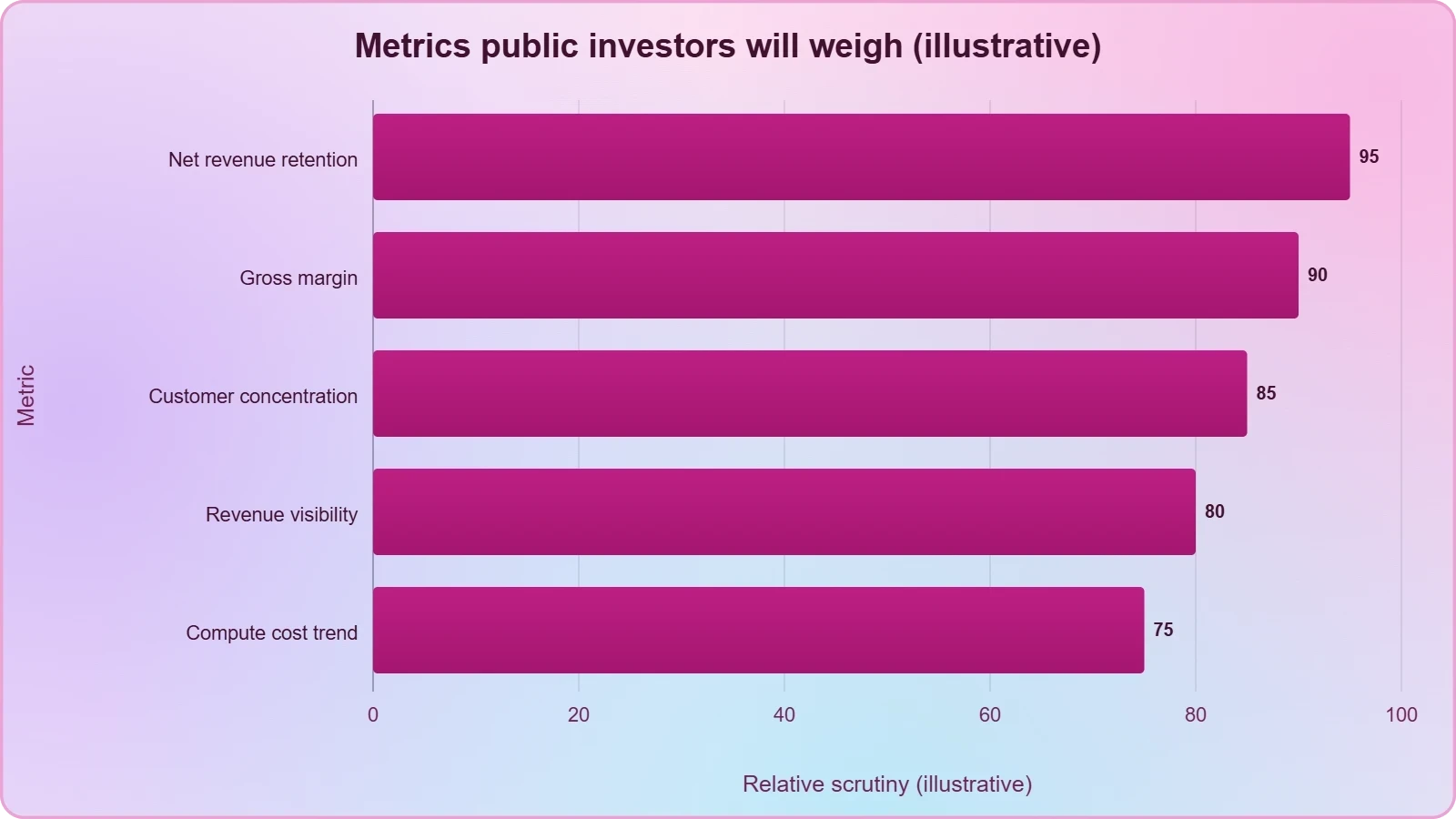
Gross margin deserves particular attention because AI businesses carry infrastructure costs that traditional software does not. Every inference request consumes compute, so revenue growth without efficiency gains can compress margins. Public investors will want evidence that unit economics improve as scale increases — through better model efficiency, custom silicon, or pricing discipline. A company that can demonstrate declining cost per token alongside rising enterprise revenue tells a far more compelling story than one growing revenue while margins erode.
Competitive Pressure Across the Enterprise AI Market
OpenAI's enterprise pivot unfolds in a crowded field. Anthropic has built a strong position selling to businesses on safety and reliability grounds. Google leverages its cloud relationships to bundle models into existing enterprise agreements. Microsoft, a major OpenAI partner and investor, distributes competing and complementary capabilities through its own channels. Meta gives away capable open-weight models that erode pricing power at the lower end of the market. Each of these dynamics shapes how much of the enterprise opportunity OpenAI can capture and at what price.
Rivals and Their Enterprise Positioning
The competitive structure matters because enterprise buyers rarely standardize on a single model provider. Most large organizations now run multi-model architectures, routing different tasks to different providers based on cost, latency, and capability. This reduces the winner-take-all dynamic that characterized earlier technology markets and increases the importance of integration depth. A provider that becomes embedded in a customer's evaluation pipelines and internal tooling enjoys switching costs that pure model quality cannot replicate, which is why OpenAI's enterprise sales motion emphasizes platform services rather than raw API access alone.
Open-weight competitors exert persistent downward pressure on pricing. When capable models are freely downloadable, customers can self-host for sensitive workloads and use commercial APIs only where convenience justifies the premium. This bifurcation pushes commercial providers toward higher-value services: enterprise support, compliance certifications, fine-tuning infrastructure, and guaranteed service levels. OpenAI's revenue mix shift toward businesses aligns with this reality, because enterprises pay for reliability and accountability in ways that individual developers rarely do.
Pricing Power and the Open-Weight Threat
Pricing power in enterprise AI depends less on raw benchmark scores than on the cost of switching. A customer that has built evaluation harnesses, prompt libraries, and fine-tuned adapters around one provider faces real expense in migrating. That expense is the provider's moat. OpenAI's strategy of offering platform services — assistants, retrieval, tooling, and enterprise controls — deepens this moat by making the provider responsible for more of the customer's stack. The more surface area a provider occupies, the more painful it becomes to leave, and the more pricing latitude it retains.
Open-weight models nonetheless cap how far prices can rise. When a capable alternative is available at near-zero marginal cost, commercial providers must justify premiums through service quality, compliance, and support rather than capability alone. This dynamic favors providers with strong enterprise sales organizations and mature security postures, because those are the attributes that open-weight alternatives cannot easily replicate. OpenAI's revenue mix shift is therefore not merely a financial fact but a strategic response to competitive pressure that rewards enterprise depth over consumer breadth.
Financial Architecture of an Enterprise-Heavy Business
An enterprise-dominant revenue mix reshapes a company's financial architecture in ways that extend beyond the income statement. Sales and marketing costs rise as the company builds direct relationships with large buyers. Contract assets and deferred revenue appear on the balance sheet as customers prepay for annual commitments. Working capital dynamics improve because enterprises pay on negotiated terms rather than through monthly consumer billing. Each of these changes makes the business more legible to public investors, who are trained to evaluate enterprise software companies using established frameworks.
Unit Economics and Margin Structure
The central financial question for any AI company is whether gross margin expands with scale. Inference costs fall as models become more efficient and as providers shift workloads to custom hardware. Enterprise contracts, with their higher average values and committed volumes, allow providers to plan capacity more efficiently than unpredictable consumer demand. The combination of falling unit costs and rising contract values is the mechanism through which an AI business can approach the margin profile of traditional software, and it is the story OpenAI will need to tell convincingly before 2027.
Operating leverage is the second lever. Enterprise sales organizations are expensive to build but scale sublinearly once established, because each account executive can manage a growing book of renewals and expansions. Research and development spending, by contrast, tends to grow with ambition rather than revenue. Investors will watch whether R&D intensity declines as a percentage of revenue over time, which would signal that the company is converting research leadership into durable commercial advantage rather than perpetually funding it from new capital.
- 01
- 02
- 03
- 04
Capital Intensity and the Compute Constraint
AI companies carry a capital burden that traditional software companies avoid entirely. Training frontier models and serving inference at scale require enormous compute capacity, much of it secured through multi-year agreements with cloud providers and chip manufacturers. These commitments appear as future obligations and shape the company's risk profile. Public investors will want to understand the duration and flexibility of these commitments, because a company locked into expensive capacity while demand slows faces margin compression that no amount of enterprise sales can offset.
The compute constraint also affects growth strategy. If capacity is finite, the company must allocate it to the highest-value workloads, which typically means enterprise customers with committed contracts rather than free consumer users. This allocation logic reinforces the revenue mix shift: enterprise demand is not only more valuable per unit but also easier to plan against. The interplay between capital commitments and revenue quality is one of the most important financial stories an AI company must explain to public markets, and it will feature prominently in any 2027 offering.
Risks That Could Reshape the 2027 Timeline
Every IPO plan carries execution risk, and OpenAI's carries several that are specific to its industry and structure. Regulatory scrutiny of AI companies is intensifying across major jurisdictions, with questions about data provenance, model safety, and market concentration all in play. Any of these could delay a listing or complicate disclosure. The company's unusual corporate structure, which includes a capped-profit arm governed by a nonprofit mission, adds complexity that public investors will need to understand and that regulators may examine closely before approving a listing.
Regulatory, Structural, and Market Risks
Structural questions loom large. Converting or restructuring a capped-profit entity into a form suitable for public ownership involves legal, tax, and governance considerations that can take years to resolve. Mission alignment must be preserved in a way that satisfies the nonprofit's charter while giving public shareholders conventional rights. These are not insurmountable problems, but they are time-consuming, and they explain why a 2027 target is ambitious rather than conservative. Any litigation or regulatory objection to the restructuring could push the timeline further out.
Market risk is equally real. If enterprise AI spending decelerates, or if a high-profile failure erodes corporate confidence, the IPO window could close precisely when the company is ready to use it. Public offerings depend on buyer appetite as much as issuer readiness. A company that has done all the internal work but faces a closed window must either wait or accept a discount. OpenAI's stated preparation therefore signals capability, not certainty, and investors should read the 2027 date as a target rather than a commitment.
Customer Concentration and Demand Durability
Enterprise revenue is more predictable than consumer revenue, but it is not immune to concentration risk. If a small number of very large customers account for a disproportionate share of business revenue, the loss of even one account can materially affect results. Public investors will demand disclosure of this concentration and evidence that the customer base is broadening. OpenAI's challenge is to grow the long tail of enterprise customers fast enough that no single account dominates, which requires a sales motion that serves mid-market buyers as effectively as it serves the largest enterprises.
Demand durability is the related question. Enterprise AI budgets are currently expanding, but they are also experimental in many organizations. If early deployments fail to deliver measurable returns, budget committees could pull back. The companies most exposed are those whose value proposition rests on novelty rather than demonstrated productivity gains. OpenAI's enterprise revenue growth suggests that a meaningful share of customers has moved past experimentation into production, which is the strongest available evidence that demand is durable rather than cyclical.
What the Shift Signals About the AI Industry's Direction
The enterprise revenue milestone is a signal about where the entire AI industry is heading. Consumer adoption made generative AI culturally ubiquitous, but business adoption is what makes it economically durable. The companies that win the next phase will be those that can sell into procurement processes, satisfy security reviews, and demonstrate measurable returns inside complex organizations. OpenAI's disclosure suggests it has made that transition more successfully than its public narrative of a consumer chatbot might imply, and that the industry's center of gravity is shifting accordingly.
From Novelty to Infrastructure
Every major computing platform follows a similar arc: novelty, then utility, then infrastructure. Generative AI is moving from the novelty phase into the utility phase, where businesses treat models as components of larger systems rather than destinations in themselves. This transition favors providers that offer reliability, integration, and governance over those that compete purely on benchmark performance. The enterprise revenue shift at OpenAI is evidence that the utility phase has arrived, and that the companies positioned as infrastructure rather than entertainment will capture the larger share of long-term value.
The infrastructure framing also clarifies why an IPO makes sense in 2027 rather than earlier or later. Infrastructure businesses are valued on predictable metrics — revenue visibility, margin trajectory, customer retention — that require several years of operating history to establish credibly. By 2027, OpenAI will have accumulated enough enterprise contract data to present a coherent financial narrative. Listing earlier would mean asking investors to value a story; listing later would mean ceding early-mover advantage in public capital markets to competitors who move first.
Implications for Competitors and Investors
Competitors will read OpenAI's disclosure as a signal about where to invest. If enterprise revenue is now the majority of the market leader's business, then enterprise sales capability becomes a strategic priority across the industry. Companies that built consumer-first products will need to develop procurement-ready offerings, and those that already sell to businesses will accelerate. The disclosure also gives investors a benchmark against which to evaluate other AI companies preparing for public markets, establishing enterprise revenue mix as a key metric in the sector's valuation vocabulary.
For investors, the lesson is that AI is becoming a business-to-business industry faster than the consumer narrative suggests. The companies that will compound value over the next decade are those that embed themselves in organizational workflows and earn recurring budget lines. OpenAI's shift toward enterprise revenue, paired with a 2027 IPO target, positions it as a candidate for that category. Whether it executes on the timeline depends on factors it controls — governance, margins, customer diversification — and factors it does not, including regulation and market appetite.
From our network :
- Committed Mediterranean Precipitation Decline: Why Emissions Cuts Alone Cannot Restore Winter RainsNew NOAA research reveals that Mediterranean winter rains may decline irreversibly even with emissions cuts. Explore the science of committed climate change and regional impacts.
- University Language Proficiency Exams: Why Institutional Tests Demand Different Preparation Than IELTS and TOEFLDiscover why university-specific language proficiency examinations differ fundamentally from IELTS and TOEFL, and learn strategic preparation approaches for institutional assessment success.
- Forbidden Matrix Patterns and Visible Lattice Points: A Geometric DictionaryExplore how multidimensional 0–1 matrices encode geometric truths, linking forbidden patterns to visible lattice points and hypergraph theory, with applications in combinatorics and computational geometry.
- The Final Descent: How ESA Retired the Legendary Cluster Constellation After 24 Years of Space Weather ScienceAfter 24 years mapping Earth’s magnetosphere, ESA’s Cluster mission concluded with a precisely controlled reentry over the South Pacific. This analysis explores the scientific legacy, engineering decisions, and debris mitigation principles behind one of space exploration’s most responsible retirements.
- The Hidden Cost of AI Convenience: Why Over-Permissioned Agents Are a Security Time BombDiscover why AI agents with excessive permissions create dangerous single points of failure, and learn how implementing least privilege principles can protect your organization from exploitation.
- Live Online English Classes for Kids: Do They Actually Reduce Anxiety?A ten-week study reveals that synchronous online English classes can significantly reduce child language anxiety while improving listening and reading skills. Discover what makes these programs effective and how parents can select the right one.
- CISA’s Ten-Advisory Wave: Why Generic Patching Fails in OT and How to Build Product-Specific PlaybooksCISA released ten ICS advisories in one week, exposing critical infrastructure risks. Generic patching fails in OT. Learn to build product-specific remediation playbooks.
- How AI Agents Will Change the Way We Manage Personal FinancesExplore how AI agents are transforming personal finance through automated budgeting, bill payment, and investment management, while examining the critical security protocols and governance frameworks required for safe deployment.
- Mobile Learning and VR in English: What Global Evidence Reveals About Effective Language TechnologyA systematic review across 14 countries reveals which language-learning technologies genuinely work. Mobile learning, AI, and VR show measurable benefits when pedagogically integrated. This evidence-based guide helps educators and learners select technology that delivers real return on investment.
RESOURCES
- OpenAI Revenue, Losses, and IPO Valuation: Forecasts Through ...futuresearch.aiMay 27, 2026 ... OpenAI Revenue, Losses, and IPO Valuation: Forecasts Through Late 2027 ... The enterprise market is expanding fast enough that OpenAI's ...
- OpenAI's IPO Window Shifts to 2027 as Anthropic Leads ... - LinkedInlinkedin.comMay 5, 2026 ... On May 4, both Anthropic and OpenAI ... enterprise revenue with identifiable buyers and known contract structures. That's IPO-ready revenue…
- OpenAI 'will be a public company in 2027' or sooner, CFO Friar tells ...cnbc.comAug 19, 2026 ... OpenAI confidentially filed its IPO prospectus with regulators in ... OpenAI told investors it generated $6.7 billion in revenue for ...
- OpenAI lays groundwork for juggernaut IPO at up to $1 trillion ...reuters.comOct 30, 2025 ... Chief Financial Officer Sarah Friar has told some associates the company is aiming for a 2027 listing, the people said.…
- OpenAI CFO Sarah Friar says IPO is coming in 2027 - Quartzqz.comAug 20, 2026 ... During the meeting, Friar walked employees through a set of slides: revenue run rate had climbed 35% quarter to date,…
- OpenAI, ready to IPO in 2027, now counts majority of sales ... - Reutersreuters.com6 hours ago ... OpenAI President Greg Brockman said on Wednesday the company now generates the majority of its revenue from enterprise sales and…
- OpenAI's CFO Just Told Employees the IPO Is Coming in 2027 or ...finance.yahoo.comAug 24, 2026 ... Enterprise revenue growing 50% quarter-to-date outpaces the blended 35% rate, and that mix at filing determines whether OpenAI prices like ...
- OpenAI Missed Multiple Revenue Targets—Here's Why It Likely ...global.morningstar.comMay 5, 2026 ... Why OpenAI is Likely Not Going Public This Year. A realistic IPO window has shifted from Q4 2026 to mid-to-late…
- AI: Anthropic's IPO Go Time, OpenAI's $1.4 Trillion, Gemini 4 & More ...michaelparekh.substack.comOct 3, 2026 ... ... IPO moves to 2027 and this round becomes the bridge. On the business side, OpenAI's enterprise revenue crossed over…
- OpenAI, ready to IPO in 2027, now counts majority of sales from ...thenewstribune.com5 hours ago ... NAPA, California, Nov 4 (Reuters) - OpenAI President Greg Brockman said on Wednesday the company now generates the majority of…
- OpenAI CFO Sets 2027 IPO Timeline as Revenue Growth Slows and ...finance.biggo.comAug 19, 2026 ... ... 2027, with the possibility of an earlier debut if business growth remains strong. OpenAI confidentially filed IPO paperwork with…
- OpenAI Wants to Go Public. First Sarah Friar Needs to Get It to ... - WSJwsj.comMay 2, 2026 ... https://www.wsj.com/business/openai-sam-altman-ipo-sarah-friar-392c582b ... OpenAI missed some internal revenue targets. A company ...
- OpenAI, ready to IPO in 2027, now counts majority of ... - Wichita Eaglekansas.com5 hours ago ... ... generates the majority of its revenue from enterprise sales and he believes it will be ready to go public…
- OpenAI CFO Tells Staff IPO Is Coming in 2027 or Sooner, Framing ...finance.biggo.comAug 24, 2026 ... She cited internal figures showing revenue run rate up 35% quarter to date and enterprise revenue up 50%, though those…
- OpenAI May Delay Its IPO To 2027, Report Says - Forbesforbes.comJun 25, 2026 ... Amid growing doubts about whether AI companies can turn a profit, the company is now hunting for new revenue, experimenting…
- 01
- 02
- 03
- 04
- 05
- 06
- 07
- 08
0 Comments