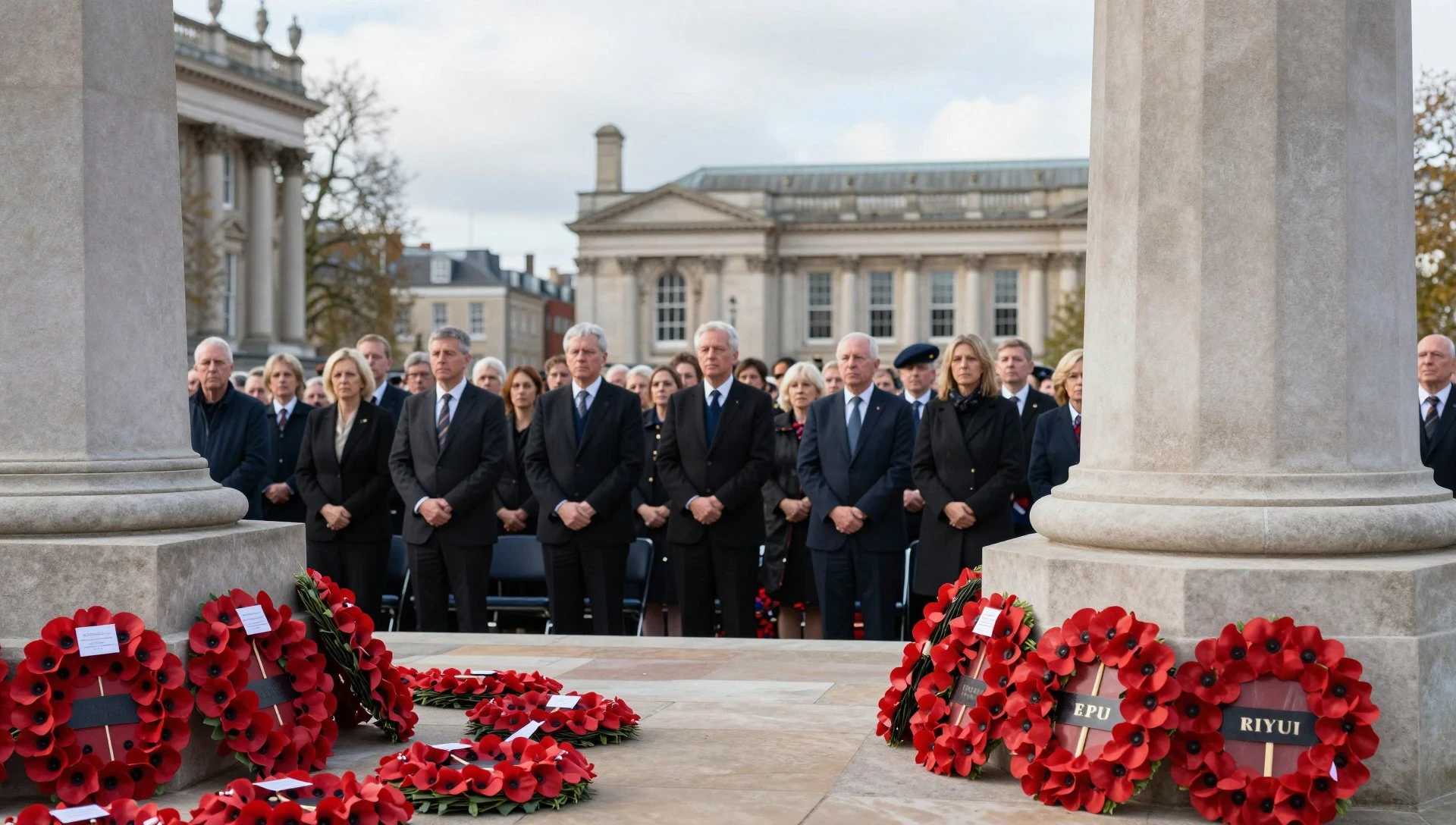
Armistice Day occupies a singular place in the British civic calendar, a moment when the machinery of national life slows to a deliberate, ceremonial pause. Each November the eleventh, at the eleventh hour, communities across the United Kingdom gather at war memorials, village greens, cathedrals and railway stations to observe two minutes of silence. The ritual commemorates the signing of the armistice that ended hostilities on the Western Front in 1918, yet its resonance has long since outgrown that single historical event. It has become a broader act of collective remembrance, honouring the dead of two world wars and every subsequent conflict in which British service personnel have served.
The nationwide character of the observance is what gives it enduring weight. Services are not confined to London or to Westminster Abbey; they unfold simultaneously in cities, market towns, coastal villages and overseas territories, binding disparate communities into a shared rhythm of reflection. Local councils, faith leaders, veterans' organisations and schoolchildren all participate, often in ceremonies that are modest in scale but profound in meaning. This decentralised, grassroots quality distinguishes Armistice Day from state occasions that depend on centralised pageantry, and it explains why the commemoration continues to command broad public respect across generations and political divides.
Understanding the day requires more than a passing nod to history. It demands attention to the symbolism of the poppy, the evolving composition of remembrance as the veteran generation of the World Wars passes away, and the delicate balance between solemnity and accessibility. It also invites scrutiny of how a nation transmits memory through ritual, education and media. The analysis that follows examines the structure of the observance, the institutions that sustain it, the controversies that occasionally surround it, and the quiet civic philosophy that underpins the eleventh hour.
On This Page
TL;DR Armistice Day is observed across the United Kingdom each 11 November with nationwide services, two minutes of silence and the wearing of poppies, commemorating the 1918 armistice and honouring all who died in conflict. The observance blends state ceremony with grassroots local participation, sustained by the Royal British Legion, faith communities, schools and broadcasters. Its meaning has evolved from a purely military commemoration into a broad civic ritual of remembrance, reflection and national unity, while remaining subject to periodic debate over participation, symbolism and the place of remembrance in modern public life.
The Historical Foundations of Armistice Day
Armistice Day traces its origins to the moment the guns fell silent on the Western Front at 11am on 11 November 1918, following the signing of an armistice between the Allies and Germany at Compiègne. The agreement ended more than four years of industrialised warfare that had killed millions and reshaped the political map of Europe. Within a year, King George V had issued a proclamation calling for a two-minute silence across the Empire, a gesture that fixed the eleventh hour as a permanent anchor of national memory and gave the commemoration a rhythm that has survived for more than a century.
The Compiègne Armistice and the Eleventh Hour
The armistice signed in a railway carriage in the Forest of Compiègne stipulated that hostilities would cease at the eleventh hour of the eleventh day of the eleventh month. That precise timing, repeated annually, lends the observance an almost liturgical quality, transforming a military document into a recurring civic appointment. The symmetry of the date and hour has proved remarkably durable, surviving the upheavals of the twentieth century and providing a fixed point around which communities can organise their remembrance with confidence and consistency.
Historians note that the armistice was, strictly speaking, a ceasefire rather than a peace treaty, with the formal settlement arriving at Versailles the following year. Yet popular memory has attached itself to November rather than June, because the silence of the guns carried an immediacy that no diplomatic document could match. The eleventh hour thus became a symbol not merely of victory but of relief, exhaustion and grief, a layered emotional inheritance that continues to inform how the day is observed and understood.
From Victory to Remembrance
In the years immediately after 1918, Armistice Day carried an unmistakable tone of triumph alongside mourning. As the scale of the war's human cost became fully apparent, and as a second global conflict followed within a generation, the emphasis shifted decisively toward remembrance rather than celebration. The language of commemoration moved from victory to sacrifice, from national triumph to shared grief, and the day gradually acquired the reflective, inclusive character that defines it in contemporary Britain.
This evolution was neither automatic nor uncontested. Veterans' organisations, churches and successive governments each shaped the transition, negotiating how the dead should be honoured and which conflicts should be included. The result is a commemoration that is deliberately capacious, capable of absorbing new wars and new generations without losing its original anchor in the events of 1918. That flexibility, historians argue, is precisely what has allowed Armistice Day to remain relevant while other commemorative traditions have faded.
The Architecture of Nationwide Observance
The nationwide services that mark Armistice Day form a layered architecture of ceremony, ranging from the National Service of Remembrance at the Cenotaph in Whitehall to intimate gatherings at village memorials. Each layer performs a distinct function: the national ceremony projects unity and continuity, while local services foster intimacy and personal connection. Together they create a commemorative ecosystem in which citizens can participate at whatever scale feels meaningful, whether through mass attendance in the capital or a quiet act of reflection in a parish church or school hall.
The Cenotaph and the National Service
The Cenotaph in Whitehall serves as the symbolic centre of the national observance, a stark Portland stone monument designed by Edwin Lutyens and unveiled in 1920. Its austere geometry, deliberately devoid of religious iconography, allows it to function as a universal focal point for grief. The National Service of Remembrance, attended by the monarch, political leaders, military chiefs and representatives of allied nations, is broadcast live and watched by millions, extending the ceremony far beyond the physical confines of Whitehall and into homes across the country.
The choreography of the national service is meticulously calibrated. Wreaths are laid in a fixed order, the silence is observed with precision, and the sounding of the Last Post and the recitation of the Ode of Remembrance lend the occasion a solemn cadence. These elements are repeated annually with minimal variation, and it is precisely this repetition that gives the ceremony its power, embedding the ritual in the national consciousness and allowing each generation to inherit it intact.
Local Services and Community Participation
Beyond the capital, Armistice Day is observed through thousands of local services organised by councils, churches, branches of the Royal British Legion, schools and community groups. These gatherings often involve the laying of wreaths at parish memorials, readings of names of the fallen, and the participation of uniformed youth organisations such as the Scouts, Guides and cadet forces. Their scale may be modest, but their cumulative effect is substantial, weaving remembrance into the everyday geography of towns and villages across the United Kingdom.
Local observance also accommodates regional and cultural variation. In Scotland, Wales and Northern Ireland, services often incorporate distinct traditions and languages, reflecting the devolved character of civic life. Schools frequently hold their own assemblies, introducing children to the meaning of the silence and the poppy. This grassroots dimension ensures that Armistice Day is not merely a state occasion imposed from above but a living practice sustained by communities that choose, year after year, to remember.
Symbols, Silence and the Poppy
The visual and auditory vocabulary of Armistice Day is remarkably consistent: the red poppy, the two-minute silence, the Last Post, the Kohima Epitaph and the Ode of Remembrance. These symbols function as a shared language, allowing strangers to participate in a common act of memory without instruction. Their power lies in restraint; the observance is defined as much by what is absent, such as speech and spectacle, as by what is present. This economy of symbolism is central to the day's capacity to accommodate diverse beliefs and backgrounds.
The Poppy and the Royal British Legion
The red poppy draws its symbolism from the fields of Flanders, where the flower grew amid the devastation of war and inspired John McCrae's poem "In Flanders Fields." The Royal British Legion adopted the poppy as its emblem in 1921, and the annual Poppy Appeal has since become one of the most recognisable charity campaigns in the country. Funds raised support veterans, serving personnel and their families, linking remembrance directly to practical welfare and giving the public a tangible way to contribute.
The poppy has also attracted debate, with some arguing that its ubiquity risks militarising remembrance or pressuring public figures to conform. Alternative symbols, including the white poppy for peace and the purple poppy for animal casualties, have emerged in response. These debates, while occasionally heated, arguably strengthen the tradition by forcing reflection on what remembrance means and whom it should include, ensuring the symbol remains a living subject of civic conversation rather than a static emblem.
The Two-Minute Silence and the Ode
The two-minute silence, first observed in 1919, remains the emotional core of Armistice Day. Its simplicity is its strength: for 120 seconds, normal activity ceases, and individuals are invited to reflect privately within a collective framework. The silence is observed in workplaces, schools, shops, railway stations and sports grounds, and its reach extends into broadcast media, where programming is paused or adjusted to accommodate the moment of stillness and reflection.
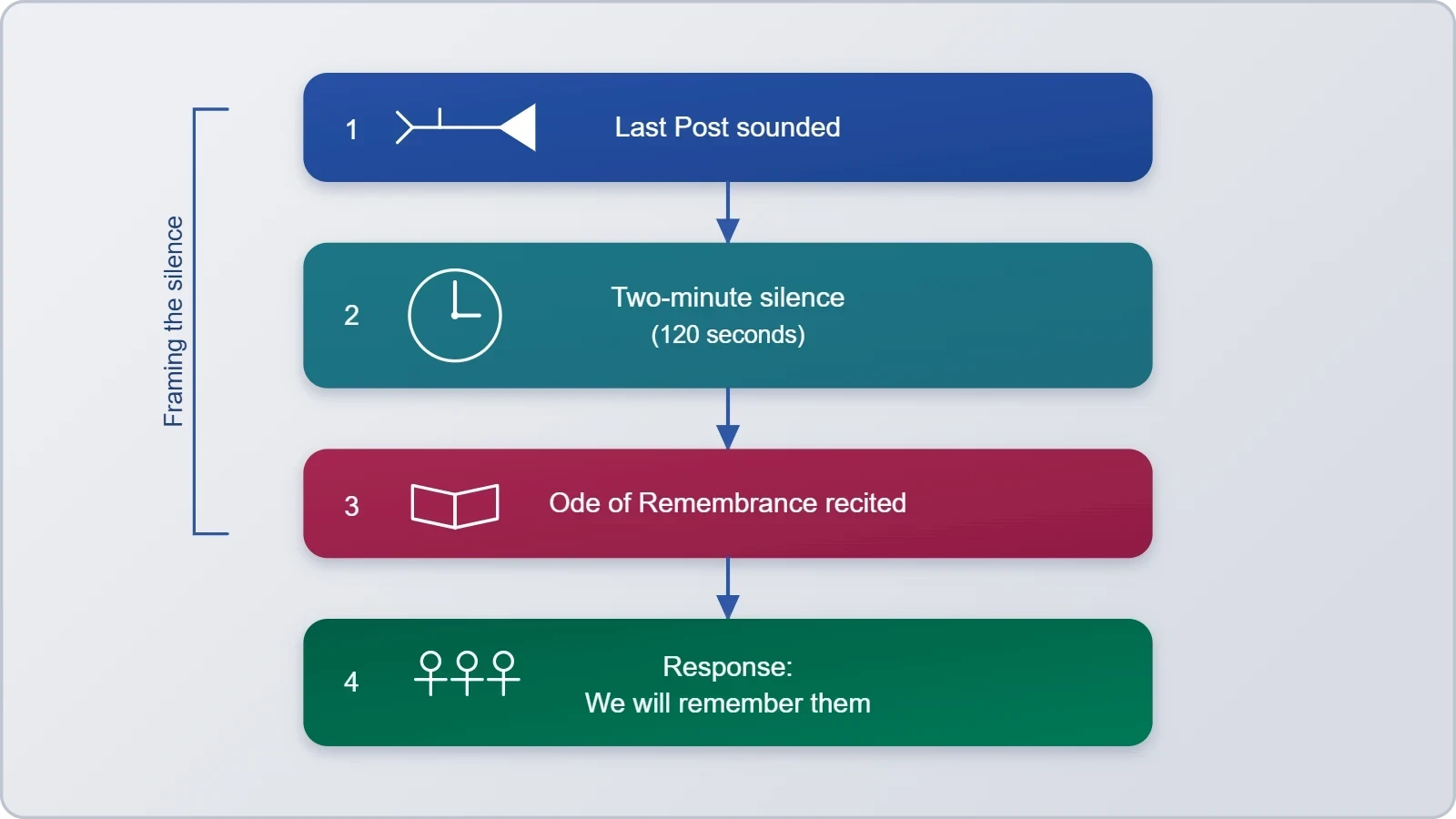
The silence is typically framed by the sounding of the Last Post, a bugle call associated with military funerals, and the recitation of the Ode of Remembrance, drawn from Laurence Binyon's poem "For the Fallen." The line "We will remember them" is repeated by assembled crowds, creating a call-and-response that binds participants together. These elements, repeated annually, have acquired the force of liturgy, carrying emotional weight that transcends their origins in the aftermath of the First World War.
Institutions That Sustain Remembrance
Armistice Day is not self-sustaining; it depends on a network of institutions that organise, fund and publicise the observance. The Royal British Legion, the armed forces, churches, local government, schools and the BBC all play defined roles, each contributing resources and legitimacy. This institutional scaffolding ensures continuity from year to year, allowing the commemoration to adapt to changing circumstances while preserving its essential rituals. Without such coordination, the day would risk fragmenting into disconnected local practices.
The Royal British Legion and the Poppy Appeal
The Royal British Legion, founded in 1921, is the principal custodian of remembrance in the United Kingdom. Its annual Poppy Appeal mobilises tens of thousands of volunteers and raises substantial sums for welfare services supporting veterans, serving personnel and their families. The Legion also organises the Festival of Remembrance at the Royal Albert Hall, a televised event that blends music, testimony and ceremony, extending the reach of remembrance into popular culture and providing a major platform for public reflection.
The Legion's role extends beyond fundraising into advocacy and education. It campaigns on issues affecting the armed forces community, provides advice and support services, and works with schools to develop remembrance resources. This combination of welfare, advocacy and commemoration gives the organisation a distinctive position in British civic life, bridging the gap between ceremonial remembrance and the practical needs of those who have served, and lending the observance a tangible social purpose.
Broadcasters, Schools and Civic Bodies
The BBC has long served as the principal broadcaster of remembrance, carrying the national service live and producing documentaries, dramas and educational content around the theme. Its coverage shapes public understanding of the day, framing the ceremony for audiences who cannot attend in person. Schools, meanwhile, introduce remembrance through assemblies, lessons and creative projects, ensuring that younger generations encounter the tradition and are invited to reflect on its meaning in their own terms.
Local government and faith communities provide the physical and organisational infrastructure for services, maintaining memorials and coordinating ceremonies. Churches, mosques, synagogues and temples often host interfaith gatherings, reflecting the diverse composition of modern Britain. Together, these institutions create a dense network of participation that sustains the observance across the country, ensuring that remembrance is embedded in civic life rather than confined to a single national event.
- 01
- 02
- 03
- 04
Debates, Criticisms and Evolving Meaning
Armistice Day is not immune to controversy, and periodic debates reveal the tensions inherent in public remembrance. Questions about who should be included, whether participation should be expected or voluntary, and how the day should relate to contemporary conflicts surface regularly. These debates are often portrayed as signs of decline, yet they can equally be read as evidence of vitality, demonstrating that the observance remains meaningful enough to argue about and that citizens continue to invest emotional energy in its interpretation.
Participation, Politics and Public Expectation
Debates over participation have intensified in recent years, particularly regarding public figures who choose not to wear a poppy or who question the framing of remembrance. Some argue that social pressure to conform undermines the voluntary spirit of the gesture, while others contend that visible participation signals respect for sacrifice. These disagreements reflect broader questions about national identity, patriotism and the boundaries of acceptable dissent, and they surface most visibly in media commentary and on social platforms each November.
The relationship between remembrance and contemporary conflict also attracts scrutiny. Critics question whether honouring the dead of past wars can coexist with opposition to present or future military action, and whether the language of sacrifice risks glorifying war. Defenders respond that remembrance is fundamentally about grief and gratitude rather than endorsement of conflict, and that the day's capacity to hold dissent alongside commemoration is a mark of maturity rather than weakness.
Inclusion, Diversity and Generational Change
As the generation that fought in the World Wars passes away, remembrance faces the challenge of maintaining relevance without direct living memory. Organisations have responded by broadening the scope of commemoration to include subsequent conflicts and by emphasising themes of service, community and shared sacrifice. This widening of focus has been broadly welcomed, though it raises questions about coherence and about how the day should balance specific historical commemoration with a more general honouring of service.
Diversity and inclusion have also become central themes, with efforts to reflect the contributions of Commonwealth personnel, women, and minority communities in remembrance narratives. Historians have highlighted the often-overlooked service of colonial troops, and contemporary ceremonies increasingly acknowledge this history. These developments suggest that Armistice Day is evolving into a more inclusive civic ritual, capable of accommodating a plural society while retaining its core commitment to honouring the dead.
We Also Published
The Civic Philosophy of the Eleventh Hour
Beneath the ceremony and symbolism lies a distinctive civic philosophy, one that treats remembrance as a public good rather than a private sentiment. Armistice Day invites citizens to acknowledge obligations to the past and to one another, fostering a form of solidarity that transcends political affiliation. It is, in essence, a rehearsal of citizenship, teaching that a society is defined not only by how it treats the living but by how it honours the dead and cares for those who bear the costs of conflict.
Memory, Gratitude and Social Obligation
The philosopher Avishai Margalit has argued that communities have ethical duties to remember, particularly to those who sacrificed on their behalf. Armistice Day operationalises this idea, translating abstract obligation into concrete ritual. The silence, the poppy and the wreath are not merely decorative; they are instruments through which gratitude is expressed and social bonds renewed. This ethical dimension helps explain why the observance retains authority even in a secular, plural society that struggles to agree on shared narratives.
Gratitude, however, is not the same as nostalgia. The most thoughtful commemorations acknowledge the complexity of war, including its moral ambiguities and human costs, rather than presenting a sanitised version of history. By holding grief, gratitude and critical reflection together, Armistice Day can function as a mature civic practice, one that honours sacrifice without glorifying conflict and that invites citizens to consider how the lessons of the past might inform the present.
Remembrance in a Changing Nation
The United Kingdom that observes Armistice Day today is markedly different from the one that first fell silent in 1919. It is more diverse, more secular in its institutions, and more contested in its national narratives. Yet the observance has shown a remarkable capacity to adapt, incorporating new conflicts, new communities and new forms of participation. This adaptability suggests that remembrance is not a relic but a living tradition, one that evolves as the society it serves evolves, and that draws strength from its willingness to change.
Looking ahead, the challenge will be to preserve the day's solemnity while widening its embrace. Digital commemoration, school-led initiatives and community projects offer avenues for engagement, while ongoing debates ensure that the tradition remains responsive. If Armistice Day is to retain its authority, it must continue to balance continuity with openness, honouring the dead while speaking meaningfully to the living, and remaining a moment when a diverse nation can pause, together, in shared reflection.
Conclusion: A Nation Pauses Together
Armistice Day endures because it answers a deep human need: the desire to acknowledge loss, express gratitude and belong to something larger than individual experience. Across the United Kingdom, from the Cenotaph to the smallest village memorial, the eleventh hour provides a shared moment in which difference is set aside and a common humanity is affirmed. The nationwide services that mark the day are not merely historical re-enactments; they are active civic practices, renewed annually by the participation of millions who choose to pause, reflect and remember.
The day's future will depend on its capacity to remain both faithful to its origins and open to new generations. As living memory of the World Wars recedes, remembrance must find fresh ways to communicate the human reality of conflict and the value of peace. The debates that surround the observance, far from signalling decline, indicate that it remains a living tradition, contested and cherished in equal measure. In that tension lies its strength, and in the silence of the eleventh hour lies its enduring promise.
From our network :
- Live Online English Classes for Kids: Do They Actually Reduce Anxiety?A ten-week study reveals that synchronous online English classes can significantly reduce child language anxiety while improving listening and reading skills. Discover what makes these programs effective and how parents can select the right one.
- CISA’s Ten-Advisory Wave: Why Generic Patching Fails in OT and How to Build Product-Specific PlaybooksCISA released ten ICS advisories in one week, exposing critical infrastructure risks. Generic patching fails in OT. Learn to build product-specific remediation playbooks.
- The Hidden Cost of AI Convenience: Why Over-Permissioned Agents Are a Security Time BombDiscover why AI agents with excessive permissions create dangerous single points of failure, and learn how implementing least privilege principles can protect your organization from exploitation.
- Mobile Learning and VR in English: What Global Evidence Reveals About Effective Language TechnologyA systematic review across 14 countries reveals which language-learning technologies genuinely work. Mobile learning, AI, and VR show measurable benefits when pedagogically integrated. This evidence-based guide helps educators and learners select technology that delivers real return on investment.
- University Language Proficiency Exams: Why Institutional Tests Demand Different Preparation Than IELTS and TOEFLDiscover why university-specific language proficiency examinations differ fundamentally from IELTS and TOEFL, and learn strategic preparation approaches for institutional assessment success.
- Forbidden Matrix Patterns and Visible Lattice Points: A Geometric DictionaryExplore how multidimensional 0–1 matrices encode geometric truths, linking forbidden patterns to visible lattice points and hypergraph theory, with applications in combinatorics and computational geometry.
- The Final Descent: How ESA Retired the Legendary Cluster Constellation After 24 Years of Space Weather ScienceAfter 24 years mapping Earth’s magnetosphere, ESA’s Cluster mission concluded with a precisely controlled reentry over the South Pacific. This analysis explores the scientific legacy, engineering decisions, and debris mitigation principles behind one of space exploration’s most responsible retirements.
- How AI Agents Will Change the Way We Manage Personal FinancesExplore how AI agents are transforming personal finance through automated budgeting, bill payment, and investment management, while examining the critical security protocols and governance frameworks required for safe deployment.
- Committed Mediterranean Precipitation Decline: Why Emissions Cuts Alone Cannot Restore Winter RainsNew NOAA research reveals that Mediterranean winter rains may decline irreversibly even with emissions cuts. Explore the science of committed climate change and regional impacts.
RESOURCES
- At 11am, where duty permitted, officers and staff across Scotland ...facebook.comNov 11, 2025 ... ... remembrance, we joined our communities nationwide to honour and commemorate. ... Remembrance at ceremonies across the UK to mark…
- Everything you need to know about Remembrance Day - CWGCcwgc.org7 days ago ... The main UK national day of Remembrance ceremonies. Armistice Day. 11 November. Marks the anniversary of the Armistice taking effect…
- Today is Armistice day. At 11am, a two-minute silence will be held at ...facebook.comNov 11, 2025 ... Remembrance services and events at war memorials, cenotaphs and ... The traditional UK-wide Remembrance ceremony will be held in ...
- 132 Nationwide War Memorials Listed Ahead of Armistice Dayhistoricengland.org.ukNov 10, 2020 ... ... Services (63). It was ... The cross stands here as a memorial to the representatives of the British nation…
- Remembrance 2019 | The Royal Familyroyal.ukOther Remembrance events this year include: Monday 11 November - The Duke of Kent will attend The National Memorial Arboretum Armistice Day Service in ...
- UK Civil Service's Post - LinkedInlinkedin.com7 hours ago ... #RemembranceDay #ArmisticeDay #LestWeForget #UKCivilService. the ... Hundreds of Best Start Family Hubs open nationwide. UK Civil Service ...
- Is There a Better Way to Observe Veterans Day? - The Atlantictheatlantic.comNov 11, 2014 ... ... Armistice Day in tribute to those who have died in military service. In a nationwide survey of adults by…
- Police Scotland Remembrance Day Armistice Day 2025scotland.police.ukNov 7, 2025 ... As part of efforts nationwide, a memorial service at Scottish Police ... Chief Constable Jo Farrell attends SPC Tulliallan's Armistice…
- Southwark Remembers 2025southwark.gov.ukOct 7, 2025 ... ... nationwide two-minute silence at 11am. It will ... The official borough service for Armistice Day will take place at…
- The origins of Memorial Day and how it has evolved | PBS Newspbs.orgMay 25, 2026 ... Memorial Day is a U.S. holiday that is officially about mourning the nation's fallen service ... Armistice Day, which marked…
- Remembrance poppy - Wikipediaen.wikipedia.org... nationwide distribution of remembrance poppies before Memorial Day in 1922. ... "Armistice Day, Remembrance Day commemorations in Korea". www.koreaherald ...
- Our history - The Royal Canadian Legionlegion.ca... British Empire Services ... Canada observed its first Armistice Day one year after the First World War ended, officially recognized as Remembrance Day…
- How the end of the First World War will be honoured 100 years onthe-independent.comNov 11, 2018 ... Appropriately, Armistice Day coincides with Remembrance Sunday for its centenary, the latter always held on the second Sunday in November, ...
- Armistice Day London 2026: Cenotaph and Quiet Memorialsfunlondontours.com7 days ago ... How Is Remembrance Marked in the UK? Through the two-minute silence ... services in towns and cities nationwide. The National…
- Remembrance Parades And Services Across the UKblesma.orgIn Southampton, a parade is held on Armistice Day, on 11th November. This will take place at the Cenotaph in Watts Park from 10:30AM.…
- 01
- 02
- 03
- 04
- 05
- 06
- 07
- 08
0 Comments