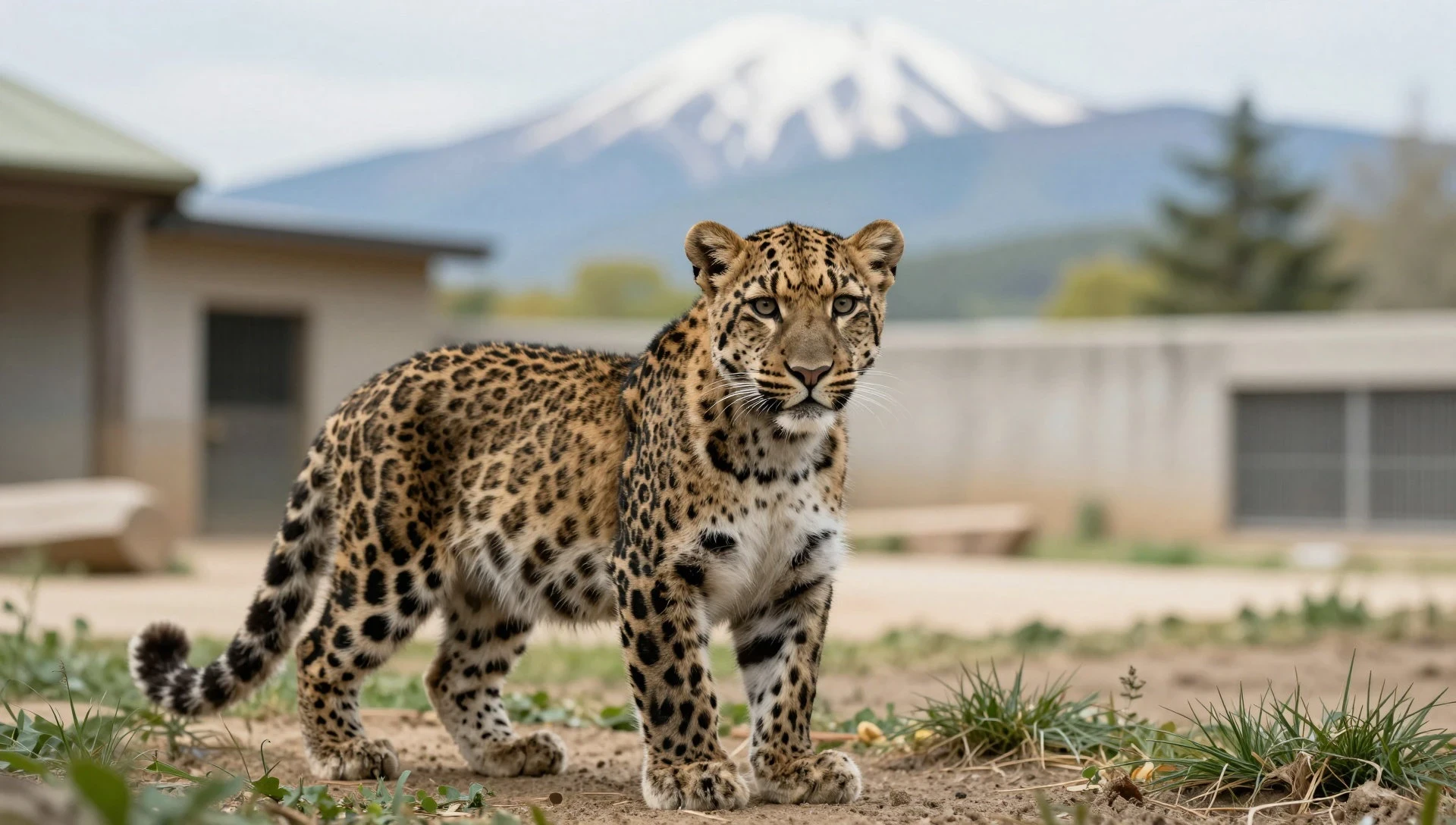
On 11 November 2026, Asahiyama Zoo in Hokkaido opened a public naming contest for a rare Amur leopard cub, inviting visitors to help choose the name that will follow the animal through its life. The announcement is brief, almost modest in its framing, yet it carries a weight that extends well beyond a single zoo enclosure in northern Japan. A naming contest is, at its surface, a piece of visitor engagement — a warm, participatory gesture that draws the public into the institution's daily life. Beneath that surface, however, sits a far more consequential story about one of the most endangered big cats on Earth and the fragile institutional machinery that keeps its lineage alive.
The Amur leopard, native to the temperate forests of the Russian Far East and the borderlands of northeast China, is among the rarest felids in existence. Wild populations have hovered in the low hundreds for decades, and every cub born under managed care represents a meaningful addition to a genetic pool that conservationists guard with extraordinary care. When a zoo asks the public to name such an animal, it is performing two functions at once: it is building emotional attachment to a species most people will never see in the wild, and it is quietly recruiting a constituency for conservation. The contest is therefore both a celebration and a strategic act of public education.
This analysis examines the Hokkaido announcement through the lenses that matter most — the biology and conservation status of the Amur leopard, the institutional role of Asahiyama Zoo, the mechanics and cultural logic of naming contests, and the broader question of how modern zoos convert a single newborn animal into durable public value. What emerges is a portrait of a small news item that functions as a window onto wildlife conservation, institutional branding, and the emotional economy of endangered species.
On This Page
- The Amur Leopard: A Species on the Edge
- Asahiyama Zoo and the Strategy of Public Engagement
- The Cultural Mechanics of Naming Contests
- From Cub to Cause: The Economics of Endangered Species
- Media Framing and the Global Conservation Conversation
- What the Cub Represents: Conservation, Kinship, and Hope
- The Road Ahead for the Hokkaido Cub
TL;DR Asahiyama Zoo in Hokkaido has invited visitors to name a rare Amur leopard cub that first appeared publicly on 11 November 2026. The contest is a public-engagement device, but it also sits atop a serious conservation reality: Amur leopards are among the world's most endangered big cats, with wild numbers in the low hundreds. This analysis unpacks the species' biology, the zoo's institutional strategy, the cultural mechanics of naming contests, and the wider economics of endangered-species display — showing how a single cub becomes a vehicle for education, fundraising, and genetic stewardship.
The Amur Leopard: A Species on the Edge
The Amur leopard (Panthera pardus orientalis) occupies a narrow and unforgiving niche. It is the northernmost of all leopard subspecies, adapted to the cold, snow-heavy forests of the Russian Far East and the mountainous border country of northeast China. Its coat grows thick and pale in winter, a physiological response to temperatures that routinely plunge far below freezing. Unlike its savanna relatives, it hunts in deep snow and dense taiga, preying on roe deer, sika deer, and hare. This specialization is precisely what makes the subspecies so vulnerable: it is exquisitely tuned to a habitat that is itself shrinking under logging, road construction, and human settlement.
Population Status and Genetic Fragility
Wild Amur leopard numbers have been estimated in the low hundreds, with camera-trap surveys in Russia's Land of the Leopard National Park suggesting a slowly recovering but still perilously small population. Small populations carry a compounding burden: reduced genetic diversity, inbreeding depression, and heightened susceptibility to disease and stochastic events. A single outbreak or a severe winter can erase years of incremental gain. Conservation geneticists therefore treat every captive birth as a contribution to a managed metapopulation — a coordinated breeding network designed to preserve genetic variation that the wild population can no longer afford to lose.
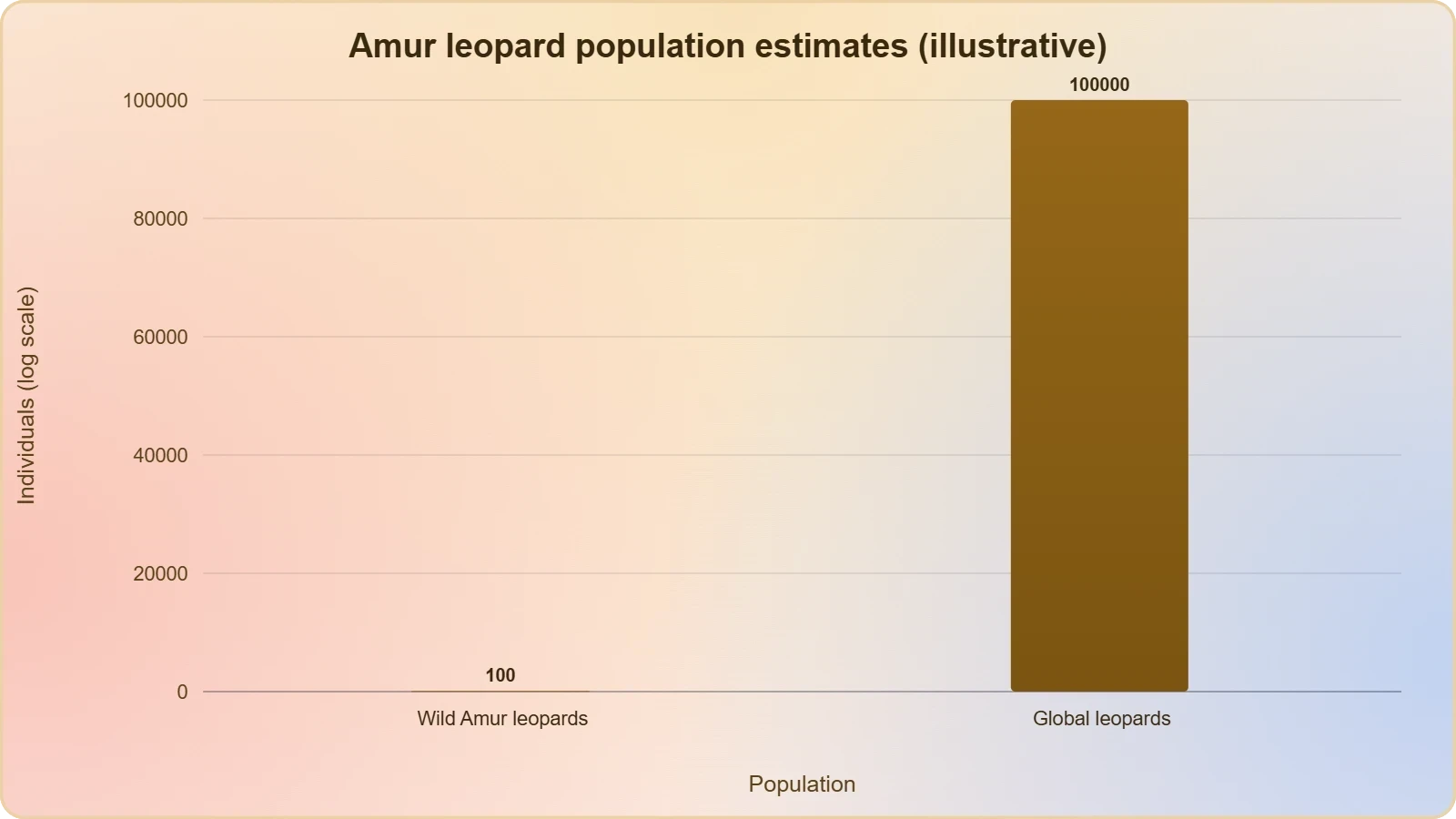
The captive population itself is small and carefully tracked through studbooks. Each cub is assigned a recorded lineage, and breeding recommendations are made to minimize inbreeding coefficients. This is where the mathematics of conservation becomes concrete: genetic diversity is measured and managed, not left to chance. The health of a cub born at Asahiyama Zoo is thus a data point in a continental breeding strategy, and its name — however whimsical — will attach to an animal whose genetic profile is already documented in international registries.
Habitat, Range, and the Recovery Effort
The Amur leopard's wild range has contracted dramatically over the past century, from a broad sweep of the Korean Peninsula and northeast China to a fragment of transboundary forest. Recovery efforts have concentrated on protecting that fragment, expanding protected areas, and reducing poaching and prey depletion. Russia's Land of the Leopard park, established in 2012, has become the anchor of these efforts, and camera traps there have documented population growth from a low of roughly 30 adults to the low hundreds. China has established its own reserves across the border, and cross-border cooperation has become essential to the subspecies' survival.
Reintroduction and population reinforcement remain technically difficult. Leopards require large territories, abundant prey, and safe corridors between habitat patches. Each of these requirements is a policy problem as much as an ecological one, involving land-use planning, anti-poaching enforcement, and community engagement. Zoos enter this picture as holders of genetic insurance and as institutions capable of generating the public will that funds enforcement and habitat protection. The cub in Hokkaido is, in this sense, a diplomatic and financial asset as much as a biological one.
Asahiyama Zoo and the Strategy of Public Engagement
Asahiyama Zoo, perched on a hillside in Asahikawa, Hokkaido, is not an ordinary municipal zoo. Over the past two decades it has become one of Japan's most visited animal parks, celebrated for exhibit design that emphasizes behavioral enrichment and close, respectful viewing. Its polar bear and penguin exhibits are famous for allowing visitors to observe animals from unusual angles, and its philosophy of "action display" — designing enclosures that reveal natural behavior — has been widely studied. The zoo's decision to stage a public naming contest for an Amur leopard cub fits squarely within this institutional identity.
Institutional Identity and Visitor Bonds
A naming contest is a low-cost, high-return engagement tool. It invites visitors to invest attention, generates local media coverage, and creates a sense of shared ownership that translates into repeat visits and membership sales. For a zoo that depends on gate revenue and municipal support, such bonds are not trivial. The contest also produces a stream of user-generated content — entries, social posts, and word-of-mouth — that no advertising budget could easily replicate. In this respect, the Hokkaido contest is a textbook example of participatory marketing applied to a conservation institution.
Yet the strategy is more than marketing. Zoos that succeed in conservation education do so by converting curiosity into care. A visitor who has helped name a cub is far more likely to read the accompanying signage, to understand why the species is endangered, and to support the zoo's breeding and field-conservation programs. The naming contest is thus a gateway: it uses affection for a single animal to open a door onto the larger story of habitat loss and species recovery. That is a legitimate and well-established educational technique, and Asahiyama Zoo is deploying it with characteristic polish.
Hokkaido's Place in Japanese Wildlife Conservation
Hokkaido occupies a distinctive position in Japanese conservation. The island hosts the last wild populations of the Blakiston's fish owl and the Hokkaido brown bear, and it has become a laboratory for coexistence between wildlife and human settlement. Asahiyama Zoo's location in this landscape gives its conservation messaging a natural credibility. The Amur leopard, though not native to Hokkaido, belongs to the same northern temperate biome that the island's own fauna inhabit, making the species a fitting ambassador for cold-climate conservation themes.
The zoo's regional context also shapes its audience. Hokkaido attracts domestic and international tourism, and Asahiyama Zoo is a major draw. A naming contest therefore reaches beyond the local community to a national and even international public, amplifying the conservation message. The cub becomes a small diplomatic figure, linking a northern Japanese city to the transboundary forests of the Russian Far East and to the global network of institutions working to keep the subspecies alive.
The Cultural Mechanics of Naming Contests
Naming contests are a familiar ritual in zoos, aquariums, and wildlife parks worldwide, and their popularity rests on a simple psychological truth: people form attachments to named individuals far more readily than to abstract species. A leopard is a category; a named leopard is a character. Once named, the animal acquires a biography, a personality in the public imagination, and a claim on visitors' attention. Zoos have understood this for generations, and the naming contest is one of the most efficient tools for converting a newborn animal into a recognizable public figure.
Participation, Ritual, and Local Identity
The contest format also carries a ritual dimension. It marks the cub's public debut, gives the community a shared event, and creates a small civic identity around the zoo. In Japan, where seasonal events and community participation are deeply embedded in institutional life, the naming contest fits naturally into a calendar of public programming. Entries are typically submitted by visitors, sometimes by schoolchildren, and the final selection is often made by a committee or a public vote. The process is deliberately transparent and inclusive, reinforcing the zoo's role as a civic institution rather than a distant scientific one.
There is also a linguistic dimension. Japanese naming conventions often favor names that evoke nature, seasons, or qualities, and a leopard cub's name may draw on Hokkaido's landscape — snow, wind, forest, or light. The chosen name will appear on signage, in press releases, and in the zoo's promotional materials for years. It becomes, in effect, a small piece of institutional branding, and the contest ensures that the public feels a stake in that branding. The cub's name is thus both a personal identifier and a collective artifact.
Ethics and the Limits of Spectacle
Naming contests are not without critics. Some conservation commentators worry that the spectacle of a cute cub can overshadow the harder, less photogenic work of habitat protection and anti-poaching enforcement. There is a risk that public attention gravitates toward the charismatic individual while the systemic threats to the species remain underfunded. Zoos are increasingly aware of this tension and often pair naming contests with explicit conservation messaging, fundraising appeals, and partnerships with field programs. The contest becomes a hook rather than an end in itself.
A second concern is animal welfare. Public naming contests can generate intense media interest, and zoos must balance that interest against the cub's need for quiet, controlled development. Reputable institutions manage access carefully, limiting handling and exposure in the early months. Asahiyama Zoo's announcement, which frames the cub's first public appearance as a milestone, suggests a measured approach. The ethical test is whether the contest serves the animal's welfare and the species' conservation, or merely the institution's attendance figures. Done well, it can serve all three.
We Also Published
From Cub to Cause: The Economics of Endangered Species
Endangered species are expensive to keep, and the economics of conservation institutions deserve more attention than they usually receive. A single large carnivore consumes significant resources — food, veterinary care, enclosure maintenance, and specialized staff. Breeding programs add genetic management, record-keeping, and coordination costs. Zoos fund these activities through a mix of gate revenue, memberships, donations, corporate sponsorships, and public subsidies. A high-profile birth like the Amur leopard cub is therefore an economic event as well as a biological one, because it generates the attention that underpins all of these revenue streams.
Visitor Revenue and Conservation Funding
The relationship between visitor revenue and conservation funding is indirect but real. Zoos that attract more visitors can invest more in both exhibits and field programs, and many institutions allocate a portion of admission revenue to conservation partners. A naming contest, by generating media coverage and repeat visits, contributes to this cycle. The cub becomes a revenue catalyst whose value extends far beyond its enclosure. This is not cynicism; it is the practical reality of how conservation is financed in a market economy, and institutions that ignore it struggle to sustain their programs.
There is also a philanthropic dimension. Major donors are often drawn to specific animals and specific stories, and a named cub provides a focal point for giving. Zoos frequently use high-profile births to launch fundraising campaigns, sometimes tied to field projects in the species' native range. The Amur leopard, with its dramatic story of near-extinction and partial recovery, is an especially compelling case. Donors can see a direct line from the cub in Hokkaido to the camera traps and anti-poaching patrols in the Russian Far East.
Genetic Management as Long-Term Investment
Behind the visitor-facing spectacle lies a rigorous scientific enterprise. Captive breeding programs for endangered species are coordinated through studbooks and regional associations, and breeding recommendations are made on the basis of genetic distance, age, and health. The goal is to maintain a population that is genetically diverse enough to remain viable over decades, serving as a backup for the wild population and, in some cases, a source for reintroduction. Each cub is a long-term investment in that genetic reservoir.
The mathematics of small populations is unforgiving. Inbreeding coefficients rise quickly when the number of breeding individuals is small, and the resulting loss of fitness can be severe. Conservation geneticists therefore model breeding scenarios carefully, sometimes using software that simulates pedigrees over many generations. The cub born at Asahiyama Zoo will have its lineage recorded and its future breeding prospects assessed within this framework. Its name may be chosen by the public, but its genetic destiny is decided by science.
- 01
- 02
- 03
- 04
Media Framing and the Global Conservation Conversation
The Hokkaido announcement reached international audiences through NHK World, Japan's public broadcaster, and its framing is instructive. The story is presented as a short, warm news item: a rare cub, a public contest, a date. There is no mention of habitat loss, poaching, or the genetic mathematics of captive breeding. This is not a criticism so much as an observation about how conservation news travels. Short-form broadcast items prioritize accessibility and emotional resonance, and the naming contest provides both. The deeper context is left to longer-form coverage and to the institutions themselves.
How Short-Form News Shapes Perception
Short-form news has a distinctive grammar. It favors concrete, visual, and emotionally legible facts — a cub, a contest, a date — over systemic analysis. This grammar is effective at capturing attention but limited in its capacity to convey complexity. Audiences who encounter the Amur leopard only through such items may come away with a warm feeling and little understanding of why the species is endangered or what would be required to save it. The naming contest, in this framing, is a hook without a line attached.
Yet the hook matters. Conservation communication research consistently finds that emotional engagement precedes informational uptake. A reader who feels something about a cub is more likely to seek out the fuller story than one who encounters a dry population statistic. The short news item is therefore not a failure of depth but a first step in a longer chain of engagement. Zoos, NGOs, and documentary makers build on that first step, and the cub's name becomes a search term that leads curious readers toward richer material.
Japan's Role in Global Wildlife Diplomacy
Japan occupies an ambivalent position in global conservation. It is a wealthy nation with strong scientific institutions and public interest in wildlife, but its record on certain issues — notably whaling and the wildlife trade — has drawn international criticism. Against that backdrop, positive conservation stories from Japanese institutions carry diplomatic weight. A well-run breeding program and a public engagement initiative at a respected zoo contribute to a more constructive image, and they align with Japan's broader soft-power interests in environmental governance.
The Amur leopard story also connects Japan to its neighbors. The subspecies' range spans Russia and China, and conservation efforts require cross-border cooperation. Japanese zoos participate in international breeding networks and contribute to genetic management, and their public-facing initiatives help sustain domestic support for these commitments. The cub in Hokkaido is thus a small node in a transnational network, and its naming contest is a reminder that conservation is as much a matter of public will as of scientific technique.
What the Cub Represents: Conservation, Kinship, and Hope
Strip away the marketing, the genetics, and the media theory, and what remains is a simple and durable fact: a rare animal has been born, and people are being invited to care about it. That invitation is not trivial. In a world where conservation news is often a litany of decline, a healthy cub is a counter-narrative. It suggests that the work of protection can produce results, that institutions can keep species alive, and that public attention can be channeled toward something other than consumption. The naming contest is a small ritual of hope, and hope is a resource that conservation badly needs.
The Emotional Economy of Endangered Species
Emotions are not soft extras in conservation; they are operational inputs. Donations, volunteer hours, political support, and compliance with wildlife regulations all depend on public sentiment. Charismatic species — leopards, pandas, tigers, elephants — generate disproportionate emotional returns, and institutions deploy them strategically. This is sometimes criticized as superficial, but the alternative is worse: a public that feels nothing about extinction is a public that will not fund its prevention. The Amur leopard cub is a charismatic asset, and its naming contest is a way of converting charm into commitment.
The emotional economy has its own logic. Attachment grows through familiarity, and familiarity grows through repeated, positive contact. A named cub provides a stable reference point across visits, news cycles, and social media posts. Over time, the animal becomes a familiar figure in the public imagination, and that familiarity can be extended to its species and its habitat. The process is slow and imperfect, but it is one of the few reliable mechanisms by which distant conservation problems become locally meaningful.
Lessons for Conservation Communication
The Hokkaido contest offers several practical lessons. First, participation beats broadcast: people engage more deeply with conservation when they are invited to do something, even something as small as submitting a name. Second, specificity beats abstraction: a single cub is more compelling than a population statistic. Third, institutions matter: a respected zoo with a clear conservation identity can carry a message that a generic campaign cannot. These lessons are not new, but they are worth restating because they are so often forgotten in practice.
A fourth lesson concerns follow-through. A naming contest generates a spike of attention that fades quickly unless it is connected to ongoing programming. Zoos that succeed in conservation communication build a calendar of engagement — updates on the cub's growth, milestones, educational events, and fundraising appeals — that sustains interest over time. The contest is the beginning of a relationship, not the end of a campaign. Asahiyama Zoo's handling of the months ahead will determine whether the cub becomes a lasting ambassador or a brief news item.
The Road Ahead for the Hokkaido Cub
The cub's immediate future is one of careful management. Young leopards require close veterinary attention, gradual introduction to their environment, and controlled exposure to visitors. The naming contest will conclude, a name will be chosen, and the animal will settle into the routines of captive life. Over the coming years, its progress will be tracked, its health monitored, and its genetic profile integrated into breeding recommendations. If all goes well, it may one day contribute to the captive population's long-term viability, and perhaps — in a distant and uncertain future — to the recovery of its wild relatives.
From Naming Contest to Long-Term Stewardship
The contest is a beginning, not an ending. The real work of stewardship lies in the unglamorous routines that follow: veterinary checkups, dietary management, behavioral enrichment, and record-keeping. It lies, too, in the institutional commitment to conservation that the contest advertises. Visitors who named the cub will expect the zoo to live up to the promise implicit in the event — that this is an institution serious about protecting a species, not merely displaying one. The cub's name will be a reminder of that promise, and the zoo's conduct will determine whether it is kept.
For the public, the cub offers a small and accessible entry point into a large and difficult subject. It is easy to feel overwhelmed by the scale of global biodiversity loss, and easy to conclude that individual actions and local institutions do not matter. The Hokkaido contest suggests otherwise. A single cub, carefully managed and publicly celebrated, can carry a message that reaches thousands of people and sustains a network of institutions working on the species' behalf. That is a modest but genuine contribution, and it deserves to be recognized as such.
Why Small Stories Matter in Conservation
Conservation is often narrated through crises, and crises are necessary to mobilize attention. But crises alone are exhausting, and audiences eventually turn away. Small, positive stories provide balance. They show that the work is ongoing, that births happen, that institutions endure, and that the future is not entirely bleak. The Amur leopard cub in Hokkaido is one such story. It does not solve the species' problems, but it keeps the species in view, and keeping a species in view is a precondition for saving it.
The naming contest, in this light, is more than a publicity stunt. It is a small act of cultural maintenance, a way of keeping a rare animal present in public consciousness. The name chosen will be spoken by children, printed on signs, and shared online. Each of those acts is a tiny reinforcement of the idea that Amur leopards matter. Multiplied across institutions and years, such reinforcements build the public will that conservation ultimately depends on. The cub's name, whatever it turns out to be, will carry that weight.
From our network :
- CISA’s Ten-Advisory Wave: Why Generic Patching Fails in OT and How to Build Product-Specific PlaybooksCISA released ten ICS advisories in one week, exposing critical infrastructure risks. Generic patching fails in OT. Learn to build product-specific remediation playbooks.
- Live Online English Classes for Kids: Do They Actually Reduce Anxiety?A ten-week study reveals that synchronous online English classes can significantly reduce child language anxiety while improving listening and reading skills. Discover what makes these programs effective and how parents can select the right one.
- Forbidden Matrix Patterns and Visible Lattice Points: A Geometric DictionaryExplore how multidimensional 0–1 matrices encode geometric truths, linking forbidden patterns to visible lattice points and hypergraph theory, with applications in combinatorics and computational geometry.
- The Final Descent: How ESA Retired the Legendary Cluster Constellation After 24 Years of Space Weather ScienceAfter 24 years mapping Earth’s magnetosphere, ESA’s Cluster mission concluded with a precisely controlled reentry over the South Pacific. This analysis explores the scientific legacy, engineering decisions, and debris mitigation principles behind one of space exploration’s most responsible retirements.
- The Hidden Cost of AI Convenience: Why Over-Permissioned Agents Are a Security Time BombDiscover why AI agents with excessive permissions create dangerous single points of failure, and learn how implementing least privilege principles can protect your organization from exploitation.
- Mobile Learning and VR in English: What Global Evidence Reveals About Effective Language TechnologyA systematic review across 14 countries reveals which language-learning technologies genuinely work. Mobile learning, AI, and VR show measurable benefits when pedagogically integrated. This evidence-based guide helps educators and learners select technology that delivers real return on investment.
- Committed Mediterranean Precipitation Decline: Why Emissions Cuts Alone Cannot Restore Winter RainsNew NOAA research reveals that Mediterranean winter rains may decline irreversibly even with emissions cuts. Explore the science of committed climate change and regional impacts.
- University Language Proficiency Exams: Why Institutional Tests Demand Different Preparation Than IELTS and TOEFLDiscover why university-specific language proficiency examinations differ fundamentally from IELTS and TOEFL, and learn strategic preparation approaches for institutional assessment success.
- How AI Agents Will Change the Way We Manage Personal FinancesExplore how AI agents are transforming personal finance through automated budgeting, bill payment, and investment management, while examining the critical security protocols and governance frameworks required for safe deployment.
RESOURCES
- Rare leopard cub at zoo in Hokkaido seeks a name - Facebookfacebook.com5 hours ago ... A visitor contest will decide the name of an Amur leopard cub at Asahiyama Zoo in Hokkaido. The cub made…
- Amur Leopard Animal Facts - Panthera pardus orientalisa-z-animals.comAmur leopard at Asahiyama Zoo (Asahikawa, Hokkaido) Musashi2001/Shutterstock.com ... Reproduction and Life Cycles. Amur Leopard Cub. Amur leopard cubs live ...
- The Polar Bears of Asahiyama - Rare Photos by Viki Panditvikipandit.comMar 8, 2016 ... ... Amur Leopards, and Scops Owls. In winter ... Racoon Dog at Asahiyama Zoo · Asahikawa · Hokkaido · Japan…
- Rare leopard cub at zoo in Hokkaido seeks a nameーNHK WORLD ...youtube.com8 hours ago ... A visitor contest will decide the name of an Amur leopard cub at Asahiyama Zoo in Hokkaido. The cub made…
- Amur Leopard images - Shutterstockshutterstock.comAmur leopard at Asahiyama Zoo (Asahikawa, Hokkaido) Stock Photo. Amur leopard ... Amur leopard cub, Panthera pardus orientalis, roaring, isolated on white ...
- Ussuri brown bear - Wikipediaen.wikipedia.orgThe native range of the bear lies mainly in the Russian Far East, Northeast China, Hokkaido and on some islands in the Sea of…
- Leopardo De Amur royalty-free images - Shutterstockshutterstock.comAmur leopard at Asahiyama Zoo (Asahikawa, Hokkaido). Amur leopard at Asahiyama Zoo (Asahikawa, Hokkaido) Stock Photo ... Amur leopard cub walking, showing ...
- North American Regional Amur Leopard Studbookalouattasen.weebly.comGRANBY - Granby Zoo / Zoo De Granby, Granby, Quebec, Canada. 585 F 17 ... Wildlife Conservation Center, Asahikawa-shi, Hokkaido, Japan, 708 11. 81…
- Amur Leopard Habitat Planet Zoo - Instagraminstagram.com... zoo 北海道 hokkaido 旭川 asahikawa 動物 animal. Suns out, cubs out ☀️ #ICYMI: You can now visit Amur leopard cubs · hoglezoo. 28.9K.…
- Rare leopard cub at zoo in Hokkaido seeks a namewww3.nhk.or.jp8 hours ago ... A visitor contest will decide the name of an Amur leopard cub at Asahiyama Zoo in Hokkaido. The cub made…
- Up close for penguins and seals! "ASAHIYAMA ZOO" 4 points and ...allway-japan.comIt is home to four species of felines: lion, amur tiger, snow leopard, and amur leopard. ... Address: Kuranuma, Higashi-Asahikawa-cho, Asahikawa-shi, Hokkaido
- ABE Hiroshi - IBBY.orgibby.orgMar 27, 2025 ... Born in 1948 in Asahikawa City, Hokkaido. From 1972, he worked as a zookeeper at Asahiyama. Zoo in Asahikawa for…
- Tokyo Friends of the Zoo Magazine "Animals and the Zoo"tokyo-zoo.netThe cover features Tsushima Leopard Cat at Inokashira Park Zoo. We will also introduce Snow Leopard breeding, the raising of three native horses -…
- 721 leopard facing Images & Stock Photos - Dreamstimedreamstime.comAmur Leopard panting, with tongue sticking out. ... A lion (Panthera leo) is seen through the bars of its enclosure at Asahiyama Zoo in…
- Summer's exciting event! I went to Sapporo's Maruyama Zoo at night!hokkaido-labo.comNov 2, 2026 ... Visiting zoos has become a staple of Hokkaido tourism! Alongside Asahiyama Zoo ... Hokkaido brown bears, and Amur tigers were…
- 01
- 02
- 03
- 04
- 05
- 06
- 07
- 08
0 Comments