Belgium has crossed a threshold that few European democracies anticipated crossing so soon. In a parliamentary vote that followed months of tense debate, lawmakers approved legislation empowering police to enter private residences without the occupant's consent in order to remove individuals whose applications to remain in the country have been rejected. The measure, expected to take effect next spring, reframes the home — long treated as a sanctuary shielded by constitutional protection — as a site of administrative enforcement. The vote did not arrive quietly. More than sixty demonstrations unfolded across the country beforehand, and the objections came not only from activist circles but from judges, lawyers' associations, and human rights organisations who ordinarily occupy a more measured register.
What makes the Belgian law consequential is not simply its domestic reach but its position within a wider European drift. The legislation allows the immigration office to petition an investigating judge for authorisation to enter residences where undocumented people may be living, including the homes of friends or family members hosting them. Once a warrant is issued, police may enter between 5am and 9pm, detain individuals, and search for identity documents — potentially while children are present. Officials frame the measures as targeting three categories: rejected asylum seekers, those who have ignored departure orders, and persons deemed a threat to public order or national security. Critics counter that the definition of "public threat" remains dangerously elastic, delegated to individual judges without meaningful appeal mechanisms.
The controversy extends well beyond Belgium's borders. The Brussels-based Platform for International Cooperation on Undocumented Migrants has warned that the law treats deportation — an administrative procedure — as though it were criminal enforcement, and pointed to comparable developments in the Netherlands and Germany, alongside the European Union's recently approved returns regulation. Rights groups argue that home raids of this kind, as witnessed in the United States, generate fear, fracture families, and erode trust in public institutions. The deeper question the Belgian vote raises is structural: whether liberal democracies can reconcile immigration control with constitutional protections that were never designed to distinguish between citizens and non-citizens inside the home.
On This Page
TL;DR Belgium's parliament has approved a law permitting police to enter homes without consent to remove undocumented migrants whose asylum claims have been rejected or who have ignored departure orders. Entry requires judicial authorisation and may occur between 5am and 9pm, with police empowered to detain people and search for identity documents. Officials describe the measure as a targeted enforcement tool; critics — including Amnesty International, judges' associations, and more than twenty rights groups — call it vague, unappealable, and constitutionally troubling. The law mirrors developments in the Netherlands, Germany, and the EU's returns regulation, signalling a broader European shift toward enforcement-led immigration policy.
The Architecture of Belgium's New Enforcement Law
The Belgian legislation is best understood as a procedural instrument rather than a blanket power. It does not grant police the authority to enter any home at will; instead, it creates a chain of authorisation beginning with the immigration office, passing through an investigating judge, and culminating in a warrant that permits entry during defined daytime hours. That architecture matters because it places the judiciary at the centre of enforcement, at least formally. Yet the law's critics argue that this judicial layer provides thinner protection than it appears, since judges are asked to assess threat classifications that the statute itself leaves undefined and that no appeals process can subsequently revisit.
How the Authorisation Chain Operates
The immigration office initiates the process by identifying a residence where an individual subject to removal may be living. That residence need not belong to the migrant; the law explicitly contemplates homes where friends or family are hosting someone whose claim has failed. The office then requests that an investigating judge authorise entry. Once granted, police may enter between 5am and 9pm — a window that deliberately captures early morning hours when people are most likely to be present. During entry, officers may detain the individual and search for identity documents, a provision that extends the operation beyond simple removal into evidentiary territory.
The 5am to 9pm window has drawn particular scrutiny because it permits operations at hours when children are typically at home preparing for school. Officials insist the measures are calibrated toward individuals who have exhausted legal avenues or who pose genuine security concerns. But the statute's language does not require officers to schedule entries around family circumstances, and no provision mandates that minors be shielded from the process. For critics, this is where administrative efficiency collides with the constitutional principle that the home enjoys protection irrespective of the resident's administrative status — a principle Belgian rights groups have invoked repeatedly.
The Three Categories Targeted by the Measure
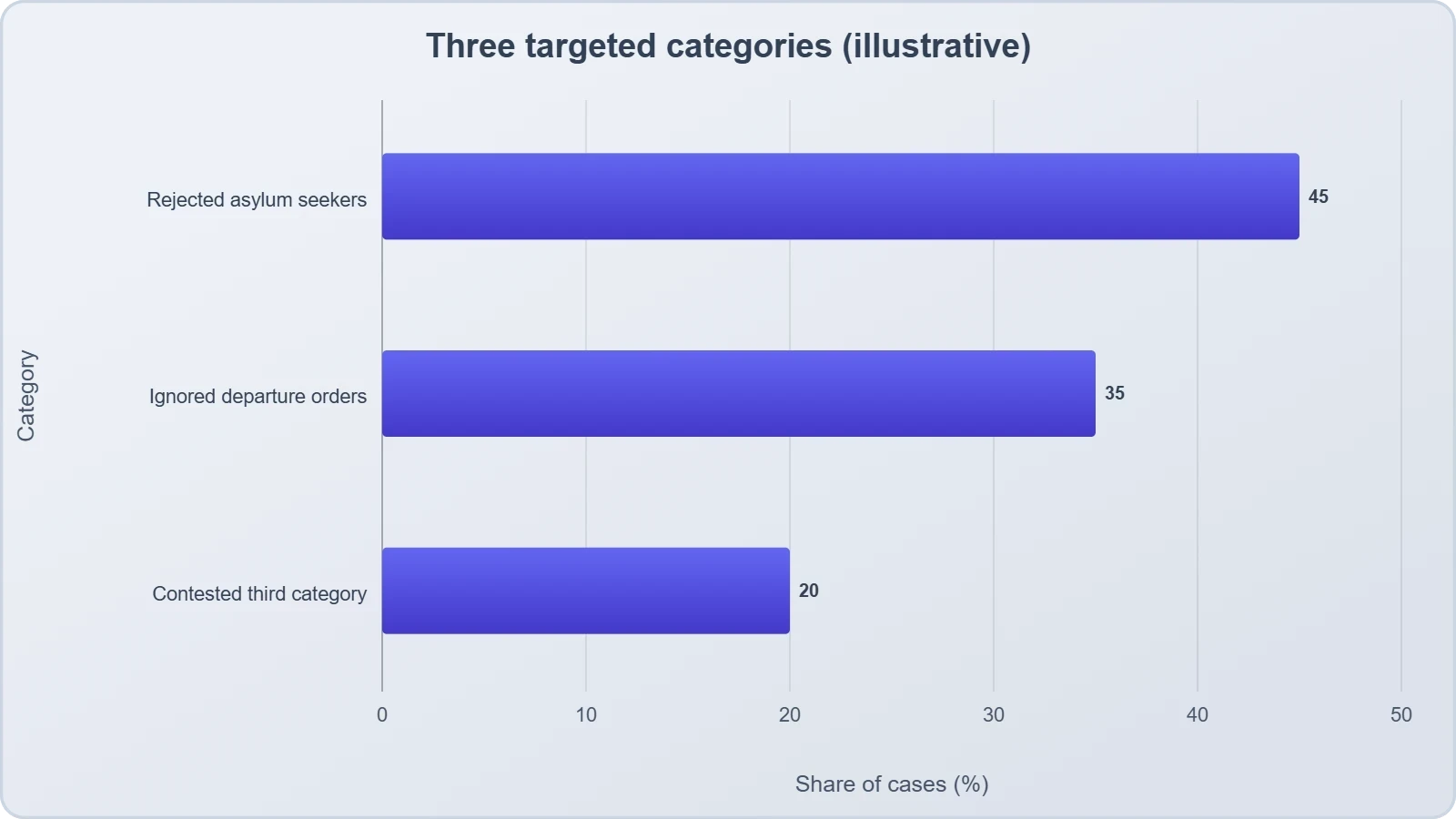
Officials have been careful to describe the law as narrowly aimed. The first category comprises rejected asylum seekers who have exhausted their appeals. The second covers individuals who have received departure orders and ignored them. The third — and most contested — encompasses persons considered a threat to public order or national security. It is this third category that has generated the sharpest objections, because "public order" and "national security" are terms whose boundaries shift with political circumstance. Critics note that the law offers no statutory definition, leaving individual judges to determine what constitutes a threat, with no avenue for those affected to challenge the classification.
The absence of an appeal mechanism is, for legal scholars, among the law's most troubling features. Administrative detention and removal decisions ordinarily carry some route to review, however constrained. Under the new framework, once a judge authorises entry, the operation proceeds without a subsequent hearing on the merits of the threat assessment. Lawyers' associations have argued that this creates an asymmetry: the state may act on a classification that the affected person cannot contest. The result, they contend, is a system where judicial authorisation functions as a formality rather than a genuine check on executive power.
The Legal and Constitutional Battle Lines
At the heart of the dispute lies a question older than the Belgian state itself: what does the constitutional protection of the home actually guarantee, and to whom? Belgian rights groups have argued that the home's inviolability attaches to the dwelling, not to the legal status of the person inside it. Twenty organisations issued a joint warning that the law conflates the absence of legal status with criminal behaviour — a conflation they regard as both legally unsound and morally corrosive. The government's position is that enforcement of removal orders is a legitimate administrative function, and that judicial authorisation supplies the necessary safeguard against arbitrary action.
Why "Public Threat" Remains Contested
The phrase "threat to public order or national security" carries substantial weight in the statute, yet the law supplies no definition. In practice, this means individual investigating judges will determine, case by case, whether a person's presence meets the threshold. Critics argue this produces inconsistent outcomes across jurisdictions and invites judicial discretion to fill gaps that legislators declined to close. Defence lawyers have noted that the absence of a definitional anchor makes it difficult to prepare any meaningful challenge, since the criteria against which a client is measured remain opaque until the moment of decision.
Comparative experience offers limited reassurance. The Netherlands and Germany operate comparable measures, and the European Union's recently approved returns regulation contains provisions in a similar spirit. But the existence of precedent does not settle the constitutional question; it merely relocates it. Belgian legal scholars have pointed out that the country's constitutional tradition treats the home as a protected sphere precisely because administrative convenience has historically been an insufficient justification for intrusion. Whether that tradition bends or holds under the new law will likely be tested in the courts, and possibly before the European Court of Human Rights.
The Absence of an Appeal Mechanism
Perhaps the most consequential feature of the legislation is what it omits. Once a judge authorises entry, the affected person has no statutory route to contest the underlying threat classification. Administrative removal proceedings ordinarily carry some review, however compressed; this framework does not. Lawyers' associations have described the omission as a structural defect rather than an oversight, arguing that it renders judicial authorisation a procedural formality. The practical effect, they contend, is that the state may act on a classification the individual cannot examine, let alone rebut, before enforcement occurs.
This asymmetry has implications beyond Belgium. If the law survives legal challenge, it establishes a template in which judicial involvement legitimises enforcement without providing contestation. Other EU member states weighing similar measures may cite the Belgian model as evidence that judicial authorisation satisfies rule-of-law requirements. Critics warn that this reasoning mistakes form for substance: a judge who authorises entry on undefined criteria is not exercising the checking function that judicial oversight is meant to perform. The argument is likely to shape litigation for years.
Civil Society, Protest, and the Language of Fear
The public response to the Belgian law has been unusually broad for an immigration measure. More than sixty protests took place across the country in the weeks preceding the vote, drawing participants well beyond the activist base that typically mobilises on migration issues. Judges and lawyers' associations added their voices, lending the opposition a professional and institutional character that governments find harder to dismiss than street demonstrations. Amnesty International's French-speaking Belgian section distilled the critique into a single phrase — "a law of fear" — that has since travelled through European media coverage of the vote.
Why Judges and Lawyers Broke Ranks
The participation of judges and lawyers' associations is significant because these groups rarely oppose enforcement legislation in public. Their objection centred on the law's procedural architecture: the delegation of undefined threat assessments to individual judges, and the absence of any appeal route for those affected. When the people who administer the legal system warn that a statute undermines it, the warning carries weight that political opposition cannot replicate. Their intervention also complicates the government's framing of criticism as partisan or ideological, since the objections came from within the professional apparatus of the state itself.
Rights organisations made a parallel argument in constitutional terms. Twenty groups warned that the law conflates lack of legal status with criminal behaviour, and that the home is protected under the Belgian constitution regardless of the residents' administrative position. This is not a novel claim; it restates a principle long embedded in European constitutional traditions. What is new is the assertion that a democratically elected parliament has legislated against it. The dispute therefore concerns not only immigration policy but the limits of parliamentary power when it encounters entrenched constitutional guarantees.
The PICUM Warning and the American Precedent
The Platform for International Cooperation on Undocumented Migrants, based in Brussels, has framed the law as a deportation instrument dressed in criminal enforcement language. Its most pointed observation concerns the American precedent: home raids in the United States, it notes, have generated widespread fear, separated families, and driven undocumented populations further from health and education services. PICUM's warning is that Belgium is moving in a similar direction, and that the consequences — diminished public trust, reduced cooperation with authorities, and the normalisation of domestic intrusion — will follow a familiar pattern.
The organisation also situates Belgium within a continental trend. The Netherlands and Germany maintain comparable measures, and the EU's recently approved returns regulation includes provisions in the same spirit. This means Belgium is not an outlier but a participant in a broader realignment of European immigration enforcement. Campaigners argue that the cumulative effect of such measures is a gradual weakening of the rule of law and of respect for human rights — not through any single dramatic rupture, but through the steady accretion of powers that individually appear modest and collectively transform the relationship between the state and the home.
We Also Published
- 01
- 02
- 03
- 04
Constitutional Inviolability and the Administrative Status Question
The constitutional argument advanced by Belgian rights groups deserves careful attention because it reframes the debate. Their claim is not that immigration enforcement is illegitimate, but that the home's protection under the constitution does not depend on the resident's administrative status. If that reading is correct, the law's reliance on status to justify entry represents a constitutional innovation of considerable magnitude. Governments across Europe have long distinguished between citizens and non-citizens in matters of entry, residence, and removal. Extending that distinction into the physical sanctuary of the dwelling is a different order of policy change.
What the Constitution Actually Protects
Belgian constitutional doctrine, like that of most European states, treats the home as a protected sphere against arbitrary intrusion. The protection is ordinarily understood to attach to the dwelling itself rather than to the person occupying it, which is precisely why rights groups argue that administrative status is legally irrelevant to the question of entry. The government's counter-position is that removal orders are lawful exercises of state authority, and that judicial authorisation supplies the safeguard the constitution requires. Whether that reasoning holds will depend on how courts interpret the relationship between enforcement powers and constitutional guarantees.
The stakes extend beyond any single case. If courts accept that judicial authorisation alone satisfies constitutional requirements, the practical protection afforded to residents becomes procedural rather than substantive. If they reject that reasoning, the Belgian law may require amendment or face invalidation. Either outcome will influence how other European states design their own enforcement frameworks. The litigation, when it comes, will therefore function as a referendum not only on Belgium's law but on the broader European assumption that administrative efficiency can be reconciled with constitutional protection through procedural formality.
The Wider European Trajectory
Belgium's vote is best read as a data point in a longer trend rather than an isolated event. Across the European Union, governments have been converging on enforcement-led immigration policies, and the recently approved returns regulation provides a continental framework that member states can invoke. The Netherlands and Germany already operate comparable measures. What distinguishes the Belgian case is the speed of adoption, the breadth of domestic opposition, and the explicit invocation of the American precedent by rights organisations. Together these factors make Belgium a test case for how far European publics will permit enforcement to extend into the private sphere.
The trajectory raises a question that transcends immigration policy: what happens to constitutional protections when they encounter populations that lack political voice? Undocumented migrants cannot vote, rarely litigate successfully, and depend on civil society to articulate their interests. When legislation targets precisely such populations, the ordinary mechanisms of democratic accountability operate weakly. Critics argue that this asymmetry is not incidental but structural, and that the gradual weakening of rule-of-law norms proceeds most easily against those least able to resist. The Belgian law, on this reading, is less about migration than about the conditions under which rights erode.
What the Belgian Precedent Means for European Migration Policy
Belgium's law matters disproportionately to its size because it demonstrates that a founding member of the European project can adopt enforcement measures previously associated with more restrictive jurisdictions. The government's framing — targeted, judicially authorised, limited to rejected claims and security threats — offers a template that other capitals can adapt. The critics' framing — vague, unappealable, constitutionally corrosive — offers a warning that other civil societies can invoke. Which framing prevails will depend less on the merits of either argument than on the political weather across the continent, and on whether courts intervene before the law becomes embedded practice.
The Mechanics of Gradual Erosion
Campaigners have been careful to describe the Belgian law not as a rupture but as an accretion. Each measure appears modest in isolation: a judicial warrant here, a daytime entry window there, a threat classification left to individual judges. The cumulative effect, however, is a transformation of the relationship between the state and the home. This is the mechanism that rights organisations describe when they speak of gradual weakening: not a single dramatic assault on constitutional norms, but a sequence of procedural adjustments that individually seem reasonable and collectively redefine what the state may do inside a private residence.
The mechanism is difficult to resist precisely because each step can be defended on its own terms. Judicial authorisation sounds like a safeguard. Targeting rejected claims sounds like administrative efficiency. Limiting entry to daytime hours sounds like restraint. Only when the provisions are read together does the architecture become visible: a system in which the home's protection depends on administrative status, in which threat classifications escape contestation, and in which enforcement proceeds without meaningful appeal. Critics argue that this is how rule-of-law erosion actually occurs — not through dramatic rupture, but through the accumulation of measures that each appear defensible.
Questions the Belgian Vote Leaves Open
Several questions remain unresolved. Whether the law survives constitutional challenge is uncertain; the litigation has not yet begun. Whether other EU member states will cite Belgium as precedent is likely but not guaranteed. Whether the European Court of Human Rights will find the absence of an appeal mechanism incompatible with fair-trial guarantees is a live question that could reshape enforcement frameworks across the continent. And whether the Belgian public's evident discomfort — expressed through more than sixty protests — will translate into sustained political pressure remains to be seen. Each of these questions will shape how the precedent travels.
The most consequential open question concerns the relationship between judicial authorisation and genuine oversight. If courts accept that a warrant issued on undefined criteria satisfies constitutional requirements, the Belgian model becomes exportable. If they insist that authorisation must rest on defined standards and permit contestation, the model collapses. The answer will determine not only the fate of Belgium's law but the terms on which European democracies balance immigration enforcement against the protections that have long defined their constitutional order. For now, the law stands approved, the protests have subsided, and the courts await their turn.
Reading the Vote in Context
The Belgian parliament's decision will be remembered less for what it changes in Belgium than for what it signals in Europe. A founding member of the European Union has approved police entry into private homes to remove people whose administrative status is contested, and has done so over the objections of judges, lawyers, and a broad coalition of human rights organisations. The law's defenders describe a targeted instrument of enforcement; its critics describe a constitutional rupture dressed in procedural language. Both descriptions contain truth, and the tension between them is precisely what makes the vote consequential.
What Observers Should Watch Next
Three developments merit close attention. First, the constitutional litigation that will almost certainly follow the law's commencement in spring 2027, and whether Belgian courts accept that judicial authorisation on undefined criteria satisfies the constitution's protection of the home. Second, the European Court of Human Rights, which may be asked to assess whether the absence of an appeal mechanism is compatible with fair-trial guarantees. Third, the behaviour of other EU member states, several of which have been weighing comparable measures and may cite Belgium as evidence that such laws are politically and legally viable.
Beyond the legal arena, the political question is whether public opposition sustains. More than sixty protests before the vote demonstrated substantial discomfort, but demonstrations rarely translate directly into legislative reversal. The law's critics will need to convert street-level concern into sustained pressure through litigation, parliamentary scrutiny, and public argument. Whether they succeed will determine not only the fate of this particular statute but the broader trajectory of European immigration enforcement. The Belgian vote, in that sense, is less an ending than an opening — the first move in a contest whose outcome remains genuinely uncertain.
The Broader Meaning for Democratic Governance
What the Belgian episode ultimately illuminates is a structural tension within liberal democracy itself. States must enforce immigration law, and enforcement requires some capacity to locate and remove people who have no right to remain. Yet the same states are constitutionally committed to protecting the home from arbitrary intrusion, and that commitment was never designed to distinguish between citizens and non-citizens. The Belgian law attempts to reconcile these imperatives through procedural formality — judicial warrants, defined hours, targeted categories. Whether that reconciliation is genuine or merely apparent is the question courts will now answer, and the answer will resonate far beyond Belgium's borders.
The episode also demonstrates how quickly enforcement measures can travel. A law adopted in Brussels becomes a precedent in The Hague, a talking point in Berlin, and a model for the EU's returns regulation. Rights organisations understand this diffusion mechanism well, which is why they framed their objections in continental rather than purely national terms. The Belgian vote is therefore best understood as a node in a network of European policy developments, each reinforcing the others. Campaigners warn that such measures gradually weaken the rule of law; governments reply that they merely enforce it. The disagreement is fundamental, and it is not likely to be resolved by any single court or parliament.
From our network :
- Committed Mediterranean Precipitation Decline: Why Emissions Cuts Alone Cannot Restore Winter RainsNew NOAA research reveals that Mediterranean winter rains may decline irreversibly even with emissions cuts. Explore the science of committed climate change and regional impacts.
- CISA’s Ten-Advisory Wave: Why Generic Patching Fails in OT and How to Build Product-Specific PlaybooksCISA released ten ICS advisories in one week, exposing critical infrastructure risks. Generic patching fails in OT. Learn to build product-specific remediation playbooks.
- The Final Descent: How ESA Retired the Legendary Cluster Constellation After 24 Years of Space Weather ScienceAfter 24 years mapping Earth’s magnetosphere, ESA’s Cluster mission concluded with a precisely controlled reentry over the South Pacific. This analysis explores the scientific legacy, engineering decisions, and debris mitigation principles behind one of space exploration’s most responsible retirements.
- Mobile Learning and VR in English: What Global Evidence Reveals About Effective Language TechnologyA systematic review across 14 countries reveals which language-learning technologies genuinely work. Mobile learning, AI, and VR show measurable benefits when pedagogically integrated. This evidence-based guide helps educators and learners select technology that delivers real return on investment.
- How AI Agents Will Change the Way We Manage Personal FinancesExplore how AI agents are transforming personal finance through automated budgeting, bill payment, and investment management, while examining the critical security protocols and governance frameworks required for safe deployment.
- University Language Proficiency Exams: Why Institutional Tests Demand Different Preparation Than IELTS and TOEFLDiscover why university-specific language proficiency examinations differ fundamentally from IELTS and TOEFL, and learn strategic preparation approaches for institutional assessment success.
- Forbidden Matrix Patterns and Visible Lattice Points: A Geometric DictionaryExplore how multidimensional 0–1 matrices encode geometric truths, linking forbidden patterns to visible lattice points and hypergraph theory, with applications in combinatorics and computational geometry.
- The Hidden Cost of AI Convenience: Why Over-Permissioned Agents Are a Security Time BombDiscover why AI agents with excessive permissions create dangerous single points of failure, and learn how implementing least privilege principles can protect your organization from exploitation.
- Live Online English Classes for Kids: Do They Actually Reduce Anxiety?A ten-week study reveals that synchronous online English classes can significantly reduce child language anxiety while improving listening and reading skills. Discover what makes these programs effective and how parents can select the right one.
RESOURCES
- Belgium's Undocumented Hold Lessons for EUmigrationpolicy.orgInterviews with 130 undocumented migrants in Belgium showed motivations are complex, challenging EU migration policy assumptions.
- PICUM: Homepicum.orgCriminal law and other approaches based on sanctions are often used to punish migrants ... Our member organisations work to advance the rights of…
- Entry/Exit System (EES) - Migration and Home Affairshome-affairs.ec.europa.euThis includes: the EU asylum system, legal migration, irregular migration ... Researcher in Belgium · Researcher in Austria · Researcher in Bulgaria · Researcher ...
- No to EU law enabling home raids, policing of public services and ...picum.orgFeb 11, 2026 ... ... Belgium's introduction of internal border checks on highways, stations and airports. ... homes to locate undocumented migrants. Moreover, most…
- Temporary Reintroduction of Border Controlhome-affairs.ec.europa.euThis includes: the EU asylum system, legal migration, irregular migration ... Learn about EU funds supporting projects on migration and home affairs: Asylum, ...
- Belgian plan for ICE-style immigration raids on homes criticised as ...theguardian.com3 hours ago ... ... law that allows police to forcibly enter properties to remove undocumented people. For months, intense debate has swirled across…
- Belgium approves home raids for migration enforcement - InfoMigrantsinfomigrants.net5 days ago ... The law allows the Immigration Office to ask an investigating judge to authorize police to enter a residence where a…
- Key Migration Terms - IOMiom.intIrregular migration – Movement of persons ... In addition, refugees are protected under international law against being penalized for unauthorized entry ...
- Belgium passes law allowing police searches of undocumented ...sana.sy5 days ago ... Belgium passes law allowing police searches of undocumented migrants' homes ... entries for immigration enforcement raise serious ...
- A new inhumane law, introduced by the right? Fork found in kitchen ...facebook.com1 day ago ... ... homes of certain undocumented migrants who have ignored official ... Belgium Facing the Rule of Law Test: The "Home…
- Belgian parliament to vote on divisive new law allowing police raids ...euobserver.comOct 30, 2026 ... Belgium is pressing ahead with a new bill allowing police to potentially raid a person's home suspected of harbouring an…
- Belgian parliament to legislate to allow police to enter homes ... - VRTvrt.beOct 8, 2026 ... Belgian police will soon be able, in conjunction with the Immigration Office (DVZ), to enter the homes of undocumented migrants…
- “The Law Was Against Me”: Migrant Women's Access to Protection ...hrw.orgNov 8, 2012 ... ... law entitling undocumented migrants to a residence ... home countries also made them reluctant to report violence to the…
- What is happening with Belgium's latest immigration bill?brusselstimes.comOct 1, 2026 ... Home entries without consent: What is happening with Belgium's latest immigration bill? ... homes to detain undocumented migrants. Latest ...
- The Regularisation of Unauthorized Migrants: Literature Survey and ...compas.ox.ac.ukWithout a system of legal protection, undocumented migrants became ... In fact, there is a general consensus that since 1962 legal entries into Belgium…
- 01
- 02
- 03
- 04
- 05
- 06
- 07
- 08
0 Comments