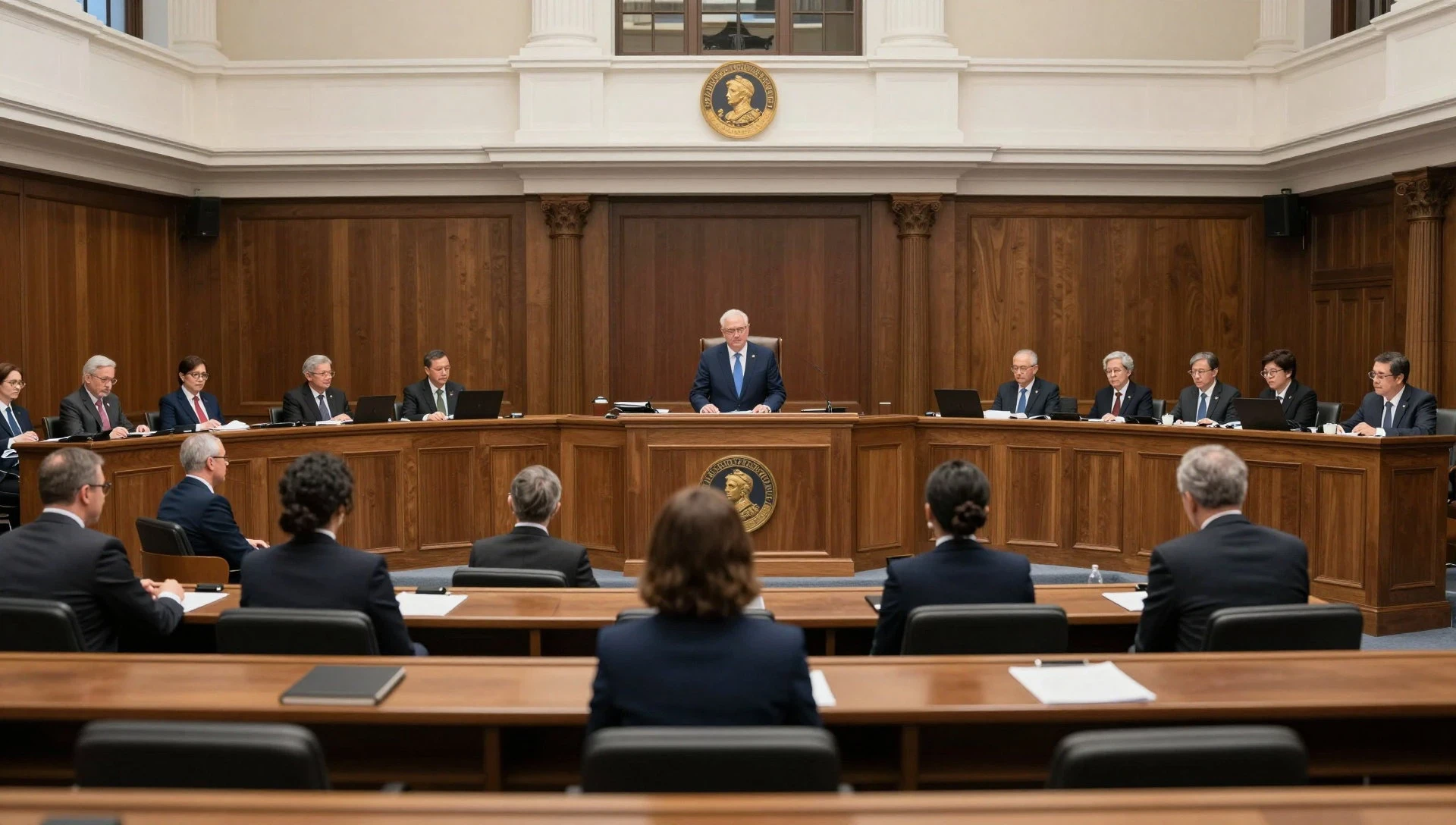
The House of Representatives has once again demonstrated that impeachment is as much a procedural instrument as it is a constitutional one. In a sharply divided 211–204 vote, lawmakers agreed to route eight articles of impeachment against Defense Secretary Pete Hegseth to the House Judiciary Committee, a panel chaired by the Republican majority. That referral, dry as it sounds, effectively parks the effort: rather than forcing a floor debate on removal, the maneuver consigns the charges to a committee process that the governing party controls. The episode is a study in how institutional mechanics can absorb political fury without ever resolving it.
What makes the vote remarkable is not merely its outcome but its arithmetic and its authorship. The push was led by Representative Thomas Massie, a Kentucky Republican leaving Congress, and he stood essentially alone within his conference. Every other Republican opposed the measure, while Democrats overwhelmingly backed it, with eleven members—including former Speaker Nancy Pelosi—absent. Had eight of those Democrats been present and voted, the procedural motion would have failed, opening the door to a full House impeachment vote. The margin, in other words, was narrower than the headline suggests, and the outcome hinged on attendance as much as conviction.
The underlying charges are extraordinary in scope. The articles accused Hegseth of illegally ordering military action in Iran and Yemen, attacking boats in the Caribbean Sea, and capturing Venezuelan President Nicolás Maduro in January, alongside broader allegations of abuses of power. Set against a stalemated war centered on the Strait of Hormuz and a midterm election that handed Democrats control of Congress, the referral becomes a prelude rather than a conclusion. This analysis examines the vote, the constitutional machinery, the political calculations, and what the coming transfer of power likely means for accountability.
On This Page
TL;DR The US House blocked an attempt to impeach Defense Secretary Pete Hegseth by a 211–204 vote, referring eight articles of impeachment to the Republican-led Judiciary Committee and effectively halting the effort for now. The charges alleged unlawful military action in Iran and Yemen, attacks on boats in the Caribbean, and the capture of Venezuela's president. Representative Thomas Massie led the effort almost single-handedly; eleven absent Democrats nearly changed the outcome. With Democrats poised to take Congress in January amid public anger over the Iran war, the referral is best read as a deferral, not a verdict.
The Anatomy of a Blocked Impeachment
The vote of 11 November 2026 belongs to a familiar genre of congressional theater: the motion that looks like a confrontation but functions as a valve. By agreeing to send the articles to the Judiciary Committee, the House did not dismiss the charges outright, nor did it embrace them. It chose the middle path that institutions favor when the political cost of either extreme is too high. Understanding why requires separating the constitutional question from the parliamentary one, because the two moved on entirely different tracks throughout the day.
What the Eight Articles Actually Allege
The articles centered on decisions made in the conduct of foreign military operations. They accused Hegseth of illegally ordering military action in Iran and Yemen, of authorizing attacks on boats in the Caribbean Sea, and of capturing Venezuelan President Nicolás Maduro in January. Beyond those specific operations, the articles alleged a pattern of other abuses of power, framing the secretary's conduct as a sustained disregard for legal constraint rather than a series of isolated errors. Each charge, if substantiated, would raise questions about civilian control, statutory authorization, and the limits of executive war-making.
The legal architecture matters here. Impeachment of a cabinet secretary is constitutionally available but historically rare, and the threshold is political as much as juridical. The articles did not need to survive a courtroom; they needed to survive a committee and then a floor. By bundling discrete military episodes into a single impeachment package, the sponsors forced lawmakers to weigh operational secrecy against accountability, a tension that rarely resolves cleanly in public proceedings and almost never resolves quickly.
The Procedural Motion That Decided Everything
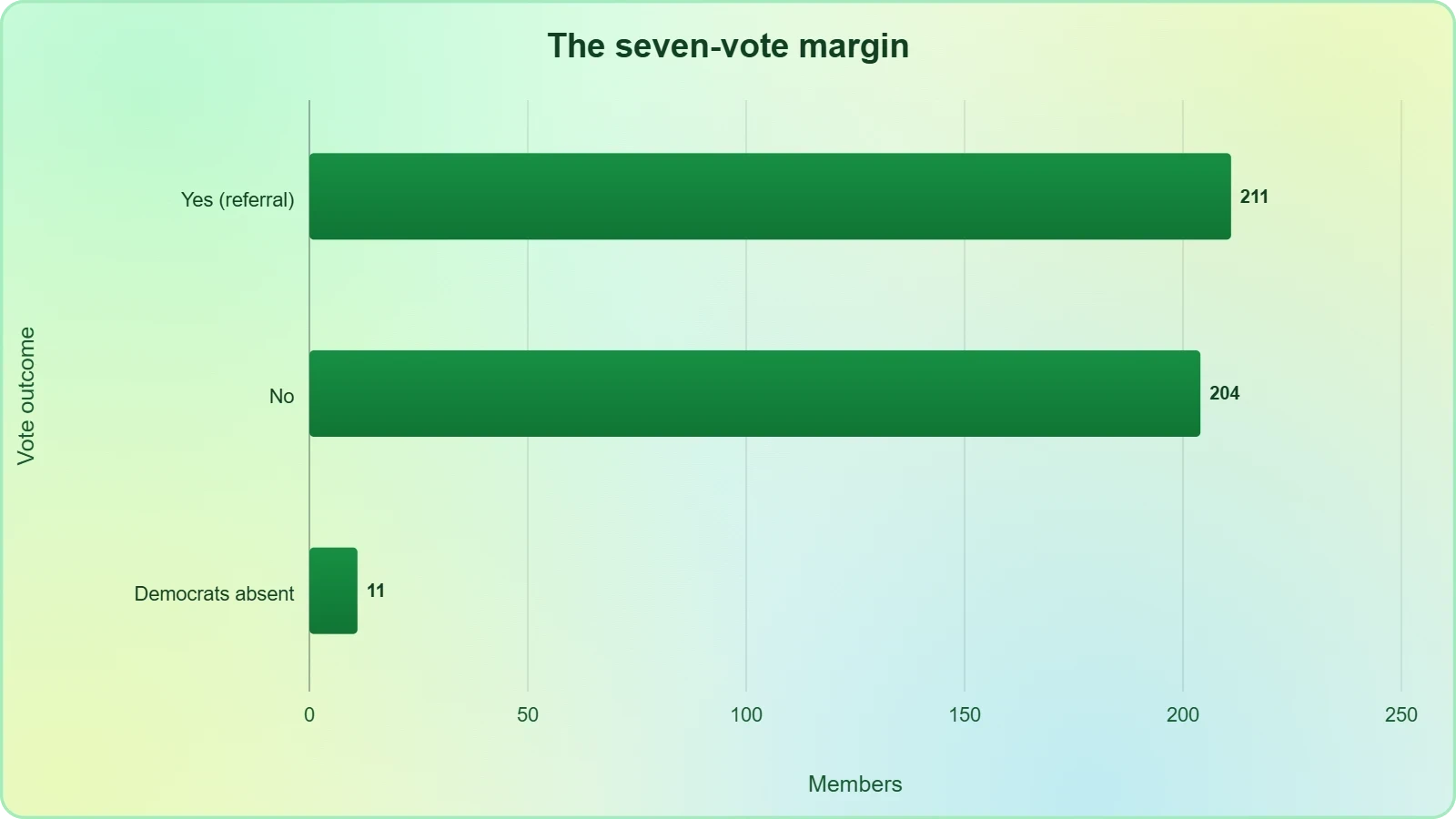
The decisive question was never whether a majority opposed Hegseth's conduct; it was whether a majority would permit the House to vote on it. The motion to refer carried 211–204, a margin of seven. Because eleven Democrats were absent, the arithmetic was fragile: eight additional Democratic votes against referral would have sunk the motion and unlocked a full floor debate. That the outcome turned on attendance rather than persuasion is a reminder that legislative majorities are assembled from calendars and travel schedules as much as from ideology.
Pelosi's office explained her absence as attendance at an annual veterans event in San Francisco, adding that she would have voted against the procedural motion. Whether that explanation satisfies critics or not, it illustrates the fragility of narrow margins. A single chartered flight, a single illness, a single scheduling conflict can redirect the course of a constitutional process. The referral therefore stands not as a considered judgment of the House but as the residue of a seven-vote gap and a handful of empty seats.
The Constitutional Machinery Behind the Referral
Impeachment is often described as a political remedy dressed in legal language, and the Hegseth episode fits that description precisely. The House holds the sole power of impeachment; the Senate holds the sole power to try. Between those two poles sits a procedural middle ground—referral, committee review, scheduling—where most impeachment efforts quietly expire. The referral to the Judiciary Committee placed the articles in a venue where the majority party sets the agenda, controls the calendar, and decides whether hearings ever occur. That is not a loophole; it is the design.
Why Cabinet Impeachments Are So Rare
History offers thin precedent. No US defense secretary has ever been impeached, and the last civilian leader of the military to face such a proceeding was William Belknap, who held the title of secretary of war in 1876. That gap of a century and a half is not accidental. Cabinet officers serve at the president's pleasure and can be removed by resignation or dismissal; impeachment of a subordinate is therefore often treated as a proxy fight against the president himself, which raises the political stakes considerably and makes lawmakers cautious about establishing precedents they may later regret.
The rarity also reflects institutional self-interest. A House that routinely impeaches cabinet secretaries would transform routine policy disputes into constitutional crises, and neither party wants to govern under those conditions. The referral mechanism allows members to register disapproval without crossing that threshold. It is, in effect, a pressure-release valve that preserves the possibility of future action while ensuring that nothing happens immediately—a compromise that satisfies the aggrieved without threatening the executive.
The Belknap Precedent and Its Limits
William Belknap's case is instructive precisely because it is so distant. Accused of corruption in the administration of Indian affairs, he resigned before the House could act, and the Senate nonetheless proceeded to try him—establishing the principle that resignation does not automatically moot impeachment. That precedent speaks to accountability after departure, not to the mechanics of impeaching a sitting secretary of defense in a modern media environment. Invoking Belknap therefore lends historical gravity without supplying a workable roadmap.
Modern impeachment politics operates under different constraints: twenty-four-hour news cycles, polling that moves within hours, and a base that expects visible combat. The Belknap comparison flatters the current effort by associating it with a genuine constitutional confrontation, but the analogy strains under scrutiny. What the precedent does confirm is that Congress has long treated impeachment as a flexible instrument, adaptable to circumstance, and that the absence of recent examples reflects political choice rather than constitutional prohibition.
We Also Published
The Politics of a Single Republican Dissent
Representative Thomas Massie's decision to force the issue is the most revealing detail in the entire episode. A Kentucky Republican leaving Congress, Massie acted without meaningful support from his own conference, and no other Republican joined him in backing the measure. That isolation tells us less about the merits of the charges than about the internal discipline of the Republican Party and the cost of breaking ranks on national security questions. When a single departing member becomes the face of an impeachment effort, the effort is already structurally doomed.
Massie's Calculus and the Cost of Isolation
Members who are leaving Congress occupy a peculiar position: they are free from the electoral consequences that constrain their colleagues, which makes them both more willing to take unpopular stands and less able to build coalitions. Massie's sponsorship carried moral weight but little leverage. Without a second Republican, the effort could be framed as a partisan maneuver rather than a bipartisan judgment, and that framing is fatal in a chamber where the majority controls the referral process. His isolation was not incidental to the outcome; it was the outcome's precondition.
The episode also illustrates how quickly institutional loyalty reasserts itself. Republicans who might privately harbor doubts about the secretary's conduct had every incentive to vote against referral: doing so avoided a public rupture with the White House, preserved committee leverage, and denied Democrats a procedural victory. The result was near-unanimity in the conference and a referral that satisfied the base's demand for loyalty without requiring anyone to defend the underlying operations on the merits.
Democratic Absences and the Seven-Vote Gap
On the Democratic side, the story is one of near-miss arithmetic. Eleven members were absent, including Pelosi, whose spokesperson cited an annual veterans event in San Francisco and stated she would have voted against the procedural motion. Had eight of those absent Democrats been present and voted against referral, the motion would have failed and a full House impeachment vote would have followed. The gap between what happened and what nearly happened is measured in single digits, and that fragility deserves more attention than the final tally usually receives.
Absences are rarely random. They reflect scheduling priorities, district obligations, health, and sometimes quiet calculation about which votes are worth attending. In a chamber of 435 members, a handful of empty seats can determine whether a constitutional question reaches the floor. The Democratic caucus will need to reckon with that reality as it prepares to assume control, because the same arithmetic that saved the referral could, in January, produce the opposite result on a different question.
- 01
- 02
- 03
- 04
War, Public Opinion, and the Midterm Reckoning
The impeachment referral did not occur in a vacuum; it occurred against the backdrop of an unpopular and stalemated war. The conflict with Iran, now centered on the Strait of Hormuz, has become a grinding standoff with no clear exit, and voter anger over that stalemate contributed directly to Democratic victories in last week's midterm elections. A Reuters/Ipsos poll published on the same day as the vote found that a majority of Americans want the incoming Democratic-majority Congress to act to end the war. That polling transforms the referral from a procedural footnote into a preview of coming confrontations.
The Strait of Hormuz Stalemate
The Strait of Hormuz is the world's most consequential maritime chokepoint, a narrow passage through which a substantial share of global petroleum exports must transit. A stalemate centered there is not merely a military problem; it is an economic one, with implications for energy prices, insurance markets, and shipping routes that ripple far beyond the region. The articles' allegations about attacks on boats in the Caribbean Sea and the capture of Venezuela's president suggest a conflict that has already spread well beyond its original theater, complicating any clean resolution.
For voters, the war's persistence is the salient fact. Stalemates are politically corrosive because they deny both supporters and opponents a decisive outcome; they simply continue, consuming resources and attention. The administration's inability to convert military action into a settled political result has become the central vulnerability that Democrats intend to exploit, and the impeachment articles were, in part, an attempt to attach a legal frame to a strategic failure that the public already perceives.
What the Polling Signals for January
The Reuters/Ipsos finding that a majority wants Congress to act to end the war is a mandate in the loosest sense: it signals direction without specifying mechanism. Ending a war can mean cutting appropriations, repealing authorizations, imposing reporting requirements, or negotiating a settlement, and each path carries different political risks. Democrats will have to convert diffuse public anger into legislative action, a task that is far harder than opposing a referral motion and will expose fissures within their own coalition once concrete choices must be made.
The polling also constrains the White House. A president whose party has just lost Congress and whose war lacks majority support faces pressure to demonstrate progress before the new session begins. That pressure may produce diplomatic initiatives, drawdowns, or rhetorical reframing, any of which could alter the context in which the referred articles are eventually considered. Public opinion rarely dictates specific outcomes, but it sets the boundaries within which institutional actors maneuver.
Rebranding the Pentagon and the Symbolism of Titles
Amid the legal and electoral drama, one detail deserves closer attention: Hegseth refers to himself as secretary of war as part of an effort to rebrand the military. The title is historically resonant—the War Department existed until 1947—and its revival carries symbolic weight that extends beyond nomenclature. Titles shape institutional identity, signal priorities, and frame how the public understands the use of force. Choosing "war" over "defense" is a rhetorical act with policy implications, and it sits uneasily alongside an impeachment effort that centers on the legality of military action.
From Defense to War: A Rhetorical Shift
The shift from "defense" to "war" in self-description is not merely cosmetic. Language frames perception: a department of defense implies restraint, deterrence, and response, while a department of war implies initiative, projection, and conflict. For a secretary facing allegations of unauthorized military action, adopting the more aggressive title reinforces the very framing his critics find troubling. It also appeals to a constituency that views the post-1947 restructuring as an erosion of martial clarity, making the rebrand a gesture of ideological alignment as much as administrative preference.
Symbolism has limits, however. A title cannot legalize an operation, satisfy a statute, or persuade a committee. The rebrand may energize supporters and irritate opponents, but it does not alter the evidentiary questions at the heart of the referred articles. What it does accomplish is to sharpen the contrast: the secretary presents himself as a wartime leader, while his critics present him as an official who exceeded legal authority. Both framings can coexist, and the committee will eventually have to choose which one the record supports.
Accountability in an Era of Executive Assertion
The deeper question raised by the referral concerns the balance between executive initiative and legislative oversight. Modern warfare moves quickly, and Congress has repeatedly delegated broad authority while retaining formal oversight. When a secretary orders action that critics deem unauthorized, the remedy is contested: courts invoke political questions, committees move slowly, and impeachment is a blunt instrument. The Hegseth episode exposes the gap between the speed of military decision-making and the deliberative pace of accountability mechanisms designed for a slower era.
That gap is unlikely to close soon. The incoming Democratic majority will have more tools—subpoenas, hearings, appropriations—but each requires sustained attention and political capital. The referred articles may become the foundation for that oversight, or they may quietly expire in committee. What is certain is that the underlying tension between executive assertion and legislative accountability will persist long after this particular secretary leaves office, and the precedent set here will shape how future Congresses respond.
What the Referral Means for the Coming Session
The referral is best understood as a deferral with a shelf life. When Democrats take control of Congress in January, the Judiciary Committee's composition and priorities will change, and the eight articles will sit in a different institutional context. Whether they are revived, folded into broader war-powers oversight, or quietly abandoned depends on calculations that have not yet been made. The vote of 11 November settled the immediate question but left the underlying one untouched: whether the conduct alleged warrants removal, and who gets to decide.
Scenarios for the Articles in January
Three plausible paths exist. The first is revival: a Democratic-led committee holds hearings, builds a record, and reports articles to the floor, testing whether the narrow margin that saved the referral can be reversed. The second is absorption: the articles' substance is folded into broader oversight of the war, with hearings on authorization and appropriations rather than removal. The third is dormancy: the articles remain filed but unactioned, a symbolic marker of disapproval without operative consequence. Each path carries different costs and signals different priorities.
Revival would be the most dramatic and the most risky. It would consume committee bandwidth, invite charges of partisan retribution, and require sustained public attention that may not materialize once the war's immediate salience fades. Absorption is more likely because it aligns with the polling mandate to end the war and offers concrete legislative levers. Dormancy is the default outcome of most congressional referrals, and it should not be discounted simply because the underlying allegations are serious.
Institutional Consequences Beyond This Episode
Whatever happens to the articles, the episode has already shaped institutional expectations. It has demonstrated that a single determined member can force a vote on cabinet impeachment, that a seven-vote margin can decide a constitutional question, and that absences matter as much as arguments. Those lessons will be studied by future members contemplating similar moves, and they will inform how leadership schedules votes and manages attendance. Precedent in Congress is rarely established by landmark rulings; more often it accumulates through procedural skirmishes like this one.
The broader consequence concerns the credibility of oversight itself. If referrals become the standard response to serious allegations, the mechanism may lose its signaling power; if they are routinely ignored, the public may conclude that accountability is theatrical. The Hegseth episode sits at that inflection point, and how the incoming majority handles the referred articles will shape whether impeachment remains a credible threat or becomes a procedural ritual performed for the benefit of attentive constituencies.
From our network :
- Live Online English Classes for Kids: Do They Actually Reduce Anxiety?A ten-week study reveals that synchronous online English classes can significantly reduce child language anxiety while improving listening and reading skills. Discover what makes these programs effective and how parents can select the right one.
- Forbidden Matrix Patterns and Visible Lattice Points: A Geometric DictionaryExplore how multidimensional 0–1 matrices encode geometric truths, linking forbidden patterns to visible lattice points and hypergraph theory, with applications in combinatorics and computational geometry.
- Committed Mediterranean Precipitation Decline: Why Emissions Cuts Alone Cannot Restore Winter RainsNew NOAA research reveals that Mediterranean winter rains may decline irreversibly even with emissions cuts. Explore the science of committed climate change and regional impacts.
- University Language Proficiency Exams: Why Institutional Tests Demand Different Preparation Than IELTS and TOEFLDiscover why university-specific language proficiency examinations differ fundamentally from IELTS and TOEFL, and learn strategic preparation approaches for institutional assessment success.
- The Hidden Cost of AI Convenience: Why Over-Permissioned Agents Are a Security Time BombDiscover why AI agents with excessive permissions create dangerous single points of failure, and learn how implementing least privilege principles can protect your organization from exploitation.
- The Final Descent: How ESA Retired the Legendary Cluster Constellation After 24 Years of Space Weather ScienceAfter 24 years mapping Earth’s magnetosphere, ESA’s Cluster mission concluded with a precisely controlled reentry over the South Pacific. This analysis explores the scientific legacy, engineering decisions, and debris mitigation principles behind one of space exploration’s most responsible retirements.
- Mobile Learning and VR in English: What Global Evidence Reveals About Effective Language TechnologyA systematic review across 14 countries reveals which language-learning technologies genuinely work. Mobile learning, AI, and VR show measurable benefits when pedagogically integrated. This evidence-based guide helps educators and learners select technology that delivers real return on investment.
- CISA’s Ten-Advisory Wave: Why Generic Patching Fails in OT and How to Build Product-Specific PlaybooksCISA released ten ICS advisories in one week, exposing critical infrastructure risks. Generic patching fails in OT. Learn to build product-specific remediation playbooks.
- How AI Agents Will Change the Way We Manage Personal FinancesExplore how AI agents are transforming personal finance through automated budgeting, bill payment, and investment management, while examining the critical security protocols and governance frameworks required for safe deployment.
RESOURCES
- Fitzpatrick Makes Official Referral To House Judiciary Committee ...fitzpatrick.house.gov17 hours ago ... The actions of Secretary of War Pete Hegseth on multiple matters, to include Ukraine (which, unfortunately, is nowhere mentioned in…
- US House blocks bid to impeach Defence Secretary Pete Hegseth ...bbc.com5 hours ago ... ... refer impeachment articles to a committee ... refer the resolution to the House Judiciary Committee, which is led by…
- House opts to stall Hegseth impeachment vote, sending resolution ...breakingdefense.com18 hours ago ... ... Hegseth, House lawmakers today opted to refer the impeachment resolution to the House Judiciary Committee for further consideration. The ...
- House tables Hegseth impeachment, effectively killing it in ... - abc7NYabc7ny.com23 hours ago ... ... Pete Hegseth to the House Judiciary Committee by ... "The referral of these baseless impeachment articles to the House…
- Ranking Member Raskin Statement on the Vote on the Motion to ...democrats-judiciary.house.govDec 11, 2025 ... ... Pete Hegseth, Secretary Robert F. Kennedy, Jr., and Secretary ... House Judiciary Committee and delivered to the Members. “Thus,…
- US House votes to derail impeachment of Defense Secretary Hegsethreuters.com18 hours ago ... The chamber voted 211 to 204 in favor of a motion to refer the impeachment charges to the Republican-led House…
- House Republicans block effort to impeach Pentagon chief Pete ...theguardian.com18 hours ago ... “The referral of these baseless impeachment articles to the House judiciary committee marks total victory for Secretary Hegseth, the ...
- House GOP derails Hegseth impeachment over Iran, Kelly and boat ...cronkitenews.azpbs.org15 hours ago ... “The referral of these baseless impeachment articles to the House Judiciary Committee marks total victory for Secretary Hegseth, the ...
- House Blocks Pete Hegseth Impeachment as 11 Democrats Miss Votelawcommentary.com16 hours ago ... ... Pete Hegseth, sending eight articles accusing him of unlawful military operations and abuse of power to the House Judiciary…
- House shelves Hegseth impeachment resolution - NBC Newsnbcnews.com15 hours ago ... Defense Secretary Pete Hegseth addresses a House impeachment threat and Republicans choose their leadership for the new Congress.
- House tables Hegseth impeachment, effectively killing it in current ...abcnews.com16 hours ago ... ... impeach Defense Secretary Pete Hegseth as the ... "The referral of these baseless impeachment articles to the House Judiciary…
- House Republicans on Tuesday stalled an effort to impeach ...facebook.com17 hours ago ... ... Pete Hegseth by voting to refer the articles of impeachment to committee. ... refer the charges to the House…
- TOTAL VICTORY! The referral of these baseless impeachment ...instagram.com18 hours ago ... The referral of these baseless impeachment articles to the House Judiciary Committee ... Defense Secretary Pete Hegseth emphasizes military ...
- House GOP shelves Pete Hegseth impeachment articles - The Hillthehill.com18 hours ago ... House Republicans voted to refer impeachment articles against Defense Secretary Pete Hegseth to committee on Tuesday.
- How Kansas and Missouri lawmakers voted on Hegseth impeachmentkansascity.com17 hours ago ... All nine Republican House lawmakers from both states voted to refer the resolution to the Judiciary Committee, a move designed…
- 01
- 02
- 03
- 04
- 05
- 06
- 07
- 08
0 Comments