
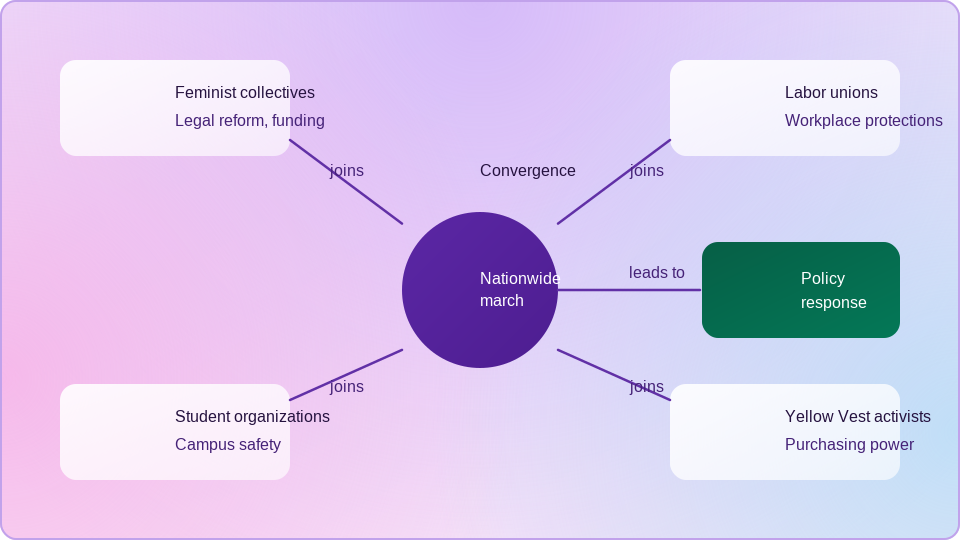
France is preparing for a Saturday of coordinated mobilization, with thousands of demonstrators expected to take to the streets of Paris, Lyon, Marseille, and other major cities to condemn violence against women. The call has been issued by feminist collectives, and it has drawn an unusually broad coalition: labor unions, student organizations, and Yellow Vest activists have all signaled their participation. What might otherwise read as a single-issue march is instead unfolding inside a much wider cycle of social unrest, one that has already reshaped the rhythm of French public life over the past two months.
The timing is far from incidental. The demonstrations coincide with a seventh consecutive week of protests over the cost of living, a wave that has tested the government's capacity to manage inflation, energy prices, and household purchasing power. By folding the fight against gender-based violence into this broader movement, organizers are making a deliberate argument: that violence against women is not a private tragedy but a structural failure, entangled with economic precarity, institutional neglect, and the everyday pressures of a society under strain. The march thus becomes both a demand for protection and a critique of the conditions that leave women exposed.
Understanding this moment requires more than a headline count of participants. It requires attention to the legal machinery that French activists have spent years trying to reform, the coalition arithmetic that determines how much pressure the streets can generate, and the political calculations of a government already stretched by cost-of-living discontent. The analysis below examines the composition of the protests, the legislative battleground around gender-based violence, the economics of the wider unrest, and the question of whether these converging movements can translate moral urgency into durable policy change.
On This Page
TL;DR Protests are planned across France on Saturday, 28 November 2026, bringing together feminist groups, labor unions, students, and Yellow Vest activists to condemn violence against women. The marches occur during a seventh consecutive week of cost-of-living protests, creating an unusual convergence of gender justice and economic grievance. This analysis examines the coalition's composition, the legislative context around gender-based violence in France, the economic pressures fueling the wider unrest, and the strategic question of whether street mobilization can convert into enforceable policy.
The Anatomy of a Converging Protest Movement
The demonstrations scheduled for Saturday represent a coalition rather than a single organization, and that distinction matters enormously for how the event should be read. Feminist collectives provide the moral core and the framing language, labor unions supply logistical capacity and membership networks, student organizations bring energy and campus reach, and Yellow Vest activists contribute a decentralized, anti-establishment edge. Each group arrives with its own grievances, its own vocabulary, and its own relationship to the state. The result is a march that is simultaneously a gender justice rally, a cost-of-living protest, and a referendum on institutional trust.
Coalitions of this kind are powerful but fragile. They amplify turnout and media attention, yet they also create internal tensions over messaging, demands, and the acceptable boundaries of confrontation. When feminist organizers share a platform with Yellow Vest activists, questions arise about whether the specific demands around violence against women will be diluted or, conversely, whether the broader movement will adopt gender justice as a central rather than decorative concern. The answer will shape not only Saturday's coverage but the durability of any alliance that emerges from it.
Who Is Marching and Why
Feminist groups anchor the mobilization around a clear demand: that violence against women be treated as a national emergency requiring resources, enforcement, and legal reform rather than periodic symbolic gestures. Their participation reflects years of advocacy, including campaigns that have pressed for better funding of shelters, faster judicial processing, and stronger protection orders. For these organizations, the march is an opportunity to force the issue onto a national agenda already crowded with economic anxiety, ensuring that gender-based violence is not sidelined when the political conversation narrows to inflation and purchasing power.
Labor unions and student organizations bring a different calculus. Unions have increasingly framed gender-based violence as a workplace issue, linking it to harassment, precarious employment, and the vulnerability of workers in low-wage sectors. Students, meanwhile, have been at the forefront of recent campus movements addressing sexual violence and inadequate institutional responses. Their presence signals that the march is not confined to a single generation or a single sector, but spans the breadth of French civil society in a way that few recent mobilizations have managed to achieve.
The Yellow Vest Dimension
The participation of Yellow Vest activists introduces a complicating and politically significant element. Born from fuel tax protests and sustained by grievances over purchasing power and urban-rural inequality, the movement has historically been decentralized and suspicious of established institutions, including some feminist organizations. Its presence on Saturday suggests an attempt to bridge two constituencies that are often treated as separate: those demanding economic justice and those demanding gender justice. Whether that bridge holds under the pressure of a live march remains an open question.
For analysts, the Yellow Vest involvement is a test of whether the cost-of-living movement can broaden its agenda without fracturing. If the alliance holds, it could produce a more resilient and electorally relevant coalition. If it splinters, the march may be remembered as a symbolic gesture rather than a political turning point. The outcome will depend heavily on how organizers manage competing demands and how the government responds in the days that follow.
The Legislative Battleground on Gender-Based Violence
Behind the banners lies a dense legislative struggle that has occupied French lawmakers for years. France has adopted a series of measures intended to strengthen protections for victims, including expanded use of protection orders, provisions for electronic monitoring of convicted offenders, and efforts to improve police reception of complaints. Yet advocates argue that implementation lags far behind legal ambition. Reporting rates remain uneven, specialized units are under-resourced, and the gap between a law's passage and its practical effect continues to frustrate organizations working on the ground.
The protests therefore function as a form of legislative pressure. By assembling a broad coalition, organizers hope to signal that the issue commands a constituency far larger than the specialized advocacy sector. This is a familiar dynamic in French politics, where street mobilization has historically served as a lever on parliamentary process. The question is whether a march embedded in a wider cost-of-living movement can generate the sustained attention needed to move specific provisions through a crowded legislative calendar.
From Symbolic Commitment to Enforceable Protection
The central tension in French policy on gender-based violence is the distance between declaration and delivery. Successive governments have pledged to treat the issue as a priority, announced action plans, and convened national consultations. Advocacy groups acknowledge these gestures but point to persistent shortfalls: insufficient shelter capacity, long delays in judicial processing, and inconsistent training for law enforcement. For them, the measure of political seriousness is not the number of announcements but the number of women who can actually access protection when they need it.
This gap between promise and practice is what gives the march its edge. Organizers are not simply asking for new laws; they are demanding that existing commitments be funded and enforced. That framing is strategically shrewd, because it shifts the debate from abstract values to concrete budgetary choices. It also creates a direct link to the cost-of-living protests, since both movements ultimately concern how public resources are allocated and who bears the burden when they fall short.
The Role of Public Opinion and Media Framing
Public opinion in France has shifted markedly on questions of gender-based violence, with surveys consistently showing broad support for stronger protections and greater investment in prevention. That consensus gives protesters a favorable backdrop, but it also creates a risk: when an issue enjoys near-universal verbal support, it can become rhetorically uncontested yet practically neglected. The challenge for organizers is to convert diffuse sympathy into specific, actionable demands that politicians cannot easily absorb into generalities.
Media framing will play a decisive role. Coverage that focuses solely on crowd sizes and scattered incidents risks reducing a substantive policy mobilization to spectacle. Coverage that engages with the coalition's demands, the legislative record, and the resource gap can sustain public attention beyond a single weekend. The way French outlets narrate Saturday's marches will influence whether the event registers as a turning point or a footnote in a longer season of unrest.
The Economics Beneath the Unrest
The seventh consecutive week of cost-of-living protests provides the economic backdrop against which Saturday's marches will unfold. Rising prices for energy, food, and housing have squeezed household budgets, and the resulting discontent has proven durable in a way that many single-issue protests are not. When people feel that their material security is eroding, their tolerance for institutional promises diminishes sharply. This is the environment in which feminist organizers are making their case, and it explains why they have chosen to align rather than compete with the broader movement.
The economic dimension also reframes the issue of violence against women in material terms. Leaving an abusive household often requires financial independence, access to housing, and reliable childcare, all of which become harder to secure when costs rise. Advocates have long argued that economic precarity and gender-based violence are mutually reinforcing, and the current climate makes that argument concrete rather than theoretical. A woman who cannot afford to leave is, in a very direct sense, a casualty of both failures at once.
Purchasing Power as a Political Variable
Purchasing power has become the organizing principle of French political contestation, and its persistence across seven weeks of protest signals a structural rather than episodic grievance. The government's room for maneuver is constrained by fiscal rules, European commitments, and the cost of energy support measures. Each of these constraints is real, but together they create a perception that the state is managing decline rather than delivering relief. That perception is the fuel on which sustained mobilization runs, and it does not dissipate simply because a march ends.
For the coalition behind Saturday's demonstrations, purchasing power offers both an opportunity and a hazard. The opportunity lies in scale: economic grievance reaches constituencies that gender-focused advocacy alone might not. The hazard lies in dilution: when everything is framed as a cost-of-living issue, the specific demands around violence against women can lose definition. Managing that balance is the central strategic challenge facing organizers as they approach the weekend.
Who Bears the Cost of Inaction
The distributional question is unavoidable. Budgets are finite, and every allocation reflects a political choice about whose safety matters. Advocates argue that spending on prevention, shelters, and judicial capacity is not a luxury to be deferred during economic difficulty but a core function of a functioning state. Framed this way, the demand for resources becomes an economic argument as much as a moral one, since the downstream costs of unaddressed violence, including healthcare, lost productivity, and intergenerational harm, are substantial.
This framing has the advantage of speaking to audiences beyond the already-convinced. It translates a moral imperative into the language of public finance, which is the language in which governments actually make decisions. Whether that translation succeeds will depend on how effectively the coalition communicates it, and on whether the political class is willing to hear it during a season already dominated by economic anxiety.
Similar Posts
- 01
- 02
- 03
- 04
Protest Strategy and the Limits of the Street
France has a long and consequential tradition of street politics, and the organizers behind Saturday's marches are operating within a well-established repertoire. Demonstrations, strikes, and coordinated blockades have historically served as effective levers on policy, capable of forcing concessions that parliamentary processes alone would not produce. Yet the repertoire also has limits. Sustained mobilization requires organizational capacity, public sympathy, and a clear set of demands that can be negotiated. When any of these weaken, momentum dissipates quickly, and the political class learns to wait out the pressure.
The coalition's strategic challenge is therefore twofold. It must maintain turnout and visibility across multiple weekends while also converting visibility into concrete outcomes. The first task is about logistics and messaging; the second is about political access and legislative follow-through. Movements that excel at the first but neglect the second often find themselves celebrated in retrospect while achieving little in the moment. The organizers appear aware of this risk, which is why the demands have been framed with unusual specificity.
Coalition Management Under Pressure
Managing a coalition of feminists, unions, students, and Yellow Vest activists requires constant negotiation over tone, priorities, and the boundaries of acceptable action. Each bloc has its own internal dynamics and its own constituency to satisfy. Feminist organizations must protect the centrality of gender-based violence as a demand; unions must balance workplace concerns with broader solidarity; students bring moral energy but limited institutional leverage; Yellow Vest activists carry anti-establishment credibility but also a reputation for unpredictability that can unsettle more established partners.
The coalition's durability will be tested not on Saturday but in the weeks that follow. If the groups can agree on a shared platform and coordinate follow-up actions, they can sustain pressure on the government. If they fragment into competing narratives, the march will be remembered as a moment of symbolic unity rather than a durable political force. Coalition management, unglamorous as it is, may prove the decisive variable in determining the movement's legacy.
What Would Count as Success
Success for a mobilization of this kind is rarely measured in a single metric. Turnout matters, but so does the composition of the crowd, the framing of media coverage, and the response of political actors. A march that draws large numbers but generates no policy follow-through may be judged a partial failure; a smaller march that forces a specific commitment may be judged a success. Organizers are likely tracking all of these dimensions, even as public attention focuses on the most visible one.
The most meaningful indicator will be whether the issue of violence against women gains sustained legislative traction in the weeks ahead. If the march produces hearings, funding commitments, or accelerated consideration of pending provisions, it will have achieved something concrete. If it produces only statements of sympathy, the coalition will need to escalate. The coming weeks will reveal which outcome the political system intends to deliver.
Political Consequences and the Road Ahead
The political consequences of Saturday's marches will extend well beyond the weekend. France is in a period of heightened contestation, with cost-of-living grievances, institutional distrust, and debates over public spending all converging. A march that successfully links gender justice to this broader agenda could reshape how the political class discusses both issues. Conversely, a march that is absorbed into the general noise of unrest may reinforce the impression that mobilization produces visibility without results, a perception that erodes trust in collective action itself.
The government's response will be closely watched. A substantive response would involve concrete commitments on funding, enforcement, and judicial capacity, ideally announced within days rather than months. A symbolic response would involve statements of solidarity and vague assurances of attention. The difference between the two will tell observers a great deal about how seriously the executive takes the coalition's demands, and how much political capital it is willing to spend during an already difficult season.
Reading the Government's Next Move
Governments facing broad coalitions typically pursue a strategy of selective engagement, offering concessions to the most moderate partners while isolating the most disruptive. Applied here, that strategy might involve engaging feminist organizations and unions on specific policy points while distancing from Yellow Vest elements. Such an approach can be effective in the short term, but it risks undermining the coalition's unity and, with it, the pressure that made engagement worthwhile in the first place. The coalition's response to this tactic will be a key test of its political sophistication.
Alternatively, the government may choose to wait, calculating that the cost-of-living movement will eventually exhaust itself and that the gender-based violence issue can be managed through existing channels. This is a common calculation in French politics, and it sometimes works. But it carries risk: if the coalition sustains momentum, a strategy of waiting can appear indifferent, reinforcing the very grievances that fuel the protests. The coming weeks will reveal which calculation prevails.
Why This Moment Matters Beyond France
The convergence of gender justice and economic grievance is not unique to France. Across Europe and beyond, movements are increasingly recognizing that violence against women cannot be addressed in isolation from housing, wages, and public services. France's experiment in coalition-building will therefore be watched internationally, both by advocates seeking models and by governments seeking to understand how such movements develop. The outcome will inform debates far beyond the Hexagon.
For observers, the lesson is that single-issue framing often understates the interconnectedness of social problems. Violence against women is shaped by economic conditions, institutional capacity, and political will, and movements that address all three simultaneously are more likely to produce durable change than those that address only one. Whether Saturday's marches achieve that integration in practice remains to be seen, but the attempt itself is significant.
Conclusion: A Test of Convergence
Saturday's marches across France will be judged by many measures, but the most important may be whether they demonstrate that gender justice and economic justice can be pursued as a single agenda rather than competing ones. The coalition behind the demonstrations has made that bet explicitly, bringing together groups that have historically operated in separate spheres. If the bet pays off, it could establish a template for mobilization that other movements adopt. If it fails, it will serve as a cautionary tale about the difficulty of sustaining broad alliances under pressure.
For now, the immediate task is turnout, discipline, and messaging. The broader task is conversion: turning a weekend of visibility into a season of policy pressure. French politics rewards persistence, and the coalition's ability to sustain its demands beyond the headlines will determine whether Saturday is remembered as a beginning or an end. The streets will speak first; the institutions will answer later, and that answer is what ultimately matters.
From our network :
- The Final Descent: How ESA Retired the Legendary Cluster Constellation After 24 Years of Space Weather ScienceAfter 24 years mapping Earth’s magnetosphere, ESA’s Cluster mission concluded with a precisely controlled reentry over the South Pacific. This analysis explores the scientific legacy, engineering decisions, and debris mitigation principles behind one of space exploration’s most responsible retirements.
- Mobile Learning and VR in English: What Global Evidence Reveals About Effective Language TechnologyA systematic review across 14 countries reveals which language-learning technologies genuinely work. Mobile learning, AI, and VR show measurable benefits when pedagogically integrated. This evidence-based guide helps educators and learners select technology that delivers real return on investment.
- Committed Mediterranean Precipitation Decline: Why Emissions Cuts Alone Cannot Restore Winter RainsNew NOAA research reveals that Mediterranean winter rains may decline irreversibly even with emissions cuts. Explore the science of committed climate change and regional impacts.
- Live Online English Classes for Kids: Do They Actually Reduce Anxiety?A ten-week study reveals that synchronous online English classes can significantly reduce child language anxiety while improving listening and reading skills. Discover what makes these programs effective and how parents can select the right one.
- Forbidden Matrix Patterns and Visible Lattice Points: A Geometric DictionaryExplore how multidimensional 0–1 matrices encode geometric truths, linking forbidden patterns to visible lattice points and hypergraph theory, with applications in combinatorics and computational geometry.
- CISA’s Ten-Advisory Wave: Why Generic Patching Fails in OT and How to Build Product-Specific PlaybooksCISA released ten ICS advisories in one week, exposing critical infrastructure risks. Generic patching fails in OT. Learn to build product-specific remediation playbooks.
- The Hidden Cost of AI Convenience: Why Over-Permissioned Agents Are a Security Time BombDiscover why AI agents with excessive permissions create dangerous single points of failure, and learn how implementing least privilege principles can protect your organization from exploitation.
- How AI Agents Will Change the Way We Manage Personal FinancesExplore how AI agents are transforming personal finance through automated budgeting, bill payment, and investment management, while examining the critical security protocols and governance frameworks required for safe deployment.
- University Language Proficiency Exams: Why Institutional Tests Demand Different Preparation Than IELTS and TOEFLDiscover why university-specific language proficiency examinations differ fundamentally from IELTS and TOEFL, and learn strategic preparation approaches for institutional assessment success.
RESOURCES
- France holds nationwide protests against violence towards womenfrance24.com5 hours ago ... Calls to protest gender-based violence across France this Saturday are expected to draw thousands amid the ongoing cost-of-living demonstrations ...
- Demonstrations condemning violence against women are set to ...facebook.com3 hours ago ... Tens of thousands of people marched across France on Saturday for a sixth consecutive weekend, protesting rising living costs, growing ...
- French activists demand a tear gas suspension over reported ... - PBSpbs.org6 days ago ... ... protests and demonstrations over the cost of living, some marred by violence. Some women reported painful cramps, unexpected bleeding…
- Mapping how France's protest wave spread across Europealjazeera.comNov 8, 2026 ... It soon broadened into protests against the rising cost of living ... International Day for the Elimination of Violence Against…
- Global Protest Tracker - Carnegie Endowment for International Peacecarnegieendowment.orgJan 26, 2026 ... ... to regulate protests, and aggressive police response to violence against women protests. ... Protest against gender-based violence, France ...
- protests against gender-based violence during COVID-19data.unwomen.orgDec 12, 2022 ... Women's demonstrations are defined as demonstration events that are: a) made up entirely of women, a women's group or have…
- Cost of living protests to spread to Germany and reignite in France ...theguardian.comOct 30, 2026 ... ... on participants to exercise restraint: “Our protest is peaceful, without exception. Violence goes against everything we stand for. Only ...
- Photos from a weekend of riots across France - Reutersreuters.comOct 19, 2026 ... Rioting erupted in cities across France on Saturday as demonstrations against rising living costs and declining public services spiraled out ...
- French protests see numbers surge as unions join strikes over ... - BBCbbc.comNov 5, 2026 ... Meanwhile, a revived gilets jaunes (yellow-vest) movement that staged a revolt against the high cost of living several years ago…
- Violent protests in France as police battle demonstrators, in photosap.orgOct 18, 2026 ... ... to disperse violent protesters ... They joined nationwide demonstrations against rising living costs and in support of high school…
- France protests: 600,000 demonstrate amid high living costs - DW.comdw.comNov 5, 2026 ... Demonstrators took to the streets in several French cities to call for government action on the high cost of living.…
- 'Beyond the cost of living, what was at stake on October ... - LeMonde.frlemonde.frOct 23, 2026 ... Iran denounces police violence in France and urges Paris to guarantee 'freedom of protest' · Paris police set curfew in…
- Cost of living protests in France - DW.comdw.comOct 8, 2026 ... In Paris and other cities in France, as well as across Europe, the protests turned violent. Shops were looted, cars…
- 'Connect the dots' between street protests and global turmoil, urges ...news.un.orgOct 22, 2026 ... ... to the streets to express frustration over the rising cost of living. ... violence and destruction seen during days…
- Police violence in France: our open letter to the Minister of the Interioreuropeanjournalists.orgNov 18, 2026 ... ... against the high cost of living and for education. With a climax on October 17, these demonstrations were marked…
Related By Tags
- 01
- 02
- 03
- 04
- 05
- 06
- 07
- 08
0 Comments