The death of a worker at a waterfront property in Stanley Point, on Auckland's North Shore, has drawn attention to a quiet but consequential intersection of private construction, regulatory oversight, and workplace safety. A digger went over a seawall at a property on Stanley Point Road, and the man operating or working near the machine was pronounced dead at the scene. Emergency services responded in force, and a body covered by a sheet was visible near where the digger came to rest in the shallows of Secret Cove. The incident is now the subject of parallel inquiries by police and WorkSafe.
What elevates this tragedy beyond a single workplace accident is the regulatory history attached to the site. The property is owned by Point Seventy Ltd, a company linked to businessman Berridge Spencer, and a previous building performance decision from the Ministry of Business, Innovation and Employment found that a seawall at the property had been built without a building consent. A resource consent was granted in December 2024 before construction began, but no building consent was sought or granted, and the company disputed the notice to fix on the grounds that it believed consent was not required.
Those two threads — a fatal accident and a contested consent record — do not automatically connect, and investigators have not drawn a causal line between them. Yet the coincidence invites a careful reading of how coastal earthworks are approved, supervised, and audited in New Zealand, and of what obligations fall on landowners who commission work on structures that sit at the boundary between land and sea. The following analysis examines the incident, the consent framework, and the wider questions it raises.
On This Page
- The Incident at Secret Cove and the Emergency Response
- Resource Consent Versus Building Consent: The Regulatory Distinction
- Coastal Earthworks and the Physics of Plant Stability
- WorkSafe, Police and the Parallel Investigative Track
- The Consent Dispute and What It Signals About Enforcement
- Reading the Public Record Carefully
TL;DR A digger went over a seawall at a Stanley Point, Auckland waterfront property, killing a man at the scene. Police and WorkSafe are investigating, and the property owner, Point Seventy Ltd, has said it is cooperating. Separately, a Ministry of Business, Innovation and Employment building performance decision previously found that a seawall at the property was built without a building consent, even though a resource consent had been granted in December 2024. The company disputed the notice to fix, arguing consent was not required. The case illustrates the distinction between resource consents and building consents, the safety risks of coastal earthworks, and the enforcement tools available when consent records are contested.
The Incident at Secret Cove and the Emergency Response
The sequence of events on the day was compressed and brutal. Police were notified at 10.47am of a person critically injured in a vehicle crash at an address on Stanley Point Road, and the person was pronounced dead at the scene. Emergency services, including helicopters, ambulances, fire engines and police cars, converged on the cove. A witness said they were told a digger had rolled and that someone was under it. The machine came to rest in the shallows, and a body covered by a sheet was seen nearby.
Stanley Point is a low-density, high-value peninsula suburb on the North Shore, where properties frequently front directly onto the harbour and where seawalls, slipways and retaining structures are common. That geography shapes both the risk profile and the response logistics. Access to a foreshore is narrow, tidal and often constrained by private boundaries, which complicates the movement of heavy plant and the positioning of rescue equipment. The presence of helicopters in the response indicates the seriousness with which the incident was treated from the first call.
What Witnesses and Officials Have Confirmed
Confirmed facts remain limited, which is normal at this stage of a fatal incident. Police have described a vehicle crash involving a digger at a residential address, and WorkSafe has been notified, as it must be when a person dies in a work-related context. The company that owns the property has issued a statement expressing devastation and extending condolences to the man's family and friends. Beyond those elements, the precise mechanics — gradient, ground conditions, machine orientation, and whether the operator was inside or outside the cab — have not been publicly established.
For readers following the case, the distinction between confirmed and reported information matters. Witness accounts are valuable but preliminary, and the technical reconstruction of a plant rollover typically takes weeks. Investigators will examine the machine's stability envelope, the bearing capacity of the ground near the seawall edge, and whether the work was being carried out under a documented safe system of work. Until those findings are released, conclusions about cause should be treated as provisional rather than settled.
The Human and Corporate Dimensions
A workplace death carries consequences that extend well beyond the site. The company's statement — that it is assisting police and WorkSafe and that its thoughts are with the man's family and friends — reflects the standard posture of an organisation facing a fatality on its property. Under New Zealand's health and safety framework, a PCBU (person conducting a business or undertaking) owes duties to workers and others affected by its operations, and those duties can extend to contractors engaged on site. The scope of those obligations in this case will depend on contractual arrangements and on who controlled the work.
There is also a reputational dimension for a privately held vehicle associated with a prominent business figure. High-profile owners attract heightened scrutiny, and the combination of a fatality with a contested consent history is precisely the kind of fact pattern that generates sustained public interest. The company's willingness to cooperate publicly is sensible, but cooperation with regulators is a legal baseline rather than a defence, and the substantive questions will be answered through the investigative record rather than through statements.
Resource Consent Versus Building Consent: The Regulatory Distinction
Much of the public confusion around this site stems from a distinction that is fundamental to New Zealand's planning and construction law but rarely explained in plain terms. A resource consent, granted under the Resource Management Act, authorises an activity in relation to land use and its effects on the environment. A building consent, issued under the Building Act, certifies that proposed building work will comply with the building code. The two regimes serve different purposes, are administered through different processes, and one does not substitute for the other.
In this case, a resource consent was granted to Point Seventy Ltd in December 2024 before construction began, but no building consent was sought or granted. A Ministry of Business, Innovation and Employment building performance decision had earlier found that a seawall at the property had been built without a building consent. The company disputed the resulting notice to fix, saying it believed a building consent was not required. That position is not frivolous on its face — the boundary of what constitutes "building work" for certain coastal structures can be genuinely contestable — but it is a position that regulators have tested and, at least initially, rejected.
Why the Two Regimes Are Not Interchangeable
The resource consent process asks whether an activity is acceptable in its environment, considering effects on coastal processes, sediment movement, amenity and neighbouring properties. The building consent process asks whether the structure itself will be safe, durable and compliant with technical standards. A seawall can pass the first test and fail the second, or vice versa. Confusing the two is a common error among landowners, and it is one that regulators encounter often enough that guidance material exists specifically to clarify the difference.
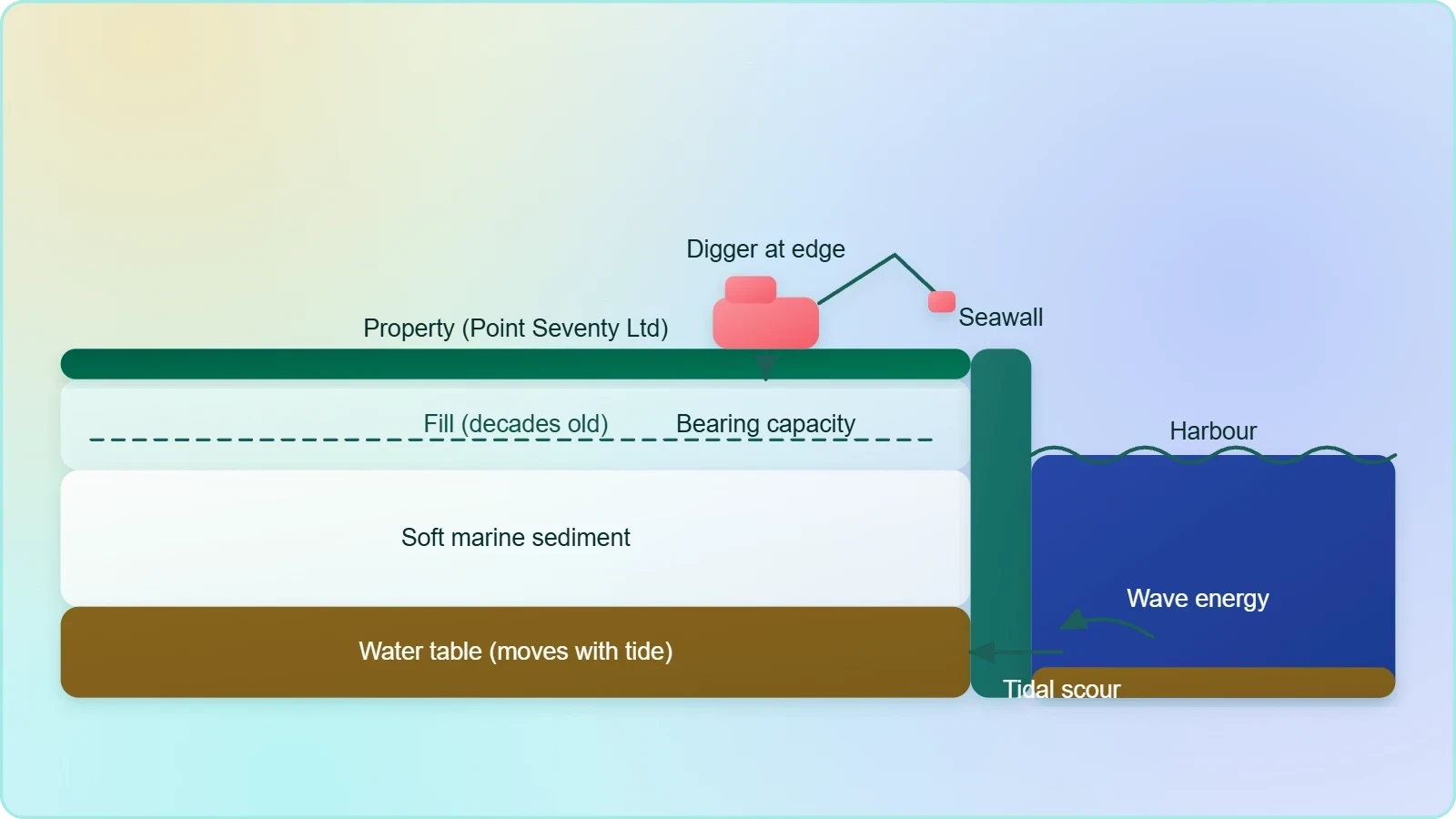
For coastal structures, the stakes are elevated. Seawalls interact with wave energy, tidal scour and groundwater, and a defect can manifest slowly before failing suddenly. Building consent review is the mechanism through which structural adequacy, foundation design and material specification are independently checked. Where that check is absent, the risk is not merely legal; it is physical, and it can persist for years before an event exposes it. That is why the consent record matters even when it appears to be a paperwork question.
Notices to Fix and the Enforcement Pathway
A notice to fix is a statutory enforcement tool under the Building Act, issued when building work is found to be non-compliant. It requires the recipient to remedy the breach within a specified period. Recipients can dispute a notice, and the dispute process allows for independent determination. The existence of a dispute does not suspend the underlying question of compliance; it simply channels the disagreement into a formal process with defined outcomes. The Ministry's building performance decision represents a determination in that chain.
Enforcement in this space is deliberately graduated. Regulators generally prefer remediation to prosecution, and the notice to fix is designed to secure a compliant outcome rather than to punish. But the tool depends on the recipient's cooperation, and where a recipient maintains that no consent was required, the matter can become protracted. The practical consequence is that a structure may remain in place, and in use, while the legal position is resolved — a gap that safety advocates have long identified as a weakness in the framework.
We Also Published
Coastal Earthworks and the Physics of Plant Stability
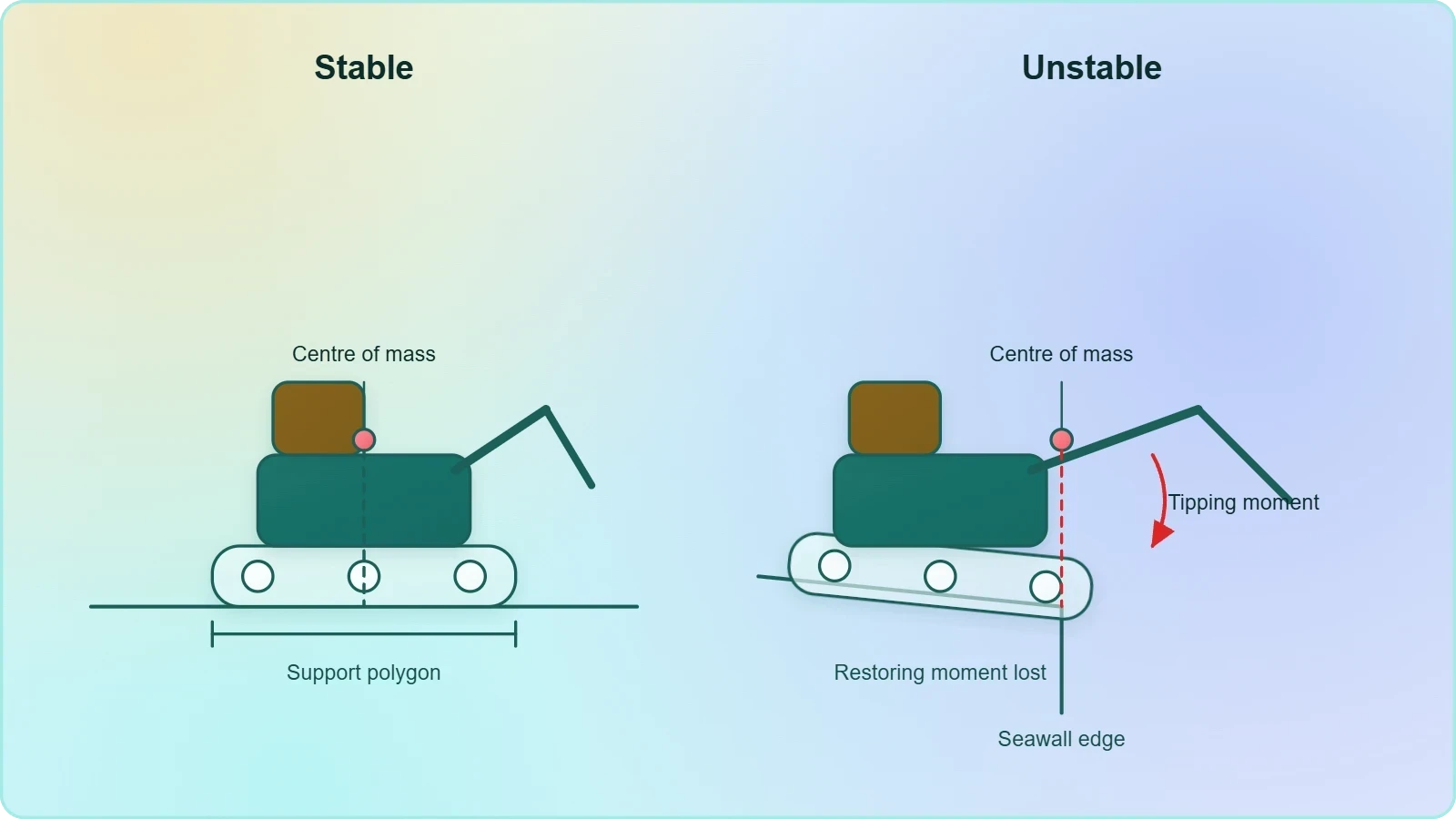
Diggers and excavators are counterbalanced machines, and their stability depends on a narrow margin that shifts with boom position, load, ground slope and soil bearing capacity. On a seawall edge, several of those variables deteriorate at once. The ground may be fill rather than natural formation, saturated by tidal action, and undercut by scour on the seaward face. An operator working near that edge is managing a machine whose centre of gravity can move outside its support polygon with very little warning, particularly when the arm is extended or a bucket is loaded.
The physics is unforgiving and can be expressed simply. A machine remains upright while the projection of its centre of mass falls within the polygon defined by its ground contact points. Once that condition fails, the restoring moment vanishes and the machine rotates. On sloping or yielding ground, the effective support polygon shrinks, and the margin between stability and rollover narrows accordingly. This is why exclusion zones, edge protection and ground assessment are standard controls for plant working near excavations, embankments and waterfront structures.
Ground Conditions at the Land-Sea Boundary
Coastal properties present ground conditions that are difficult to characterise from the surface. Fill placed decades ago may overlie soft marine sediments, and the water table fluctuates with the tide. A seawall that has been modified or rebuilt can create voids behind its face where material has been washed out. None of this is visible to an operator in a cab, which is why competent geotechnical assessment before plant is positioned near an edge is not a bureaucratic nicety but a core control. Where such assessment is absent or outdated, the risk is carried silently until it is realised.
New Zealand's coastal environment adds further variables. King tides, storm surge and seismic activity all affect the integrity of foreshore structures, and the Auckland region has experienced significant coastal damage in recent years. A seawall that performed adequately at the time of construction may not perform adequately after a sequence of storm events. Regular inspection and reassessment are therefore part of the ordinary duty of a landowner, not an optional extra, and the absence of a building consent record can make that reassessment harder to evidence.
Safe Systems of Work Around Heavy Plant
Health and safety practice around heavy plant rests on a small number of well-established controls: a documented safe system of work, a competent and appropriately licensed operator, exclusion zones for pedestrians, ground assessment before positioning, and a spotter where visibility is restricted. These controls are not novel, and their effectiveness is well evidenced. Failures tend to occur not because the controls are unknown but because they are treated as paperwork rather than practice, or because commercial pressure compresses the time available to implement them properly.
For a small residential project on a private property, the temptation to treat earthworks as straightforward is strong. The site is not a large industrial one, the work may be brief, and the contractor may be known to the owner. That familiarity is precisely where risk accumulates. Regulators have consistently found that fatalities on small sites involve ordinary tasks performed without ordinary controls, and the pattern is remarkably stable across sectors and jurisdictions. The lesson is unglamorous but reliable: the size of the job does not determine the size of the consequence.
- 01
- 02
- 03
- 04
WorkSafe, Police and the Parallel Investigative Track
Two investigations now run in parallel, and they serve different purposes. Police investigate the circumstances of a death, with a focus on whether any offence has been committed. WorkSafe investigates the work-related circumstances, with a focus on whether duties under the Health and Safety at Work Act were breached. The two can share information, but they are not the same inquiry, and their findings may diverge. It is entirely possible for a police investigation to conclude without charges while a WorkSafe process results in an infringement, a improvement notice, or a prosecution.
The WorkSafe track is the one most likely to produce a public account of what went wrong. Its investigations typically examine the PCBU's risk management, the adequacy of training and supervision, and whether reasonably practicable steps were taken to eliminate or minimise risk. The concept of "reasonably practicable" is central and frequently misunderstood: it requires duty holders to do what is proportionate to the risk, not what is theoretically possible. In a fatal plant rollover, the question of what was reasonably practicable near a seawall edge is likely to be central.
How Workplace Fatality Inquiries Typically Proceed
WorkSafe's process begins with scene examination and evidence gathering, including witness statements, machine inspection and documentary review. Investigators will want to see the safe system of work, the operator's competency records, and any ground assessment or engineering advice obtained before work began. They will also examine the contractual chain to establish who was the PCBU for the work and how duties were allocated. This phase can take many months, and the absence of public updates during it is normal rather than indicative of inaction.
At the conclusion of an investigation, WorkSafe may take a range of actions, from a letter of expectation through to enforcement action and prosecution. The threshold for prosecution is high, and the decision is made against statutory criteria rather than public sentiment. For the family of the deceased, the process can feel slow and opaque, and victim support and family liaison arrangements exist precisely because the timeline is long. Understanding that timeline is useful context for anyone following the case.
Corporate Liability and the Duty to Contractors
A landowner who engages a contractor is not automatically liable for the contractor's safety failures, but neither is the landowner automatically insulated. The Health and Safety at Work Act imposes overlapping duties, and a PCBU that controls a workplace or engages workers can hold duties that extend to contractors and their employees. The extent of those duties depends on the degree of influence and control the landowner exercised over the work, including site access, sequencing and any instructions given.
In practice, this means that a property owner commissioning earthworks near a seawall should be able to demonstrate that it engaged competent contractors, that it disclosed known site hazards, and that it did not direct work in a manner that compromised safety. Where a site has a contested consent history, that disclosure obligation becomes more significant, because the absence of a building consent may itself be a hazard indicator. These are the questions that a corporate liability analysis will eventually address.
The Consent Dispute and What It Signals About Enforcement
The company's decision to dispute the notice to fix is legally unremarkable and substantively significant. It is unremarkable because the Building Act provides for dispute and independent determination, and parties are entitled to use it. It is significant because the dispute reveals a genuine disagreement about whether the seawall constituted building work requiring consent. That disagreement, once resolved by the Ministry's building performance decision, establishes a record that the structure was built without consent — a finding with implications for insurance, future sale, and any subsequent works on the site.
For regulators, the case illustrates a familiar tension. Enforcement tools are designed to secure compliance, but they depend on the recipient accepting the regulator's characterisation of the work. Where that characterisation is contested, the process lengthens, and the structure remains in place throughout. The Ministry's determination resolves the legal question but does not, by itself, physically remediate the structure. Remediation requires a subsequent step, and the public record does not yet establish whether that step has been completed.
Insurance, Disclosure and Property Transactions
An unconsented structure on a coastal property is not a trivial matter at the point of sale or renewal of insurance. Insurers increasingly ask specific questions about consented works, and a known unconsented seawall may be excluded from cover or attract a premium loading. Buyers' solicitors routinely request LIM reports and property files, and a building performance decision finding unconsented work is exactly the kind of document that surfaces in due diligence. The commercial consequences can therefore outlast the regulatory process itself.
Disclosure obligations also run in the other direction. A vendor who knows of unconsented work and fails to disclose it can face claims after settlement, and the standard warranty regime in New Zealand property transactions is not generous to sellers who remain silent. For a corporate owner, the issue is compounded by governance expectations: directors are expected to know about material regulatory findings affecting company assets, and a fatality on a property with a contested consent history is precisely the sort of matter that boards are expected to have visibility of.
Lessons for Landowners Commissioning Coastal Work
The practical lessons are straightforward, even if the regulatory detail is not. Before commissioning any work on a seawall, retaining structure or foreshore asset, a landowner should establish in writing whether a building consent is required, obtain that advice from a suitably qualified person, and keep a record of the reasoning. Where a resource consent has been granted, that is not the end of the inquiry; it is the beginning of a separate one. Treating the two as interchangeable is the single most common error in this area.
Beyond consent, the safety lessons concern procurement and supervision. Engaging a contractor with demonstrable experience in coastal earthworks, requiring a written safe system of work, and ensuring that ground conditions near any edge are assessed before plant is positioned are all proportionate steps. None of them is onerous, and all of them are cheaper than the consequences of their absence. The tragedy at Stanley Point is a reminder that these steps are not administrative formalities but the practical expression of a duty owed to people who go to work on other people's property.
Reading the Public Record Carefully
Incidents of this kind generate a great deal of coverage quickly, and much of it blends confirmed fact with inference. The confirmed facts here are narrow: a digger went over a seawall, a man died, emergency services responded, WorkSafe was notified, and the property owner has said it is cooperating. The consent history is also documented through a Ministry decision. What remains unconfirmed is the causal relationship, if any, between the consent position and the accident, and it would be a mistake to assume one exists simply because both facts concern the same seawall.
Careful reading also requires attention to what is not said. The company's statement does not address the consent history, and the regulators have not commented on the relationship between the two threads. That silence is not evidence of concealment; it is the ordinary posture of parties in an active investigation. Readers who follow the case should expect the picture to change as the investigative record develops, and should treat early characterisations — whether sympathetic or damning — with appropriate caution.
What to Watch as the Investigations Develop
Several developments would materially change the public understanding. A WorkSafe finding on the adequacy of the safe system of work would clarify whether the accident is best understood as a control failure, a ground condition failure, or something else. A decision on remediation of the seawall would clarify whether the consent gap has been closed. Any coronial referral would produce a public narrative of the events and, potentially, recommendations. Each of these would add a piece to a picture that is currently incomplete.
It is also worth watching how the case is discussed publicly. Fatalities involving heavy plant on private property often receive less sustained attention than industrial incidents, despite involving similar hazards. If this case prompts wider scrutiny of how coastal earthworks are consented and supervised, that would be a meaningful outcome. If it fades from view after the initial coverage, the regulatory questions it raises will remain unanswered, and the conditions that produced the risk will persist on other properties around the harbour.
The Broader Question of Regulatory Coherence
New Zealand's split between resource management and building control is not unique, but it does create seams where compliance can fall between regimes. A landowner who obtains one consent and not the other may believe, genuinely, that the process is complete. Regulators encounter this regularly, and the guidance that exists is not always read by the people who most need it. The result is a system that works well for sophisticated developers and less well for private owners undertaking occasional works on their own properties.
Closing that gap is a matter of design rather than resources. Clearer signposting at the point of resource consent, a single point of inquiry for coastal structures, and better public explanation of the distinction would reduce the incidence of inadvertent non-compliance. None of these measures would have prevented the accident at Stanley Point on its own, and it would be wrong to suggest otherwise. But they would reduce the number of properties carrying unresolved consent questions, and that is a worthwhile objective in its own right.
From our network :
- University Language Proficiency Exams: Why Institutional Tests Demand Different Preparation Than IELTS and TOEFLDiscover why university-specific language proficiency examinations differ fundamentally from IELTS and TOEFL, and learn strategic preparation approaches for institutional assessment success.
- The Final Descent: How ESA Retired the Legendary Cluster Constellation After 24 Years of Space Weather ScienceAfter 24 years mapping Earth’s magnetosphere, ESA’s Cluster mission concluded with a precisely controlled reentry over the South Pacific. This analysis explores the scientific legacy, engineering decisions, and debris mitigation principles behind one of space exploration’s most responsible retirements.
- Mobile Learning and VR in English: What Global Evidence Reveals About Effective Language TechnologyA systematic review across 14 countries reveals which language-learning technologies genuinely work. Mobile learning, AI, and VR show measurable benefits when pedagogically integrated. This evidence-based guide helps educators and learners select technology that delivers real return on investment.
- Committed Mediterranean Precipitation Decline: Why Emissions Cuts Alone Cannot Restore Winter RainsNew NOAA research reveals that Mediterranean winter rains may decline irreversibly even with emissions cuts. Explore the science of committed climate change and regional impacts.
- The Hidden Cost of AI Convenience: Why Over-Permissioned Agents Are a Security Time BombDiscover why AI agents with excessive permissions create dangerous single points of failure, and learn how implementing least privilege principles can protect your organization from exploitation.
- Forbidden Matrix Patterns and Visible Lattice Points: A Geometric DictionaryExplore how multidimensional 0–1 matrices encode geometric truths, linking forbidden patterns to visible lattice points and hypergraph theory, with applications in combinatorics and computational geometry.
- CISA’s Ten-Advisory Wave: Why Generic Patching Fails in OT and How to Build Product-Specific PlaybooksCISA released ten ICS advisories in one week, exposing critical infrastructure risks. Generic patching fails in OT. Learn to build product-specific remediation playbooks.
- How AI Agents Will Change the Way We Manage Personal FinancesExplore how AI agents are transforming personal finance through automated budgeting, bill payment, and investment management, while examining the critical security protocols and governance frameworks required for safe deployment.
- Live Online English Classes for Kids: Do They Actually Reduce Anxiety?A ten-week study reveals that synchronous online English classes can significantly reduce child language anxiety while improving listening and reading skills. Discover what makes these programs effective and how parents can select the right one.
RESOURCES
- r/auckland - Redditreddit.com'Living seawalls' trial boosts marine life at Westhaven · News · https ... https://www.nzherald.co.nz/nz/auckland/stanley-point-crash-multiple-fire ...
- January 10, 2023 The Organizational Meeting of the Town Board of ...shelterislandtown.govJan 10, 2023 ... ... Bay Drive, for permission to rede- velop residential ... (f) Any and all applications for a causeway wetlands permit…
- Newstalk ZBnewstalkzb.co.nzGet the latest news from Newstalk ZB. From breaking news to the debate and opinion, we bring NZ the news from around the world…
- U.S. Marines in the Korean Warmarines.mil... point of similarity. Except for senior generals, no one—soldier or. Marine—had more than a vague idea of how or why they came to…
- Disaster Ready Fund - NEMAnema.gov.au8 days ago ... ... Seawall Replacement, QLD - Moreton Bay, The ... Building RediCommunities among First Nations communities in Bega Valley, Mehi and…
- Panama Canal record - GovInfogovinfo.govToro Point cove range reconstructed, 319. Air compressor plant, Balboa ... Building Division, appointments, designing engineer- ing work, 5 7. See also ...
- Final NASA WFF Shoreline Enhancement and Restoration Project ...nasa.govSeawall Extension. The initial phase of the 50 year SRIPP project was ... Elimination System permit program regulates point source discharges to Virginia's.
- Resolutions Index - St. Johns County Clerk of the Circuit Court and ...stjohnsclerk.com... POINT LLC Res. 2019-435 - Authorizes to execute a purchase and sale ... Consents to SJC Council on Aging's improvements to a county-owned…
- SCHED2 – Historic Heritage Items - Waitaki District Councilwaitaki.govt.nzThe church, with its finely detailed stonework, richly coloured stained glass memorial windows and striking interior with kauri joinery, is a landmark building ...
- Chris Booth: Sculpture into Ecology - Interalia Magazineinteraliamag.orgJKG: And you recycled unused sea wall stones from near Stanley Park as part of the installation. ... We have a pile at Stanley…
- Town of - Harpswell, Maineharpswell.maine.gov... point at which it was leased to HCA. As with any physical asset, the building, which currently also houses the Harpswell Neck Library,…
- Chaplains With Marines in Vietnam 1962-1971 PCN 19000309100usmcu.edudistribution point . Chaplains established Christmas displays in the ... permission to have Mass in a huge Butler Building. When he arrived the place ...
- Draft EIS for the Proposed Corpus Christi Ship Channel Deepening ...swg.usace.army.milThe DA permit application is for deepening of the Corpus Christi Ship Channel (CCSC) at Port Aransas, Nueces County, Texas. The application was originally ...
- Titan (submersible) - Wikipediaen.wikipedia.orgA central point made in the documentary is Rush's ... Based on his experience building and testing submersibles, and taking tourists underwater, Stanley ...
- CITY AND COUNTY OF HONOLULU - Hawaii.govfiles.hawaii.govNov 8, 2021 ... The prior threshold for requiring an SMA Permit was for homes exceeding 7,500 sf on shoreline parcels. The City DPP…
- 01
- 02
- 03
- 04
- 05
- 06
- 07
- 08
0 Comments