When Canva confirmed that roughly one-fifth of its global workforce would be leaving the business just weeks before Christmas, the announcement landed with unusual force. Canva is not a struggling startup or a legacy incumbent in decline; it is one of Australia's most celebrated technology exports, a design platform valued in the tens of billions and used by hundreds of millions of people worldwide. The timing, scale, and symbolism of the cuts therefore invite a broader question than any single company's balance sheet can answer: is artificial intelligence beginning to reshape white-collar employment in the very firms that built their reputations on creative software?
The same week, the Reserve Bank of Australia delivered a second, quieter piece of news with equally far-reaching consequences. Borrowers learned that interest rates would rise again, with inflation proving stickier than policymakers had hoped. For households already stretched by mortgage repayments, the message was sobering: relief may be further away than expected. Together, the corporate retrenchment at Canva and the monetary tightening in Sydney sketch a portrait of an economy caught between technological disruption and persistent price pressure, two forces that rarely announce themselves politely.
This analysis examines both developments as connected signals rather than isolated headlines. It considers what Canva's restructuring reveals about the economics of AI adoption, how the Reserve Bank's decision reflects deeper structural inflation, and why the Australian experience offers lessons for advanced economies everywhere. The aim is not to predict the future with false confidence, but to read the present with greater clarity, separating genuine structural shifts from the noise that surrounds every corporate announcement and central bank statement.
On This Page
TL;DR Canva's decision to cut approximately one-fifth of its workforce ahead of Christmas, arriving alongside another Reserve Bank of Australia rate rise, captures two converging pressures on the Australian economy. The design platform's restructuring reflects a genuine strategic pivot toward AI-native operations, where smaller teams leverage automation to do more, while the central bank's tightening signals that inflation remains entrenched enough to justify prolonged pain for borrowers. Together they illustrate how technological displacement and monetary policy are reshaping employment, household finances, and corporate strategy simultaneously, with implications that extend well beyond Australia's borders.
The Canva Restructuring and What It Signals
Canva's announcement was notable less for the raw number of departures than for the identity of the company making them. A profitable, venture-backed design platform with a vast user base and a strong brand is precisely the kind of firm that conventional wisdom says should be insulated from layoffs. When such a company reduces headcount by roughly twenty percent, the market reads it as a statement about expected future conditions rather than present distress. The restructuring suggests leadership believes the operating model that carried Canva through its growth phase is no longer the model that will carry it through the next one.
The Economics of AI-Native Operations
The phrase "AI-native" has become a staple of corporate communication, but its economic logic is concrete. Software firms have historically scaled by hiring proportionally to revenue, adding engineers, designers, marketers, and support staff as the customer base expanded. Generative tools disrupt that relationship by compressing the labor required per unit of output. A design platform that once needed large teams to build templates, localize content, and support users can increasingly automate portions of that work, allowing revenue to grow while headcount stays flat or declines. The savings are real, but so is the human cost.
For Canva specifically, the strategic calculus involves defending margins against well-funded competitors while investing heavily in its own AI capabilities. Every dollar redirected from payroll toward model development and infrastructure is a bet that the next phase of competition will be won on product intelligence rather than service breadth. That bet may prove correct, but it transfers risk onto employees who helped build the franchise. The restructuring is therefore best understood not as a sign of failure but as a reallocation of capital and capability, executed with the bluntness that public markets and private investors now expect.
Timing, Reputation, and Workforce Trust
Announcing cuts weeks before Christmas carries reputational risk that extends beyond the departing employees. Canva has cultivated an employer brand built on generosity, including unusually extensive leave policies and profit-sharing arrangements. Layoffs of this magnitude test whether that brand was substantive or performative, and the answer will shape recruiting for years. Skilled engineers and designers choose employers partly on cultural reputation, and a perception that generosity evaporates under pressure can raise future hiring costs. The company's handling of severance, transition support, and communication will therefore matter as much as the financial savings themselves.
There is also a subtler timing consideration. Firms often prefer to complete restructurings before year-end to start the new fiscal period with a clean cost base, and the pre-Christmas window, however uncomfortable, aligns with that accounting logic. Investors and analysts reward decisiveness, while delay invites speculation about deeper problems. The result is a familiar pattern in which operational rationality and human decency pull in opposite directions, and companies must choose how much weight to give each. Canva's choices in the coming months will be watched closely as a template for how Australian tech handles its first serious encounter with AI-driven downsizing.
The Reserve Bank's Rate Decision in Context
The Reserve Bank of Australia's decision to raise rates again was framed by borrowers as unwelcome news, but its significance lies in what it reveals about the central bank's reading of inflation. When price pressures prove persistent, policymakers face a choice between tolerating slower disinflation and accepting higher unemployment. The RBA's choice to tighten further indicates that it regards inflation as the more dangerous of the two risks, a judgment with direct consequences for mortgage holders, small businesses, and consumer confidence. The decision also signals that the easing cycle many households anticipated has been deferred, perhaps substantially.
Why Inflation Has Proven Sticky
Australian inflation has been sustained by a combination of factors that resist quick monetary fixes. Services prices, driven by wages and domestic demand, have proven slower to cool than goods prices, which benefited from the normalization of global supply chains. Housing costs, including rents, remain elevated because of structural shortages in construction and population growth that outpaces new supply. These are not problems that interest rates solve efficiently; higher borrowing costs can suppress demand, but they cannot build houses or expand the labor force. The result is a central bank forced to apply blunt instruments to a problem with sharp structural edges.
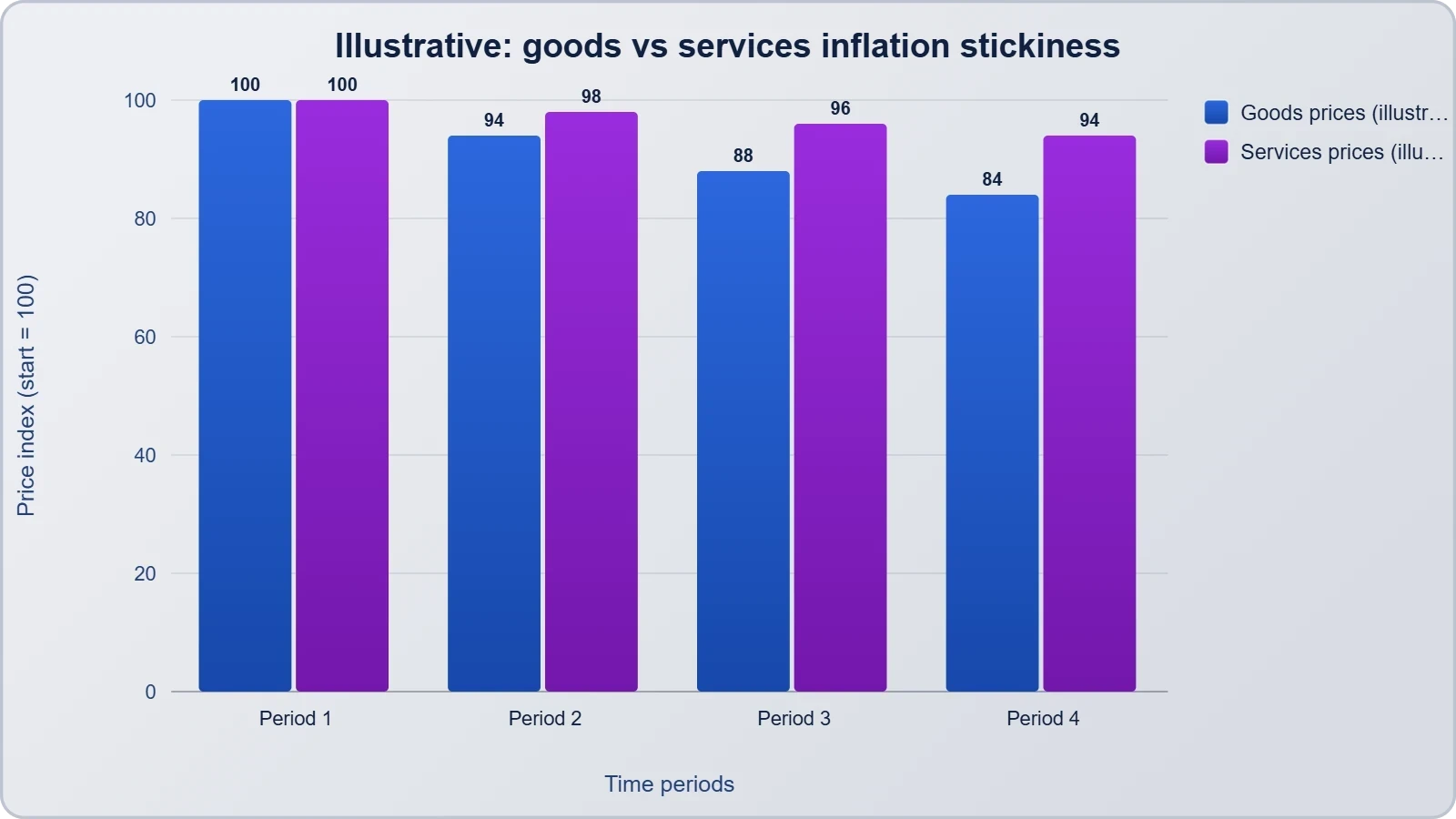
There is also a global dimension. Energy prices, geopolitical fragmentation, and the fiscal expansion of major economies all feed into domestic price pressures through trade and expectations. Australia, as a small open economy with a floating currency, imports a portion of its inflation regardless of domestic policy. The RBA must therefore calibrate against conditions it cannot control, knowing that overtightening risks a sharper slowdown than necessary while undertightening risks entrenching expectations. This dilemma explains why central bank communication has grown more cautious even as the decisions themselves remain firm.
The Household Squeeze and Consumer Behavior
For households, the arithmetic of higher rates is immediate and personal. Mortgage repayments absorb a larger share of disposable income, and the "mortgage cliff" of fixed-rate loans rolling onto variable rates amplifies the shock for many families. Economists describe the effect as feeling poorer for longer, and the phrase captures something important: the pain is not a single event but a sustained condition that reshapes spending, saving, and confidence. Retailers, already contending with softer demand, must plan for a consumer who is more cautious and more price-sensitive than in recent years.
Consumer behavior under prolonged pressure tends to shift in predictable ways. Discretionary spending falls first, with households deferring large purchases and trading down on everyday items. Savings buffers accumulated during the pandemic are drawn down, and credit usage rises among those with less cushion. These adjustments are rational at the household level but collectively they slow the economy, which is precisely the transmission mechanism the central bank intends. The question is whether the slowdown remains orderly or tips into something sharper, and that uncertainty is now central to every business forecast in the country.
Is AI Really Coming for White-Collar Work?
The question posed by the ABC Business Daily episode, whether AI is coming for Canva, deserves a careful answer rather than a reflexive one. Generative AI is genuinely capable of performing tasks that once required human designers, writers, and analysts, but the translation from task capability to job elimination is neither automatic nor uniform. Firms adopt automation when it improves quality, speed, or cost in ways that justify disruption, and they often discover that the technology augments more than it replaces. The more accurate framing is that AI is reshaping the composition of work, changing which tasks are valuable and which skills command a premium.
Task Automation Versus Job Displacement
Labor economists distinguish between automating tasks and eliminating jobs, and the distinction matters enormously. A single role bundles many tasks, some highly automatable and others stubbornly human. Design work, for instance, includes ideation, client communication, brand judgment, and technical execution; AI can accelerate the last of these while leaving the others largely untouched. When firms restructure, they are often rebalancing the bundle rather than removing it entirely, which means the net employment effect depends on how quickly new tasks and new roles emerge to absorb displaced workers.
History offers grounds for cautious optimism alongside genuine concern. Previous general-purpose technologies, from electricity to computing, ultimately created more employment than they destroyed, but the transition took decades and imposed severe costs on specific groups. The current wave is arriving faster, and its effects are concentrated among educated white-collar workers who had assumed their skills were insulated. That concentration is politically significant because it touches constituencies with loud voices and strong institutional representation, which may accelerate policy responses but also intensify the sense of disruption.
The Productivity Dividend and Its Distribution
If AI delivers the productivity gains its proponents promise, the economic question becomes one of distribution rather than aggregate output. Productivity growth expands the total pie, but nothing guarantees that workers capture a fair share. Bargaining power, tax policy, competition, and labor market institutions determine how gains are divided, and current trends favor capital over labor in many sectors. The Canva restructuring is a small but instructive example: efficiency gains are being realized through headcount reduction rather than wage growth or shorter hours, which is one distributional choice among several possible ones.
Public policy therefore has a role that markets alone will not fill. Retraining programs, portable benefits, and wage insurance can cushion transitions, while competition policy can prevent productivity gains from being captured by a handful of dominant platforms. The alternative is a scenario in which AI enriches shareholders and a narrow technical elite while displacing a broad middle class, an outcome that would undermine the social stability on which profitable markets depend. Australia, with its strong institutions and relatively centralized wage system, is better positioned than many countries to manage this transition, but positioning is not the same as action.
- 01
- 02
- 03
- 04
Reading the Australian Economy's Twin Signals
Placed side by side, the Canva layoffs and the RBA rate rise describe an economy undergoing two kinds of adjustment at once. The first is technological: firms are reorganizing production around AI, which changes the demand for labor even when output is growing. The second is monetary: the central bank is suppressing demand to bring inflation down, which slows hiring and investment across the board. Neither force is temporary, and their interaction is what makes the current moment unusually difficult to navigate for businesses, workers, and policymakers alike.
Corporate Strategy Under Dual Pressure
Companies now plan against a backdrop in which both their cost of capital and their labor model are shifting simultaneously. Higher rates raise the hurdle for investment, while AI lowers the marginal cost of certain functions, creating a strong incentive to substitute capital for labor precisely when financing is more expensive. Firms with strong balance sheets can fund the transition internally; weaker ones may be forced to restructure defensively. The result is likely to be consolidation within sectors, as scale becomes more valuable for absorbing transition costs and investing in proprietary technology.
For Australian businesses, geography adds another layer. The domestic market is small, so growth depends on export and international competition, where AI adoption rates elsewhere set the benchmark. Falling behind on productivity would erode competitiveness over time, which argues for aggressive adoption. Yet aggressive adoption carries social and political costs at home, particularly in regional communities and among older workers less able to retrain. Managing this tension is the central strategic challenge for Australian corporate leadership in the coming decade, and there is no painless path through it.
Policy Choices Ahead
The policy agenda implied by these developments is broader than interest rate setting. Fiscal policy can support displaced workers through income support and retraining, competition policy can keep markets contestable as AI raises barriers to entry, and education policy can equip the next generation with skills that complement rather than compete with machines. None of these levers operates quickly, which is precisely why they should be pulled before the disruption becomes acute. The RBA can manage demand, but it cannot build the institutional infrastructure that determines whether the AI transition is broadly shared or narrowly captured.
There is also a communication challenge. Central banks and governments must explain trade-offs honestly, acknowledging that disinflation involves real hardship and that technological progress creates losers as well as winners. Euphemism erodes trust, and trust is the currency on which policy credibility depends. The Canva announcement and the rate decision are, in this sense, tests of institutional candor as much as economic management. How Australia's leaders frame these twin pressures will shape public acceptance of the measures required to address them, and that acceptance is not guaranteed.
We Also Published
Lessons for Advanced Economies Beyond Australia
Australia's experience is not unique, and that is precisely what makes it instructive. Advanced economies everywhere are grappling with the same pairing of rapid AI adoption and restrictive monetary policy, and the sequencing of these pressures varies only in degree. The United States, the United Kingdom, and the euro area have all seen technology firms restructure while central banks hold rates higher for longer. What differs is the institutional context, and Australia's relatively centralized wage system and strong social safety net offer a useful test case for how such transitions might be managed more equitably than in more fragmented labor markets.
Comparative Institutional Responses
Different economies are responding to the same pressures with different institutional tools. The United States relies heavily on market adjustment, with rapid hiring and firing and limited retraining infrastructure, producing dynamism alongside insecurity. European economies lean on employment protection and works councils, which slow adjustment but distribute its costs more evenly. Australia sits between these models, with a award-based wage system, compulsory superannuation, and a history of centralized bargaining that gives it unusual capacity to coordinate a response if policymakers choose to use it.
The comparison matters because it shows that the distributional outcome of the AI transition is a policy variable, not a technological inevitability. Countries that invest in transition support, maintain competitive markets, and preserve strong social insurance will experience the same technology with less social damage. Those that leave adjustment entirely to markets will generate faster productivity growth and greater inequality, a trade-off that is politically sustainable only up to a point. The Australian case will be watched as evidence of which approach proves more durable.
What to Watch in the Coming Quarters
Several indicators will reveal how these pressures evolve. The pace of further technology-sector restructurings will show whether Canva's move is an outlier or the leading edge of a broader pattern. Inflation readings, particularly in services, will determine whether the RBA's tightening has further to run. Wage growth and unemployment data will indicate how quickly displaced workers are absorbed elsewhere. And business investment surveys will reveal whether firms are substituting technology for labor at a pace that outruns the creation of new roles.
For investors, the implications are concrete. Companies that can demonstrate credible AI-driven efficiency gains may command premium valuations, while those that restructure defensively may face skepticism about execution. For workers, the premium on skills that complement AI, judgment, client relationships, and cross-domain synthesis, is likely to rise. For policymakers, the window for proactive action is narrowing, and the cost of delay will be measured in lost output and diminished trust. The twin signals from Australia are a timely reminder that these forces are already here, not approaching.
Conclusion: Reading the Signals Honestly
The Canva restructuring and the Reserve Bank's rate decision are not separate stories that happen to share a news cycle. They are expressions of the same underlying adjustment, in which an economy built on certain assumptions about labor, capital, and prices is being reorganized around new ones. AI is changing what work is worth, higher rates are changing what capital costs, and households are absorbing the consequences of both. Understanding these connections is more useful than reacting to each headline in isolation, because the connections determine what comes next.
What comes next depends substantially on choices that have not yet been made. Companies can choose how generously they manage transitions. Policymakers can choose how proactively they support displaced workers. Investors can choose whether to reward short-term cost cutting or long-term capability building. None of these choices is determined by technology, and framing the AI transition as inevitable obscures the agency that institutions and individuals still possess. The Australian experience offers a case study in how those choices are being made in real time, with all the messiness that entails.
The most honest conclusion is that the picture is mixed and the outcome is contingent. Canva's cuts are painful for those affected and rational for the company, and both truths can hold at once. The RBA's rate rise is necessary for price stability and costly for borrowers, and both truths can hold at once. What matters is whether the institutions that mediate these pressures, from corporate boards to central banks to governments, act with competence and candor. On that question, the evidence is still being gathered, and the next few quarters will be decisive.
From our network :
- CISA’s Ten-Advisory Wave: Why Generic Patching Fails in OT and How to Build Product-Specific PlaybooksCISA released ten ICS advisories in one week, exposing critical infrastructure risks. Generic patching fails in OT. Learn to build product-specific remediation playbooks.
- The Final Descent: How ESA Retired the Legendary Cluster Constellation After 24 Years of Space Weather ScienceAfter 24 years mapping Earth’s magnetosphere, ESA’s Cluster mission concluded with a precisely controlled reentry over the South Pacific. This analysis explores the scientific legacy, engineering decisions, and debris mitigation principles behind one of space exploration’s most responsible retirements.
- Mobile Learning and VR in English: What Global Evidence Reveals About Effective Language TechnologyA systematic review across 14 countries reveals which language-learning technologies genuinely work. Mobile learning, AI, and VR show measurable benefits when pedagogically integrated. This evidence-based guide helps educators and learners select technology that delivers real return on investment.
- Forbidden Matrix Patterns and Visible Lattice Points: A Geometric DictionaryExplore how multidimensional 0–1 matrices encode geometric truths, linking forbidden patterns to visible lattice points and hypergraph theory, with applications in combinatorics and computational geometry.
- Live Online English Classes for Kids: Do They Actually Reduce Anxiety?A ten-week study reveals that synchronous online English classes can significantly reduce child language anxiety while improving listening and reading skills. Discover what makes these programs effective and how parents can select the right one.
- Committed Mediterranean Precipitation Decline: Why Emissions Cuts Alone Cannot Restore Winter RainsNew NOAA research reveals that Mediterranean winter rains may decline irreversibly even with emissions cuts. Explore the science of committed climate change and regional impacts.
- How AI Agents Will Change the Way We Manage Personal FinancesExplore how AI agents are transforming personal finance through automated budgeting, bill payment, and investment management, while examining the critical security protocols and governance frameworks required for safe deployment.
- The Hidden Cost of AI Convenience: Why Over-Permissioned Agents Are a Security Time BombDiscover why AI agents with excessive permissions create dangerous single points of failure, and learn how implementing least privilege principles can protect your organization from exploitation.
- University Language Proficiency Exams: Why Institutional Tests Demand Different Preparation Than IELTS and TOEFLDiscover why university-specific language proficiency examinations differ fundamentally from IELTS and TOEFL, and learn strategic preparation approaches for institutional assessment success.
RESOURCES
- Latest Australia news and comment | The Guardiantheguardian.comVideo. Hide. RBA interest rates: governor Michele Bullock explains decision ...
- Canva to impact 1271 roles to return to start-up roots - Ninenine.com.au8 hours ago ... Australian design software giant Canva will change 1271 jobs, or 22 ... Two big four banks make moves after RBA…
- r/auscorp - Redditreddit.comApr 23, 2023 ... Canva unveils mass job cuts in 'hardest moment' of its history · Industry - Tech / Startups · https://www.smh.com.au/technology/canva-unveils ...
- Canva layoffs: design giant to cut or relocate more than ... - Navtarangnavtarang.com.au2 hours ago ... RBA interest rates live: Reserve Bank of Australia meeting today before cash rate decision and. Local News. RBA interest rates…
- News - ABC listenabc.net.au3 days ago ... What the RBA's split decision means for rate rises. Duration: 4 minutes 35 seconds 4 m 35 s · Are…
- Canva reveals sweeping job cuts - News | InDaily, Inside Queenslandindailyqld.com.au7 hours ago ... Australian design software firm Canva has announced a major ... RBA delivers fifth interest rate hike in bid to battle…
- Sam Altman insists we 'should trust' AI firms amid push for slowdownabc.net.auSep 15, 2026 ... Are Canva's mass layoffs a warning sign for the economy? Published: Tue ... More Like This. Carousel. Australia waits for…
- Australian Rates & Bonds - Bloomberg.combloomberg.comGet updated data about Australian bonds. Find information on government bonds yields and interest rates in Australia ... Canva Announces Layoffs, Job Changes for ...
- Australia - Latest News and Updates - WSJ.comwsj.comAustralian Design Startup Canva Avoiding Tech-Sector Layoffs · The design ... Australia's RBA Raises Rates in Split Decision as Inflation Fears Intensify.
- Top stories - Google Newsnews.google.comABC News & Headlines – Australian Broadcasting Corporation. 'Like they don't care': RBA's fifth rate hike a huge blow to mortgage borrowers. 3 hours…
- Mikhail Konovalov - Staff Platform Engineer | Turning vibe-coded ...au.linkedin.comSydney, New South Wales, Australia. Building engine for matching patients with clinical trials in Australia and US (laid-off). Senior Software Engineer. Canva.
- Appen loses $154m offer as Innodata claims confidentiality brokentheaustralian.com.auMar 14, 2024 ... ... interest rate hits an 18-year high. MATTHEW CRANSTON, THOMAS HENRY ... Canva job cuts are the start of the…
- Australia lifts minimum wage by 4.75% as inflation reacceleratesreuters.comJun 1, 2026 ... Analysts at Citi said the wage decision, combined with existing cost ... The RBA has raised interest rates three times…
- RBA delivers Cup rate hike - LinkedInlinkedin.com7 days ago ... In a 6-3 majority decision, the Reserve Bank of Australia has raised the official cash rate to 4.85%, its highest…
- From Crisis to Recovery | OECDoecd.orgpeople will develop a collective sense of where inflation and interest rates are heading, which will guide their decisions. ... www.rba.gov.au/ ...
- 01
- 02
- 03
- 04
- 05
- 06
- 07
- 08
0 Comments