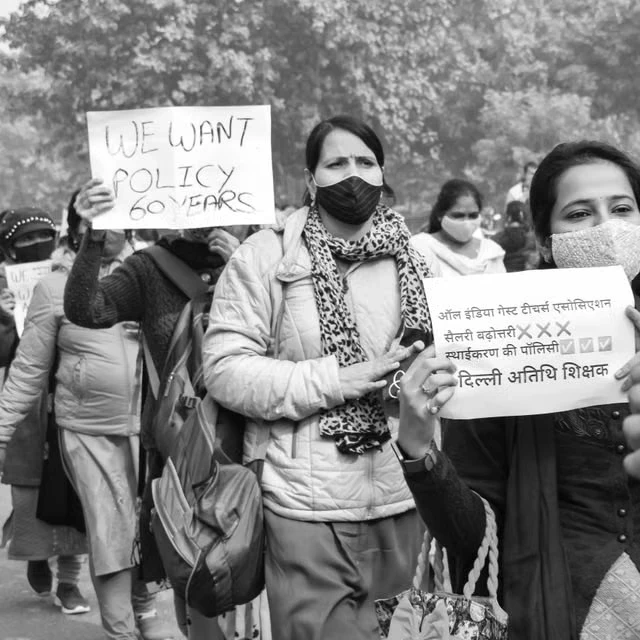
Delhi’s decision to release three Cockroach Janta Party leaders after airport detention is not a minor procedural footnote; it is a blunt reminder of how quickly protest politics collides with administrative power. When permission for a demonstration is denied and security is tightened across the capital, the state is not merely managing traffic or crowd control. It is making a deliberate judgment about order, legitimacy, and the boundaries of dissent.
The case of Abhijeet Dipke, Saurav Das, and Ashutosh Ranka exposes a familiar Indian public-order pattern: preventive detention, judicial oversight, and a release conditioned on future restraint. The court’s one-year peace requirement signals caution rather than vindication, while the leaders’ sharp rhetoric after release shows how political theater intensifies even when the immediate legal battle is over. The real story lies in the tension between constitutional protest rights and the machinery of restraint.
At its core, the episode demonstrates how a denied rally can escalate into a symbolic confrontation between opposition activism and the state. The protesters sought to gather at Jantar Mantar to demand the resignation of Chief Election Commissioner Gyanesh Kumar, but they were intercepted before the demonstration could begin.
On This Page
That sequence matters, because it shows the modern logic of preemption: stop the assembly early, manage the optics tightly, and let the courts decide the rest.
TL;DR Three CJP leaders were detained at Delhi airport while traveling to join a protest at Jantar Mantar and later released by a special executive magistrate court with a one-year condition not to disturb peace. The incident reflects a hard-edged clash between protest rights, administrative restrictions, and political messaging in India’s capital. It also highlights how quickly a denied demonstration can become a legal and symbolic contest over dissent, authority, and public order.
What Happened and Why It Matters
The sequence began with a planned protest in Delhi, where CJP leaders intended to demand the resignation of Chief Election Commissioner Gyanesh Kumar. Delhi Police refused permission and reinforced security, effectively blocking the gathering before it could form. That made the airport detention of the three leaders a preventive action rather than a response to violence already underway.
Detention Before the Demonstration
Abhijeet Dipke, Saurav Das, and Ashutosh Ranka were reportedly taken from their aircraft seats at Indira Gandhi International Airport. This detail is significant because it underscores how decisively authorities acted to prevent the protest from reaching the city. In public-order disputes, timing often becomes the decisive weapon.
The state’s logic was straightforward: stop the organizers before they can mobilize supporters. Yet such preemptive measures also sharpen the perception that political expression is being managed through coercion rather than negotiation. The moment police intervene before a protest begins, the legal question expands beyond logistics into democratic legitimacy.
The Court’s Release Order
The leaders were produced before a magistrate at Delhi Cantonment police station and subsequently released by the court. Their release was not unconditional; CJP office bearers said the order required them to avoid any activity that could disturb peace and tranquility for a year. That type of condition is a common judicial compromise in politically sensitive cases.
Such orders do not erase the confrontation; they merely lower its temperature. The court signaled that liberty could be restored, but only within a framework of restraint. In practical terms, the ruling tried to balance civil freedoms against the state’s claim that public order had to be safeguarded in the capital.
Political Context and Public-Order Strategy
This incident should be read in the broader context of India’s recurring struggle between street politics and administrative control. Jantar Mantar has long served as a symbolic protest ground, but access to it is never politically neutral. When authorities deny permission there, they are not simply closing a location; they are curating the conditions of dissent.
Why Jantar Mantar Remains Symbolic
Jantar Mantar is more than a public space. It is a stage on which opposition groups seek visibility, media coverage, and moral pressure. A protest there signals not just discontent, but an attempt to convert grievance into national attention.
Because of that symbolism, the choice to gather there is itself strategic. Authorities understand this and often respond with heightened sensitivity, especially when the issue involves election institutions. The result is a contest over who controls the narrative before a crowd even assembles.
Administrative Preemption as a Tactic
Preventive detention in political cases functions as an instrument of anticipation. Instead of waiting for a rally to become disruptive, officials move early and then defend the action as necessary for maintaining peace. The approach may reduce immediate unrest, but it can also deepen distrust and amplify accusations of suppression.
From the government’s perspective, a stopped protest is a controlled risk. From the opposition’s perspective, it becomes evidence that the state fears mobilization itself. That interpretive divide is the real engine of many such confrontations, and it rarely disappears with a court order.
We Also Published
Legal Significance of the Release Condition
A release conditioned on maintaining peace for a year is notable because it does not function like an ordinary acquittal. It is a regulatory compromise, a judicial attempt to resolve immediate custody while imposing a future behavioral boundary. This is legal restraint with political consequences attached.
What the Condition Actually Means
In plain terms, the court did not decide the broader political dispute. It addressed conduct, risk, and peacekeeping. Such conditions often aim to discourage repeated confrontation, but they can also feel expansive, because they extend the court’s influence into future speech and assembly.
That ambiguity is part of the design. The order avoids a direct endorsement of the protest while preventing open-ended detention. It is a narrow legal door, not a triumphant opening, and both sides can claim something from it without fully winning the field.
Judicial Balancing in Sensitive Cases
Courts in politically charged matters often walk a tight line between civil liberties and public order. If they appear too permissive, they invite criticism that law and order has been abandoned. If they appear too restrictive, they risk being seen as tools of executive suppression. The Delhi order sits squarely inside that tension.
For legal observers, the case shows how magistrate courts can become the final buffer between aggressive policing and political grievance. Their role is not glamorous, but it is consequential. In such moments, the court is less a grand arbiter than a pressure valve for the state system.
- 01
- 02
- 03
- 04
Communication, Provocation, and the Politics of Messaging
The final stage of this event unfolded not in court, but on social media. After his release, Abhijeet Dipke posted aggressive remarks on X, including a direct insult to Prime Minister Narendra Modi. That choice matters because modern opposition politics is no longer confined to the street; it extends instantly into digital confrontation.
Social Media as a Second Arena
Online language now serves as a continuation of protest by other means. A sharp post can frame the narrative, rally sympathizers, and transform legal release into a new political moment. It is not incidental communication; it is strategic messaging calibrated for visibility and outrage.
Dipke’s language also reveals how grievance is converted into moral polarization. Once that happens, the issue is no longer the specific protest or its denied permission. It becomes a broader contest over dignity, state authority, and the symbolic legitimacy of leadership.
The Cost of Escalatory Rhetoric
Such rhetoric may energize a political base, but it also narrows the room for negotiation. When leaders respond to detention with insult rather than institutional argument, they invite stronger countermeasures and harder public judgment. The cycle becomes self-reinforcing: restriction produces provocation, which then justifies more restriction.
That is why the political aftermath matters as much as the detention itself. The court may have resolved the immediate custody issue, but the communication war continued instantly. In a media-driven environment, the loudest sentence often becomes more influential than the official order.
What This Episode Reveals About Indian Democracy
This case is not merely about three leaders, one denied protest, or one court order. It reveals the operational character of democracy under pressure: institutions still function, but they often do so through friction, compromise, and strategic constraint. That is not the same as democratic failure; it is the lived texture of contested governance.
Rights, Order, and Institutional Friction
The central lesson is that democratic rights do not disappear when they are challenged. They are filtered through police discretion, judicial review, and political calculation. In that filter, every action leaves a mark: the state asserts control, the opposition claims suppression, and courts attempt to stabilize both sides.
Viewed this way, the Delhi episode becomes a case study in institutional friction rather than a simple law-and-order story. The system did not collapse; it negotiated. Yet the very need for negotiation shows how fragile trust can become when protest, authority, and symbolism collide in the national capital.
The Deeper Political Message
The deeper message is that modern Indian politics increasingly treats visibility as power. A protest denied is still a message; a detention still produces attention; a release still leaves behind a narrative. Those who understand this dynamic can turn setback into stagecraft, but the cost is that public debate becomes even more adversarial.
That is why the episode should be read as a warning about escalation discipline. Institutions can absorb conflict only if participants accept some shared limits. When every intervention becomes a performance and every release becomes a fresh attack, the public sphere hardens into theater, and democratic compromise grows thinner.
From our network :
- Committed Mediterranean Precipitation Decline: Why Emissions Cuts Alone Cannot Restore Winter RainsNew NOAA research reveals that Mediterranean winter rains may decline irreversibly even with emissions cuts. Explore the science of committed climate change and regional impacts.
- The Hidden Cost of AI Convenience: Why Over-Permissioned Agents Are a Security Time BombDiscover why AI agents with excessive permissions create dangerous single points of failure, and learn how implementing least privilege principles can protect your organization from exploitation.
- Forbidden Matrix Patterns and Visible Lattice Points: A Geometric DictionaryExplore how multidimensional 0–1 matrices encode geometric truths, linking forbidden patterns to visible lattice points and hypergraph theory, with applications in combinatorics and computational geometry.
- The Final Descent: How ESA Retired the Legendary Cluster Constellation After 24 Years of Space Weather ScienceAfter 24 years mapping Earth’s magnetosphere, ESA’s Cluster mission concluded with a precisely controlled reentry over the South Pacific. This analysis explores the scientific legacy, engineering decisions, and debris mitigation principles behind one of space exploration’s most responsible retirements.
- University Language Proficiency Exams: Why Institutional Tests Demand Different Preparation Than IELTS and TOEFLDiscover why university-specific language proficiency examinations differ fundamentally from IELTS and TOEFL, and learn strategic preparation approaches for institutional assessment success.
- Live Online English Classes for Kids: Do They Actually Reduce Anxiety?A ten-week study reveals that synchronous online English classes can significantly reduce child language anxiety while improving listening and reading skills. Discover what makes these programs effective and how parents can select the right one.
- Mobile Learning and VR in English: What Global Evidence Reveals About Effective Language TechnologyA systematic review across 14 countries reveals which language-learning technologies genuinely work. Mobile learning, AI, and VR show measurable benefits when pedagogically integrated. This evidence-based guide helps educators and learners select technology that delivers real return on investment.
- How AI Agents Will Change the Way We Manage Personal FinancesExplore how AI agents are transforming personal finance through automated budgeting, bill payment, and investment management, while examining the critical security protocols and governance frameworks required for safe deployment.
- CISA’s Ten-Advisory Wave: Why Generic Patching Fails in OT and How to Build Product-Specific PlaybooksCISA released ten ICS advisories in one week, exposing critical infrastructure risks. Generic patching fails in OT. Learn to build product-specific remediation playbooks.
RESOURCES
- Leaders from India's 'Cockroach' movement released from detention ...pbs.org2 days ago ... Security personnel detain protesters during a protest by the Cockroach Janta Party (CJP) ... protest site in New Delhi, India,…
- Delhi sees more protests as freed 'cockroach' group's leaders vow to ...bbc.com2 days ago ... The CJP first emerged as a major protest movement during weeks of demonstrations over the summer demanding education reforms. Dipke,…
- India: Unlawful and deadly force against CJP-led protests in Delhiamnesty.caAug 24, 2026 ... Indian police deployed unlawful and deadly force against peaceful protesters at the Cockroach Janata Party (CJP)-led "Chalo Sansad" march.
- Tens of thousands of forces deployed as Delhi braces for cockroach ...bbc.com3 days ago ... The CJP first emerged as a major protest movement during weeks of demonstrations demanding education reforms over the summer. The…
- India protest updates: 'Cockroach' leaders detained; New Delhi in ...aljazeera.com3 days ago ... June 6: Hundreds of CJP supporters wearing cockroach masks and carrying exam guides gather at New Delhi's Jantar Mantar to…
- India: Crackdown on peaceful protesters in New Delhi raises serious ...amnesty.orgJul 20, 2026 ... The protesters, led by the Cockroach Janta Party (CJP), a youth-led movement, are demanding accountability over alleged examination paper ...
- Indian police detain 'cockroach' movement founder Abhijeet Dipkereuters.com3 days ago ... NEW DELHI, Oct 10 (Reuters) - Police in the Indian capital Delhi detained the founder of the Cockroach Janta Party,…
- India: New investigation documents unlawful and deadly force ...amnesty.orgAug 24, 2026 ... One month after Indian police deployed unlawful and deadly force against peaceful protesters at the Cockroach Janata Party (CJP)-led “Chalo ...
- 'Cockroach' youth group founder leads first street protest after arrival ...reuters.comJun 6, 2026 ... The founder of India's viral Cockroach Janta Party led a street protest in New Delhi on Saturday demanding the resignation…
- 'Cockroach' group leaders among hundreds detained in Delhi protestbbc.co.uk3 days ago ... Hundreds of protesters have been detained in Delhi during the latest demonstration by the Gen-Z-led Cockroach Janta Party (CJP) calling…
- Demonstration Alert: U.S. Embassy New Delhi, India (July 17, 2026)in.usembassy.govJul 17, 2026 ... Location: · Event: Additionally, a protest at Kisan Ghat in Central Delhi is expected on July 21, 2026. An alliance…
- Delhi sees more protests as freed 'cockroach' group's leaders vow to ...bbc.co.uk2 days ago ... The CJP first emerged as a major protest movement during weeks of demonstrations over the summer demanding education reforms. Dipke,…
- India news: Protests over 'rigged' elections escalate - DW.comdw.comSep 25, 2026 ... Protesters from various groups gathered in Delhi on Friday demanding the resignation of Chief Election Commissioner Gyanesh Kumar, amid a ...
- Student Protests in Delhi and India 2026: Gen-Z's Frustration and ...blog.prif.orgAug 5, 2026 ... From June 6 to July 25, 2026, India witnessed the world's largest Gen-Z protest movement. Led by the Cockroach Janta…
- 01
- 02
- 03
- 04
- 05
- 06
- 07
- 08
0 Comments