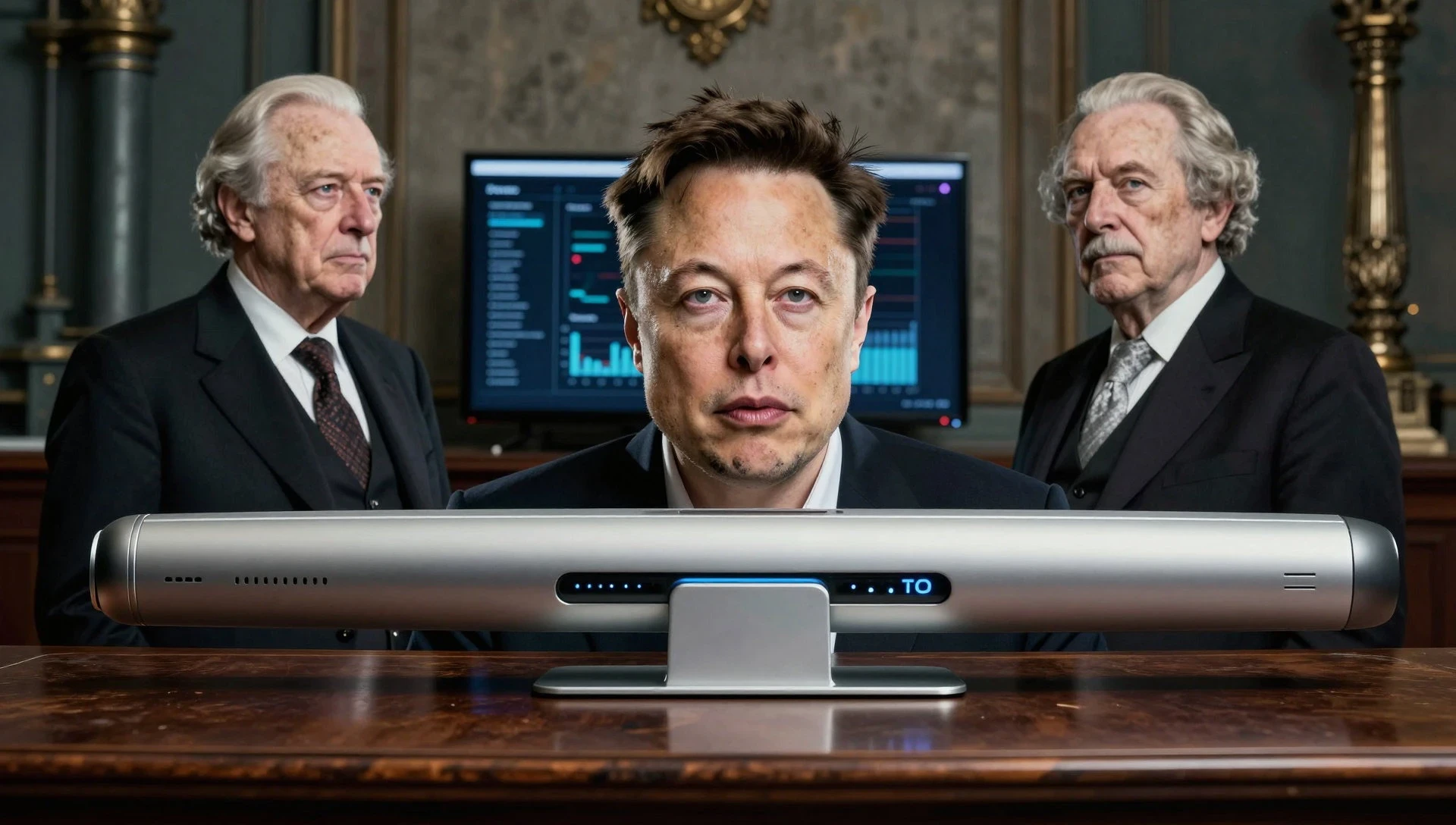
Elon Musk occupies a category of political influence that has no clean historical precedent, and the comparison with earlier American moguls is less a question of degree than of structural difference.
The NPR segment that anchors this analysis frames the issue carefully: it asks how much power Musk actually holds, then declines to deliver a simple verdict, preferring to measure him against business figures who also shaped politics. That restraint is analytically correct.
Influence of this kind is not a single quantity to be estimated but a bundle of mechanisms — capital, media reach, regulatory exposure, contracting leverage — each operating on different timelines and with different constraints.
On This Page
- The Historical Lineage of American Business Power
- The Channels Through Which Musk's Influence Operates
- Structural Limits and the Balance of Power
- Regulatory and Legal Counterweights
- Market Discipline and Financial Exposure
- Electoral Accountability and Public Opinion
- Counterweights to Private Political Power
- What the Historical Record Predicts
- Assessing the Comparison Fairly
- Comparative Influence Profile: Musk Versus Predecessors
- Implications for Policy and Public Understanding
- Policy Instruments Matched to Influence Channels
- Conclusion: Reading the Comparison Correctly
The historical record offers useful benchmarks. Henry Ford commanded enormous public attention and employed thousands, yet his political interventions were largely rhetorical and ultimately damaging to his own reputation. Andrew Mellon moved directly into government, converting private financial expertise into formal fiscal authority.
The Koch network built durable institutional machinery that outlasted individual election cycles. Musk differs from all three in combining operational control of strategically vital firms with an unmediated public megaphone and, at various points, formal advisory proximity to the executive branch.
What follows examines that combination through three lenses: the historical lineage of American business power, the specific channels through which Musk's influence now flows, and the structural limits that constrain even the wealthiest actors. The evidence points toward a conclusion that is neither alarmist nor dismissive.
Musk's leverage is real, measurable in contracts, market movements and regulatory outcomes, but it is also contingent, reversible and dependent on political goodwill that no private citizen can permanently secure.
TL;DR Elon Musk's political influence is best understood not as an amplified version of past business power but as a distinct configuration: operational control of firms tied to national security, direct ownership of a major communication platform, and intermittent formal access to government. Historical comparisons — Ford, Mellon, the Koch network — illuminate the mechanisms but understate the concentration. The decisive variables are federal contracting exposure, regulatory dependence and public credibility, all of which impose real ceilings on private political power in the United States.
The Historical Lineage of American Business Power
American business leaders have intervened in politics since the republic's founding, but the forms of intervention have shifted with the structure of the economy. Railroad barons bought legislators outright; industrialists funded newspapers and campaigns; twentieth-century executives built foundations and think tanks that shaped policy indirectly.
Each era's dominant business figure reflected the era's dominant asset. Musk's asset base — aerospace, electric vehicles, satellite communications, social media — is unusually entangled with state functions, which changes the calculus considerably.
Ford, Mellon and the Koch Network as Reference Points
Henry Ford's political influence rested on celebrity and a vast workforce, yet it translated poorly into durable policy outcomes. His antisemitic publications and peace missions damaged his standing without reshaping legislation.
Ford demonstrates that public attention, however large, is a weak instrument when it is not paired with institutional access or financial leverage over decision-makers. Notoriety and power are not the same commodity.
Andrew Mellon represents the opposite case: a financier who entered government directly, serving as Treasury Secretary from 1921 to 1932. His influence operated through formal authority rather than public persuasion, and it reshaped tax policy for a generation.
Mellon's model required institutional position, which in turn required political appointment and the accountability that comes with it. Musk has flirted with this model without fully adopting its constraints.
The Koch network offers a third template: patient, institutionalized spending across decades, focused on state legislatures, judicial races and academic programs. Its influence is diffuse and difficult to attribute to any single election. This model trades visibility for durability.
Musk's approach is closer to the Ford template in visibility and closer to Mellon's in access, but lacks the Koch network's institutional patience and distributed structure.
These three cases suggest a rough taxonomy of business political power: rhetorical, institutional and formal. Each has distinct failure modes. Rhetorical power collapses when public opinion turns. Institutional power erodes when donors lose interest or coordination fails. Formal power ends the moment the officeholder leaves.
Musk's position combines all three, which is precisely why it resists easy comparison and why the NPR segment declined to render a verdict.
Why the Comparison Is Structurally Incomplete
Past moguls operated in an economy where information moved slowly and capital was geographically anchored. Musk operates in a system where a single post reaches tens of millions within minutes and where his companies hold contracts with agencies that also regulate them.
The speed and simultaneity of these channels have no nineteenth- or twentieth-century analogue. Comparison illuminates mechanisms but cannot calibrate magnitude.
The Question NPR Left Open
The segment's refusal to quantify Musk's power is methodologically defensible. Political influence resists aggregation because its components are incommensurable: a launch contract, a platform algorithm change and a presidential endorsement cannot be summed. What can be assessed is exposure — how much each side depends on the other. That asymmetry, not raw wealth, determines who prevails when interests diverge.
We Also Published
The Channels Through Which Musk's Influence Operates
Musk's influence flows through identifiable channels rather than a single reservoir of wealth. Federal contracting ties SpaceX and Tesla to agencies whose budgets and priorities he can affect only indirectly. Platform ownership gives him agenda-setting capacity over political discourse. Personal capital funds campaigns and advocacy.
Each channel has distinct audiences, distinct constraints and distinct failure modes, and conflating them produces the confusion the NPR segment implicitly acknowledged.
Federal Contracting and Regulatory Exposure
SpaceX's role as a primary launch provider for NASA and the Department of Defense creates mutual dependence rather than unilateral leverage. The government needs reliable access to orbit; the company needs contract revenue. This interdependence constrains both parties.
A contractor who becomes indispensable gains bargaining power, but also becomes subject to audit, oversight and political retaliation when administrations change.
Tesla's position is different. Its revenue depends on consumer demand and regulatory treatment of electric vehicles, charging standards and autonomous driving. Policy shifts on any of these fronts move the share price materially.
Musk's political activity therefore carries direct financial risk, a vulnerability past moguls largely avoided because their political exposure was not coupled to a traded equity.
Platform Ownership as Agenda-Setting Power
Owning a major social platform gives Musk something no earlier industrialist possessed: the ability to shape the informational environment in which politics occurs. Newspapers once offered similar power, but they were numerous, local and expensive to operate.
A single platform concentrates reach and moderation discretion in one owner, raising questions about editorial power that regulators have only begun to address.
The limits are equally real. Advertisers can withdraw, users can migrate, and governments can regulate. Platform influence is powerful but fragile, dependent on continued voluntary participation by millions of users who owe the owner nothing.
Musk's political posts reach enormous audiences, yet their persuasive effect is contested and difficult to measure with any precision.
Personal Capital and Campaign Finance
Direct political spending is the most legible channel and the most heavily regulated. Campaign finance law caps direct contributions but permits unlimited independent expenditures through super PACs, subject to disclosure rules. Musk's capacity to fund such vehicles is substantial, though its marginal effect on outcomes is disputed among political scientists. Money buys advertising, not votes.
Historical evidence suggests diminishing returns. Mellon's tax advocacy succeeded because it aligned with a broader political coalition, not because of his personal fortune. Ford's spending failed to purchase durable influence. The lesson is consistent: capital amplifies an existing political alignment but rarely creates one from nothing. Musk's spending matters most where it reinforces sentiment already present.
Advisory Access and Its Limits
Formal advisory roles confer proximity but not authority. An adviser can shape agendas, frame options and influence appointments, yet cannot bind an administration to any course. Access is revocable at will and often revoked.
Mellon's tenure succeeded because it came with statutory power; advisory positions carry no such weight, and their influence evaporates when the principal disagrees.
Public Persuasion and Reputational Capital
Musk's direct communication with large audiences is his most distinctive asset and his most volatile. Reputational capital depreciates quickly when controversy accumulates, and it cannot be rebuilt on demand. Polling on public figures shows wide variance across demographics, which limits the reach of any single message. Persuasion is real but bounded by audience receptivity.
Structural Limits and the Balance of Power
Every channel of influence runs into a countervailing structure. Contractors face oversight; platforms face regulation; donors face disclosure; advisers face dismissal. The American system disperses power deliberately, and the dispersion is not merely formal.
It operates through competing institutions, federalism, an independent press and the simple fact that voters can reject any coalition. These constraints apply to Musk as they applied to his predecessors.
Regulatory and Legal Counterweights
Regulatory agencies can investigate, fine and impose conditions regardless of a firm's political connections. Securities law constrains disclosure and trading. Antitrust authorities can challenge acquisitions. Labor law governs treatment of workers. Each of these regimes creates friction that wealth cannot eliminate, only litigate.
Legal exposure is the most reliable check on private power because it operates through procedure rather than politics.
Market Discipline and Financial Exposure
Publicly traded companies answer to shareholders whose interests may diverge from the founder's political preferences. Institutional investors increasingly weigh governance and reputational risk. A sustained political controversy can depress valuation, raise borrowing costs and complicate hiring.
Market discipline is impersonal and continuous, which makes it a more effective constraint than any single regulatory action.
Electoral Accountability and Public Opinion
Elections remain the ultimate check. Endorsements can help or hurt depending on the race, the state and the moment. Candidates who accept support inherit its liabilities as well as its benefits.
Public opinion polls on Musk show substantial variation by party and generation, which means his endorsement is a targeted instrument rather than a universal one. Voters retain the final say.
What the Historical Record Predicts
Past moguls who overreached politically lost influence faster than those who exercised restraint. Ford's later career illustrates the pattern; Mellon's departure from Treasury ended his direct leverage. The record suggests that business political power is most durable when it is institutionalized and least durable when it is personalized. Musk's model is highly personalized, which implies higher volatility.
There is also a generational dimension. Public tolerance for concentrated private power fluctuates, and periods of high concentration have historically produced regulatory backlash. The Progressive Era, the New Deal and the post-2008 reforms all followed episodes of perceived excess.
Whether the current moment produces similar correction depends on politics, but the historical base rate is not reassuring for any single actor.
Assessing the Comparison Fairly
The honest conclusion is that Musk's influence is larger than that of most past business figures in scope but not necessarily in durability. He commands more simultaneous channels than Ford or Mellon, yet each channel is more contestable than the formal authority Mellon briefly held. The comparison is therefore a warning against both exaggeration and dismissal.
NPR's decision to leave the question open reflects this ambiguity rather than evasion. Quantifying political power requires assumptions that the evidence cannot support. What can be said with confidence is that the mechanisms are identifiable, the constraints are real, and the outcome depends on contingencies no analyst can fully anticipate. That is a more useful conclusion than any single number.
Implications for Policy and Public Understanding
If influence is channel-specific, then regulation should be channel-specific as well. Contracting rules, platform transparency requirements and campaign finance disclosure each address a distinct mechanism. Treating the problem as a single phenomenon invites either overreach or neglect.
The analytical task is to match instruments to channels, which is precisely what current policy debates struggle to do.
For the public, the practical implication is skepticism toward both heroic and conspiratorial narratives. Musk is neither an all-powerful puppet master nor a marginal commentator. He is a highly visible actor operating through multiple constrained channels, whose influence rises and falls with political conditions. That description is less dramatic than either extreme, and considerably more accurate.
Conclusion: Reading the Comparison Correctly
The comparison between Musk and past business leaders is most useful when treated as a diagnostic exercise rather than a ranking. It identifies which mechanisms have historical precedent and which are genuinely new.
Platform ownership and the coupling of political activity to traded equity are novel; contracting leverage and campaign spending are old. The novel elements deserve the most scrutiny because they lack established regulatory frameworks.
NPR's segment, by declining to quantify, implicitly acknowledged that the question is structural rather than numerical. The right response is not to estimate a single power score but to map channels, identify constraints and monitor how each evolves.
That approach yields testable claims and avoids the twin errors of alarmism and complacency that dominate public discussion of concentrated private influence.
The broader lesson concerns how democracies absorb private power. They do so through dispersion, procedure and periodic correction, not through any single decisive check. Musk's influence will be shaped by the same forces that shaped Ford's, Mellon's and the Koch network's: the willingness of institutions to assert themselves and the willingness of voters to enforce boundaries. Those variables remain, as ever, political.
From our network :
- Committed Mediterranean Precipitation Decline: Why Emissions Cuts Alone Cannot Restore Winter RainsNew NOAA research reveals that Mediterranean winter rains may decline irreversibly even with emissions cuts. Explore the science of committed climate change and regional impacts.
- The Final Descent: How ESA Retired the Legendary Cluster Constellation After 24 Years of Space Weather ScienceAfter 24 years mapping Earth’s magnetosphere, ESA’s Cluster mission concluded with a precisely controlled reentry over the South Pacific. This analysis explores the scientific legacy, engineering decisions, and debris mitigation principles behind one of space exploration’s most responsible retirements.
- Mobile Learning and VR in English: What Global Evidence Reveals About Effective Language TechnologyA systematic review across 14 countries reveals which language-learning technologies genuinely work. Mobile learning, AI, and VR show measurable benefits when pedagogically integrated. This evidence-based guide helps educators and learners select technology that delivers real return on investment.
- Live Online English Classes for Kids: Do They Actually Reduce Anxiety?A ten-week study reveals that synchronous online English classes can significantly reduce child language anxiety while improving listening and reading skills. Discover what makes these programs effective and how parents can select the right one.
- CISA’s Ten-Advisory Wave: Why Generic Patching Fails in OT and How to Build Product-Specific PlaybooksCISA released ten ICS advisories in one week, exposing critical infrastructure risks. Generic patching fails in OT. Learn to build product-specific remediation playbooks.
- Forbidden Matrix Patterns and Visible Lattice Points: A Geometric DictionaryExplore how multidimensional 0–1 matrices encode geometric truths, linking forbidden patterns to visible lattice points and hypergraph theory, with applications in combinatorics and computational geometry.
- How AI Agents Will Change the Way We Manage Personal FinancesExplore how AI agents are transforming personal finance through automated budgeting, bill payment, and investment management, while examining the critical security protocols and governance frameworks required for safe deployment.
- University Language Proficiency Exams: Why Institutional Tests Demand Different Preparation Than IELTS and TOEFLDiscover why university-specific language proficiency examinations differ fundamentally from IELTS and TOEFL, and learn strategic preparation approaches for institutional assessment success.
- The Hidden Cost of AI Convenience: Why Over-Permissioned Agents Are a Security Time BombDiscover why AI agents with excessive permissions create dangerous single points of failure, and learn how implementing least privilege principles can protect your organization from exploitation.
RESOURCES
- How powerful is Elon Musk? How his political influence compares to ...npr.org3 days ago ... How powerful is Elon Musk? How his political influence compares to past U.S. moguls. October 30, 20265:00 AM ...
- Citizens United, Explained | Brennan Center for Justicebrennancenter.orgDec 12, 2019 ... The 2010 Supreme Court decision further tilted political influence toward wealthy donors and corporations ... A group funded by Elon…
- Revealed: the tech bosses who poured $394.1m into US electiontheguardian.comDec 7, 2024 ... Revealed: the tech bosses who poured $394.1m into US election - and how they compared to Elon Musk ... influence…
- How Does the Citizens United Decision Still Affect Us in 2026?campaignlegal.orgJan 21, 2026 ... Voters have a right to know which wealthy special interests are spending big money to influence their decisions and their…
- The Power and Limitations of Celebrity Political Endorsementsfairelectionscenter.orgNov 26, 2024 ... ... American politics. While celebrities wield ... business figures like Elon Musk and Dave Ramsey tend to influence older demographics.
- Elon Musk and the oligarchs of the 'Second Gilded Age' can not only ...theconversation.comApr 27, 2022 ... ... business leaders with a great deal of political influence.” Some ... Over the past decade, numerous American billionaires have ...
- How politics and business are driving the AI arms race with Chinathebulletin.orgMay 12, 2023 ... In March, thousands of tech leaders—Elon Musk among them—signed an ... An influential paper published in 2005 found that US…
- Elon Musk vs Donald Trump: Who Made the Bigger Impact? Two ...instagram.comJun 14, 2025 ... ... business mogul turned 45th President of the United States, known for his bold political strategies and global influence. Musk…
- Elon Musk and oligarchs of the 'Second Gilded Age' can both sway ...ohiocapitaljournal.comApr 29, 2022 ... ... business leaders with a great deal of political influence.” Some ... Over the past decade, numerous American billionaires have ...
- How powerful is Elon Musk? How his political influence compares to ...vpm.org3 days ago ... “Wealthy accomplished people, having been participants in the global economy and in the American capital system, may actually have better…
- The “Charity” of Elon Musk - Alan Cantor Consultingalancantorconsulting.comMar 20, 2024 ... Musk's “philanthropy” in large part has gone to enterprises that technically qualify as charitable, but that also support his own…
- How Naguib Sawiris Twitter Reshaped Business, Politics &news.climate.columbia.eduAug 24, 2026 ... Explore the strategic impact of Naguib Sawiris Twitter—how his digital presence blends business acumen, political commentary, ...
- How powerful is Elon Musk? How his political influence compares to ...northcountrypublicradio.org3 days ago ... How does Musk's power compare to American business titans of the past? NPR's Frank Langfitt asked around. FRANK LANGFITT, BYLINE:…
- Elon Musk's fortune should never place him beyond public scrutiny ...facebook.comOct 23, 2026 ... When someone holds enormous influence over communications, government business, and politics, demanding answers should be the bare minimum. U.S. ...
- Corporate populism: How corporations construct and represent 'the ...sciencedirect.comIn this essay, we are interested in how firms and their leaders engage as political actors to influence politics. ... Elon Musk deletes tweet…
- 01
- 02
- 03
- 04
- 05
- 06
- 07
- 08
0 Comments