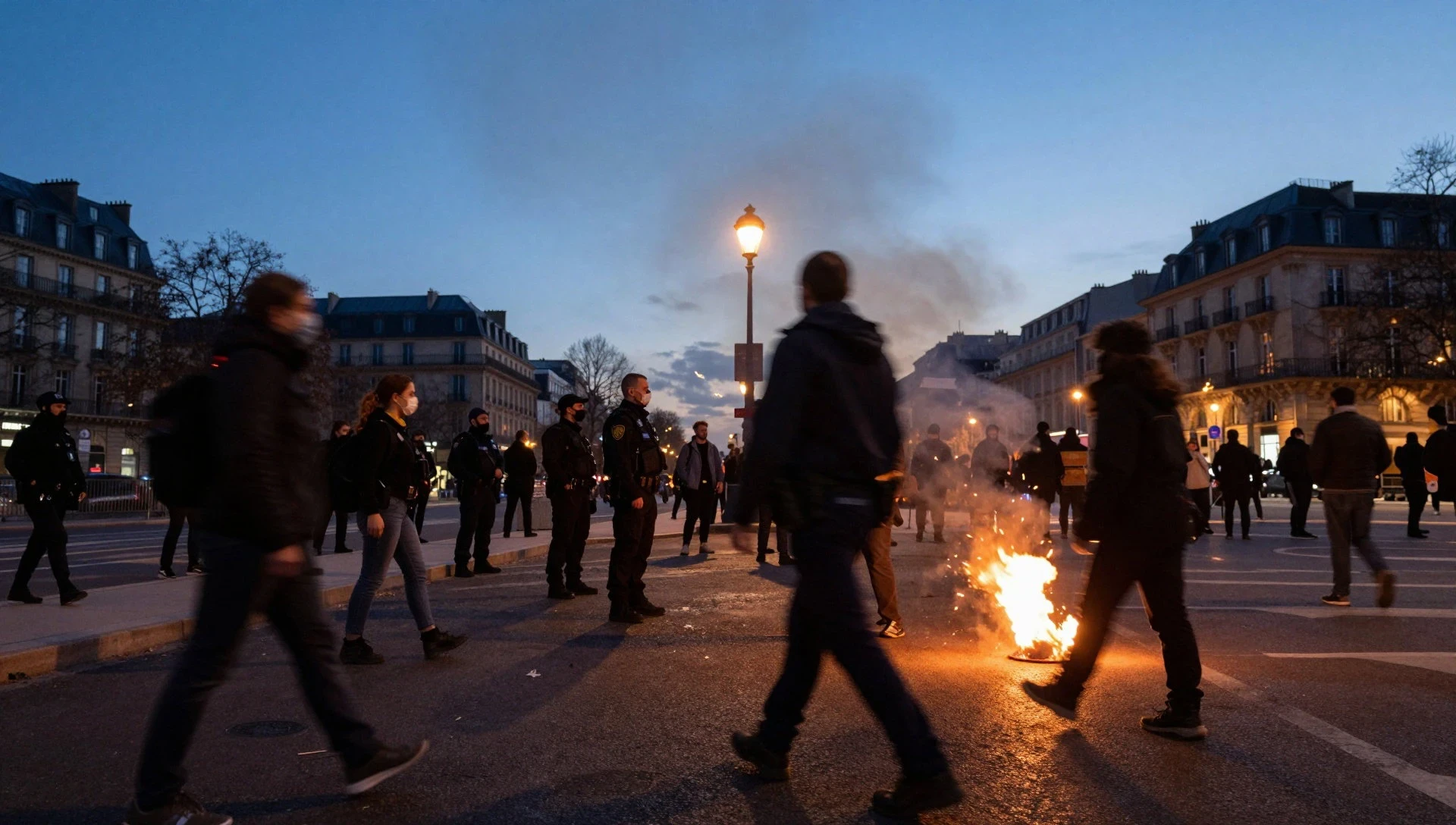
France's third consecutive weekend of cost-of-living protests on Saturday produced the most volatile security environment of the movement to date, with the interior ministry confirming 565 arrests nationwide and four police officers plus one gendarme injured in Paris alone.
Three of those injuries came from Molotov cocktails, and Interior Minister Laurent Nunez characterised the firebombing of a riot police officer as an "attempted murder" rather than an act of protest.
The figures matter because they establish a clear escalation curve: what began as a wage-and-prices grievance has acquired the tactical signature of organised confrontation.
On This Page
The turnout dispute is equally instructive. Authorities counted roughly 320,000 demonstrators across France, including 70,000 in the capital, while youth organisations claimed nearly half a million nationally and 200,000 in Paris.
That gap of more than 50 percent between official and organiser estimates is a recurring feature of French protest accounting, and it shapes how the movement's legitimacy is framed in public debate. Neither figure is independently audited, so both sides deploy their numbers as political instruments rather than neutral measurements.
Beneath the Halloween costumes and the placards — "No need for tear gas to make our future look bleak" — sits a structural question about the French state's management of dissent.
A night-time curfew imposed on the Republique and Chatelet-Les Halles districts, bans on unauthorised gatherings, and the deliberate pushing of marches outside city centres all point to a pre-emptive containment doctrine.
This analysis examines the security data, the political realignment it exposes, and the economic pressures driving hundreds of thousands into the streets.
TL;DR France's third weekend of living-cost protests drew between 320,000 (official) and nearly 500,000 (organiser) participants, ending in 565 arrests, five injured security personnel, and a Molotov cocktail attack on a Paris riot officer that the interior minister labelled attempted murder. A curfew in central Paris, bans on unauthorised marches, and clashes in Lyon, Toulouse, Bordeaux and Marseille reveal a hardening containment strategy. The episode tests the balance between the constitutional right to protest and the state's duty of public order, while far-left and far-right leaders compete to own the grievance.
The Security Arithmetic of a Third Weekend
The operational data from Saturday describes a demonstration that was, by official account, largely orderly in its marching phase and violent only at its margins. Nunez himself conceded the marches were "largely orderly," which makes the 565 arrests a measure of fringe density rather than movement-wide disorder. That distinction is analytically important: it separates the grievance coalition from the confrontation cadre operating within it.
Arrests, Injuries and the Geography of Clashes
Paris absorbed the heaviest concentration of violence. Dozens of masked demonstrators dressed in black used hammers to pry up paving stones and hurl them at police, according to AFP journalists on the ground.
Police replied with tear gas and several baton charges, and the Paris prefecture reported that several hundred rioters attacked security forces with projectiles. The pattern — improvised masonry as ammunition, hammers as tools — indicates preparation rather than spontaneous anger.
Beyond the capital, the interior ministry identified "radical elements" attempting to penetrate city centres in Bordeaux, Toulouse and Marseille "with the aim of carrying out vandalism and looting." In Lyon, France's third-largest city, projectiles thrown at police prompted tear gas volleys.
Toulouse saw water cannon deployed against an unauthorised gathering of several thousand. The geographic spread suggests a decentralised mobilisation model rather than a single command structure.
Nunez attributed the attacks on security forces to far-left extremist groups and described the level of violence as "extraordinary." Whether or not that attribution holds under investigation, the political effect is immediate: it allows the government to reframe an economic protest as a public-order emergency. That reframing justifies curfews, bans and tactical equipment deployments that would otherwise face legal challenge.
The Molotov Cocktail as Legal and Political Threshold
The firebombing of a riot police officer marks a qualitative shift in the movement's risk profile. Nunez called it an "attempted murder," and the officer escaped with minor injuries only by circumstance.
Once an incident is classified that way, prosecutorial resources and investigative priority shift accordingly, and the state gains a stronger footing for restrictive measures.
Marine Le Pen's response illustrates how quickly the episode entered partisan competition. The far-right leader demanded that those responsible be "punished with the utmost severity," describing footage of the burning officer as "unbearable."
Her intervention positions the National Rally as the party of order while simultaneously validating the underlying cost-of-living grievance — a dual appeal that has proven electorally potent.
Jean-Luc Melenchon, leader of France Unbowed, marched in Paris and welcomed the strong turnout, framing the mobilisation as democratic vitality rather than disorder. The two leaders thus read identical events through opposite lenses, and both benefit politically from the confrontation. That symmetry complicates any simple narrative of government versus protesters.
Curfews, Bans and the Containment Doctrine
The night-time curfew covering Republique and Chatelet-Les Halles from 11:00 pm to 6:00 am on Saturday and Sunday is a targeted instrument, not a general lockdown. It concentrates restrictions on two symbolic squares where protest crowds historically converge. The design suggests precision policing aimed at denying assembly points rather than suppressing the movement wholesale.
Demonstrator Alice Hien, a video game developer, articulated the counter-argument with unusual clarity: pushing demonstrations outside city centres and banning so many protests constitutes "really an attack on freedom." Her framing matters because it shifts the debate from property damage to constitutional rights. When ordinary participants perceive bans as illegitimate, enforcement itself becomes a recruitment tool for the movement.
Nunez's warning that authorities were "fully prepared for those looking for confrontation tonight" signals a pre-positioned tactical posture. Water cannon in Toulouse, tear gas in Lyon, and baton charges in Paris reflect a graduated response doctrine.
The question is whether graduated response can hold when the underlying economic pressure shows no sign of easing.
Turnout, Legitimacy and the Politics of Counting
Protest counts in France function as political claims rather than statistical facts, and Saturday's divergence was wide. The interior ministry's 320,000 national figure and 70,000 Paris figure sit against youth organisation claims of nearly 500,000 nationally and 200,000 in the capital. The Paris discrepancy alone exceeds 130,000 people — a margin too large to attribute to methodology alone.
Official Versus Organiser Estimates
Police counts typically rely on officers positioned along march routes and tend to undercount dispersed crowds. Organiser counts extrapolate from density sampling and tend to overcount. Neither method is peer-reviewed, and both are released within hours under political pressure. The result is a permanent measurement dispute that no institution currently resolves.
The practical consequence is that each side can claim a mandate. A government citing 320,000 can argue the movement is significant but containable. Organisers citing 500,000 can argue the opposite. Because the third weekend reportedly exceeded earlier turnouts, the trajectory favours the organisers' narrative regardless of which absolute number is accurate.
Costumes, Symbols and the Softening of Public Sympathy
Halloween costumes — Spider-Man, Frankenstein, and self-described "angry citizens" — performed a specific communicative function. They signalled that participants were ordinary consumers and workers rather than professional militants. Placards such as "No need for tear gas to make our future look bleak" compressed economic grievance and state coercion into a single memorable line.
This symbolic framing is strategically valuable because public sympathy for a movement erodes quickly once violence dominates coverage. By dressing as revellers, marchers insulated themselves from association with the masked stone-throwers. The costume tactic thus created a visible boundary between the grievance coalition and the confrontation cadre operating at its edges.
That boundary is fragile. Once hammers appear and paving stones fly, media coverage collapses the distinction regardless of intent. The movement's organisers therefore face a recurring problem: they cannot fully control the fringe, yet they bear the reputational cost of its actions. Managing that asymmetry is the central organisational challenge of any mass protest.
Trajectory: Third Weekend and Rising
The fact that this was the third consecutive weekend matters more than any single day's numbers. Sustained mobilisation across three weekends indicates organisational infrastructure — communication networks, transport coordination, and local assembly capacity — that does not dissipate quickly. Movements that survive the third weekend typically survive the fifth.
Rising living costs provide the underlying fuel, and that variable is not within the government's short-term control. Energy prices, food inflation and housing costs respond to global markets and monetary policy, not to interior ministry tactics. As long as the economic pressure persists, the recruitment pool for further weekends remains replenished.
Nunez's "fully prepared" posture addresses the symptom rather than the cause. A state can deploy water cannon indefinitely, but each deployment generates imagery that feeds the grievance narrative. The equilibrium is unstable: enforcement suppresses disorder while simultaneously supplying the movement with moral ammunition.
We Also Published
Economic Grievance, Political Realignment and the Wider Signal
The French episode belongs to a broader European pattern in which cost-of-living pressure has become the primary engine of street politics. From energy-price protests to housing demonstrations, the common thread is purchasing power rather than ideology.
That distinguishes the current cycle from earlier movements organised around identity or institutional reform, and it broadens the potential coalition considerably.
From Purchasing Power to Partisan Competition
Both flanks of French politics are competing to own the grievance. Le Pen emphasises order and severity toward attackers while validating economic anger; Melenchon emphasises mobilisation and democratic vitality. Neither position requires resolving the underlying inflation problem, which is why both can sustain their appeals indefinitely without legislative delivery.
This competition has a measurable effect on the centre. A government that cannot reduce living costs must demonstrate control, and control is demonstrated through arrests, curfews and bans. Each of those measures is legible to voters as competence, but each also confirms the protesters' claim that the state responds to hardship with force rather than relief.
- 01
- 02
- 03
- 04
What the French Case Signals for European Stability
France's protest tradition is exceptional in intensity but not in kind. Comparable cost-of-living mobilisations have surfaced across Europe, and the common variable is real wage stagnation against administered and market prices. Where institutions absorb that pressure through negotiated wage settlements, street conflict remains episodic; where they do not, it compounds.
The containment doctrine on display — curfews, bans, water cannon — is effective at protecting property and limiting injury. It is not effective at reducing grievance, and it carries a measurable legitimacy cost when ordinary participants perceive assembly rights as curtailed. That trade-off is the central policy dilemma the French government now manages weekend by weekend.
For observers elsewhere, the lesson is that protest intensity tracks purchasing power more reliably than ideology. A movement that begins with grocery bills can acquire a confrontation fringe, a partisan competition, and a constitutional argument within three weekends.
The escalation is fast, and the instruments available to the state address the symptoms rather than the arithmetic of household budgets.
Reading the Next Weekend
Three indicators will determine whether the movement consolidates or fragments. First, turnout trajectory: a fourth weekend at or above the third confirms organisational durability. Second, the arrest-to-participant ratio: a rising ratio signals hardening enforcement and likely reciprocal radicalisation. Third, whether mainstream unions formally join, which would transform a protest cycle into a bargaining confrontation.
The economic backdrop supplies the decisive variable. If inflation moderates and real wages recover, the recruitment pool shrinks and the confrontation fringe becomes isolated. If pressure persists, the movement acquires a stable base and the government's containment doctrine faces its real test. The arithmetic of household budgets, not the tactics of Saturday, will settle the outcome.
From our network :
- Mobile Learning and VR in English: What Global Evidence Reveals About Effective Language TechnologyA systematic review across 14 countries reveals which language-learning technologies genuinely work. Mobile learning, AI, and VR show measurable benefits when pedagogically integrated. This evidence-based guide helps educators and learners select technology that delivers real return on investment.
- The Hidden Cost of AI Convenience: Why Over-Permissioned Agents Are a Security Time BombDiscover why AI agents with excessive permissions create dangerous single points of failure, and learn how implementing least privilege principles can protect your organization from exploitation.
- Committed Mediterranean Precipitation Decline: Why Emissions Cuts Alone Cannot Restore Winter RainsNew NOAA research reveals that Mediterranean winter rains may decline irreversibly even with emissions cuts. Explore the science of committed climate change and regional impacts.
- The Final Descent: How ESA Retired the Legendary Cluster Constellation After 24 Years of Space Weather ScienceAfter 24 years mapping Earth’s magnetosphere, ESA’s Cluster mission concluded with a precisely controlled reentry over the South Pacific. This analysis explores the scientific legacy, engineering decisions, and debris mitigation principles behind one of space exploration’s most responsible retirements.
- How AI Agents Will Change the Way We Manage Personal FinancesExplore how AI agents are transforming personal finance through automated budgeting, bill payment, and investment management, while examining the critical security protocols and governance frameworks required for safe deployment.
- CISA’s Ten-Advisory Wave: Why Generic Patching Fails in OT and How to Build Product-Specific PlaybooksCISA released ten ICS advisories in one week, exposing critical infrastructure risks. Generic patching fails in OT. Learn to build product-specific remediation playbooks.
- Forbidden Matrix Patterns and Visible Lattice Points: A Geometric DictionaryExplore how multidimensional 0–1 matrices encode geometric truths, linking forbidden patterns to visible lattice points and hypergraph theory, with applications in combinatorics and computational geometry.
- Live Online English Classes for Kids: Do They Actually Reduce Anxiety?A ten-week study reveals that synchronous online English classes can significantly reduce child language anxiety while improving listening and reading skills. Discover what makes these programs effective and how parents can select the right one.
- University Language Proficiency Exams: Why Institutional Tests Demand Different Preparation Than IELTS and TOEFLDiscover why university-specific language proficiency examinations differ fundamentally from IELTS and TOEFL, and learn strategic preparation approaches for institutional assessment success.
RESOURCES
- Clashes break out as hundreds of thousands protest in Franceafp.com2 days ago ... ... protests at soaring living costs. More than 500 ... He described the throwing of a Molotov cocktail at a…
- #FMTWorld Clashes erupted in Paris and other French cities on ...instagram.com1 day ago ... ... protests at soaring living costs. Hundreds of people were arrested as police fired water cannon and tear gas to…
- Third weekend of French protests brings hundreds of thousands to ...lemonde.fr2 days ago ... He described the throwing of a Molotov cocktail at a riot police officer in Paris ... It initially focused on…
- Clashes break out as hundreds of thousands protest in Francenews.abs-cbn.com1 day ago ... ... protests at soaring living costs ... He described the throwing of a Molotov cocktail at a riot police officer…
- Wave of protests sweeps across dozen European countriesbelganewsagency.eu1 day ago ... In France, police arrested about 565 people on Saturday during demonstrations across the country. ... protests against the rising cost…
- Clashes break out as hundreds of thousands protest in Francethedailystar.net1 day ago ... He described the throwing of a Molotov cocktail at a riot police officer in Paris as an "attempted murder", adding…
- Binance says it has covered $6 billion of $6.3 billion stolen in hackthedailystar.net1 day ago ... ... protests at soaring living costs. More than 500 ... He described the throwing of a Molotov cocktail at a…
- France announces curfews as government grapples with unrest ...facebook.comOct 19, 2026 ... France imposes curfew to quell rising living costs protests. France has introduced curfew measures in Martinique to control violent protests ...
- Clashes break out as hundreds of thousands protest in Francesharjah24.ae23 hours ago ... ... living costs, with police arresting 565 people nationwide. . ... He described the throwing of a Molotov cocktail at…
- Halloween costumes, tear gas and 565 arrests: France's protests ...newswav.com1 day ago ... ... protests at soaring living costs. More than 500 ... He described the throwing of a Molotov cocktail at a…
- Clashes break out as hundreds of thousands protest in Francetoday.rtl.lu2 days ago ... Thousands of cost-of-living protesters took to the streets across France for a third weekend, with 70000 security personnel deployed to ...
- 500,000 MARCHERS AGAINST COST OF LIVING CURFEWS AT ...uspa24.com1 day ago ... The Interior Ministry counted 320,000 demonstrators in France, including 70,000 in Paris ... Yet 565 arrests in a single day,…
- France: Clashes break out as hundreds of thousands protestcebudailynews.inquirer.net1 day ago ... ... protest, a third weekend of protests at soaring living costs ... He described the throwing of a Molotov cocktail…
- SOCIAL, CULTURAL & POLITICAL DEVELOPMENT (1874-1979)cityofpasadena.net1629 “Friend of Nisei To Be Honored by Living Memorial,” Pasadena Star News, January 23, 1946. Japanese Union Church Congregation, 1925. Source: Pasadena City ...
- 01
- 02
- 03
- 04
- 05
- 06
- 07
- 08
0 Comments